Loading...

Long stories of futuristic cities for children aged 11 to 12

Dive into a captivating universe with our long stories specially designed for children aged 11 to 12. Discover fascinating tales set in futuristic cities, where imagination and adventure meet at every turn. Whether for online reading or free PDF download, each story promises to spark curiosity and inspire young readers. Give them a unique and enriching literary experience that will transport them beyond the limits of everyday life.

Futuristic city stories: all the stories (46)

Age:

Create a story where your child is the hero!

suggestion for youfree and fast

Create easily and for free your story of a futuristic city where your child becomes the main character! Simply enter their first name, a place, and secondary characters, and discover an incredible 100% personalized illustrated story with AI!

Create a story
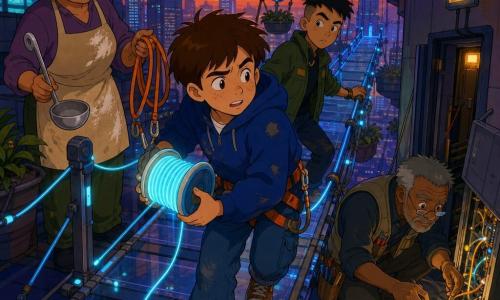
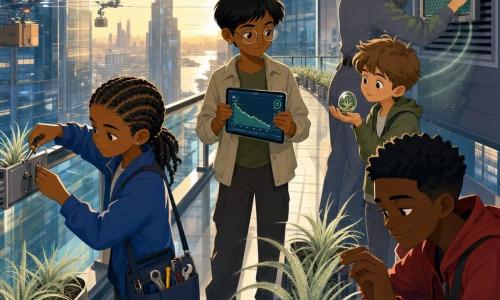
A 12-year-old boy with a round freckled face, short tousled chestnut hair and a determined, slightly anxious expression, wide bright eyes, wearing a worn blue hoodie, jeans and an orange safety harness around his waist, holding a spool of fluorescent rope and looking up while walking on an aerial walkway; Auntie Rina, about 40, warm-faced with gray hair in a bun and a flour-stained apron, stands at the ramp entrance holding a large ladle and two orange safety lines, encouraging the boy; Jax, about 13, with shaved sides and black hair, a green jacket and confident but worried posture, walks just behind with his hand on the metal railing; Mr. Olo, about 60, short gray beard and a tool-filled jacket, crouches by an open technical panel on the walkway lit by a small portable lamp, inspecting sparkling cables; the setting is an aerial walkway between rooftop gardens in a futuristic city with wide glass and metal planks, hanging plant troughs, petal-shaped solar panels, ropes and blinking blue light rails, glass-faced skyscrapers and an orange twilight sky; the main situation: an urgent repair and human coordination as guide lights flicker and the team works to secure the passage and restore a safety panel on the roof access door, tense but supportive atmosphere with strong contrasts between dark walkway areas and warm portable lamps.

The Night the Walkways Blinked

Reading 26 min. 11-12 years old

Eleven-year-old Milo rallies his neighborhood to investigate flickering guide lights and a locked rooftop safety system in Skygarden City, learning what responsibility and community coordination mean as they try to keep the rooftop gardens safe.

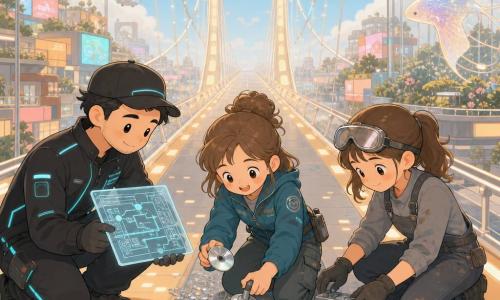
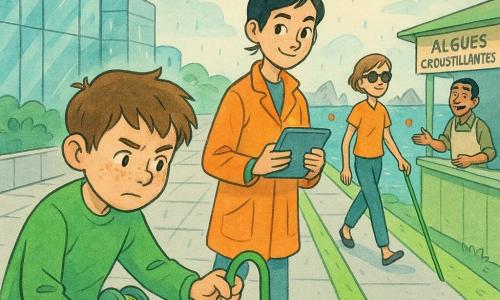
A bright, optimistic scene on the Sunspan Bridge showing 12-year-old Mina—light brown hair in a messy bun, petrol-blue jacket, cargo pants—holding a small shiny sensor disk in her left hand and a silver mini-suction in her right; to her right 12-year-old Rin, shy and hopeful with welding goggles on her forehead and stained grey overalls, adjusts a small luminous rectangular motor on the roof behind Mina; to the left a calm, smiling 35-year-old technician, Sol, in a black jacket with cyan light lines and a cap, holds a holographic tablet showing a circuit diagram; the trio remove a strip of metallic confetti from a dull panel and install a small buffer module to stabilize energy as gentle beams of light re-synchronize across the honey-colored bridge, which features smooth rectangular light slabs, thin cables and filaments under a translucent layer, terraced roofs with miniature gardens, colorful billboards, floating bubble shuttles, and a silver greenhouse with a kite-sail shaped like a luminous ray; palette of warm pastels (honey, coral, soft cyan) with silver metallic accents and pale neons, simple composition with characters in the foreground, slight perspective, soft expressions, rounded shapes, thin outlines, optimistic atmosphere.

The Day Sunspan Bridge Flickered

Reading 27 min. (1) 11-12 years old

When a dimming light bridge threatens Skyharbor’s flow, curious Mina teams up with technician Sol and inventor Rin to uncover the cause and work out a clever, responsible solution, discovering how cooperation and small inventions can help a city.

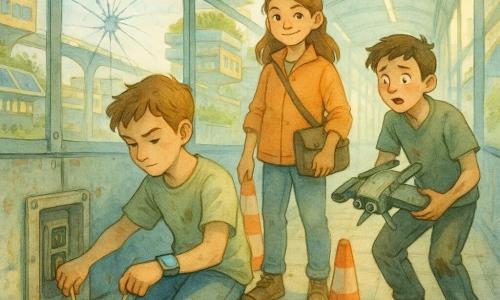
A 12-year-old boy (Milo) kneels before a small technical box set into the glazed corridor wall, focused with furrowed-but-soft brows, thin quick hands, pale green oil-stained tee and worn jeans, plugging in a glowing cable while checking his wrist display; beside him a confident 12-year-old girl (Zia) in a light orange jacket with a tool satchel sets safety cones at the glazed passage entrance, and a slightly older girl (Nova, ~13) crouches back a little, short-haired and grease-stained, holding a flat service drone with folded wings, worried but relieved, watching a fan-shaped crack in the glass; the setting is the Windowway of an old-quarter in a futuristic city—an elevated glass-paneled corridor with slim metal bays, visible modular joints, thin LED edge lights, rooftop gardens and stacked modules in the background; the repair is underway: Milo resynchronizes a sound unit, Nova prepares a resin tape from her drone, Zia secures the passage as the crack slowly seals, the mood one of cooperation and focus in soft watercolor tones (pale blues, grassy greens, warm golds) with controlled splashes suggesting urban vibrancy.

The Day the City Lost the Hourly Chime

Reading 27 min. (2) 11-12 years old

In a movable city where hourly chimes keep people's routines, young Milo teams up with friends Zia and Nova to investigate a mysterious, unverified patch that disrupts the carillon and threatens a fragile glass corridor. As they trace the glitch through modular systems and community channels, they must balance ingenuity with respect for shared spaces and schedules.

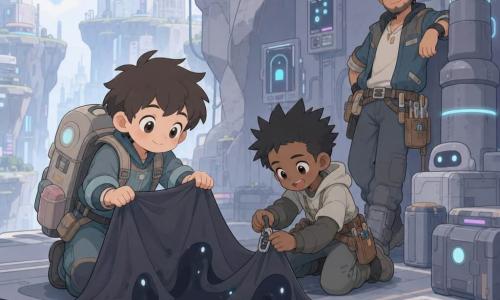
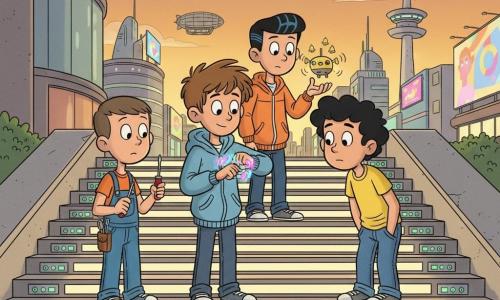
Four 11-year-old boys stand on the illuminated Recharge Steps: Milo (messy brown hair, light blue hooded jacket) at center-left watches a pulsing blue-and-pink bracelet; Theo (curly black hair, yellow T-shirt) stands just right of Milo, hands in pockets, leaning forward curious; Jax (fair skin, short cut, wearing overalls with a small toolkit) stands left of Milo holding a screwdriver like a detective; Rami (slicked black hair, orange jacket) is slightly behind with a small vibrating yellow drone named Saffron ringing tiny chimes above his palm. The broad polished concrete steps glow in soft bands with silver charging ports and integrated solar panels; a futuristic city skyline with curved glass buildings, floating trams, garden airships and a tall antenna-covered tower fills the background with colorful holographic ads. The children listen to a soft repeating signal, faces full of wonder and concentration as dusk’s golden light mixes with neon; warm, mysterious retro-cartoon style with rounded shapes, fluid lines and vivid light contrasts.

Neon Harbor and the Three Gentle Choices

Interactive story (1) 11-12 years old

In a bright future city, four 11-year-old boys follow a mysterious signal through drones, gardens, and sky-rails, making choices that lead to 27 different hopeful endings.

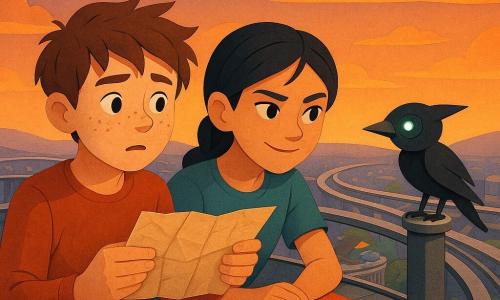
Twelve-year-old Milo, round-faced with freckles and messy brown hair, holds a crumpled paper map and looks toward the horizon with a curious, slightly worried expression; beside him stands twelve-year-old Inez, black hair in a braid, sharp determined eyes, leaning over the map with one hand on a picnic blanket edge and a confident half-smile. A small shiny black bird-shaped drone perches on a nearby metal post, its glowing lens casting a faint green light on the map. They stand on the Skyline Deck, a glass-and-metal platform at the edge of a rolling city—curved polished steel railings, orange-purple sunset sky, silver rails sweeping away, miniature rooftop gardens and mosaic solar panels below—holding a mysterious city-laid map on a magnetic picnic blanket as wind ruffles the pages, a tense, curious moment of decision.

The City That Learned to Care

Reading 38 min. 11-12 years old

When Lumen, a moving, learning city, becomes stuck by a mysterious instruction to "return," curious Milo and his friend Inez uncover a hidden device and venture into the city's patterns to help it decide.

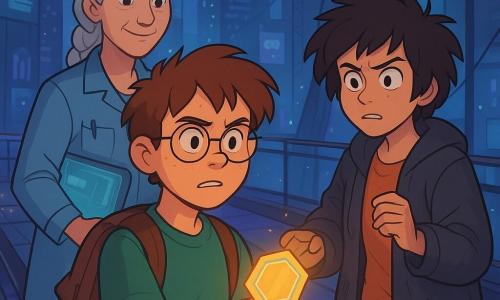
A 12-year-old boy with a round freckled face, messy brown hair and a determined, anxious expression holds a glowing hexagonal badge in an outstretched hand; he wears a green T‑shirt, worn backpack and thin‑rimmed glasses and stands on a smoked‑glass skybridge while a calm, kindly ~60‑year‑old woman with silver braided hair, a workshop smock and a holographic tablet watches from behind, and a wary but surprised ~14‑year‑old girl in an oversized jacket with short tousled hair and grease‑stained hands, a few steps below, reaches to clip the badge to her chest. The modern skybridge has blinking luminous floor tiles, thin metal rails, exposed cables and views of skyscrapers with flexible screens and floating holograms; the scene focuses on the badge transfer as bridge lamps flicker in blue‑violet ambient light with drifting particles, sharp glass‑to‑metal contrasts and a tense yet warm atmosphere.

The badges that said thank you

Reading 32 min. 11-12 years old

An inventive boy named Milo and his wise mentor Ms. Orin create neighborhood badges that remind people to share energy and gratitude, leading them to confront an energy drain and reach out to a hidden community in need.

Captivating Stories of Futuristic Cities

Futuristic stories fascinate with their ability to transport us to unknown worlds, where technology and innovation reign supreme. For children aged 11 to 12, these tales are an invitation to explore imaginary cities, where every street corner hides a new adventure. Young readers are invited to immerse themselves in universes where the impossible becomes reality, thus stimulating their imagination and curiosity.

Why read futuristic stories?

Reading stories of futuristic cities allows children to develop their critical thinking and open-mindedness. These tales encourage them to reflect on the impacts of technology on our daily lives and to imagine innovative solutions for tomorrow's challenges. Moreover, plots rich in twists captivate their attention and nurture their creativity.

Enjoy our stories for free

Our stories of futuristic cities are available online for free, offering easy and instant access to a world of discoveries. Children can also choose to download them in PDF format to read at their own pace, whether at home, while traveling, or even at school. Free access to these tales allows every child to benefit from quality content without constraints.

Benefits of futuristic stories for children aged 11 to 12

  • ✅ Development of imagination and creativity
  • ✅ Stimulation of curiosity and critical thinking
  • ✅ Free online access and PDF for flexible reading
  • ✅ Encouragement to think about tomorrow's technological challenges

Get new stories every Sunday evening!

Receive 7 exciting and captivating stories, tailored to your child's age and tastes, every Sunday at 5 PM*. It's free and guaranteed spam-free!
*Email sent at 5 PM Central European Time (CET).
We don't like spam either. So, we will only send you stories. You can unsubscribe whenever you want.