Chapter 1: The City That Could Move
In the year 2149, the city of Lumenward never stayed exactly the same for long.
From a distance, it looked like a mountain made of glass and warm-colored metal, stacked in clean layers. Up close, it was a living puzzle: modular districts that could slide, rotate, and lock together like giant building blocks. When a neighborhood needed more shade in summer, panels unfolded like wings. When families grew, new rooms clipped onto the sides of towers. When storms rolled in from the salt flats, wind-walls rose with a soft, steady hum.
Up on Roof-Farm District Seven, twelve-year-old Milo Ardent balanced a crate of strawberries against his hip and nudged the greenhouse door shut with his elbow.
“Careful,” said Aunt Sera, her voice floating from behind a wall of tomato vines. “Those are for the co-op table. If you eat one, you have to eat three, and then we'll have a problem.”
Milo's mouth twitched. “That's not how problems work.”
“It is in this family,” she replied.
Milo was small for twelve, with dark curls that never listened and a habit of watching things as if they might be lonely. He liked machines, but he liked people more. The roof farms were full of both: irrigation spiders that clicked along rails, pollination drones that buzzed politely, and neighbors who shared tools the way older cities shared gossip.
Today, the air smelled of basil and rain. Below, the sky-lanes carried silent buses like silver fish. Farther still, the central spire of Lumenward glowed with a gentle pulse—its energy-heart, fed in part by rooftop harvests like theirs.
A soft chime echoed across the district: bright, a little too loud, and slightly late.
Milo stopped. The chime was supposed to sound every hour, crisp as a promise. But lately it had been unpredictable—sometimes skipping, sometimes doubling, sometimes arriving like it had tripped over its own feet.
Aunt Sera appeared, wiping her hands on her apron. “There it is again. Off-key, off-time.”
Milo frowned toward the nearest speaker pillar, a slim post with a ring of lights around its middle. “The hourly carillon's glitching.”
“Or the city's getting sleepy,” Aunt Sera said. “Either way, folks rely on it. The co-op meetings, the school shift bells, the water-share schedule… We're a modular city, Milo. We move things around. We need time to stay steady.”
Milo set the crate down gently, as if strawberries had feelings. “I can check it. Maybe the timing script needs a patch.”
Aunt Sera's eyes softened. “Tender hands, brave heart. Just don't climb anywhere ridiculous.”
Milo raised two fingers. “Only mildly ridiculous.”
He grabbed his toolkit—half screws, half snacks—and headed for the maintenance lift that ran down the side of the farm tower.
As he descended, the city unfolded beneath him: walkways like ribbons, terraces like steps, bright murals painted on solar skins. People waved from balconies. A pair of kids raced by on magnet-skates, laughing as their wheels never quite touched the ground.
At the base of the speaker pillar, Milo found a small access panel. Someone had slapped a sticker on it: a smiling sun with the words RESPECT THE HOURS.
Milo nodded at the sticker. “Fair.”
He popped the panel open. Inside, a neat bundle of fiber cables blinked with light. A tiny control board sat in the center—clean, modern, and… dusty.
“That's odd,” Milo murmured. The city's maintenance bots usually kept everything spotless.
His wrist-screen pinged. A message from his friend Zia: YOU HEAR THE CHIME? IT JUST SCARED MY CAT INTO PHILOSOPHY.
Milo typed back: I'M ON IT.
Then he leaned closer, tenderly, like he was listening to a nervous animal. The control board's clock crystal flickered, as if it couldn't decide what second it was living in.
Milo breathed out. “Okay. Let's help you remember.”
Chapter 2: The Wrong Note
The speaker pillar's system was simple on the surface: a clock, a sound library, and a schedule that told the city when to sing. But in Lumenward, “simple” often meant “simple until you open the hatch.”
Milo connected a thin cable from his wrist-screen to the board. Lines of code scrolled up—most of it neat and familiar, city-standard.
Then he saw it: a new file tucked into the schedule folder.
CARILLON_PATCH_3B—UNVERIFIED.
Milo's eyebrows rose. “Unverified? Who sneaks a patch into a public system?”
A shadow passed over him. He looked up.
An elder named Mr. Venn stood nearby with a basket of herbs. He had a beard like a soft storm cloud and eyes that missed nothing.
“Morning, Milo,” Mr. Venn said. “Is the city singing wrong again?”
“It is,” Milo admitted. He hesitated. “Did anyone announce maintenance on the carillon?”
Mr. Venn shook his head. “Not that I heard. And I hear plenty. I live next to the elevator that complains.”
Milo smiled despite himself. “Elevators complain?”
“In a modular city, everything has opinions.”
Milo glanced back at the code. The unverified patch adjusted the chime volume randomly, and—strangest of all—it nudged the time forward and backward in tiny jumps, like a kid poking a sleeping dog to see if it would wake up.
That wasn't just a mistake. It was a prank. Or a test.
Milo tapped his wrist-screen and messaged Zia again: DID YOU PATCH THE CARILLON FOR YOUR CAT'S PHILOSOPHY CLUB?
Zia replied instantly: RUDE. ALSO NO. I'M AT THE CO-OP WINDMILL. WANT ME TO BRING A WRENCH OR A NET?
Milo typed: BRING YOUR BRAIN.
He turned to Mr. Venn. “Someone inserted an unverified patch. It's messing with the timing.”
Mr. Venn's face tightened. “That's disrespectful. People depend on the chime. My neighbor, Lina, can't see well—she counts on it for her medicine.”
Milo's chest warmed with a protective kind of anger. Not loud, not sharp. The kind that made you want to fix things instead of smash them.
“I'll remove it,” Milo said.
Mr. Venn nodded slowly. “Good. But be careful. Sometimes, when you pull one thread, you find out it's tied to the whole sweater.”
Milo hovered his finger over the delete command.
The lights on the board suddenly flickered faster. The speaker pillar emitted a sound—not a chime, but a short burst of static that made Milo's teeth buzz. His wrist-screen flashed an alert:
ACCESS CONTESTED.
Milo leaned back. “What?”
A second later, the access panel snapped shut on its own with a sharp click.
Milo jumped. “Hey! I didn't—”
The panel's seams glowed faintly, like a door that had decided to lock itself.
Mr. Venn's eyebrows climbed. “That pillar just told you ‘no.'”
Milo swallowed. “That means something else is controlling it.”
Above them, the city's next hourly chime should have sounded.
Instead, it played a wild little tune, as if the carillon had learned jazz and got too excited.
People paused on the walkways. Some laughed. Some frowned. A toddler clapped. A dog howled in dramatic agreement.
Milo looked up at the speaker ring, listening to the wrong notes tumble out.
“Okay,” he said quietly. “If you want to play games… we'll play smart.”
Chapter 3: The Modular Trail
Zia arrived ten minutes later, wind-tousled and bright-eyed, with a tool bag slung like she was going to repair the sun.
She crouched beside Milo at the pillar. “So the carillon's possessed.”
“It locked me out,” Milo said. “And it's running an unverified patch.”
Zia whistled. “That's not a normal glitch. That's someone steering.”
Milo pointed toward the seams of the access panel. “It's using city security. Like it thinks it's protecting itself.”
Zia tapped her wrist-screen, pulling up the public maintenance map. “Speaker pillars are linked in a chain. If one's acting weird, the signal might be coming from a hub.”
“A hub like… the Roof-Farm control node?” Milo guessed.
“Or the district connector,” Zia said. She grinned. “Wanna go for a walk through a city that rearranges itself?”
Milo hesitated only a moment. “Yes. But we do it politely.”
Zia blinked. “Politely?”
“We're in shared spaces,” Milo said, as if that explained everything. “Respect the hours. Respect the halls. Respect the people who didn't ask for our mystery.”
Zia's grin softened. “Fine. Captain Respect.”
They headed toward the district connector, where modular neighborhoods met like puzzle edges. As they walked, the city shifted—quietly, smoothly. A whole row of apartments slid sideways on hidden rails to make room for an incoming clinic module. People stepped aside without fuss; a traffic light blinked a friendly apology; a maintenance drone projected arrows in the air.
Milo loved that about Lumenward. It didn't pretend change was scary. It treated change like furniture you could rearrange together.
At the connector, a tall arch of carbon-glass rose over a junction of walkways. Beneath it, a control kiosk displayed district status: WATER: STABLE. POWER: STABLE. COMMUNITY MOOD: MOSTLY OPTIMISTIC.
Zia leaned in. “Community mood?”
Milo shrugged. “The city listens.”
A faint musical hiccup came from a nearby speaker: a half-chime, then silence.
Milo's wrist-screen buzzed again. A new notification popped up, not from Zia—an anonymous system ping.
COME TO THE WINDOWWAY.
Zia saw it over his shoulder. “That's… creepy.”
Milo stared at the message. “The Windowway is in Old Glass Quarter.”
“Which is currently,” Zia checked the map, “two modules east and one module down. Unless the city decides to wiggle.”
Milo's stomach fluttered. The anonymous ping felt like someone tugging on his sleeve in a crowded room.
“Could be a trap,” Zia said.
“Could be someone asking for help,” Milo replied.
Zia studied him. “You're going anyway.”
Milo nodded. “But we take the bright routes. Public walkways. And if anyone needs space, we give it.”
Zia sighed, dramatic. “Yes, Captain Respect. You and your heroic manners.”
They took a sky-bridge lined with rooftop gardens. Below, cooperative farms spread like green quilts across building tops—shared lettuce beds, bee boxes with gentle hum-shields, and water collectors that glittered with rain.
On one roof, volunteers passed baskets hand to hand, laughing. A sign read: TAKE WHAT YOU NEED, LEAVE WHAT YOU CAN.
Milo's heart felt steadier seeing it. Whatever was wrong with the carillon, the city's best parts were still here—people choosing each other, over and over, in small ways.
As they entered Old Glass Quarter, the buildings changed. The newer modules of Lumenward were sleek and bright, but here the towers wore older skins: panels with tiny scratches, windows framed with metal that had known a hundred storms.
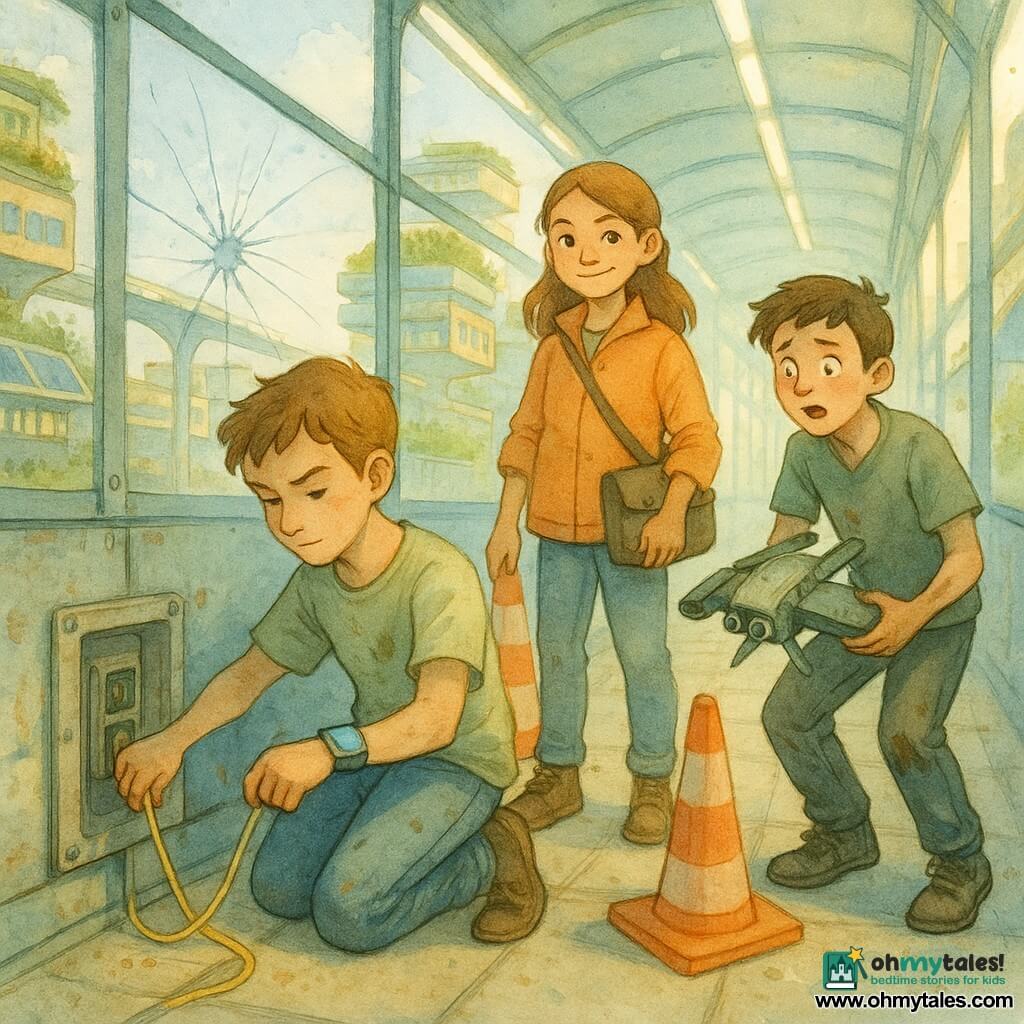
And there, stretching between two buildings, was the Windowway—an elevated corridor made almost entirely of glass. It shimmered like a frozen ribbon.
Halfway along, one window panel was cracked, the fracture lines catching the light like spiderwebs.
Zia slowed. “That doesn't look safe.”
Milo's gaze locked on the crack. “And it's not just damage. It's… recent.”
As if the city itself had been tapped too hard.
Then the speakers overhead played another wrong chime—this one lower, almost sad.
Milo whispered, “Someone's using the carillon to lead us.”
Zia leaned close. “Or warn us.”
They stepped onto the Windowway. Their footsteps sounded small on the glass.
And somewhere ahead, a soft voice said, “You came.”
Chapter 4: The Girl in the Service Light
The voice came from a service alcove tucked into the side of the corridor, half-hidden behind a maintenance panel. A strip of pale blue light outlined the opening.
Milo and Zia stopped a careful distance away.
A girl stepped out—about their age, maybe a little taller, with hair cropped short and fingers stained with grease. She held a small drone in her palm, its wings folded like a sleeping insect.
“I'm Nova,” she said quickly, as if she expected them to run. “I didn't know who else to call.”
Zia crossed her arms. “So you hacked the city's hourly carillon to send an anonymous message?”
Nova winced. “I didn't mean to… hack it. I meant to borrow it. Just for a minute.”
Milo's eyes flicked to the cracked window panel nearby. “Did you crack the glass?”
Nova shook her head hard. “No! That happened when the district shifted last night. The alignment was off by a few millimeters. That's all it takes. Glass remembers.”
Milo crouched, examining the crack without touching it. “If it's misaligned, pressure will keep spreading the fracture.”
“I tried to report it,” Nova said. “But the maintenance queue is backed up. And… my little brother uses this corridor to get to the clinic module. He hates elevators. He says they smell like impatience.”
Zia muttered, “He's not wrong.”
Nova continued, words tumbling. “So I thought—if I could get someone's attention fast, someone who knows systems—I could flag it. The carillon reaches everyone.”
Milo stood slowly. His anger softened into something else: understanding, mixed with worry.
“You should have asked,” he said, gentle but firm. “People rely on that chime. Mr. Venn's neighbor times her medicine by it.”
Nova's cheeks flushed. “I didn't think. I just… panicked.”
Zia tilted her head. “Why did the pillar lock Milo out, then? That's not panic. That's security.”
Nova looked down at the drone in her hand. “Because I didn't just send a message. I also tried to write a patch—an override—to push the maintenance alert through. But the city saw it as an intrusion and fought back. It's like trying to feed a cat a pill. The cat does not cooperate.”
Milo almost smiled. “Your method was messy.”
“I know,” Nova said. “But please—help me fix it. The crack is getting worse, and the carillon is spiraling. I can't undo it alone.”
Milo glanced around the corridor. People were still using the Windowway, stepping carefully around the cracked panel, eyes darting to the fracture lines. A delivery bot paused, calculated, and rerouted, its lights blinking an apology.
Milo imagined Lina counting minutes by a chime that couldn't choose a tune. He imagined Nova's brother walking under stressed glass.
He breathed in. “Okay. We'll fix it. Together. But first—respect.”
Nova blinked. “Respect?”
Zia groaned softly. “Here we go.”
Milo spoke plainly. “We tell the truth to the district steward. We don't keep secret hacks running. We protect people's routines. And we repair what's broken.”
Nova nodded, relieved. “Yes. All of that.”
Zia pointed at the drone. “And what's that?”
Nova lifted it. “A service wren. It can slip into panel seams and carry micro-cables. I built it from co-op scrap.”
Milo's eyes warmed. “It's beautiful.”
Nova looked surprised, then pleased in a shy way. “Thanks. It bites sometimes, but so do I.”
They all looked at the cracked window again.
The fracture had spread a hair's breadth while they watched, like a slow breath.
Milo straightened. “We need two fixes: the carillon schedule and this Windowway panel. The city's modular—maybe we can relieve pressure by adjusting the connector.”
Zia's fingers danced over her wrist-screen. “District shift controls are steward-only.”
Nova swallowed. “Unless we access them through the service channel. Which I can do. Carefully. Respectfully.”
Milo held out his hand. “No more surprise patches. We do it clean. I'll program a proper hourly carillon script—verified, transparent, and steady. Zia, can you handle the manual side?”
Zia cracked her knuckles. “I was born ready to intimidate a bolt.”
Nova glanced between them, hope flickering like a small lamp. “And I'll guide the alignment, and put in an official maintenance request with proof.”
Milo nodded. “Then let's bring time back into tune.”
Chapter 5: The Hourly Carillon
They set up a temporary work spot in the service alcove. Nova opened the panel with a special key that looked like a thin star. Inside, cables ran like colorful vines.
Zia placed safety markers along the corridor so people would keep a respectful distance from the cracked glass. She even added a handwritten note on a strip of tape: PLEASE WALK SOFTLY—GLASS IS BRAVE BUT TIRED.
A few passersby chuckled and obeyed.
Milo connected his wrist-screen to the service line. The city's interface bloomed across his display: tidy menus, calm colors, and the faint pulse of Lumenward's central heart.
“Okay,” Milo murmured. “Hourly carillon program. Version… new.”
Nova hovered near his shoulder, nervous. “I really am sorry.”
“I know,” Milo said. “But being sorry is step one. Step two is fixing. Step three is not doing it again.”
Zia called from the corridor. “Step four is snacks.”
Milo smiled. “Agreed.”
He began to code.
Instead of the chaotic patch Nova had forced in, Milo built a clean schedule: each hour assigned a chime sequence, volume limits based on district quiet-hours, and a syncing check that compared local time crystals with the central spire every ten minutes. If any pillar drifted, it would correct gently, not jump.
He also added something simple and kind: a “community notice” flag that could be triggered only by stewards or approved co-op leaders. That way, urgent messages could ride the chime network without sneaky back doors.
Nova watched the code scroll. “You make it look… calm.”
Milo shrugged. “Machines like calm. People too.”
A warning flashed on his screen: ACCESS CONTESTED.
Zia's voice sharpened. “Uh, Milo? The speakers just—”
Outside, the carillon rang again, loud and wrong, as if it were trying to drown Milo's fingers.
Nova's face went pale. “It's resisting. The security system thinks we're still intruding.”
Milo clenched his jaw. The city wasn't angry; it was cautious. Like a guard dog that had been startled.
He spoke softly, as if the system could hear tone through wires. “Lumenward, we're not here to hurt you. We're here to restore your rhythm.”
Zia leaned into the alcove. “Are you… talking to the city?”
Milo didn't look away from the screen. “It listens. Remember?”
Nova swallowed. “How do we convince it?”
Milo's eyes flicked to the sticker he'd seen earlier: RESPECT THE HOURS.
He opened the system log. There it was: Nova's earlier forced patch, labeled as a breach. The city's security was now maintaining a “defensive loop,” actively preventing changes.
Milo highlighted the breach entry and selected a function he'd only seen used in training: AMNESTY REQUEST—COMMUNITY REPAIR.
A prompt appeared:
STATE PURPOSE. STATE IMPACT. STATE CONSENT.
Milo typed carefully:
PURPOSE: Restore accurate hourly chime for residents' routines and accessibility.
IMPACT: Stable time sync; volume limits; steward-controlled notices.
CONSENT: District Steward pending; co-op witnesses present (Zia Kade, Nova Vale, Milo Ardent).
Nova whispered, “You're putting our names.”
“Yes,” Milo said. “Respect means owning what you do.”
He sent the request.
For a second, everything went quiet—no buzzing cables, no wrong chimes, just the hush of people passing on glass.
Then the system replied:
AMNESTY GRANTED—PROVISIONAL. COMPLETE PUBLIC REPORT WITHIN 24 HOURS.
The access lock lifted. Milo exhaled.
Zia pumped a fist. “Nice! The city just gave you a hall pass.”
Milo uploaded the new carillon script—verified, signed, and clear as a bell.
The next hour approached. Milo watched the countdown on his screen.
59… 58… 57…
At exactly zero, the speakers across Old Glass Quarter rang.
This time, the chime was perfect: bright, warm, and steady. Not too loud. Not too shy. Like a friendly knock on every door at once.
People looked up. Smiles appeared. A woman on a bench nodded, as if her day had clicked back into place.
Nova's shoulders sagged with relief. “It worked.”
Milo nodded. “Time's back.”
Zia leaned closer to the cracked window. “Now we fix space.”
Chapter 6: The Repaired Window
Fixing the window was less about strength and more about patience.
Nova guided Milo and Zia into the maintenance channel that controlled the connector joints around the Windowway. On Milo's screen, the corridor appeared as a wireframe model, with tiny stress indicators glowing near the cracked panel.
“The shift last night misaligned this joint,” Nova said, pointing. “It's pushing the frame inward. We need to relieve pressure first, then mend.”
Zia crouched by a floor hatch and opened it with a satisfying click. “Manual brace ready.”
From the hatch, she unfolded a compact support strut—like a metal knee—that locked into place beneath the corridor frame. It hummed as it took some of the load.
Milo watched the stress indicator dim from angry red to cautious orange.
“Better,” he said.
Nova released her service wren drone. It slipped into the frame seam, carrying a thin ribbon of smart-resin. On Milo's display, the drone's camera showed the crack from inside: jagged edges, glittering dust, and a narrow gap where the fracture wanted to grow.
“Okay,” Nova murmured, voice steady now. “Resin flow in three… two… one.”
The drone dispensed the resin along the crack. It spread like clear honey, then hardened as it met the glass, knitting the fracture lines together with microscopic fibers.
Zia watched, impressed. “That's like giving the window a bandage made of sunlight.”
Nova smiled faintly. “Pretty much.”
Milo kept his hands light on the controls, adjusting the joint alignment by fractions. The modular district's connector responded with careful obedience, shifting the frame outward just enough to remove the last pressure.
On the stress map, the indicator faded to green.
Milo let out a breath he hadn't realized he'd been holding.
Outside the corridor, the city continued to move—buses gliding, gardens rustling, drones humming—unbothered by the small drama of one window being brave.
A little boy approached with an adult, peering up at the repaired panel. He had a clinic wristband and eyes that didn't trust elevators.
Nova's face softened. “That's him.”
The boy pointed. “Is it gonna break?”
Milo stepped forward, keeping a respectful distance so he wouldn't crowd the child. “No,” he said gently. “We took the pressure off. The crack is sealed. But we'll still ask the steward to schedule a full panel check, just to be safe.”
The boy frowned in deep concentration, then nodded, satisfied by the honesty. “Okay.”
He and the adult crossed the Windowway, their footsteps lighter than before.
Nova blinked fast. “Thank you.”
Zia slung her tool bag over her shoulder. “Next time you need help, you don't hijack the city's musical instruments.”
Nova gave a small, embarrassed laugh. “Deal.”
Milo opened his wrist-screen and recorded a quick public report: what had happened, what they'd changed, and how they'd repaired the window. He included a note about respecting shared systems and asking for consent when a fix could affect others.
When he sent it to the district steward, a reply came almost immediately:
REPORT RECEIVED. THANK YOU FOR COMMUNITY CARE. WINDOWWAY MAINTENANCE PRIORITIZED.
The carillon chimed again, on time, calm as a heartbeat.
Milo looked through the repaired glass. The city beyond was bright and layered, modular neighborhoods fitting together like a promise kept. The crack was still visible if you searched for it—a faint memory, sealed and safe.
Nova stood beside him. “I thought being clever was enough,” she admitted. “But… I see it now. Clever without respect just makes more mess.”
Milo nodded. “Respect is what keeps a city from turning into a pile of parts.”
Zia snorted. “Also, snacks.”
Milo laughed, the sound echoing softly along the corridor.
They walked off the Windowway together, leaving behind a steady chime, a safer path, and one repaired window that caught the future in its clear, unbroken light.