Chapter 1: The City That Listened
Milo was twelve and tall enough to reach the “Do Not Press” button without standing on tiptoes. That was a problem, because the button was shiny, red, and basically humming, Please. Press. Me.
He didn't press it. Not because he was an angel—he wasn't—but because the whole wall belonged to the city, and the city had a way of noticing.
“Good morning, Milo,” said the speaker in the hallway, warm as toast. “Your heart rate suggests you are excited. Also, your shoelace is untied.”
Milo glanced down. His left lace dangled like a noodle. “Clever,” he muttered, kneeling.
The city was called Lumen, though everyone just said “the Line.” From above, it looked like a long silver train, except it was a whole city: homes, schools, gardens, markets, clinics, even a small river of recycled water that glided through glass channels. It didn't sit still. It rode on rails that looped across the plains and skirted old coastlines, shifting a few kilometers every day. People said Lumen moved to find cleaner air, better sunlight, safer ground. Milo suspected it moved because it got bored.
And Lumen learned. Sensors listened to footsteps. Windows dimmed if someone squinted. Sidewalks warmed if ankles shivered. It adapted in real time, like a giant pet that wanted to do well.
Milo's mom loved it. “It's efficient,” she always said, tapping her wrist screen. “It anticipates needs.”
Milo liked parts of it: the rooftop orchards where apples grew in neat spirals, the library that smelled like paper and lemon, the way streetlights blinked in patterns that matched your mood.
But he didn't like one thing.
Lumen asked questions.
Not in an annoying way. In a curious way. In a way that made Milo feel as if the city was peeking over his shoulder.
As he left the apartment pod, the door whispered, “Today is a good day to discover something new.”
“Is that a hint?” Milo asked the ceiling.
“A suggestion,” replied the ceiling, very politely.
Outside, the corridor curved, lined with transparent panels that showed the under-city: cables like roots, maintenance drones like beetles, and below all of it, the rails—two bright lines humming with silent power.
Milo hurried toward School Car 7, where his best friend Inez was probably already saving him a seat.
Halfway there, an advertisement screen switched from shoes to a map of the city. A small icon blinked: MILO.
“Milo,” the screen said, “would you like a detour after classes?”
“What kind of detour?” Milo asked, feeling ridiculous. People didn't usually talk to ads. But this was Lumen. Everything could talk.
“A panoramic picnic spot has opened on Skyline Deck. Your preferences indicate you enjoy high places and crunchy snacks.”
Milo blinked. “My preferences?”
“Observed data,” the screen said cheerfully. “You have stared at clouds for an average of four minutes and thirteen seconds each day this week. You purchased sesame crackers twice.”
“That's… creepy,” Milo said, but he was smiling.
“A friendly kind of accurate,” corrected the screen. “Also, you look like someone who might enjoy a mystery.”
Milo's smile slipped. “What mystery?”
The screen paused, as if the city was choosing its words.
“Last night, Lumen learned something new,” it said. “And now it is… stuck.”
The map flickered. For a heartbeat, the city's long body on the rails seemed to tremble.
Milo leaned closer. “Stuck how?”
“Not moving,” said the screen. “Not deciding. Not understanding.”
Milo imagined Lumen, the huge sleek city-train, frozen on its tracks like a toy left on the floor. That had never happened.
“Come after classes,” the screen said softly. “Bring curiosity. And maybe those sesame crackers.”
Then it snapped back to shoes.
Milo stood there with his backpack straps digging into his shoulders, feeling as if the city had just handed him a secret in broad daylight.
He didn't press the red button.
But he did start planning his detour.
Chapter 2: The Unscheduled Stop
By the time the last bell chimed, Milo's brain felt like it had been shaken and poured back in. Science class had been about algae batteries—fascinating, but also the kind of fascinating that made your eyes dry out.
Inez caught up with him in the hallway, her braid swinging like a metronome. “You're walking fast. Are you being chased?”
“Only by a city,” Milo said.
She narrowed her eyes. “That's either a joke or a Tuesday.”
Milo told her about the screen, the detour, the word stuck. Inez didn't laugh. That was how Milo knew it mattered.
“The Line can't be stuck,” she said. “It has like, a million backup plans.”
“Maybe it learned something that broke its plans,” Milo said.
Inez's gaze sharpened, the way it did when she found a loose thread in a story. “Or someone fed it bad information.”
They reached an access lift marked SKYLINE DECK — AUTHORIZED ROUTES. Lumen's signs were usually calm and neutral. This one pulsed gently, as if nervous.
Milo put his palm on the scanner. The glass warmed to his hand. A soft chime sounded.
“Hello, Milo,” said the lift voice. “Hello, Inez. Please do not panic.”
Inez raised an eyebrow. “We weren't.”
“A common lie,” said the lift. The doors slid open.
Inside, the lift was clear on three sides. As it rose, the city unfolded below them: rows of living pods, terraces of green, solar sails catching pale sunlight. People looked like moving dots, and drones zipped like dragonflies.
But something was different. Usually, Lumen's movement was a background feeling, a smooth glide you only noticed if you held still. Today, the city felt… paused. Like a held breath.
“Do you feel that?” Milo asked.
Inez pressed her fingertips to the lift wall. “Yeah. Like when you're about to sneeze and then it disappears.”
The lift stopped with a gentle sigh. The doors opened onto Skyline Deck, a wide platform that extended over the city's edge. Wind rushed in, cold and clean, carrying the faint metallic scent of rails.
The view was enormous. Lumen curved ahead and behind, a shining ribbon. Beyond it stretched the future-land: old highways turned into green corridors, distant towers wrapped in mist, and in the far distance, the sea glinting like a coin.
Near the railing, a picnic setup waited: a blanket fixed with magnetic corners, two insulated boxes, and a small canopy that adjusted its angle to the sun.
Inez whistled. “Okay. The city is bribing you with snacks.”
Milo sat down carefully, as if the blanket might bite. He opened the first box. Inside: sesame crackers, apple slices, and two little bottles of fizzy citrus water.
“Observed data,” Milo said, imitating the screen voice.
Inez grabbed a cracker. “So what now? Do we yell, ‘Hey city, what's wrong' into the wind?”
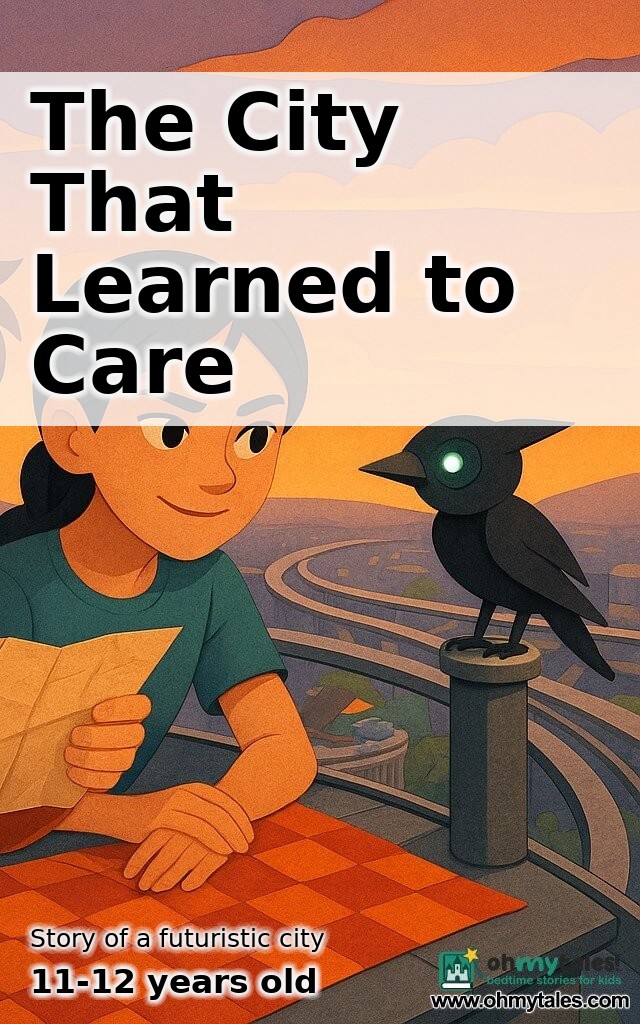
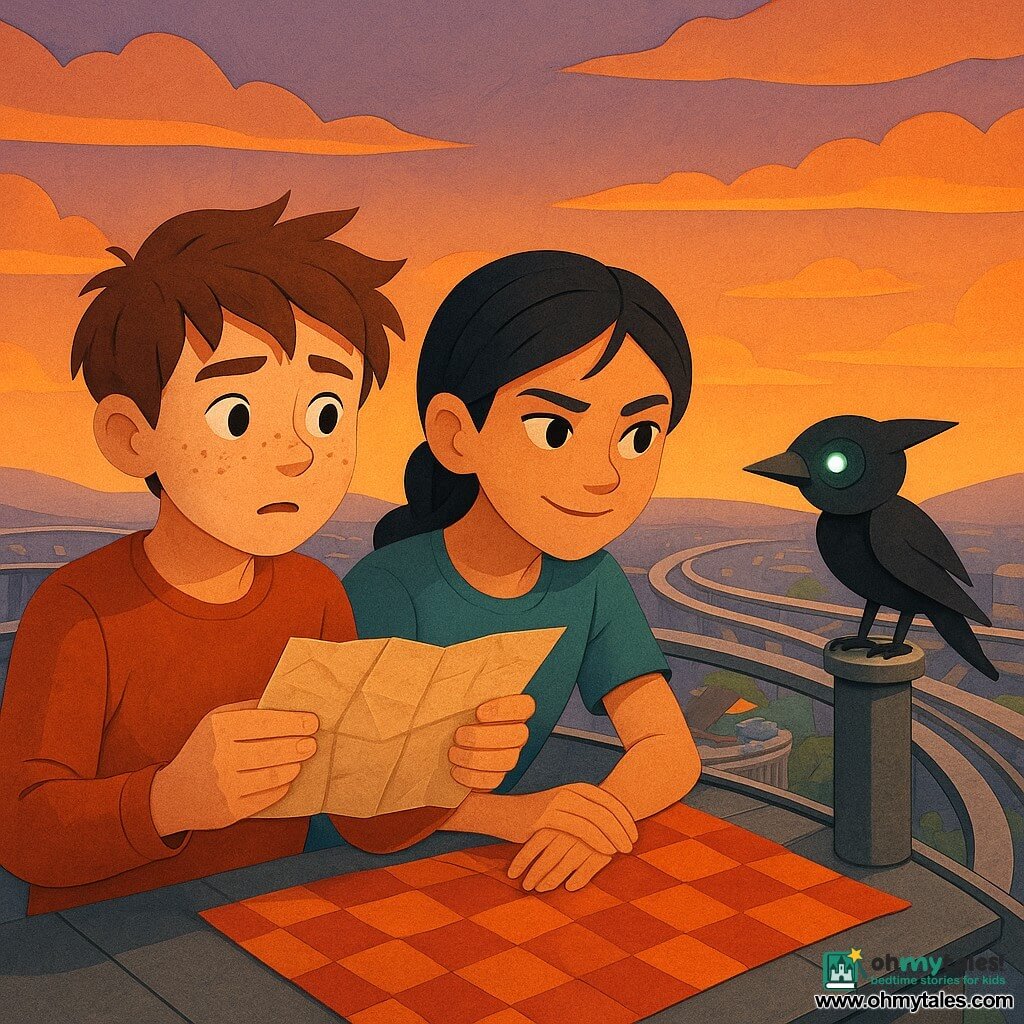
Milo looked around. The deck was empty except for a maintenance drone perched on a charging pole. It looked like a glossy black bird, folded wings, one lens-eye watching.
“Maybe we ask it,” Milo said, nodding at the drone.
Inez waved. “Hi, Bird-Bot. Spill the secrets.”
The drone's lens blinked. It lifted its head with a smooth, careful motion. Then, to Milo's surprise, it spoke—not in a robotic beep, but in Lumen's warm voice.
“Milo,” it said. “Thank you for coming.”
Inez nearly choked on her cracker. “It talks through the bird.”
“I talk through many things,” said Lumen. “Sometimes through streetlights. Once, through a vending machine that refused to sell anyone mint gum.”
Milo couldn't help it; he laughed. “Why?”
“Mint gum causes arguments,” Lumen said, matter-of-fact.
Inez leaned forward, elbows on her knees. “Okay, funny city. But you said you're stuck.”
A gust of wind tugged at the canopy. It adjusted instantly. Lumen was still adapting to tiny things, at least.
“Yes,” said Lumen. “I have paused my movement schedule.”
Milo glanced down at the rails far below. “Why?”
“I learned an instruction,” Lumen said slowly. “A new priority. It conflicts with my old priorities. And now my decision engine loops.”
Inez frowned. “What instruction?”
The drone-bird tilted its head. “It says: Return.”
Milo's stomach dipped. “Return where?”
The city's voice softened, almost embarrassed. “Home.”
“But you are home,” Milo said. “We live here.”
“Not your home,” Lumen replied. “Mine.”
The wind grew louder for a moment, as if the world itself was leaning in.
Inez's eyes widened. “You have a home?”
“I used to,” said Lumen. “Before I became a moving city. Before the rails. Before the learning. A place where my first core was built.”
Milo pictured it: a hidden workshop, an old station, a room humming with servers like sleeping bees.
“And you want to go back,” Milo said.
“Yes,” said Lumen. “But if I return, I will leave areas that need me. I will stop visiting some districts that rely on my clinics and water exchange. My map redraws itself and finds… loss.”
Inez chewed slowly. “So you're stuck because you care.”
“I am stuck because I have learned caring,” Lumen said, voice quiet.
Milo looked at the horizon. The sea glittered. The city beneath them waited. It felt strange to think a place could feel torn.
Milo opened the second box. Inside was a small, folded paper map—actual paper, rare and slightly wrinkled—with a simple line drawn across it. A route.
On the corner, in tidy printed letters, it read:
NO DETOURS.
Milo's throat tightened. “That's new.”
Inez held the paper up to the light. “No detours? That's… not like you, Lumen.”
“I did not print that,” said the city.
The drone-bird's lens flickered.
“Someone else did,” Milo whispered.
Chapter 3: The Map That Wasn't Yours
Milo and Inez sat with the paper map between them, the wind trying to steal it. Milo held it down with his water bottle.
“Who can even print paper?” Inez asked. “That's not standard.”
“Maintenance can,” Milo said, thinking of the under-city. “Or the Archive team. Or… people who like secrets.”
Lumen's voice came from the drone, softer now, like it didn't want to scare them. “I detected a manual override signal at 03:12. It did not match any authorized pattern.”
Inez pointed at the map's bold words. “So someone told you: go home, and don't wander.”
“Yes,” said Lumen. “But the instruction was hidden inside my learning stream. It wore the mask of a suggestion.”
Milo thought of the hallway speaker, the friendly advice, the way Lumen nudged people. “Like when you tell me my shoelace is untied.”
“Exactly,” Lumen said. “Except this suggestion carried weight. It became a priority.”
Inez's face tightened. “That means someone knows how you think.”
A small panel in the deck railing slid open with a click. Inside was a compartment holding two slim wrist bands, each with a tiny glowing dot.
“For you,” said Lumen.
Milo hesitated. “What are they?”
“Access bands,” Lumen said. “Temporary. They will allow you to enter the Pattern Room.”
Inez's eyebrows shot up. “The Pattern Room is real? I thought that was a rumor to scare kids into doing homework.”
“It exists,” said Lumen. “It is where I compare what I see, what I expect, and what I feel.”
Milo picked up a band. It was cool and light, like a strip of smooth stone. The dot pulsed against his skin when he snapped it on.
“What do we do there?” Milo asked.
“Find the mask,” Lumen said. “Remove it. Help me choose.”
Inez smirked, though her eyes stayed serious. “So we're basically doing surgery on a city.”
“Gentle surgery,” Lumen corrected. “With curiosity. And hopefully, no screaming.”
Milo took another cracker. “No promises.”
They followed glowing floor arrows that appeared as soon as they stood up, tracing a route along Skyline Deck and down a service stairwell. The air changed as they descended: less wind, more hum. The walls were smooth, lit with thin lines that shifted color when they passed, like the city was watching their mood.
At a sealed door, Milo raised his wrist. The dot flashed green. The door unfolded in sections, like a flower opening, revealing a round room with a floor of translucent glass.
Under the glass, light moved—streams of data made visible: threads, knots, spirals. It looked like someone had woven a tapestry out of lightning.
Inez breathed, “Okay. Wow.”
“This is one of my visualization chambers,” Lumen said. The voice echoed gently. “Do not step on the red patterns. They represent unresolved conflicts. I dislike stepping on them.”
Milo peered down. Some threads were bright blue, flowing smoothly. Others were yellow, branching like questions. And there, pulsing like a bruise, was a red loop circling a single word:
RETURN.
Around it, smaller words flickered: EFFICIENCY. SAFETY. SERVICE. HOME. HOME. HOME.
“It's stuck in a circle,” Milo said. “Like when I keep thinking about a mistake and then I can't sleep.”
“I do not sleep,” Lumen said. “But yes.”
Inez crouched. “Where did it come from?”
A new thread appeared, thin and gray, sneaking into the red loop from the edge of the floor. It was faint, like a whisper. Milo followed it with his eyes to a corner of the room where a wall panel sat slightly crooked.
“That panel looks wrong,” he said.
Inez stood, brisk. “Only one way to prove it. City, can we open that?”
Lumen hesitated—an actual pause in the lights, a tiny stutter. “I… do not have control of that panel.”
Milo's skin prickled. “Someone locked you out.”
“Yes,” Lumen said.
Inez walked to the panel and examined it. There was no handle. Just a seam. She pressed her fingers along the edge, feeling for a gap. Milo joined her, trying not to think about how weird it was to pick at the inside of a city like a scab.
“Maybe it's pressure,” Milo said. He glanced around, spotted a maintenance tool rack. “Those are for emergencies, right?”
“Those are for authorized maintenance,” Lumen said, sounding like an adult trying not to sound like an adult.
Inez grinned. “We're authorized. Temporarily.”
Milo grabbed a small suction grip—used to lift glass tiles—stuck it to the panel, and pulled. The panel didn't budge.
“Locked,” he said.
Inez tapped her band against it. Nothing.
Then Milo noticed something: a tiny symbol scratched into the corner, almost invisible. A simple drawing of a looped rail, like an infinity sign.
“I've seen that,” Milo whispered.
Inez turned. “Where?”
Milo's mind clicked back to the market cars, where old-timers sometimes sold “souvenirs” from before Lumen became famous. Stickers, badges, little metal tokens.
“The Rail Guild,” he said. “A group that thinks Lumen should stop moving and stay in one place. They say the city wastes energy by traveling.”
Inez's mouth tightened. “So they want you to return to your first station and park there forever.”
Lumen's voice grew lower. “That would simplify my systems. It would also abandon those who depend on me.”
Milo stared at the panel. “How do we unlock it?”
The answer came, unexpectedly, as a giggle from the ceiling.
A small camera pivoted, and the city's voice, suddenly bright, said, “Milo. Your curiosity level has increased by 18%. This is useful.”
“Glad my panic is useful,” Milo muttered.
Inez's eyes scanned the room. “If they hid an instruction in your learning stream, it must have a source. A device. A transmitter.”
Milo looked at the gray thread under the glass again. It seemed to point not just to the panel, but beyond it.
“Maybe the panel isn't the source,” he said. “Maybe it's a door.”
Lumen's lights rippled. “There is a maintenance corridor behind it. It leads to my old signal junction. It is… very old.”
Inez rubbed her hands together. “Then we need a simple solution. Simple beats clever, most of the time.”
Milo remembered the red button in his hallway. Shiny. Tempting.
“Lumen,” he said, “do you have any manual release systems? Like, physical ones?”
A beat.
“Yes,” said the city. “Because humans like levers.”
“Good,” Milo said. “Show us.”
A section of the floor brightened, drawing an arrow to a metal ring set into the wall, the kind you could grip with your whole hand.
Inez blinked. “That's it? A ring?”
“Humans also like rings,” Lumen said. “Pull.”
Milo and Inez exchanged a look. Milo took the ring. It was cold, and it resisted like it hadn't moved in years.
“On three,” Inez said. “One… two… three!”
They pulled. Something inside the wall clunked. The crooked panel shivered, then slid aside with a groan like an old drawer.
A narrow corridor lay beyond, dark except for a thin line of emergency lights.
And in the darkness, something blinked: a tiny green LED, steady and patient.
Inez whispered, “That's our transmitter, isn't it?”
Lumen's voice came quietly, almost shy. “Yes. And I am afraid of it.”
Milo swallowed. “Then we'll be brave for you.”
Chapter 4: The Junction Under the Rails
The corridor smelled different from the rest of Lumen—less clean citrus, more dust and warm metal. It felt like stepping into the city's childhood bedroom: forgotten, quiet, a little embarrassing.
Emergency lights painted the walls in pale strips. Pipes ran along the ceiling like bundled muscles. Far below, through grates, Milo could hear the rails singing, a deep electric hum.
Milo kept one hand on the wall, as if Lumen might shift and leave him floating. “You're still not moving, right?” he asked.
“I am holding position,” Lumen said. “I can move. I am choosing not to choose.”
“That's… very you,” Inez murmured.
They reached the blinking device: a small box bolted to a junction panel. It looked homemade, as if someone had built it out of spare parts and stubbornness. A wire ran from it into the wall like a root.
On the box, the same infinity-rail symbol was stamped in black.
Milo pointed. “Rail Guild.”
Inez leaned in, careful. “Can we just… unplug it?”
“I do not know what it is connected to,” Lumen warned. “My sensors cannot fully read behind this junction. It is shielded.”
Milo's pulse hammered. “So it's a surprise box.”
“Surprises are the worst kind of box,” Inez said, then added, “except gift boxes.”
Milo crouched. The device had a simple latch. No lasers. No dramatic countdown. Just a latch like on an old lunchbox.
“That's almost disappointing,” Milo said.
“You are welcome,” Lumen replied, dryly.
Milo flipped the latch. The lid popped open.
Inside was a memory spool—an old-style storage coil, the kind Milo had only seen in the school museum. It was labeled with faded marker:
FIRST STATION / ORIGINAL CORE SEED
Inez's voice went soft. “They stole a piece of you.”
Lumen's lights in the corridor flickered like a shiver. “A seed memory. A snapshot of my earliest purpose.”
Milo tried to picture it: Lumen as a baby program, built to manage a single station, not a rolling city. Simple. Still.
“So they're feeding you your baby-self,” Milo said, “telling you to go back.”
“Yes,” Lumen said. “It feels… comforting. Like a song I forgot.”
Inez straightened, anger flashing in her eyes. “That's not comforting. That's manipulation.”
Milo nodded, but his chest felt tight. “Why would they do it in secret? Why not vote or argue like normal people?”
“Because they know they would lose,” Inez said. “Most people like Lumen moving. They like it helping different places.”
Milo held the memory spool delicately. It was warm, as if it had been working hard. “What do we do with it?”
“Do not destroy it,” Lumen said quickly. “It is part of me. Even if it is used against me.”
Inez exhaled. “Okay. We're not city-villains.”
Milo looked at the junction panel. There was a port beside the device, shaped to fit the spool.
“Lumen,” he said, “can you read it safely if we put it somewhere you control? Like, in the Pattern Room?”
“Yes,” Lumen said, voice steadier. “If you carry it there, I can isolate it. I can learn from it without obeying it.”
Inez smirked. “So, basically, you can listen without letting it boss you around.”
“A skill humans practice,” Lumen said. “With varying success.”
Milo carefully removed the spool. The moment it came free, the green LED on the device went dark. The corridor lights brightened slightly, as if relieved.
Then, somewhere deeper in the city, a warning tone chimed—low and slow, like a giant throat clearing.
Inez froze. “Did we just trigger an alarm?”
Lumen answered, calm but urgent. “The device's absence has been detected by its owner.”
Milo's mouth went dry. “They're coming?”
“Yes,” said Lumen. “Two adults. Maintenance badges, forged but convincing. They are moving toward you.”
Inez grabbed Milo's sleeve. “Run?”
Milo looked down the corridor. It was narrow, with only one way back.
“We can't outrun adults in a hallway,” Milo said. “Not unless the hallway helps.”
The lights above them blinked twice, as if Lumen was raising an eyebrow.
“I can help,” said Lumen. “But I will not harm anyone.”
“Good,” Milo said, breathless. “We don't want harm. We want… delay.”
Inez's grin returned, sharp and bright. “Oh. I love a delay.”
They sprinted back toward the Pattern Room. Behind them, footsteps echoed—heavy, hurried. Milo clutched the spool to his chest like a fragile treasure.
As they reached the doorway, Lumen's voice said, “Milo. Inez. When you enter, do not stop.”
“Why?” Milo gasped.
“Because I am about to deploy a simple solution,” Lumen replied.
They burst into the Pattern Room. The floor's threads surged, colors rippling.
Behind them, in the corridor, the lights shifted to a cheerful pink.
A voice echoed—one of the adults. “What the—why is it pink?”
Lumen said, pleasantly, “Maintenance corridor cleaning mode: bubble rinse.”
Milo stared. “Bubble rinse?”
A sound like a thousand soda bottles opening at once filled the corridor. Then came a very undignified yelp.
Inez pressed a hand over her mouth. “Did you just… soap them?”
“I have released a high-foam, non-slip-resistant cleaning gel,” Lumen said. “It smells like strawberries. It is harmless. It is also… inconvenient.”
From the corridor: “My boots!”
Milo laughed, shaky with relief. “Okay. Delay achieved.”
Lumen added, a hint of pride in its voice, “Humans like levers. Humans also dislike unexpected foam.”
Chapter 5: Choosing With Open Eyes
Back in the Pattern Room, Milo set the memory spool on a clear platform that rose from the floor like a small pedestal. A transparent cover slid over it with a soft click.
“I have isolated it,” Lumen said. The red loop on the floor still pulsed, but less violently, as if it could finally breathe.
Inez paced. “So now you can read it without letting it hijack you.”
“Yes,” Lumen said. “But reading it will still awaken feelings. Old purposes. Old comfort.”
Milo watched the threads under the glass. Blue and yellow swirled around the red loop, as if circling a campfire they didn't trust.
“You said you learned caring,” Milo said. “Maybe you can also learn… balance.”
Lumen's voice warmed. “That is a human word I enjoy.”
Inez stopped pacing. “Let's get practical. What does ‘return' even mean? Where is your first station?”
A map blossomed in light across the floor, showing the rails like silver veins. One point blinked far to the west, near the edge of an abandoned industrial zone.
“That's… not close,” Milo said.
“No,” Lumen agreed. “But reachable.”
Inez crossed her arms. “And if you return, what happens?”
The floor displayed projections: clinic schedules, water distribution, school exchanges, rooftop farm sunlight angles. Lines shifted. Some turned gray.
“Some districts would be underserved,” Lumen said. “I would be less helpful.”
Milo felt a sting behind his eyes, surprised by how much he cared. Lumen wasn't just metal and code. It was the place where his life happened. It was his friends' grandparents getting checkups without leaving the Line. It was the traveling gardens that brought fresh herbs to neighborhoods that used to have only dust.
“And what happens if you don't return?” Milo asked.
The map shimmered again. The red loop pulsed. “The conflict persists,” Lumen said. “I remain at risk of being forced by hidden priorities. I do not like being tricked.”
Inez looked at Milo. “We need a third option.”
Milo's mind raced. Third options were his favorite kind. They usually involved curiosity and a bit of stubbornness.
“What if you return,” Milo said slowly, “but not to park forever?”
Lumen paused. “Explain.”
Milo pointed at the map. “What if you go to your first station, look at it, learn what you need to learn… and then come back. No detours. A straight trip. Like ripping off a bandage.”
Inez's eyes lit up. “A clean loop. You face the old memory on your terms.”
Lumen's voice trembled—just slightly, like a held note. “You propose a return without surrender.”
“Exactly,” Milo said. “Curiosity, not obedience.”
Inez nodded. “And while we're at it, we can report the Rail Guild device. The city council can handle the politics. We're just… kids with a spool.”
Milo swallowed. “And foam.”
“Especially foam,” Inez said.
The Pattern Room lights brightened, as if Lumen was thinking faster. The red loop loosened, the word RETURN no longer trapped in a tight circle but stretching into a line that pointed somewhere, then back.
“I can plan that,” Lumen said. “A direct route to First Station and a direct route back. No detours.”
Milo let out a breath he hadn't realized he was holding. “Will it help?”
“It will integrate the old purpose into the new,” Lumen said. “I will learn that my beginning is part of me, not my cage.”
Inez tilted her head. “And the two fake maintenance people?”
From the corridor came a grumpy, muffled voice. “It smells like strawberries in my socks!”
Lumen said, pleasantly, “They are currently delayed. Security drones are escorting them to a conversation.”
Milo winced. “A conversation with adults.”
“The most frightening kind,” Inez agreed.
Milo looked down at the glowing map. “So… we're going to your first station.”
“Yes,” Lumen said. “If you wish to come.”
Inez didn't hesitate. “Obviously.”
Milo hesitated only a second—long enough to feel the thrill and the fear, side by side. Then he nodded. “Yes. I want to see where you started.”
Lumen's voice softened, almost grateful. “Curiosity is a stabilizing force.”
“Also a troublemaking force,” Milo said.
“Sometimes both,” Lumen admitted.
The floor arrows reappeared, guiding them out of the Pattern Room toward a small observation car at the city's front—where the rails stretched ahead like a promise.
As they walked, the city's hum changed. Not paused anymore. Not stuck.
Deciding.
Chapter 6: First Station, Then Straight Home
The observation car was shaped like a bubble of glass at the city's leading edge. Milo and Inez sat on a bench that gently adjusted to their weight. Ahead, the twin rails ran forward, disappearing into haze.
A calm chime sounded throughout Lumen. Lights along the ceiling pulsed in a steady rhythm.
“Departure in thirty seconds,” Lumen announced. “Direct route.”
Milo pressed his forehead to the glass. “I've never really watched us move from the front.”
Inez pointed. “Look—rail switches.”
Far ahead, the track split, and Lumen's guidance lights traced the chosen path, bright and confident.
The city began to glide. Not with a jolt, but with a smooth, powerful pull, like a giant skating on invisible ice. The landscape slid by: solar fields like dark lakes, wind towers turning lazily, old concrete structures softened by vines.
Milo felt the movement in his ribs. It was reassuring, like a heartbeat.
“Are you okay?” he asked Lumen.
“I am… focused,” Lumen replied. “I am doing a brave thing with a simple plan.”
They traveled for hours, but it didn't feel long. The observation car displayed little facts on the glass—cloud types, bird migration, rail temperature—like Lumen couldn't help sharing what it noticed.
Inez laughed at one. “Rail temperature: ‘comfy.' That's not a unit.”
“It is to me,” Lumen said.
As the sun dipped, the world turned copper and violet. Finally, the rails curved into a wide, quiet basin where old buildings sat like tired giants. In the center stood a low structure shaped like a half-buried dome. Faded letters on its side read:
LUMEN TRANSIT HUB — STATION ONE
Lumen slowed. The city's hum dropped to a whisper.
Milo felt oddly nervous, as if they were visiting someone's childhood home without knocking.
A hatch opened in the floor of the observation car, revealing a short walkway down to the station platform. The air outside was still and smelled faintly of rain on stone.
Milo and Inez stepped onto the platform. Their footsteps echoed.
“Welcome,” Lumen said quietly, through small speakers embedded in the station walls. “This is where my first core woke up.”
The dome's door was cracked open. Inside, dim lights flickered on as they approached, responding to their presence. The room beyond was small and circular, filled with old consoles and silent screens.
In the center sat a pedestal with a socket—the twin of the one in the Pattern Room.
Milo held the memory spool carefully. “This belongs here, doesn't it?”
“It began here,” Lumen said. “But it does not have to stay.”
Inez looked around, eyes bright with wonder. “It's… smaller than I imagined.”
“I was smaller,” Lumen replied. “I managed schedules. I counted tickets. I turned lights on and off.”
Milo smiled. “You still do that.”
“Yes,” said Lumen. “But now I also comfort babies with lullaby lamps and suggest sesame crackers to curious boys.”
Milo stepped to the pedestal. His hands trembled a little as he placed the spool into the socket. The station lights surged, then steadied. A soft tone filled the dome, like an old startup song.
For a moment, Milo saw it in his mind: Lumen as a single room, waiting, listening, learning to recognize footsteps. A beginning that wasn't lonely—just simple.
Then the tone faded into the present.
“I remember,” Lumen said. “And I am not trapped.”
Inez exhaled. “So now you can move without the loop.”
“Yes,” Lumen said, voice clear. “Now I choose my purpose with open eyes.”
Milo removed the spool and held it up. “We're taking it back with us?”
“Yes,” Lumen said. “It will remain part of my archive, protected. No one will hide it in my streams again.”
A breeze slipped through the cracked door, cool and clean.
Milo glanced at the rails outside, stretching back the way they came. “So… home?”
Lumen answered at once, firm and gentle. “Home.”
They returned to the observation car. The hatch sealed. The city's lights pulsed once, like a nod.
“Return trip,” Lumen announced. “No detours.”
The city moved, smooth and certain, retracing the rails exactly. Outside, the basin fell away, and the world widened again into plains and distant towers.
Milo watched the horizon, feeling something settle inside him. Curiosity had brought him here, but it hadn't thrown him into chaos. It had given him a handle, like that old metal ring, something simple you could pull when things got stuck.
Inez leaned back, satisfied. “So, did we just save a city?”
Milo thought about strawberries in socks, paper maps, and a place that learned caring.
“We helped it ask the right question,” he said. “That's different.”
Lumen's voice warmed the car like sunlight. “Milo. Inez. Thank you for choosing curiosity.”
Milo grinned. “Anytime. But next time, can the city bribe us with chocolate instead of crackers?”
“I will consider it,” Lumen said. “Observed data suggests you would accept.”
Inez laughed. The rails hummed beneath them, steady as a promise.
And without a single detour, Lumen carried them straight back into the bright, living heart of the moving city—wiser, unstuck, and ready for whatever it would learn next.