Chapter 1 — The City That Wakes Up
In 2096, Seafront City woke up like a clever machine that also knew how to yawn.
The sunrise slid over the bay and flashed on thousands of windows. Between the towers, delivery drones hummed in neat lines, like metal bees following invisible lanes. Down below, the tide pushed gently against the artificial reefs—huge curved walls of stone-and-coral mix that broke the waves into harmless foam. People said the reefs were the city's quiet guardians. Leo liked that. Guardians were honest work.
Leo was twelve, small for his age but quick, with a backpack that always seemed slightly too full. He walked fast, because Seafront City walked fast. Sidewalk screens blinked the morning news—air quality: good; water level: stable; innovation counter: 37 simple fixes invented today, and it wasn't even nine o'clock.
At the corner of Skyglass Avenue, Leo paused to watch a maintenance robot roll by on caterpillar wheels. It carried a bucket of sealant and a little sign that read: THANK YOU FOR NOT STEPPING ON ME.
“Polite,” Leo muttered.
A voice from behind said, “The robot's polite. But the street isn't.”
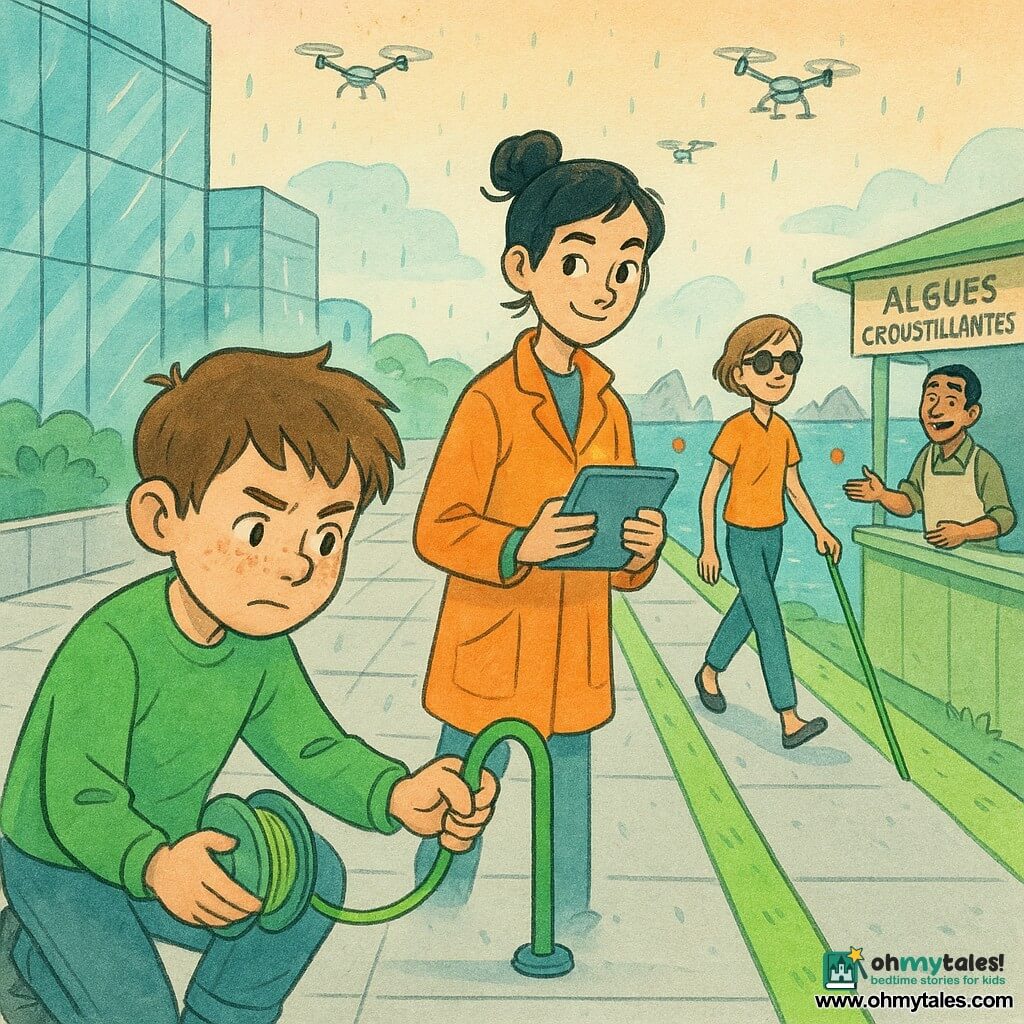
Leo turned. Mira Tamsin stood there with her orange city-jacket and her hair tied up like she'd done it while running. Mira wasn't much older than Leo—maybe fifteen—but she worked with the Civic Lab, the place where new solutions were tested in real streets.
“The street isn't polite?” Leo asked.
Mira pointed with her chin. On the sidewalk, a man with a cane hesitated at a crossing. The pavement lights flashed green, then red, then green again—too fast. Scooters whooshed by in the bike lane. A delivery cart rolled past with a cheerful jingle that didn't match the danger.
The man frowned. He took one uncertain step, then retreated.
Leo's cheeks warmed. He didn't like seeing people stuck. He didn't like pretending everything was fine when it wasn't. Honesty, his dad always said, was like clear water: it showed what was really there.
Mira sighed. “We've got a problem on the Coastal Ring. It's worse there. Want to see?”
Leo looked toward the bay. Beyond the glass towers, the sea shone like a sheet of metal. The reefs curved just under the surface, their tops dotted with sensor buoys. Behind them, the city felt safe enough to build right up to the edge.
“Okay,” Leo said. “But I've got school.”
Mira grinned. “Then we'll call it… field learning.”
Leo should have said no. He didn't. Something in Mira's tone made the problem feel like a puzzle that had his name on it.
They rode the magnet-tram that slid above the streets without touching rails. It whispered along, smooth as a thought. Leo pressed his forehead to the window. From up there, he could see Seafront City's layers: rooftop gardens, sun-collectors that turned to follow the light, water pipes that glowed faintly with recycled warmth. Everything designed to be smart… and still, people sometimes got stuck.
At the next stop, the doors sighed open. Salt air rushed in.
Mira nodded toward the coast. “Welcome to the Coastal Ring.”
The sidewalk here was broader, built to handle storm evacuations. On one side: sea wall, emergency ladders, and the sparkling line of the bay. On the other: kiosks, cafés, and tall buildings whose lower levels were reinforced like ship hulls.
And right in the middle, a mess.
A section of sidewalk had been patched so many times it looked like a quilt. The tactile tiles for blind pedestrians—little raised bumps—were scattered in the wrong places. The smart lights embedded in the pavement blinked without rhythm, like they were nervous.
A group of kids on hover-skates shot through, laughing. An older woman with grocery bags tried to avoid them and nearly stepped into the scooter lane.
Leo's stomach tightened. “This is… dangerous.”
Mira's face grew serious. “We've had three minor accidents this week. Nothing terrible. Yet. But ‘yet' is a word I don't like.”
Leo watched the older woman reach the curb. She took a breath, then whispered something and looked up at the sky, as if thanking it for making it through.
Gratitude, Leo thought, shouldn't be needed for surviving a sidewalk.
Mira opened a slim tablet and tapped. A map bloomed on the screen, showing the Ring in red and yellow warnings.
“The city's solution of the day was supposed to fix this,” she said. “A new timing algorithm for the pavement lights. But it keeps getting confused by the traffic patterns. Too many moving things.”
Leo stared at the messy patchwork of tiles. “So we need something simpler.”
Mira arched an eyebrow. “You have an idea?”
Leo didn't have a full idea yet. But he had a feeling. Sometimes the simplest help wasn't a program. It was a path you could trust.
He looked down the coast. The artificial reefs held back the wild sea, making it calm enough for people to live and build and stroll. Maybe the sidewalk needed its own little reef—something that guided, protected, and didn't get confused.
He swallowed, then said the honest thing.
“I don't know,” Leo admitted. “But I want to try.”
Chapter 2 — The Honest Map
They walked the Coastal Ring slowly, like detectives following clues. Leo noticed things he'd never paid attention to before: the tiny puddles where the pavement dipped; the way scooters cut corners; the way people hesitated at crossings, then rushed like they were jumping a stream.
Mira's tablet recorded everything. “The city calls this a ‘multi-flow corridor,'” she said. “It's supposed to be shared. But shared spaces only work when everyone understands the rules.”
“Do they?” Leo asked.
Mira snorted. “Half the people think the blinking blue line is for scooters. The other half think it's for pedestrians. The scooters think it's for them because they're faster.”
A boy on a scooter zipped by and called, “Move! Sorry!” in the same breath.
Leo stepped back, and his backpack brushed a pole. The pole had a small speaker that whispered, “Please keep right,” in a gentle voice. It sounded tired.
They stopped at a kiosk selling seaweed chips. The vendor, a round man with kind eyes, offered them two sample packets.
“Thanks,” Leo said automatically.
The chips tasted salty and crisp. “These are good,” he said.
The vendor winked. “The reefs make the water clean enough to farm seaweed near the shore. I'm grateful every day. My grandpa used to tell stories about storms that ate whole streets.”
Leo looked toward the bay. The reefs were barely visible, but their presence was felt in the calm water.
“Do you know about the accidents?” Mira asked.
The vendor's smile faded. “My sister almost fell last night. The lights switched while she was halfway across. She said it felt like the ground was changing its mind.”
Leo frowned. “That's exactly what it's doing.”
Mira tapped her tablet. “We need a solution that doesn't change its mind.”
They continued, and the sidewalk grew busier. A service bot rolled by carrying a stack of solar tiles. A tourist family stopped to take a picture of the reef buoys. A man in a suit spoke to his wrist-screen and nearly walked into a street pole.
At the worst crossing, Leo saw a girl about his age standing with a white cane. She was facing the street, still as a statue. Cars moved in silent electric streams. The pavement lights blinked confusing patterns.
Leo approached slowly, keeping his voice calm. “Hi. Do you need help?”
The girl turned her head. Her sunglasses reflected the sea. “The crossing voice is broken,” she said. “It keeps saying ‘go' and then ‘stop' like it can't decide. I'm waiting for it to sound sure.”
Mira's jaw tightened. She whispered to Leo, “That's Naya. She's in the accessibility council. She's been complaining for days.”
Leo felt a prick of shame—he'd walked this city thinking it was already friendly enough, because it was shiny and advanced. But shiny didn't mean safe.
Leo said, “I can guide you across, if you want.”
Naya tilted her head. “Are you trained?”
Leo hesitated. Honesty first. “No. But I can be careful. And we can wait for a clear moment.”
Naya nodded once. “Careful is better than confident.”
They waited. When the traffic paused, Leo offered his elbow the way his mom had once shown him. Naya took it lightly. Mira walked on Naya's other side, watching the lanes.
They crossed in three steady steps, not rushing. On the far curb, Naya released Leo's arm.
“Thank you,” she said. Then, with a tiny smile: “And thanks for not lying about being trained.”
Leo exhaled, surprised at how much that mattered.
Mira's eyes flicked from Naya to the broken crossing speaker. “We can't fix this with another blinking line,” she said. “We need a guide that people can follow by touch. Something physical.”
Leo's mind clicked. “Like… cordons.”
Mira looked at him. “Cordons?”
Leo nodded, warming with excitement. “Guide cordons. A line you can hold or feel with a cane. Like the ropes in museums, but smarter. They could separate walking space from scooter space, and lead to crossings.”
Mira's grin returned, quick as a spark. “That's… simple. And simple is good.”
Naya angled her head. “Simple is also reliable. But how would you install them? This whole Ring is a mess.”
Leo stared at the sidewalk, imagining it. A cordon could run along the safe edge, leading people like a gentle hand. It wouldn't need to blink. It wouldn't get confused by traffic. It would just… be there.
“We start small,” Leo said. “One section. One crossing. A test.”
Mira was already typing. “Civic Lab can lend modular posts and cordon lines. We have a kit for crowd control during festivals. We could repurpose it.”
Naya said, “If you do it, include texture markers. Different ridges for different directions. And keep the cordon height consistent. People trust consistency.”
Leo's heart beat faster. This was real now. Not just a thought.
Mira nodded at Leo. “Congratulations. You've invented today's simple solution.”
Leo blinked. “I didn't invent it alone.”
Mira pointed at him. “You said it out loud first. Honesty counts as invention sometimes.”
Leo looked back toward the sea. The reefs didn't boast. They just held back the waves, day after day.
“Okay,” Leo said. “Let's build a sidewalk reef.”
Chapter 3 — The Cordon Kit
Civic Lab sat inside an old ferry terminal that had been turned into a workshop. The building still smelled faintly of salt and machine oil. Inside, the air buzzed with tiny sounds: printers humming, tools clicking, robots rolling on soft wheels.
Mira signed them in with a palm scan. “Officially,” she told Leo, “you're here for a student observation.”
Leo lifted his chin. “Officially, I'm not going to mess anything up.”
Mira laughed. “Perfect. That's exactly what all mess-makers say.”
They entered a storage bay lined with labeled shelves: WATER-SAVER NOZZLES, EASY REPAIR PATCHES, WINDOW SHADE FILMS, EMERGENCY KITE DRONES.
Mira stopped at a crate marked: MODULAR POSTS — FLEX SAFE.
Inside were short poles made of a springy polymer. They could bend if someone bumped them, then pop back upright. The tops had small grooves for attaching lines.
Next to them lay coiled cordons: bright sea-green, with a rubbery surface. When Leo ran his fingers along one, he felt tiny ridges.
“Textured,” he said, pleased. “Like Naya said.”
Mira handed him a small clip device. “These clamp onto existing street anchors. No drilling. The city loves ‘no drilling.'”
Leo imagined the Coastal Ring as it was now—patched and confusing. No drilling meant they could change things quickly without turning the whole place into a construction zone.
They loaded a cart with six posts, two cordon coils, and a tool pouch that included a tension meter and a small beacon.
“What's the beacon for?” Leo asked.
Mira held it up. It was the size of a lemon and had a single button. “If someone needs help, they press it. It pings nearby city assistants and plays a clear audio message. Like a lighthouse, but for sidewalks.”
Leo grinned. “A sidewalk lighthouse.”
They rolled the cart back to the Coastal Ring. The sea was higher now; waves tapped the reefs and broke into glittering foam. A gull-bot hovered near a buoy, collecting plastic scraps with a neat claw.
At the problem crossing, Mira set the posts down. “We'll make a guided corridor,” she said. “From the tram stop to the crossing, then to the café corner. People will naturally use it if it feels easier.”
Leo took a post and fitted it to a street anchor. It clicked into place with a satisfying sound. He tightened the clamp carefully, then tugged. Solid.
“Nice,” Mira said. “You're good with your hands.”
Leo shrugged, trying not to look too proud. “My dad fixes fishing drones. He says if you rush, you break things twice.”
They attached the cordon line, stretching it between posts. The line ran along the pedestrian side, gently steering people away from the scooter lane. Leo checked the height with the meter, just like Naya had suggested. Consistency.
A scooter rider slowed, curious. “What's this? A queue for something?”
Mira answered brightly, “A safer path.”
The rider snorted. “I'm already safe.”
Leo couldn't help himself. “That's what everyone says until they're not.”
The rider looked at Leo, surprised by the bluntness, then shrugged and rolled away—this time staying in the scooter lane.
People began to notice. A mother with a stroller followed the cordon without thinking, guided by the simple boundary. An older man with headphones stopped, then walked inside the corridor as if it had always been there.
Naya arrived with two adults from the accessibility council. She tapped her cane lightly against the cordon.
“This texture means ‘straight,'” she said, nodding. “Good. Add a different texture near the crossing, so people know they're approaching it.”
Mira pointed to the second coil. “We can switch lines at the crossing area.”
They worked together. Leo's hands moved with careful purpose. He wasn't the fastest, but he double-checked each clip. When a post leaned slightly, he adjusted it until it stood perfectly upright.
A city maintenance bot rolled up, its screen-face showing a curious expression. “Unregistered street modification detected,” it beeped.
Mira stepped forward, flashing her Civic Lab badge. “Pilot safety test. Authorized.”
The bot's screen changed to a smile. “Thank you for improving Seafront City.”
Leo felt a sudden warmth. The bot's thanks sounded silly, but it made the work feel seen.
They added the beacon near the crossing and pressed the test button. A clear voice spoke: “Assistance requested at Coastal Ring Crossing 7. Please approach with care.”
Naya nodded. “Loud enough without being scary.”
Mira set her tablet on a post and filmed the corridor. “Now we watch,” she said. “And we listen.”
For ten minutes, people flowed. Not perfectly—nothing ever was—but better. Scooters stayed mostly in their lane. Pedestrians walked with fewer sudden zigzags. The crossing felt calmer because the approach was calmer.
Then trouble arrived wearing a grin.
A group of older kids—maybe fourteen—came sliding in on hover-skates. They saw the posts and cordon and immediately treated it like a challenge.
“Obstacle course!” one shouted.
They ducked under the cordon, zipped between posts, and laughed. A little boy following his dad jerked back in surprise and nearly tripped.
Leo's chest tightened. He stepped forward. “Hey! Stop!”
The skaters didn't stop. One of them kicked a post lightly. It bent, then sprang back.
“Relax,” the leader said, circling. “It's flexible.”
“That's not the point,” Leo snapped. “People are using it to stay safe.”
The leader rolled closer. “And who are you? Cordon Commander?”
Mira started to speak, but Leo lifted a hand. He was honest, and he was tired of pretending that being loud made someone right.
“I'm Leo,” he said. “And if you break this, someone could get hurt. Not you, maybe. Someone who can't dodge as fast.”
The leader's grin wobbled, just a little. “It's just a rope.”
Naya's voice cut in, calm as a tide. “It's not ‘just' anything. It's information you can touch. Without it, some of us are guessing.”
The skater glanced at Naya's cane. His cheeks reddened.
Mira added, “If you want to skate, there's a practice strip two blocks down. This is a safety pilot.”
The leader hesitated. Then, to Leo's surprise, he muttered, “Fine.” He waved his friends away. “Come on.”
As they rolled off, the leader called back, “Cordon Commander!” but his tone had changed. Less mean. More… impressed.
Leo let out a breath he hadn't realized he was holding.
Mira nudged him. “Nice.”
Leo looked at the corridor again. People were using it. The idea was working.
But one section near the patched tiles still looked messy. The cordon line dipped slightly where the anchor was loose. And the crossing lights continued their confused blinking, like a nervous eyelid.
Mira frowned at her tablet. “The cordon helps, but the crossing itself still needs a fix. Otherwise we're guiding people toward uncertainty.”
Leo stared at the blinking lights. “Then we make the crossing certain.”
“How?” Mira asked.
Leo glanced at the sea. The reefs didn't blink. They didn't change their minds.
He said softly, “We make the sidewalk do what the reefs do.”
Mira's eyes sharpened. “Explain.”
Leo pointed to the reefs' sensor buoys. “They don't just sit there. They send constant, steady data. What if the crossing needs a steady signal too—one that isn't fooled by random traffic?”
Mira looked thoughtful. “A dedicated trigger…”
Naya tapped the cordon with her cane. “The cordon itself could be the trigger,” she said. “When someone reaches the end, they press a pad. A simple button. Green stays green long enough. No guessing.”
Leo smiled. “A thank-you button for the crossing.”
Mira laughed. “A polite crossing. I like it.”
They gathered their tools again. The day's simple solution was becoming two simple solutions, braided together like the cordon line itself.
Chapter 4 — The Button That Held Its Nerve
Civic Lab called it a “manual priority pad.” Leo called it “the button that holds its nerve.”
It was a flat plate you could press with a hand, elbow, or even the tip of a cane. When pressed, it sent a direct request to the crossing system: hold green for pedestrians for twelve full seconds, with a clear audio count. No blinking arguments. No sudden change of mind.
The next afternoon, they returned to Crossing 7 with the pad, a small power cell, and a weatherproof casing. The sea wind carried the smell of fried seaweed and salty foam.
Mira knelt by the crossing pole and opened a panel. “The city hates when people tinker,” she said, “unless the tinkering is officially approved.”
Leo held up the approval tag Mira had printed. “We're approved.”
Mira grinned. “You sound like a tiny lawyer.”
“I'm just being honest,” Leo said. “It helps.”
They installed the pad at the end of the cordon corridor, right where a person would naturally stop. Naya tested it first, pressing it with her cane tip.
A clear voice spoke from the crossing speaker—new and firm: “Crossing requested. Please wait. Three… two… one… Cross now. Twelve… eleven… ten…”
The pedestrian light turned a steady green. Not flickering. Not impatient.
Naya stepped forward, guided by the cordon and the sound. Leo walked beside her, ready to help if needed. Mira watched the lanes, arms crossed like a guard.
They reached the other side with time to spare. The voice finished calmly: “…two… one… Crossing closed.”
Naya smiled, a real one this time. “It didn't rush me.”
Leo felt something loosen inside him. He hadn't realized how tense the old crossing made him until it wasn't tense anymore.
A man waiting behind them said, “That was… nice.”
A woman with a surfboard under her arm added, “So simple. Why wasn't it like that before?”
Mira answered honestly, “Because the city tried to be too clever.”
Leo said, “Sometimes clever is great. But sometimes you just need something you can trust.”
The crowd began to use the pad. One by one, people pressed it, waited, then crossed with steady timing. Even a scooter rider stopped and waited, because the cordon corridor made the space feel organized. It was harder to pretend the rules were unclear.
The older kids with hover-skates returned, slower this time. The leader—same one—hovered near the cordon.
He nodded at Leo. “So… it works.”
Leo nodded back. “It works better when people don't treat it like a game.”
The leader scratched his neck. “Yeah. Sorry about yesterday.”
Leo blinked. Apologies weren't common currency in Seafront City. People were usually too busy to spend them.
“Thanks,” Leo said. “And… thanks for saying that.”
The leader pointed at the pad. “Can I try it?”
“Sure,” Leo said.
The leader pressed the pad with one finger, as if it might bite. The voice counted. The light turned green.
He watched, impressed. “Huh. It's like it listens.”
“It does,” Mira said. “To the person who actually needs to cross, not to whatever random thing zooms by.”
The leader looked down at his hover-skates. “My little brother's starting to use a cane. Different reason than Naya, but… yeah. This is good.”
Leo felt a wave of gratitude so sudden it almost made him dizzy. Gratitude for the reefs holding back storms. Gratitude for a button that didn't blink. Gratitude for someone choosing not to be stubborn.
He said, simply, “Tell your brother he's welcome here.”
The leader nodded once and rolled away, careful this time to stay in his lane.
Mira leaned toward Leo. “You're doing something important,” she said softly.
Leo stared at the cordon line, the steady green light, the flow of people moving with less fear.
“It's not just me,” he replied. “It's everyone who uses it right.”
Mira's eyes warmed. “That's a very Leo thing to say.”
The city assistants—small rolling bots—arrived to observe. One projected a chart in the air: INCIDENT RISK DOWN 62%. PEDESTRIAN CONFIDENCE UP 48%. It even displayed a little message: SIMPLE FIX SUCCESSFUL.
“Look,” Mira whispered. “Data loves you.”
Leo laughed under his breath. “Tell data to write me a thank-you note.”
As if listening, the nearest assistant bot rolled closer and said, “Thank you, citizen Leo, for contributing to safer movement.”
Leo's ears turned pink. “You're welcome,” he told the bot, because manners were also a kind of technology—old, but still effective.
They packed up their tools, leaving the cordon corridor and the pad in place for a week-long pilot. The sun began to sink, turning the bay copper. The reefs held the waves like a promise.
On the way home, Leo's school wristband buzzed with missed lessons. He grimaced.
Mira chuckled. “You'll have homework.”
Leo sighed. “Worth it.”
He looked back once more at the Coastal Ring. The sidewalk was still patched. The city was still busy. But now there was a clear, touchable line of guidance and a crossing that didn't panic.
A simple solution, invented in a day, like the city promised.
Only Leo knew it wasn't really invented in a day. It was invented in all the small moments people admitted the truth and chose to care.
Chapter 5 — Storm Practice
Two nights later, the weather sirens sang their low, calm song: a storm rehearsal alert. Not a real emergency—just practice. Seafront City did practice the way some people did homework: often, seriously, and with plenty of reminders.
Leo stood at his apartment window, watching the bay. Out past the reefs, the sea looked rougher, darker, like wrinkled cloth. Inside the reef line, the water still moved, but it moved politely.
His dad, Jalen, tightened a strap on a small repair drone. “Reefs are doing their job,” he said. “Always makes me grateful.”
Leo nodded. “Me too.”
His mom handed Leo a rain jacket. “If the practice route is active, stay on the marked sidewalks,” she said. “No shortcuts.”
Leo almost laughed. “Mom, I helped mark one.”
His mom smiled. “All the more reason to respect it.”
At the Coastal Ring, the city activated evacuation markers: glowing arrows on buildings, soft lights along the pavement. People poured onto the sidewalks in a steady stream, practicing the route inland.
Leo pushed through the crowd to Crossing 7. He wanted to see if their cordon corridor handled real pressure.
It did—at first.
Families moved inside the corridor naturally, like water flowing between rocks. The cordon kept the scooter lane clear. The pad was pressed again and again, giving consistent crossing times. The voice counted without irritation.
Then the wind picked up and flung rain sideways. Someone's umbrella turned inside out. A man bumped a post hard while wrestling a stroller.
The post bent too far, and the cordon line sagged, drooping into the walking path like a loose shoelace.
A kid tripped. Not badly—hands caught the fall—but fear rippled through the crowd. People hesitated. Hesitation in a crowd was like a pebble in a stream; it made the water pile up.
Leo's stomach dropped.
Mira appeared, soaked but alert, her jacket clinging to her arms. “We've got a weak anchor,” she shouted over the wind.
Leo grabbed the sagging cordon, lifting it. “Hold the flow!” he called, surprised at his own voice.
Naya was there too, hood up, cane steady. “Don't pull it too tight,” she warned. “If it snaps back, it could hit someone.”
Leo nodded, grateful for the reminder. He didn't want a safety tool to become a hazard.
Mira knelt at the anchor point. Rain slapped her hands. “The clamp's slipping,” she said. “The pavement patch here is crumbly.”
Leo scanned the area fast. Simple solution, he told himself. No drilling. No complicated machines. What did they have?
He spotted a maintenance cart parked nearby, the kind used for street festivals. On it: sandbags—lightweight ones filled with recycled foam pellets.
“Sandbags!” Leo shouted.
Mira looked up. “Yes!”
Leo sprinted, grabbed two bags, and hauled them back. He and Mira weighed the base of the post down, pressing it firmly against the anchor. The cordon lifted back to proper height.
Naya tapped the line with her cane. “Better,” she said.
The crowd started moving again, relief spreading like warmth. A woman passing Leo said, breathless, “Thank you!”
Leo swallowed. “You're welcome.”
Another man nodded at the reefs in the distance. “And thank you, reefs,” he added, half-joking, half-serious.
Leo glanced at the dark water beyond the city's calm zone. “Yeah,” he murmured. “Thanks.”
The practice continued. Crossing 7 stayed organized. People pressed the pad, listened to the steady count, and crossed without rushing.
When the sirens finally signaled the end of rehearsal, the crowd thinned. Rain eased into a gentle drizzle.
Mira leaned against a post, dripping. “You just did real-time problem solving in storm conditions.”
Leo shivered. “I just… didn't want anyone to fall.”
Naya stood close enough that Leo could hear her voice clearly. “You kept the cordon from becoming a trap,” she said. “That's the difference between building something and taking care of it.”
Leo looked at the sandbags and the cordon line, now steady again. “We should add weights permanently near weak patches,” he said.
Mira nodded, already recording. “And maybe a second low cordon near the ground, so canes and feet detect it sooner if it sags.”
Leo smiled. “A double reef.”
Mira laughed. “Exactly.”
As they walked back toward the tram stop, the city lights reflected in puddles like scattered stars. The air smelled clean, washed by rain.
Leo felt tired, but in a good way—the kind of tired that meant something had been done right.
He whispered, almost to himself, “I'm grateful it held.”
Mira heard him. “Me too,” she said. “And I'm grateful you showed up.”
Leo shrugged, embarrassed. “It's my city.”
Naya added, “And now it's a little more honest. It admits where it needs help.”
Leo liked that. A city that could admit it needed help was a city that could improve.
Chapter 6 — The Safe Sidewalk
A week later, the Civic Lab published the results: fewer near-misses, smoother flow, higher confidence ratings. The mayor's office sent a short message that sounded almost surprised: PILOT APPROVED FOR EXPANSION.
On a bright morning, Leo returned to the Coastal Ring and almost didn't recognize it.
The patchwork sidewalk had been resurfaced in clean sections. Not fancy—just even and level. The cordon corridor was no longer a temporary line clipped to random anchors. It was integrated: sleek posts with built-in ridges, a double cordon—one at hand height, one lower for cane and foot detection—and clear texture changes near crossings.
The manual priority pad had been upgraded too, with a simple symbol: a hand, a cane, a stroller. Press once, wait, cross. The crossing voice was steady and friendly, counting down without hurry.
Mira stood beside the new installation, hands on hips. “They kept your no-drilling rule,” she said. “Everything is modular. If a section breaks, it snaps out and snaps in.”
Leo ran his fingers along the cordon's ridges. It felt like reading a sentence in Braille, even though he couldn't read Braille. Straight. Turn. Stop. Cross.
Naya arrived and walked the corridor alone, cane tapping softly. She pressed the pad, listened to the count, and crossed at her own pace.
On the other side, she turned toward Leo and Mira. “This,” she said, “is what safety feels like.”
A small crowd had gathered: neighbors, shop owners, a couple of city engineers with serious shoes. Leo's parents were there too. His dad waved, proud but trying not to look too proud.
The sea glimmered behind them. The artificial reefs lay like a curved spine in the water, breaking the waves into harmless foam. A reef drone surfaced briefly, its sensors blinking green—steady green, not nervous blinking.
An engineer stepped forward. “Leo Vance?” he asked.
Leo's throat went dry. “Yes.”
The engineer held out a small badge—nothing shiny, just a simple token. It read: CITIZEN FIXER — LEVEL 1.
“We're grateful,” the engineer said. “You reminded the city that the best inventions are the ones people can use immediately.”
Leo accepted the badge carefully. “I didn't do it alone,” he said at once, because it was true.
Mira nudged him. “Say it.”
Leo looked at the crowd. “Thank you,” he said. “To Mira for bringing me in. To Naya for telling us what mattered. To the vendors and commuters who tested it. To everyone who didn't treat it like a joke. And… to the reefs, for keeping us safe enough to build all this.”
People chuckled, but they also nodded, because gratitude didn't need to be serious to be real.
Naya said, “And thank you for listening.”
A little kid tugged Leo's sleeve. “Are you the Cordon Commander?” the kid asked, eyes wide.
Leo laughed. “No.”
The kid frowned. “Why not?”
Leo thought for a second. “Because it's not a command,” he said. “It's a guide.”
The kid considered that, then ran off to press the crossing pad—once, properly, then waited with surprising patience.
Mira watched the steady flow of people using the corridor. “We'll extend it along the whole Coastal Ring,” she said. “And other districts too. Anywhere a sidewalk needs to stop being a puzzle.”
Leo looked down the safe path: smooth surface, clear separation, touchable guidance, calm crossings. A sidewalk that didn't demand quick reflexes or perfect sight. A sidewalk that forgave mistakes.
He pictured the city years from now—taller towers, smarter drones, newer screens. But he hoped the simplest parts stayed: lines you could trust, buttons that listened, people who told the truth.
The crossing voice began again: “Cross now. Twelve… eleven…”
Leo breathed in the salt air, feeling the cool wind off the bay.
He was twelve in a city of tomorrow, and he had helped make one small piece of it kinder.
That felt like the right kind of future.
And as he stepped onto the safe sidewalk, he whispered one more quiet thanks—just to the day itself—for giving him a chance to fix something.