Chapter 1: The City That Hummed Like a Leaf
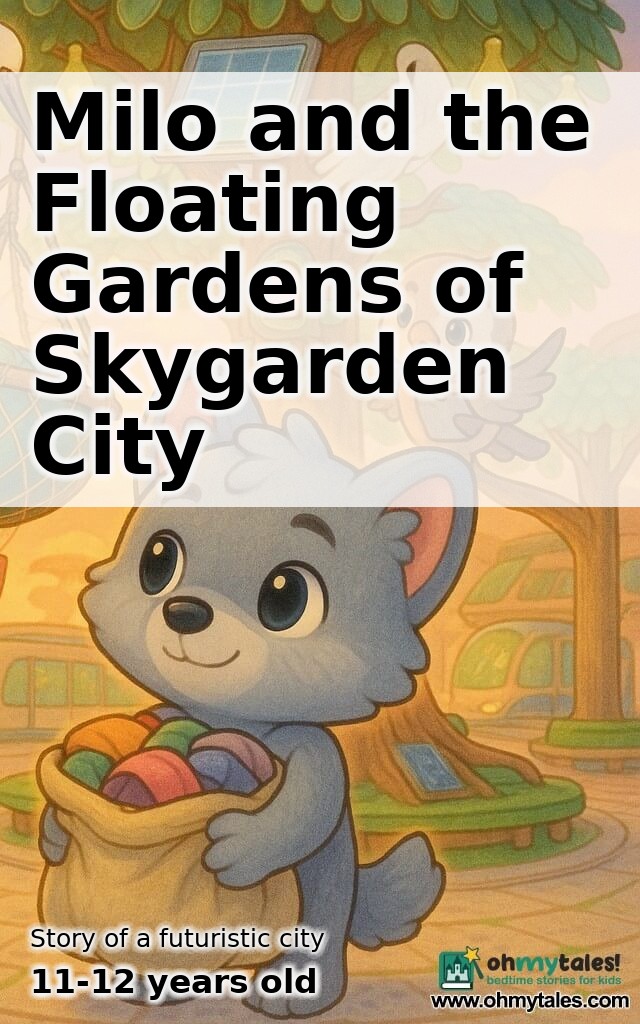
Milo was a small wolf, the kind with soft gray fur and ears that never quite decided whether to stand up or flop over. In Skygarden City, that made him look permanently curious, which was useful. Curiosity, Milo had learned, was safer than fear.
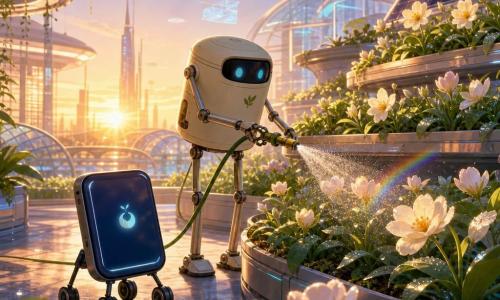
The city rose in layers—terraces stacked like giant steps—each one draped with hanging vines and bright planters. Gardens didn't just sit on rooftops here. They floated.
Above Milo's head, a suspended orchard swayed gently on carbon-fiber cables, its branches heavy with glassy pears that glowed faint green when the wind touched them. Between the terraces, streams ran in clear tubes, glittering as they carried recycled rainwater to every level. Everything in Skygarden City moved with a quiet, clean purpose.
No smoke. No roaring engines. Just the whisper of solar sails unfurling, the sigh of wind turbines turning, and the soft click-click of pedal lanes where bikes rolled past in orderly lines.
Milo stepped onto a moving walkway—one of the slow ones, the kind that didn't yank you forward like an impatient friend. It carried him along the edge of Terrace Seven, where the air smelled like mint and sun-warmed stone.
A sleek tram slid by on magnetic rails, silent as a shadow. Its windows reflected the gardens above, so it looked like it was gliding through a forest in the sky.
Milo's wrist band—woven from plant fiber and threaded with tiny lights—buzzed once.
CLOTHING COLLECTION TODAY, it flashed.
DROP POINT: CLOUDLOOP PLAZA.
TIME: BEFORE SUNSET.
Milo's tail gave a small, pleased wag. The city didn't force anyone to help, but it invited everyone. And Milo liked invitations. They made cooperation feel like a door held open, not a shove.
He hopped off the walkway and trotted toward Cloudloop Plaza, where the wind always carried bits of laughter and the occasional lost paper kite.
“Don't be late,” he told himself, out loud, because it made the promise feel more real.
His ears flicked as he passed a group of courier cats on longboards made from recycled bamboo. One of them called, “Hey, Milo! Your ears are doing the thing again!”
Milo lifted his chin. “They're thinking.”
“They look like they're arguing,” the cat replied, and zipped away.
Milo smiled anyway. In Skygarden City, even teasing felt like a gentle nudge.
The sun sat bright and round between two floating terraces. Above it all, the suspended gardens cast shifting shadows, like giant leaves moving across the city's skin.
Milo quickened his pace. A collection wasn't just a pile of old shirts. It was a web of small choices, tied together by many paws.
And Milo liked webs. They held things up.
Chapter 2: The Drop Point and the Problem
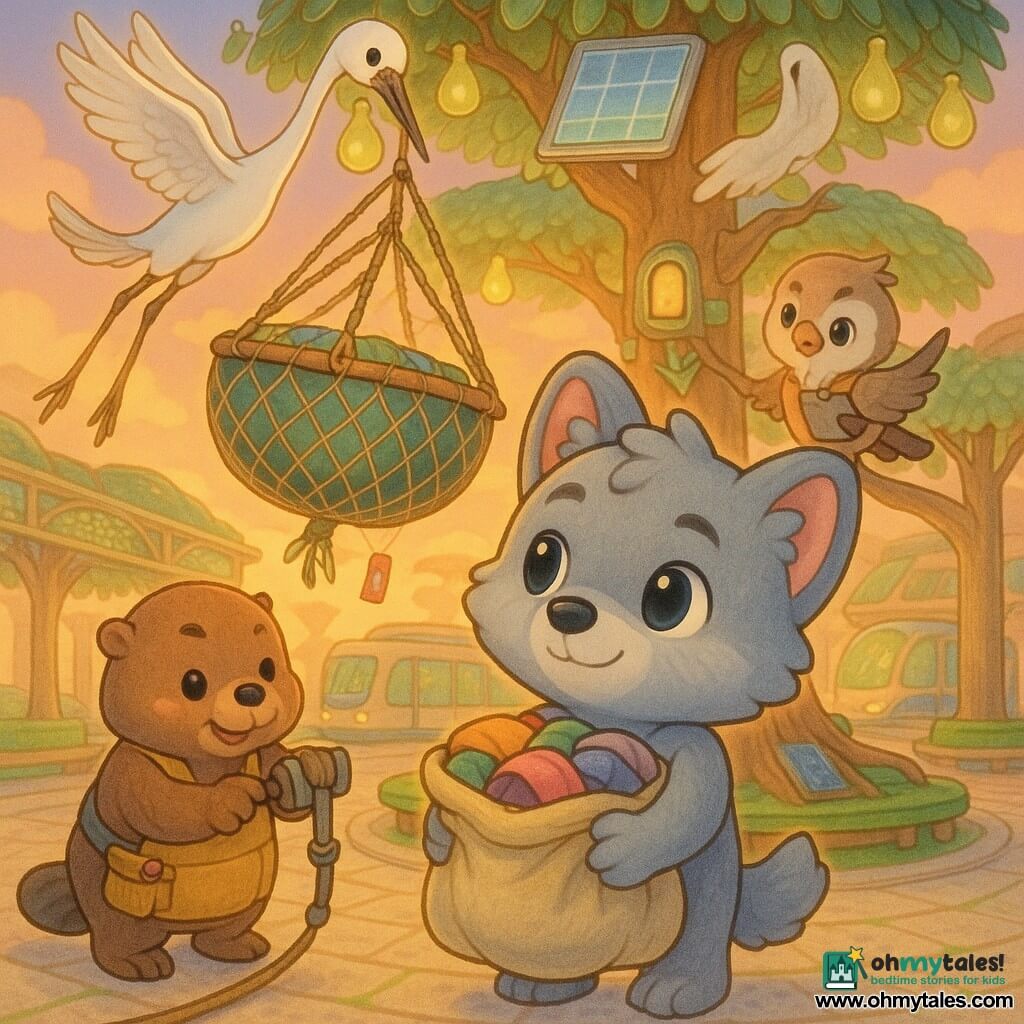
Cloudloop Plaza was shaped like a spiral shell. Smooth paths curled inward, bordered by mossy benches and little charging stones where bikes could sip solar power through their frames. In the center stood the Drop Tree: a tall structure made from reclaimed wood and clear panels, with friendly signs and swinging baskets at different heights.
Already, animals had gathered—raccoons with neatly folded sweaters, otters with waterproof coats, a herd of small deer balancing scarves like colorful noodles.
Milo approached the Drop Tree with a canvas bag slung across his back. Inside were three things: a warm hoodie he'd outgrown, two pairs of socks that no longer matched anything, and a bright yellow rain jacket that made him look like a walking lemon.
A cheerful voice chirped, “Milo!”
Pip, a sparrow with a tiny vest and a clipboard strapped to his chest, fluttered down to the Drop Tree. Pip was the plaza's volunteer coordinator. He looked organized in the way some birds look like they're born with a schedule.
“You came!” Pip said.
“I said I would.” Milo lifted his bag. “Where do you want these?”
Pip pointed a wing at the baskets. “Sort by size, then by fabric type. Soft-warm in the left baskets, rainproof in the right, and anything with holes—” He paused, eyeing Milo. “Not your ears.”
Milo snorted. “Very funny.”
Pip's eyes narrowed suddenly. “Oh no.”
Milo followed his gaze.
One of the Drop Tree's main baskets—the biggest one, meant for heavy winter coats—hung crooked. Its support cable was twisted, and the basket bumped softly against the tree's panel with each gust of wind, like it was knocking to be let back into place.
“Is it going to fall?” Milo asked, keeping his voice calm, even though his stomach tightened.
“It shouldn't,” Pip said, but his feathers puffed with worry. “But the cable's tangled with the vine netting from the garden above. If it snaps—”
A deep, slow creak rolled through the plaza.
Milo's ears shot straight up, no argument now.
A small crowd noticed. The otters paused mid-joke. A raccoon stopped folding. Even the breeze seemed to hold its breath.
Milo stepped forward, closer to the Drop Tree, and studied the problem the way he studied everything that scared him: carefully, like it was a puzzle rather than a monster.
The cable wasn't broken. It was twisted around a loop of vine net—part of the suspended garden's safety mesh. The mesh had sagged lower than usual, drifting down like a lazy green curtain. Every time the wind moved it, it tugged the cable tighter.
“We need to untwist it,” Milo said.
Pip fluttered anxiously. “We're small. That cable's thick. And if we pull wrong—”
“Then we don't pull wrong,” Milo said. He looked around. “We cooperate.”
A beaver in a tool apron waddled up, chewing thoughtfully on a twig. “I can bring a stabilizer clamp,” the beaver said. “Keeps tension steady.”
A pair of lanky crane siblings stepped in. “We can reach the high loop,” one said, stretching a wing like it was already measuring the air.
A mouse with a belt of mini gadgets squeaked, “I have a twist-reader! It shows which direction to unwind.”
Pip blinked. “You… you all just have these things?”
The mouse shrugged. “It's Skygarden City. We like being prepared.”
Milo set down his clothing bag gently, like it was important—because it was. Then he nodded at the others.
“Okay,” he said. “Let's make this basket safe. Then we can collect clothes without anyone worrying about getting bonked by a flying coat.”
A raccoon muttered, “That's a terrifying sentence,” and everyone laughed just enough to loosen the tightness in the air.
Chapter 3: The Untangling Plan
They formed a neat half-circle around the Drop Tree. Milo stood in front, not because he was the biggest—he wasn't—but because he spoke like the ground was steady under his paws.
“First,” Milo said, “we stop it from swinging more.”
The beaver slid a stabilizer clamp from a satchel. It looked like a metal jaw lined with rubber. The beaver snapped it around the basket's bottom support bar, then anchored it to the Drop Tree's trunk with a strap.
The basket stopped bumping. The plaza exhaled.
“Second,” Milo continued, “we find the twist direction.”
The mouse held up a twist-reader: a clear disk with tiny arrows that lit up when held near the cable. The arrows blinked in a spiral pattern.
“It's wound clockwise,” the mouse announced. “We need to unwind counterclockwise.”
Pip scribbled furiously on his clipboard. “This is—this is going to be a great safety report.”
Milo pointed with his nose at the vine netting. “Third, we lift the net loop away from the cable so it can turn freely.”
The crane siblings stepped forward. Their legs were long and careful, their movements slow and precise. One reached up and hooked the vine net with the curve of a wingtip, holding it away. The other stretched higher and caught the sagging section so it wouldn't drop back down.
Now the cable was visible in full: thick, braided, and gleaming slightly, made from recycled alloy and plant polymer.
“Fourth,” Milo said, “we unwind. Gently.”
“Who's ‘we'?” asked an otter, grinning.
Milo looked at the crowd. “Everyone who can grip. But we do it together. Same direction. Same pace.”
Several animals stepped in: the otters, two raccoons, and a sturdy tortoise who looked like he could outlast time itself.
They all wrapped paws around the cable where it dipped low enough to reach.
Milo didn't grab the cable. His paws were small, and he knew it. Instead, he watched the tension points—the way the cable pulled, the way the basket held, the way the vines trembled.
“Ready,” Milo said. “Counterclockwise. One… two… three.”
They turned together, slowly, like opening a very stubborn jar. The cable resisted at first, then shifted with a soft metallic sigh.
The twist-reader's arrows blinked faster. “Good!” the mouse squeaked. “Keep going!”
Wind brushed across the plaza. The suspended orchard above rustled, and the vine net shivered in the crane's wings.
Pip hovered close, voice thin. “If it slips—”
“It won't,” Milo said quietly. “Not if we stay steady.”
The group turned again. The cable loosened around the vine loop, like a knot giving up. The beaver adjusted the clamp to keep the basket from swinging.
Then—pop.
Not a scary pop. A satisfying one. Like a seal finally breaking.
The vine net sprang free, lifting back toward the suspended garden above as if relieved to be untangled from someone else's business.
The cable straightened, smooth and aligned.
The basket hung perfectly still.
For a moment, everyone stared at it, as if waiting for it to do something dramatic. It didn't. It simply stayed where it was supposed to be.
Milo let out a breath he hadn't noticed he was holding.
Pip's feathers relaxed. “We did it,” he said, sounding surprised.
“We did,” Milo agreed.
The raccoon wiped his brow. “I would like to officially retire from battling baskets.”
The otter bumped shoulders with him. “Too bad. There's probably a rebellious scarf somewhere.”
Milo chuckled, and the plaza filled with sound again—light and ordinary and safe.
Then Milo picked up his canvas bag.
“Okay,” he said. “Now we collect clothes.”
Chapter 4: Clothes, Stories, and a Secret Pocket
The Drop Tree's baskets swung gently now, friendly as fruit. Pip resumed his cheerful authority, directing animals to the right spots.
“Rainproof here! Soft-warm there! If it sparkles, ask first!” Pip called, because sometimes smart fabric did that, and you didn't want a jacket accidentally trying to have a conversation with your elbow.
Milo helped sort. He ran his paws over textures: fluffy fleece, smooth recycled nylon, knit scarves that smelled faintly like cedar closets and cinnamon snacks.
Each item seemed to carry a story. A tiny cap with stitched stars. A pair of mittens with one missing button. A long coat lined with bright orange, like someone had wanted to keep sunset close.
A shy hedgehog rolled up, unrolled, and pushed forward a folded stack. “They're clean,” the hedgehog said. “I washed them twice.”
Milo offered a reassuring smile. “Thank you. That's thoughtful.”
The hedgehog's spines settled a little, as if the compliment smoothed them.
As the baskets filled, a soft chime sounded from the Drop Tree—an alert tone, not an alarm. A panel on the trunk lit up with a gentle blue glow.
Pip tilted his head. “What now?”
The panel displayed a simple message:
WEIGHT IMBALANCE DETECTED.
RECOMMENDED ACTION: REDISTRIBUTE LOAD.
Milo stepped closer. The big winter-coat basket, now safe, was getting heavy. Too many thick coats on one side could pull the Drop Tree's support frame unevenly.
“It's not dangerous yet,” Milo said, reading the color and the calm tone. Skygarden City didn't like panic. “But we should listen.”
“Redistribute,” Pip repeated, as if the word itself needed organizing. “Okay! We can do that.”
The beaver came back with a small rolling platform—a cart that moved on smooth, silent wheels. “Load transfer,” the beaver said proudly.
They worked in teams. Otters lifted coats two at a time, raccoons folded them tighter to save space, deer carried lighter items to the upper baskets. Milo guided without rushing.
“Not all heavy things go in one place,” Milo said, mostly to himself, but a nearby squirrel nodded like it was a life lesson.
While Milo sorted a pile of hoodies, he felt something stiff in the pocket of one—a rectangle shape that didn't belong.
He carefully unzipped the pocket and pulled out a slim data-card, the kind used for delivery routes and access passes. Its surface shimmered with a faint holographic stamp: CITY GARDEN MAINTENANCE.
Pip fluttered over. “What's that?”
“Something left behind,” Milo said. He turned the card in the light. “Probably by accident.”
The card activated with a tap from Milo's claw. A small map appeared—Skygarden City's upper layers, including the suspended gardens. One section flashed amber: NETTING SECTION 4B: SAGGING.
Milo's ears tilted. “That's the vine net that tangled our cable.”
The mouse squeaked, leaning in. “It's flagged for repair. But maybe the notice didn't reach the right place.”
Pip frowned. “If that net sags again, it could tangle with something else. Or someone.”
Milo looked up at the floating terraces, where gardens hung like green clouds. Beautiful, yes. But beauty still needed maintenance. Cooperation wasn't just about fixing what happened. It was about preventing the next problem.
“We should bring this to the Garden Hub,” Milo said.
Pip hesitated. “But the collection—”
“We'll keep it going,” Milo said. He nodded to the beaver and the otters. “Can you handle sorting for a bit?”
The otter saluted with a paw. “Captain Beaver, you have the clipboard now.”
The beaver blinked. “I do not want the clipboard.”
Pip clutched his clipboard protectively. “Nobody takes the clipboard.”
Milo held the data-card gently, like it was a fragile promise. “I'll go fast. I'll be back before sunset.”
Pip studied Milo's face, then nodded. “Okay. But be careful.”
Milo's tail lifted. “I'm a small wolf,” he said. “Careful is kind of my thing.”
Chapter 5: The Garden Hub Above the Lanes
Milo took the pedal lane up—a smooth, spiraling path that climbed along the side of a terrace. He didn't have a bike with him yet, so he jogged at an easy pace, passing charging stones and little rest nooks where vines grew in neat braids.
Along the way, he saw the city's clean systems at work: drones shaped like seedpods drifting between planters, dropping compost pellets exactly where they were needed; thin solar films stretched like transparent ribbons across railings; water misters puffing a cool cloud over a patch of thirsty herbs.
Everything looked calm. But Milo knew calm didn't mean nothing could go wrong. It meant the city was constantly adjusting, like a balanced mobile.
At the top of the lane, the Garden Hub waited—a round platform tucked under a floating terrace. It smelled like wet soil and lemon leaves. Tools hung on racks: spoolers for cables, patch kits for netting, small bots that looked like shiny beetles.
A pair of maintenance bots rolled up. They were about the size of lunchboxes, with soft indicator lights and tiny arms that moved with careful precision.
One of them projected a simple symbol: a leaf with a wrench.
Milo held up the data-card. “Hi,” he said, because politeness always mattered, even with bots. “This was in a hoodie pocket. It shows Section 4B sagging.”
The bots' lights brightened. The second bot extended an arm and accepted the card. A hologram blossomed between them, showing the same amber warning.
The first bot's light shifted to a warm yellow—attention, not panic. It projected text:
TASK NOT CONFIRMED.
NETTING SAG LEVEL: MODERATE.
RISK: TANGLE EVENTS.
“Yes,” Milo said. “We already had one tangle event. With the Drop Tree basket.”
The bots paused, as if thinking. Then they both rolled to a tool rack and selected a patch spool and a tension adjuster. Their lights flickered in quick coordination, like they were silently agreeing on a plan.
Milo followed as they rolled toward the edge of the platform. Below, the city spread out in bright layers. Above, the suspended garden hovered, its netting visible like a faint grid against the sky.
A soft gust lifted the net slightly, then let it dip again.
The bots fired a slim line upward—sticky, strong, and biodegradable. It latched onto the net. The second bot anchored the other end to the platform's railing, then adjusted the tension with a small turning wheel.
The net rose a few inches, steadier now.
Milo watched closely. “Will that hold?”
The first bot projected:
TEMP FIX.
FULL MAINTENANCE REQUIRED.
COMMUNITY ASSIST REQUEST: CARRY PATCH KITS TO SECTION 4B ACCESS.
Milo's heart gave a small, satisfied thump. It wasn't asking him to do everything alone. It was asking him to be part of the solution.
“I can help carry,” Milo said.
A storage drawer slid open, offering a light pack of net patches—thin squares that looked like spiderwebs made from plant fiber.
Milo strapped the pack on. “I'll bring it,” he said, and then hesitated. “But… I need to get back to the clothing collection too.”
The bot's light pulsed once, almost like a nod. It projected:
COOPERATION ROUTE AVAILABLE.
A map appeared, highlighting a shortcut: a glide ramp connecting Terrace Nine to Cloudloop Plaza, designed for cargo bikes and walking carriers. Clean, safe, efficient.
Milo smiled. “Of course you have a cooperation route.”
He trotted onto the glide ramp. The surface responded to his weight, gently assisting his movement forward with stored kinetic energy. It felt like the ground itself was lending him a hand.
As he descended, the city's gardens shimmered above him, steadier now, as if grateful.
Milo held the patch kit tight.
One task at a time, he thought. But not alone.
Chapter 6: Sunset, Sharing, and a Parked Bike
By the time Milo returned to Cloudloop Plaza, the light had turned honey-gold. The suspended gardens cast long, soft shadows, and the Drop Tree's panels caught the sunset like it was painted glass.
The collection was still going strong. Baskets were neatly filled, labels updated, and the plaza felt like a well-run picnic—busy, but comfortable.
Pip spotted Milo immediately. “You're back!”
“I'm back,” Milo said, and held up the patch kit. “And I found the Garden Hub. They're putting a temp fix on the net and asked for patches delivered to the Section 4B access point.”
Pip's eyes widened. “You did all that and didn't even look frazzled.”
Milo shrugged. “I jogged with purpose.”
The beaver waddled over. “We kept the load balanced,” the beaver said, sounding grudgingly proud. “Nobody got bonked by a coat.”
“Excellent,” Milo said.
A courier cat rolled in on a slim cargo bike, its frame gleaming with solar-thread details. Two small baskets were attached to the sides, perfect for carrying packs like Milo's.
The cat skidded to a gentle stop. “Delivery request?” the cat asked, and then squinted. “Oh. It's you. The ear-arguer.”
“My ears have reached a truce,” Milo said.
Pip fluttered, excited. “Can you take these patch kits to Section 4B access? It's for the netting repair.”
The cat nodded. “Hop on.”
Milo climbed carefully into the back basket. It was snug but comfortable, lined with recycled foam. The cat pedaled, and the bike moved almost silently, tires whispering over the smooth lane.
They passed through the city's lower spiral and up again, gliding over bridges wrapped in flowering vines. The air felt clean and cool. Wind turbines turned lazily overhead, and solar sails angled themselves toward the last bright slice of sun.
At the access point, the maintenance bots were already there, joined by a couple of sturdy badgers with tool belts and a trio of energetic squirrels who looked thrilled to be trusted with anything important.
Milo handed over the patch kit. “From the Garden Hub,” he said.
One badger nodded. “Good timing. We're reinforcing the net before night wind picks up.”
The squirrels cheered quietly, as if loud cheering might scare the net.
Milo watched them work for a moment—patches pressed into place, tension adjusted, the net rising back to its proper line. A small fix, done with many paws, making the city safer for everyone.
When the work was underway, the courier cat pedaled Milo back to Cloudloop Plaza. The collection was winding down. The Drop Tree's baskets were full, stable, and ready for pickup by the distribution tram.
Pip fluttered down to Milo. “You helped twice today,” Pip said softly. “You didn't have to.”
Milo looked at the Drop Tree, at the neat stacks of clothing, at the calm faces around him. “I like when things hold,” he said. “Baskets. Nets. Communities.”
Pip's expression warmed. “That should be on a poster.”
“It would be a boring poster,” Milo said. “Just a picture of a basket.”
Pip laughed. “A very inspiring basket.”
As the last of the sunset faded, the courier cat leaned on the cargo bike. “You can hop off now, hero wolf.”
Milo climbed out and patted the bike's frame gently, grateful for the ride. Then, because it felt right to finish the day properly, he rolled the bike toward the plaza's charging stones.
The cat blinked. “You're… parking my bike?”
“Yes,” Milo said, lining it up with the others. “It belongs in a neat row. It looks calmer that way.”
The cat stared, then shook his head like he couldn't decide whether Milo was strange or brilliant. “Fine,” he said. “Park it. But if it learns manners from you, I'm billing you for emotional improvements.”
Milo chuckled as he guided the bike into place, slotting its front wheel into the stand. The charging stone's tiny light flickered on, connecting clean power to clean transport.
The bike was stored, steady and ready for tomorrow.
Milo stepped back, ears relaxed, tail loose. Above him, the suspended gardens floated in the darkening sky, their netting taut again, their leaves whispering like quiet applause.
In the future city of Skygarden, problems came and went like gusts of wind. But cooperation—simple, shared, and steady—was what kept everything from falling.