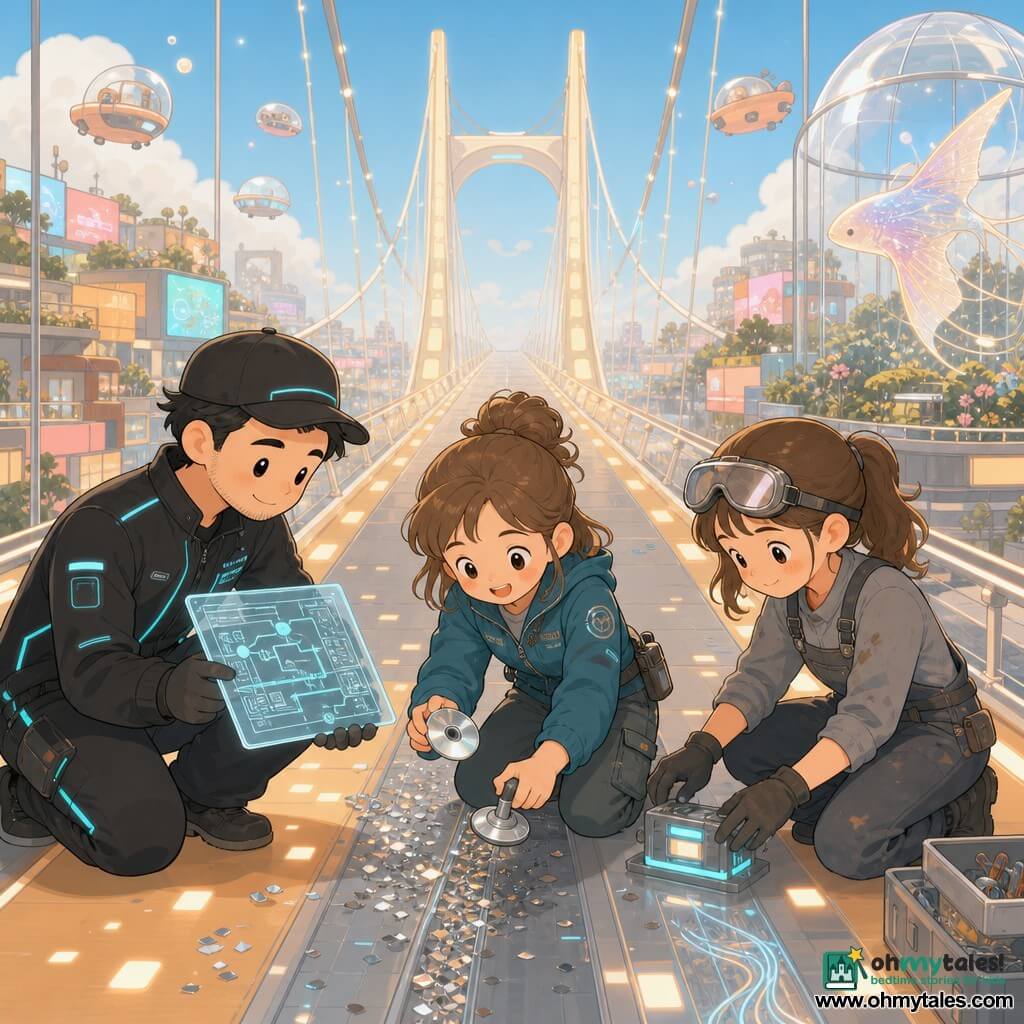
Chapter 1: Roof-Shuttle Morning
In Skyharbor City, the mornings didn't arrive quietly. They slid in on ribbons of light.
Twelve-year-old Mina Quill stood on the roof of Block 77 with her hair tied up in a messy knot and her backpack hanging off one shoulder. Around her, rooftop gardens rustled in the breeze—tiny lemon trees in smart pots, basil that smelled like summer, and a row of solar tiles so clean they looked like black mirrors.
Above the street far below, roof shuttles moved like patient beetles. They hovered from building to building, following painted air-lanes and humming softly. Their sides were clear, like bubbles, so you could see people inside sipping cocoa, reading, or dozing with their heads on the glass.
Mina didn't like to doze. Mina liked to build.
She had a pocket full of small parts: a coil of copper filament, two thumbnail-sized magnets, and a little disk that used to be a sensor from her old school project. The disk was warm from being in her palm.
“Okay,” she whispered to it, as if it could hear. “Today, you're going to help me.”
Her idea was simple, and Mina loved simple ideas. She wanted to make a “friendly finder”—a tiny device that could beep softly whenever someone nearby looked lost. Not a loud alarm. Just a gentle nudge, like a tap on the shoulder. Skyharbor was bright and clever, but it was also big. Big enough to swallow visitors.
She stepped into the nearest shuttle. The door irised open with a polite sigh.
“Destination?” asked the shuttle in a voice that sounded like a calm librarian.
“Sunspan Bridge,” Mina said. “And… can you play ‘Upbeat Morning'?”
A cheerful melody filled the bubble. The shuttle lifted, smooth as a thought, and Mina watched the city unfold.
Skyharbor's towers were pale and glossy, with balconies that looked like stacked petals. Between them hung luminous bridges—wide footpaths suspended in air, made of light woven into solid shapes. Some bridges shimmered gold. Others glowed sea-green. Mina had heard they could change color to guide crowds, like friendly rivers in the sky.
She pressed her nose to the glass. Sunspan Bridge was her favorite: a long arc between two neighborhoods, where the light was warm, like honey.
Today, though, something looked… wrong.
Halfway along the bridge, the glow flickered. A soft stutter of light, like a lantern in a breeze.
Mina's stomach tightened. In Skyharbor, light bridges weren't just pretty. They were pathways. They were safety.
“Hey,” Mina said to the shuttle, “is Sunspan Bridge okay?”
“Minor irregularity detected,” the shuttle replied. “Maintenance scheduled. Please remain calm.”
Mina stared at the flicker again. “Minor irregularities don't look like that,” she muttered.
And then she saw it: a single bright panel along the bridge dimmed to a dull gray, like a missing tooth.
Mina's fingers closed around the little sensor disk in her pocket. Her friendly finder could wait.
Today, the city might need something else.
Chapter 2: The Dim Patch
The shuttle docked with a click against a roof platform near Sunspan Bridge. Mina hopped out, her sneakers tapping on the rooftop's textured surface. The air smelled faintly of ozone and warm metal, the smell of machines that had been working all night.
She walked toward the bridge entrance. A soft sign hovered in midair: SUNSPAN BRIDGE — WALKWAY ACTIVE. Under it, a smaller line of text blinked: PLEASE USE CAUTION.
Mina did.
The bridge felt strange under her feet—not quite like concrete, not quite like glass. It had a springy firmness, as if the light itself had decided to hold hands and become solid. Below, the streets were tiny, a moving carpet of delivery bots and slow buses.
A few people crossed, but they did it quickly, eyes forward. No one stopped to admire the view.
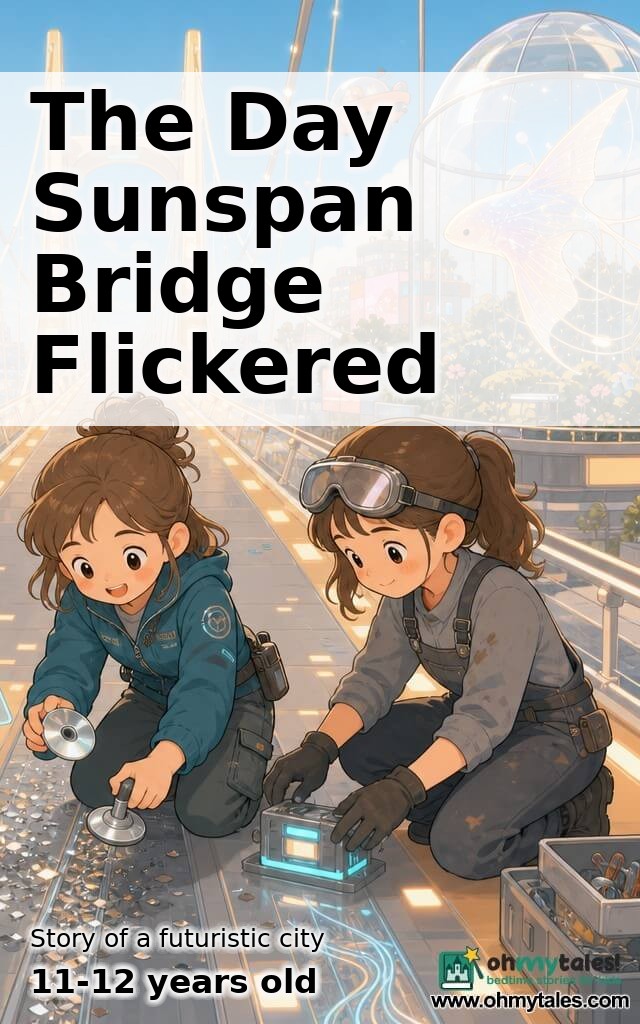
Mina stopped anyway. She crouched near the dim patch. Up close, the difference was obvious: most of the bridge glowed steady and warm, but this section pulsed like a tired heartbeat.
She took out her sensor disk and held it near the surface. The disk blinked blue, then a worrying orange.
“Heat fluctuation,” Mina murmured. “Or power drift. Or—”
“Or a connector that's sulking,” said a voice behind her.
Mina turned fast. A technician stood there, leaning on a tool case. The technician wore a jacket threaded with thin luminous lines—bridge-tech uniforms, Mina guessed. Their hair was tucked under a cap, and their smile was easy, as if flickering bridges were just another kind of weather.
They held out a hand. “I'm Sol. Luminous Bridge Technician. And you're… a brave kid with a sensor disk.”
Mina shook their hand. “Mina. I'm not brave. I'm… curious.”
Sol's eyes crinkled. “Curious is how brave starts.”
Mina looked back at the dim patch. “Is it dangerous?”
Sol tapped the surface lightly with a knuckle. The patch answered with a faint, unhappy flicker. “Not dangerous yet. But it's getting dramatic. The bridge panels share load and power. If one panel keeps throwing a tantrum, the others have to work harder.”
Mina's face tightened. “Can you fix it?”
“I can,” Sol said, “but it's like fixing a poem you can't quite read. The bridges are woven light—millions of tiny emitters talking to each other. When one gets confused, it can make the rest nervous.”
Mina lifted her disk again. “My sensor says it's warm.”
Sol whistled softly. “Nice tool. Did you make that?”
“It used to be a school project,” Mina said. “I'm turning it into a friendly finder.”
“A friendly finder,” Sol repeated, amused. “That sounds very Skyharbor.”
Mina felt her cheeks warm. “I just… people get lost. I thought a gentle beep could help.”
Sol nodded. “And a gentle fix could help a bridge. Tell you what, Mina. I could use an extra pair of sharp eyes. Want to see how a light bridge really works?”
Mina's heart did a small jump. “Yes. Definitely. But—shouldn't I be in school?”
Sol glanced at Mina's wristband. It flashed the day's schedule: CREATIVE LAB — FLEXIBLE HOURS.
Sol laughed. “Ah. Flexible hours. The best invention after hot chocolate.”
Mina grinned. “Okay. What do we do?”
Sol opened the tool case. Inside were sleek instruments, coils of fiber, and a handful of tiny cubes that glowed faintly.
“We start,” Sol said, “by listening to the bridge.”
Chapter 3: Listening to Light
Sol placed one glowing cube on the bridge near the dim patch. It clung there as if magnetized, then unfolded into a thin ring.
“Bridge stethoscope,” Sol said. “It hears the chatter between emitters.”
Mina leaned closer. At first she heard nothing. Then, faintly, a pattern: soft clicks and chirps, like distant insects. Most of them were steady, rhythmic.
But near the dim panel, the rhythm stumbled.
“Sounds like it's tripping over its own shoelaces,” Mina said.
Sol pointed at Mina. “Exactly. Now, bridges don't trip for fun. Something's making that panel misread the flow.”
Sol offered Mina a small pair of lens-glasses. “Put these on.”
Mina did. The city sharpened, but not in the normal way. She could see threads of light beneath the bridge surface, like veins under skin. The healthy sections were thick with bright streams. The dim patch had a thin spot, like a river that had lost its water.
“Whoa,” Mina breathed. “It's beautiful.”
“Beautiful and stubborn,” Sol replied. “See that thin stream? That's a power filament. Might be cracked. Or misaligned.”
Mina took a careful step closer and noticed something stuck along the edge of the panel: a strip of metallic confetti, tangled and shimmering.
She poked it with a fingertip. It was light, almost weightless.
“That shouldn't be there,” Mina said.
Sol's brows lifted. “Good catch. Festival leftovers?”
Mina remembered. Last night had been the Skyharbor Kite Parade. People flew bright, self-lit kites between rooftops, and confetti drones sprinkled sparkles like tiny shooting stars.
“Probably,” Mina said. “But how can confetti mess up a bridge?”
Sol's mouth twisted thoughtfully. “If it's metallic, it can mess with the panel's field alignment. Like putting a spoon near a compass.”
Mina's eyes widened. “So it's not broken. It's distracted.”
Sol snapped their fingers. “You're learning the language. All right, we remove it. Carefully.”
Sol handed Mina a small wand with a soft suction tip. “Gently. Like you're picking up a sleeping cat.”
Mina tried not to laugh. “I've never picked up a sleeping cat.”
“Then pretend the confetti is… a stack of cupcakes.”
“I can do cupcakes,” Mina said solemnly.
She hovered the wand over the confetti. It lifted in a slow swirl, sticking to the suction tip like glittery seaweed. The moment it rose, the panel's flicker eased. The grayness faded slightly.
Mina held her breath. The bridge's hum steadied. The ring-stethoscope clicked in a smoother rhythm.
Sol exhaled. “Nice. But we're not done. That confetti might have caused a miscalibration. We need to re-sync the panel with the rest.”
Mina glanced along the bridge. People were starting to slow down, noticing that the dim patch wasn't as dim. A little boy tugged his parent's sleeve and pointed.
“Can I help with the re-sync?” Mina asked quickly, before Sol could say no.
Sol studied Mina for a moment, then nodded. “Yes. Because you're careful. And because you asked.”
They pulled out a flat tablet with a holographic map of the bridge. Tiny dots pulsed across it—emitters, thousands of them.
“We send a gentle wave,” Sol said. “Like telling the panel, ‘Hey, everyone else is dancing this way. Join in.'”
Mina watched Sol's fingers move, swift and confident. The dim panel glowed, hesitated, then matched the honey-warm color around it.
For a second, Mina felt a silly urge to clap.
Then the bridge shivered.
Not a dangerous shake—more like a startled twitch.
The ring-stethoscope beeped sharply.
Sol's face changed. “That's… not right.”
Mina's throat went tight. “What?”
Sol stared at the tablet. “The panel re-synced, but something else is pulling power. Like a hidden drain. Something is sipping light where it shouldn't.”
Mina swallowed. “Where would it go?”
Sol's gaze slid upward, toward the web of rooftop lanes and shimmering signs.
“Up,” Sol said softly. “Into the roof-shuttle network.”
Chapter 4: The Rooftop Lanes
Sol and Mina rode a service shuttle—smaller than the regular bubbles, with a tool rack and a smell of clean plastic. It zipped above the bridge and between towers, following a maintenance lane marked by floating blue arrows.
Through the window, Mina saw the roof-shuttle city from a new angle. Every rooftop was a little world: cafés under glass domes, sports courts with anti-gravity nets, quiet parks where people read under shade-lamps. Between roofs, shuttles drifted in neat lines like migrating birds.
Sol held the tablet in their lap. A thin line pulsed on the map, tracing the power drain like a glowing breadcrumb trail.
“Someone's plugging into the bridge system,” Mina said, trying to keep her voice steady. “Like stealing electricity?”
Sol shook their head. “Not exactly stealing. More like… borrowing without asking. The bridge has safeguards. But if the drain is small and smart, it can hide inside normal use.”
Mina thought of her friendly finder. “Maybe it's a device that doesn't know it's causing trouble.”
Sol glanced at her. “That's a kind thought.”
Mina shrugged. “Most problems aren't evil. They're messy.”
Sol laughed quietly. “You'd be surprised how many technicians forget that.”
The shuttle slowed near a tall building topped with a ring of bright billboards. One billboard showed a cartoon comet advertising fizzy juice. Another showed an upcoming virtual concert. Beneath them, a narrow rooftop garden wrapped around a structure that looked like a greenhouse made of silver ribs.
The tablet pinged.
Sol pointed. “There. The drain ends on that roof.”
They stepped out onto the platform. The air was warmer here, stirred by the building's thermal vents. Mina heard a faint buzzing, like a swarm of tiny fans.
They followed the sound to the greenhouse structure. Inside, something glowed.
Mina peered through the silver ribs. “Is that… a kite?”
It was a kite, but not like the parade ones. This one was shaped like a manta ray, wide and elegant, with a skin of thin light-film. It was tethered to a compact device on the floor—an engine no bigger than a lunchbox. Wires ran from the engine into a port on the building's roof panel.
The kite pulsed gently, drinking in energy, then releasing it in soft waves. It was mesmerizing. Mina felt her anger evaporate into curiosity.
Sol crouched, examining the port. “It's connected to the roof grid. And the roof grid is linked to the bridge system. Not directly, but through the city's balancing network.”
Mina frowned. “So this kite is pulling power from the bridge without meaning to?”
“Possibly,” Sol said. “But who built a kite that needs that much power?”
A voice spoke from behind them, thin and startled. “I did.”
Mina spun around.
A girl stood there, about Mina's age, wearing oversized goggles pushed up on her forehead. Her hands were smudged with something dark—graphite or grease. She clutched a small remote like it was a fragile secret.
Her eyes darted between Sol and Mina.
“I'm not stealing,” the girl blurted. “I'm testing. It's just a prototype. It's supposed to—well—it's supposed to help.”
Sol rose slowly, keeping their hands visible. Their voice stayed calm. “What's your name?”
“Rin,” the girl said. “Rin Halley.”
Mina couldn't help it. “Like the comet?”
Rin's mouth twitched. “My dad likes space.”
Sol nodded. “Rin, your prototype is beautiful. But it's draining power from Sunspan Bridge. People use that bridge.”
Rin's face went pale. “No. I— I didn't connect to the bridge. I connected to the roof grid because my battery packs kept overheating. I thought the grid could handle it.”
Mina stepped closer. “What does the kite do?”
Rin hesitated, then lifted her chin. “It's a signal sail. If someone is lost in the roof lanes, it can glow patterns that guide them home. Like a lighthouse, but for shuttles and people.”
Mina felt a spark inside her, bright as the bridge. “That's… that's like my friendly finder. But bigger.”
Rin stared at Mina. “You made something?”
Mina showed her the sensor disk. “I'm trying to. A gentle beep for lost people.”
Rin's shoulders loosened a little. “Mine is a gentle glow.”
Sol looked between them, and Mina could almost see Sol deciding not to scold.
“Okay,” Sol said. “Then we're all on the same team. We just need to stop your gentle glow from making the bridge faint.”
Rin chewed her lip. “Can you… can you help me fix it? Please? I don't want to ruin anything.”
Mina nodded before Sol could answer. “Yes.”
Sol's smile returned, small but real. “Yes. But we do it properly. With permission from the grid, not by sneaking a straw into someone else's drink.”
Rin blinked. “That's a weird comparison.”
Sol shrugged. “I'm hungry.”
Even Rin laughed at that, a quick burst like a spark catching.
Chapter 5: A Simple Fix
They sat on the greenhouse floor around Rin's engine box. Sol opened their tool case. Mina laid out her parts like a tiny treasure pile.
Rin explained fast, words tumbling out. “The sail reads roof-lane traffic and projects arrows and colors. It uses a lot of power only when it's bright outside, because the light has to compete with the sun lamps and all the ads. I tried to be efficient, but—”
Sol held up a hand. “Breathe. Start with what the engine needs: stable input, clean output.”
Mina watched Sol connect a diagnostic cable. A hologram rose above the engine: waveforms, numbers, a blinking warning icon that looked like an angry little triangle.
“Your intake is spiking,” Sol said. “When you ask for a bright pattern, it gulps energy in sudden bites. The grid feels it and tries to balance. The bridge, nearby and already sensitive, takes the hit.”
Rin's shoulders slumped. “So I made a power-hungry monster.”
Mina shook her head. “You made a lighthouse that eats too fast.”
Rin snorted. “That's not better.”
“It is,” Mina insisted. “Because lighthouses are good.”
Sol nodded toward Mina's pocket. “Mina, that sensor disk—does it have a smoothing capacitor?”
Mina blinked. “It has a micro-buffer. I salvaged it from a drone.”
Sol's eyes lit. “Perfect. Rin needs a buffer. Something that stores a bit of energy and releases it evenly, so the grid doesn't get yanked around.”
Mina pulled out the disk. “But it's tiny.”
Sol tapped the engine box. “Tiny can be clever. If we pair it with Rin's existing cells, it can manage the gulping. Like taking smaller sips.”
Rin's face brightened, cautious hope dawning. “You'd… you'd put your part in my project?”
Mina hesitated for half a second. She'd been proud of her friendly finder. But she remembered the bridge flickering, the people hurrying across, the way the city depended on little things working together.
“I can make another,” Mina said. “Also… our projects are kind of cousins.”
Rin looked at her, eyes shiny behind the smudges. “No one's ever called my projects cousins.”
Sol cleared their throat, pretending not to notice the moment getting mushy. “All right. Let's do some cousin engineering.”
They worked with steady hands. Sol guided them, but Mina and Rin did the connecting. Mina held wires while Rin soldered with a small heat pen that smelled faintly like toasted plastic. Rin adjusted a dial; Mina watched the waveform smooth out.
“Look!” Mina said as the angry triangle softened into a calm green circle. “The spikes are gone.”
Rin leaned in close. “It's… stable.”
Sol checked the tablet linked to the bridge network. The drain line faded until it was barely a whisper.
“Sunspan Bridge should stop flickering,” Sol said.
Rin let out a long breath. “I'm so sorry.”
Mina nudged Rin's shoulder lightly. “You didn't mean harm. You meant help. You just needed… a smaller sip.”
Sol snapped the tool case shut. “Now we do the important part: we ask permission. We'll register your sail with the grid, so it gets a proper power budget.”
Rin's eyes widened. “You can do that?”
“I can,” Sol said, “and you can too, with an adult co-signer. City systems like to know who's doing what. Not to punish—just to keep everyone safe.”
Mina raised her hand, joking. “I vote Sol as co-signer of everything.”
Sol laughed. “Denied.”
Rin's kite-sail glowed softly, no longer frantic. It sent a gentle blue arrow along the greenhouse wall, pointing toward the door like it was saying: This way, friends.
Mina's chest warmed. “It's kind,” she said.
Rin nodded. “So is yours. The beep thing.”
Mina grinned. “It's not finished.”
Rin pushed her goggles up properly. “Then we can finish it together.”
Sol pretended to yawn. “Uh-oh. Two creative preteens planning. The city may not survive.”
Mina and Rin said at the same time, “Yes it will.”
And for the first time since Mina saw the bridge flicker, she believed it completely.
Chapter 6: The Friendly Meeting
By late afternoon, Sunspan Bridge glowed like a perfect stripe of sunlight between towers. Mina stood near the entrance again, this time with Sol on one side and Rin on the other.
The city felt different when a problem had been solved. Not quieter—Skyharbor was never quiet—but smoother, as if the air itself had unclenched.
Sol checked the bridge stethoscope one last time. The clicks and chirps were steady, almost musical.
“All right,” Sol said. “Bridge is happy. Grid is happy. And,” they added, looking at Rin, “your sail is registered. Officially. No more sneaking straws.”
Rin smiled sheepishly. “No more.”
Mina pulled out her sensor disk—now missing its micro-buffer—and sighed dramatically. “My friendly finder is back to being… a not-so-friendly finder.”
Rin dug into her pocket and produced a small component, square and silver. “I have something. It's a spare buffer tile from my kit. Not as good as yours, but it might help.”
Mina stared. “You'd give me that?”
Rin shrugged, trying to act casual. “Cousins, right?”
Mina took it carefully, as if it might fly away. “Cousins.”
They sat on a bench made of recycled composite, watching shuttles glide by overhead. A group of kids in bright jackets raced across the bridge, laughing as the light beneath their feet shifted colors in gentle ripples. The bridge seemed to enjoy the attention.
Sol leaned back. “You know,” they said, “most days I fix things that people never notice. That's the job. But it's nice when the city shows its gears a little, and someone like you two actually looks.”
Mina blinked at the skyline. “Skyharbor is like a giant invention,” she said. “It's just… most people only use it. They don't wonder how it works.”
Rin swung her legs. “I wonder. A lot.”
Mina glanced at her. “Me too.”
Sol stood. “Then here's an idea. There's a small community workshop near the bridge—open tables, shared tools, snacks that aren't terrible. You two should meet there once a week. Build your friendly finder and your signal sail. Make them talk to each other.”
Rin's eyes lit up. “Like—if someone gets lost, Mina's device beeps, and my sail shows a pattern?”
Mina's grin grew wide. “A beep and a glow. Gentle teamwork.”
Sol nodded. “And if you ever need help, you know where the bridge tech office is. We're the people with the luminous jackets and the permanent smell of warm metal.”
Rin laughed. “That's… weirdly comforting.”
They walked to the workshop together, the three of them merging into the flow of the city. Above, the sky-lamps brightened as evening approached, turning the towers rosy and gold. The bridges lit one by one, like a constellation being drawn across Skyharbor.
At the workshop entrance, Mina paused. She looked back at Sunspan Bridge, steady and shining, and felt something settle inside her—not pride exactly, but a softer feeling. A sense that being creative wasn't just making cool things.
It was noticing. It was caring. It was asking, “Are you okay?”—even to a bridge made of light.
Rin nudged her. “Coming?”
Mina nodded. “Yeah.”
Inside, a long table waited, covered in simple tools and tidy bins of parts. Sol brought three cups of cocoa from the snack machine—one for each of them.
They clinked the cups gently like a promise.
“To friendly inventions,” Mina said.
“To gentle glows,” Rin added.
Sol smiled. “To a city that shines brighter when people are kind.”
And in Skyharbor City, where bridges were made of light and rooftops were highways, three friends sat down to build something that would help others find their way—one small, steady sip at a time.