Chapter 1: The Dust That Wouldn't Behave
Light-Halls City always looked clean from far away. Its towers were smooth as river stones, and the skyways between them shone like ribbons. At night the streets glowed softly—panels in the pavement storing sunlight and giving it back, step by step, like the city was breathing.
But lately, the light had seemed blurred.
Milo noticed it first on his walk to school. He was eleven, small for his age but quick, with a habit of looking up when everyone else looked down. The morning air used to smell like rain on warm metal. Now it smelled dry, like chalk.
He stopped beside a street-lamp that was really a thin pillar of glass. Inside it, tiny lights drifted up and down, as if swimming. Today, the lights looked fuzzy, as if someone had smeared them with a thumb.
“Maybe it's just your sleepy eyes,” said Yara, jogging up beside him.
Yara was eleven too, with braids tied back in a way that made her look ready for anything. She carried a little toolkit in her backpack because she liked to fix things people had given up on.
Milo rubbed his nose. “It's in the air.”
Yara squinted. In the beam of the lamp, something pale swirled. It wasn't fog. It didn't curl and vanish like mist. It hung there, stubborn, as if it didn't know when to stop.
“Dust,” Yara said, frowning. “But… why so much?”
A delivery drone zipped overhead, its belly full of sealed crates stamped with a bright blue mark: IMPORTED MATERIALS. The drone's fans pushed air downward, and the dust below spun into a little storm.
Milo coughed. “It won't settle.”
At the corner, two more kids were waiting under the awning of a café that served foamed cocoa and steamed fruit buns. Lina stood with her hands in her pockets, watching everything like she was taking notes in her head. Jax sat on the bench with his feet on the rail, swinging them like a pendulum.
“We've got Dust Day again,” Jax called. “If we get enough, we can build a desert.”
Lina didn't laugh, but her eyes flicked to the air filter box mounted on the wall. It was the size of a bread loaf, with a vent that usually hummed steadily. Now it was whining, a high thin sound like a mosquito stuck in a jar.
“It's struggling,” Lina said. “I heard the school's indoor air alarms went off yesterday.”
Yara tapped the filter box with her knuckles. “Filters can clog. But the city's supposed to handle that.”
Milo looked along the street. People wore light scarves or clear face-shields. A sanitation bot rolled by, spraying a fine mist that made the dust clump into gray beads—only for new dust to drift in and replace it.
“Where's it coming from?” Milo asked.
Lina pointed up toward the freight lanes, where drones and cargo gliders slid between the towers. “Imports. My aunt works at the Sorting Spine. She said they started bringing in powdered stone for building repairs. Cheaper, but it leaks.”
Jax hopped down from the bench. “So we just tell someone important, and they stop.”
Yara's mouth tightened. “We told. My mom filed a report. So did half our building.”
Milo imagined the reports traveling into a bright, clean office somewhere, landing in a neat digital pile, and then being covered—slowly, politely—by more reports.
The school bell chimed through the street speakers, warm and musical. They started walking, the four of them falling into their usual formation: Lina steady at the front, Yara beside her, Jax bouncing around like a loose spring, Milo drifting a little behind, looking up at the hazy light between the towers.
“Maybe we can fix it ourselves,” Yara said suddenly.
Jax blinked. “Like… with a broom?”
Yara grinned, but it was a determined grin. “Like with a plan.”
Milo watched a strip of sunlight slide down a glass wall and fade into gray. The city felt like it was holding its breath.
He didn't like that feeling at all.
Chapter 2: The Engineer With Green Stains
After school, the four friends didn't go straight home. They took the long way through Corridor Nine, where the buildings leaned closer and the streets were lined with shops that sold old-fashioned things: paper notebooks, mechanical toys, jars of real honey.
At the end of Corridor Nine was a door most people ignored. It was set into the base of a tower and marked with a simple sign:
NEIGHBORHOOD MAINTENANCE — DROP-IN HOURS
The door sighed open when Yara pressed the button. Inside, the air smelled different—damp and earthy, like a garden after watering.
A woman stood at a workbench, tightening a bolt on something that looked like a small windmill. Her hair was tied in a knot, and there were green stains on her sleeves.
She glanced up. “You're not here to steal my wrench again, are you?”
Jax put a hand to his chest in dramatic shock. “Ms. Sato, I would never.”
Ms. Sato's eyes softened. She was the community engineer for their block, which meant she kept the little systems running: water recyclers, elevator rails, air scrubbers, and the light-panels in the sidewalks. When something broke, she fixed it. When something was missing, she found another way.
Yara stepped forward. “We came about the dust.”
Ms. Sato set down her tool. “Ah.”
Lina said, “The wall filters are struggling. People are coughing. The lights look dim.”
Milo added, “It won't settle. It just… floats.”
Ms. Sato wiped her hands on a cloth. “Imported construction dust. It's fine enough to slip through gaps. The city's main scrubbers can handle some, but not this much, and not this constant.”
Jax folded his arms. “So why don't they stop importing it?”
Ms. Sato made a face that looked like she'd bitten into a lemon. “Contracts. Deadlines. Big decisions made high up, far away from the people who breathe the air.”
Yara leaned in. “Can we do anything? Something local?”
Ms. Sato's gaze slid to a shelf where a row of clear tubes stood upright, each holding a plant. Not a normal plant with leaves and stems. These had fronds like soft feathers, pale green with tiny silver threads running through them. They seemed to shimmer even in the dim workshop light.
Milo stepped closer. “What are those?”
“Aerophylla,” Ms. Sato said. She sounded proud, and also cautious, like she was introducing a pet dragon. “Air-eater plants. They were designed for stations and tunnels. Their fronds catch fine particles, and the silver threads break them down into harmless bits.”
Jax's eyebrows went up. “So they eat dust.”
“Not with teeth,” Lina said, but she sounded interested.
Ms. Sato smiled. “No teeth. Just clever biology.”
Yara's eyes shone. “Could we grow them? Put them in our building? Along the walkways?”
“We could,” Ms. Sato said slowly. “But they need care. They don't like dry air. And they need their fronds cleaned, or they get overloaded.”
Milo looked at the little plants, swaying gently in their tubes. He imagined them lining the streets like quiet guardians, catching dust the way nets catch fish.
Lina asked, “Why aren't they already everywhere?”
“Because they're not fashionable,” Ms. Sato said. “The city loves big machines. It forgets small living helpers.”
Jax pointed to a stack of flat black frames leaning against the wall. “What are those?”
“Prototype filter frames,” Ms. Sato replied. “For windows and vents. I've been testing materials, but I need more data—different locations, different wind patterns.”
Yara straightened, like a soldier receiving orders. “We can help. We can track where the dust is worst. We can water plants. We can clean fronds.”
Ms. Sato studied the four faces in front of her: eager, worried, stubborn, bright. Then she nodded once.
“All right,” she said. “But we do it safely. No hero stunts. We'll start small—your building, your street. If it works, we'll show the numbers to the council.”
Jax pumped his fist. “Operation: Eat the Dust!”
Milo couldn't help smiling. The air outside was still gray, but in the workshop, the plants glimmered softly, as if they had their own private sunlight.
Ms. Sato handed each of them a slim wrist band with a tiny screen. “Air meters,” she said. “They measure particulates. You'll log readings morning and evening.”
Lina slipped hers on immediately. “Data,” she murmured, satisfied.
Yara accepted hers like it was a key. “When do we start?”
Ms. Sato reached for a tray of Aerophylla seedlings, each in a small capsule of gel. “Now,” she said. “Before the dust decides it owns us.”
Chapter 3: Gardens on the Skywalk
They began with their own apartment block, Tower Seventeen, which rose like a pale column above Corridor Nine. The lobby was bright, with a waterfall wall that recycled water in a thin sheet. Usually it was soothing. Today, dust clung to the wet glass in faint gray freckles.
Ms. Sato met them after dinner with a cart full of supplies: Aerophylla capsules, narrow planter boxes, a coil of drip tubing, and a bundle of soft brushes for cleaning fronds.
“Rule one,” she said as they rode the elevator up, “we don't block exits. Rule two, we don't mess with power lines. Rule three—”
“Don't fall off the skywalk,” Jax said.
“Exactly,” Ms. Sato replied.
The skywalk on the thirty-second floor was a wide bridge between Tower Seventeen and Tower Eighteen. Its sides were clear panels, and you could see the city spread below: layers of light, moving vehicles like beads, rooftop gardens, and far away, the shimmering curve of the river that ran under the city like a dark ribbon.
But the view was muted, as if someone had pulled a thin curtain across it.
Yara knelt by the railing where a narrow maintenance strip ran along the edge. “Perfect,” she said. “Planters here won't be in anyone's way.”
Ms. Sato showed them how to clip the planter boxes to the rail supports. The boxes were slim and deep, designed for roots to grow downward. She connected the drip tubing to a small water tap meant for cleaning the panels.
“We'll set it to a slow pulse,” she explained. “Aerophylla likes steady moisture.”
Milo held a capsule in his palm. It was cool and slightly squishy, like jelly. Inside, a curled sprout waited.
“It looks like a sleeping sea creature,” he said.
Lina checked her wrist meter. “Particulate level: high,” she read. “Higher than yesterday.”
Jax made a face. “The dust is winning.”
“Not if we give it something to lose against,” Yara said.
They pressed the capsules into the planters, spaced evenly. As they worked, the city's wind brushed their faces, bringing with it that chalky smell. Milo could feel tiny grains settle on his eyelashes.
Ms. Sato handed him a soft brush. “Once the fronds open, you'll clean them every three days. Gentle strokes. Think of it like brushing a cat that doesn't like you.”
Jax snorted. “All cats don't like me.”
“That might be a you problem,” Lina said, and for once her voice carried a hint of humor.
They finished the first row of planters. Then Ms. Sato added two flat filter frames to the skywalk's vent grilles.
“These are prototypes,” she said. “One is fiber-mesh, one is electrofilm. We'll compare.”
Lina's eyes brightened. “A controlled experiment.”
Yara looked out at the city. “Do you think it'll make a difference?”
Ms. Sato rested her hand on the railing. “Small things add up,” she said. “A city is just a lot of small systems agreeing to cooperate.”
That night, when Milo went home, he stood at his window. He could see the skywalk from his room, a thin line between towers. The planters were dark shapes now, but the streetlights below shone up, making the capsules look like faint green pearls.
He imagined the seedlings waking, unfurling, reaching into the dusty air like hands.
In the morning, the four friends met before school to take readings.
Yara held her wrist meter up. “Look,” she said.
Milo leaned in. The number was still high, but it had dipped—just a little—compared to the reading from the elevator lobby.
“It's working,” Milo whispered.
Lina nodded. “Not dramatic yet. But measurable.”
Jax spread his arms wide. “You're welcome, city!”
Yara laughed, and the sound felt clean, like running water.
Then Milo saw something else: along the edge of the skywalk, near the far end, a thin seam in the wall paneling that didn't match the rest. A maintenance hatch, maybe. Half-hidden.
He pointed. “What's that?”
Ms. Sato followed his gaze. Her eyes narrowed. “That,” she said slowly, “is not on my map.”
Chapter 4: The Hidden Routes
Ms. Sato didn't open the hatch right away. She made them wait until Saturday, when the skywalk was quieter and the maintenance schedules were less busy.
“Sometimes,” she told them, “a city has old bones. Hidden corridors from earlier designs. Usually they're sealed for safety. Usually.”
Jax bounced on his toes. “We're going treasure hunting.”
“We're going careful,” Ms. Sato corrected, handing him a small headlamp.
They stood at the far end of the skywalk. Up close, the hatch looked like a narrow door disguised as part of the wall. There was no handle, only a small panel with a faded symbol: a circle crossed by three lines.
Lina traced the symbol with her finger. “Transit maintenance mark,” she said. “My dad showed me once.”
Yara tried the panel. It didn't respond.
Ms. Sato pulled out a slim device and pressed it against the seam. It beeped softly. “Magnetic lock,” she murmured. “Old model.”
Milo watched her hands. They moved with confidence, like she was speaking a language made of screws and circuits.
The lock clicked.
The hatch swung inward with a sigh of stale air.
Behind it was a narrow passage, dark and dusty—real dust, thicker and heavier than the floating kind. The walls were ribbed metal, and thin cables ran along the ceiling like vines.
Jax peered in. “It smells like a museum.”
“It smells like nobody's been here in a long time,” Yara said, and her voice sounded both thrilled and nervous.
Ms. Sato stepped in first. “Stay close. If you feel dizzy, we go back.”
Their headlamps made bright circles on the walls. As they walked, Milo noticed little vents set low near the floor, each with a tiny fan behind it. Many of the fans were still.
“Those fans…” he said. “They're off.”
Ms. Sato crouched, shining her light into a vent. “They're clogged,” she said. “And disconnected from the newer system.”
Lina's wrist meter beeped and displayed a spike. “Particulate level: very high.”
“No wonder,” Milo said. “If this corridor connects to air routes—”
“It might be leaking dust into the skywalk area,” Yara finished.
They followed the passage as it curved around the tower's inner structure. Sometimes they passed old access ladders going up into darkness. Sometimes there were small doors with numbers worn away.
Jax stopped beside a panel the size of a closet. “What's in there?”
Ms. Sato read the faint label. “Auxiliary air intake.”
Yara's eyes widened. “An intake? Like… it brings air in?”
“Yes,” Ms. Sato said. She sounded grim now. “And if it's pulling in dusty freight-lane air without proper filtering, it could be feeding the problem.”
Milo felt a chill, even though the corridor was warm. The city he loved—bright, humming, organized—had a hidden throat pulling in dirty air.
Ms. Sato opened the panel. Inside were filter slots, empty. Not just clogged—empty, as if someone had removed them.
Lina leaned closer. “Why would filters be missing?”
Jax swallowed. “Maybe they fell out?”
“Filters don't fall out,” Yara said softly.
Ms. Sato took a long breath. “They might have been taken to use elsewhere, during a shortage. Or forgotten during an upgrade. Or…” She didn't finish.
Milo looked at the bare slots. He imagined air rushing through, carrying powder-fine dust straight into their neighborhood.
“We can replace them,” Yara said, voice firm.
“With what?” Lina asked.
Ms. Sato's eyes flicked to the Aerophylla planters they'd installed on the skywalk. “With a mix,” she said. “Mechanical filters to catch the bulk, and living filters to handle the fine stuff.”
Jax brightened. “So the plants are like backup heroes.”
“They're part of the team,” Milo said.
Ms. Sato nodded. “We'll need materials. And permission. And proof.”
Lina lifted her wrist meter. “We have data.”
Yara pulled out her toolkit. “And we have hands.”
Ms. Sato smiled, tired but real. “All right,” she said. “We'll do this the proper way—fast, careful, documented.”
As they walked back, Milo looked again at the corridor walls. He noticed small scratches, like drag marks near the panel edges.
Someone had been here not long ago.
The dust wasn't only an accident. It was a consequence—of choices, shortcuts, maybe even quiet stealing.
Outside, the skywalk light felt brighter by comparison, even though the air was still hazy. Milo breathed in and tasted dust.
He exhaled slowly.
“We'll clean it,” he said.
Yara bumped his shoulder with hers. “Together,” she replied.
Chapter 5: Filters, Fronds, and a Neighborhood Map
Over the next week, the four friends became very busy in a way that felt almost grown-up.
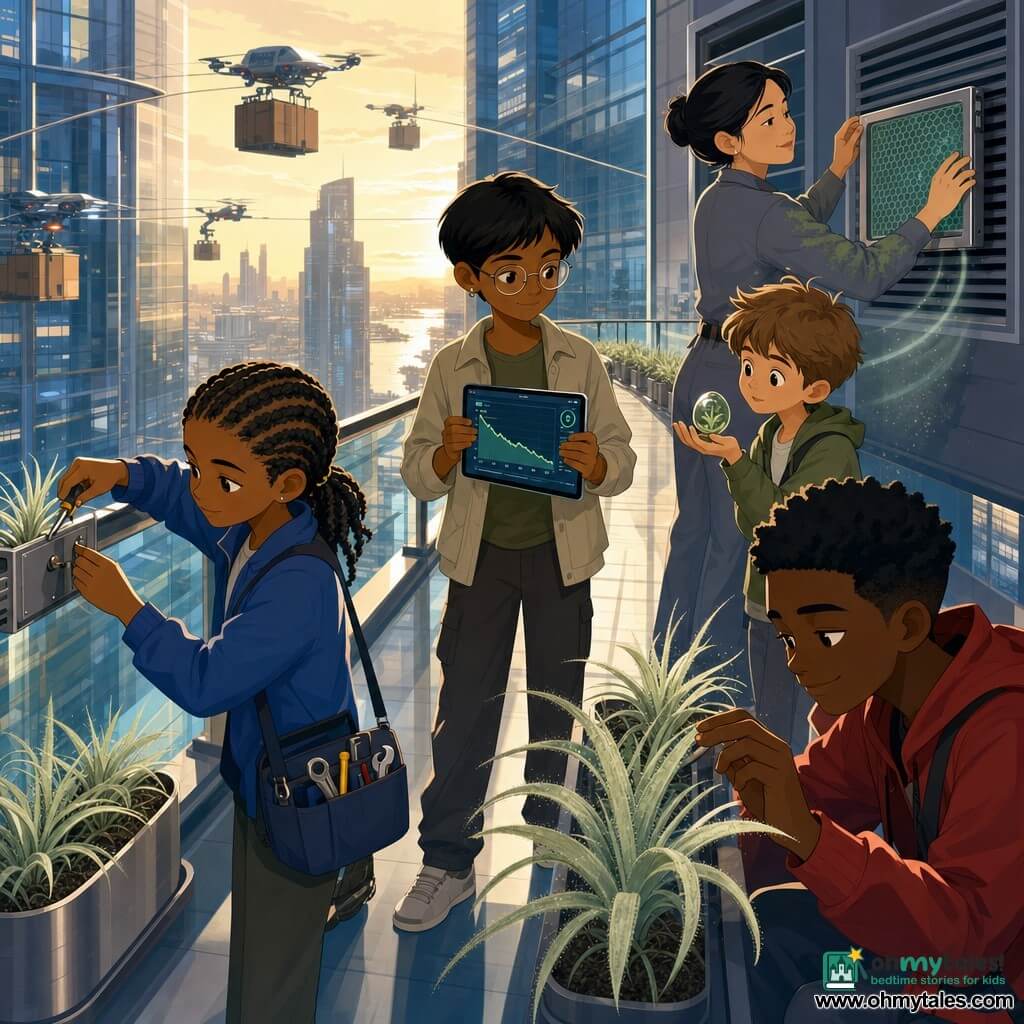
In the mornings, they took air readings in four places: the elevator lobby, the skywalk, the courtyard playground, and the street-level café awning. Lina kept the numbers in a shared log, adding notes about wind direction and delivery traffic.
“It's worst after freight peak,” she reported one afternoon, pointing at a graph on her tablet. “Between five and seven.”
Jax whistled. “So the dust rides in with the cargo.”
Yara and Milo helped Ms. Sato build replacement filters in the workshop. The fiber-mesh frames were layered like a sandwich: a coarse outer net, a dense inner mat, and a thin electrofilm sheet that crackled faintly when powered.
Milo liked the electrofilm best. When he held it, the hair on his arm lifted slightly, as if the sheet was whispering to it.
“Static charge catches fine particles,” Ms. Sato explained. “Like a balloon on a sweater. Only less embarrassing.”
“Speak for yourself,” Jax said. “I look great with balloon hair.”
They carried two finished frames to the skywalk intake panel, the one with the missing filters. Ms. Sato had filed a maintenance request, attached photos, and—thanks to Lina—added a tidy set of data showing the particulate spike near the hidden corridor.
The request came back with a bland message: UNDER REVIEW.
Ms. Sato stared at it until her jaw tightened. Then she printed it, folded it, and tucked it into her pocket like she was saving it for later.
“We're not waiting,” she said.
“Is that… allowed?” Milo asked, heart thumping.
Ms. Sato looked at him. “It's maintenance. The system is unsafe. Neighborhood engineers are authorized to prevent harm.” She paused. “And we're documenting everything.”
Lina nodded, satisfied. “Accountability.”
They installed the frames carefully, sealing the edges with foam strips. When Ms. Sato powered the electrofilm, it made a soft hum, almost like a purr.
Then came the Aerophylla.
The seedlings on the skywalk had unfurled into feathery fans, pale green and lively. When Milo brushed a frond, it bent and sprang back, shedding a tiny puff of gray that the wind carried away.
They added more planters—along the skywalk, by the courtyard benches, even on the ledges of the lobby waterfall wall, where the constant moisture made the plants look especially happy.
Neighbors noticed.
An older man with a cane stopped to peer at the fronds. “Those plants,” he said, “they're eating the air dirt?”
Yara nodded. “That's the idea.”
The man smiled. “Good. I miss seeing the river clearly.”
A woman pushing a stroller asked, “Can we help?”
Ms. Sato handed her a brush. “Yes,” she said. “Gentle strokes. Like you're petting a nervous cat.”
Soon there were more brushes. More hands. A small schedule taped near the lobby: AEROPHYLLA CARE — VOLUNTEERS WELCOME.
Jax made a map on a big sheet of paper, drawing their block like a little kingdom. He marked dust hotspots with gray dots and plant locations with green stars. The more stars they added, the more hopeful the map looked.
One evening, Milo stood with Lina at the skywalk railing. The air was still not perfect, but the lights below looked sharper, less smeared.
Lina checked her meter. “Down twelve percent from last week,” she said.
Milo grinned. “Twelve is a lot.”
“It's not victory,” Lina said, but her voice was softer. “It's progress.”
A freight glider passed overhead, and the air stirred. Milo watched dust try to swirl—and then, near the planters, he saw it snag. Tiny particles clung to the Aerophylla fronds like glitter caught in eyelashes.
The plants held steady, patient as statues.
Milo thought about the empty filter slots in the hidden corridor. He thought about the drag marks.
“Someone took the old filters,” he said quietly.
Lina's eyes narrowed. “Maybe. Or the filters were diverted. Either way, it's a system problem.”
Yara joined them, holding a tablet with Ms. Sato's latest message. “The review is still ‘under review,'” she said. Then she lifted her chin. “So we'll show them more than numbers.”
Jax appeared, breathless. “Guess what! The café owner says we can put planters on her awning. And she'll give free cocoa to anyone who waters.”
Yara laughed. “Bribery with cocoa. Powerful.”
Ms. Sato came out onto the skywalk, her sleeves smudged with green. “Tomorrow,” she said, “we take our report to the District Council in person.”
Milo's stomach flipped. The council offices were high up, bright, and full of adults who spoke in careful sentences.
“What if they don't listen?” he asked.
Ms. Sato looked at the planters, then out at the city. “Then,” she said, “we keep making the air cleaner until they have to notice.”
Chapter 6: The Council and the Breathing City
The District Council building was shaped like a stack of curved glass plates. Inside, the floors were so polished that Milo felt like he was walking on frozen water.
They were allowed in because Ms. Sato had a badge, and because Lina had attached so many files to the maintenance request that the system had, finally, gotten tired of ignoring it.
A council assistant led them to a waiting area with soft chairs and a wall screen showing the city's air quality in cheerful colors. The colors were not cheerful today.
Jax whispered, “Do you think they'll arrest us for… plant crimes?”
Yara whispered back, “If they do, make sure it's on a school day so we get out of math.”
Milo tried to laugh, but his hands were sweaty.
When they were called in, the council room was smaller than Milo expected. No grand throne. Just a table, a few officials, and a window that should have shown a clear view of the river—except the river was smudged.
Ms. Sato placed a folder on the table. “Auxiliary intake filters missing,” she said. “Hidden corridor leaking dust into residential zone. Here are the readings.”
Lina slid forward her graphs, neat and labeled. “Particulate spikes correlate with freight peak,” she added. “Local interventions reduced levels by twelve percent in one week.”
One official, a woman with a silver pin shaped like a sun, leaned forward. “You installed equipment without final approval.”
Ms. Sato met her gaze. “I replaced missing safety components. The system was unsafe.”
The woman looked at the children. “And you four… assisted?”
Yara spoke first. “We measured and logged. We helped build planters and clean them. Our neighbors helped too.”
Milo found his voice. “The Aerophylla works,” he said. “It catches the dust that doesn't settle. And it makes people feel like they can do something.”
Jax added quickly, “Also, cocoa helps.”
For a moment, one of the officials almost smiled.
Another official tapped the table. “These plants—can they scale? Can they handle citywide dust levels?”
Ms. Sato nodded. “With enough water access and volunteer maintenance, yes. And we're not suggesting plants alone. We're suggesting a layered approach: restore mechanical filters, improve seals on import containers, and use Aerophylla in high-traffic corridors.”
The woman with the sun pin studied the graphs again. “Why were the filters missing?”
Ms. Sato's voice was steady. “That's for an investigation. My job is to keep people safe.”
The room went quiet. Milo could hear the faint hum of the building's air system, like a distant ocean.
Finally, the sun-pin woman stood. She walked to the window and stared out at the hazy view. When she turned back, her face had changed. She looked less like a distant decision-maker and more like a person who wanted to breathe easily.
“We'll authorize emergency replacements for auxiliary intakes in this district,” she said. “And we'll fund a pilot program for Aerophylla corridors, starting with your neighborhood.”
Yara exhaled a breath she'd been holding for days.
Lina's shoulders dropped, just slightly, like a book closing.
Jax whispered, “We did it,” as if he couldn't quite believe it.
Ms. Sato didn't smile right away. “Thank you,” she said. “And please—seal standards for imported powdered materials need enforcement. Otherwise we'll be cleaning forever.”
The official nodded. “Agreed.”
Two weeks later, the city felt different.
Not perfect. There were still dusty days when the wind blew wrong and freight gliders passed too low. But the air no longer felt like it was thickening quietly, day by day.
Along the skywalks, green fronds waved in rows, catching sunlight and dust alike. In the hidden corridor, new filters sat snug in their slots, and the old fans whirred again, steady and purposeful.
In Tower Seventeen's lobby, the waterfall wall ran clean, its glass clear. People lingered there again, talking. A little kid tried to touch the Aerophylla fronds, and his older sister gently guided his hand with a brush instead.
Milo stood on the skywalk with his friends and watched the river glint between the towers. The city's light looked sharper, as if someone had polished it.
Yara leaned on the railing. “It's like the city can breathe again.”
Lina checked her meter out of habit, then tucked it away. “Down twenty-eight percent,” she said. “Stable.”
Jax stretched his arms wide. “We are officially certified air heroes.”
Milo laughed. A breeze passed, cooler now, carrying the faint scent of wet leaves from rooftop gardens.
Below them, Light-Halls City shimmered, full of moving parts—machines, people, plants, and bright paths that remembered the sun.
Milo looked at the Aerophylla fronds, dust clinging to them in tiny specks, and felt something settle inside him at last.
Not the dust.
Hope.