Chapter 1: Gardens in the Sky
Kian liked the roofs best, because the roofs were alive.
Up on the tenth terrace of Cliffside City, the air smelled like mint and warm stone. Bees worked the rooftop gardens in lazy spirals, and tiny sprinkler-drones zipped between tomato vines, puffing mist like miniature clouds.
Below him, the city clung to the cliff like a stack of bright, busy shelves. Each terrace was carved straight into the rock, with homes and shops tucked under overhangs, and wide walkways that looked out over the ocean far beneath. Between terraces, airy bridges and glass lifts stitched everything together. People moved like colorful dots along the paths, and delivery pods hummed through the air lanes, blinking green as they passed.
Kian was twelve, small for his age, with a backpack that always seemed a bit too big. Inside it he carried the most important thing he owned: his PatchKit.
Most kids carried games. Kian carried tools.
He walked the Skywalk—one of the higher aerial bridges—toward the Listening Garden, where wind chimes were tuned to different tones and the city's breeze made its own music.
He wasn't in a hurry. Kian never was. He noticed things.
A lady leaned on a railing, frowning at a plant that had drooped like a sad umbrella.
“Is it thirsty?” Kian asked.
The lady blinked. “Oh! I didn't realize I was making my worry face.”
Kian grinned. “I make mine too. My sister says I look like I'm trying to solve a math problem with my eyebrows.”
The lady laughed, and her worry loosened. “The plant's fine. I'm waiting for my brother. He's supposed to meet me, but his wristband says he's… downstairs? That makes no sense.”
Kian's own wristband flickered as he glanced at it. The city map hovered above it, a pale blue model of terraces and bridges. For a second, a section of Terrace Nine blurred, as if the map didn't know what was there.
Kian frowned. Terrace Nine was supposed to be solid. Terrace Nine was where his dad worked, maintaining the cliff bolts and the big water pipes that ran like silver veins through the rock.
He felt a familiar tug in his chest—part curiosity, part concern. The feeling that other people's problems were little hooks, catching on him.
“Maybe his band is confused,” Kian said, though he didn't believe it. “Has it ever done that before?”
“Never,” the lady replied. “And he's not the type to get lost. He's… stubborn as a door.”
Kian looked out over the city. Sunlight bounced off glass roofs and solar sails. Everything seemed bright and safe.
But his wristband map still shimmered oddly around Terrace Nine, like a nervous eyelid.
“I can check,” Kian heard himself say.
The lady's shoulders lifted with hope. “Would you? That would be… kind.”
Kind. That was the word people used when Kian couldn't just walk away.
He adjusted his backpack straps and headed for the nearest lift tube, already feeling the adventure begin like a soft engine starting up inside his ribs.
Chapter 2: The Blinking Terrace
The lift tube was a clear cylinder hugging the cliff face. Kian stepped in, and the floor pad warmed under his shoes. A gentle hum rose, and the city dropped away beneath him as he glided downward.
Terrace Nine was busier than Ten. More shops, more scooters, more people arguing about lunch.
But something was wrong.
The air tasted… flat, like soda gone stale. And the lights along the walkway blinked in uneven bursts, as if they were stuttering.
Kian followed the main path toward the maintenance doors cut into the cliff. A row of wall screens usually showed public news—sports, weather, a looping ad for “GlowNoodles: Shine Through Hunger!”—but now each screen displayed a pale gray swirl, like fog trapped behind glass.
A boy about Kian's age stood beneath one of the screens, poking it with a finger.
“It's broken,” the boy announced to nobody in particular. He wore a school uniform with a patch that read CLIFFSIDE ACADEMY: CURIOUS MINDS. His hair stuck up as if it was trying to escape.
Kian stopped. “All of them?”
The boy nodded. “Yep. Like the whole terrace caught a cold.”
Kian snorted. “Terraces sneeze now?”
“Mine does,” the boy said seriously. “My aunt lives on Terrace Two. It's always sneezing because of the sea air.”
Kian smiled despite himself. “I'm Kian.”
“Lio,” the boy said. “You look like you're on a mission.”
“I kind of am.” Kian glanced at the blurred section on his wristband map. It was worse down here. The blur pulsed, like a heartbeat.
“Cool,” Lio said, instantly interested. “Can I be on it too?”
Kian hesitated. He'd always worked better alone. Less explaining. Less worrying about someone getting hurt.
But he looked at Lio's eager face and thought of the lady upstairs, waiting with her worry face.
“Okay,” Kian said. “But if I say ‘stop,' you stop.”
Lio saluted. “Captain Kian.”
Kian rolled his eyes. “Don't call me that.”
They moved toward the maintenance doors. A sign read: AUTHORIZED STAFF ONLY—PLEASE DO NOT FEED THE ROBOTS. Under it, someone had scribbled: EVEN IF THEY LOOK HUNGRY.
Kian's dad had a key code for these doors. Kian didn't.
But Kian did have a PatchKit.
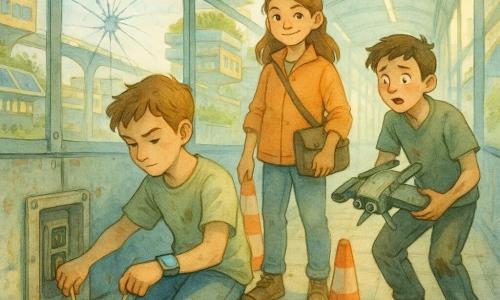
He crouched by the panel and pulled out a thin cable with a magnet tip. His hands were steady. He'd watched his dad fix panels since he was small enough to sit inside a toolbox.
Lio leaned in. “Is that… hacking?”
“It's… persuading,” Kian said. “I'm asking nicely with technology.”
The panel beeped. A tiny light turned from red to amber.
Kian swallowed. He hadn't expected it to work that fast.
The door slid open with a sigh, releasing cooler air from inside the cliff. It smelled of damp stone and metal.
Lio's eyes widened. “Whoa.”
Kian stepped into the service corridor. The wall lights were dimmer here, and the floor vibrated faintly with the city's heartbeat—water pumps, power lines, the steady groan of the cliff supports.
Then Kian heard it.
A sound like whispering, too soft to be words. It seemed to come from ahead, where the corridor bent into darkness.
Lio whispered, “Did you hear—”
“Yeah,” Kian murmured.
Kian's curiosity pushed him forward, but his empathy tugged at him too. If someone was stuck down here, frightened, he couldn't just leave them in the dark.
They walked, footsteps quiet, until the corridor widened into a maintenance bay.
And the whispering turned into something else.
A shiver of shadow, moving across the floor like spilled ink—except ink doesn't crawl toward you.
Chapter 3: The Hungry Shadow
The shadow stopped at the edge of the bay's light, as if it didn't like being seen.
Kian stared. Lio made a noise that was half gasp, half squeak.
“It's… a stain?” Lio whispered.
“It's moving,” Kian said, and his voice came out calmer than he felt.
The maintenance bay was full of pipes and storage crates. A small utility robot sat slumped against the wall, its face screen blank. Usually those robots rolled around cheerfully, sweeping dust and chirping reminders like: PLEASE DO NOT LEAN ON THE EMERGENCY BUTTON.
This one looked drained, like a toy with dead batteries.
Kian stepped closer, slowly, keeping his hands visible, as if the shadow might be an animal that scared easily.
The shadow rippled away from him.
Then it surged toward the utility robot and seemed to… drink the last of its light. The robot's indicator LED, already dim, winked out completely.
Lio grabbed Kian's sleeve. “Okay, I vote we run.”
Kian didn't run. Not yet. He felt a twist of sadness for the powerless robot, as if it were a pet left out in the cold.
“What are you?” Kian whispered to the shadow. “Why are you here?”
Of course it didn't answer. But it reacted.
The shadow swelled, like it had heard him. It pressed against the air, then slid along the floor toward a wall screen showing system diagnostics. The screen's glow flickered and dulled.
“It eats power,” Kian said.
Lio's eyes were huge. “That's… bad.”
Kian nodded. “If it keeps going, Terrace Nine could lose lights, lifts—everything.”
A voice crackled from a speaker in the ceiling. “Maintenance Bay 9-B. Warning: energy fluctuation detected.”
Kian's wristband chimed as a message popped up: SYSTEM ALERT—UNMAPPED ANOMALY.
Unmapped. That explained the blur.
Lio swallowed hard. “My grandma says shadows are just light taking a break.”
Kian almost laughed. “This one's taking everybody else's break too.”
The shadow slid toward them again, and Kian felt cold creep up his shins, like stepping into deep water.
He backed up, scanning the bay for something—anything—that could help. His PatchKit had small tools: tape, clamps, a light coil, emergency foil. Nothing that screamed “defeat mysterious power-eating shadow.”
Then he saw a bundle of folded fabric in a crate marked: SUNSHADE—COMMUNITY NAP ZONE.
Kian blinked. “A nap zone?”
Lio followed his gaze. “Oh! That's for the daycare terrace visits. Little kids nap while grown-ups do tours. Cute.”
Cute wasn't helpful. But SUNSHADE meant one thing: designed to block light.
If the shadow hated being seen… maybe it liked darkness too much. Maybe if you gave it darkness, it would stop hunting for it.
An idea sparked—simple, strange, and worth trying.
“Lio,” Kian said, “help me with that shade cloth.”
Lio stared. “You want to… throw a blanket at it?”
“Kind of,” Kian said. “But not like a hero. Like a person dealing with a wild cat. Gently.”
Lio hesitated, then nodded. “Okay. Captain Kian—”
“Don't,” Kian warned, but he was smiling now, and the fear loosened just enough to let him think.
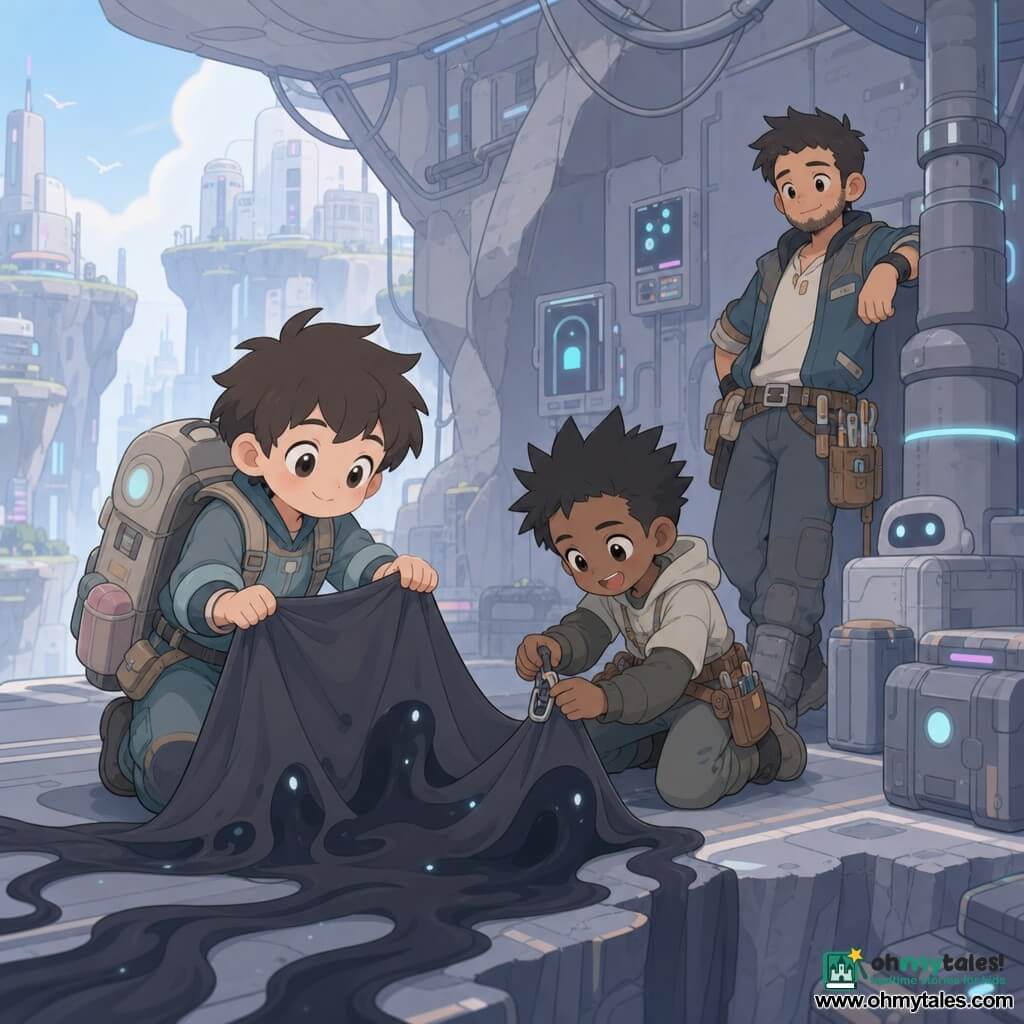
They pulled the fabric free. It was darker than normal cloth, almost velvety, threaded with flexible ribs that could unfold into a canopy. Along the edge were clips meant to attach to walls.
Kian snapped it open halfway. It spread like a wing.
The shadow paused, as if sensing the approaching darkness.
“Easy,” Kian murmured, not sure who he was talking to—the shadow, Lio, or his own pounding heart.
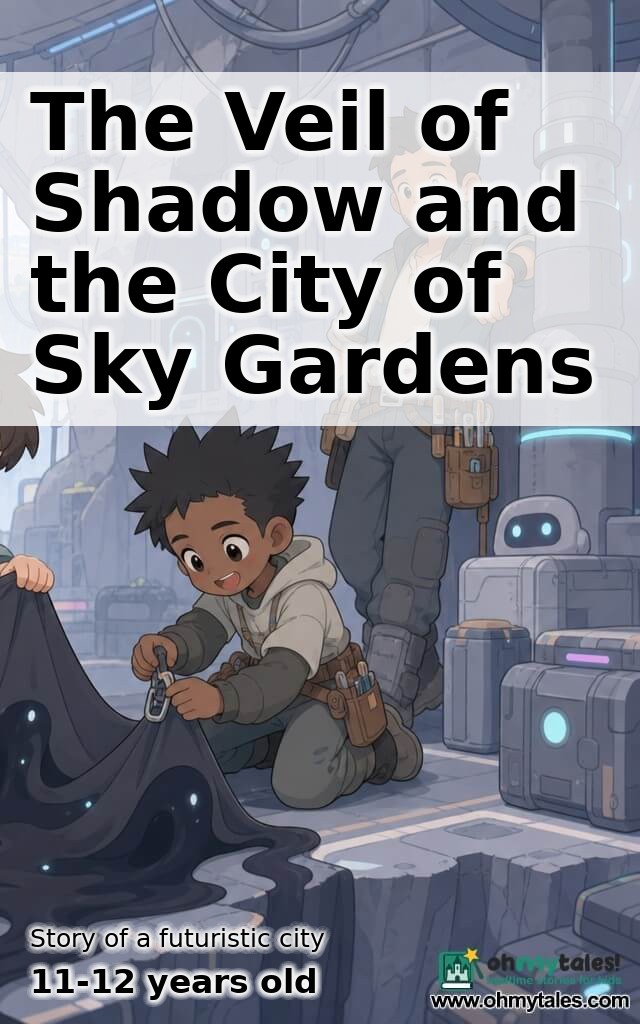
He stepped forward and lowered the shade cloth between the bay lights and the shadow. The cloth drank the light, making a pocket of dimness.
The shadow flowed toward it immediately, slipping under the fabric like water under a door.
“It likes it!” Lio hissed.
Kian's hands shook as he clipped one edge to a pipe, then another. The shade began to form a low tent over the floor, a “veil of shadow” that created a controlled dark space.
The shadow gathered under it, calmer, less frantic. It stopped lunging at screens and robots. The whispering softened into a sighing sound, like wind settling.
Kian exhaled slowly. “It was… hungry.”
“For darkness?” Lio asked.
“For quiet,” Kian said, surprising himself. He thought of the flickering terrace, the jittery screens. The city was bright and loud all the time. Maybe whatever this was had nowhere to rest.
He adjusted the last clip, securing the veil in place.
There. A shade for a shadow.
It would have been funny if it wasn't also terrifying.
A new sound came from deeper in the corridor—footsteps, heavier than theirs, and a human voice.
“Hello?” someone called. “Is anyone in there?”
Kian's empathy tugged again. Someone else was down here.
Someone who might have been chased by the hungry shadow before Kian gave it a place to nap.
Chapter 4: The Lost Engineer
Kian and Lio followed the voice through the corridor, leaving the veil clipped in the maintenance bay like a dark little campsite.
They turned a corner and found a man sitting on the floor, leaning against a pipe. His hair was damp with sweat, and his tool belt lay open beside him. A wristband on his arm blinked weakly.
He looked up, startled. “Kids? What are you doing down here?”
Kian recognized the uniform—city engineering. The man's badge read: ORIN VALE.
“You're the lady's brother,” Kian said. “On Terrace Ten. She's waiting for you.”
Orin's face softened with relief. “Mira sent you?”
“She didn't exactly send me,” Kian admitted. “Her wristband said you were downstairs, and my map was… glitchy.”
Orin tried to stand, then winced and sat again. “I'm fine. Just… stuck. The lift controls down here went weird, and then the lights started blinking. My band wouldn't connect. I thought the cliff was about to—”
He didn't finish the sentence. Nobody liked to say the scary thing out loud: collapse.
Lio crouched beside him. “Did you see a… shadow thing?”
Orin rubbed his face. “Yes. It moved like smoke, but it made the screens die when it touched them. I tried to reroute power, but it kept draining the lines faster than I could patch them.”
Kian nodded, feeling both proud and worried. Proud that his guess was right. Worried because grown-up engineers couldn't fix it with grown-up tools.
“I think we calmed it,” Kian said. “We put up a sunshade. Like a nap tent.”
Orin blinked. “You did what?”
Kian expected laughter. Instead, Orin's expression changed—curiosity, then respect.
“That's…” Orin began, then shook his head. “That's clever. Giving it a place instead of fighting it.”
Kian's cheeks warmed. “It seemed upset.”
Orin studied him. “You notice feelings, don't you? Even when the thing doesn't have a face.”
Kian shrugged. “I just… feel what other people feel. And sometimes what other things might feel.”
Orin smiled faintly. “Empathy. Best tool in the kit.”
Lio pointed at Orin's wristband. “Can you call your sister now?”
Orin tapped it. The screen flickered. “Still weak. The network nodes on this terrace are struggling. But if your shade keeps that… anomaly occupied, I can reach the main junction box and reboot the node.”
Kian tightened his backpack straps. “We'll help.”
Orin's eyebrows rose. “You're kids.”
“We're curious,” Lio said proudly, as if curiosity was a license.
Orin chuckled. “Fair. But stay behind me, and if I say ‘run,' you run.”
Kian nodded, then added, “If I say ‘stop,' you stop.”
Lio saluted again. “Aye, mutual captains.”
They moved carefully back toward the maintenance bay. The corridor lights flickered, but less than before, like the terrace was catching its breath.
Inside the bay, the veil of shadow still hung low, its dark fabric gently rising and falling as the ventilation shifted. Under it, the shadow remained pooled, quiet. The whispering was now a soft, sleepy murmur.
Orin approached the junction box on the wall, a metal cabinet with warning stickers.
One sticker showed a cartoon robot holding a finger to its mouth: SHH—POWER IS THINKING.
Orin opened the box. Inside were cables as neat as braids. He plugged in a small diagnostic tool.
The readings danced.
“Whoa,” Lio whispered. “It really ate a lot.”
Orin's jaw tightened. “If it spreads to other terraces—”
“It won't,” Kian said, surprising himself with the certainty in his voice. He looked at the veil. “It doesn't want to spread. It wants to rest.”
Orin glanced at him, then back to the readings. “Then we'll make a rest place permanent. A controlled darkness chamber. But first—reboot.”
He pressed a recessed button.
For a second, the bay lights went out entirely.
Kian's heart slammed.
In the sudden dark, he felt the shadow stir under the veil, like a creature waking.
Then the lights returned—steady, bright.
The wall screen beside them blinked back to life, displaying: NODE 9 ONLINE.
Orin exhaled. “Yes.”
Kian's wristband map sharpened. The blur around Terrace Nine cleared as if someone had wiped fog off a window.
Outside the bay, the corridor lights steadied too. The terrace above them seemed to hum with relief.
Lio grinned. “We did it!”
Under the veil, the shadow made one last whispery sigh, and then it became very still.
Kian leaned closer, careful not to touch the fabric. “Sleep,” he murmured.
Orin looked at the dark tent thoughtfully. “You know,” he said, “this city is always chasing sunlight. Solar sails, glass roofs, glowing paths. We forget that even machines—and maybe strange things born from machines—might need shade.”
Kian thought of the rooftop gardens again. Plants needed sun, yes. But they also needed cool soil, dampness, nights.
Balance.
They helped Orin up. He was steadier now.
“Let's get you back to your sister,” Kian said.
Orin smiled. “And let's tell the council what two curious kids did with a nap tent.”
Lio's grin widened. “Best mission ever.”
Kian looked once more at the veil, clipped neatly in place. A simple solution, made from noticing, not fighting.
His favorite kind.
Chapter 5: Bridges, Breezes, and Big News
They took a service lift up to Terrace Ten. The lift's glass walls showed the cliff face sliding past, bands of rock lit by embedded safety lights. Far below, the ocean flashed silver.
When the doors opened, Terrace Ten felt brighter than before, as if the city had turned its smile back on. The wind chimes in the Listening Garden sang a clean, cheerful tune.
Mira—Orin's sister—stood near the railing, twisting her hands. The moment she saw Orin, she ran to him and hugged him so hard his tool belt jingled.
“Orin! I thought—” Her voice broke, and she pulled back, scolding him through relief. “You ridiculous door.”
Orin laughed. “Stubborn as ever.”
Mira looked at Kian and Lio. “You found him?”
Kian nodded. “He was stuck because… something was draining power.”
Mira's eyes widened. “A blackout?”
“Almost,” Orin said. “But these two handled it.”
Lio puffed up. “We installed a veil of shadow for the shadow.”
Mira blinked. “I'm sorry, you did what?”
Orin chuckled. “Exactly what it sounds like. Kian noticed the anomaly behaved like it was hungry for darkness. He gave it a controlled place to… nap.”
Mira stared at Kian as if he'd grown an extra head, then shook it, laughing. “Only in Cliffside City.”
Kian felt embarrassed and pleased at the same time, which was a confusing mixture, like eating sweet-and-salty popcorn too fast.
Soon, council drones arrived—small hovering orbs with polite voices.
“PLEASE REMAIN CALM,” one said. “THIS IS A ROUTINE INVESTIGATION. THANK YOU FOR YOUR COOPERATION AND YOUR EXCELLENT HAIRSTYLES.”
Lio touched his spiky hair. “It likes me.”
Engineers followed, including Kian's dad, Jace, with his usual serious face and his usual soft eyes. When he saw Kian, his serious face tried to become stricter, but it didn't quite manage.
“Kian,” his dad said. “Why are you in a restricted corridor report?”
Kian opened his mouth, then shut it. Lio jumped in.
“Because of curiosity and heroism,” Lio declared.
Kian groaned. “Because I wanted to help someone.”
His dad's eyes softened. “That's the truth. But helping should be safe.”
Kian nodded. “I know.”
Orin stepped forward. “He was careful. And he solved the problem in a way none of us thought of.”
Kian's dad looked from Orin to Kian. “What did you do?”
Kian explained, as simply as he could, about the power-eating shadow and the sunshade veil. His dad listened without interrupting, which meant he was taking it seriously.
When Kian finished, his dad let out a slow breath. “A shade cloth,” he repeated, amazed. “You gave the anomaly a boundary.”
Kian nodded. “It stopped attacking the lights.”
His dad put a hand on Kian's shoulder. “That was smart. And kind.”
Kind again. The word warmed Kian more than the sun did.
The engineers went to Terrace Nine to build a proper chamber—safe, shielded, with sensors and backup power. They called it a “Shadow Shelter,” which sounded like a place you'd go during a storm made of night.
Kian and Lio weren't allowed back down during construction, which was fair. They watched from Terrace Ten as drones zipped along the cliff, carrying dark panels and cables.
Life in the city resumed its rhythm: scooters zipping, lifts gliding, rooftop sprinklers hissing. The terrace screens returned to normal, including the GlowNoodles ad, which Lio claimed was “the true sign of civilization.”
That evening, Kian lay on a roof garden bench and stared up at the sky. Air traffic blinked like slow fireflies. Far away, wind turbines turned their long arms patiently.
His wristband chimed. A message from the city council appeared:
THANK YOU FOR YOUR OBSERVATION AND QUICK THINKING. YOU ARE INVITED TO THE COMMEMORATION ON SUNDATE 14.
Kian read it twice.
“A commemoration?” he muttered.
His sister, Aya, leaned over him, chewing an apple. “That means they're going to make a speech,” she said, mouth full. “Try not to look like a math problem with your eyebrows.”
Kian tossed a cushion at her. “I can't help my eyebrows.”
Aya dodged and grinned. “What's it for?”
Kian looked out over the terraces carved into the cliff—homes tucked into stone, gardens blooming on rooftops, bridges floating like ribbons.
“It's for curiosity,” he said softly. “And for shade.”
Chapter 6: The Plaque on the Terrace
SunDate 14 arrived with bright weather and a breeze that smelled of salt and basil.
A small crowd gathered on Terrace Nine, near the entrance to the newly built Shadow Shelter. The shelter's door was a smooth oval of dark metal, set into the cliff wall. Above it, a sign glowed gently: REST ZONE—AUTHORIZED ENTRY ONLY.
Kian stood with his dad, Aya, Mira, Orin, and Lio—who had combed his spiky hair into an even spikier arrangement, as if he'd upgraded it.
“I'm here for moral support,” Lio whispered. “And also applause.”
A council member stepped onto a little platform. She wore a sleek jacket with solar-thread seams that shimmered when she moved.
“Citizens of Cliffside City,” she began, voice amplified but warm. “We live in a place built on daring ideas—terraces carved into stone, gardens planted in the sky, bridges that dance on the wind.”
Kian listened, half nervous, half fascinated. He liked hearing people describe the city as if it were a story.
“Recently,” the council member continued, “we faced an unusual energy anomaly on this terrace. It caused disruption, fear, and confusion. But it was resolved without panic, through observation, curiosity, and a remarkably simple act of care.”
Her gaze found Kian.
Kian felt his ears heat up.
The council member gestured to the shelter. “This chamber will keep the anomaly contained and studied. Our engineers believe it may be a byproduct of old power systems—a kind of wandering ‘darkness appetite' created when certain light-absorbing materials interacted with damaged grid pulses. We will learn from it.”
She paused. “And we will remember how it was first calmed.”
Two workers rolled forward a cloth-covered object mounted on the cliff wall near the shelter door. The council member nodded, and the cloth was pulled away.
A plaque.
It was brushed steel, engraved with crisp letters. Sunlight caught on it, making the words easy to read.
Kian stepped closer, heart thumping.
The plaque read:
IN THE YEAR 2189, A TERRACE FLICKERED AND FEAR GREW.
A BOY NOTICED HUNGER WHERE OTHERS SAW THREAT.
WITH CURIOSITY, KINDNESS, AND A SIMPLE SHADE,
KIAN RAISED A VEIL OF SHADOW—AND BROUGHT BACK THE LIGHT.
BENEATH THESE GARDENS AND BRIDGES,
MAY WE ALWAYS MAKE ROOM FOR REST,
AND MAY QUESTIONS BE BRAVER THAN PANIC.
Kian stared at the words until they blurred—not from a map glitch this time, but from the sudden sting behind his eyes.
Aya elbowed him lightly. “Try not to cry,” she whispered. “It'll make your eyebrows do something dramatic.”
Kian let out a shaky laugh. “Too late.”
Lio leaned in to read the plaque, then whispered, “It doesn't mention me.”
Kian whispered back, “It also doesn't mention your hair.”
Lio considered this. “Fair trade.”
Orin stepped beside Kian. “That plaque isn't just about you,” he said quietly. “It's about how we want to live in this city. Bright, yes. But thoughtful too.”
Kian nodded. He glanced at the shelter door. Inside, somewhere, the shadow rested in its controlled darkness, no longer hunting, no longer frightening.
A problem turned into a lesson. A scare turned into a place.
The council member finished her speech. People applauded. Someone released a string of tiny seed-drones that floated upward and scattered basil and lavender seeds onto nearby roof gardens.
Kian's dad put an arm around him. “Curiosity,” he said, “can be a kind of courage.”
Kian looked up at the terraces rising above them, carved into the cliff like steps toward the sky. He could see rooftop gardens, aerial bridges, bright windows. He could see the Listening Garden wind chimes swinging gently.
He could also see the plaque, steady and real, promising that questions belonged here.
Kian took a deep breath of salty, green-scented air.
Then he smiled, and for once his eyebrows didn't look like a math problem at all. They looked like a kid ready for the next thing the future might whisper out of the walls.