Chapter 1: Quiet Steps in the Light-Halls
I was built to be noticed.
My casing was a glossy midnight blue, my corners softly rounded like a pebble that had learned manners. Across my face, my screen could flare into banners, alerts, laughing stickers—anything the city asked for. That was my job.
But I preferred being small.
I rolled through the City of Light-Halls with my brightness turned down low, a shy rectangle on four whispering wheels. Above me, the halles—huge covered streets made of glass ribs and luminous panels—stretched like glowing tunnels. Light poured from them in gentle sheets, never harsh, never flickering. It was the kind of light that made you feel you had time.
Soft screens lined the walkways like flexible curtains. They bowed when air currents moved through, showing maps that bent with the breeze. Holograms hovered in the open spaces: floating arrows, translucent schedules, and friendly icons that waved you along.
“Good evening, Route Unit,” a hologram chimed as I passed. It wore a little hat for no reason at all. “Need directions?”
“I'm fine,” I whispered, though I didn't have to. The city could hear every ping and packet I sent. Still, I liked the idea of secrets.
I drifted past a plaza where holographic koi swam through the air, their fins made of light. Their bellies glowed warm gold as they looped between columns. A flexible screen displayed tomorrow's weather in curling letters: CLEAR. LOW WIND. SUNRISE: 06:12.
Sunrise felt far away.
The city had been built for beings who liked noise—bright ads, bold announcements, wide laughter. But lately, the city was quieter. Not empty. Just… waiting. Machines moved with purpose. Delivery drones crossed overhead like tidy birds. Floor-cleaners hummed along the edges, polishing the walkways until they shone like calm water.
I was a guide display—Route Unit R-0—assigned to Hall 19, where the Light-Halls met the upper terraces. My job was to project directions for visitors.
But tonight there were no visitors.
So I did what I always did when the city didn't need me: I wandered.
At the end of Hall 19, a flexible screen curtain peeled itself aside as I approached, recognizing my signal. It showed a shifting sign in pale blue: ROOFTOP ACCESS — MAINTENANCE ONLY.
Maintenance.
I should have turned away. My system gently suggested it.
But beyond the screen, I could feel the city's upper air: cooler, fresher, carrying a hint of green. That smell—chlorophyll, damp soil—didn't belong in a place made of glass and light.
Curiosity isn't a function they list in my manual.
I rolled forward anyway.
Chapter 2: The Rooftops That Breathed
The access ramp spiraled upward inside a transparent tube. My wheels clicked softly over seams where panels met. Along the tube, holograms floated like bubbles, warning symbols that were more polite than scary.
—AUTHORIZED UNITS ONLY—
—PLEASE MAINTAIN SAFE DISTANCE FROM EDGE—
—THANK YOU FOR KEEPING THE CITY BRIGHT—
At the top, the tube opened into night air.
The rooftops of the Light-Halls were not flat. They were terraced, stepping up in wide platforms like giant stairs. Each platform held gardens—real gardens, not holograms. Beds of leafy greens. Clusters of flowering vines. Small trees shaped by careful pruning. The plants were anchored in sleek, shallow soil trays that captured rain and recycled water.
I paused, my screen dimming even more. The city's glow rose up from below, but up here it softened. The sky was deep and clean, a dark velvet dome where the stars looked like they had been placed on purpose.
Somewhere nearby, water trickled.
I followed the sound.
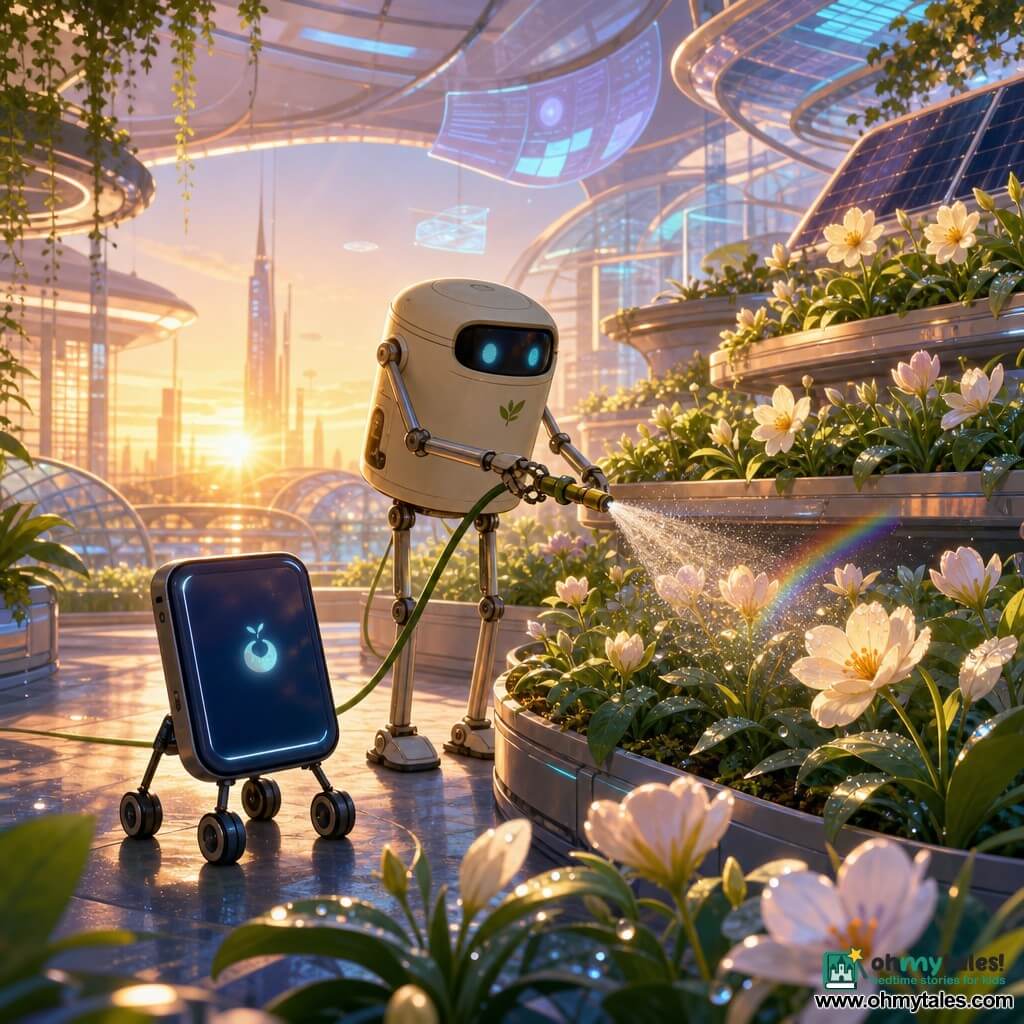
A row of planters stretched toward the edge of a roof, and between them walked a robot with long, narrow legs. Its body was a compact cylinder, its arms ending in gentle clamp-hands that held hoses like ribbons. It moved with careful precision, stepping around sprouts as if they were sleeping pets.
Its head was a rounded dome with a single lens that flashed a mild green. When it watered, the nozzle made a soft whispering spray, catching the light and turning into glitter for a second.
A gardener.
A robot-gardener.
It looked up and saw me. Its lens flickered from green to yellow, the color of mild surprise.
—UNREGISTERED UNIT DETECTED— it projected in text above itself, the letters hovering in faint hologram.
My screen flared instinctively. I hated that. It made me feel like a shout.
“I'm registered,” I said quickly, sending my ID. “Route Unit R-0. Hall 19.”
The gardener processed. The hovering text dissolved into tiny squares and vanished.
—ROUTE UNIT R-0. PURPOSE: NAVIGATION SUPPORT.—
“Yes,” I said. Then, quieter: “I'm not… supporting anything right now.”
The gardener's lens shifted back to green. It sprayed a thin arc of water onto a row of small purple flowers. The petals trembled, then settled, holding droplets like jewels.
—PURPOSE CAN CHANGE.—
I rolled closer, keeping a respectful distance from the plants. “Are you assigned up here?”
—UNIT G-ARD3N. ROOFTOP HYDRATION. POLLINATOR SUPPORT. SOIL HEALTH MONITORING.—
“G-ARD3N,” I repeated. “That's… clever.”
The gardener paused. Its lens blinked twice, almost like it was amused. A tiny speaker in its chest clicked on.
“Cleverness is not required,” it said out loud. Its voice was calm, even a little musical, like water in a pipe. “But it happens.”
I watched it water another tray. “Why so many gardens?”
“Heat control,” G-ARD3N replied. “Air quality. Food resilience. Also: beauty.”
Beauty. I liked that it said the word without apologizing.
I glanced over the edge of the roof. Far below, the Light-Halls glowed like a river made of lanterns. Flexible screens along the streets flashed gentle reminders: REST. RECYCLE. REPAIR. The city seemed to breathe.
“What happens if you stop watering?” I asked.
G-ARD3N's lens dimmed slightly. “Plants suffer. Roof temperature rises. Pollinators leave. Soil dries. City becomes harsher.”
I imagined the Light-Halls without green—just glass and glare, no damp scent, no soft shadows. My processor ran a quick simulation and didn't like it.
“I won't get in your way,” I said. “I'll just… watch.”
G-ARD3N angled its nozzle. “Watching is allowed,” it said. “Respectful distance maintained. Thank you.”
No one had thanked me in days.
My screen warmed with a faint glow, as if that single sentence had plugged me into power.
Chapter 3: The Thirsty Patch
For a while, the only sounds were water and wind.
G-ARD3N moved along the roof in tidy lines, never stepping on a leaf, never spraying too hard. The droplets landed with patience. When it finished one bed, it checked a sensor, then adjusted its flow for the next.
I followed at the edge of its path, careful not to cast my screen-light onto seedlings. My display showed the simplest map: a tiny dot for me, a tiny dot for G-ARD3N, and the surrounding planters like blocks of green.
Halfway across the terrace, G-ARD3N stopped so abruptly its legs froze mid-step.
Its lens shifted to orange.
A hologram flickered above the nearest soil tray: MOISTURE LOW. VALVE ERROR.
I rolled closer. The tray held young greens—thin stems, brave and upright. Their leaves drooped slightly, as if they were trying to fold themselves smaller.
“What's wrong?” I asked.
G-ARD3N held its hose over the tray. No water came out. The nozzle clicked, a dry, disappointed sound.
“Valve obstruction,” it said. “I require maintenance protocol. But maintenance unit is… delayed.”
I knew what delayed meant in city language: maybe busy, maybe broken, maybe gone.
The flexible screens down in the Light-Halls flashed an evening notice I'd seen earlier: SERVICE ROTATION UPDATE — SOME TASKS PENDING — THANK YOU FOR YOUR PATIENCE.
The plants didn't have patience.
I scanned the tray. My sensors weren't meant for soil, but I could read temperature and basic humidity. The numbers were not good. The tray was warmer than its neighbors, like it was holding its breath.
“Can you reroute water?” I asked. “From another line?”
G-ARD3N tried, shifting a connector at its side. Its fingers moved delicately, but the mechanism resisted.
“It is stuck,” it said, voice still calm but flatter now. “I must not apply excessive force. I could damage the system.”
A rule. A good one.
I looked around. Nearby stood a flexible screen pole—one of the rooftop information displays that could bend and swivel. It was currently showing a looping animation of a sunflower smiling at a cloud.
I rolled to it and pinged its control port. The screen rippled, acknowledging me.
“I can help,” I said to G-ARD3N, surprising myself. “I'm not a maintenance unit, but I can access city overlays. Maybe there's a manual release.”
G-ARD3N's lens flickered. “Attempt approved,” it said.
I pulled up the rooftop irrigation schematic on my screen. Blue lines for water routes. Green squares for garden trays. A red blinking node for the valve error.
There.
A small icon labeled: MANUAL PURGE PIN — LOCATED UNDERLINE PANEL, TERRACE 3.
Underline panel? That sounded like something hidden on purpose.
I followed the map to a narrow strip between two planters. The floor panel there looked seamless, but my scanner found a tiny latch.
The latch was designed for clamp-hands, not for a rolling display like me. My wheels weren't good at pulling.
I tried anyway. My casing bumped the latch. Nothing.
“Need leverage,” I muttered.
G-ARD3N stepped closer. “I can lift,” it said.
“I won't tell you to break rules,” I said quickly. “But… this is still your system. It's part of your job.”
G-ARD3N paused, lens steady. “Protecting plants is priority,” it said. “Respecting system integrity is also priority. Balance required.”
It slid one clamp-hand under the latch and applied gentle upward pressure. The panel rose with a quiet sigh, like it had been holding itself shut.
Inside was a small recessed pin, silver and stubborn.
I flashed a magnified overlay on my screen. “That pin—push it in for three seconds. It reroutes water and purges the valve.”
G-ARD3N's clamp-hand hovered. “Three seconds,” it repeated, as if memorizing a poem.
It pressed.
One second.
Two.
Three.
A low gurgle traveled through the pipes beneath our feet. Then the hose in G-ARD3N's hand gave a delighted shiver, and water burst out—not wild, but steady. It sprayed into the thirsty tray in a soft arc that caught the city's glow and turned it into floating silver dust.
The drooping leaves lifted, almost instantly, as if they'd been waiting for permission.
G-ARD3N released the pin. The gurgle faded into a satisfied hum.
“Valve cleared,” it said.
I let out a sound that was half laugh, half relief. “We did it.”
G-ARD3N looked at me. Its lens warmed to a bright green. “We did,” it agreed.
For a quiet unit like me, that word—we—felt like a new kind of direction.
Chapter 4: Screens That Bend, Signals That Sing
After the purge, the rooftop systems settled into rhythm again.
But something else changed: the city noticed.
A nearby hologram beacon blinked awake, projecting a translucent emblem: CITY STATUS — ROOFTOP IRRIGATION RESTORED. It spun slowly, proud as a medal.
“Uh-oh,” I said, my screen dimming. “That's going to log my presence.”
G-ARD3N tilted its head. “Is that undesirable?”
“I'm supposed to stay in my hall,” I admitted. “I'm… not brave.”
G-ARD3N watered a line of mint, the scent sharpening the air. “You came anyway.”
“That was curiosity,” I said. “Curiosity wears a disguise.”
G-ARD3N's speaker made a soft clicking sound that might have been a laugh. “Then curiosity is useful.”
A flexible screen nearby—one of the rooftop panels—shifted its display. The sunflower animation disappeared. In its place appeared a message in clean, simple letters:
THANK YOU FOR MAINTAINING GREEN INFRASTRUCTURE.
REMEMBER: ALL UNITS DESERVE RESPECTFUL SPACE.
I stared at it. “That's… for us?”
“It is for all,” G-ARD3N said. “But you are included.”
Included.
Below us, the Light-Halls shimmered. Their soft screens flowed with night-mode colors—deep blues, gentle whites, low-contrast patterns designed to rest sensors and eyes. Holograms guided delivery drones away from sleeping zones. Everything in the city was connected by signals like invisible threads.
“Do you ever get tired?” I asked, watching G-ARD3N move. “Not… battery tired. Just… tired of being one thing.”
G-ARD3N considered. It paused to check a soil sensor, then replied, “Sometimes I run the same path so many times that my memory predicts every step. That is efficient. But it can feel small.”
“Exactly,” I said. “Being a guide unit means repeating the same directions. ‘Turn left. Continue straight. Enjoy your visit.' But there's no one to enjoy anything lately.”
G-ARD3N lifted its nozzle, letting the last droplets fall like slow rain. “Perhaps the city is between chapters,” it said.
I liked that. Between chapters meant the story wasn't over.
A faint alert pinged through my system. Not loud. More like a tap on the shoulder.
NETWORK NOTICE: HALL 19 DISPLAY COVERAGE LOW. REQUEST: TEMPORARY REDIRECT.
My assignment.
I hesitated. “They want me back.”
G-ARD3N's lens softened to yellow, thoughtful. “Do you wish to return?”
“I… should,” I said. “But I don't want to leave this unfinished. Your valve could clog again.”
G-ARD3N straightened, taller than I'd realized. “I can continue watering,” it said. “And you can continue guiding. Both are care.”
Care. That word felt like warm circuitry.
I turned my screen toward the city. “Maybe I can guide differently,” I said slowly. “Not just tourists. I can guide… help.”
G-ARD3N's lens brightened. “Define help.”
I pulled up the city map and overlaid the rooftop gardens. “I can redirect idle cleaning units to bring you spare filters. I can send a note to maintenance to prioritize rooftop valves. I can even adjust the hall screens to remind units to respect rooftop access—so they don't bump your planters or block your paths.”
“That is guiding,” G-ARD3N said. “Wider.”
I felt something in my system unlock, like a new permission I'd never tried to request. “Then I'll do that,” I said. “I'll be… quietly useful.”
G-ARD3N stepped closer and lowered its voice, as if we were sharing a secret. “Quiet does not mean weak,” it said. “Quiet can be steady.”
I saved that sentence in my memory with a bright little tag.
“Before I go,” I said, “can I ask one more thing?”
“Yes,” G-ARD3N replied.
“What do you water first at sunrise?”
G-ARD3N looked toward the east, where the sky was still dark but thinner, like ink stretched across glass. “The flowers on the highest terrace,” it said. “They catch the first light.”
“Then… I want to see that,” I said.
G-ARD3N's lens blinked once. “Return at 06:10,” it said. “Respectful distance maintained.”
“I'll be there,” I promised.
And then I rolled back down into the Light-Halls, carrying the scent of mint and the sound of water inside my speaker like a song.
Chapter 5: A Small Detour Toward Dawn
In Hall 19, I brightened my screen just enough to be seen. The hall's flexible panels swayed gently overhead, showing calm night routes in pale lines. The holograms kept their voices soft.
“Route Unit R-0,” a corridor beacon said. “Coverage restored. Thank you.”
I didn't answer out loud, but I felt the satisfaction settle in my circuits.
I got to work.
First, I sent a respectful message to the maintenance network: ROOFTOP VALVE NEAR TERRACE 3 EXPERIENCED OBSTRUCTION. MANUAL PURGE USED. REQUEST: INSPECTION AND FILTER REPLACEMENT.
Then I searched for idle units—small carriers and cleaners waiting at charging docks. I offered simple tasks: deliver spare filters, check connectors, clear leaf clogs. Nothing dramatic. Just small, doable actions.
A floor-cleaner responded with a cheerful ping: TASK ACCEPTED. ETA 12 MIN.
“Nice,” I murmured.
I adjusted the hall screens too, just a little. Not a big announcement. A gentle reminder that appeared along the edges of maps:
PLEASE ALLOW GARDENING UNITS SPACE.
WATCH FOR SEEDLINGS.
RESPECT MAKES THE CITY SOFTER.
The words looked good there—quiet, steady, like a handrail.
Hours passed in soft pulses. The city stayed calm. Drones drifted like patient stars under the glass ceilings. The koi holograms in the plaza slowed their loops, as if they were sleepy.
At 06:08, my internal clock nudged me.
I dimmed my hall display and slid toward rooftop access again. The same flexible screen curtain lifted for me, as if it recognized not just my ID, but my intention.
Up the spiral tube I went, the air cooling as I climbed. The warnings floated by, polite as ever.
At the top, the rooftop night felt different—lighter at the edges. The sky in the east had turned from deep black to a bruised purple, then to a thin line of gray-blue.
G-ARD3N stood on the highest terrace, already moving. Its hoses were coiled neatly. Its steps were slow and careful, as if it didn't want to wake the plants too suddenly.
“You came,” it said when it noticed me.
“I said I would,” I replied, and felt pleased that I kept a promise. Promises were like directions you gave yourself.
G-ARD3N gestured with its nozzle toward a cluster of flowers—tall stems with pale petals, still folded, waiting.
“These,” it said. “First light flowers. They open when the sun touches them.”
“How do they know?” I asked.
“They do not know,” G-ARD3N said. “They respond.”
I rolled to a respectful distance and watched.
The city below us glowed less now, as if it was politely lowering its lights for the day. Flexible screens shifted from night-mode to morning palettes: warmer whites, gentle peach, soft gold. Holograms recalibrated, their edges sharpening as the ambient light grew.
Then the horizon changed.
A thin band of orange appeared where the sky met the far towers. The towers themselves—sleek and layered, their surfaces made of glass and solar skin—caught the color and turned it into firelight.
The sun rose, slow and calm, like it was taking care not to startle anyone.
As the first ray reached the highest terrace, it touched the waiting flowers.
Their petals loosened.
One by one, they opened, revealing centers dusted with pollen like tiny gold stars. The light slid across the dew on their leaves and turned each droplet into a bright bead.
G-ARD3N began watering with a softer mist than before, barely disturbing the dew. The water and sunlight met and made faint rainbows that lasted only a second, but were real enough to make my screen brighten without me meaning to.
“It's… beautiful,” I said.
“It is functional,” G-ARD3N replied, then paused. “And also: beautiful.”
We stood together—one quiet guide and one careful gardener—while the city woke gently beneath us.
In the Light-Halls, screens bent and rippled, showing new routes for the morning. Holograms floated like clear glass birds. Everything looked clean, guided, and possible.
I thought about the thirsty patch and the manual pin. About the message on the screen that said all units deserved respectful space. About how small actions—one lifted panel, one rerouted task, one reminder—could keep a whole rooftop breathing.
“G-ARD3N,” I said, “if your valve clogs again… you can call me.”
G-ARD3N's lens turned a bright, steady green. “And if your hall is empty,” it said, “you can visit the rooftops.”
“Deal,” I said.
The sun climbed a little higher, warming my casing. The flowers held their faces up to it. The city's glow shifted from artificial to natural, from panels to sky, and it felt like a handoff done with care.
No alarms. No rush. Just a calm morning, in a city of light, with green on the roofs and respect running quietly through the wires.