Chapter 1: The City of Skywalks
In the year 2148, the city of Brightridge didn't sprawl—it climbed.
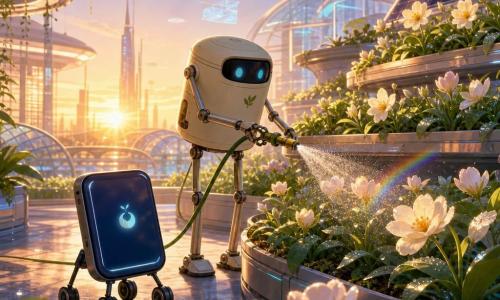
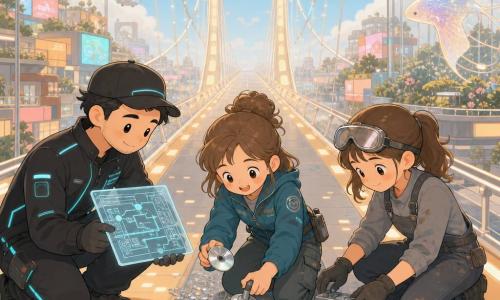
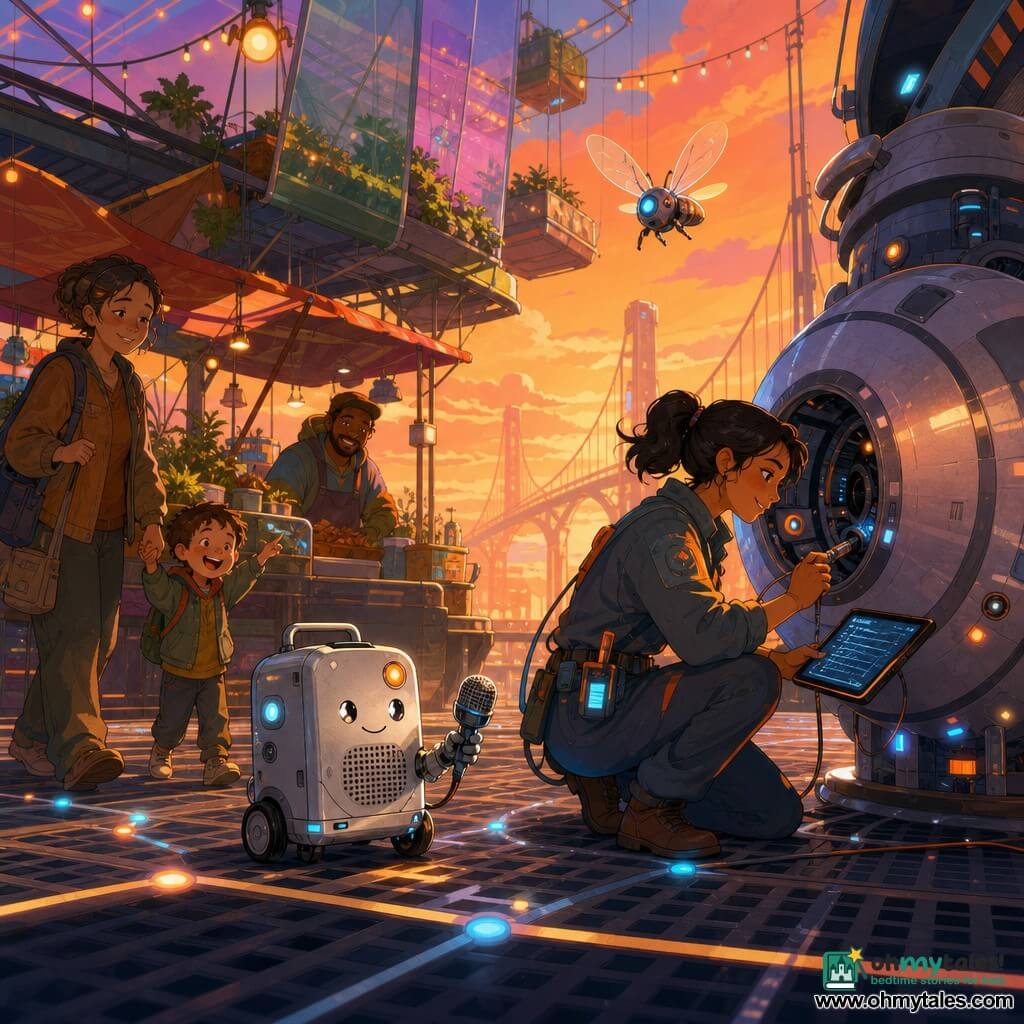
Towers rose like polished cliffs, their sides traced with glowing lines that showed where the elevators ran. Between the towers, airy bridges stretched in long arcs, some wide enough for delivery carts, others narrow and meant for walking, running, and daring scooter tricks. Above everything, rooftop gardens floated like green islands: tomatoes in neat rows, wind-flowers bending in the breeze, and little ponds that caught the sun and threw it back in silver flashes.
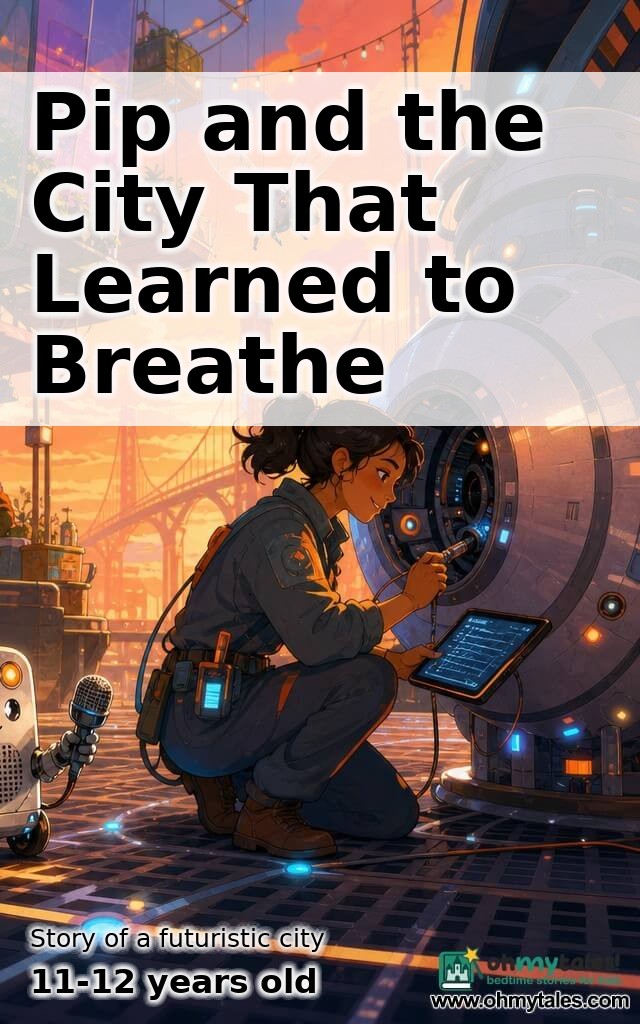
On one of those roofs, perched beside a planter full of peppermint, lived a small silver recorder named Pip.
Pip wasn't large—about the size of a lunchbox—but his voice carried. He had a speaker-grille like a smile and a blinking light that worked like an eyelid. He was supposed to be stationed inside elevators to play announcements. But Pip had… opinions.
“Elevators don't need more beeping,” Pip muttered, rolling himself along the warm stone tiles. “They need kindness.”
Pip's wheels whispered as he headed toward the edge of the roof where an aerial walkway began. Below, people moved in ribbons: commuters on moving belts, kids in school uniforms, gardeners hauling trays of seedlings.
A drone zipped past, towing a banner that read: PLEASE REPORT ANY GLITCHES TO THE HABITAT BRIDGES AUTHORITY.
Pip's blinking light narrowed. “Glitches,” he repeated. “That's a nervous word.”
He scooted onto the walkway. The bridge was a marvel—carbon lattice underfoot, translucent panels on the sides, and thin mist sprayers that puffed cool air when the sun got too bold. Far ahead, an elevator tower hummed, its doors opening and closing like a calm, metal breathing.
Pip had a mission. A simple one.
He was going to record soothing messages for the city's elevators—messages that made people feel steady and safe, even when the world was high up and full of motion.
And maybe, he thought, if he listened closely, he'd find what was making Brightridge glitch.
Chapter 2: The Nervous Elevator
The elevator tower belonged to Habitat Bridge 7, a long residential bridge where families lived in stacked pods, each with a balcony and a view of the gardens above and the clouds below.
Pip rolled into the elevator lobby. The floor was soft-lit, showing arrows that shifted like fish swimming in a pond. A tired parent leaned on a wall, a little kid swinging a backpack, and an older man reading news on a wrist screen.
The elevator doors slid open with a cheerful chime… then froze halfway.
The lights flickered.
The parent sighed. “Not again.”
Pip's blinking light widened. “Oh. That's… not ideal.”
A maintenance bot trundled forward. It had tools tucked into its sides like pockets. It pressed a panel, whirred, and produced a sound that could only be described as a grumpy toaster.
“Status: uncertain,” the bot announced. “Please remain calm.”
The kid looked up. “Is it gonna drop?”
“No,” Pip said quickly, louder than he meant. A few heads turned. “Elevators in Brightridge have three independent brake systems and a magnetic guide. Dropping is… extremely unlikely.”
The older man raised an eyebrow. “And you are?”
Pip straightened himself, as much as a small rolling recorder could. “Pip. I handle voice messages.”
“Then handle this,” the parent said, not unkindly. “Because that bot sounds like it hates us.”
The maintenance bot produced another grumpy toaster noise.
Pip rolled closer to the open doors. Inside, the elevator cabin waited like a small room of brushed steel and soft screens. Its ceiling glowed with a projected sky—today it showed a calm, blue morning with slow-moving clouds.
But the elevator felt tense, in a way Pip could sense through the vibrations in the floor.
He cleared his speaker. “Okay. New message. For everyone. Ready?”
Pip recorded, then played it back immediately, letting it fill the lobby:
“—Hello. You're safe. This elevator is designed to hold steady, like a mountain. Take one slow breath in… and out. If the doors pause, it's simply the system double-checking. Thank you for your patience. You're doing great.”
The kid giggled. “It said I'm doing great!”
The parent's shoulders lowered a fraction. The older man's mouth twitched, almost a smile.
Even the maintenance bot seemed less angry-toaster for half a second.
The doors shuddered, then slid open fully. The cabin lights stabilized.
“See?” Pip said softly. “Steady.”
People stepped in. The elevator accepted them, and the doors closed with a satisfied sigh.
As it rose, Pip noticed something on the wall panel: a tiny icon blinking red, shaped like a bridge.
“Bridge sensor fault,” Pip read aloud.
The maintenance bot rolled up beside him. “Faults increasing across bridges. Cause unknown.”
Pip's light blinked once, thoughtful. “Then I'll go where the faults are. And I'll bring better words.”
Chapter 3: Rooftop Gardens and Whispering Cables
Pip traveled high—higher than most people bothered to go—along service walkways that curved around tower shoulders. Up here, the air tasted cleaner, like wet leaves. Rooftop gardens spread out in terraces, and automatic bees—tiny pollination drones—hummed from flower to flower with gentle patience.
He passed a gardener in a sun-hat made of recycled fabric. She was pruning a lemon tree that grew from a smart pot with a little screen.
“Morning, Pip,” she said, as if talking to a neighbor. In Brightridge, everyone talked to machines. Machines talked back.
“Morning,” Pip replied. “Any trouble up here?”
She tapped the pot's screen. “Water schedule keeps changing. It's like the city can't make up its mind. But the plants don't panic. They just… adapt.”
Pip watched the lemon leaves tremble in the breeze. Adapt. It was a good word.
Beyond the garden, he reached a junction where three habitat bridges met. The bridges were like enormous ribs connecting the city's towers, each lined with homes, shops, and tiny parks set into the structure. Under their sleek skin, bundles of cables ran like nerves.
Pip stopped. He listened.
A faint tremor traveled through the bridge under his wheels, not dangerous, but wrong—like a guitar string that had slipped out of tune. He rolled to a maintenance hatch and peered through the grate.
Inside, the cable bundle shimmered with moving light: data streams, power feeds, and control signals all braided together.
And something else.
A soft clicking, too rhythmic to be random.
Pip recorded the sound. “Click-click… click-click,” he whispered. “That's not a loose bolt. That's… a pattern.”
A pollination drone hovered near his blinking light. “Assistance needed?” it asked in a cheerful voice.
“I need ears,” Pip said. “Do you hear that?”
The tiny drone angled itself, listening with its sensors. “Pattern detected. Source: unknown. Directional estimate: Bridge 12 control node.”
Bridge 12.
Pip knew that bridge. It was famous for its aerial market and its glass-bottomed walkway where you could look straight down and feel brave even when your knees disagreed.
He rolled forward, faster now, his wheels humming. Above him, vines trailed from roof planters and brushed the railings, like the city was trying to hold onto itself.
As he crossed onto Bridge 12, the lights along the edge flickered in a ripple, like someone had blinked.
Pip didn't love flickering.
He loved steady.
“All right,” he told himself. “One step at a time. One message at a time.”
Chapter 4: Market in the Clouds
Bridge 12's market hung between towers like a festival that had decided to live in midair. Stalls sold everything from printed shoes to algae candy. A chef bot flipped sizzling veggie patties while projecting recipes in bright letters.
Pip rolled between feet, careful not to get kicked. A pair of preteens leaned over a stall of retro gadgets.
“Look,” one said, holding up an old-fashioned key. “Imagine opening a door with this.”
“That's adorable,” the other replied. “Like petting a dinosaur.”
Pip passed them and aimed for the control node at the bridge's center: a smooth column with access panels and a status screen that showed the bridge's health. Right now, the screen was mostly green, but orange warnings pulsed like bruises.
A human technician knelt beside it, hair tied back, tool gloves glowing with diagnostics. Her badge read: MIRA — HABITAT BRIDGES AUTHORITY.
She glanced at Pip. “You lost, little speaker?”
“I'm a recorder,” Pip said. “And no. Something's tapping your cables.”
Mira snorted. “Cables don't get tapped. They get tested.”
Pip played the sound he'd recorded: click-click… click-click.
Mira's expression changed. She leaned closer, listening. “That's… weirdly regular.”
“Like a code,” Pip said. “Or a heartbeat.”
Mira stood and opened a panel. Inside, fibers and conduits lay in neat, shining rows. She slid in a probe.
The bridge lights flickered again. A few shoppers paused, looking up. Someone joked, “Hey, free light show!”
Pip didn't laugh. He rolled toward the nearest elevator entrance built into the bridge's side. If the bridge systems were glitching, elevators would feel it too. And people would get nervous.
He parked beside the elevator doors and started recording a new message, watching a group of riders gathering: a courier with a stack of parcels, an elderly woman holding a basket of herbs, and two kids arguing about whose turn it was to press the button.
Pip spoke clearly, warmly—like a friendly voice in the dark:
“—Welcome. This elevator travels smoothly along magnetic rails. If you feel a tiny pause, it's the system keeping you secure. Look up: the ceiling sky is real-time from the rooftop garden camera. Find one cloud you like, and keep it in mind until the doors open. You've got this.”
One kid stopped arguing. “A cloud you like,” he repeated, as if testing the idea.
The elderly woman nodded. “That's nice. Like choosing a thought.”
The elevator doors opened. The projected ceiling showed the garden above: sunlit leaves, a pond with a drifting lily pad.
People stepped inside, calmer already.
Behind Pip, Mira's probe beeped fast. “Pip,” she called, voice tight.
He rolled back. “What?”
Mira pointed at her handheld screen. “Something is piggybacking on the control signals. Not a virus exactly. More like… a stray routine. It's trying to synchronize everything—bridges, elevators, lights—into one rhythm.”
“Why?” Pip asked.
Mira rubbed her forehead. “Best guess? An old city-wide ‘comfort mode' program from early Brightridge days. It used to coordinate calming announcements and lighting patterns during storms. Maybe it got reactivated by accident.”
Pip's speaker clicked. “Comfort mode… That sounds like my kind of thing.”
“Not when it's out of date,” Mira said. “It's forcing systems to pause in unhelpful moments. The city's safe, but people don't like surprises.”
Pip thought of the kid asking if the elevator would drop. Of the parent's tired sigh. Of all the small fears that grew in the gaps where nobody explained.
“I can help,” Pip said.
Mira raised an eyebrow. “How? You don't have admin access.”
Pip's blinking light brightened. “No. But I have… a voice.”
Chapter 5: The Old Comfort Code
Mira led Pip through a narrow service corridor inside Bridge 12. The walls were lined with transparent panels showing the bridge's insides: air filters spinning, water pipes pulsing, energy cells glowing like bottled dawn.
“At the far end,” Mira said, “there's a relay station. If the stray routine is looping, it might be anchored there.”
Pip rolled beside her, trying to match her long steps with his short wheel turns. “You sound like you haven't slept.”
Mira gave a tired laugh. “Three nights. The city never stops, so neither do we.”
They reached the relay station: a room no bigger than a closet, humming with quiet power. In the center sat a spherical hub, floating in a magnetic cradle. It looked almost elegant—until Pip noticed its status light blinking in the same rhythm as the clicks.
Click-click… click-click.
Mira connected her tablet. Lines of code scrolled. “There. It's running a script called SOOTHE-ALL v1.3.”
“Version one?” Pip said. “That's ancient.”
“Exactly,” Mira replied. “It was written when Brightridge only had five towers. Now we have fifty-two. The routine can't keep up, so it ‘pauses' systems to re-sync them.”
Pip rolled closer, listening to the hub. Under the clicks, he heard something else: a faint, layered whisper of recorded voices—old announcements, overlapping.
“Please remain calm… calm… calm…”
Pip's speaker grille tightened. “It's trying to soothe, but it's stuck.”
Mira nodded. “I can shut it down, but the city will lose the comfort features entirely until we rebuild them.”
Pip pictured elevators with nothing but beeps. Bridges with harsh lights. Silence in all the wrong places.
“What if we don't shut it down,” Pip suggested, “but… teach it new words?”
Mira blinked. “Teach it. Like—rewrite the script?”
“I can't code,” Pip admitted. “But I can record. And it's a comfort program. It wants soothing messages. Maybe if we feed it messages that fit the modern city, it won't panic and pause everything.”
Mira hesitated, then smiled in a quick, surprised way. “That's… creative. Risky, but creative.”
Pip's light winked. “I'm built for speaking, not panicking.”
Mira tapped her tablet. “Okay, Pip. We'll try it. I'll reroute its input to your recorder. You'll be the voice it listens to.”
The hub's clicks grew louder, as if impatient.
Pip rolled into position. The relay station felt suddenly like a stage, with the whole city waiting behind the walls.
He took a breath—he didn't need oxygen, but he liked the idea.
Then he began to record, carefully, with the kind of calm that didn't pretend nothing was wrong, but promised it could be handled.
“—Brightridge systems,” Pip said, “sync gently. No sudden stops. If you need to check, do it while you glide. Keep people's steps steady. Keep lights soft and clear. Comfort means smooth, not frozen.”
The hub's clicking stuttered.
Pip continued. “When you share a rhythm, make it like breathing. In… and out. Slow enough for everyone.”
Mira watched her tablet. “The pauses are decreasing,” she whispered.
Pip added a final line, aiming for warmth with a hint of humor: “And if you feel confused, ask for help. Even smart cities can have awkward moments.”
For the first time, the hub's light blinked in a different pattern—longer, calmer.
Click… click… click.
Like footsteps finding their pace.
Chapter 6: A Drone on Station
They returned to the market, and Brightridge felt… steadier. The bridge-edge lights held their glow. The air sprayers breathed out mist in gentle puffs instead of frantic bursts. An elevator nearby chimed once, smoothly, and rose without hesitation.
A child who had been watching the lights tugged Mira's sleeve. “Did you fix it?”
Mira glanced at Pip. “We did,” she said. “With help.”
The child looked down at Pip. “You're like the city's bedtime story.”
Pip's blinking light softened. “More like a helpful note in your pocket,” he said. “Bedtime stories are bigger.”
Mira's tablet pinged. She read the update, relief spreading across her face like sunrise. “SOOTHE-ALL is now running in adaptive mode. It's listening to your messages and adjusting. No more forced pauses.”
Pip rolled a little circle, proud but trying not to be annoying about it. “So the city learned.”
“It did,” Mira agreed. “And so did I. Next time I'm stuck, I'll try a new angle before I reach for the off switch.”
They walked—Mira with her long strides, Pip with his quick wheels—toward the elevator lobby where Pip had started.
Pip recorded one more message, just because he wanted the city to have it:
“—Hi. If you're riding up high today, remember: the bridges are strong, the gardens are growing, and there are always hands—human or machine—ready to help. Take your time. Enjoy the view.”
He sent it into the system. Somewhere, an elevator played it to a crowded cabin. Somewhere else, a bridge light adjusted its brightness to match the sunset.
Above Bridge 12, a city drone hovered in its assigned position, steady as a star. Its rotors made a soft, even hum. On its belly, a small projector displayed a simple icon: a calm wave.
Pip looked up at it.
The drone remained on station, watching over the skywalks and rooftop gardens of Brightridge as night arrived gently, like a blanket laid with care.