Chapter 1: The City That Grew Upward
In Skygarden City, the streets didn't stop at the ground. They climbed.
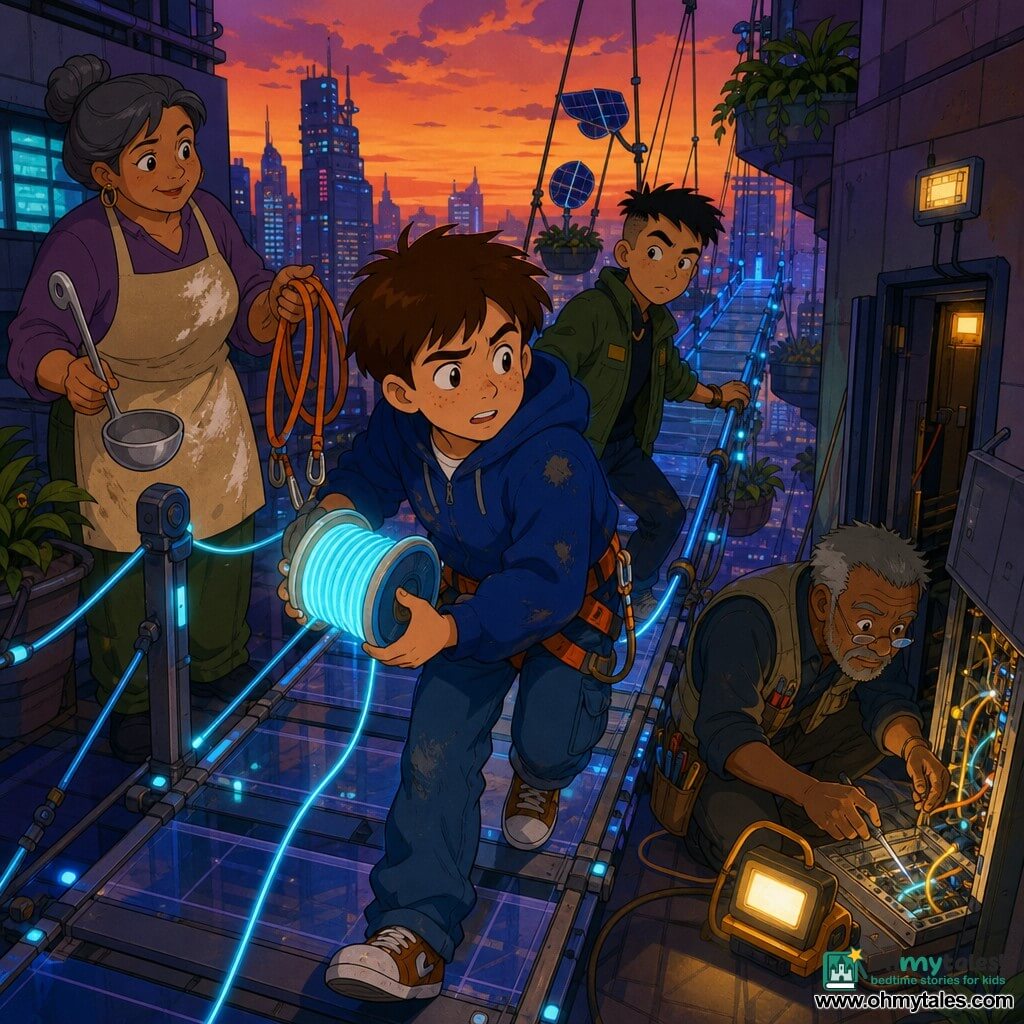
Above the old avenues rose layers of rooftops turned into gardens—long beds of mint and strawberries, dwarf fruit trees tied to cables, and soft lawns where solar tiles blinked like sleepy fish. Between towers, aerial walkways stretched like ribbons, humming faintly as people crossed on foot or on little roll-boards that knew how to brake by themselves.
Eleven-year-old Milo loved those walkways. They made him feel as if he could step straight into the sky.
Down below, though, the city changed. Between the tall foundations, there was a different world: the City of Shadows. Cool alleys ran like streams between buildings. Light fell in narrow slices. The air smelled of wet stone and machine oil.
Milo liked that place, too. It was quieter. It was where you could hear your own thoughts.
He slipped into Shadow Alley after school, his backpack bumping against his spine. His wristband—an old one, patched with tape—blinked a message: LOW BATTERY. Milo tapped it.
“Not now,” he muttered. “I'm busy.”
He was busy because he had a job, even if it wasn't official. People in Skygarden City had delivery drones and chat walls and news streams that played on any surface. But in the City of Shadows, people still gathered for something else.
Stories.
Milo was a gatherer. He knew how to pull people together the way wind gathers leaves into a corner. He didn't force anyone. He just… made it easy to stay.
He reached the small square where old pipes curved out of a wall like ribs. Above it, an awning stretched—bright fabric repaired with different-colored patches. Under it, a few stools, some stacked crates, and a circle of warm light from a hanging lantern.
Milo ducked under the awning.
“Hey, Milo!” called Auntie Rina from her noodle cart. Steam rose around her face like a friendly cloud. “You're early.”
“I've got a new one today,” Milo said, trying to sound mysterious.
Jax, who was twelve and always acted as if he'd been born knowing everything, leaned on a crate. “A new story or a new mistake?”
Milo grinned. “Both, maybe.”
People drifted in: delivery riders resting their legs, a gardener with dirt under her nails, two little kids with wide eyes, and Mr. Olo, who repaired old tech and never laughed loud but always laughed first.
Milo watched them settle. He felt that small, happy click inside him—like a latch closing. A circle was forming.
He didn't know yet that tonight, the city above their heads was about to test how responsible an eleven-year-old could be.
Chapter 2: The Quiet Blink
The lantern under the awning flickered once, then steadied. Milo cleared his throat, the way he'd seen teachers do, and began.
“Okay. Imagine this,” he said. “A robot cat—”
“Too easy,” Jax interrupted. “Robot cats are everywhere.”
“Fine,” Milo said. “A robot cat that's afraid of heights.”
That got a few chuckles. Even Jax's mouth twitched.
Milo kept going, letting the story run like water: the robot cat sneaking across aerial bridges, pretending it wasn't scared; its human friend, a kid who promised to keep it safe; the moment when the bridge shook in the wind and the cat had to choose between running away or saving someone smaller.
As Milo spoke, he noticed something odd.
Far above, between the towers, the aerial walkways had their usual guide lights—thin lines that glowed blue to show safe paths. Tonight, one line blinked.
Once. Twice. Then it went dark for a second too long.
Milo paused mid-sentence. The circle under the awning waited.
“What?” Jax said. “You forgot your cat?”
“No,” Milo whispered. He stared up.
A second walkway line blinked, farther away, like a firefly that had lost its rhythm.
Mr. Olo followed Milo's gaze. “That's not right.”
Auntie Rina turned down her stove. “If the guide lights are failing, people can misstep. Those bridges aren't toys.”
Everyone in Skygarden City knew the bridges were safe. That was the whole point—safe routes between rooftop gardens, schools, clinics, markets. The city loved safety. It advertised safety.
Yet the blinking made Milo's stomach tighten.
His wristband buzzed again. Another message slid across the scratched screen:
CITY NOTICE: POWER BALANCE ADJUSTMENT. PLEASE REMAIN CALM.
“Power balance?” Milo echoed.
Jax shrugged, pretending not to care. “They do that all the time. The towers drink electricity like Juno drinks soda.”
A little kid tugged Milo's sleeve. “Is it dangerous?”
Milo looked at the child's face, round and worried under the lantern light. He remembered his story: the robot cat that had to choose.
“It's… not dangerous if people pay attention,” Milo said carefully. “And if we help.”
Auntie Rina leaned close. “Milo, you're good at bringing people together. But don't go playing hero on a bridge.”
“I won't,” Milo said.
He meant it. Mostly.
Then, somewhere above, there was a soft sound—like a metal throat clearing. A public announcement speaker crackled, but instead of the calm city voice, it released a burst of static.
Milo's wristband flashed one more time, and this time the words made his chest jump:
ROOF ACCESS LOCKDOWN: LEVEL 27-TO-30.
Level 30 was the highest garden roof in their district. The one with the community greenhouse. The one with the rain collectors.
The one that kept half the neighborhood's plants alive.
Mr. Olo's eyes narrowed. “If those locks close and the power is unstable…”
“Then the roof safety net might not deploy,” Auntie Rina finished.
Jax finally stopped pretending. “Wait. There's a roof safety net?”
“There's always a safety net,” Mr. Olo said. “Unless it loses power.”
Milo swallowed. A simple idea appeared in his head—simple and heavy.
Someone needed to check on Level 30.
And Milo had just gathered a circle of people who cared.
Chapter 3: The Walkway of Wind
Milo climbed out from under the awning. The cool air of the shadow alley hugged his skin.
“I'm going to look,” he said.
Auntie Rina caught his wrist gently. “Milo. Responsibility means knowing what you can't do alone.”
Milo nodded. “That's why I'm not going alone.”
Jax stepped forward too quickly, like he was afraid someone might think he was scared. “I know the shortcut ramps.”
Mr. Olo pulled a small tool kit from under his coat. “If it's a lock problem, a few tools may help. If it's a power problem… we'll need to be smart.”
Auntie Rina sighed the way adults sigh when they want to say no but know they can't. “You're not crossing any bridges without a tether.”
She reached into her cart and pulled out two thin safety lines—bright orange, self-tightening. She clipped one to Milo's belt loop and handed him the spool.
“And no running,” she added. “This isn't one of your stories.”
“It is now,” Milo said, and tried to smile.
They moved out of the City of Shadows, climbing a spiral ramp that wrapped around a tower like a vine. As they rose, the air warmed, and the sound of the city shifted from dripping water and quiet footsteps to the higher music of wind and distant drones.
At Level 27, they reached the first aerial walkway.
It stretched across open air to the next tower, with garden roofs visible below like green squares on a game board. Normally, the guide lights would draw a confident line along the edges. Tonight, several segments blinked, unsure of themselves.
A service drone floated nearby, its white shell marked with the city emblem. It scanned the walkway and made a polite chime.
“—MAINTENANCE IN PROGRESS—” it said in a flat voice. “—PLEASE USE ALTERNATE ROUTE—”
Jax snorted. “Alternate route? The alternate route is always ‘go back and try later.'”
Milo leaned over the railing. Far down, the City of Shadows looked like a dark lake between bright towers. Under that patched awning, people would be waiting for the end of his story.
He took a breath. “We go slow. We tether. We watch the lights.”
Mr. Olo clipped his own line to a pole. “Good. And if something feels wrong, we stop.”
They stepped onto the walkway.
It vibrated faintly, as if it had a heartbeat. The wind pushed at Milo's hoodie. His hair whipped into his eyes, and he blinked hard.
Halfway across, the guide lights went dark for a full second.
Milo froze.
Jax grabbed the rail. “That's not funny.”
A small panel on the side of the bridge popped open with a click. A cable inside twitched like a nervous worm.
Mr. Olo leaned in, eyes sharp. “It's not the main power line. It's the local stabilizer. It's flickering.”
“Can you fix it?” Milo asked.
Mr. Olo hesitated—just long enough to tell the truth. “Not here. Not fast.”
Milo looked forward. The other tower was close now. The rooftop ramp up to Level 30 waited beyond it, like a promise.
“We keep going,” Milo said, voice steady even though his stomach wasn't. “We get to the roof access. We make sure the safety systems are on.”
“And if they're not?” Jax asked.
“Then we switch them on,” Milo said.
Auntie Rina's voice came through Milo's earpiece—she'd stayed behind but kept a comm-link open. “Switching things on is not always a button, Milo.”
“I know,” he said. “But there's always a way.”
When they stepped off the bridge, Milo realized his hands were shaking. He tucked them into his pockets so no one would see.
Responsibility, he thought, isn't feeling brave.
It's walking anyway, but carefully.
Chapter 4: Locked Sky, Open Shadow
The ramp to Level 30 was guarded by a door that looked like plain metal, except for the palm scanner glowing green beside it.
Milo pressed his hand to the scanner.
A red line swept across his fingers. The door beeped.
ACCESS DENIED. LOCKDOWN ACTIVE.
Jax groaned. “Of course.”
Mr. Olo crouched by the scanner. “Lockdown is citywide, but it's controlled from the district hub. Usually.”
“Usually?” Milo repeated.
Mr. Olo opened his tool kit. “Sometimes, during power adjustments, the system gets confused. It locks everything instead of only what it should. It's like a scared animal.”
Milo leaned closer. “Can you talk to it?”
Mr. Olo's mouth tightened. “I can try.”
He connected a thin cable from his pocket device to the panel. The panel flickered. A soft tone rang out, then a sharp buzz.
“—ERROR—” the panel said. “—PRIORITY: ROOF SAFETY PROTOCOL—OFFLINE—”
Milo's throat went dry. “The roof safety protocol is offline.”
Jax's eyes widened. “That's the net?”
“And the rail sensors,” Mr. Olo said. “And the warning beacons. Without those, a roof garden is still beautiful… but it becomes risky when the wind is strong, or when people gather.”
Milo thought of tomorrow. Market day on Level 30. Kids running between planters. Older people leaning on rails to watch drone shows.
He pictured the rooftop without its quiet protections, like a bike missing its brakes.
A memory hit him: last month, Milo had borrowed a neighbor's hoverboard without asking. He'd only wanted one fast ride. He'd hit a curb, scratched the board, and then tried to hide it. The neighbor hadn't yelled. She'd just said, tiredly, “If it breaks at the wrong time, someone gets hurt.”
Milo had promised to be more careful.
Promises were not supposed to be like balloons. They were supposed to be like knots.
He looked at the scanner again. “We need power to the safety protocol,” he said. “Where does it come from?”
Mr. Olo pointed to a small hatch beside the door. “Emergency capacitor inside. It should hold charge for hours. But if it's empty…”
Jax rubbed his arms. “So it's empty.”
Milo stared at the hatch. On it was a warning symbol and a simple line of text:
FOR CERTIFIED TECHNICIANS ONLY.
Milo felt the weight of those words.
“I'm not certified,” he said quietly.
“No,” Mr. Olo agreed. “And neither am I. Not anymore.”
Jax looked between them. “Then what do we do? Wait for the city to notice?”
Above them, another guide light line blinked out. The walkway behind them shivered with a gust.
Milo imagined waiting. Imagined someone on Level 30 tomorrow, leaning on a rail that didn't warn them, stepping into a spot where the smart floor didn't correct their balance.
He took a breath and made a decision that felt like picking up a heavy box: you could do it wrong, or you could do it right.
“We do the responsible thing,” Milo said. “We get help. Real help.”
Jax frowned. “From who?”
Milo pointed down, toward the City of Shadows. “From the people who actually show up.”
Chapter 5: Stories Under the Awning
They hurried back down the ramp, and the shadow alleys welcomed them with cool air and steady ground. Milo's legs felt wobbly, but his thoughts were clear.
Under the patched awning, the lantern still glowed. More people had gathered, drawn by the half-finished story and the strange city messages. Faces turned as Milo arrived.
Auntie Rina was there, arms crossed. She didn't look angry. She looked ready.
Milo stepped onto an upturned crate. He could feel everyone's attention like warmth on his skin.
“Okay,” he said. “I'm going to finish the story later. Right now, we have a real problem.”
Jax whispered, “Nice opening.”
Milo ignored him. “The roof safety protocol for Level 30 is offline, and the access door is locked. The guide lights are flickering. That means the city's power adjustment isn't going smoothly.”
A murmur moved through the crowd.
Mr. Olo lifted his kit. “We can't force the lock. We shouldn't. But we can do something smarter. We can create our own safety.”
A delivery rider raised a hand. “How?”
Milo swallowed. He'd never led something like this. He was just a kid with stories.
But being a gatherer meant more than telling tales. It meant giving everyone a place in the circle.
“We split into teams,” Milo said. “Team one: get message lines out. Warn people not to use the flickering walkways. Team two: bring portable lights and tethers to the ramps leading to Level 30. Team three: come with us to the district hub entrance. We can't hack it, but we can alert it properly, in person.”
A woman with gardening gloves nodded. “I have beacon sticks in my shed.”
Mr. Olo added, “I know where the old service intercom is. It's in the shadow level. City workers used it before everything went wireless.”
Jax raised his eyebrows. “You mean we can actually talk to a human?”
“Sometimes,” Mr. Olo said. “If a human is listening.”
Auntie Rina pointed a ladle at Milo. “And you, Milo. You're responsible for what you start. You don't run ahead. You stay with your team.”
Milo nodded, throat tight. “I will.”
Before they moved, a small kid—one of the listeners—tugged Milo's sleeve again. “Are we going to fall?”
Milo crouched until they were eye level. “No,” he said. “Because we're paying attention, and we're helping each other. That's how you stay safe in a big city.”
The kid seemed to breathe again.
They launched into motion. People who had come for noodles and stories now carried beacon sticks, coiled tethers, and portable lanterns. The City of Shadows, usually quiet, became busy in a calm way—like ants building a bridge leaf by leaf.
As they worked, Milo realized something surprising.
This felt like one of his stories.
Except it was real, and everyone had a part.
Chapter 6: The District Hub and the Simple Switch
The district hub sat at the edge of the shadow zone, a thick building with smooth walls and a single door that recognized city badges. Above it, screens usually played cheerful announcements about rooftop harvests and bridge festivals. Tonight, the screens showed only a spinning symbol: RECALIBRATING.
Mr. Olo led Milo and Jax to a narrow side passage where an old intercom box hid behind a peeling poster. He brushed away dust and pressed the button.
Nothing.
He pressed again, longer.
A crackle answered, and then a voice—sleepy, annoyed, human.
“Maintenance desk,” it said. “This line is decommissioned.”
Mr. Olo spoke fast and clear. “This is Olo Marek, former district tech. Roof safety protocol on Level 30 is offline during power adjustment. Guide lights flickering on Walkway 27-B. Lockdown preventing access. We have people placing beacons, but you need to restore emergency capacitor feed.”
There was a pause. Milo held his breath. He heard faint typing.
The voice returned, sharper now. “Who authorized you to use this line?”
“No one,” Mr. Olo said. “That's why we're calling. It's an emergency.”
Jax leaned toward the intercom. “People could get hurt tomorrow. Do you want that on your log?”
Milo shot Jax a look—half shocked, half impressed.
Another pause. Then a different voice came on, older and steadier. “This is Supervisor Chen. Repeat the protocol status.”
Mr. Olo repeated it. Milo added, “We saw the error message: ‘Roof Safety Protocol—Offline.'”
Supervisor Chen exhaled. “All right. Good catch. The system should have switched to capacitor mode automatically. It may be stuck in lockdown priority.”
Milo leaned closer. “Can you fix it from there?”
“Yes,” Supervisor Chen said. “But I need confirmation someone is physically at the Level 30 access door. The sensors are unreliable right now.”
Milo's heart bumped. “We were there. We can go back.”
Auntie Rina's voice snapped in Milo's earbud. “Milo—”
Milo pressed the comm button. “Not just me. Mr. Olo and Jax too. With tethers and lights. We'll be careful.”
Auntie Rina hesitated, then sighed. “I'm coming up to Level 27 ramp with more adults. You don't move until I'm there.”
Milo glanced at Mr. Olo. Mr. Olo nodded. “Agreed.”
Supervisor Chen spoke again. “Good. When you're at the door, I'll send a manual reset. It's basically a simple switch, but the system hides it behind too many ‘smart' layers. Humans still matter.”
Milo almost laughed from relief. “We're good at being humans,” he said.
They moved back up with their small group, this time with extra lanterns and two adults from the awning crowd—strong, calm people who didn't ask for applause.
At the Level 30 access door, Milo pressed the intercom button on his pocket device. “We're here,” he said.
“Copy,” Supervisor Chen replied. “Stand clear.”
The scanner panel blinked. The red denial light flashed, then went amber, then green.
A soft hum ran through the door, like it was waking up.
On the panel, new text appeared:
ROOF SAFETY PROTOCOL: ONLINE.
WARNING BEACONS: ACTIVE.
RAIL SENSORS: ACTIVE.
Milo's shoulders dropped, as if someone had removed a heavy backpack he hadn't realized he was carrying.
Jax let out a long breath. “So it really was a hidden switch.”
“Most problems are,” Mr. Olo said. “Hidden behind panic.”
Supervisor Chen's voice softened. “Thank you for reporting responsibly. I'm sending drones to stabilize the walkway lights. And I'm removing lockdown for your district. Level 30 remains restricted until we verify, but the safety systems are now powered.”
Milo leaned his forehead against the cool metal of the door for a second. He didn't want to cry. He didn't want to cheer. He just wanted to feel the city steady again.
Auntie Rina arrived, slightly out of breath. She looked at Milo's face, then at the green status on the panel.
“You did not do it alone,” she said firmly.
“No,” Milo agreed. “I didn't.”
“And you didn't force the lock,” she added.
“No,” Milo said again. “We asked for help.”
Auntie Rina nodded once, satisfied. “That,” she said, “is what responsibility looks like.”
Chapter 7: The Secured Roof
Two days later, Level 30 reopened with a new sign beside the door:
ROOF SECURED — SAFETY SYSTEMS VERIFIED DAILY.
The city had added extra guide lights on the walkways too—brighter, with backup strips that didn't depend on one stabilizer. Supervisor Chen had even sent a message to the awning community, thanking them for “excellent neighborhood coordination.”
Milo read the message three times, not because it was long, but because it felt unreal to be noticed by the city.
That afternoon, Milo climbed to Level 30 with Jax and Auntie Rina. The door opened smoothly. A soft tone chimed, friendly as a bell.
Up on the roof, the garden spread out like a green quilt. Wind turbines turned slowly at the edges, their blades whispering. Solar petals tilted toward the sun. Rain collectors stood like silver umbrellas, gleaming.
And along every railing, tiny sensors blinked a steady, calm blue.
Milo walked to the center where a small canopy had been installed—new fabric, but stitched with a few patches donated from the old awning, as if the City of Shadows had reached up to leave its mark.
People gathered: gardeners, kids, elders, riders. A circle formed naturally.
Jax nudged Milo. “So. Story time?”
Milo sat on a low bench and looked around. The roof felt safe, not because it had rails and sensors—though it did—but because people were here, together, watching out for one another.
He began, “Remember the robot cat that was afraid of heights?”
A few smiles appeared. Even Mr. Olo, standing near a planter of tomatoes, tilted his head as if he'd been waiting.
“In the end,” Milo said, “the cat learned something. It wasn't brave because it had metal paws or a smart map. It was brave because it asked for help when it needed it… and because it didn't pretend danger was a joke.”
Jax muttered, “You're totally talking about us.”
Milo shot him a grin. “Maybe. Also, the cat stole a fish sandwich.”
Laughter rippled through the circle, light as wind across leaves.
Milo continued the story, his voice steady, his words painting pictures of bridges and skies and mistakes turned into lessons. Above them, the city towers shone, their rooftop gardens glowing like stepping-stones to the future.
And beneath their feet, the secured roof held them—safe, strong, and ready for whatever came next.