Chapter 1
The city of Lumenwell never really went dark. Even at night, the buildings wore gentle light like scarves—soft screens that wrapped around corners, showing floating arrows, weather ripples, and quick little messages in clean blue letters: SAVE ENERGY. SHARE ENERGY. SAY THANK YOU.
Milo Kade was eleven years old and small for his age, but he moved like someone who had decided not to be pushed around by the world. He ran through the morning crowd with his backpack tapping his shoulders, weaving between delivery drones that hummed like bees.
Above him, clear holograms hung in the air at each crossing: a bright map of the neighborhood, the next tram times, the energy level in the local grid. The holograms were sharp enough to cast tiny shadows on people's hands when they reached up to swipe them.
Milo stopped under one of the biggest ones, the one at Splitway Plaza, where six walkways fanned out like ribbons. The hologram showed the city's districts as colored tiles. Each tile pulsed, brighter or dimmer, depending on how much energy that district had stored and shared.
“River Quarter is high again,” Milo murmured.
“Because they're careful,” said a voice beside him.
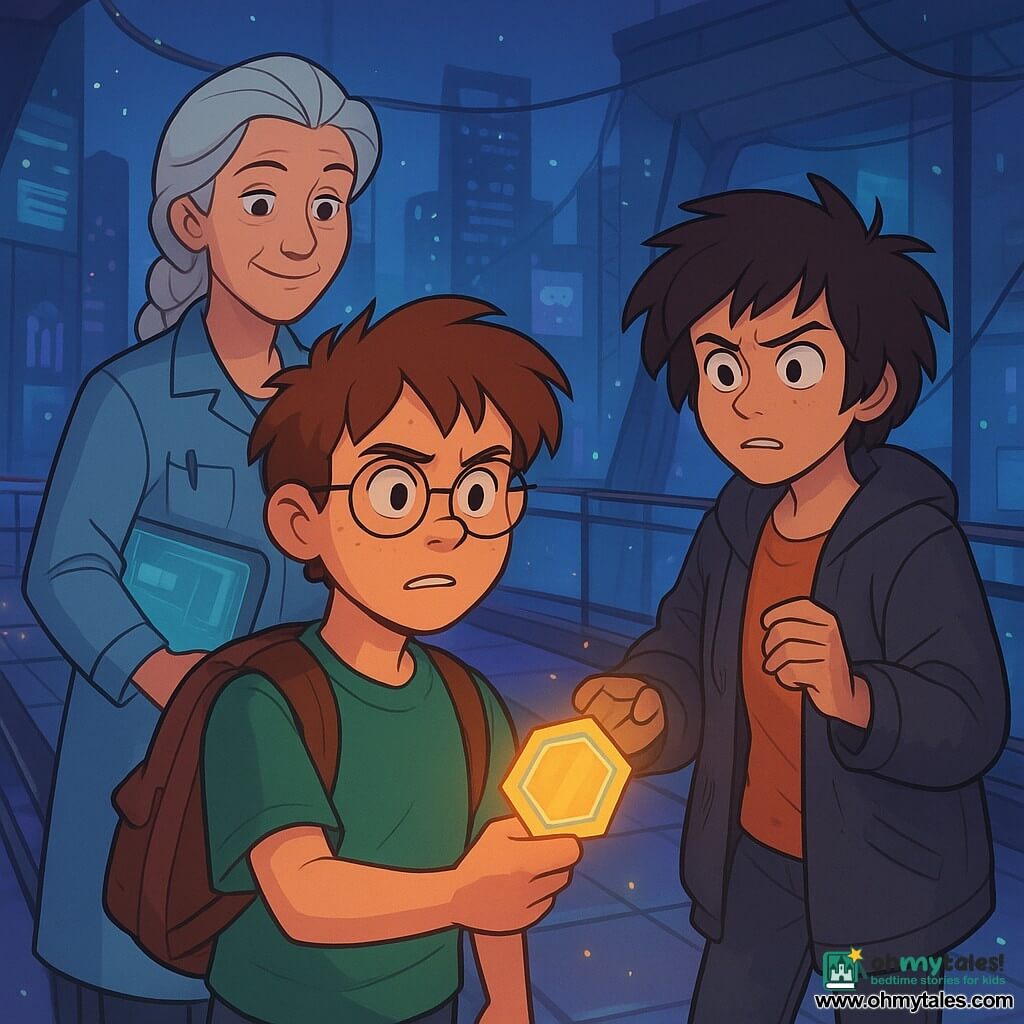
It was Ms. Orin, the caretaker of the Community Workshop. She had silver hair braided tight, and she always smelled faintly of solder and peppermint tea. She carried a thin tablet that bent as she tucked it under her arm.
“We're careful too,” Milo said, a little defensive.
Ms. Orin's eyes softened. “I know. But careful is a habit you make every day.”
Milo looked at the hologram again. Their district, Lantern Row, flickered a warm amber—steady, but not bursting.
Ms. Orin tapped the air and the display zoomed in. “We've got a job today. The city council is updating neighborhood access. They want new district badges. Real ones, not just codes on a screen.”
Badges. Milo's stomach did a quick flip. He loved making things—anything you could hold, anything that had weight and a click when it worked.
“Can I help?” he asked, trying not to sound too eager.
Ms. Orin smiled like she'd been waiting for that exact sentence. “You can lead it.”
Milo blinked. “Me?”
“You're brave,” she said simply. “And you pay attention. We'll need both.”
Brave. Milo didn't always feel brave. Sometimes he felt like a small bolt in a giant machine. But he liked the way the word sat in his chest, warm and steady.
They crossed the plaza toward the workshop. As they walked, Milo noticed all the things people usually didn't: the way flexible screens curled around lampposts like leaves, showing reminders to drink water; the way holograms floated at shoulder height for kids, and higher for adults; the way energy-sharing kiosks blinked politely, waiting to be touched.
At the workshop door, Ms. Orin held out a palm-sized case. “Your starter kit,” she said. “Badge blank, coil thread, and a stamp chip.”
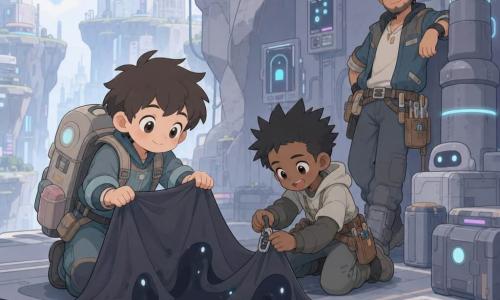
Milo opened it carefully. Inside was a thin hexagon of pale metal, light as a coin but larger, and a tiny chip no bigger than a fingernail.
“What's the chip do?” Milo asked.
“It tells the city grid who you are and where you belong,” Ms. Orin said. “But it also does something else. If we make them right.”
Milo looked up. “What else?”
Ms. Orin's expression turned serious. “It can help people remember to be grateful. And in a city like ours, that matters more than people think.”
Chapter 2
Inside the Community Workshop, sunlight poured through ceiling panels that shifted their tint like sunglasses. Worktables lined the room, each with neat trays of parts: recycled wire, small magnets, colored resin, stamp chips, and flexible screen strips that could be folded into any shape.
Milo set his kit on the nearest table. The hexagon badge blank looked plain and quiet, like it was waiting for a story.
Ms. Orin slid a stool over. “The council wants each district badge to do three things,” she said, counting on her fingers. “Identify your neighborhood. Let you access shared-energy doors and chargers. And”—she tapped the table—“carry a thank-you.”
“A thank-you?” Milo echoed.
“A message,” Ms. Orin said. “Not fancy. Just real. Something you mean.”
Milo's face scrunched. “Why? The badge is for doors.”
Ms. Orin leaned closer. “Because when energy is shared, people can forget it comes from somewhere. Someone chose to give. Someone turned off a heater, or waited to charge, or fixed a leaking line. Gratitude keeps the sharing honest.”
Milo thought of the energy kiosks, and the way people sometimes frowned at the numbers as if the city owed them more.
“How do we put a message on a badge?” he asked.
Ms. Orin lifted a strip of flexible screen. It shimmered like fish skin. “This wraps along the edge. It only lights when the badge is used—like a whisper. You'll program the message into the chip, and the edge-screen will glow the words for three seconds.”
Milo picked up the badge blank and ran a thumb along its smooth sides. “So… every time you open a door, it says thank you?”
“Or reminds you to say it,” Ms. Orin said.
Milo grinned. “That's kind of… sneaky.”
“Kind,” Ms. Orin corrected. “Not sneaky. Kind.”
They spent the next hour building the first prototype. Milo threaded coil wire through the tiny channel in the badge, snapping it into place. He pressed the stamp chip into its socket and watched a thin line of light crawl around the edge, testing connections.
On the table, Ms. Orin projected a small hologram keyboard. Milo typed slowly with two fingers.
MESSAGE: THANK YOU FOR SHARING.
He hesitated, then deleted it. It sounded like something a poster would say.
He tried again.
MESSAGE: THANK YOU, NEIGHBOR.
That felt better. It sounded like you were looking at a person, not a rule.
When he finished, he held the badge up. The edge-screen lit in soft amber: THANK YOU, NEIGHBOR.
Ms. Orin nodded. “Good.”
Milo clipped it to his shirt and walked to the workshop door. The lock had no handle—just a smooth panel that read the badge. He leaned in. The panel flashed green. The door slid open with a quiet sigh.
For three seconds, his badge glowed: THANK YOU, NEIGHBOR.
Milo felt it like a tiny tap on the heart. He thought of the door itself—powered by shared energy from hundreds of homes. He found himself whispering, “Thanks,” to nobody in particular.
Ms. Orin heard him anyway. “See?” she said. “It works.”
Then her tablet chimed, sharp and urgent. A red hologram blinked above it.
Lantern Row Energy Balance: Dropping.
Reason: Unregistered drain detected near Skybridge 12.
Milo's grin slid away. “What's Skybridge 12?”
Ms. Orin's voice was steady, but her fingers tightened around the tablet. “A bridge between districts. And if something is draining energy there, it won't just affect Lantern Row.”
Milo straightened. “Then we should go.”
Ms. Orin studied him for half a breath, like she was checking if his courage was real. Then she handed him a small pouch of badge blanks.
“Bring these,” she said. “And bring your eyes. We may need both more than tools.”
Chapter 3
They stepped out into the moving city.
A tram slid past on a silent track, its sides made of flexible screens showing a looping underwater scene—schools of glowing fish swimming along the length of the car. Kids pressed their hands to it, laughing when the fish scattered.
Milo and Ms. Orin walked fast, following street holograms that hovered like signposts. The arrows adjusted as they moved, always pointing the quickest way. Above them, delivery drones zipped between rooftops, their shadows skipping across pavement.
Lantern Row was built in tiers. Gardens grew on balconies, and water ran in narrow channels down the sides of buildings, filtered and reused. Every few blocks, an energy-sharing hub stood like a tall blue lantern. People could plug in devices, donate stored power, or borrow it when they needed.
As they neared Skybridge 12, the air changed. The wind smelled cooler, carrying metal and rain.
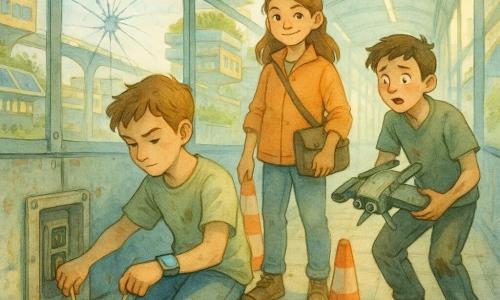
The bridge itself arched high over an open gap where older buildings had been cleared decades ago. It was made of smart glass and thin beams. Under each step, the floor lit softly—guiding lights that adjusted to your pace.
Halfway across, the lights flickered.
Milo slowed. “That's not normal.”
“No,” Ms. Orin agreed.
A maintenance hologram floated near the center of the bridge, usually a friendly green wrench symbol. Today it flashed yellow, then orange, then red. The words beneath it pulsed:
ENERGY LEAK DETECTED.
PLEASE REPORT TO CITY SYSTEMS.
But no one had. People were hurrying past, eyes forward, pretending they couldn't see. Milo watched a man step around the blinking hologram as if it were a puddle.
“Why aren't they stopping?” Milo asked.
Ms. Orin's mouth tightened. “Sometimes people think someone else will handle it.”
Milo felt a prickly heat in his ears. He didn't like that kind of thinking. It made problems bigger.
He crouched and pressed his palm to the bridge floor. The glass was cool. Beneath it, faint light lines—energy pathways—ran like veins. In one spot, the light dimmed and then surged, like a heartbeat skipping.
“There,” Milo said.
Ms. Orin knelt beside him and scanned with her tablet. “Drain point confirmed.”
Milo looked around. “So what's doing it? A broken cable?”
“Maybe.” Ms. Orin's eyes swept the bridge supports. “Or maybe someone tapped into the line.”
Milo's stomach dropped. “Stealing energy?”
Ms. Orin didn't answer right away. She stood and walked to the railing, peering down into the gap below. The space was filled with scaffolds and old beams, a shadowy tangle.
Milo followed her gaze and saw it: a thin wire trailing from the underside of the bridge, disappearing into the dark.
Ms. Orin exhaled. “Yes.”
Milo gripped the railing. “Who would do that?”
“Someone who is afraid,” Ms. Orin said. “Or someone who's tired. Or someone who thinks they'll be fine as long as they're not caught.”
The wire twitched, just slightly, like it was being pulled.
Milo's courage tried to slide backward, like a chair on a slick floor. The gap below looked deep. The city noises seemed far away.
Ms. Orin turned to him. “We don't chase strangers into dark places,” she said firmly. “We do this the safe way.”
Milo nodded, but his eyes stayed on the wire. “We can cut it.”
“And leave them without power?” Ms. Orin asked. “That might make them do something worse. We need to stop the drain and offer help.”
Milo frowned. That sounded… too gentle. But Ms. Orin wasn't soft. She was careful.
She opened Milo's pouch of badge blanks. “This is where your badges matter,” she said. “If we can get the right person to come up, we can give them a proper neighborhood badge—one that lets them use the sharing hubs legally. But first we need them to trust us.”
“How?” Milo asked.
Ms. Orin pointed to a small maintenance hatch set into the bridge railing. “There's a speaker line. We can talk down.”
Milo swallowed. His voice might shake. But he could do brave things even with a shaking voice. He had learned that once, when he got a shot at the clinic and didn't cry until afterward.
He climbed onto the low step near the hatch and opened it. A small microphone and a dusty speaker blinked awake.
Milo leaned in. “Hello?” he called, his voice echoing slightly under the bridge. “We can see your line. We're not here to hurt you.”
For a moment, only wind answered.
Then a thin voice rose from the shadows. “Go away.”
Milo's fingers tightened on the railing edge. “If you keep draining the bridge, Lantern Row will go dim. People will lose lights. Lifts. Heat.”
Silence.
Ms. Orin nodded at him, urging him gently onward.
Milo took a breath. “We can help you. We're from the workshop. We make district badges. The kind that lets you charge at the hubs. The honest way.”
A pause. Then the voice, quieter: “Badges cost credits.”
Milo shook his head even though the person couldn't see it. “These don't. Not today.”
The wire twitched again. Milo heard a soft scrape, like someone shifting on metal beams.
“Why would you do that?” the voice asked. “For me.”
Milo glanced at the flickering bridge lights. “Because someone shared with me first,” he said. “And… because it's right.”
His badge edge lit as if it agreed: THANK YOU, NEIGHBOR.
Down below, there was another long silence. Then: “I can't come up. The scanners—”
Ms. Orin stepped forward. “I can disable the scanner at this entrance for two minutes,” she called into the hatch. “If you step into the light on the stairwell, we'll see you. No one else needs to.”
Milo held his breath. The bridge lights flickered again, impatient.
Finally, from the dark below, footsteps rang on metal rungs.
Chapter 4
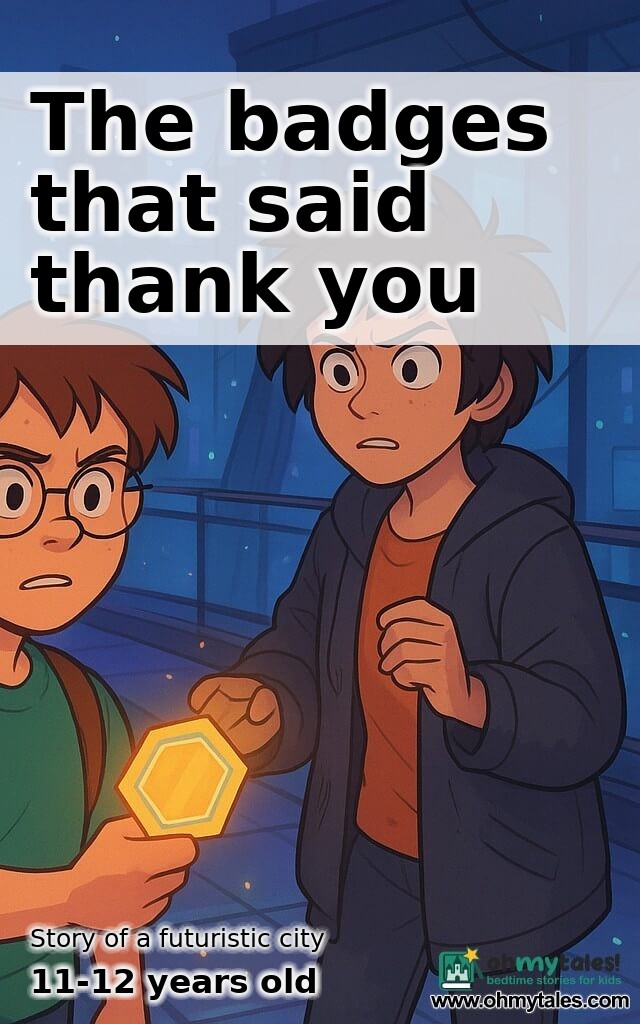
A girl climbed into view, older than Milo—maybe thirteen or fourteen—with short hair that stuck up in uneven spikes, like she had cut it herself. Her jacket was too big, sleeves rolled, and her eyes were sharp, like she expected the world to grab her.
She stopped at the top stair, blinking against the bright city light. In her hand was a small tool kit, and around her wrist, a loop of wire.
Ms. Orin lifted her tablet and tapped twice. The scanner panel near the bridge entrance went blank.
“You have two minutes,” Ms. Orin said. “What's your name?”
The girl's gaze bounced from Ms. Orin to Milo's glowing badge. “Tara,” she said. Her voice sounded tougher than her face looked.
Milo noticed a smear of grease on her cheek and a faint tremble in her hands. Not fearless. Just determined.
Ms. Orin kept her tone calm. “Tara, you tapped into shared power. That hurts the districts that are trying to stay balanced.”
Tara's chin lifted. “I wasn't taking much.”
Milo blurted, “It's enough to make the bridge lights flicker.”
Tara's eyes flashed. “So? You have lights everywhere. Screens that wrap around buildings. Holograms telling you what time it is like you can't feel it.”
Milo's cheeks warmed. He wanted to argue. But then he remembered Ms. Orin's words: Someone who is afraid. Someone who's tired.
He tried again, slower. “Why did you need it?”
Tara hesitated. Her tough look slipped, just a crack. “My little brother,” she said. “He's sick. The clinic gave us filters for his lungs, but the purifier at our place is old. It eats power. Our district badge expired when we moved, and… we don't have a district anymore.”
Milo pictured an apartment with dim lights and stale air. He imagined a kid breathing through a humming machine that might stop if the power ran out. His anger thinned into something else.
Ms. Orin nodded as if she had been expecting exactly this. “Where are you staying?”
“In the hollow towers,” Tara said, eyes flicking away. “The old ones by the gap.”
Milo knew them—tall buildings left from before the shared-grid system, their windows dark, their halls full of echo. People didn't talk about them much. They were like a missing tooth in the city smile.
Ms. Orin opened Milo's pouch and pulled out a blank badge. “Then we'll do something simple,” she said. “We'll give you a temporary badge for Lantern Row. It will register you for energy hubs and clinic access. It will also—” she glanced at Milo—“carry a message.”
Tara stared. “Why would Lantern Row accept me?”
Milo felt the bridge lights pulsing under his shoes. This was the key moment, the part where you either turned away or stepped closer.
He held out his own badge so Tara could see the glowing edge. “Because we share,” he said. “And because I don't want your brother's machine to stop.”
Tara's eyes narrowed, suspicious. “What's the message?”
Milo swallowed. He hadn't planned one for her. But he knew what he wanted her to feel, every time she used the badge. Not shame. Not fear. Something steadier.
He looked at Ms. Orin. “Can I program it now?”
Ms. Orin handed him the tablet. “Quickly.”
Milo's fingers moved fast over the hologram keys. The bridge wind tugged at his hair. He typed:
MESSAGE: THANK YOU FOR ASKING, NOT TAKING.
He hesitated. Was that too sharp? He changed it.
MESSAGE: THANK YOU FOR TRYING AGAIN.
He looked up at Tara. “Is that okay?”
Tara's mouth twitched, almost a smile, but it didn't fully arrive. “No one says thank you where I'm from,” she muttered. “They say, ‘Don't get caught.'”
“Then this will be different,” Milo said.
Ms. Orin snapped the chip into the badge and pressed the edge-screen strip into place. The badge lit briefly, then settled.
She handed it to Tara. “Clip it on,” she said. “And unplug your line.”
Tara stared at the badge like it might vanish. Then she clipped it to her jacket. The edge flashed softly:
THANK YOU FOR TRYING AGAIN.
For a moment, Tara's tough mask cracked wider. Her eyes shone, then hardened again, like she was afraid of her own feelings.
“I'll unplug it,” she said, and started back down.
Milo leaned over the railing. “Wait—”
Tara paused, looking up.
Milo's voice came out small but clear. “When you're done… come to the workshop. We can make a real badge for your district. Or help you join one.”
Tara blinked. “Why would you do all that?”
Milo thought of the city grid, the colored tiles pulsing together. He thought of Ms. Orin's hands steady on the tools. He thought of the thousand invisible choices that kept the lights on.
He answered honestly. “Because I'm grateful,” he said. “For what I have. And I want to be the kind of person who doesn't forget.”
Tara didn't reply, but she nodded once, sharp and quick, then disappeared into the shadows below.
Ms. Orin released a breath. “Two minutes almost up,” she said, and reactivated the scanners.
The bridge lights steadied, glowing smooth beneath Milo's feet.
Milo exhaled too, realizing how tightly he'd been holding himself together. “Is it fixed?”
“The drain will stop,” Ms. Orin said. “But the larger problem remains.”
Milo looked toward the hollow towers. “People without districts,” he said.
Ms. Orin nodded. “And people who don't think anyone will help.”
Milo's fingers brushed the pouch of badge blanks. They felt heavier now, as if each blank carried a promise.
“Then we make more,” he said.
Ms. Orin's gaze warmed. “Yes,” she said. “We make more.”
Chapter 5
By afternoon, the Community Workshop buzzed like a hive.
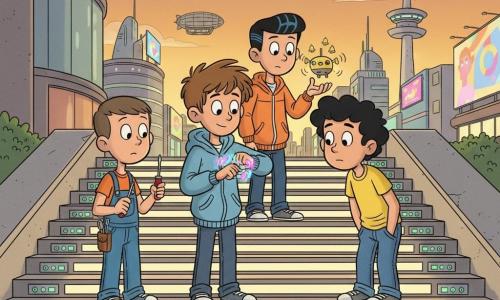
Milo stood at the center table with three other kids from Lantern Row—Jessa, who could solder without shaking; Arun, who understood codes like they were songs; and Pilar, who always had a joke ready.
Pilar held up a badge and made it glow. “Mine says, ‘Thank you for not hogging the charger,'” she announced.
Jessa snorted. “That's not gratitude. That's a threat.”
“It's a polite threat,” Pilar argued, grinning.
Ms. Orin clapped once. “Messages should be kind,” she reminded them, but her eyes were amused.
Milo set up a line of badge blanks, each one waiting. Outside the workshop windows, the city screens rolled news in gentle colors: SKYBRIDGE 12 STABILIZED. THANK YOU FOR REPORTING. But Milo noticed the message didn't say who had fixed it. It didn't mention Tara. It didn't mention the hollow towers.
Maybe some stories stayed quiet. Maybe that was okay.
They worked in a rhythm: thread coil wire, snap in chip, attach edge-screen, program message, test at the door panel, stack neatly.
Milo wrote different gratitude messages for different needs. Some were simple:
THANK YOU FOR SHARING LIGHT.
THANK YOU FOR WAITING YOUR TURN.
THANK YOU FOR FIXING WHAT'S BROKEN.
Some were softer:
THANK YOU FOR NOTICING ME.
THANK YOU FOR COMING BACK.
Arun raised an eyebrow at that one. “Who's that for?”
Milo didn't answer. He wasn't sure himself. Maybe for Tara. Maybe for anyone who had stepped away from the world and needed a path back.
As the badge stacks grew, Ms. Orin checked the city grid hologram. Lantern Row's tile brightened, steady and strong. Nearby tiles—River Quarter, Skygarden, Slate Market—pulsed in calm colors.
“See?” Ms. Orin said quietly to Milo. “One fix helps, but a system stays healthy when people feel included.”
Milo nodded. His hands kept moving.
Late in the day, the workshop door slid open. A cold draft slipped in.
Tara stood in the doorway, one hand half-hidden in her jacket pocket. Her badge edge glowed faintly, as if it had just been used. Behind her, a smaller boy peeked out, his face pale and curious. He held a small breathing filter that hummed softly.
Milo's chest tightened. “You came.”
Tara shrugged, but her eyes flicked to the tables covered with badges. “You said to,” she muttered.
Ms. Orin approached slowly, not crowding them. “How is he?”
“My brother's name is Ren,” Tara said. “And he's… better. The purifier ran steady all night.”
Ren gave a shy little wave. “Hi,” he said.
Pilar leaned down to Ren's level. “Do you like badges?” she asked. “Because we've got more badges than a robot scout troop.”
Ren's mouth opened in a surprised laugh. It sounded rusty, like a door that hadn't been used in a while.
Milo showed Tara an empty stool. “Sit,” he said. “We'll make you a real one.”
Tara didn't sit right away. She looked at Milo's badge, then at Ms. Orin, then at the stacks of neatly finished hexagons.
“No one ever… makes something for us,” she said, and her voice caught on the last word like it had thorns.
Milo didn't know the perfect thing to say. So he said something true. “You helped too,” he told her. “You unplugged the line. You tried again.”
Tara's jaw tightened. She stared at her badge edge-screen when it lit with its gentle reminder: THANK YOU FOR TRYING AGAIN.
For a moment, she looked like she might cry. Instead, she sat down hard on the stool and shoved her hands onto the table. “Fine,” she said roughly. “Teach me.”
Milo's grin returned, bright and unstoppable. “Okay,” he said. “First, we thread the coil wire. Like this.”
They worked together, their heads close over the tiny parts. Tara's hands were quick. Ren sat beside Pilar, watching the hologram keyboard float in the air like magic.
When Tara's badge was finished, Milo helped her choose a message.
Tara chewed her lip, thinking. Finally she said, quietly, “Put… ‘Thank you for seeing us.'”
Milo typed it carefully.
MESSAGE: THANK YOU FOR SEEING US.
They tested it at the workshop door. The panel flashed green. The badge glowed for three seconds.
THANK YOU FOR SEEING US.
Tara's shoulders dropped a fraction, like she'd been carrying a heavy pack and finally loosened the straps.
Ms. Orin lifted a new map hologram, showing district tiles. She pointed to a small section near Lantern Row that was dim but not empty. “This used to be Hollow District,” she said. “It was never fully registered into the shared grid. We can bring it back as a neighborhood. With help.”
Tara stared. “You mean… we could have our own tile?”
“Yes,” Ms. Orin said. “And your own energy hub. But you'll need a sign. A symbol. A badge design that people can recognize and be proud of.”
Milo's mind sparked. “A neighborhood badge,” he said. “Not just for doors—like a flag you can wear.”
Ren's eyes widened. “Can it have a comet?” he asked.
Pilar laughed. “Everything should have a comet.”
Milo looked at Tara. “Do you want a comet?”
Tara's tough look softened, just barely. “Ren likes comets,” she said. “So… sure.”
Milo felt something warm spread through him—gratitude, yes, but also a bright sense of building something that mattered.
“Then we'll make Hollow District badges,” Milo said. “Comets and all.”
Chapter 6
Two weeks later, the city looked the same on the surface—screens flowing, holograms guiding, trams sliding soundlessly past. But Milo noticed small differences, like a person notices freckles after they've learned to look.
In the gap near the hollow towers, a new energy-sharing hub stood upright, its lantern glow a calm violet. A flexible screen wrapped around it, displaying simple instructions in big letters:
TAKE WHAT YOU NEED.
GIVE WHAT YOU CAN.
SAY THANK YOU.
On the walkway leading to it, people wore new badges: hexagons edged with violet light, stamped with a small comet arcing over a tower shape. When they used the hub, their badges whispered their message in soft glowing letters.
THANK YOU FOR SEEING US.
Milo watched Tara plug in a purifier battery while Ren held the cord steady. Tara's badge lit, and she paused—actually paused—then looked at the person waiting behind her.
“Go ahead,” Tara said, stepping aside. “You can charge first.”
The waiting woman blinked, surprised. Then she smiled. “Thank you,” she said.
Tara's mouth twitched, and this time the smile made it all the way onto her face. “Yeah,” she said, like she was trying the word out. “You're welcome.”
Milo stood beside Ms. Orin, his own Lantern Row badge warm against his shirt. “It worked,” he whispered.
Ms. Orin's eyes were bright. “People did,” she corrected. “The badge just reminded them.”
Milo watched the district map hologram at the nearby signpost. A new tile had appeared: COMET HOLLOW, pulsing violet—not huge, not blazing, but steady. Connected.
He thought of Skybridge 12 and the wire disappearing into darkness. He thought of how easy it would have been to yell, to cut the line, to walk away. He felt grateful that Ms. Orin had taught him a different kind of brave—the kind that didn't just confront, but also offered a hand.
The day drifted toward evening. The city's flexible screens softened their brightness, turning from sharp blue to warm gold. Holograms along the streets grew gentler, showing slower arrows and calm reminders: HEAD HOME. REST. SHARE TOMORROW.
Milo and Ms. Orin walked back toward Lantern Row. The air smelled like rooftop gardens and clean rain.
At Splitway Plaza, Milo stopped and looked up. The district tiles floated above them like stained glass in the sky. Amber, green, blue, violet—each one a living pulse. Each one made of choices.
Ms. Orin stood beside him. “You did well,” she said.
Milo shrugged, but he couldn't hide his happiness. “I just made badges.”
“You made belonging,” Ms. Orin replied.
Milo touched his badge edge-screen with one finger, feeling its smooth curve. “I'm grateful,” he said, and this time he didn't whisper it to nobody. He said it to the city, to the people, to the shared light.
As they headed home, the sun slid low between the towers, spilling orange along the glass and screens. The buildings caught the color and held it, as if they were saving it for later.
Above the horizon, the last holograms faded to a soft shimmer so the real sky could show through.
The sun set slowly, a warm, steady coin sinking behind Lumenwell, and the city's lights rose—shared, patient, and bright.