Chapter 1: The Wheel That Forgot to Sing
In a valley folded between green hills, the rice paddies lay like mirrors set carefully on the earth. In them, the sky practiced being water. When the wind passed, it drew soft lines across the surface, as if a brush were painting on glass.
A young man named Haru lived at the edge of the village of Aogiri. He was loyal the way a pine tree is loyal to its mountain—quiet, steady, always there. Each morning he helped carry bundles of rice seedlings, each evening he swept the shrine steps and left a cup of clean water for the kami, the kindly spirits who listened better than people sometimes did.
And every day, as he crossed the narrow footbridge, Haru looked at the old water wheel.
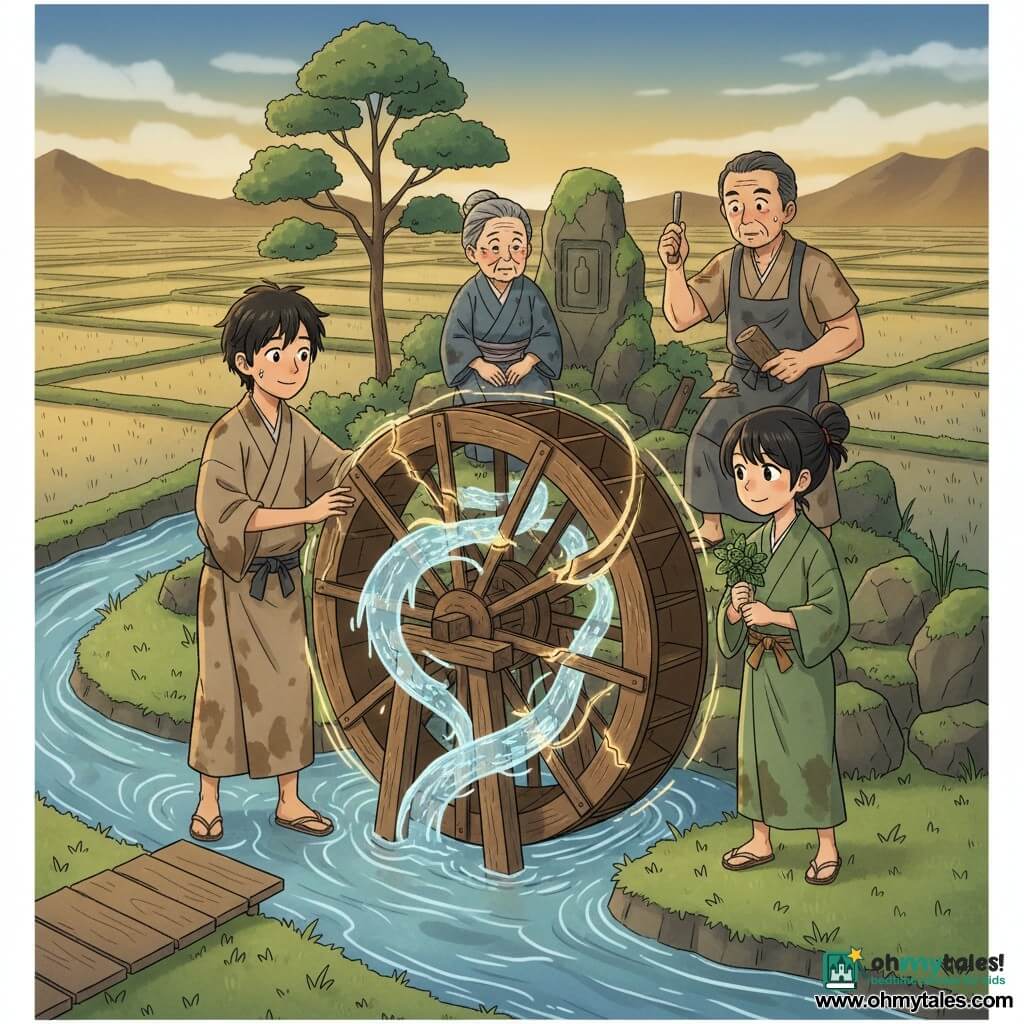
It stood beside the stream like a giant wooden sun that had stopped rising. Its paddles were cracked, its axle groaned, and one section had sagged so low that the wheel dipped and shivered instead of turning smoothly. The water still pushed, patient as a grandmother, but the wheel only managed a tired half-spin and then a stubborn sigh.
Without the wheel, the irrigation channels ran thin. The paddies drank slower. The village still ate, but everyone worried, the way you worry when a candle flame becomes small.
Haru's dream was a secret he kept tucked inside his chest like a warm pebble: he wanted to repair the wheel and make it sing again.
He had asked the head carpenter once, “Could I learn to fix it?”
The carpenter, Old Jiro, had scratched his chin. “You can learn. But the wheel is older than my knees. It needs more than hands. It needs harmony.”
“Harmony?” Haru had repeated, feeling the word settle like mist.
Old Jiro had nodded toward the shrine. “Watch. Imitate. Thank. That's how wood listens.”
So Haru watched. He watched the stream's patience, the wheel's stubbornness, the way the reeds bowed and rose. He copied the carpenter's knots on spare rope. He thanked the river for its coolness and the trees for their shade.
Still, his secret stayed secret.
At night, he lay under the paper walls of his small room and listened to frogs tapping out their bright, uneven music. In the dark he imagined the wheel turning again, pouring water into the channels like a generous ladle.
Then, one evening, as summer began to loosen its grip and the first thread of autumn slipped into the air, Haru heard something strange—something that did not belong to frogs or wind.
A faint singing drifted from the direction of the broken wheel.
Not a human voice. Not quite.
It was as if the river itself had found an old lullaby and was humming it through stones.
Haru sat up, heart thumping like a small drum.
And the night, usually gentle, suddenly felt full of eyes—curious, not cruel.
“Haru,” the darkness seemed to whisper, “listen.”
Chapter 2: The Song Under the Water
The next morning the village smelled of rice straw and miso. Smoke rose in thin lines from cooking fires, like messages sent upward.
Haru kept his face calm, but inside he was a kite tugging at its string. After his chores he walked to the stream, pretending to check the channels, but really he was chasing that night-song.
The water wheel stood in its usual tired pose. A dragonfly perched on a broken paddle, wearing the sunlight like a jewel.
Haru bowed, as he always did when he approached something old. “Thank you for feeding us,” he said softly, because gratitude was a language spirits understood.
He leaned close. The wheel smelled of wet wood and moss, like the inside of a forest.
Then he heard it again—very faint, hiding under the gurgle.
A melody, slow and circular, like the wheel's best memory.
Haru put his hand on the wheel's rim. The wood was cold, but a small shiver ran through his fingers as if the wheel were trying to reply.
“What are you singing?” he whispered.
The water burbled. A leaf floated by, twirling once, twice, as if dancing to the tune.
Behind him, a voice said, “If you put your ear right there, you'll hear the river gossip.”
Haru startled and turned. It was Mei, the shrine keeper's niece, carrying a basket of herbs. Her smile was sharp in a friendly way, like a new knife that only cuts vegetables.
“You're spying on the wheel,” she said.
“I'm… listening,” Haru answered.
Mei stepped closer, her sandals whispering on the stones. “My grandmother told me this wheel used to sing out loud. In the old days, when people worked together, it made a sound like laughter.”
“Do you think it can sing again?” Haru asked before he could stop himself.
Mei raised her eyebrows. “You want to fix it.”
Haru's cheeks warmed. Secrets, it turned out, were not very good at hiding.
He exhaled. “Yes. But I don't know if I'm strong enough, or skilled enough.”
Mei squatted and plucked a sprig of mint. “Maybe it's not about strength. Maybe it's about… listening the right way.”
She tilted her head. “Last night, did you hear something? Like a song?”
Haru's eyes widened. “You heard it too?”
Mei nodded, suddenly serious. “It came from the stream, and it made my skin feel prickly. My grandmother says ancient songs are like keys. They open things.”
Haru looked at the wheel, at its cracked paddles and sagging frame. “Open what?”
Mei shrugged. “Doors. Hearts. Old promises.”
A breeze slid along the water. For a moment, the wheel turned a fraction, not because of the current, but as if it had chosen to move.
Haru swallowed. “If a song is a key,” he said, “maybe it can open the wheel's memory.”
Mei grinned again. “Then we'd better find the rest of the song.”
And with that, the mystery shifted, like the season changing in a single breath.
Chapter 3: The Shrine of Listening Stones
That afternoon, Haru carried a small offering—two rice cakes wrapped in leaves—to the shrine at the top of the village. The stone steps were warm from sun, and cedar shadows lay across them like dark ribbons.
Mei met him there, smelling of herbs and determination.
Inside the shrine grounds, a row of smooth stones sat beneath a sakaki tree. Villagers called them the Listening Stones because, long ago, someone claimed the kami leaned down to rest their ears on them.
Haru knelt and placed the rice cakes neatly on a wooden stand. He clapped twice, bowed, and spoke in a voice that did not tremble—because this was something he had practiced his whole life.
“Kind spirits,” he said, “thank you for water and grain. Please help us learn what we need to learn.”
Mei leaned toward him and whispered, “Ask about the song.”
Haru nodded. “And… please, if there is an old song meant for our wheel, let us hear it.”
The air felt thicker, like the moment before rain. A crow called from the gate, then went quiet as if it, too, had decided to listen.
Nothing happened.
Mei's mouth tightened. “Maybe they're busy.”
Haru touched the nearest Listening Stone. It was cool, almost damp, though the day was dry. He closed his eyes and tried to do what Old Jiro had said: watch, imitate, thank.
He listened, not only with ears, but with the quiet part of himself.
At first he heard only ordinary sounds: leaves rustling, someone's far-off laughter, a bell on a goat. Then, under all that, something else—a humming so gentle it could have been his own blood.
Mei's hand found his sleeve. “I hear it,” she breathed.
The humming grew clearer. It wasn't words yet—more like a path being drawn.
Then, from behind the shrine, an old woman appeared.
Haru knew her. Everyone did. She was called Oba Sumi, and she lived alone near the bamboo grove. Children said she could scold thunder into being polite.
Oba Sumi walked as if she had nowhere else to be. She stopped in front of Haru and Mei and looked at the rice cakes.
“So,” she said, “you've come to bother the spirits with your questions.”
Mei opened her mouth, but Oba Sumi held up one finger. “No babbling. The kami like respect, not noise.”
Haru bowed low. “Oba Sumi, we heard an old song by the water wheel.”
The old woman's eyes sharpened. “Did you, now?”
“Yes,” Haru said. “It felt like… an invitation.”
Oba Sumi sat on a stone and sighed as if she had been carrying a story for too long. “My mother taught me that song. Her mother taught her. It's not for showing off. It's for working together.”
Mei leaned forward. “Will you teach us?”
Oba Sumi's gaze moved from Mei to Haru. “Why do you want it, boy?”
Haru thought of the paddies, the thin channels, the worried faces. He thought of his secret dream, now standing in daylight.
“So everyone can have enough,” he said. “And so the wheel can do what it was made to do. I want to share the water fairly.”
The old woman's expression softened—just a little, like a tight knot loosening. “A wheel is a circle,” she said. “And a circle does not keep anything for itself.”
She began to hum.
The melody curled like steam from a teacup. Then words slid into it, simple as river stones:
“Turn, turn, wooden sun,
drink the stream and share with all.
Laugh, laugh, wheel of old,
let the rice fields hear your call.”
Haru repeated it, carefully. Mei joined, and their voices wove together—two threads finding the same needle.
Oba Sumi nodded. “Tonight, sing it by the wheel. But remember: a song is only air unless your hands and hearts move with it.”
Haru bowed again, feeling the world shift into a new shape—one where his dream was no longer just his.
It belonged to the village. And perhaps, to the spirits too.
Chapter 4: Wood, Water, and Wide Smiles
The next day Haru went to Old Jiro's workshop. The smell of sawdust and cedar hit him like a friendly wave. Tools hung on the wall, each one waiting like a soldier at ease.
Old Jiro looked up from a plank. “If you've come to borrow my chisel, you'll bring it back sharper than you found it.”
Haru bowed. “I've come to ask for help.”
Old Jiro snorted. “Finally. Your eyes have been staring at that wheel so hard I thought they'd fall in.”
Haru explained about the song, about Oba Sumi, about the Listening Stones. He expected the carpenter to laugh.
Instead, Old Jiro's face grew thoughtful. “Ancient songs,” he murmured. “My father said the same: wood remembers music.”
He set down his plank. “All right. We will repair it. But not you alone.”
Mei appeared at the doorway, holding a bucket. “I can carry water and fetch herbs for blisters.”
Old Jiro pointed at her. “You can also keep the boy from doing something heroic and foolish.”
Mei saluted with two fingers. “My greatest talent.”
News traveled fast in Aogiri. By afternoon, two farmers arrived with rope. A fisherman came with sturdy bamboo poles. Even little Kenji, who was ten and missing a front tooth, brought nails in a pouch and said, “My mother says I should be useful.”
Old Jiro made everyone bow to the wheel before they touched it. “Respect first,” he said. “Then work.”
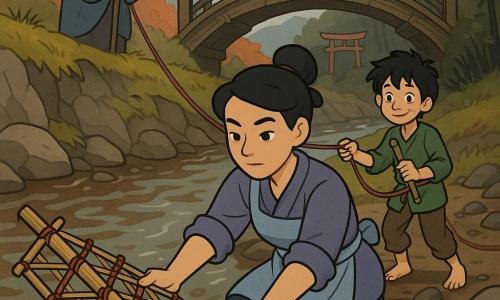
They lifted the sagging section with bamboo supports. Haru scraped moss from the axle, his arms aching but his mind bright. Mei tied knots that looked like tiny miracles. The farmers hammered wedges. The fisherman adjusted the paddles with the calm patience of someone who has waited for fish to decide.
When someone dropped a nail into the stream, Kenji yelped, “The river stole it!”
Mei peered into the water. “It's not stealing. It's borrowing. The river always gives back… usually in the form of wet socks.”
Even Old Jiro's moustache twitched, which was as close as he came to laughing.
As the sun lowered, the wheel looked less like a broken sun and more like one preparing to rise. Fresh wood pieces gleamed pale against the dark old beams, like bandages on a brave elbow.
But when they removed the supports, the wheel still refused to turn properly. It groaned, shuddered, and stopped again.
Old Jiro wiped his forehead. “Something is still wrong. The wheel is balanced, but it doesn't want to move.”
Haru placed his hand on the rim. He felt the wood's chill. He imagined it as a tired elder who had been asked to run without being greeted.
He looked at the villagers—sweaty, dusty, helpful. They had given their time, their strength, their jokes. They had shared.
That was the difference.
“This is where the song comes in,” Haru said.
The villagers exchanged glances. Some looked curious; some looked as if they were about to blame the boy for talking to water.
Mei stepped beside Haru. “We're going to sing,” she announced, “and if any of you giggle, the frogs will judge you.”
Kenji immediately giggled, then clamped a hand over his mouth.
Old Jiro grunted. “If singing fixes wood, I will personally sing to my roof and ask it to stop leaking.”
“Deal,” Mei said.
Haru took a breath and felt the stream's cool air fill him. He began softly:
“Turn, turn, wooden sun…”
Mei joined. Then, to Haru's surprise, one farmer added his deep voice. The fisherman followed, and even Kenji sang, a little off-key but fierce with effort.
Their voices rose together, not perfect, but honest. The sound moved across the water like a lantern carried through mist.
And somewhere in that sound, Haru felt the wheel listening.
Chapter 5: The Kind Spirits of the Current
As the chorus reached “share with all,” the stream changed its voice. It did not become louder; it became clearer, like a bell ringing underwater.
The wheel trembled.
At first Haru thought it was only the current pushing harder. Then he saw it: a pale shimmer at the wheel's base, as if moonlight had decided to visit early.
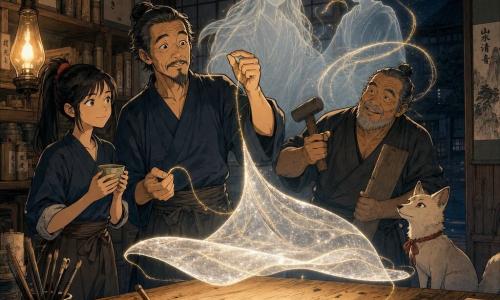
Tiny shapes—no bigger than a child's fist—rose from the water. They were not frightening. They looked like droplets given faces, like the river's laughter made visible. Their eyes were dark beads, their bodies clear as glass, and each one held a thread of light.
“Suijin's helpers,” Oba Sumi whispered from behind them. Somehow she had arrived without anyone noticing, as if old women and spirits shared a secret path.
The villagers froze. Kenji's jaw fell open so wide Haru worried a dragonfly might fly in.
The little river-spirits floated around the wheel's axle. They did not speak with mouths. They chimed, like pebbles clinking together, and Haru understood in the way you understand a dream: they were answering the song.
Mei's voice shook but did not stop. Haru kept singing, because fear was only another kind of wind, and you could sing through wind.
One spirit touched the new wood patch. Another slid its light-thread along a crack, sealing it with a gleam like morning frost. A third circled the axle, and the groan in the wood softened into a sigh of relief.
Old Jiro stared, then muttered, “Well. I'll be. My roof owes me an apology.”
The villagers' voices grew stronger. Not because they were brave heroes, but because they were together. Sharing the song felt like sharing a bowl of warm soup—simple, necessary, comforting.
The wheel began to turn.
Slowly at first. A creak, then a smooth roll. Water spilled from the paddles in sparkling sheets. The wheel's shadow rotated on the stones like the hands of a giant clock.
The river-spirits drifted upward, spinning around each other like playful minnows. Their threads of light twined into the air and vanished.
And the wheel—finally moving—made a sound Haru had never heard before.
It was not just creaking wood.
It was laughter.
Not loud laughter. The soft, steady laughter of something doing its job again after a long, lonely pause.
Haru felt his throat tighten. He blinked fast, blaming dust.
Mei nudged him. “Your secret dream is making a lot of noise,” she whispered.
Haru whispered back, “It's not mine anymore.”
Oba Sumi nodded once, as if she had been waiting to hear those exact words.
The wheel turned and turned, and water ran into the channels, quickening like excited feet. The paddies drank, and the mirrored fields caught the last light of day and held it like a promise.
Chapter 6: The Circle of Sharing
By the next morning, the rice paddies looked different. The water level was higher, and the seedlings stood straighter, as if someone had whispered good news to them during the night.
Villagers gathered by the wheel with offerings: a bowl of rice, a handful of persimmons, a cup of tea that steamed like a small cloud. No one spoke loudly. Even Kenji behaved as if his missing tooth had learned manners.
Old Jiro cleared his throat. “We should thank the river,” he said, then added quickly, “and the boy, too, I suppose.”
Mei crossed her arms. “He's right here, you know. You can thank him without pretending it's an accident.”
Haru shook his head. “Thank everyone,” he said. “I couldn't have lifted one paddle alone.”
So they did. They thanked the carpenter for his skill, the farmers for their strength, the fisherman for his calm, Mei for her quick hands, Kenji for his nails, Oba Sumi for the song.
And they thanked the stream and the wheel and the unseen spirits who had stitched light into old wood.
Then Haru did something he had not planned, but felt as natural as breathing.
“There's a festival in three nights,” he said. “For the harvest moon. Usually we each bring food for our own families.”
Mei tilted her head. “Usually.”
Haru looked at the turning wheel, at how it took the river's push and gave it back as water for everyone. “This year,” he said, “let's make one long table. Let's share the meal the way the wheel shares the stream.”
A silence followed, the kind that measures an idea.
Then Kenji burst out, “One long table means I can sit next to anyone! Even the grown-ups who tell scary stories!”
The fisherman chuckled. “And I can bring extra eel. My brother always eats half before it reaches the table.”
A farmer's wife said, “I'll make more rice balls than usual. If we run out, we'll laugh and make more.”
Old Jiro nodded slowly. “A circle feeds best when it stays unbroken.”
Oba Sumi smiled, and it changed her face into something younger for a moment. “Good,” she said. “A song should not be kept in a jar.”
That night, Haru went alone to the wheel and bowed. The moon hung above it like a silver coin offered to the sky.
“Thank you,” he whispered. “For remembering how to turn.”
The wheel kept spinning, steady as a heartbeat. Water flowed into the channels, into the paddies, into the future.
Haru walked home under the quiet stars, feeling the village around him like a warm cloak. His secret dream had opened like a lantern—brightest not when held close, but when carried where others could see.
And from the stream, very faintly, as if the river were smiling in its sleep, the ancient melody returned—soft, circular, and shared.