Chapter 1: The Teahouse of Quiet Strings
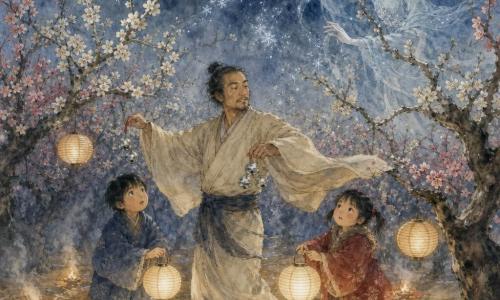
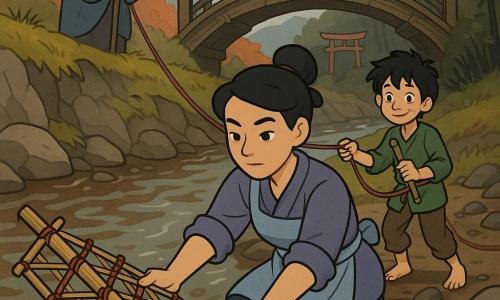
In the mountain town of Mizunagi, spring arrived like a soft brushstroke. Plum blossoms dabbed the air with pink, and the river below the мост—old people still called it the “Moon Bridge”—carried melted snow as if it were gossip from the peaks.
Aiko served tea at the Teahouse of Quiet Strings. She was an adult, with hands that moved gently, as if every cup were a small promise. The teahouse sat beside a cedar grove where wind chimes hung like silver seeds, and the chimes spoke in tiny voices whenever the breeze remembered to breathe.
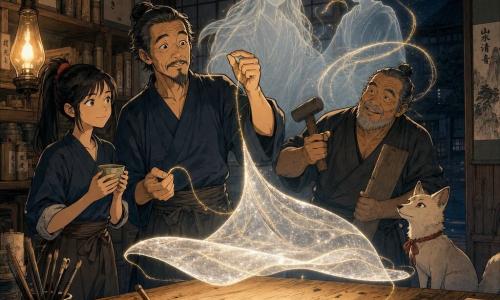
Most evenings, someone asked about the dusty instruments displayed along the wall: a shamisen with a cracked skin, a bamboo flute with a missing knot, a small taiko drum whose rope had frayed into tassels.
“They belonged to the River Lantern Ensemble,” Aiko would say, polishing the counter with a cloth that smelled faintly of rice and sun. Her voice had the calm of water over stones. “Before they scattered.”
The customers always leaned in at that word—scattered—like birds startled from one branch.
It had happened years ago. The musicians had argued during the Lantern Festival. No one in town repeated the exact words, because words can be sharp, and Mizunagi preferred smooth things: round stones, warm bowls, quiet apologies. The quarrel had cracked their harmony like ice on a pond. After that, the flutist left for the coast, the drummer traveled to shrines, the koto player married into a far village, and the shamisen player… well, the shamisen player simply stopped playing, as if she had swallowed her own music.
Aiko never said what she truly wished. She kept her dream tucked inside her like a folded paper crane: to gather the ensemble again, not to force them, not to embarrass anyone, but to bring their music back the way you bring a lantern back to the dark—carefully, without spilling the flame.
That night, rain tapped the roof with patient fingers. Aiko swept the floor after closing. Under the low shelf where old festival posters were stored, her broom snagged on something thin.
A page slid out—yellowed, edged with ink, and scented with cedar smoke. It looked like it had been waiting there, holding its breath.
Aiko picked it up. Lines of music curved across it like little rivers. In the corner was a stamp: a heron standing on one leg, watching the world.
Her heart made a quiet leap.
“The ensemble's seal,” she whispered.
Outside, the rain paused. In the cedar grove, the chimes gave one bright note, as if someone had nodded in the dark.
Chapter 2: The Page That Would Not Stay Still
Aiko carried the page to the lantern light. The notes seemed ordinary at first—dots and tails marching in neat rows—but when she blinked, the ink shimmered like fish under water. The page was a map wearing the costume of a song.
On the back, in careful brushstrokes, a message appeared as if written by a hand made of mist:
When the four agree to listen, the river will remember their names.
Aiko's mouth went dry, not from fear exactly, but from the strange feeling of being seen by something older than the town.
She wrapped the page in cloth and placed it on the altar shelf at home, beside a small bowl of salt and a sprig of sakaki. Aiko didn't think of herself as a heroic person. She paid rent, she swept floors, she mended torn sleeves. Yet, looking at the folded page, she felt a thread tugging at her sleeves from somewhere beyond the cedar trees.
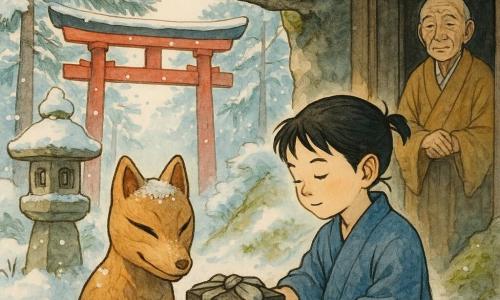
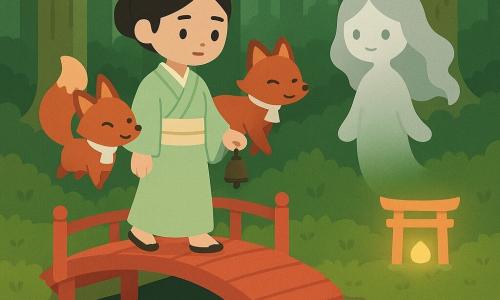
In the morning she visited the shrine at the edge of Mizunagi. The torii gate stood like a red frame for the sky. Fox statues watched with stone patience, their mouths curled in secret jokes.
The shrine keeper, an elderly woman named Oba-san Kiyo, was trimming moss from the steps with the seriousness of a scholar reading a sacred text.
Aiko bowed. “Oba-san… I found something.”
She unwrapped the cloth. The music page lay on her palms like a sleeping moth.
Oba-san Kiyo's eyebrows rose. “Ah. The river's handwriting.”
“The river can write?” Aiko asked, half smiling at how odd it sounded.
“The river can do many things,” Oba-san said. “Mostly it listens. Sometimes it speaks. When it is in a generous mood, it leaves hints.”
Aiko swallowed. “It belongs to the River Lantern Ensemble. I want to bring them back together. But I don't want to drag anyone. And I don't want the town to laugh at them for what happened.”
Oba-san Kiyo snorted softly. “Justice that humiliates is only another kind of cruelty. In Mizunagi, we mend. We do not smash.”
Aiko's shoulders loosened, as if someone had untied a knot.
Oba-san Kiyo leaned closer. “If you go, go like rain. Rain does not shout at the roof. It simply returns, again and again, until even hard wood remembers water.”
Aiko looked at the stamped heron on the page. “Where do I start?”
Oba-san Kiyo pointed to the river, glittering beyond the shrine. “Walk along it. Let the song lead. And if you meet spirits, bow first. Even a mischievous spirit likes good manners.”
As Aiko turned to leave, a gust of wind rolled through the shrine grounds. A single maple leaf—bright red, impossibly out of season—fell into Aiko's hand.
Oba-san Kiyo's eyes twinkled. “A traveling sign. Keep it. Some doors open only for those holding autumn.”
Aiko tucked the leaf into her pocket beside the page. Then she started down the river path, where the water ran like a silver ribbon tied around the town's waist.
Chapter 3: The Flute by the Tide
The first notes on the page curved toward the coast. Aiko followed the river until it widened, grew brackish, and finally joined the sea with a sigh.
The coastal village of Shiosato smelled of salt and grilled fish. Sea gulls argued loudly above the roofs, like old men competing to tell the same story.
Aiko found the flutist, Ren, near the tide pools. He was crouched beside a rock, speaking to a crab as if it were a strict teacher.
“Don't pinch,” Ren scolded gently. “Use your words.”
The crab pinched anyway, because crabs are not famous for taking advice.
Aiko stepped closer. “Ren?”
He looked up, startled. His hair was longer than Aiko remembered, tied back with a faded ribbon. His eyes had the careful look of someone who has learned to dodge certain memories.
“Aiko from Mizunagi,” he said slowly. “The teahouse.”
“Yes,” she replied. “I came because… I found something.”
Ren wiped his hands on his trousers. “If you came to ask about the ensemble, don't. That's a closed door.”
Aiko didn't argue. She didn't push. She held out the maple leaf, red as a small sunset, and then the music page.
Ren stared. The sea wind ruffled the paper. The notes seemed to sway, like reeds in a current.
His voice softened despite himself. “Where did you get that?”
“Under a shelf,” Aiko said. “Like it was hiding, or waiting.”
Ren's jaw tightened. “The quarrel wasn't small, you know.”
“I know it was painful,” Aiko said. “But I'm not here to reopen wounds. I'm here because the town is quieter without your music. And because… I think the river wants something mended.”
Ren gave a short laugh. “The river should mind its own water.”
Aiko smiled a little. “Maybe it is. Maybe this is its water.”
Ren looked away, toward the ocean. A wave rolled in, then retreated, leaving shells like scattered coins.
“I was proud,” Ren admitted at last, voice low. “I thought my breath carried the whole song. When someone criticized me, I snapped. I said things that tasted bitter even as they left my mouth.”
Aiko nodded. “When we're hurt, we sometimes throw our hurt like stones. But stones sink. They don't solve anything.”
Ren's shoulders sagged. “And if I return, everyone will remember. They'll point. They'll whisper.”
Aiko shook her head. “Not in Mizunagi. We fix without shaming. If anyone whispers, I'll serve them tea so hot they'll have to use their mouths for blowing instead.”
Ren blinked, then snorted—almost a smile.
Aiko opened the page. “Listen.”
She hummed the line of melody written there—simple, but strong as a bamboo stalk. She wasn't a trained singer, yet the tune seemed to lift itself, as if the paper lent her its voice.
Ren's fingers twitched. Then, as naturally as breathing, he whistled the next phrase. The sound was thin at first, like a thread, then steadier, brightening in the sea air.
A tide pool reflected the sky. For a moment, Aiko thought she saw a heron's shadow glide across the water, though no bird stood nearby.
Ren stopped whistling and stared at his own hands, as if surprised they still remembered music.
“Come back,” Aiko said quietly. “Not for the old argument. For the new peace.”
Ren took a long breath, tasting salt and something else—possibility.
“I don't have my flute,” he said.
Aiko pointed toward the tide pools. “Then let's ask the sea politely.”
Ren raised an eyebrow. Aiko bowed to the water anyway. “Please. If you've borrowed what was lost, return it. We will thank you.”
The waves chuckled against the rocks. A small piece of bamboo floated up, nudged by the current, and bumped Ren's ankle. It was his flute, sealed in waxed cloth, scratched but safe.
Ren stared, then bowed—deeply, like a man learning a forgotten lesson.
“All right,” he said. “I'll come. But only if no one turns it into a punishment.”
Aiko's eyes warmed. “Agreed.”
Chapter 4: The Drum That Answered in Thunder
The next part of the page led inland, where fields rolled like green quilts. Summer had begun to stretch its arms. Cicadas sang as if trying to outshout the sun.
Aiko and Ren walked along the road, and when their feet grew sore, they spoke about small things: tea flavors, sea gulls, the crab who refused to learn manners. Their laughter was light, like paper lanterns bobbing on water.
They found the drummer, Daichi, at a mountain shrine. He was repairing a torii gate, his sleeves tied up, his face smeared with honest dirt. A taiko drum sat nearby, but its skin was patched, its voice likely dull.
Daichi spotted them and straightened, cautious. “If you came to complain, I already confessed to the priest this morning.”
Ren muttered, “He confesses for fun.”
Daichi glared. “I do not.”
Aiko stepped between them like a calm stream between two rocks. “Daichi, we didn't come to complain. We came to invite.”
Daichi's eyes narrowed at the page when Aiko showed it. “That seal… That song.”
“We're trying to mend what broke,” Aiko said. “Without making anyone a villain.”
Daichi's shoulders rose defensively. “Everyone already decided I was the villain. ‘Daichi shouted.' ‘Daichi slammed his drumsticks.' Like I'm some kind of walking thundercloud.”
Ren opened his mouth, but Aiko lifted a hand.
“Thunder isn't evil,” she said. “It just means the sky is full. But people can learn to empty themselves gently.”
Daichi's expression flickered. “You speak like Oba-san Kiyo.”
“Maybe her words are sticky,” Aiko said. “They cling to whoever listens.”
Daichi looked away at the shrine steps, where moss grew in patient layers. “I was angry because no one listened. The music was falling apart. I thought if I hit harder, everyone would follow.”
Ren's voice softened. “And I thought if I played louder, everyone would admire me.”
They both fell quiet, the way boys sometimes do when they find themselves standing in the same puddle.
Aiko unfolded the page. “This part of the song needs a heartbeat,” she said. “Not a battle.”
Daichi approached the patched taiko. He tapped it with his fingers. The drum answered with a tired thump, like an old man clearing his throat.
Daichi grimaced. “It sounds like it's made of boiled potatoes.”
Ren laughed. “At least boiled potatoes are dependable.”
Daichi tried to smile, but worry tugged at him. “If I come back with a drum that croaks, I'll ruin everything.”
Aiko crouched beside the taiko. On the wooden frame, she noticed tiny carvings—spirals like whirlpools, barely visible.
“Daichi,” she said, “did you ever thank your drum?”
He blinked. “It's a drum.”
“Instruments listen too,” Aiko replied. “They don't like being treated like tools you can yell through.”
Daichi rubbed the back of his neck, embarrassed. Then he bowed to the drum—awkwardly at first, like someone bowing to a cat.
“Thank you,” he said, voice low. “For carrying my noise when my heart was too heavy.”
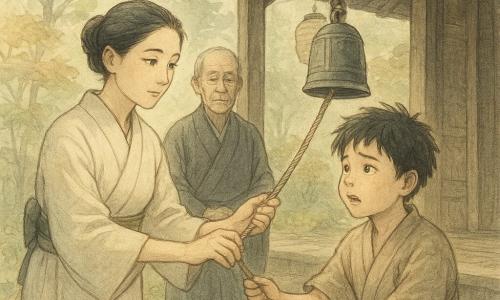
The air shifted. A breeze slid through the cedar branches, and the shrine's bell gave a small ring without being touched.
Daichi tapped the drum again. The sound was deeper now, rounder, like a warm stone dropping into water—plop, and then ripples.
Daichi's eyes widened. “Did… did it just wake up?”
Ren grinned. “Maybe it was offended by the boiled potatoes comment.”
Aiko smiled. “Or maybe it just wanted kindness.”
Daichi stood straighter. “All right. I'll come back with you. But if anyone tries to make me grovel—”
“No groveling,” Aiko said firmly. “Only listening.”
Daichi nodded, relief and fear mixed together like ink in water.
As they left the shrine, Aiko thought she heard footsteps behind them—soft, like bare feet on leaves. When she turned, no one was there. Only a dragonfly hovered in the air, its wings catching sunlight like tiny panes of glass.
Chapter 5: The Koto in the House of Many Silences
The last trail of notes pointed to a village where rice paddies mirrored the sky. It was early autumn now; the world had shifted into gold, as if summer had exhaled and left warmth behind.
They reached a house surrounded by persimmon trees. Orange fruit hung like lanterns that had forgotten to be lit.
Inside lived Hana, the koto player. She was married, busy, and known for being polite in a way that kept everyone at a safe distance—like a fence painted with beautiful flowers.
Aiko bowed at the gate. “Hana.”
Hana opened the door and froze when she saw Ren and Daichi. Her smile appeared, small and careful. “You've come a long way.”
“We came because the river sent us,” Daichi said, immediately regretting how strange it sounded.
Hana's gaze slid to Aiko, who held up the page. “I found this,” Aiko said. “It belongs to the ensemble.”
Hana's fingers tightened on the doorframe. “I don't play anymore.”
Ren frowned. “But you—”
Aiko gave him a look that said, Not yet.
Hana stepped outside, closing the door behind her, as if afraid her home might overhear. “When we argued,” she said softly, “I felt like a bridge with too many feet stomping on it. I thought if I left, the bridge would stop shaking.”
Daichi's face fell. “We didn't mean—”
“I know,” Hana said quickly. “That's the problem. Nobody meant anything, and still everything happened.”
Aiko listened to the pauses between Hana's words. They were heavy pauses, like stones in a pocket.
“We want to play again,” Ren said. “But not the old way.”
Hana shook her head. “I have a family now. I have work. I can't chase music like a firefly.”
Aiko's voice was gentle. “No one is asking you to chase. Only to hold your lantern still for a moment, so others can find the path.”
Hana's eyes flickered, betrayed by longing. “If I return and fail… if my fingers are slow… if the town remembers my running away—”
Aiko stepped closer. “In Mizunagi, justice repairs without humiliating. If someone speaks cruelly, we will answer with calm. Cruelty is a spark; calm is a river.”
Daichi nodded. “I was loud back then. If you come, I'll be quieter. I swear. I can keep my thunder in my pocket.”
Ren added, “And I'll stop acting like my flute is the sun.”
Hana let out a small laugh, surprised by it. Then her laughter faded into a sigh.
“My koto is stored away,” she said. “It feels like it belongs to a different person.”
“Maybe,” Aiko replied, “but that person is still part of you, like a season you once lived through.”
Hana hesitated, then opened the door and led them inside.
The koto lay in a long wooden case. When Hana lifted the lid, a smell of paulownia and old festivals rose up. She ran her fingers over the strings without plucking them, as if greeting sleeping birds.
Aiko placed the red maple leaf on the koto's surface. “Autumn came with us,” she whispered, though she wasn't sure to whom.
Hana looked at the leaf, then at the music page. The notes gleamed faintly.
“I'll come,” Hana said at last. “But only if we do it gently. No competitions. No blaming. No forcing the song.”
Aiko bowed deeply. “Gently.”
That night, as they slept under Hana's roof, Aiko dreamed of a river made of sound. In the dream, a heron walked along the music, dipping its beak into notes and lifting out little pearls of light.
Chapter 6: The Lantern Festival That Mended the Dark
By the time they returned to Mizunagi, leaves had begun to turn. The town smelled of roasted chestnuts and wood smoke. Lanterns were being painted for the festival, their paper bellies waiting for fire.
Only one musician remained: the shamisen player, Sora, the one who had stopped playing. She lived near the cedar grove, in a small house where the shutters were often closed, as if she kept the daylight outside to avoid questions.
Aiko went alone.
She knocked. The sound seemed loud, like a pebble dropped into a well.
After a long moment, Sora opened the door a crack. Her face was pale, not sickly, but moon-pale, as if she spent her time in quiet.
“Aiko,” she said, surprised. “Do you need tea leaves?”
“I need your ears,” Aiko replied softly. “May I come in?”
Sora hesitated, then stepped aside.
The room smelled of dust and cedar. In the corner lay a shamisen wrapped in cloth, like a secret.
Aiko sat on her heels. “I found a page,” she said. “The ensemble's song.”
Sora's eyes tightened, like someone bracing for cold water.
“I brought Ren back. And Daichi. And Hana,” Aiko continued. “Not to accuse. Not to replay the argument. To listen, and to mend.”
Sora's voice was thin. “You can't mend what I broke.”
Aiko looked at Sora steadily. “What did you break?”
Sora's hands clenched in her lap. “I… I said the cruelest thing,” she whispered. “I used someone's private pain as a weapon. When I saw their face… I realized I had struck where it would never heal.”
Aiko did not ask who. Names were not always helpful. Sometimes they were nails.
Sora's eyes shone. “After that, I thought the only honest thing was to disappear from music. I didn't deserve it.”
Aiko leaned forward slightly. “Non-violence isn't only about not hitting with fists. It's also about not hitting yourself forever. Punishing yourself doesn't heal the person you hurt. It just makes two wounded hearts instead of one.”
Sora flinched, as if the words were both true and difficult.
Aiko drew the music page from her sleeve. “This page said: ‘When the four agree to listen, the river will remember their names.' It doesn't say, ‘When the four are perfect.' It says, ‘When the four listen.'”
Sora stared at the notes. Her breath trembled.
“There will be no public shaming,” Aiko promised. “If there is an apology, it will be like a lantern offered with both hands—private, steady, sincere.”
Sora's eyes slipped toward the wrapped shamisen. “What if they don't want me?”
“Then we will accept their no,” Aiko said. “Non-violence means we do not force. But we can invite. And we can be brave enough to hear the answer.”
Sora was silent for a long time. Outside, the cedar chimes sang one soft note, like a finger tapping a cup.
Finally, Sora stood and crossed the room. She unwrapped the shamisen slowly. The instrument's wood was dark and worn, like a river stone smoothed by years.
Sora held it as if it were fragile. “My hands feel… guilty,” she said.
“Then let them learn gentleness,” Aiko replied.
On the night of the Lantern Festival, the town gathered by the river. Paper lanterns floated on the water, each one carrying a wish like a little boat of light.
Aiko had arranged the performance quietly. No posters shouting about a reunion. No dramatic announcements. Only a simple note at the teahouse: Music by the river. Bring warm sleeves.
The four musicians met behind the shrine's side building. They stood in a half-circle, like strangers sharing the same shadow.
Ren spoke first, voice careful. “Before we play… I'm sorry. I turned music into a mirror for my ego.”
Daichi bowed. “I'm sorry for trying to hammer harmony into place.”
Hana's eyes shone as she bowed too. “I'm sorry for leaving without explaining. I thought silence was safer than truth.”
Sora's lips trembled. She bowed so low her forehead nearly touched the floor. “I said something unforgivable,” she whispered. “I won't repeat it. But I will carry the shame of it without throwing it at anyone else. If you can't forgive me, I will understand.”
The air held its breath. Even the river seemed to pause, lanterns drifting like patient stars.
Ren looked at Sora. “I don't forgive you like it's a prize,” he said slowly. “But I can choose not to hurt you back. And I can choose to let you change.”
Daichi nodded. “No more stones.”
Hana stepped forward and touched Sora's sleeve—lightly, like a falling leaf. “Let's play. Let the music do what we couldn't.”
Sora's eyes filled, but she blinked the tears back. “Thank you,” she whispered.
They walked to the riverbank where people waited with quiet curiosity. No one jeered. No one pointed. In Mizunagi, the crowd watched the way you watch a candle being lit—carefully, hoping it won't go out.
Aiko stood a little behind them, not part of the ensemble, but part of the mending. The night was cool. The moon hung above the water like a pale drum.
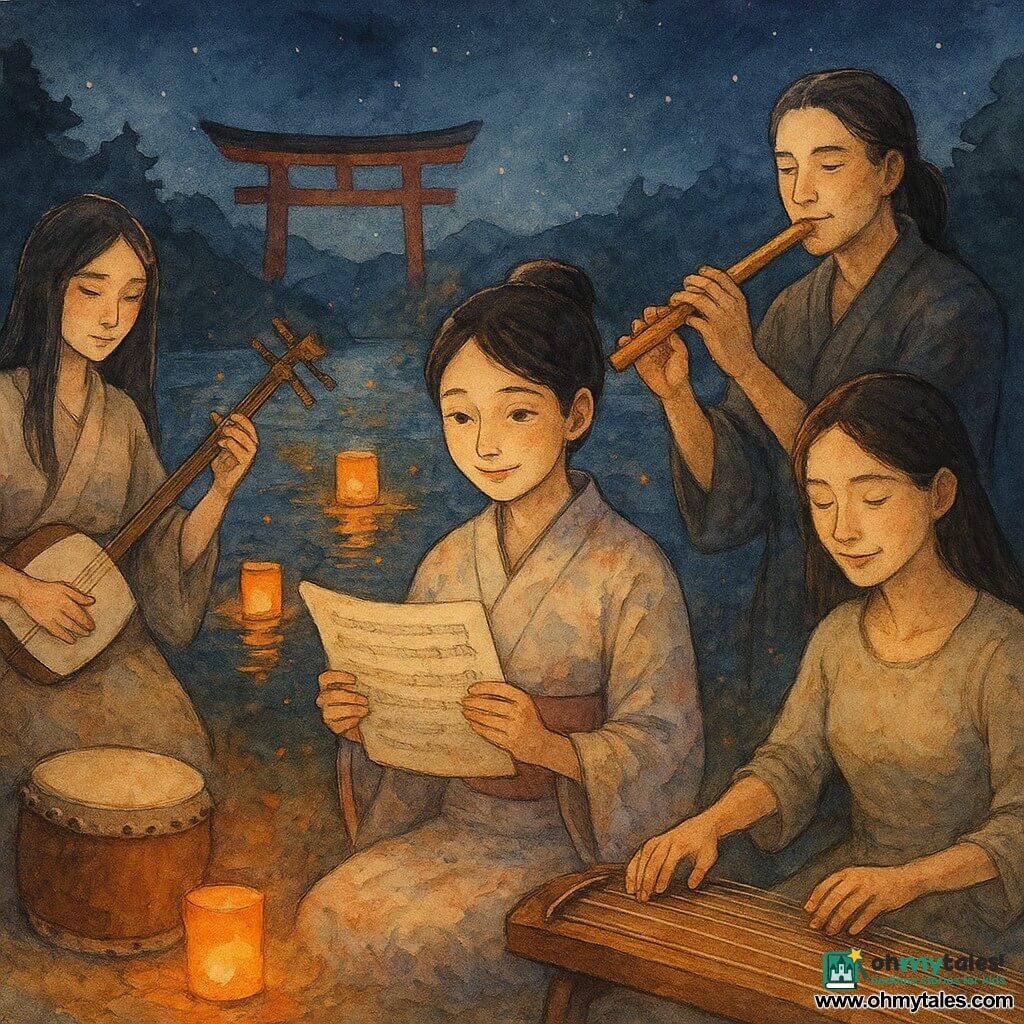
Ren lifted his flute. Daichi raised his sticks. Hana placed her fingers on the koto strings. Sora set her hand on the shamisen's neck.
They began.
At first the music wobbled, like a newborn deer finding its legs. Then it steadied. The melody from the page rose into the air, curling through lantern light, slipping between cedar trunks, brushing the shrine's torii like a prayer.
The sound was not loud. It didn't need to be. It was strong the way roots are strong—hidden, patient, holding the earth together.
As they played, a heron appeared on the far bank, white in the dark, watching with calm eyes. It stood perfectly still, as if it had been carved from moonlight.
Aiko's throat tightened. She remembered the stamp, the shimmering ink, the message.
When the song reached its final line, the river seemed to answer. The lanterns drifted in a slow spiral, forming a wide circle of light. For a moment, the water reflected not just moon and flame, but four clear shapes—four musicians—bound together by sound.
The crowd sighed, a single soft wave of breath.
A child near Aiko tugged her sleeve. “Is it magic?” the child whispered.
Aiko smiled. “It's listening,” she whispered back. “Listening is a kind of magic.”
After the performance, people approached the musicians one by one. Not to scold, not to demand a story, but to offer small kindnesses: a rice ball wrapped in seaweed, a wool scarf, a warm cup of tea.
No one asked for the details of the quarrel. Mizunagi didn't need to chew on old thorns.
Later, when the lanterns had floated out of sight and the night grew sleepy, the four musicians stood by the river with Aiko.
Ren looked at her. “You did this.”
Aiko shook her head. “The river did. I only carried the page.”
Daichi chuckled. “Still. You carried it like it mattered.”
Hana's smile was gentle. “What now?”
Aiko watched the water glide past, endlessly moving, never rushing. “Now you keep listening,” she said. “When pride rises, listen. When anger knocks, listen. When silence tempts you to run, listen. Not to win—just to understand.”
Sora glanced at her shamisen, then at the lanterns' fading glow. “I thought justice meant I had to suffer forever,” she said.
Aiko's voice was as soft as the river's edge. “Justice that repairs makes space for change. It doesn't build cages.”
The heron on the far bank lifted its wings once—slow, dignified—then vanished into the dark, as if it had never been there at all.
But the music remained, humming in the air, settling into the town like warm tea into a cup.
And Aiko, modest as a single candle, walked home under the cedar chimes, her secret dream no longer folded away, but opened—like a paper crane finally taking flight.