The Morning the Sea Held Its Breath
Sayo walked the shore at dawn, when the sea wore a veil of mist and the stones kept secrets under moss. Her sandals whispered in the damp sand. The wind shook the pine needles like tiny bells, and the gulls wrote messy letters in the air that no one could read.
“Another day,” Sayo murmured. She was a weaver of nets and a mender of little things—cracked bowls, torn sleeves, and promises that had frayed with time. She carried a coil of rope at her hip and a cloth bag of tools that chimed softly as she walked.
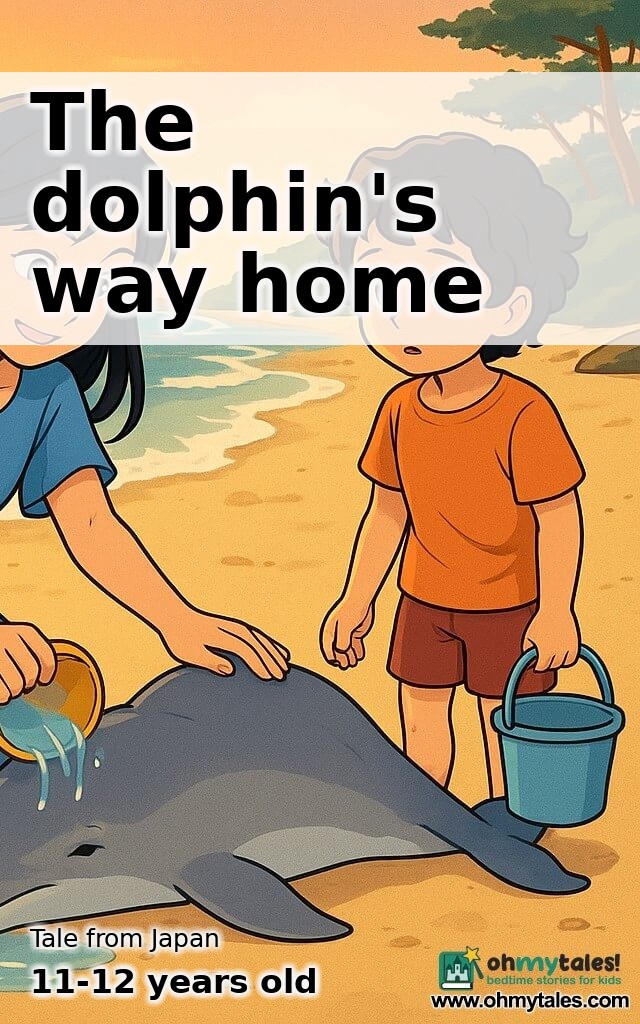
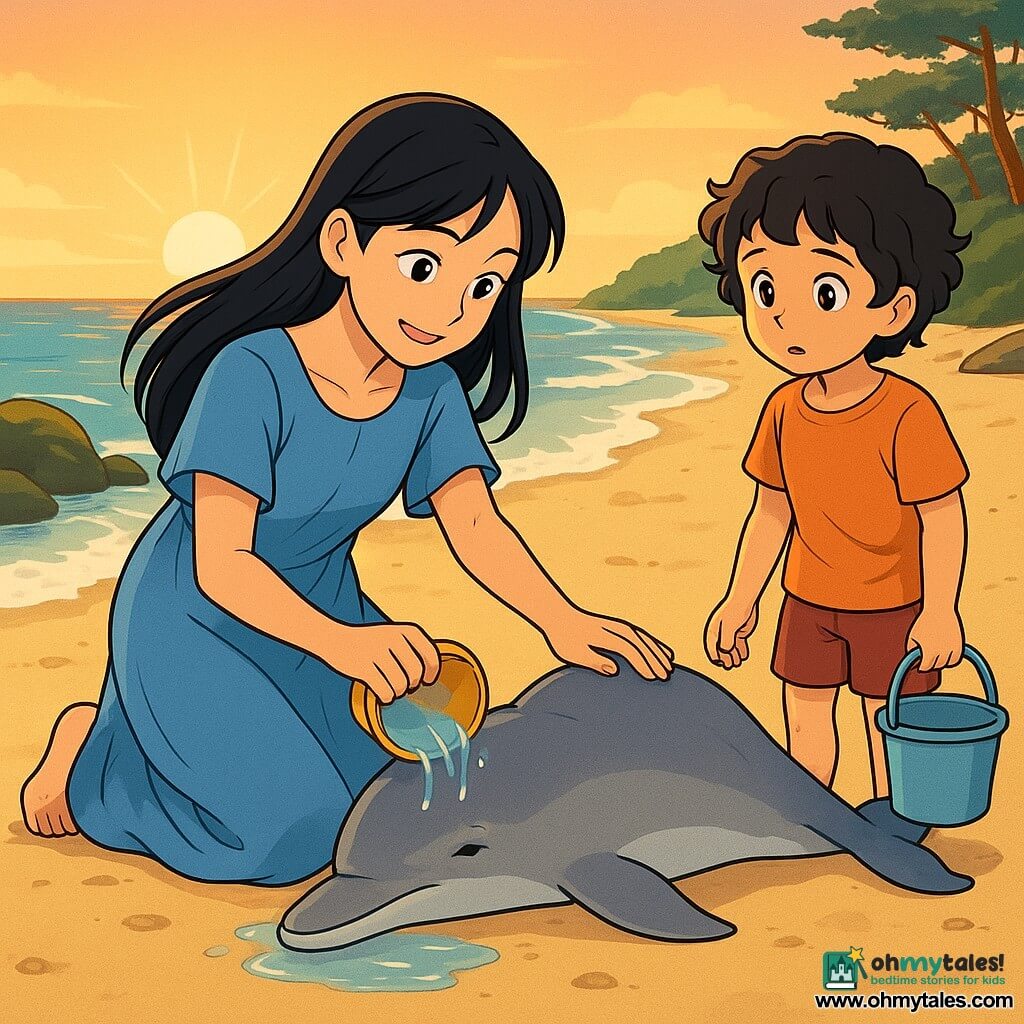
By a tidepool, something gray and shining like a drop of moonlight lay still on the shore. It was a dolphin, smooth as a river stone and breathing in shallow shivers. Its dark eye blinked up at the pale morning.
“Oh,” Sayo breathed. She knelt, her knees dampened by the sand. “You have come too far.”
The dolphin lifted its head an inch, then let it fall. It made a thin whistle, a sound like a distant flute. The sea, only a few arm-lengths away, rolled and sighed as if embarrassed to be late.
Sayo touched the dolphin's skin. It was warm, not yet burned by the sun. “You're heavy with the weight of the world,” she whispered. “But you belong to the sea. We will get you home.”
She slipped off her jacket and made a shade over the dolphin's back. Then she soaked her scarf in a tidepool and laid it over the animal's skin. The scarf smelled of seaweed and spray. “There, gentle friend,” she said, steady. “I will not leave you.”
The shore was empty. The village was still asleep, roofs tucked under the last dreams of night. Sayo looked east. The sun was a hand holding a golden fan, opening slow. “We have time before it burns too bright,” she said. “We must be clever. We must be kind.”
The dolphin blinked again, as if listening. Sayo felt an old ache in her chest, a memory that tugged like a tide: years ago, she had promised as a girl to the sea-kami at the shrine, standing under the red torii with wet hair and bright eyes. She had whispered, “I will help those who are lost.” Now, as an adult with hands rough from work, that promise rose like a lantern inside her.
She tied her hair back, and the wind stirred as if curious. “All right,” she said, smiling at the dolphin. “Let's begin.”
Salt, Song, and Small Magic
Sayo filled her bucket again and again, pouring water over the dolphin's skin to keep it cool. She hummed a tune her grandmother had taught her, a shanty about a silver carp that leaped into the moon and came back as a falling star. The dolphin's breath evened. Its flukes twitched, an oar remembering water.
“I will need help,” Sayo said to the air. She looked up at the cliff where a line of Jizō statues watched the shore with stone patience. “Please,” she called softly. “If any good spirits are listening, send me a hand. Or a paw. Or a gust of wind.”
From the dune grass came a rustle. A tanuki peered out, round as a dumpling and twice as serious. It adjusted a leaf on its head as if it were a hat.
“You called?” the tanuki asked, voice low and grumbly.
Sayo bowed. “Honored neighbor,” she said with a smile, “do you know where I can find bamboo poles? And a cart? And perhaps three more pairs of hands?”
The tanuki scratched its belly. “A cart? Hm. The fox has a cart. Stole it from the shrine last festival, then felt guilty and kept it polished. As for hands, I have paws and a nose. The bamboo is by the path of the old well.”
“Thank you,” Sayo said. “Would you watch over my friend while I gather these things?”
The tanuki shuffled closer to the dolphin and blew a careful breath across its back. “I will sing to keep the sun lazy,” it announced, and began a deep humming that sounded like a drum made of thunderclouds.
Sayo ran, her sandals biting into the sand, up the steps to the path that curved around the cliff. At the top stood the small shrine to the sea-kami. The torii was a gate of red color, like a smile in winter. Wind chimes tinkled from the eaves, laughing quietly. Sayo placed two coins in the offering box and clapped twice. “Kami of the deep and of the shore,” she said, “lend me your calm. I have kept my promises. Help me keep this one too.”
A white paper ribbon on the sacred rope fluttered and fell into her open palm, as if the wind had given a nod. Sayo tucked it into her pocket as a charm.
“—Sayo!” called a voice. Her younger sister, Megumi, came up the path carrying a basket of plums. She had sharp eyes like the edge of a seashell. “I heard the tanuki humming from my window. What are you doing? I thought you were angry with the sea.”
Sayo's shoulder tightened. They had quarreled last winter, when Megumi wanted to leave for the city and Sayo had insisted the village needed them both. Harsh words had flown like cold birds.
“I was angry,” Sayo admitted, “but anger is a poor roof. It lets in rain.” She pointed toward the shore. “A dolphin is stranded. I need bamboo, a cart, and rope.”
Megumi looked startled, then determined. “I have rope,” she said. “And I know where the bamboo grows thick. I met a fox there yesterday. It tried to sell me a pinecone.”
“Did you buy it?” Sayo asked. Megumi snorted, then smiled, and something eased between them like knots loosening.
“Come,” Megumi said. “We'll ask the fox for the cart.”
The Fork in the Mountain Path
They hurried through the pines where the path split under a cedar, one branch leading straight to the harbor, the other winding through the old forest to an abandoned well and the bamboo grove.
Megumi stopped. “The harbor road is faster. We can wake the fishermen and pull the dolphin with their boat ropes.”
“The forest path has the bamboo,” Sayo said. She felt the air, cool and damp through the trees, as if the forest were breathing with them. “And the shrine fox has the cart.”
Megumi crossed her arms. “The tide won't wait for foxes.”
Sayo closed her eyes. In the darkness behind her lids she saw the dolphin's eye, bright and brave. She heard the tanuki's steady humming. The forked path was like a pair of chopsticks; either could lift, but together they held better. The choice was not speed alone; it was about asking for the right help.
She opened her eyes and took Megumi's hand. “We'll split,” she said. “I will take the forest and gather tools. You take the harbor road and wake the fishermen. Meet back at the shore.”
Megumi squeezed her hand. “We quarrel less when we divide the work, don't we?” Her eyes softened. “Be safe, sister.”
“And you,” Sayo said. “I promise we will laugh about this at supper.”
They parted. Sayo went into the forest, where the light stood in pillars and the ground was soft with fallen needles. A fox stepped out from behind a trunk, wearing a little red bib like the ones at the Inari shrine.
“Have you come to return something?” the fox asked, tilting its head.
“I've come to borrow something you should return,” Sayo replied. “The cart from the shrine.”
The fox licked its paw. “Ah. That. It is very useful. It rolls like a song.”
“A dolphin needs that song,” Sayo said. “Please help me.”
The fox looked at her a long moment, then nodded. “I took the cart when I felt forgotten,” it said, almost shy. “But this is a better way to be seen.” It led Sayo to a clearing where a small handcart rested under a maple. Sayo bowed in thanks.
At the old well, bamboo grew in straight green flutes. Sayo cut poles with care, and the forest watched, satisfied she took only what was needed. A breeze slipped through the leaves, soft as silk, and a voice brushed her ear—no louder than a thought.
“Tide turns at sunset,” murmured the wind. “Do not fight the sea's breath. Breathe with it.”
“I hear you,” Sayo whispered.
She loaded the cart with bamboo and rope, and the fox trotted beside her, tail held like a banner. “If you sing while you work,” it said, “the knots behave.”
“I'll sing,” Sayo promised. She hurried down the slope, the path brightening ahead like a river finding the sun.
Hands, Fins, and a Kind Wind
Back on the shore, a small crowd had gathered: fishermen with thick arms and soft hearts, grandmothers with buckets of water and advice, children with eager eyes and bare feet. Megumi was there, hair wild from running, breathing hard but grinning.
“I brought half the village,” she said, pleased. “And three crates of pickles. The fishermen insisted.”
“Pickles?” Sayo echoed, amused.
“For strength,” a fisherman named Haru announced, thumping his chest. “And for after. We will have a picnic when this friend swims.”
The tanuki hummed, eyes half-closed. “The sun is pretending to be late,” it told Sayo proudly. Clouds had slid over the sky like a white shawl. A wind rose—not sharp, not harsh, but firm and friendly, smelling of salt and distant rain.
Sayo set to work. With Megumi and three children, she slid bamboo poles under a bed of wet seaweed, making a low sled to cradle the dolphin. “Lift with the waves,” she told the group. “When the water comes in, we push. When it pulls back, we rest. We breathe with the sea.”
“That's what the wind said,” one child whispered, awed.
Sayo tied the rope around the sled, fastening it with knots that looked like the loops of a crane's legs. The fox hopped onto a rock and supervised. “Even,” it directed. “Even knots, even hearts.”
The dolphin turned its head and clicked. Sayo leaned close. “We're going home,” she promised. “Tonight the tide will meet you. We'll carry you to its arms.”
As the day went on, people took turns bringing water, shading the dolphin with umbrellas, singing softly. Sayo's song wove with the others, a small blanket stitched of many threads. The wind lifted their voices and set them gently down again.
Toward evening, the tide began to creep forward, licking the toes of the nearest stones. The water made a sound like a long breath after a good cry. Sayo stood at the dolphin's side. “On the next swell,” she called, “we move together. One, two, three—push!”
“Push!” echoed the villagers.
They heaved, feet sinking, shoulders straining. The sled slid a handspan with each wave. The dolphin's flukes stirred, recognizing the old rhythm.
Haru laughed, breathless. “This is like hauling in the moon!”
“No,” Megumi panted, pushing beside Sayo, “the moon is lighter.”
“Then it is like hauling in hope,” said an old grandmother, face crinkled like a plowed field. Everyone smiled. Hope, it turned out, was heavy and bright.
The Return to Water
The tide swelled and curled, lifting the sled almost imperceptibly. “Now,” Sayo called, and they pushed again. The dolphin slid forward, the sea greeting it with white hands of foam.
A small wave broke around Sayo's knees. She laughed, startled by the cold. The wind pressed at her back, encouraging as a friend. “Again!” she cried.
They moved with the tide's pulse—push, rest, breathe; push, rest, breathe—until at last the dolphin's body floated more than it rested on the sled. Sayo untied the rope with quick fingers. “Easy,” she said softly. “Find your water.”
A thin riptide tugged, a sly string pulling the wrong way. Sayo saw it and waded deeper. “Careful,” Megumi warned from shore.
“I will not go far,” Sayo replied. “I will keep my promise and then I will come back.” She placed her palm on the dolphin's side. The animal shivered, then twisted and found the current Sayo was pointing toward—a silver path braided into the waves.
“Go,” Sayo encouraged. “Go where the deep hums.”
The dolphin slid free and turned once, twice, as if bowing. It rose, its back cutting the water in a curve that was a smile made of seawater. It clicked again, a sound bright as bells, then streaked out, fast as a wish.
A cheer burst from the beach. The wind spun it up and spread it out, a banner of joy. The clouds parted just enough for the sun to scatter coins of light on the water. For a heartbeat the world was simple: sea and sky, breath and tide, hands and hope.
Something soft knocked against Sayo's ankle. She reached down and lifted a bit of sea-glass, pale blue and smooth, like a drop of forgotten sky. She held it up. It caught the evening light and glowed. “A thank-you,” Megumi said, coming to stand beside her. “Or a reminder.”
“A promise,” Sayo said. They walked back together, dripping, laughing. Haru passed around pickles, salty and perfect. The tanuki sighed, satisfied, and flopped onto its back.
“Work well done,” it declared. “And now I will nap until autumn.”
The fox sat on the cart and peered toward the shrine. “I will return this,” it announced. “I like being useful better than being sneaky.”
“Sometimes being sneaky is useful,” a child told it.
“True,” the fox admitted, grinning.
Lanterns and New Vows
That night, the village lit paper lanterns and set them along the shore, tiny moons with strings. The tide took some gently, tugging them into the bay, and left others to glow on the sand like grounded stars. The air smelled of grilled fish and sweet rice. Laughter rose and faded like waves.
Sayo and Megumi walked to the sea-kami's shrine under the torii. They carried a small wooden plaque—an ema—and a brush. Sayo wrote with careful strokes: Thank you for the kind wind, the steady hands, the wise animals, the open tide. Help me keep the path between sea and shore clean, kind, and brave. She added a little sketch of a dolphin with a smiling eye. Megumi drew a pickle next to it, then an apology beneath it, and both sisters laughed until they wiped their eyes.
“I'm sorry for what I said last winter,” Megumi murmured as they tied the ema to the rack. “I was afraid to stay, so I pretended I didn't care. You were afraid to be left, so you pretended you didn't need me. We are foolish.”
“We are human,” Sayo said. She took Megumi's hand. “Let's promise again, in a better way.”
“Let's promise to listen,” Megumi said.
“Let's promise to ask for help,” Sayo added.
“Let's promise to wake each other if we ever hear a tanuki humming,” Megumi finished, and they both giggled.
The wind moved through the shrine like a breath through a sleeping house. The chimes twinkled, approving.
On the way home, Sayo paused where the path split under the cedar. The night made both roads look like ink strokes on a quiet page. The memory of the day warmed her like tea. “When the path divides,” she whispered, “one road is the heart, the other is the hands. Both are needed. We walk them together.”
Far out on the dark sea, something surfaced and splashed. Sayo imagined the dolphin swimming in its cathedral of water, the blue-green halls lit by moonrays. She pressed the sea-glass to her palm. It was cool, then warm. It seemed to hum the faintest song, the same tune her grandmother had once sung, carried now by currents and whales and the tilt of the earth.
Sayo slept that night with her window open. The wind brought in the smell of salt, the whisper of pines, and a sense that the world was mended by small threads—knots tied, nets patched, quarrels softened, promises renewed. When she dreamed, she walked along a shore that was also a sky, and dolphins leaped among stars like children skipping stones.
In the morning, the sea held its breath again, then exhaled. Sayo rose, put on her sandals, and went to see what kindness the day might need. For hope was the tide inside her, steady and strong, and she knew now, more than ever, that if she listened, the sea would answer. And if the path divided, she would choose both ways—the way of courage and the way of care—so that all lost things could find their water again.