Chapter 1: Lanterns on the River
The festival night arrived like a warm breath on cool skin.
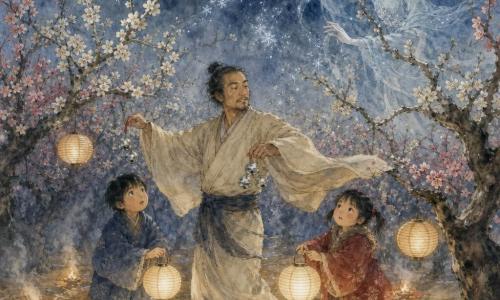
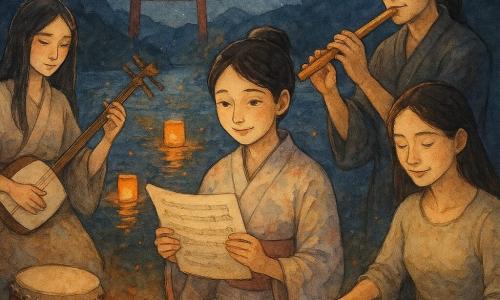
Across the village, paper lanterns swayed from strings like small moons caught in nets. Their light spilled over the street and slid down to the river, where it trembled in the dark water as if the river were dreaming in gold. Taiko drums boomed from the shrine grounds—deep, steady heartbeats that seemed to keep the whole valley alive.
Aiko walked through the crowd with careful steps, her sleeves brushed by laughing children and the scent of grilled sweet miso. She was an adult—strong-armed from carrying baskets, quick-eyed from watching weather—and yet she moved gently, as if she did not want to wake the sleeping trees.
Everyone thought she was simply enjoying the matsuri like the others. She smiled, bowed, answered greetings.
But in her chest, behind her ribs, a secret wish paced back and forth like a trapped sparrow.
At the edge of the river stood the Old Cedar Bridge, a wooden arch worn smooth by years of feet and rain. Its rails were scarred with carved initials and faded paint. In spring it looked tender, in summer brave—but in autumn, when the mountain storms came roaring, the bridge looked like a thin old man holding his breath.
Aiko stopped before it. The lantern light drew a bright line across its planks, but beneath, the river muttered in a low voice, testing stones, counting the days until the floods.
She reached out and touched the bridge's railing. The wood was cool, and the grain felt like wrinkles.
“I won't let you be taken,” she whispered.
A child's voice popped up behind her. “Talking to the bridge again, Aiko?”
It was Haru, small and bony as a reed, with a grin too big for his face. He lived with his grandmother in a low house near the bank. Haru was the kind of child who asked questions the way sparrows peck at crumbs—fast, curious, and never quite satisfied.
Aiko chuckled. “Bridges like company.”
Haru leaned over the rail to look at the water. “Grandmother says the autumn floods are hungry. They eat steps and stories. Last year they almost reached our porch.”
Aiko's eyes softened. Haru's grandmother walked with a cane, and Haru himself was not the strongest child. When the river rose, they were always among the first to worry.
“Then we must feed the floods something else,” Aiko said, half joking.
“Like what? Rice cakes?” Haru's face lit up.
“Like… wisdom,” Aiko answered, and surprised herself with the truth in her own words.
The taiko drums changed rhythm, faster now. Somewhere, a dancer's bells chimed. Aiko watched the Old Cedar Bridge, and in the lantern glow, she thought she saw its shadow bow toward her—just a little, just once.
As if it had heard her promise.
Chapter 2: The Secret Dream
The morning after the festival, the village looked washed and quiet. Lanterns had been taken down. The river returned to its ordinary voice, still dark but less restless, like a cat pretending it wasn't watching.
Aiko carried a bundle of tools to the bridge: rope, nails, a hammer, a saw with a worn handle. She had been a carpenter's helper in her younger days, and the old skills still slept in her hands.
She worked alone at first, replacing a loose plank, tightening a railing post. Each strike of her hammer was a small promise made solid.
But the Old Cedar Bridge needed more than small promises.
Autumn storms were not polite. They did not knock. They ran down the mountain with muddy feet, shoving branches, stones, and whole logs into the river's mouth like angry offerings. The bridge's supports were old, and the current chewed at them every year.
Aiko knelt and peered beneath the bridge. The nearest support beam had cracks like thin lightning.
She sat back on her heels and exhaled. “How do I protect you?” she murmured.
A leaf skittered across the planks, as if the wind had shrugged. Aiko stood and looked toward the shrine, where tall cedars guarded the hill. Between their trunks, the air always seemed a little thicker, as if the world held its breath there.
Her grandmother used to say the shrine was not only a building. It was an ear pressed to the earth. If you spoke kindly there, something might listen.
That afternoon, Aiko climbed the stone steps. She washed her hands at the basin, the water cold enough to sharpen her thoughts. Then she approached the offering box.
“I don't ask for riches,” she said quietly, bowing. “I don't ask to be praised. I only want to keep the bridge standing when the floods come. The weak live closest to the water. The children cross there. The old cross there. Please… lend me a way.”
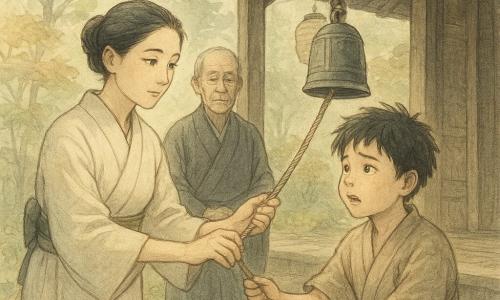
A bell rope hung beside her. She tugged it once, and the clear chime echoed through the trees like a bright pebble thrown into a deep pond.
When she turned to leave, she noticed something she had never seen before.
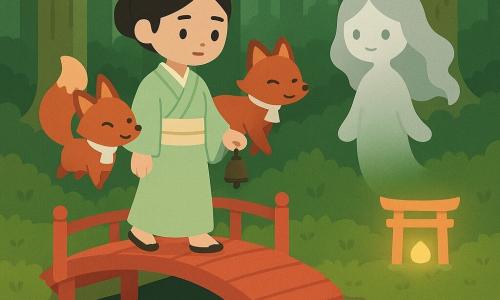
On the far side of the shrine grounds, half-hidden by bamboo, stood a small gate—two posts and a simple crossbeam, woven and tied, as if someone had made it from the forest itself. It was not painted red like a torii. It was pale green and gold, smelling faintly of fresh-cut stalks.
A bamboo gate.
Aiko frowned. She was certain it hadn't been there last week.
She stepped closer, and the air around it cooled. The bamboo leaves whispered, not like wind—more like voices trying to remember how to be voices.
Haru appeared behind her, out of breath. “Aiko! Grandmother said you came up here. She also said—” He stopped when he saw the gate. His grin faded. “What's that?”
“I was about to ask you,” Aiko said.
Haru reached out a finger, then pulled it back as if the gate might bite. “It looks like… a doorway for something that isn't us.”
Aiko's pulse tapped at her wrist. “Maybe it is.”
Behind them, a crow cawed once, sharp as a warning. In front of them, the bamboo gate stood silent, humble, and somehow waiting—like a bowl set out for a guest no one could see.
Chapter 3: The Bamboo Gate Opens
That night, Aiko could not sleep. The river's voice seemed louder, and in every creak of her house she heard the bridge's old bones complaining.
Before dawn, she returned to the shrine with a lantern of her own. The sky was the color of ink watered down. The bamboo grove was a darker shadow against darkness.
Haru, stubborn as a pebble in a shoe, was already there.
“You followed me,” Aiko said, trying to sound stern.
He lifted his chin. “You didn't tell me not to.”
Aiko almost laughed. Then she saw his thin shoulders and remembered the river's appetite. If she could help him feel safe, maybe she should not push him away.
“All right,” she said. “But you stay behind me.”
They approached the gate. Dew clung to the bamboo, shining like tiny beads of glass. Aiko raised her lantern. The light touched the gate and seemed to sink into it, the way sunlight sinks into water.
Aiko bowed, because she had been taught to bow to mountains, to elders, to storms. “If this gate belongs to the spirits of this place,” she said softly, “we come with respect.”
Haru whispered, “And with curiosity.”
“Mostly respect,” Aiko corrected, though her mouth twitched.
She placed a small offering at the foot of the gate: a pinch of salt wrapped in paper, for cleansing, and a rice cracker from her pocket, because she did not know what else to give to something unknown.
For a moment, nothing happened.
Then the bamboo leaves shivered.
Aiko heard a sound like a brush painting across silk—smooth, deliberate. The gate's woven ties loosened by themselves. The space within the frame darkened, not like shade, but like depth—like the inside of a well.
Haru's breath caught. “It's… open.”
Aiko's stomach tightened, but her feet did not step back. The world had offered a door. She had asked for a way. Sometimes answers were shaped like risks.
She stepped through.
Cold air pressed against her cheeks. The lantern's flame did not go out, but it grew pale, as if it had forgotten how to be bright. The ground beneath her felt springy, thick with moss, though she had stepped from packed earth.
Haru followed with a squeak of courage.
On the other side was a grove that was not quite the same grove. The bamboo was taller, the leaves sharper, the shadows deeper. The dawn light above was a faint pearl glow, like the inside of a shell.
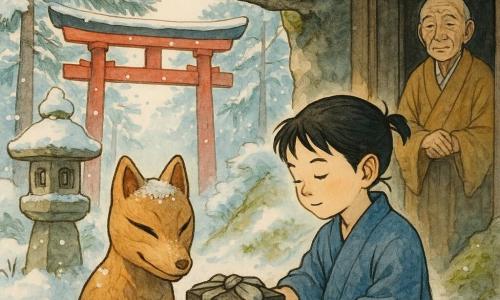
And there, sitting on a stone as if it were a throne, was a fox.
Not a normal fox—its fur was white as rice flour, and its eyes were amber, calm and knowing. Around its neck hung a little charm tied with red string. It regarded Aiko as one might regard a visitor who is late but expected.
“You bow well,” the fox said, voice smooth as river stones. “And you bring salt. Good.”
Haru made a sound between a yelp and a hiccup. “It talks!”
Aiko lowered her lantern slightly. Her fear did not vanish, but it arranged itself into a steadier shape. “Are you a spirit?”
The fox's tail flicked. “Call me Kitsune-no-Name. Names are heavy. I travel light.”
Aiko swallowed. “I need help. The autumn floods will take the Old Cedar Bridge. If it falls, the weakest in our village will suffer first.”
The fox's gaze sharpened. “You ask to protect the small ones. That is a good thread to pull. But you cannot tie the river with rope.”
“I know,” Aiko said. “That's why I'm here.”
Kitsune-no-Name stood and padded closer. Its paws made no sound. “The river does not hate your bridge,” it said. “The river is only hungry for what blocks its song. If you wish to save wood from water, you must teach them to listen to each other.”
Haru blinked hard. “How do you teach a river?”
The fox looked at him, amused. “With manners. With offerings. With clever hands. And with courage that is not loud.”
Aiko held her lantern like a small sun. “Tell me what to do.”
The fox turned its head toward the depths of the strange grove. “Beyond this place is the Workshop of Wind and Reed. It belongs to an old spirit who mends what humans forget. If you bring her three things, she may give you what you need.”
“Three things?” Aiko asked.
“A sound,” the fox said. “A kindness. And a promise.”
Haru whispered, “That's not three things. That's… feelings.”
Kitsune-no-Name's eyes gleamed. “Feelings built your world. Now let them build a bridge.”
Chapter 4: A Sound, a Kindness, a Promise
The path through the spirit grove was narrow, lined with moss that glowed faintly, like sleepy fireflies. Aiko walked carefully. Haru stayed close, stepping where she stepped.
Soon they reached a pond so still it looked like a piece of the sky dropped to the ground. A single reed stood in the center, tall and straight.
“This is the first,” Kitsune-no-Name said, though it did not walk with them anymore. Its voice seemed to float from the bamboo itself. “Bring a sound that belongs to your village.”
Aiko thought of the matsuri drums. The taiko had a voice older than words. It gathered people, warned them, soothed them. It was the village's heartbeat.
But she could not carry a drum through a spirit gate.
Haru tugged her sleeve. “My grandfather had a whistle,” he whispered. “A bamboo whistle. He used it to call dogs and children. I still have it.”
He pulled a small whistle from his pocket, carved from bamboo, smooth from use. He blew into it, softly.
The note rose clean and bright, a thread of sound stitched through the quiet. The pond rippled, as if it smiled.
Aiko nodded. “That will do,” she said. “It's our village's call—small but clear.”
They continued. The bamboo thickened, then opened into a clearing where a stone lantern lay toppled on its side, half-buried. A snail, startled by their steps, hid inside its shell.
“This is the second,” the fox's voice murmured. “Show a kindness that costs you something.”
Aiko knelt. The stone lantern was heavy, slick with moss. It must have fallen long ago. In the village, they would have left it and walked on. In the spirit grove, leaving it felt like leaving a grandparent facedown in the dirt.
She placed her hands against the stone and pushed. The lantern did not move. Her arms trembled. Haru hurried to help, pressing his thin shoulder against the cold rock.
“Ready?” Aiko asked.
Haru grunted. “Ready.”
They pushed together. The lantern shifted an inch, then another. Aiko's palms stung. Haru's face went red with effort. Finally, with a soft scrape, the lantern rolled upright.
The clearing seemed to breathe out. A breeze stirred the bamboo leaves like a gentle applause.
Haru wiped his forehead. “That cost me my dignity,” he said dramatically, and Aiko laughed—quietly, so the grove would not think they were laughing at it.
They walked on until the air changed again. It smelled like rain before it falls. Ahead stood a small house made of reeds and thin wood, its roof curved like a sleeping animal. Wind chimes hung from the eaves, but they made no sound.
The door slid open by itself.
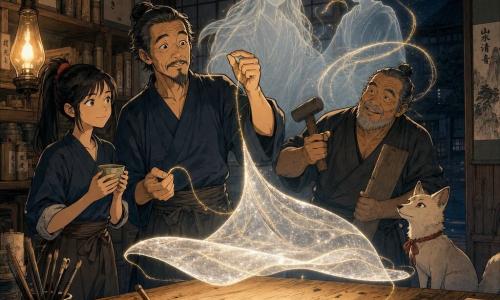
Inside, an old woman sat at a low table. Her hair was white, but not dull—it shone like spider silk. Her eyes were dark and clear as polished stones. Around her were tools: reeds, twine, small wooden pegs, and tiny bundles of straw.
She looked up. “Visitors,” she said, voice gentle and sharp at once. “Human visitors. Rare.”
Aiko bowed until her forehead nearly touched the floor. Haru copied her, a little late.
“I am Aiko,” Aiko said. “This is Haru. We came to ask for help.”
The old woman tilted her head. “Help is a bowl with two sides. What do you bring?”
Haru lifted the bamboo whistle. “A sound,” he said, and blew a note. The chimes trembled but still did not ring.
Aiko nodded toward the upright stone lantern in the clearing behind them. “A kindness,” she said. “We righted what was fallen.”
The old woman's gaze settled on Aiko. “And the promise?”
Aiko's mouth went dry. Promises were the heaviest things. They did not vanish when you wished they would. They stayed, like stones in pockets.
She looked down at her hands, still smeared with moss. Then she thought of the Old Cedar Bridge, the way it held even when it groaned. She thought of Haru's grandmother, careful on her cane. She thought of children running, not noticing how close danger lived.
“I promise,” Aiko said, voice steady, “that I will not protect the bridge only for pride. I will protect it so the weak can cross safely. And if the river must take something, I will offer my effort first, before I offer someone else.”
The old woman's eyes softened, just a little. “Good,” she said. “A promise that bends toward others is harder to break.”
She reached under the table and drew out a bundle wrapped in reed matting. She unrolled it, revealing thin bamboo strips and braided ropes, all marked with small ink symbols like tiny dancing insects.
“This is a Flood-Listening Lattice,” she said. “Not magic that blocks water. Magic that guides it. Place it upstream, where the current begins to argue with the stones. It will teach the river to split and sing around the bridge's supports, not bite them.”
Aiko leaned closer. The strips were light, but she could feel a quiet strength in them, like a well-built poem.
Haru frowned. “So we're going to… talk to the river with bamboo?”
The old woman smiled. “Bamboo is polite. It bends. Rivers respect that.”
Aiko bowed again, deeper. “Thank you.”
The old woman lifted a finger. “One more thing, Aiko. Protection is not only building. It is watching. If you truly guard the weak, you must not do it alone. Pride makes a lonely wall. And lonely walls fall.”
Aiko's cheeks warmed. She understood, and it stung—like medicine.
“We will share the work,” she said.
“Good,” the old woman replied. “Now go. Autumn is already packing its bags.”
Chapter 5: The River's Argument
Back in the ordinary shrine grove, the bamboo gate stood as if it had always been there, quiet and innocent. The morning sun was brighter now, and birds chattered as though nothing strange had happened.
Haru blinked at the normal world. “Did we—?”
“We did,” Aiko said, gripping the Flood-Listening Lattice. It felt almost weightless, yet important as a promise.
They hurried down to the river. Aiko studied the water like a reader studies a difficult page. Upstream, the current curved around rocks and rushed toward the bridge's nearest supports.
“This is where the river starts to argue,” she murmured.
Haru crouched beside her. “How do we place it?”
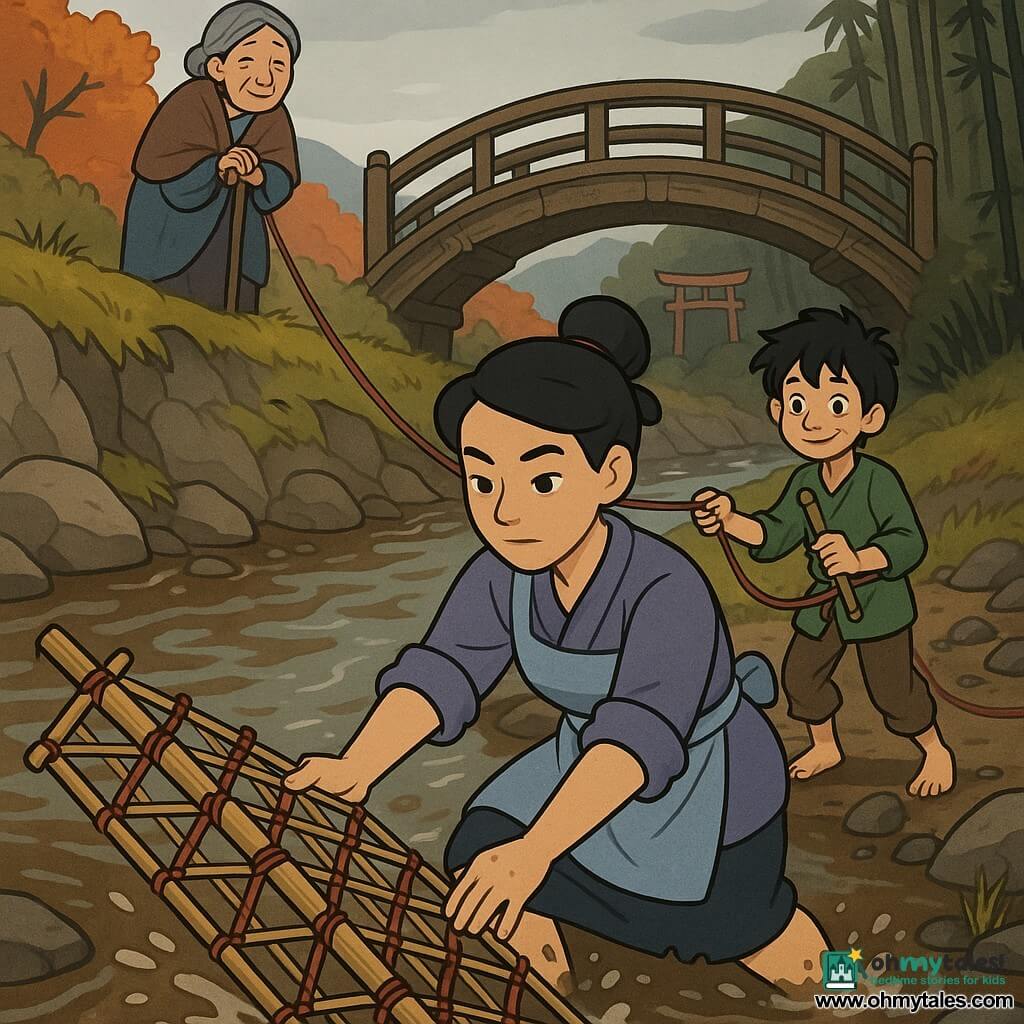
Aiko unrolled the lattice. It spread like a woven fan. The ink symbols shimmered faintly, not glowing, but looking freshly written no matter how the light changed.
“We anchor it,” Aiko said, “like a fence that doesn't trap—just points.”
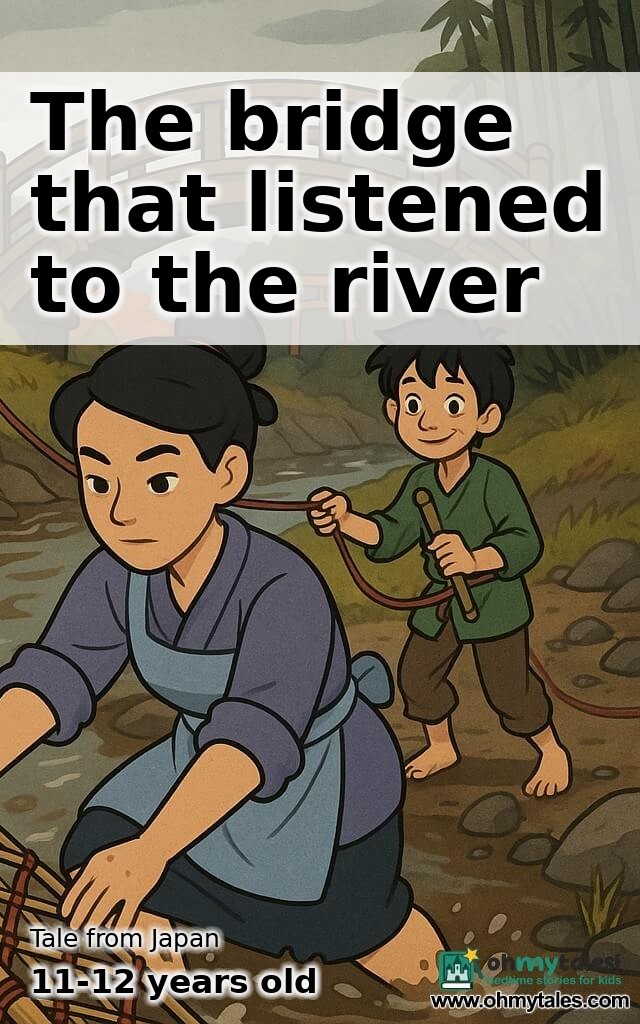
She pounded in wooden stakes, her hammer biting the earth. Haru held the ropes and tied knots the way his grandmother had taught him, neat and stubborn.
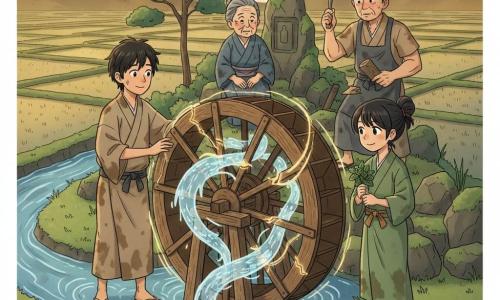
By noon, they had set the lattice in the shallows upstream, angled so the water would meet it and choose a gentler path. It looked like nothing more than bamboo and rope—simple, humble. But as the river touched it, the current changed.
The water divided, not in anger, but in decision. It fanned out, slipping around the rocks with less snarling foam. The river's voice shifted from a growl to a busy murmur, like people at a market.
Haru's eyes widened. “It's working.”
Aiko let out a breath she hadn't realized she was holding. “It's listening.”
That evening, she did what she had promised. She went door to door, not begging, not boasting—simply telling the truth.
“The bridge is in danger,” she said. “I have a plan, but I need hands. If the bridge falls, those closest to the river will suffer most. Help me protect them.”
Some villagers frowned. “The river always wins,” one man said.
Aiko looked him in the eye. “Then we must be smarter than stubborn.”
An old woman nodded slowly. “The bridge carried my wedding feet,” she said. “I will bring rope.”
A young father shifted his baby to his other arm. “My daughter will cross it someday,” he said. “I can spare a day.”
Even the man who doubted scratched his chin. “Well,” he muttered, “I do know how to swing a hammer.”
Aiko felt something warm spread through her chest. Not triumph. Not pride. Something steadier.
Community—like a lantern held by many hands, brighter than any one person's flame.
Chapter 6: The Autumn Flood
The storm arrived three days later.
It began with a hush. The birds fell silent. The mountain disappeared behind a curtain of gray. Then rain poured down as if the sky had finally decided to speak all at once.
The river rose. It swelled and darkened, thick with mud and leaves. It dragged branches like long, wet fingers. It threw itself against stones, furious and loud.
Aiko and the villagers gathered at the bridge with rain cloaks and lanterns that shuddered in the wind. The taiko drums from the shrine were not playing, but Aiko felt their rhythm anyway, beating in her blood.
“Stay back,” Aiko told the children. Haru stood near his grandmother, holding her elbow. His face was pale, but his eyes did not look away.
The water slammed into the Flood-Listening Lattice upstream.
For a terrifying moment, Aiko thought it would snap like a toy.
But the bamboo bent.
It bowed to the current, then held. The river split around it, arguing less, flowing wider. The worst of the force turned aside, guided away from the bridge's most fragile supports.
Still, the flood was hungry. A log spun toward the bridge like a battering ram.
“Rope!” Aiko shouted.
Two villagers threw a thick rope, and Aiko caught it, her hands burning as wet fibers bit into skin. Together they hauled, pulling the log sideways until it scraped harmlessly along the bank.
Another branch struck a railing. The wood groaned.
Aiko ran to it, rain stinging her eyes. She hammered in a brace plank with help from the doubtful man, who was now swearing at the storm like it had insulted his mother.
“Hold, old friend,” Aiko muttered to the bridge between hammer blows. “Hold a little longer.”
The river surged again. Water climbed the stones near Haru's grandmother's house.
Haru's grandmother shook, not from weakness alone. “My porch,” she whispered.
Aiko turned sharply. The bridge mattered, yes—but the promise mattered more.
She grabbed Haru's arm. “Get your grandmother to higher ground. Now.”
“But the bridge—” Haru began.
“I won't leave it alone,” Aiko said. “And I won't leave her either. Go!”
Haru nodded and guided his grandmother away, careful as if she were made of paper.
Aiko looked at the villagers. “Two of you with me,” she said. “We check the houses by the bank.”
They waded through water up to their calves, then their knees. They knocked on doors, helped an old fisherman carry his nets and his cat. They lifted a crying toddler onto a man's shoulders. They guided neighbors up the slope toward the shrine steps, where the ground was higher and the cedar trees stood like patient guardians.
All the while, the Old Cedar Bridge stood in the storm, shaking, but standing.
At the flood's peak, Aiko returned to the bridge. Her lantern was nearly out. Rain plastered her hair to her face. The river roared beneath, a giant throat.
She saw the lattice upstream still bending and breathing with the current, guiding the river's anger into something less sharp.
Aiko raised her chin and, without thinking too hard, bowed to the river.
“Thank you,” she whispered, voice lost in the rain. “For listening.”
The river answered, not with words, but with a change in its sound—still loud, but less cruel, like someone lowering their voice after realizing they are frightening a child.
Chapter 7: What Remains Standing
By morning, the storm had spent itself. The clouds tore open to reveal a clean, pale sky. Mist curled above the river like steam from a cup of tea.
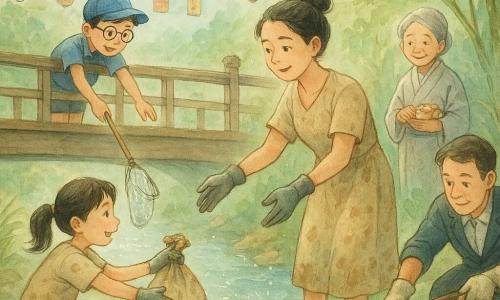
The village came out slowly, blinking at the new world. Mud coated the roads. Leaves were piled in strange places. A few fences had fallen.
But the Old Cedar Bridge still arched across the water.
Its planks were wet. Its rails were scratched. Yet it stood, stubborn and grateful, like an old guardian who had made it through the night.
Haru ran to Aiko, nearly slipping in the mud. “It's still there!” he cried.
Aiko laughed, exhausted. “Yes. It is.”
His grandmother arrived behind him, leaning on her cane. She bowed to Aiko. “You protected more than wood,” she said. “You protected our steps.”
Aiko returned the bow, her throat tight. “We protected them,” she corrected, nodding toward the villagers who had helped.
The doubtful man cleared his throat. “I still say the river always wins,” he muttered. Then he added, quieter, “But… maybe we can persuade it not to take the smallest first.”
Aiko looked at the bridge and thought of the old spirit's words: Pride makes a lonely wall. And lonely walls fall.
She walked to the riverbank and found the Flood-Listening Lattice. It was still anchored, its bamboo strips stained with mud but unbroken.
Haru crouched beside it. “Do we leave it here forever?”
Aiko considered. The lattice was a lesson as much as a tool. “We'll keep it,” she said. “We'll repair it each year, like we repair the bridge. Protection isn't a single brave moment. It's many small faithful ones.”
Haru blew his bamboo whistle, a bright note that skipped across the water. The river rippled, and for a heartbeat the lantern reflections from last night's storm-tossed festival seemed to return—tiny, trembling stars in daylight.
Aiko glanced toward the shrine hill. Between the bamboo trunks, she thought she saw a pale shape—white fur, amber eyes—watching. When she blinked, it was only bamboo and morning mist.
Still, she bowed once, just in case.
That evening, as the village cleaned and shared food, Aiko crossed the Old Cedar Bridge slowly. Each step sounded firm. The wood smelled of rain and endurance.
Halfway across, she paused and looked down at the river.
It flowed on, as rivers do—sometimes gentle, sometimes fierce. It could not be owned. It could not be bullied. But it could be respected.
Aiko rested her hand on the railing. “We will keep you safe,” she whispered to the bridge, “because some feet are lighter, and the world should not crush them.”
The wind moved through the reeds. It carried the faintest chime—like unseen wind chimes remembering their song.
And in that sound, the village's moral settled quietly into the night:
Strength is not for showing off. Strength is for sheltering what is small.