Chapter 1 — The Plum Orchard Under a Thin Moon
In the mountain village of Hoshikawa, spring arrived like a shy guest—soft footsteps, a quiet bow, then a pause in the doorway.
Haru Takeda, a grown man with calm eyes and hands that smelled faintly of cedar, walked between rows of plum trees. Their branches were ink strokes against the pale sky, and their blossoms—white and blush—looked like tiny lanterns lit from within.
He listened the way some people read letters. The orchard spoke in small sounds: petals falling like whispered secrets, a stream clicking over stones, wind brushing the grass as if smoothing a sleeping child's hair.
But tonight the wind carried a different message. It felt sharp, like a knife hidden inside a ribbon.
“A late frost,” Haru murmured.
Old Mrs. Sato, who tended the shrine steps, had warned him at market. “The cold is returning,” she had said, eyes narrowed like a cat watching a shadow. “It comes when blossoms think they are safe.”
Haru had been a kagura dancer when he was younger—mask, bells, and measured steps meant to invite good spirits and steady the world. He was not famous. He was not grand. But he believed in rhythm the way others believed in walls.
At the orchard's edge stood a small shrine, weathered and patient. A shimenawa rope circled it like a careful promise. Haru bowed, palms together.
“If there are kind spirits nearby,” he whispered, “please lend your breath. The plums feed the village. Children wait for their sweet-sour taste. Do not let the cold steal them.”
The shrine offered no loud answer, only the faintest tremble of its paper streamers—like eyelashes fluttering in a dream.
Above, the moon wore a thin face. Haru felt the night watching him back.
Chapter 2 — Bells, Masks, and a Warning Wind
The next evening, the village gathered in the shrine yard for kagura practice. Lanterns swayed on cords, glowing like small moons caught in nets. The air smelled of pine resin and warm rice.
Haru tied on a simple mask—painted with a gentle smile—and fastened bells around his wrists. When he moved, the bells sang, not loudly, but clearly, like stars making music.
Two children, Aki and Ren, sat near the drum, eyes wide.
“Do spirits really come when you dance?” Ren asked.
Haru lifted one shoulder. “Sometimes spirits come. Sometimes courage comes. Either way, we feel less alone.”
Aki giggled. “That sounds like the same thing.”
Haru tapped his mask's nose. “Different things can share the same coat.”
They began the dance. The drumbeat was a heartbeat you could borrow. Haru's feet traced circles, then straight lines, then circles again—like the village paths connecting everyone. His sleeves floated like white carp in a pond. Each step was a word in an old language the body remembered.
Between beats, Haru felt it: a sudden coldness crawling under the lantern light.
The wind slipped through the yard and curled around the plum-scented offerings. It made the flames flicker as if the lanterns were afraid.
Mrs. Sato's voice cut through the murmurs. “It's coming tonight.”
The villagers looked to Haru, because he knew the orchard best. He pulled off his mask and breathed slowly, as if calming a frightened horse.
“We can light fires,” someone offered. “We can cover the trees.”
“We can pray,” said another.
Haru nodded. “We will do all of it.”
Yet even as he spoke, he sensed something else—an unevenness, like a missing drumbeat. Not just cold, but a puzzle. Frost was natural, yes. But this wind felt… stubborn. Like it had an opinion.
When practice ended, Haru carried the bells home. Their faint jingle sounded like small questions following him down the road.
That night he dreamed of plum blossoms turning to glass.
Chapter 3 — The Page Found in the Dust of Years
In the morning, Haru went to his storehouse to search for old straw mats and oil. Cobwebs hung from beams like faded ribbons. The air tasted of dust and time.
He climbed onto a low stool and pulled down a wooden chest that had belonged to his late father. The lid creaked open with a sigh, as if relieved to speak.
Inside were cloth masks, small drums, and folded papers. Haru lifted each item carefully, remembering the weight of his father's hands—steady, patient, a quiet kind of strength.
At the bottom, under a bundle of dried herbs, he found a single page of paper. It was not part of a book anymore, only a leaf torn from a larger story. The ink had softened, but the characters still stood firm, like old soldiers refusing to fall.
Haru could read enough to understand. The page described a kagura dance meant for “the Spirit of Frost,” not to fight it like an enemy, but to speak with it like a visitor.
There was a drawing of a mask: pale blue, with eyes shaped like winter stars. Beneath it, a note:
“Do not ask the frost to leave. Ask it to share.”
Haru frowned. “Share?” he said aloud, and his voice sounded too loud in the storehouse.
He remembered his father telling him once, long ago, “Not all cold is cruel. Some cold is only lonely.”
Haru held the page up to the light. At the edge, almost invisible, was a pressed plum petal—dry and delicate—like a memory that refused to vanish.
Outside, clouds gathered, thick as folded blankets.
Haru tucked the page into his sleeve. The orchard was in danger, yes—but perhaps danger had a name, and perhaps a name could be spoken with respect.
He walked toward the shrine with the page against his skin, feeling it warm slightly, as if grateful to be found.
Chapter 4 — Meeting the Frost That Would Not Listen
By late afternoon, villagers were already carrying bundles of straw and stacks of wood into the orchard. Smoke rose in thin, hopeful threads. Children dragged blankets to wrap around young trees. Even the mayor came with sleeves rolled up, looking more like a tired uncle than a leader.
Haru directed them gently. “Small fires, many of them. Not one big blaze. The orchard needs a necklace of warmth.”
Ren pointed at the sky. “The clouds look angry.”
“They are not angry,” Haru said. “Just heavy with their own thoughts.”
As evening fell, the temperature dropped fast. The kind of cold that makes sound travel too far. The kind of cold that turns laughter into pale breath.
Haru moved between the trees, checking fires, adjusting mats, murmuring thanks. Plum blossoms trembled, fragile as paper cranes.
Then he felt it again—that stubborn wind, sliding between trunks as if it owned the path.
The air in front of him whitened. Not with snow, but with a faint shimmer, like a curtain being drawn.
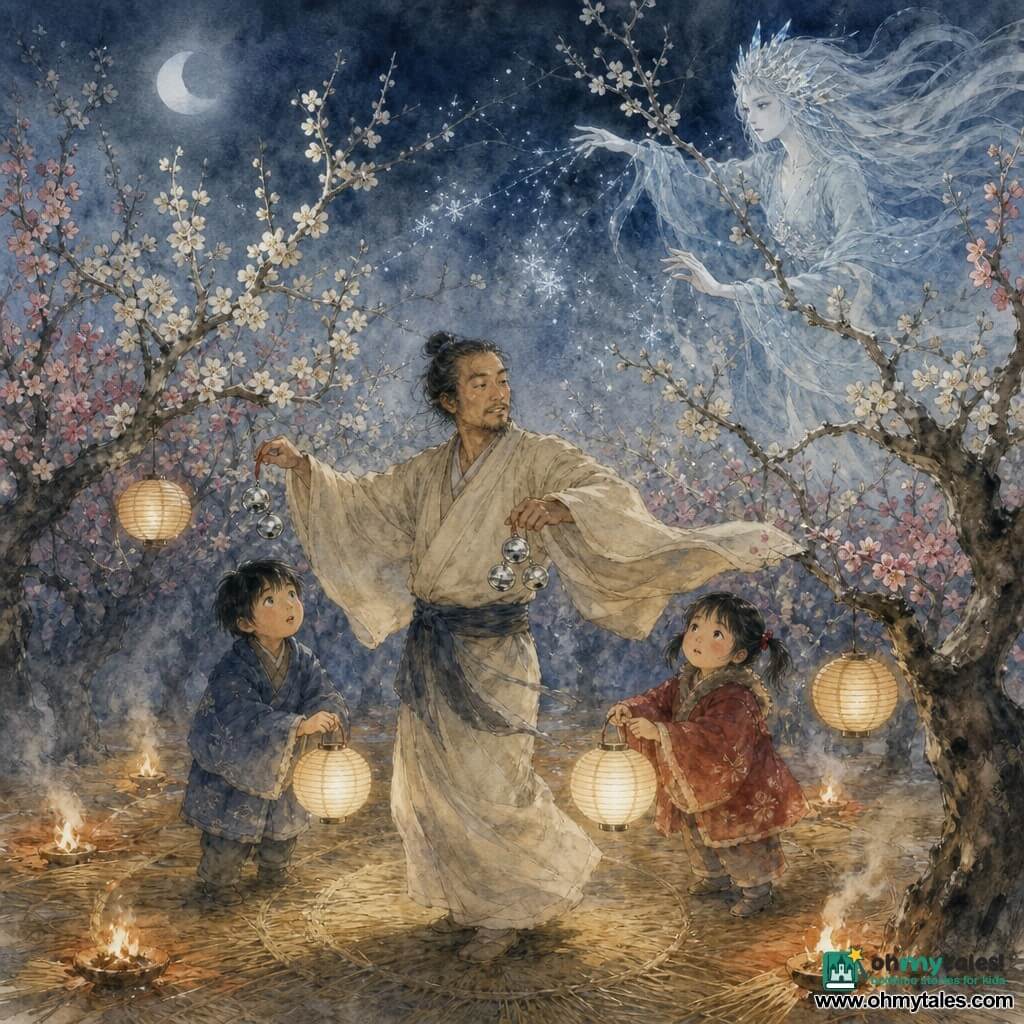
A figure stood near the shrine: tall, thin, and dressed in robes the color of winter ponds. Its hair floated as if underwater. Its eyes were bright and distant.
Haru's throat tightened, but he bowed low. “Welcome,” he said. “You have traveled far.”
The spirit's voice sounded like ice tapping ice. “You make fires,” it said. “You wrap trees. You guard your sweetness.”
“Yes,” Haru answered. “We hope to save the blossoms.”
“Hope is a warm word,” the spirit replied. “Warm words melt me. I do not like melting.”
Haru steadied his breathing. “I don't wish to harm you.”
The spirit tilted its head. “Then stop pushing me away.”
Haru glanced at the village fires. “If you stay, the orchard will die.”
The spirit's gaze drifted to the blossoms. For a moment, something like curiosity moved across its face.
“Everything dies,” it said. “Even winter.”
Haru slipped his hand into his sleeve and touched the old page. “I found something,” he said. “A dance my father kept. It says not to ask you to leave… but to share.”
The spirit's eyes narrowed, glittering. “Share what?”
Haru looked around. The villagers were busy, unaware of the figure by the shrine. The orchard's warmth and the spirit's cold stood side by side, like two strangers forced onto the same bench.
“Share the night,” Haru said carefully. “Not as enemies. As different guests.”
The spirit's mouth curved, not quite a smile. “Different,” it echoed, as if tasting the word.
The wind sharpened. Blossoms quivered.
“Show me,” the spirit said. “Show me how you speak to cold without fear.”
Haru swallowed. “Then watch.”
Chapter 5 — The Dance of Two Seasons
Haru returned to the shrine yard and brought out his kagura clothes and bells. His hands moved quickly but calmly, like a river that knows its way around stones.
Aki and Ren followed him, carrying a lantern.
“Uncle Haru,” Aki whispered, “why are you dressing up now? It's freezing!”
Haru crouched to their height. “Because sometimes you cannot argue with the wind,” he said softly. “You must sing to it.”
Ren shivered. “Can we help?”
Haru smiled. “Yes. Hold the lantern steady. Be brave enough to be gentle.”
He walked back into the orchard. The spirit waited near the shrine, silent as a snowfield.
Haru bowed again, then lifted his arms. The bells rang—small, bright sounds, like droplets of sunlight falling into a winter well.
He began the dance from the page. The steps were unfamiliar at first, like talking with a new accent. But his body remembered the old patterns of respect: approach, retreat, circle, pause.
He danced as if warmth were a story he could tell without shouting. His sleeves drew soft arcs through the air, like cranes crossing a frozen lake. The drumbeat, far away in his memory, echoed in his chest.
The spirit watched, motionless.
Haru stopped beneath the most crowded branches of blossoms. He lifted his hands and opened them, palms up, offering nothing and everything.
“You are the frost,” he said, voice steady. “You belong to this mountain as much as we do. You shape the river stones. You teach the insects to sleep. You keep the soil from growing proud.”
The spirit's eyes flickered.
“But the blossoms are also part of the mountain,” Haru continued. “They feed the birds. They brighten the hearts of tired people. They remind us that the world can begin again.”
He took a step closer to the spirit and lowered his head. “We are different,” he said. “Not better. Not worse. Different, like fire and snow. Like drum and silence.”
The bells rang again.
“Share with us,” Haru said. “Not all the orchard—only the high branches. Let the low blossoms keep their warmth. Let your cold touch the stones and the stream, not the tender hearts of these flowers.”
The spirit's robe rippled. “Why should I share?” it asked, but its voice was less sharp now, more curious than cruel.
Haru glanced at Aki and Ren holding the lantern. Their faces were pale with cold, but their hands did not shake.
“Because the village shares too,” Haru said. “We share rice with travelers. We share stories with children. We share even when we are afraid that there won't be enough.”
The spirit's gaze moved from Haru to the children, then to the fires set carefully around the trees—many small kindnesses, not one loud demand.
The wind eased, just a little, like a fist loosening.
The spirit raised one hand. Frost sparkled at its fingertips, beautiful and dangerous as crushed crystal.
“I can be gentle,” it said slowly, as if speaking a new word. “But I do not know how.”
Haru lifted his arms again. “Then follow my steps,” he said. “Not to become warm—only to become balanced.”
And in the orchard, under a moon that watched like an old grandmother, the kagura dancer and the frost spirit began to move in the same rhythm—one a candle, one a snowflake—circling without collision.
Chapter 6 — Morning, Blossoms, and the Moral of the Orchard
Night deepened. The villagers kept their fires alive, dozing in turns. Haru danced until his muscles ached and his breath came out in white ribbons.
At last the spirit stopped. The wind around it softened into a sigh that did not bite.
“I will take the upper branches,” the spirit said. “I will paint them with a thin lace. But I will not harden the buds at the heart of the trees.”
Haru bowed so low his forehead nearly touched the earth. “Thank you.”
The spirit's eyes looked almost… shy. “Do not thank me like a king,” it murmured. “I am only a season.”
“A season still deserves respect,” Haru replied.
Just before dawn, the spirit turned toward the mountains. Its robe trailed behind it like a pale river. Before it vanished, it spoke once more.
“Haru Takeda,” it said, “you did not call me a monster.”
Haru watched the last shimmer fade. “Because you are not,” he said to the empty air. “You are different.”
When sunlight finally spilled over the ridge, it touched the orchard like warm fingers. The villagers woke and hurried among the trees.
Some blossoms were edged with delicate frost, shining like silver embroidery. But most remained soft and alive, their petals opening slowly, as if relieved.
Mrs. Sato pressed a hand to her mouth. “We have blossoms,” she breathed. “We still have them.”
Aki and Ren ran to Haru. “You did it!” Ren said. “You scared the frost away!”
Haru shook his head, smiling tiredly. “No. I didn't scare it away. I listened.”
Aki frowned. “But it was cold. And mean.”
“It was cold,” Haru agreed. “And it spoke sharply. But sharp words can come from loneliness. If we treat every difference like a threat, we make the world smaller. If we greet difference with respect, the world becomes wide enough for everyone.”
Ren tilted his head. “Even frost?”
“Even frost,” Haru said.
Haru returned to the shrine and placed the found page inside a clean box, safe from dust. He added a new sheet of paper beneath it, written in his own careful hand:
“When you meet something different, do not rush to fight. First, bow. Then learn its name.”
That evening, the village ate pickled plums from last year and laughed quietly around their tables. Outside, the orchard rested, blossoms fluttering in the gentle wind.
And somewhere in the mountains, the frost spirit moved on—not defeated, not hated, but understood—like a winter cloud passing without breaking the sky.