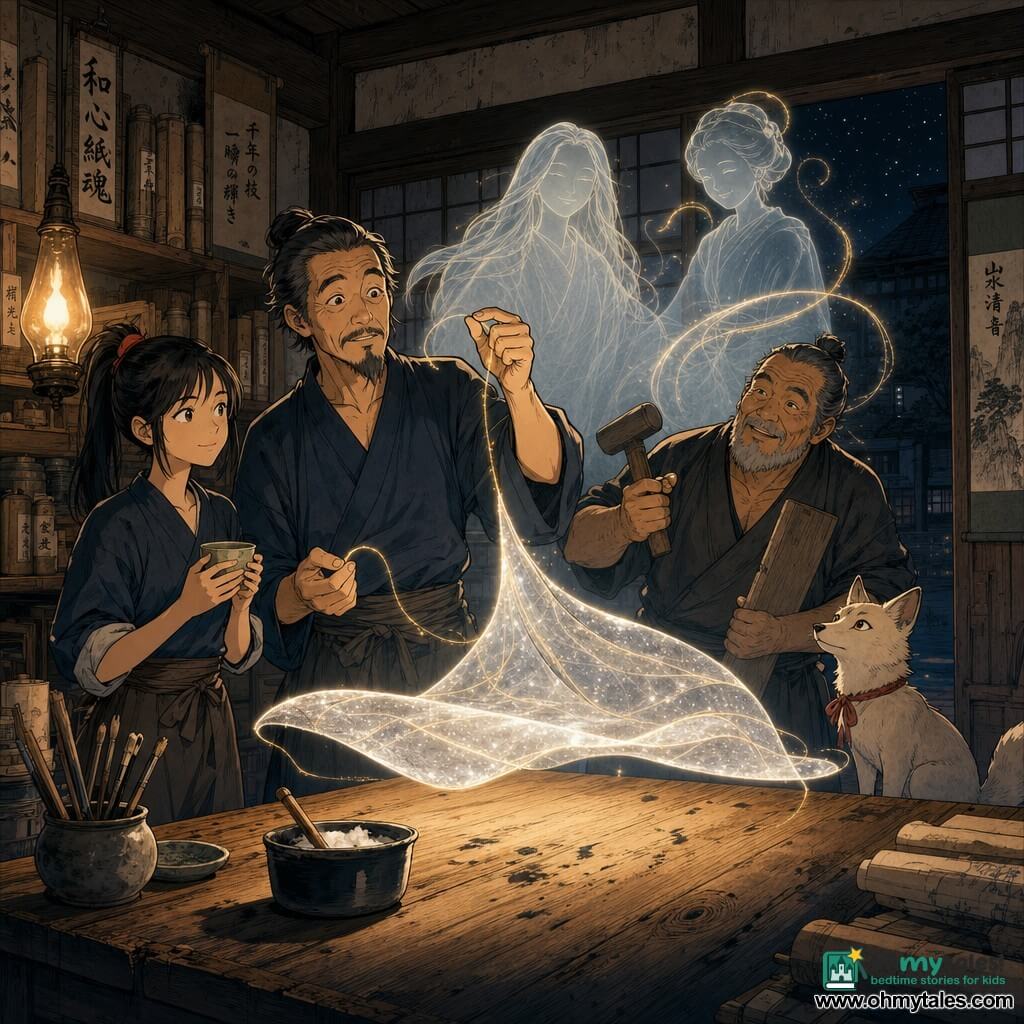
Chapter 1: The Workshop of Sleeping Scrolls
In a mountain village where roofs wore snow like soft hats and the cedar trees stood as tall as old prayers, there was a small workshop called the House of Scrolls. Its paper screens were yellowed with age, and its door sighed each time it opened, as if it carried a secret in its hinges.
Haru lived there alone.
He was a man with quiet hands and a heart that behaved like a shy lantern—glowing gently, never shouting for attention. He repaired scrolls the way some people repaired friendships: with patience, warm tea, and careful listening. His tools were simple—rice paste, brushes, silk threads, a smooth stone for pressing paper flat. Yet to Haru, each tool felt like a promise.
Lately, the workshop had been breaking down. The roof leaked in three places. The shelves leaned like tired knees. And worst of all, the long table where he mounted scrolls had split down the middle, a crack like a river cutting through a field.
Haru pressed his palm to the wood. “Hold on,” he murmured, as if speaking to a wounded friend. “I'll mend you.”
Outside, winter was loosening its grip. The wind smelled of melting snow and distant plum blossoms. From the shrine at the edge of the village, a bell rang once—clear, silver, and lonely.
Haru glanced toward the shrine and then away again. He was not the type to bother spirits with his problems. Still, as he fetched a bucket to catch the roof's drip, he couldn't help thinking: This place was more than wood and paper. The House of Scrolls held stories—old songs, painted cranes, storms captured in ink. If the workshop fell apart, the village would lose a small piece of its memory.
That evening, Haru swept the floor until the boards showed their grain like calm waves. He warmed miso soup and ate slowly, listening to the drip-drip-drip from the roof.
Then he noticed something that hadn't been there before: a thin strip of paper tucked into the crack of the broken table.
It was blank—almost. In the lamplight, a single brushstroke shimmered like a fish turning in dark water.
Haru leaned closer. The stroke looked like the beginning of a curtain being drawn aside.
And, for the first time in many months, Haru felt the air in the workshop change—like a door opening in a dream.
Chapter 2: A Brushstroke That Breathes
Haru lifted the strip of paper with two fingers, as carefully as if it were a sleeping insect. The brushstroke on it was black, but not the flat black of soot. It had depth, like a night sky where you could still sense the moon behind the clouds.
He set the strip on the table beside the crack. The stroke seemed to point toward the split, as if it wanted him to look inside.
“That's impossible,” Haru said softly, though his voice held more wonder than fear.
He fetched a candle and held it close to the crack. Warm light poured into the gap. Dust floated up like tiny ghosts leaving their beds.
And then—something moved.
Not a rat. Not an insect.
A breeze.
It slipped out of the crack and circled Haru's wrist, light as a silk ribbon. The candle flame bent politely, as if bowing.
Haru's breath caught. “Are you… from the shrine?”
The breeze answered by carrying a scent: clean water over stones, and the sharp sweetness of yuzu. It was the smell of a place that had never been forgotten.
On the floor, his loose sheets of paper fluttered. One sheet flipped over and revealed an old sketch he'd made long ago: a plum branch with one blossom, painted for someone he had never dared to impress.
Haru's ears warmed. He cleared his throat. “All right,” he told the air. “If you have a message, I'm listening.”
The candlelight trembled. A faint whisper rose, not quite words—more like the sound of a brush gliding across paper.
Haru followed it to the corner shelf, where a heavy scroll lay wrapped in faded cloth. He hadn't touched it in years. It had come from his teacher, who had said only, “This scroll chooses its moment.”
Haru untied the cloth. The scroll's paper felt cool, like river stones in shade. When he unrolled it, he found a painting of a veil—thin and pale—hung between two cedar trees. Behind the veil were shapes that could have been foxes, or clouds, or memories.
At the bottom was a short line of calligraphy:
When kindness repairs what pride ignores, the veil lifts.
Haru read it twice. Then he looked at his broken table, his leaky roof, his weary shelves.
He thought of the village, too—how people hurried past one another lately, eyes down, each person carrying their own heavy basket of worries. He thought of his own habit of working alone, as if solitude were safer than asking for help.
A soft tap came from the door.
Haru jumped, then laughed quietly at himself. “Come in,” he called.
The door slid open, and in stepped Miki, the potter's daughter, with cheeks pink from the cold and a scarf wrapped like a cozy question around her neck.
“I smelled soup,” she said. “And… are you talking to your furniture again?”
Haru coughed. “Only politely.”
Miki's eyes flicked to the unrolled scroll. Her smile softened, like snow melting on a warm stone. “That's a beautiful painting,” she said. “It feels… secret.”
Haru rolled it up quickly, embarrassed. “It's old.”
Miki held up a small jar. “My father sent rice glue. He said your roof is leaking again.”
Haru stared at the jar, as if it were a rare treasure. “Tell him thank you.”
Miki nodded, then paused at the doorway. “You know,” she said, “if you ever need an extra pair of hands… I can carry boards, too. I'm not made of porcelain.”
Haru's lantern-heart flickered brighter. “I… might,” he admitted.
After she left, the workshop felt warmer. The breeze from the crack swirled once, almost like a pleased sigh.
And Haru realized something simple and surprising: the first repair might not be wood or paper.
It might be his habit of doing everything alone.
Chapter 3: The Cedar Shrine and the Quiet Promise
The next morning, Haru carried offerings to the cedar shrine: a small bowl of rice, a cup of tea, and one plum blossom he found stubbornly blooming near a stone wall. The path was damp with thawing snow, and the earth smelled alive, like it was waking up and stretching.
The shrine sat beneath two ancient cedars. Their trunks were wide enough to hide a person, and their branches braided together high above like hands folded in prayer. A rope of straw, thick as a wrist, hung across the shrine gate with paper streamers fluttering like white birds.
Haru bowed. “If there are spirits watching,” he said, “please forgive my clumsy manners. I've been busy, and… proud.”
The wind answered by shaking the streamers. They clicked softly, like teeth of a smiling elder.
Haru placed the offerings down. “My workshop is breaking,” he continued. “I want to fix it. Not just for me. For the stories. For the village.”
A hush fell, the kind that makes you hear your own heartbeat.
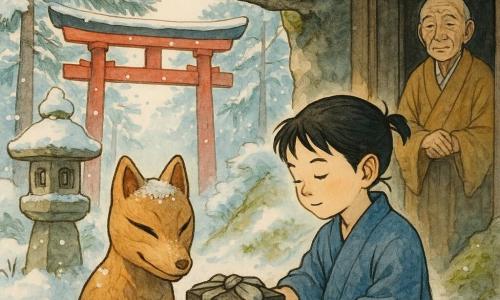
Then, from behind the shrine, a fox stepped out.
It was small and pale, with fur the color of winter clouds. Its eyes were bright as ink drops. A red ribbon was tied around its neck, neat as a festival bow.
Haru froze. His mind tried to find an ordinary explanation—someone's pet, a trick of light—but the fox's gaze was too steady, too knowing, like a teacher watching a student struggle with a difficult character.
The fox sat and lifted one paw, as if washing it. Then it tilted its head.
“You're not scared?” Haru whispered.
The fox blinked slowly, as if to say, Why waste energy on fear?
It stood and trotted a few steps away, stopping to look back. Its tail swished like a brushstroke in the air.
Haru's feet moved before his thoughts did. He followed.
The fox led him to a small hollow where snowmelt had gathered into a clear pool. Floating on the water was a single cedar needle, spinning in slow circles, like a compass choosing a direction.
The fox nudged the pool's edge with its nose, and the cedar needle drifted toward Haru.
Haru crouched. In the needle's reflection, he saw not his face, but the workshop table—cracked—and beside it, hands that were not his: the potter's rough hands, the carpenter's strong hands, Miki's quick hands.
Haru's throat tightened.
The fox met his eyes. Then it turned and trotted back toward the shrine, as if its lesson was complete.
Haru bowed again, deeper this time. “All right,” he promised the cedars, the shrine, the unseen listeners. “I will ask. I will include. I will be kind enough to let others be kind to me.”
As he stood, he felt a thin warmth in his pocket. He pulled out the strip of paper with the shimmering brushstroke. It had changed. Now, beside the first stroke, a second had appeared—curving gently, like the edge of a veil beginning to lift.
Chapter 4: Repairs Made of Wood and Warmth
Haru began with a simple visit.
He went to Old Kenji the carpenter, whose laughter could shake dust off rafters. Kenji listened to Haru's awkward request, then burst into a grin.
“So the scroll hermit finally comes out!” Kenji boomed. “Of course I'll help. But you'll pay me in tea and those sweet bean cakes you pretend you don't like.”
“I don't pretend,” Haru said, trying not to smile.
“Yes, yes. Your face is as honest as a raccoon's,” Kenji teased.
Next, Haru visited the potter, Miki's father, who scratched his chin thoughtfully. “For a workshop that keeps our stories alive,” he said, “I can spare clay weights for your roof patches, and a jar of good glue. No charge.”
When Haru protested, the potter waved him off. “Kindness is not a coin,” he said. “It doesn't get smaller when you give it.”
Soon, the workshop filled with footsteps and friendly noise. Kenji brought boards that smelled like fresh forest. Miki arrived with sleeves rolled up and hair tied back, looking ready to wrestle a mountain.
“Where do you want me?” she asked.
Haru pointed to the cracked table. “If we can brace it first—”
Miki tapped the split gently. “This table has been lonely,” she said. “Let's give it some company.”
They worked in rhythm: Kenji measured, sawed, and hammered with confident thuds. Miki held boards steady, passing nails like a magician producing silver fish from her palm. Haru spread rice glue with a brush, smoothing paper patches over weak spots in the roof. Each motion felt like a small prayer answered by action.
At midday, they ate together. Haru poured tea. The steam rose between them like a quiet ribbon tying them into one scene.
Miki leaned close to the shelves of scrolls. “Do you ever wonder,” she said, “if the stories listen to us?”
Haru thought of the breeze in the crack, the fox at the shrine. “Sometimes,” he admitted. “Sometimes I think the stories are the ones holding us together.”
Kenji snorted. “If stories can hold up a roof, I'll start reading more.”
As if offended, the roof chose that moment to drip directly onto Kenji's head.
Miki laughed so hard she nearly spilled her tea. Haru covered his mouth, but his shoulders shook. Even Kenji, wiping his hair, started laughing too.
And in that laughter, something unseen seemed to brighten—the air itself, like a room after a window is opened.
That evening, after Kenji and Miki left, Haru remained at the table. The crack was still there, but now it was hugged tight by new braces. The wood looked steadier, like a back that had finally been straightened.
He took out the strip of paper. Another brushstroke had appeared, faint but certain. Together the strokes formed the shape of a curtain caught by a gentle breeze.
A veil, lifting.
Haru swallowed. “What happens when it lifts all the way?” he asked the quiet workshop.
From the crack, the soft breeze returned and danced around the lamp flame, making it bow again.
And Haru felt, more than heard, the answer:
You will see what you have been too shy to notice.
Chapter 5: The Night the Veil Rose
Spring arrived the way a careful painter adds color—one small touch at a time. First, the plum blossoms. Then the frogs practicing their creaky songs. Then the sunlight staying a little longer, like a guest who finally feels welcome.
The workshop looked better, too. The roof no longer cried into buckets. The table stood firm. The shelves stopped leaning like they were about to whisper secrets into the floor.
Haru should have felt finished.
But the strange strip of paper kept changing. Each day, a new brushstroke appeared, as if an invisible artist worked while Haru slept. Soon, the strokes formed a full veil, delicate as mist, and behind it—two shadowy shapes, facing one another.
On the night the last stroke appeared, the air tasted like rain that hadn't fallen yet.
Haru stayed awake, lamp lit, listening.
The workshop was quiet—too quiet—like a pause in music. Then the paper screens rustled though there was no wind outside. The scrolls on the shelves hummed faintly, not with sound, but with presence, like a crowd holding its breath.
Haru stood. His heart beat a little faster, but it wasn't fear. It was the feeling of standing at the edge of a bridge.
He placed the strip of paper on the repaired table.
The brushstrokes glowed.
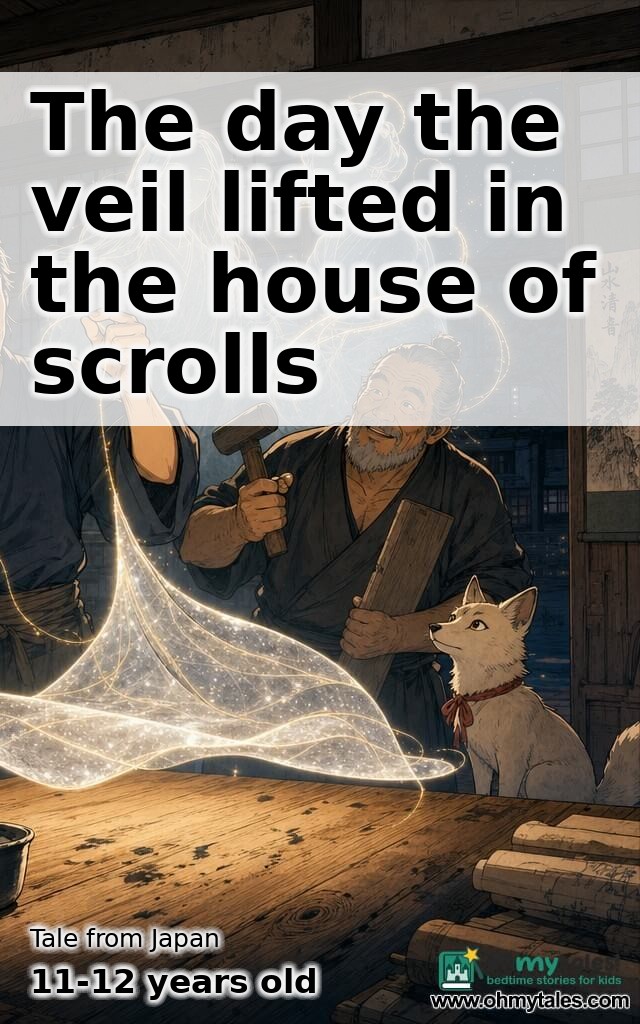
A thin light spilled out, pale and steady, and the glow widened into a soft curtain hanging in the air—an actual veil, floating where there had been nothing. It looked like moonlight woven into fabric.
Haru's mouth went dry. “So it's real,” he whispered.
Behind the veil, shapes moved. Not threatening—gentle, patient. Like people waiting to be invited inside.
Haru remembered the calligraphy: When kindness repairs what pride ignores, the veil lifts.
He bowed, because it felt right. “If you are spirits,” he said, “you are welcome here. The workshop is not perfect, but it is cared for.”
The veil fluttered. A warm breeze flowed through it, carrying the smell of cedar and fresh ink.
And then the first spirit stepped forward.
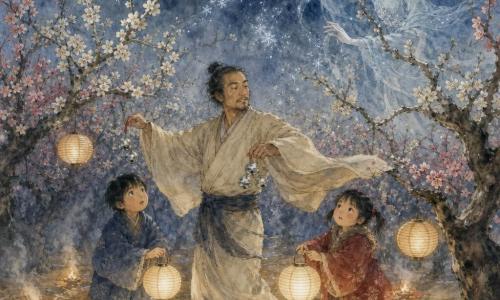
It was not a ghost in the frightening way. It was more like a person made of the season itself—edges soft, colors shifting. Its hair flowed like a stream. Its eyes were bright as morning.
Another spirit followed, smaller, with sleeves stitched from fallen petals. Tiny lights hovered around them like fireflies who had learned manners.
They looked around the workshop with fondness, as if recognizing an old friend.
The taller spirit touched the repaired table. Its fingers passed over the braces, and the wood gave a quiet, satisfied creak.
Then the spirit looked at Haru and spoke in a voice like wind through bamboo.
“Caretaker of stories,” it said, “you mended more than timber.”
Haru's throat tightened. “I only did what I could.”
The smaller spirit tilted its head. “You let others help.”
Haru thought of Kenji's booming laughter, Miki's steady hands, the potter's jar of glue. He thought of his own stubborn silence before all of that.
“Yes,” Haru said. “I did.”
The taller spirit raised a hand. In its palm appeared a small spool of thread, shining like starlight—thin, strong, and impossibly bright.
“For the tears that paper cannot hold,” the spirit said. “For the places where kindness must stitch.”
Haru reached out carefully. The thread felt warm, like it had been held close to a heart.
“Why give this to me?” he asked.
The spirits exchanged a glance, and the veil behind them rippled like water.
“Because you are gentle,” said the smaller one, “and gentleness is a bridge.”
Haru looked down at the shining thread. He thought of all the scrolls in his workshop—some old, some damaged, some waiting to be understood. He thought of the village, too, and how people were like scrolls: folded, creased, and sometimes afraid to be unrolled.
“I'll use it well,” he promised.
The taller spirit bowed. “Then our work is shared.”
As suddenly as they had come, the spirits stepped back through the veil. The curtain of light thinned, fluttered once, and vanished like mist in sunrise.
Silence returned—but it was a kinder silence, full of meaning.
Haru sat at the table and let out a long breath. He laughed softly, not because it was funny, but because his heart had no other way to release its overflowing wonder.
Then, without thinking too hard, he took out an unfinished scroll—a painting of a plum branch, meant for no one.
He began to paint again.
Chapter 6: The Kind Stitch
In the weeks that followed, Haru's workshop became busier than it had been in years. People brought him old family scrolls that had been tucked away in boxes, forgotten like last year's snow.
“There's a tear,” said one grandmother, holding out a scroll with trembling hands. “It belonged to my mother.”
“My son spilled tea on this,” said a nervous father. “My wife will turn me into a radish if it's ruined.”
Haru listened to every worry with the same calm attention he gave to paper fibers. He did not scold. He did not laugh at anyone's clumsiness. He only nodded and said, “Let's see what we can do.”
Sometimes Miki came to help, carrying water, sweeping the floor, or simply sitting nearby with her own small projects—clay charms shaped like foxes, bells, and tiny plum blossoms.
One afternoon, Haru faced the hardest repair yet: a long scroll painted with a river scene. A deep tear ran through the painted water, splitting the river like a broken mirror.
He unrolled it on the table. The torn edges looked jagged, like teeth.
Miki leaned over. “Can you fix it?”
Haru touched the tear. He remembered the spirit's gift. He opened the small box where he had kept the shining thread. It gleamed even in daylight, as if it had stolen a piece of the moon.
“I think so,” he said.
Carefully, he threaded a needle—not an ordinary needle, but a thin bamboo sliver he'd sanded smooth. He guided the shining thread through the torn paper, making tiny stitches so neat they looked like dew drops in a spiderweb.
As he worked, the room seemed to breathe with him. The tear edges drew closer. The river in the painting began to look whole again, as if the water itself wanted to be reunited.
The owner of the scroll, a boy about twelve with restless fingers, watched with wide eyes.
“That thread,” the boy whispered. “It's… weird.”
“It's special,” Haru said. “But the real magic is patience.”
The boy frowned. “Patience is hard.”
Haru smiled. “Yes. That's why it matters.”
When he finished, the tear was still faintly visible—like a thin scar—but it no longer hurt the painting. In a strange way, it made the river look more real, as if it had survived something and kept flowing anyway.
The boy stared. “It's still there.”
“It is,” Haru agreed. “We don't always erase what happened. We just make it strong enough to carry us forward.”
The boy nodded slowly, like someone fitting a new thought into place.
After the boy left, Miki picked up the scroll gently and studied it. “It's beautiful,” she said. “Even the scar.”
Haru glanced at her. Sunlight from the window brushed her cheek, soft as a petal. His lantern-heart glowed, steady and warm.
“Miki,” he said, surprising himself with how clear his voice sounded, “thank you for helping me. Not just with wood and glue.”
She looked at him, curious. “What else, then?”
Haru hesitated, then decided to be brave in a small way—the kind of bravery that doesn't shout, only steps forward.
“For reminding me,” he said, “that kindness is not something you hide. It's something you share.”
Miki's smile was gentle. “Good,” she said. “Because you're terrible at hiding anything. You blush like a lantern.”
Haru groaned. “Do I?”
“Yes,” she said, laughing. “Very loudly.”
His embarrassment melted into laughter too, and the workshop filled with it—bright, harmless, and human.
That night, Haru returned to the shrine with a cup of tea and a folded piece of paper. He placed them beneath the cedars and bowed.
“I saw the veil lift,” he whispered. “Thank you.”
The wind stirred the streamers, and somewhere in the dark, a fox barked once—sharp, playful, and approving.
Haru walked back to the workshop under a sky sprinkled with stars. Each star seemed like a tiny stitch holding the night together.
He understood, at last, the simple moral the spirits had sewn into his days:
Kindness is the strongest repair. It mends what hands cannot—loneliness, pride, and the quiet cracks in the heart.
And as Haru slid open the workshop door, the House of Scrolls no longer sighed.
It welcomed him home.