Chapter 1: The River That Forgot to Sing
In a valley where cedar trees stood like quiet guardians, a river curled through the village of Hoshikawa. In spring it used to glitter like a ribbon of glass, and in summer it used to chatter over stones as if telling jokes to dragonflies. But lately the river's voice had grown thin.
Aki, a woman with steady hands and a calm way of walking, noticed it first at dawn.
She knelt by the bank and dipped her fingers into the current. The water was cold, but not clear. Bits of plastic and tangled weeds drifted past like unwelcome thoughts. Aki's eyes stayed honest and open, the way her grandmother had taught her.
“Good morning,” she whispered to the river, as if greeting an elder. “Thank you for carrying the mountain's snow to us. Thank you for watering our rice. I'm sorry you're hurting.”
The river did not answer with words, but a dull bubble rose and popped at her fingertips, like a tired sigh.
Behind her, old Mrs. Nao from the tea shop shuffled closer, her sandals scuffing the earth. “Still talking to water, Aki?”
Aki smiled without embarrassment. “It listens. Sometimes it even scolds.”
Mrs. Nao peered at the floating trash. “It's our fault too. We've been careless. When people forget to bow, the world stops bowing back.”
Aki stood and brushed soil from her knees. “Then I'll start with my hands,” she said. “Open hands. Clear eyes. I'll return the river its clean bed.”
Mrs. Nao raised an eyebrow. “That's a long task for one person.”
Aki looked upstream where the water vanished into a bend shadowed by bamboo. “A long task is still made of small steps,” she said. “And small steps can be counted.”
The wind slipped through the reeds, making them hiss like a soft warning. Somewhere in the forest, a fox barked once—sharp as a snapped twig—then fell silent.
Chapter 2: Gratitude with Mud on Its Fingers
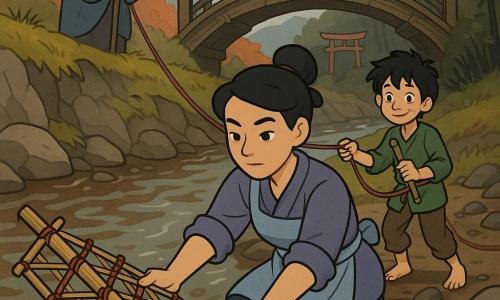
Aki began the next morning with a bucket, a rake, and a woven basket that used to carry sweet potatoes. Before she touched a single piece of litter, she bowed toward the river.
“Please forgive our clumsiness,” she said. “I will do what I can.”
The first hour was simple, almost satisfying. She lifted bottles, wrappers, and broken toys from the water. Each piece made a small sound—clink, slap, squelch—like the river clearing its throat.
Children crossing the bridge slowed down to stare.
“Why are you doing that?” asked a boy with a school cap tilted like a crooked roof.
“So the river can breathe,” Aki replied.
A girl snorted. “Rivers don't breathe.”
Aki held up a clump of wet plastic bag, stretched thin and ghostly. “Then what do you call this?” she asked gently. “A river's cough.”
The boy leaned over the railing. “It's gross.”
“It is,” Aki agreed. “But if you dropped rice on the floor, you wouldn't leave it there. You'd pick it up.”
The girl folded her arms. “That's different. The floor is mine.”
Aki pointed to the water sliding past. “And this river feeds your rice. It cools your summer. It carries your wishes when you toss petals in the current. If we take from it, we can also give.”
The children exchanged glances. Pride and curiosity wrestled on their faces.
“Can we help… just a little?” the boy asked, trying to sound like he didn't care.
Aki's smile warmed like sunlight on stones. “Just a little is how a river starts.”
Soon they were passing her rubbish like a strange relay race. They laughed when a soggy slipper surfaced like a tired fish. They groaned at slimy clumps of weeds. Aki kept her voice steady, and her gratitude steady too.
“Thank you,” she told them each time they handed her something. “Thank you. Thank you.”
By afternoon the basket was heavy, and the children's hands were muddy. The river, though still troubled, looked less crowded, as if it had room again to remember itself.
As they left, the girl glanced back. “Will it be clean tomorrow?”
Aki watched a leaf spin in an eddy, trapped by a snag of twine. “Tomorrow,” she said, “it will be cleaner than today. That is a promise you can build on.”
That night Aki set a small bowl of water on her porch, the old village way of greeting the unseen. Not as payment—she had nothing to bargain with—but as respect.
The moon rose, pale and round, and its reflection wobbled in the bowl like a shy face.
Chapter 3: The Shrine of Listening Stones
After several days, Aki learned the river's secrets the way you learn a friend's habits. She learned where the current hid trash under roots. She learned which stones were slippery with moss. She also learned that the worst mess came from upstream, where the bamboo grove thickened and the bank crumbled.
There, half-covered by vines, stood a tiny shrine—only a simple roof and a stone basin, guarded by two worn statues whose faces had softened with age. Someone had once tied bright cords and paper streamers there, but now only a few faded strips fluttered like tired prayers.
Aki paused. The air felt different, heavier, as if the forest was holding its breath. The river narrowed and hurried past, anxious.
She bowed toward the shrine. “Good day,” she said quietly. “If there are spirits here, I greet you.”
A drop of water fell from a leaf onto the stone basin with a clear plink. It sounded like an answer.
Aki noticed something caught beneath the shrine's steps: a knot of fishing line, wrapped around twigs and leaves like a cruel spiderweb. She pulled gently. It resisted, biting into the earth.
“Stubborn,” she muttered. “Like a bad habit.”
She braced her feet and tugged again. The line snapped free, and she stumbled backward—right into a cloud of startled sparrows.
From the shadows, an old man's voice chuckled. “Even rivers have snares, eh?”
Aki turned. An elderly fisherman stood near the bank, his straw hat low. His eyes were bright as river stones.
“I didn't see you,” Aki said.
“Most people don't,” he replied, as if that was normal. He pointed his chin at the pile of rubbish in her basket. “You've been working hard. For what reward?”
Aki wiped her hands on her apron. “So the river can run clear. So the fish return. So the village remembers respect.”
The fisherman nodded slowly. “Gratitude with mud on its fingers. That's the kind the mountains understand.”
Aki studied him. His clothes looked ordinary, but his shadow seemed oddly light, as if it didn't want to cling.
“Do you know why the river is so clogged here?” she asked.
He looked upstream. “The river's bed is like a story. When too many careless pages are thrown in, the story can't be read.” He tapped his fishing rod against the ground. “There is also… something else. A dream has been circling.”
Before Aki could ask, the fisherman stepped behind a bamboo stalk—and was gone, as if the forest had swallowed him politely.
Aki's breath came out in a quiet puff. She wasn't frightened. She felt watched, yes, but not threatened—more like being noticed by an old teacher.
She bowed again to the shrine. “If you are listening,” she murmured, “I am listening too.”
Chapter 4: The Fox in the Sleeping World
That night, Aki slept early, her muscles aching in a good, honest way. Rain ticked the roof like fingers drumming a gentle song.
Her dream opened like a sliding paper door.
She stood beside the river, but it was not the river she knew. It glowed from within, as if moonlight had dissolved into the water. Mist drifted over it in slow ribbons. Every stone looked freshly washed, every reed perfectly combed.
Then she saw the fox.
It sat on a flat rock in the middle of the current as if the water had agreed to hold it up. Its fur was the color of autumn fire, and its eyes were pale gold—two lanterns in the fog. Around its neck hung a thin cord with a single bell, but the bell made no sound.
Aki did not move. In stories, foxes could be tricksters. But in her grandmother's stories, a fox could also be a messenger, wearing mystery the way humans wear clothes.
The fox spoke without moving its mouth. The words arrived in Aki's mind like stones dropped into a pond.
—Your hands are open. Your gaze is straight. That is why the river shows you its pain.
Aki swallowed. “Are you… a spirit?”
The fox's tail curled around its paws.
—Names are nets. I slip through them. Listen instead.
The mist thickened, and images floated inside it: plastic shining like fish scales, oil slicks like bruises, tangled roots choking under garbage. Then another image: the shrine upstream, its paper streamers replaced with fresh white ones, fluttering like new wings.
—The river is a road for more than water, the fox said. —It carries blessings. It carries apologies. When it is clogged, the path narrows for everyone—humans, fish, and the ones you do not see.
Aki felt her chest tighten with a mixture of sadness and determination. “I'm trying,” she said. “But it's so much.”
The fox's eyes softened, a sunset turning gentle.
—Do not try to lift the whole mountain. Invite the mountain to lift with you.
Aki frowned. “How?”
The fox lifted one paw and touched the river's surface. Ripples spread outward, and in each ripple Aki saw faces: the children from the bridge, Mrs. Nao, the grumbling shopkeeper, the quiet priest at the small shrine, even the village mayor who always looked too busy to look at anything.
—Give them a reason that is bigger than scolding, the fox said. —Give them a reason they can carry in their own pockets.
Aki's voice came out small. “A reason like… hope?”
—Like belonging.
The fox's bell finally rang, just once. The sound was clear and bright, like a winter star.
Aki reached out, but her fingers touched only mist. The dream folded closed. The rain on her roof faded into silence.
When she woke, the air smelled washed clean, and a single red leaf lay on her porch beside the bowl of water. It had not been there the night before.
Chapter 5: A Festival of Small Promises
Aki carried the red leaf to the tea shop. Mrs. Nao was wiping cups, her movements brisk.
“Did a fox visit you?” Mrs. Nao asked without looking up.
Aki nearly dropped the leaf. “How did you—”
Mrs. Nao finally met her eyes. “Because you have the face of someone who has been spoken to by the forest.”
Aki sat and told her everything: the glowing river, the bell, the words about belonging. Mrs. Nao listened as if she were tasting the story like tea, letting the warmth spread.
When Aki finished, Mrs. Nao nodded. “Then we'll give the village a reason to belong to the river again.”
They planned quickly, like people who had been waiting for permission. Aki visited homes with open hands and a frank gaze.
At the rice merchant's door she bowed. “Will you help us clean the river on Saturday? We're making it a village day.”
The merchant frowned. “I'm busy.”
Aki held up her muddy gloves. “The river has been busy for you every day of your life,” she said softly. “Let's be busy for it once.”
He grunted, then sighed. “Fine. But no speeches.”
At the school, the children begged their teacher. “Please! We want to do the river relay again!”
Even the mayor, cornered near the post office, adjusted his tie and tried to escape.
“Mayor,” Aki said, stepping into his path with polite courage, “if the river becomes sick, the village becomes thirsty. If the village becomes thirsty, your job becomes… very loud.”
He blinked. “Is that a threat?”
“It's a promise,” Aki replied, and smiled. “Also, Mrs. Nao is making sweet rice cakes for volunteers.”
The mayor's serious face fought a losing battle with his sweet tooth. “I can spare an hour.”
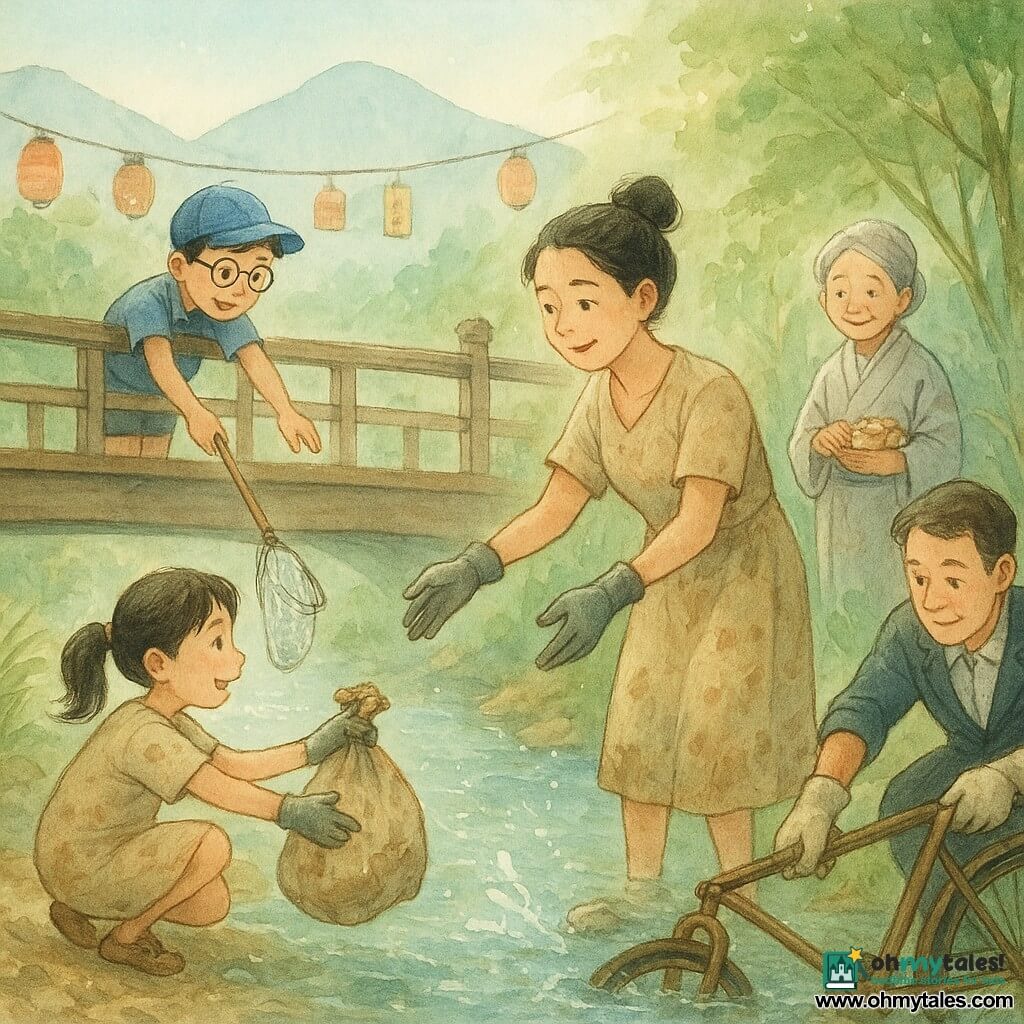
On Saturday, the village gathered by the bridge. The morning was cool, and the mountains looked like they were wearing blue robes.
Aki brought bundles of thin wooden plaques, the kind used at shrines for wishes. On each plaque was painted a simple wave.
“Write one promise,” she told everyone. “Not a giant promise. A small one that fits in your hand.”
People hesitated, then began to write.
“I won't throw wrappers on the street,” a boy wrote, sticking out his tongue in concentration.
“I will reuse my bags,” wrote a woman who sold vegetables.
“I will pick up three pieces of trash each week,” wrote the mayor, muttering, “This is ridiculous,” though his handwriting was careful.
They tied the plaques along a rope near the riverbank. The line of promises fluttered in the breeze like a school of wooden fish.
Then they worked.
The riverbank became a living chain of arms and laughter and effort. Someone found a rusted bicycle and shouted as if they'd discovered treasure. Someone else shrieked when a frog hopped onto their boot. Mrs. Nao scolded the children for splashing, then laughed when she got splashed herself.
Aki moved among them, thanking, guiding, lifting, listening. The river's smell changed slowly—from sour and trapped to fresh and green.
By noon, sunlight struck the water, and for a moment the surface flashed bright enough to make everyone pause.
“It looks…” the girl from the bridge began.
“Like it's smiling,” the boy finished, surprised by his own words.
Aki looked at the river and felt the fox's message like a warm pebble in her pocket: belonging.
Chapter 6: The River Finds Its Voice Again
In the weeks that followed, the river kept changing. Clear water did not appear like magic in one night; it returned the way trust returns—patiently, drop by drop.
Aki continued her morning visits. Sometimes she worked alone. Often someone joined her: a child with a bucket, the rice merchant with grumpy determination, the mayor with gloves that looked far too expensive for mud.
One evening, Aki climbed to the little shrine upstream with a bundle of fresh paper streamers and a length of clean cord. The forest was quiet, but not empty. The air held that same attentive weight.
She tied the streamers carefully, each one white and crisp, each one fluttering like a tiny flag of respect. Then she cleaned the stone basin and poured into it water from the river—now clearer, shining faintly in the dusk.
She bowed low. “Thank you,” she said to the place, to the river, to whatever listened.
A breeze slid through the bamboo and lifted the streamers all at once. They rustled like applause made of leaves.
Aki straightened. For a heartbeat she thought she saw a shape near the trees: a fox's tail, bright as a flame, vanishing behind a trunk. Or maybe it was only a trick of sunset.
As she walked back, she heard the river more clearly than she had in months. It didn't just flow; it spoke. It chuckled around stones. It hissed over shallows. It sang a soft, steady song that seemed to say, I am here. I am here.
At the bridge, the children were leaning over the railing again.
“Look!” the boy called. “You can see the pebbles!”
“And the fish!” the girl added, pointing to a quick silver dart beneath the surface.
Aki rested her arms on the railing beside them. The water ran clean enough to mirror the sky. The last light of day turned it the color of warmed tea.
Mrs. Nao arrived with a basket. “Rice cakes,” she announced. “For the river helpers.”
The mayor cleared his throat. “We should… do this every season,” he said, trying to sound important. Then he added, quieter, “It feels good.”
Aki nodded. “The river takes care of us,” she said. “So we take care of the river. That's not a chore. That's a relationship.”
The girl glanced up at Aki. “Do you think the river knows our promises are there?”
Aki watched the current slide past, carrying fallen petals like little boats. “I think nature hears best when we speak with our actions,” she said. “Promises are seeds. But hands are the rain.”
That night, Aki slept with her window cracked open. The river's song slipped into her room like a lullaby.
In the sleeping world, she dreamed again of mist and moonlight. The fox stood on the same rock, and this time its bell rang softly, twice.
—You did not clean the river alone, it said. —You reminded others they belonged.
Aki bowed in her dream. “Will you stay?”
The fox's eyes glimmered with gentle mystery.
—I was never yours to keep, it replied. —But when respect lives in your daily steps, you will never walk without company.
When Aki woke, the morning was clear. Outside, the river ran bright and honest, like a long mirror laid across the earth. It carried the mountain's snow, the village's laughter, and the quiet promise that if people kept their hands open and their eyes frank, the world would keep answering—one shining ripple at a time.