Chapter 1 — The Boy Who Listened
In a village folded between bamboo groves and silver rivers, there lived a young man named Haru. He moved with the quiet of someone who listened to wind more than he spoke. The elders called him gentle; the children called him a dreamer. He kept a small wooden box of proverbs passed down by his grandmother, each saying tied with a thin red thread like a blessing. He read them by lamplight: "Even the smallest seed trusts the dark before it breaks," and "A thankful heart waters the roots of kindness."
Haru's secret wish was as soft as a hidden bell: he wanted to guide the sacred white deer that sometimes wandered into the village back to the green valley beyond the hills. The deer was a spirit of the mountain, its coat like moonlight, its eyes deep as wells. Villagers treated the creature like a messenger—some left rice and tea at the shrine; others a bow. Haru believed the deer belonged to the wide world, not the narrow streets of houses. He wanted to open the deer's hoof-worn path home.
Each morning Haru walked past lacquered gates and stone lanterns and paused to listen for the deer's breath. He learned the names of spirits whispered in the crackle of rice straw and the creak of torii gates. He collected small kindnesses: a knot untied for an old neighbor, a kind word to a weeping child. He kept thinking: gratitude is a map that leads you home.
Chapter 2 — The Rain of Stars
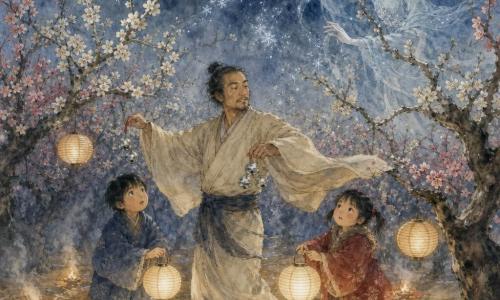
One night, while the village slept under a foxfire sky, the air changed. The moon was a thin coin. Haru sat by the shrine and read a proverb aloud, the words floating like steam: "When the mountain listens, even the sky speaks." Before his voice fell, the heavens trembled and a rain of stars began, a soft shower like silver rice. They fell in a slant, ringing the pines with tiny bells, and the world smelled of cedar and new tea.
In the wake of that celestial rain, the white deer was seen standing at the edge of the village green, its coat luminous as paper lanterns. It did not run. It did not bow. It simply watched. Haru felt a tug in his chest, a thread unspooling toward the deer. Around the village, lamps flickered and shadows became a crowd of curious spirits—foxes with priestly masks, water sprites with laughing eyes, and the old, silent kami who lived in the cedar trunks.
An elder called from her veranda, "The sky gives and the sky keeps; be careful what you ask." But Haru's wish pressed against his ribs like a small, warm pebble. He stepped toward the deer, and the world hushed like a held breath.
Chapter 3 — The Pact of Petals
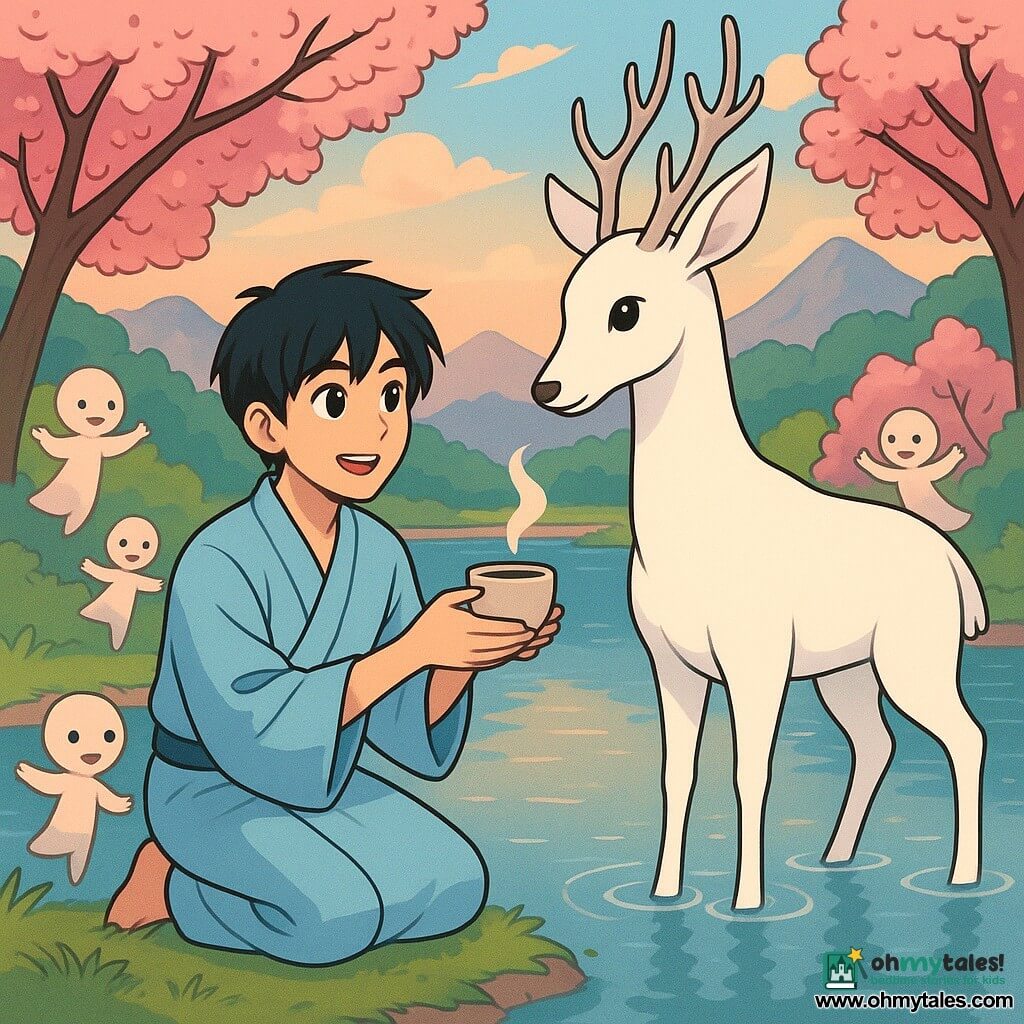
Haru hesitated, remembering his grandmother's hands threading proverbs into his life. He knelt on the damp earth and offered tea in a cracked bowl, whispering, "I only wish for you to find your path." The deer lowered its head and, with a movement like a falling willow, dropped a single white petal at Haru's feet. The petal shimmered and dissolved into the soil, and Haru felt a new proverb echo in him: "To be given a gift is to hold two threads—one to receive and one to return."
The petal became a map drawn in his chest. He understood then that guiding the deer would not be a theft but a stewardship. The deer trusted him enough to plant this petal. So Haru promised, out loud and steady: "I will bring you to the valley, step by careful step. But I will not pull you away from what is true."
That night the deer slept beneath the shrine's eaves as if beneath a mother's arm. Haru slept too, but dreams kept him company—dreams of rivers that spoke, of lanterns that hummed, of distant mountains that bent like old men nodding to passersby. When morning came, the path to the valley was as uncertain as a folded letter.
Chapter 4 — The Lessons of Wind and Stone
The journey began with simple things. Haru learned from the wind how to move without startling: small steps, slow bows of the head, breathing in rhythm with the reeds. He learned from a stone by the river—worn smooth by time—how to wait patiently. Along the way, he met folk who carried pieces of the village's history: a woodcutter who carved a tiny deer from cherry wood and taught Haru to listen to the grain of things; a tea-house woman who poured conversation like steam and taught him how to offer thanks that tasted like matcha: warm, a little bitter, and utterly honest.
Sometimes the deer paused and watched the village as if reading the map of gratitude written on the faces of people. "Why do you stop?" Haru asked once while they crossed a stream, the water moving like a song. The deer lowered its head, and in that silence Haru saw the traces of offerings—rice piled at shrines, folded paper tied to branches, the footprints of children who had sketched deer with chalk. Haru realized the deer was reading gratitude itself.
When they encountered a thick grove where the path disappeared, Haru used the proverb of his grandmother: "A lamp shared brightens far more than two kept hidden." He lit two lanterns and placed one on a low branch. The spirits of the wood, curious and good-humored, nudged aside thorn and vine, revealing a narrow trail. The deer stepped forward, confident now that the village's gratitude would not be left behind but would travel with them as light.
Chapter 5 — The Night of Mirrors
On the last night before the valley, a mirror lake lay between hillside and cloud. Its surface reflected not only the stars but the faces of those who had helped Haru. He saw his grandmother's smiling mouth, the woodcutter's rough palm, the children's chalk drawings, and the elder's bowed back. Each reflection trembled with thanks.
At the lake's edge, spirits gathered in a council of ripples—small river kami, playful foxes, and a solemn deer spirit who seemed like an elder of the herd. They circled Haru and the white deer and spoke in the hush that comes before dawn. "Why do you guide the deer?" they asked, their voices like leaves.
Haru bowed until his forehead brushed the earth. "Because the deer belongs to the valley," he answered simply. "And because I have been given much. To hold is to give back."
The deer stepped onto the water as if on glass. Haru reached out. For a moment, the world seemed to balance on the tip of a blade: if he pushed, the deer would run; if he clung, she might stay and the valley would be unmade. He let go of wanting and offered thanks instead. He whispered all the proverbs in his box, and each one was like a pebble dropped into the lake, sending rings outward that carried his gratitude.
The elder spirit bowed its antlers. "Your heart is full," it said. "Now fill another." With that blessing, the white deer moved, not led by rope or command but drawn by a longing older than names.
Chapter 6 — The Valley's Return
When the first light touched the valley, it found the deer standing beneath a grove of lacquered trees, where mist rose like breath. The herd awaited, their coats dim against the new sun, and they circled the newcomer with a murmuring that sounded like rain on paper. The white deer turned once, met Haru's eyes, and in those deep wells of gaze there was gratitude: not the shy kind of thanks whispered at a shrine, but a wide, bright recognition.
Haru felt something loosen inside him, like a knot undone. He had not simply guided the deer; he had returned a story to the mountain—a story stitched with proverbs, lit by lanterns, and carried in a grateful heart. The villagers greeted him when he returned, not with questions but with bowls of steaming rice and hands warm as summer wood. "Where did you learn to be so brave?" a child asked, eyes round.
Haru held up the empty box of proverbs and smiled. "From those who taught me to be thankful," he said. "Gratitude is a path we walk together."
That evening the village hung paper cranes and small notes of thanks from the torii, and the elders told their own children the new whisper: when the sky gives a sign, listen with gratitude, and the world will return what it can. The rain of stars had changed more than the deer's coat; it had taught a village how to hold and how to release.
In the years that followed, Haru became a keeper of small things: a repaired gate, a borrowed umbrella returned with a ribbon, a thank-you whispered to a tree. The white deer came sometimes at dawn and sometimes in mist, always leaving a single white petal on Haru's threshold. Each petal dissolved in the morning sun, and each time Haru felt the same warm pebble in his chest that had started him on the path.
Gratitude, he learned, was not a single act but a living thing—rooted like cedar, open like a lantern, and steady like a stone. It guided both the giver and the receiver, and in its light the village found its true road home.