Chapter 1: Strings Under a Gentle Night
On the edge of a cedar forest, where fireflies wrote small glowing poems in the air, lived a woman named Aiko. She was not old, not young—just the kind of age where your hands know what your heart wants, even when your thoughts still argue about it.
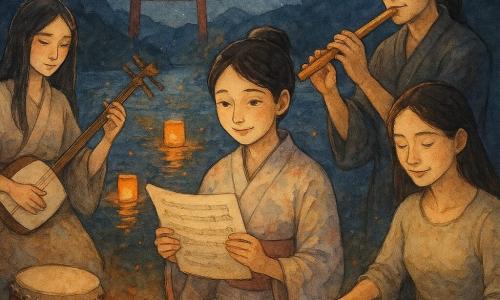
Every evening, she sat on the wooden porch of her little house and played the koto. The notes were as clear as mountain water. They slid into the night like silver fish, weaving through bamboo leaves and resting on the roofs of sleeping homes. Even the wind seemed to pause and listen, polite as a guest.
Aiko played with careful focus. Her face, lit by a paper lantern, looked calm, but her mind was busy. In the temple up the hill, there was an empty place that should not have been empty: the hook where the Birth Bell was meant to hang.
People said the Birth Bell had once rung softly whenever a child took its first breath in the village. Not loudly like a warning—more like a secret. A warm sound, like the world whispering, “Welcome.”
But the bell had been lost. Some blamed thieves. Some blamed storms. Some blamed the careless hands of humans. Aiko blamed none of them aloud, yet she felt the missing bell like a missing tooth—small, but impossible to ignore.
That night, after her last note faded into the dark, she heard another sound: a faint, hollow clink, like metal nudging stone.
She froze.
From the garden path came a shape no taller than her knee. It wore a straw hat too large for its head, and its eyes shone like wet pebbles.
“A tanuki?” Aiko whispered. Tricksters lived in old stories, but this one's posture was humble, as if it had borrowed mischief and returned it.
The tanuki bowed so low its hat slid forward. “Not here to steal,” it said, voice thin as a reed. “Here to return a worry.”
It lifted a paw. Hanging from a cord was a small bronze bell, darkened with age. It was not huge, not grand, but the air around it felt different—like the space around a sleeping baby.
Aiko's breath caught. “The Birth Bell.”
The tanuki nodded. “Found it where the river forgets its name. But my paws cannot climb temple steps. Yours can.”
Aiko reached out, careful as if touching moonlight. The bell was cool, yet it made her palm feel oddly warm.
“Why bring it to me?” she asked.
The tanuki's eyes narrowed kindly. “Because you play the koto as if you mean every note. Honest hands should carry honest things.”
Aiko swallowed. Praise felt heavy. “Then I will take it back,” she promised.
The tanuki's tail swished, half relief, half warning. “Walk before dawn. Spirits like quiet roads. And… listen for tea.”
“Tea?” Aiko repeated, puzzled.
But the tanuki had already melted into the shadow of the persimmon tree, as if it had always been part of the bark.
Aiko sat back on her heels, the bell in her lap. In the silence, she thought she heard it breathe.
Chapter 2: The Road of Cedar and Mist
Before the sky could decide whether to be night or morning, Aiko wrapped the bell in a cloth the color of pale rice and tied it with a knot her grandmother had taught her—tight enough to hold, gentle enough to untie.
She stepped onto the path toward the temple. Mist drifted between the trees like slow, thoughtful ghosts. Somewhere high above, an owl spoke in a single syllable, as if counting her footsteps.
Aiko walked steadily, her sandals making small, soft pats on the earth. The bell rested against her back, and with every step it gave a tiny, cautious tap, as if asking, “Are we there yet?”
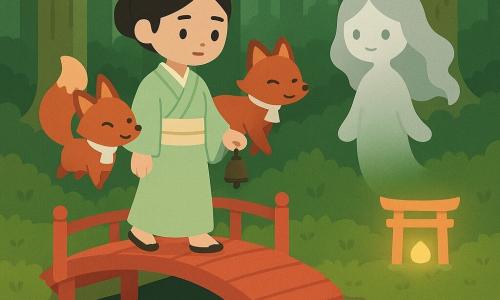
She passed a stone fox statue at the roadside shrine. Its face was chipped, but its grin remained, sly and patient. Aiko bowed.
“I'm only borrowing your road,” she murmured.
A breeze answered by fluttering the paper offerings. It sounded almost like laughter, but not unkind.
As the path climbed, the forest changed. Cedar gave way to maple, and maple to pine. The smell of sap and damp moss was sharp enough to wake the last of sleep from her eyes.
Then, just as the first thin ribbon of dawn appeared, she caught a new scent.
Tea.
Not the dry smell of leaves in a jar, but the living fragrance of brewed tea: warm, grassy, with a hint of smoke. It drifted across the path like an invisible hand trying to stop her—not with force, but with invitation.
Aiko slowed. The tanuki's words returned: listen for tea.
From behind a curtain of bamboo came a tiny teahouse she had never seen before. It was no bigger than a fisherman's hut. A lantern glowed in its window, steady as a patient star.
Aiko frowned. She knew this hill well. The temple stood above, and below were only trees and stones. There was no teahouse.
Her fingers tightened on the bell's cloth. “I can't get distracted,” she told herself. “The bell belongs at the temple.”
Still, the scent of tea tugged at her thoughts. It made her remember her grandmother's hands, the way they moved—slow, certain, real. It made her remember sitting quietly, not trying to impress anyone, just being present.
Aiko took a cautious step toward the door.
Before she could knock, it slid open with a soft wooden whisper.
Inside sat an old woman, her hair silver and pinned neatly, her kimono simple as a blank page. Her eyes were bright and dark at once, like a deep pond reflecting the sky.
“Good morning, traveler,” the old woman said. “Your shoulders carry more than weight.”
Aiko bowed. “I'm bringing the Birth Bell back to the temple.”
“Ah,” the old woman replied, as if Aiko had said, I'm bringing the sunrise back to the sky. “Then you must be very careful. Not with your hands—those seem steady. With your heart.”
Aiko blinked. “With my heart?”
The old woman poured tea into a small cup. The steam rose in pale spirals, like prayers that hadn't decided where to land.
“Sit,” the old woman invited. “A cup of tea does not steal time. It returns it.”
Aiko hesitated. The temple was close. The bell felt impatient against her back. But the tea's scent wrapped around her like a warm scarf.
She sat.
Chapter 3: The Cup That Shows What Is Real
The old woman placed the cup before Aiko. The tea was the color of spring leaves after rain—green, but not loud about it.
Aiko lifted it with both hands, as her grandmother had taught her. The cup warmed her fingers, and when she took a sip, the taste was gentle and sharp at the same time, like truth told kindly.
Outside, the bamboo tapped against itself. Inside, the teahouse felt like the pause between two koto notes.
“You are determined,” the old woman said. “That is good. Determination is a strong rope. But ropes can also tie you up.”
Aiko frowned slightly. “I don't understand.”
The old woman tilted her head. “Why do you want to return the bell?”
Aiko's answer came quickly, practiced in her mind. “Because it belongs there. Because the village needs it. Because it's wrong for it to be missing.”
The old woman nodded as if hearing a list of chores. “And also?”
Aiko opened her mouth, then closed it.
The teahouse seemed to lean in.
Aiko stared into her tea. In its surface she expected to see her own face, but instead she saw the temple courtyard—empty hook, silent air. Then she saw villagers whispering, their eyes turning to her, their mouths forming her name with hope and pressure.
Aiko's stomach tightened.
“I want them to stop looking disappointed,” she admitted softly. “I want… to be the one who fixes it.”
The old woman did not scold. She simply breathed, and the lantern flame did a small bow.
“Honest,” the old woman said. “That is a clean word. It tastes like this tea.”
Aiko's cheeks warmed. “Is that bad?”
“No,” said the old woman. “Wanting to help is good. Wanting to be admired is human. But if you carry the bell only as a trophy, it will become heavy. If you carry it as a promise, it will become light.”
Aiko glanced toward the cloth bundle on her back. It did feel heavy, but not in her muscles—in her thoughts.
The old woman leaned forward. “The Birth Bell does not ring for pride. It rings for beginnings. If you want to return it, you must return something else too.”
“What?” Aiko asked.
The old woman's eyes crinkled. “A mask.”
Aiko's hands hovered near her face as if she could find it there. “I'm not wearing—”
The old woman raised one finger. “Not on your skin. Inside. The mask that says, I must be perfect to be worthy.”
Aiko swallowed. That mask fit tightly. She had worn it so long she had stopped feeling its edges.
The old woman refilled Aiko's cup. “Drink. Then go. The path will test you. Not with danger. With choices.”
Aiko stood and bowed deeply. “Thank you. But… who are you?”
The old woman smiled as if the question were a small bird landing on her palm. “A teahouse is a bridge. Does a bridge need a name?”
Aiko stepped outside. The mist had lifted. The forest looked freshly washed. She took one step, then another.
Behind her, the teahouse was still there.
After the third step, she looked back.
Only bamboo, swaying quietly, as if nothing had happened.
Aiko exhaled, half startled, half calm. She adjusted the bundle on her back.
It felt—if not lighter—at least clearer.
Chapter 4: The Trick of the Shining Path
The temple gate came into view, its wooden beams dark and solid against the brightening sky. Aiko's heart beat faster, like a drum trying to keep up with her feet.
But the forest was not finished with her.
Just before the stone steps, the path split around a mossy boulder. Aiko had always known only one way up, but now there were two.
The left path was ordinary—stone, roots, a few fallen needles.
The right path looked as if someone had sprinkled it with powdered moonlight. The stones gleamed. The air above it shimmered. It seemed smoother, easier, almost eager.
Aiko stopped.
A laugh—quiet and snickering—bubbled from somewhere in the trees. She did not see anyone, but she felt eyes watching, curious as children hiding behind curtains.
“A shortcut,” Aiko murmured.
The bell tapped once against her back. Tap. Like a tiny question.
The shimmering path tempted her, not like a villain, but like a sweet bun in a bakery window. “Take me,” it seemed to say. “You'll arrive faster. You'll look graceful doing it.”
Aiko remembered the old woman's words: choices.
She pictured herself walking up the shining path, arriving at the temple spotless, impressive, perfect. The villagers would nod. The priests would praise her. Someone might even say her name with that special tone that turns a person into a story.
Then she pictured the tea's surface, showing her the truth. The wanting. The mask.
Aiko touched the cloth over the bell. “If I'm honest,” she whispered, “I want the shining path.”
A breeze curled around her ankles, like a cat waiting to see what she would do.
Aiko bowed toward the boulder, as if to the spirits of the hill. “But wanting isn't the same as choosing.”
She stepped onto the ordinary path.
Immediately, a branch snagged her sleeve. A root rose like a sneaky foot and tried to trip her. Aiko stumbled, caught herself, and huffed a laugh.
“Well played,” she told the forest. “I'm awake.”
The snickering in the trees softened, less mocking now, more approving—like older siblings who secretly want you to succeed.
As she climbed, Aiko's sandal straps loosened. She stopped to retie them properly, not rushing, not trying to look heroic.
“I'm not a legend,” she muttered. “I'm just Aiko.”
And saying it made her shoulders relax.
At the top of the steps, she reached the gate. The air here was different—still, clean, touched with incense and old prayers. The temple roof curved like a resting crane.
Aiko took a long breath.
Then she heard a voice behind her.
“Hey! Wait!”
Chapter 5: A Bell, a Child, and a Honest Note
A boy came running up the steps, face red, hair sticking out like a startled sparrow. He looked about eleven or twelve, the age where legs are fast but patience is slow.
“Aiko!” he panted. “My mother said you went up here. She said you might… you might have it.”
Aiko tilted her head. “Have what?”
He pointed at her back. “The bell. The Birth Bell.”
Aiko's fingers tightened on the cloth. “How do you know?”
The boy swallowed. His eyes flicked toward the temple, then down at his own feet. “Because… I saw it.”
Aiko felt the morning chill creep into her skin. “Where?”
“In my uncle's shed,” the boy confessed, words tumbling like stones down a slope. “It was under rice sacks. I heard him say he found it by the river and was going to sell it in the city.”
Aiko stared. So the river forgets its name, she thought, and people forget their promises.
The boy's voice shook. “I took it. I know I shouldn't have. But my baby sister was born last week, and there was no bell sound. My mother cried, just a little. Like she was trying not to.”
Aiko's anger rose like hot tea poured too quickly. “You stole it,” she said, sharper than she meant.
The boy flinched. “Yes. I'm sorry. I didn't know what else to do. I hid it by the river, but then I got scared and told… someone.” He glanced toward the trees. “A tanuki. It looked at me like I was a silly rock.”
Aiko's lips twitched despite herself. “That sounds like a tanuki.”
The boy clasped his hands together. “Please don't tell the priests it was me. My uncle will—”
Aiko held up a hand. The word mask echoed in her mind. She could march into the temple, present the bell, accept praise, and let the boy carry shame like a heavy bucket.
Or she could be honest.
She exhaled slowly. “Listen. What you did was wrong,” she said, meeting his eyes. “But your reason came from care, not greed. That matters. Authenticity means telling the truth of who you are, even when it's messy.”
The boy blinked hard. “So… what happens?”
Aiko turned toward the temple. “We return the bell. Together. And we tell the truth together.”
The boy's mouth fell open. “They'll hate me.”
“Maybe they'll be angry,” Aiko said. “Anger is a loud door. But behind it, there can still be understanding.”
She reached back, untied the bundle, and held it in front of them both. “Put your hands here.”
The boy hesitated, then placed his hands on the cloth. His fingers were small, but they trembled with determination.
They climbed the last few steps side by side.
Inside the courtyard, an old priest swept fallen needles. He looked up, eyes calm as worn stones.
Aiko bowed. The boy bowed too, almost folding in half.
Aiko spoke first. “We have brought back the Birth Bell.”
The priest's gaze moved to the bundle. “So the hook will no longer be empty.”
The boy's voice came out thin. “I— I helped take it. I took it from my uncle. I hid it. I'm sorry.”
Silence settled over the courtyard. Even the sparrows seemed to hold their breath.
Aiko felt her own heart thud. She wanted to add excuses, to soften the truth into something prettier. But authenticity was not decoration. It was wood, plain and strong.
The priest studied the boy for a long moment. Then he looked at Aiko. “And you chose to bring him with you.”
“Yes,” Aiko said. “Because the bell is for beginnings. This can be one.”
The priest's mouth curved slightly, not quite a smile, but not a frown either. “Then let us begin properly.”
Chapter 6: The Sound That Welcomes
They carried the bell into the inner hall. The air smelled of incense and polished wood, and the shadows were soft, as if the temple had learned how to cradle silence.
A hook waited on a beam, empty as a paused sentence.
The priest lifted the bell, surprisingly steady for his age, and hung it carefully. The bronze caught the morning light, and for a moment it looked like a small sun that had decided to live indoors.
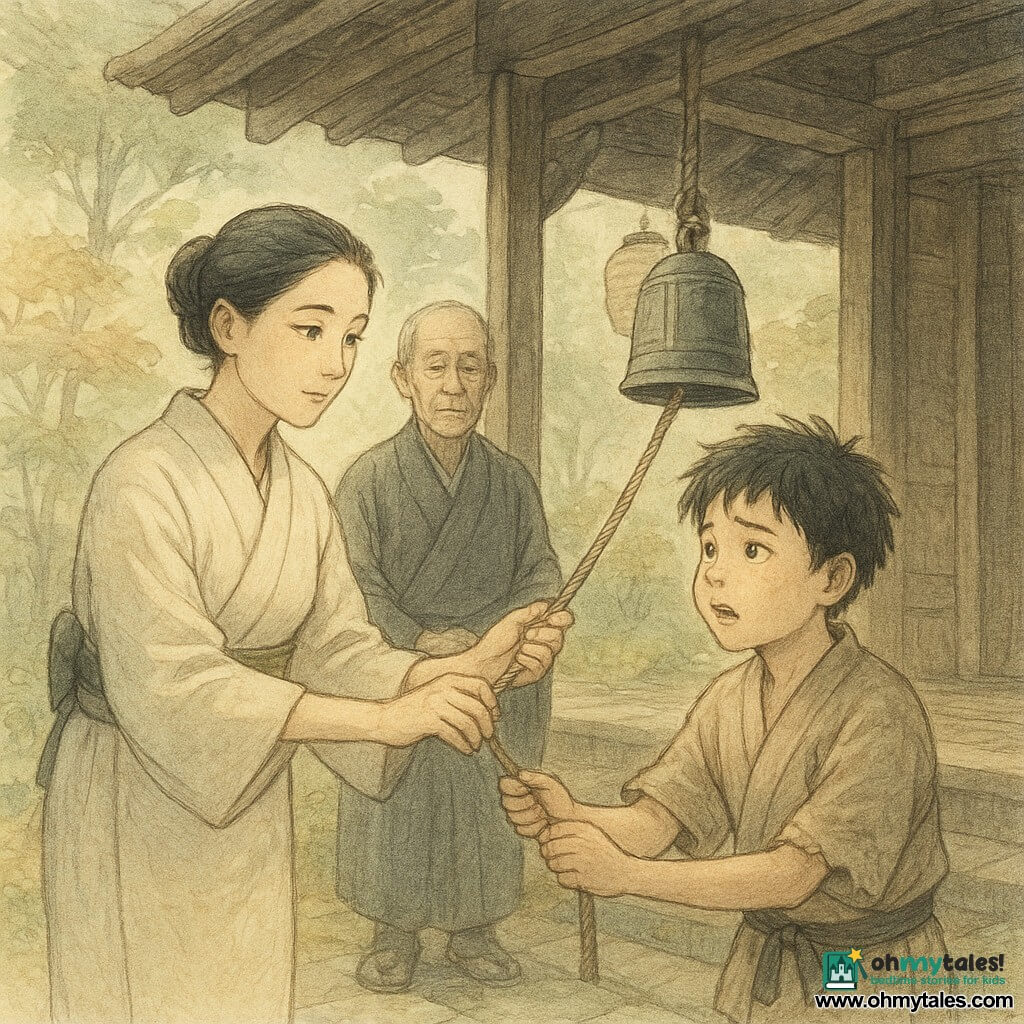
He handed the rope to Aiko. “You may ring it,” he said.
Aiko's throat tightened. She imagined the village hearing it and turning toward the temple. She imagined praise landing on her shoulders like a cloak.
Then she looked at the boy beside her, eyes wide and worried. She thought of the old woman in the teahouse, and the cup that showed what was real.
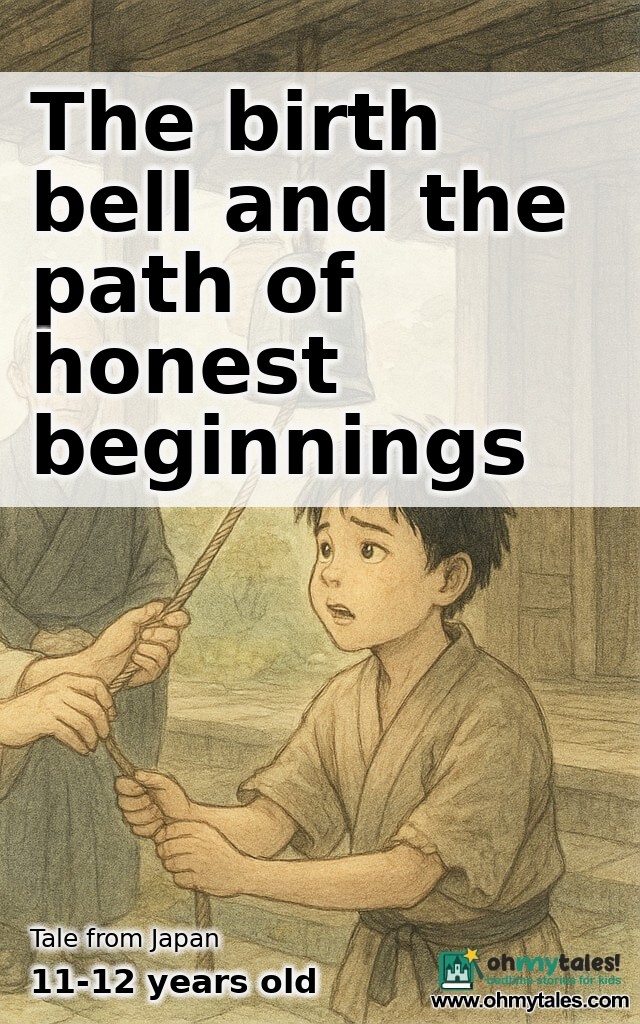
Aiko placed the rope in the boy's hands instead. “You ring it,” she said gently. “Not to erase what happened, but to welcome what can happen next.”
The boy's lips parted. “Me?”
Aiko nodded. “Be honest with the sound.”
The boy gripped the rope. His knuckles went pale. Then he pulled.
The bell rang.
It was not loud like thunder. It was clear and round, like a drop of water falling into a still pond and sending ripples through the world. The note seemed to travel through wood and stone, through branches and roofs, through sleeping hearts.
Aiko felt it in her chest, a warmth spreading as if a lantern had been lit inside her.
Outside, in the courtyard, a breeze moved through the trees. For a heartbeat, Aiko thought she saw a straw hat bob behind a pine, and a tail flick away.
The priest closed his eyes briefly, as if listening to something older than sound. When he opened them, he looked at the boy.
“Your uncle must answer for his choices,” he said calmly. “But you have answered for yours. That takes courage.”
The boy's shoulders sagged with relief, and tears spilled down his cheeks, quick as summer rain.
Aiko knelt beside him. “Courage isn't never being afraid,” she whispered. “It's telling the truth anyway.”
Later, as they stepped out of the temple, the sun had fully risen. The village below glowed softly, roofs like stacked gray shells.
Aiko heard, faintly, the twang of a koto string—though she wasn't playing. Perhaps it was only the wind threading itself through the world like music.
The boy sniffed. “Will the bell ring for my sister now?”
Aiko looked back at the temple, where the bell hung steady and real. “It already did,” she said. “Maybe not on the day she was born. But today is also a beginning.”
They walked down the hill together. The forest felt kinder, as if it had decided they belonged.
And when Aiko breathed in, she caught, just once more, the soft scent of tea—warm, grassy, honest—like a quiet reminder that the truest path is the one you walk without pretending to be anyone else.