Chapter 1: The Tea That Held the Quiet
In the village of Aoi-Mura, mornings did not begin with shouting or hurry. They began with a kettle's small sigh, like a sleeping cat turning over.
Miyako lived at the edge of the cedar forest in a house that smelled of tatami straw and roasted barley. She was an adult—old enough to have learned patience the hard way, young enough to still be surprised by moonlight. When she walked, her steps were careful, as if she didn't want to wake the floorboards.
Every day, neighbors came with sincere bows and soft voices. They sat, warmed their hands around cups, and listened to the silence between sentences. In that silence, the world felt full—like a jar of fireflies with the lid gently closed.
Miyako served tea the way some people offered prayers: steadily, respectfully, with attention sharp as a needle. Steam rose in pale ribbons, drifting like thin ghosts that meant no harm.
Yet Miyako carried a secret, folded inside her like a letter never sent.
At night she dreamed the same dream, again and again. A red bridge over a black river. A lantern swinging. A drumbeat that was not loud, but certain—thum… thum… thum—like a giant's heartbeat beneath the earth. In the dream, she always heard a voice whispering her name, and she always woke before she could answer.
The strange part was this: she was not the only one.
Old Mrs. Sato, who sold persimmons, had once murmured while sipping tea, “I dreamed of a bridge and a drum. It felt… shared.”
A fisherman named Kenji had scratched his chin and admitted, “Me too. I thought it was just the river talking.”
After that, people stopped mentioning it. Not because they forgot, but because some truths are like wild birds: you do not grab them; you wait with open hands.
Miyako, however, could not wait forever. The dream tugged at her mind the way the tide tugs at stones. She wanted to uncover why it came to so many, and what it was trying to say.
That morning, as maple leaves spun down like little red boats, Miyako stood on her porch and watched the forest breathe. She bowed toward it—slow, sincere.
“Spirits of this place,” she whispered, feeling a little foolish and a little brave, “if there is a message, I am listening.”
The wind answered with a soft rustle, as if turning a page.
And far away, deeper than thunder, the drum began to beat.
Chapter 2: The Drum Beneath the Roots
The first beat came at noon.
It was not heard so much as felt. The teacups on Miyako's tray trembled. The bamboo chimes at her eaves froze mid-song. Even the cat lifted its head, eyes wide like two ink drops.
Thum.
A second beat followed, steady as footsteps.
Thum.
Miyako set the tray down. Her heart did not race; it tightened, like a knot being pulled.
Outside, the village seemed to hold its breath. A few people stepped into the road, squinting at the sky as if expecting a storm. But the clouds were innocent, drifting like sheep.
Kenji came jogging up, sandals slapping. “Did you feel that?”
Miyako nodded. “It's the dream,” she said, and surprised herself by speaking the secret aloud.
Old Mrs. Sato shuffled behind him, her persimmon basket swinging. “The earth is knocking,” she murmured. “Or something beneath it.”
The drumbeat came again—thum—strong enough that the paper screens in Miyako's windows fluttered. A bowl rattled on a shelf like teeth in the cold.
Miyako bowed to her neighbors. “I think I should go to the forest.”
Kenji frowned. “Alone?”
Miyako looked toward the cedar line, where the shade lay thick and green. “Not truly alone,” she answered, though she did not know who might be there.
Mrs. Sato leaned closer. Her breath smelled of dried fruit and winter. “The forest is old. It remembers more than people do. If you go, take respect. And take courage.”
Courage. The word felt heavy and warm, like a stone held in the palm.
Miyako went inside and took a small cloth bundle. In it she placed three things: a pinch of salt for purity, a rice cake wrapped in leaf for offering, and a tiny bell her mother had given her long ago.
Before she left, she knelt by the hearth and poured a cup of tea onto the earth outside the door—just a little, a polite sharing. Then she bowed low enough that her forehead nearly touched the floorboards.
“I will return,” she told the quiet.
The drumbeat answered, patient as fate.
Thum.
Miyako stepped onto the path and walked toward the cedar forest, where sunlight thinned into green dusk. The air changed at once. It smelled of resin, damp soil, and secrets.
As she entered, she heard something else beneath the drum: a faint, bright sound, like laughter trapped inside water.
Chapter 3: The Fox with a Paper Lantern
The deeper Miyako walked, the more the world became a whisper.
The village noises—voices, pots, footsteps—fell away. In their place came the small truths of the forest: a crow's wing beating the air, a beetle tapping on bark, the slow drip of water from moss.
Then, between two cedars, she saw a lantern.
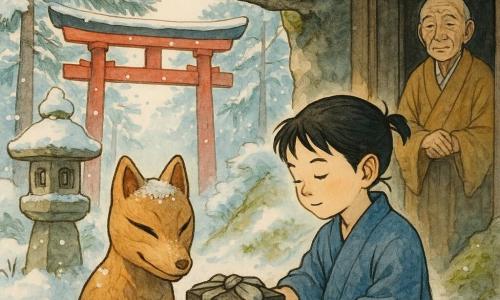
It was small, made of paper that glowed softly, though no hand held it. It bobbed in the air like a curious firefly that had learned manners. Beneath it stood a fox.
The fox's fur was the color of toasted wheat, and its tail was as neat as a brush. Around its neck hung a strip of white paper, folded like a shrine offering. Its eyes were dark and clever—but not unkind.
Miyako stopped. Her throat tried to close, but she gently told it no.
She bowed, the way you bow to a priest, or a teacher, or the first snow. “Good day,” she said.
The fox blinked slowly, as if measuring her sincerity. Then it spoke, its voice light and dry, like leaves skittering.
“You are polite. That is rare in people who walk into places that do not belong to them.”
“I'm sorry,” Miyako replied. “I didn't come to take. I came to understand.”
The drumbeat rolled through the ground, thum… thum… like a warning and a welcome at once.
The fox tilted its head. “Ah. The drum. You heard it too, in sleep.”
“Yes,” Miyako said. “And others in my village have dreamed it as well. It feels like we are standing in the same dream, even when our eyes are open.”
The lantern bobbed, casting soft light on the fox's whiskers. The fox's tail twitched once, like punctuation.
“Dreams are bridges,” it said. “But bridges are not built without a reason.”
Miyako swallowed. “What is the reason?”
The fox stepped aside, and the lantern floated forward, as if inviting her to follow. “Come,” it said. “If you are brave enough to learn, you must be brave enough to walk.”
Miyako's knees wanted to become water. Her mind offered excuses: It's late. It's dangerous. You are only one person.
Then she remembered the teacups trembling, the village holding its breath, the same dream blooming in many minds like the same flower opening in different gardens.
Courage, she thought, is not a sword. It is a lamp you carry through your own fear.
“I will walk,” Miyako said.
The fox gave what might have been a smile. “Then keep your eyes soft and your heart steady. In the places we go, loud thoughts can echo.”
They moved through the trees. The lantern's glow made the cedar trunks look like tall, sleeping guardians. Sometimes Miyako thought she saw faces in the bark—calm, watchful—yet when she looked directly, it was only wood and shadow.
At last they reached a clearing where the ground dipped like a bowl. In the center lay a stone, round and worn, covered in moss as thick as a blanket.
The drumbeat came from beneath that stone.
Thum.
Miyako felt it in her bones.
The fox sat and wrapped its tail around its paws. “Here is the root of your shared dream,” it said. “Now listen carefully. The truth does not like to be chased. It prefers to be met.”
Chapter 4: The Dream-Bridge's Secret
The mossy stone was not just a stone.
As Miyako knelt, she noticed a narrow line circling its base, like a seam. She ran her fingers along it and felt coolness—stone, yes, but also something like sleeping water.
The lantern floated closer. Its light shimmered, and for a moment the seam looked like the edge of a door.
Miyako set down her bundle. She sprinkled a pinch of salt, then placed the rice cake beside the stone. Finally, she rang her small bell once. The sound was bright and simple, like a star falling into a pond.
At the bell's note, the drumbeat paused.
In the sudden quiet, Miyako could hear her own breath, and the forest's breath, and something else—something waiting.
A voice drifted up, as soft as steam from tea.
“Miyako.”
She did not flinch this time. “I'm here,” she answered, voice steady, though her hands were trembling like leaves.
The seam widened. The stone did not lift; it opened, the way an eye opens. Darkness yawned below, not frightening, just deep. The lantern floated down a little, painting the edges gold.
The fox spoke in a tone that was suddenly respectful, almost formal. “This is not a cave. This is a passage. Long ago, when people forgot to bow with their hearts, the boundary between waking and dreaming grew thin in the wrong places. So the spirits built a bridge—but they hid it inside sleep.”
Miyako frowned. “Why would the spirits hide it?”
“Because humans run,” the fox said simply. “Even toward things that can break them.”
From the darkness rose a faint image: the red bridge of Miyako's dream, arching over black water. It hovered in the air like a reflection that had climbed out of a mirror.
On the bridge stood figures made of mist and moonlight—kindly shapes with no sharp edges. Their eyes were like river stones, smooth with age.
One stepped forward. Though it had no mouth, Miyako understood its words as clearly as if they were spoken.
We are the keepers of the boundary, it said. The drum is the call to those who listen.
Miyako's throat tightened. “Why are you calling us?”
The mist-keeper lifted one pale hand. In its palm appeared a thread—thin as spider silk, yet shining like morning. The thread stretched outward, and Miyako felt it tug at her chest, not painfully, but insistently.
Your village dreams together because your village is tied together, the keeper said. But the thread has frayed. When courage is missing, the shared dream becomes a shared fear.
Miyako thought of neighbors avoiding the topic, of people swallowing questions the way they swallowed bitter medicine. She had done it too, at first.
The keeper continued: Someone must cross the dream-bridge while awake, and return with truth. Not a rumor. Not a guess. A truth that calms the mind like warm tea.
Miyako looked at the hovering bridge. It was beautiful, but beauty can be dangerous when it invites you to step beyond what you know.
“What happens if no one crosses?” she asked.
The drum began again, slower now, like a warning heart.
Thum… thum…
The keeper's answer was a picture more than a sentence: the village asleep, twisting under heavy dreams, faces pinched by fear, friendships turning brittle.
Miyako's stomach turned cold. She had always believed courage meant facing wild animals or storms. Now she saw another kind: courage to speak clearly, to walk into mystery for the sake of others, to carry truth home.
She bowed to the mist-keepers. “I will cross.”
The fox's ears flicked. “Do not boast,” it said, but gently. “Simply step.”
Miyako stood. Her legs felt like wood, but they held her. She took one breath, then another, and stepped onto the dream-bridge.
It did not feel like stone. It felt like the moment between inhale and exhale.
Chapter 5: Across the Black River
The river below the bridge was darker than night, but it did not frighten Miyako the way she expected. It looked like ink, yes—yet ink is used to write stories, and stories are not enemies.
The air on the bridge smelled of rain on hot ground. Lantern-light drifted around her, though she couldn't see any lantern now. The bridge rails were red as autumn berries, glowing softly like they had swallowed sunset.
As Miyako walked, the drumbeat followed her, not from below, but from inside her steps.
Thum.
Her foot landed.
Thum.
Her foot lifted.
Halfway across, she saw shapes on the river's surface: faces, scenes, memories. A child crying because no one believed him. A woman swallowing her anger until it turned into sickness. A friend turning away because silence felt safer than honesty.
They were not monsters. They were ordinary fears wearing disguises.
Miyako's courage wobbled.
A whisper slid along the bridge like fog. Turn back. You are only one woman. Let the village dream. It is easier.
Miyako stopped. Her hands gripped the rail. In the black water she saw her own face—tired, uncertain, human.
Then she remembered tea.
Not just its taste, but its lesson: hot water changes the leaf, and the leaf changes the water. Neither stays the same. That is how sharing works.
“I may be one,” she said aloud, voice trembling but clear, “but one cup can warm two hands.”
The whisper hissed, annoyed. “Truth will make them upset.”
“Yes,” Miyako replied. “For a moment. Like medicine.”
She continued. The bridge seemed to brighten with each honest word, as if it liked being spoken to kindly.
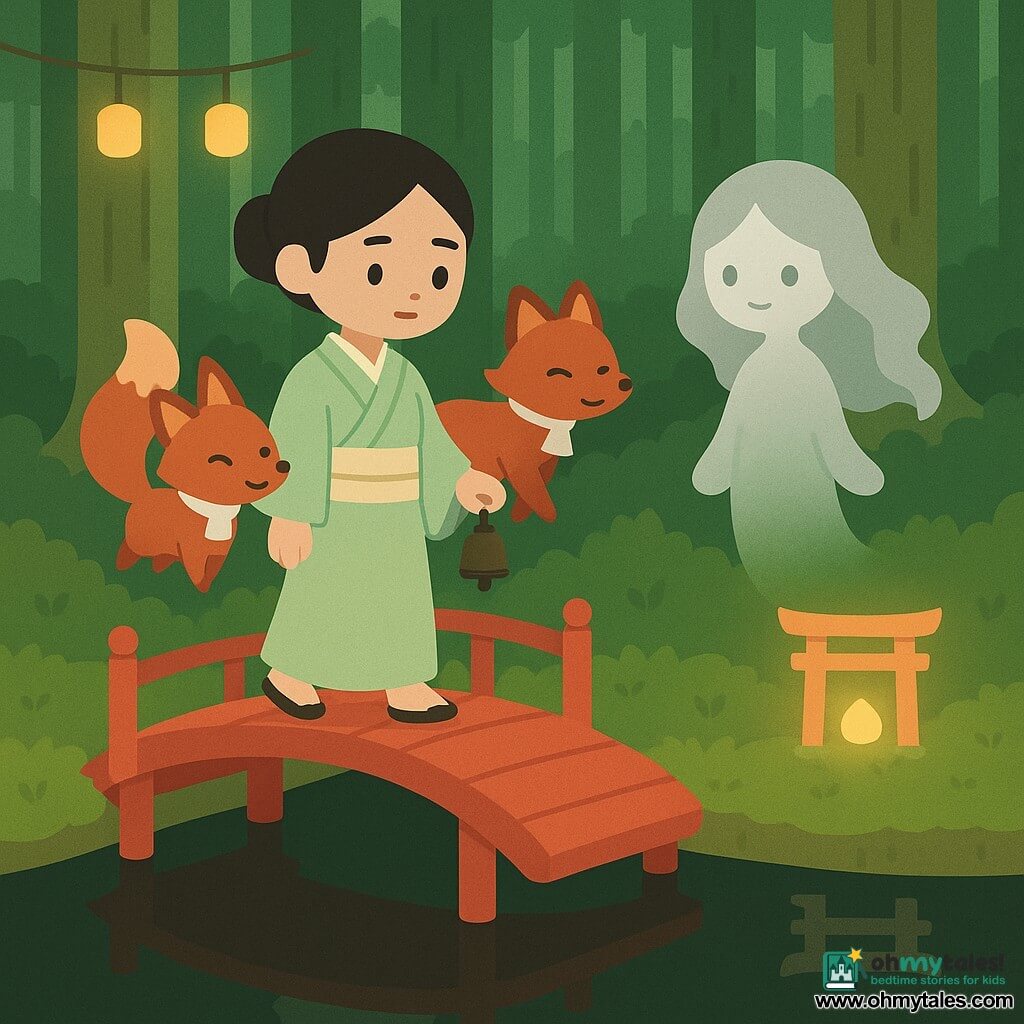
At the far end stood a small torii gate, pale and simple, as if carved from moonlight. Beneath it waited a figure in a robe the color of river mist. Its hair floated as though underwater, and its eyes held the calm of mountains.
Miyako bowed. “Are you the one calling us?”
The figure nodded. The drumbeat softened, respectful.
“I am called Kotoha,” it said, voice like a flute heard through a wall. “I am a spirit of shared dreams. Long ago, your village honored the boundary with gratitude. People spoke truth kindly and listened deeply. The boundary stayed strong.”
Kotoha lifted a hand, and the air filled with small, glowing petals—like pieces of morning torn gently from the sky.
“But lately,” Kotoha continued, “fear has been treated like a secret treasure. People hoard it. They pretend not to hear it. And fear grows fat in silence.”
Miyako felt heat rise in her eyes. “I have been silent too.”
Kotoha's gaze was steady, not accusing. “Courage is not never being afraid,” it said. “Courage is inviting fear to sit down, and then speaking anyway.”
Miyako nodded, slowly. “What truth must I bring back?”
Kotoha pointed toward the river. The dark surface cleared, like a cloudy mirror becoming bright. Miyako saw Aoi-Mura—her village—threaded together not by roads, but by glowing lines between people: acts of kindness, shared meals, small bows, cups of tea offered without being asked.
Then she saw the frayed place: a misunderstanding that had spread like mold. Someone had once claimed the dreams were a bad omen, and others had nodded because nodding was easier than asking.
Kotoha's voice lowered. “The truth is simple. The drum is not a warning of disaster. It is a call to remember together. It asks your village to face what it avoids—kindly, openly—so the shared dream becomes a shared strength.”
Miyako let out a breath she didn't know she'd been holding. “So the bridge… it appears because we need to talk?”
Kotoha's eyes shimmered, amused. “Yes. The most mysterious magic is often the most ordinary: honest words spoken with respect.”
Miyako almost laughed—a small, surprised sound. “People will be embarrassed.”
“Let them,” Kotoha said. “Embarrassment is a small price for peace.”
Kotoha reached into the air and drew out a single petal of light. It floated to Miyako's palm and settled there, warm as a living thing.
“Carry this memory,” Kotoha said. “Not as proof to show off, but as courage to begin. When the drum beats, gather them. Serve tea. Speak the truth: the dream is shared because the heart is shared.”
Miyako bowed so low her forehead nearly touched the bridge. “I will.”
As she turned back, the bridge behind her looked less like a test and more like a path that had always existed, waiting for someone to walk it awake.
Chapter 6: The Village That Answered
When Miyako stepped off the dream-bridge and into the cedar clearing, the fox was waiting, tail curled neatly, as if it had been there for only a minute.
“You crossed,” it said, sounding pleased despite itself.
Miyako opened her hand. The petal of light still rested there, faint now, like the last glow of charcoal. “I did.”
The fox sniffed the air. “Then the hardest part begins. Not the walking— the telling.”
They returned through the forest. The drumbeat followed them all the way, but it felt different now. It was not a threat. It was a reminder, like a hand tapping your shoulder when you forget something important.
At the edge of the village, people were gathered in the road, faces tilted, brows furrowed. The moment Miyako appeared, they turned toward her as sunflowers turn toward light.
Kenji stepped forward. “Miyako! What is it? What's happening?”
Miyako felt fear rise again—slippery as a fish. What if they laughed? What if they got angry? What if she couldn't explain?
Then she remembered Kotoha's words: invite fear to sit down.
She bowed to the crowd, slow and sincere. “Please,” she said, “come to my house. Bring your questions. Bring your worries. We will pour tea and speak plainly.”
People exchanged glances. Mrs. Sato lifted her basket. “I will come,” she said firmly, like someone placing the first stone in a wall.
One by one, others nodded.
Inside Miyako's house, the room filled with the soft sounds of settling—knees folding, cups placed, sleeves brushing tatami. Miyako moved between them with the kettle, her hands steady because she gave them a job: to serve.
The drumbeat sounded again—thum—gentle, patient.
Miyako set the last cup down and sat. For a moment, only steam spoke.
Then she began. “The drum is not calling disaster,” she said. “It is calling us back to each other.”
A few people blinked, confused. Someone scoffed softly. “Back from what?”
“From silence,” Miyako answered.
She told them about the fox with the paper lantern, the mossy stone that opened like an eye, the red bridge over the black river. She described the spirit Kotoha and the truth it showed her: the village bound together by invisible threads of kindness, and the frayed place where fear had been treated like a secret.
As she spoke, the room changed. Shoulders lowered. Faces softened. The story did not make them panic; it gave their worry a shape they could hold.
Kenji rubbed his neck. “So… we've been scaring ourselves with our own quiet.”
Mrs. Sato nodded, eyes shining. “Fear grows fat in silence,” she repeated, tasting the phrase as if it were tea.
A younger woman, Hana, whispered, “I thought if I talked about the dream, I would bring it closer. Like inviting a storm.”
Miyako shook her head. “Talking is not inviting the storm,” she said. “It is opening the window so you can see whether clouds are real.”
The drumbeat came again, and this time it seemed to match the rhythm of their breathing.
Thum… thum…
Miyako lifted her cup. “Courage,” she said, “is not charging into the forest with no fear. Courage is returning with truth and sharing it, even if your voice shakes.”
One man laughed—quietly, relieved. “My voice shakes all the time,” he admitted. “I thought it was just me.”
That made others chuckle, and the laughter was kind, like a blanket being pulled over a sleeping child.
They began to speak, not all at once, but one by one: worries they had hidden, apologies they had delayed, questions they had swallowed. The room became a lantern itself, glowing with honest words.
Outside, the drumbeat slowed, then softened, then faded—like footsteps walking away, satisfied.
That night, Miyako slept.
She dreamed again of the red bridge. But this time it was not empty. On it stood the people of Aoi-Mura, each holding a small lantern. They bowed to one another, and the river beneath them reflected not fear, but light.
In the morning, the kettle sighed as usual. The village woke to birdsong and honest quiet—silence no longer packed with dread, but filled with peace.
Miyako poured tea and smiled to herself.
She had not conquered a monster or found a treasure chest.
She had done something braver: she had crossed a mystery, carried truth home, and taught fear to sit politely at the edge of the room.