Chapter 1
Winter came down from the mountains like a quiet old blanket, tucking roofs, rice fields, and river stones into white sleep. In the village of Hoshikawa, even the air seemed to move more carefully, as if it did not want to crack the frost.
Ren, a young man with dark hair tied back in a plain cord, stood in his family's small storehouse and breathed in the scent of cedar, straw, and cold. On the floor rested a narrow lacquered box, wrapped in cloth the color of ash. Inside were incense sticks made only once a year: Winter Incense, pressed with pine resin and dried chrysanthemum, meant for the Snow Temple high on the ridge.
His grandmother, Obā, lowered the lid with both hands, as though closing the eyes of something sacred. “The Snow Temple keeps the village's balance,” she said softly. “When the first true snow settles, the incense must reach its altar.”
Ren nodded. He had been chosen because he was steady. Not the fastest. Not the loudest. The one who could carry a fragile thing without letting his thoughts stumble.
Obā tied the cloth with a careful knot. “Remember,” she added, tapping his chest lightly, “prudence and courage are like two sandals. Wear only one, and you will limp.”
Ren allowed himself a small smile. “I'll walk with both.”
Outside, his friend Taro leaned against the gatepost, stamping his feet for warmth. “So,” Taro called, “you're delivering perfume to the clouds!”
“It's incense,” Ren corrected, stepping out. He hugged the box close, the way you might hold a sleeping kitten.
Taro grinned. “Still. If you meet a snow spirit, tell it I said hello.”
Ren started along the road that climbed toward the forest. The village shrank behind him, and the world became quieter, as if someone had turned down the volume of everything except the whisper of wind.
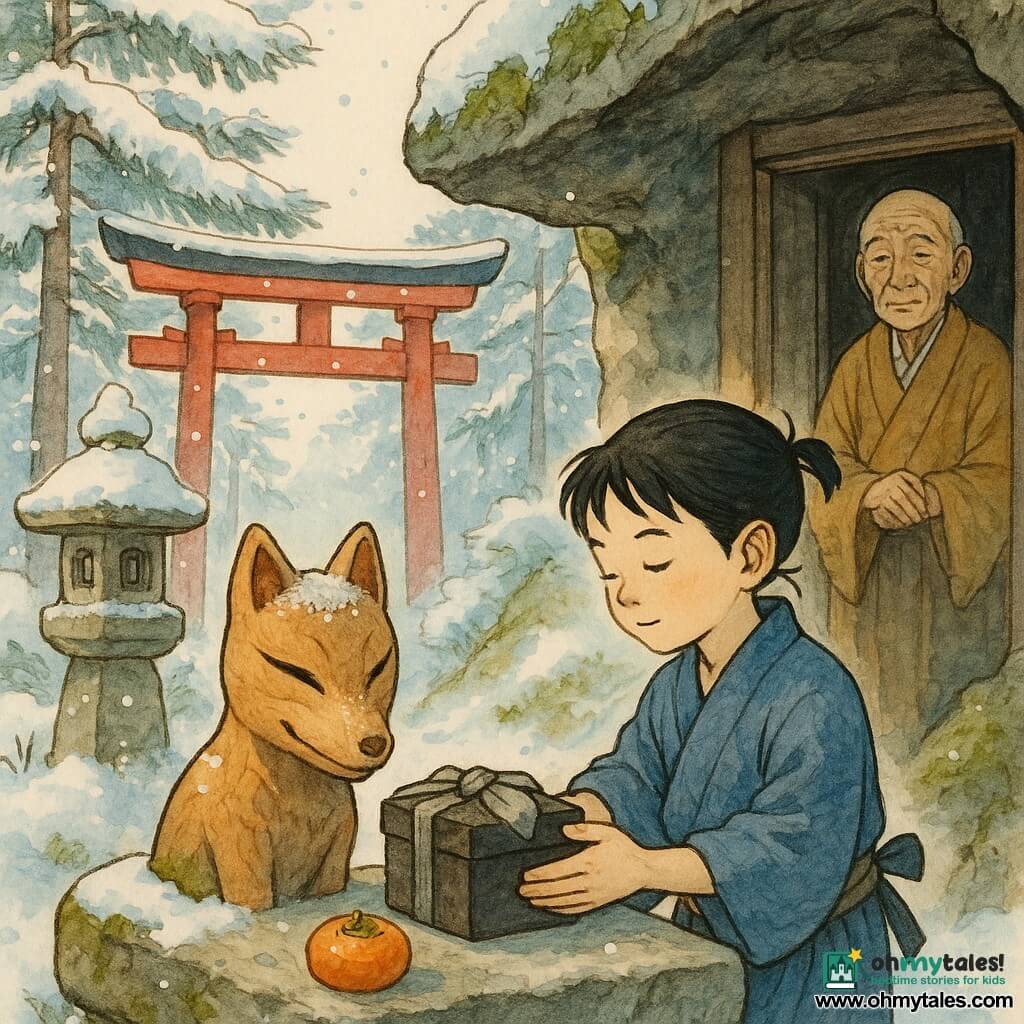
At the edge of the trees stood a stone fox statue, its nose dusted white. Someone had placed a small orange on its paws. Ren bowed. The forest, to him, was not only wood and shadow. It was a room full of unseen listeners.
“Safe steps,” he murmured, and entered.
Chapter 2
The pines lifted their branches like dark umbrellas. Snow clung to needles, and when the wind shook them, it fell in soft bursts—little sighs of white.
Ren kept to the trail, where old footprints had frozen into shallow bowls. His breath rose in pale ribbons. Each time the lacquered box pressed against his coat, he remembered: do not slip, do not drop, do not get distracted.
Yet winter loves distractions. A rabbit darted across the path, leaving a neat stitch of tracks. A crow called once, sharp as a snapped twig. Somewhere farther up, a creek ran under ice, making a secret, gurgling song.
Ren reached a small wayside shrine tucked beneath a boulder. A rope of rice straw circled it, and paper streamers fluttered like tiny white fish. In front sat a wooden mask—perhaps left from a festival—leaning against the stone.
The mask was carved into a fox face, but not a fierce one. The eyes were narrow and clever, and the mouth curved as if it knew a joke.
Ren frowned. Masks were for people. In the forest, a mask could be a doorway.
He bowed anyway, because respect is a kind of armor. “I'm only passing,” he said to the shrine, to the trees, to whatever might be listening. “I have work to do.”
The wind answered by nudging the mask.
It moved.
Not falling, not sliding. It turned, just a little, like a person waking up to glance around. The wooden fox seemed to look straight at Ren.
Ren's heart jumped, then tried to pretend it hadn't.
“Must be the wind,” he said aloud, because words can be a lantern when the dark feels curious.
The mask tilted again, as if unimpressed.
Ren took one careful step back. Prudence tugged his sleeve: Leave it. Keep walking. The Snow Temple is waiting.
But courage placed a warm hand between his shoulder blades: If you see something strange and ignore it, it may follow. Better to understand it—carefully.
Ren's mouth went dry. “Are you… a spirit?”
The fox mask's mouth did not move, yet a voice seemed to arrive inside the air, light as snow and sharp as pine. “A question with manners,” it said. “That is rare.”
Ren stared. “You can speak.”
“I can listen, too,” the voice replied. “And I heard you have something precious.”
Ren tightened his grip on the incense box. “It's for the Snow Temple.”
“Ah,” said the mask. “The temple that drinks winter's breath. You walk a high path for a young man.”
Ren swallowed. “I must.”
The mask shifted, and now it faced the trail ahead, as if peering up the mountain. “Then we are traveling in the same direction.”
“We?” Ren echoed.
The mask gave a small, almost polite nod. “I dislike being left behind in the snow.”
Ren's thoughts ran like startled sparrows. A moving mask. A speaking voice. And a responsibility tied in ash-colored cloth against his chest.
He remembered Obā's words: two sandals.
“All right,” he said slowly. “But you don't get to touch the incense.”
The mask's silent grin seemed to widen. “Touch? No. I have no hands. But I can offer something else.”
“What?” Ren asked.
“Advice,” said the fox mask. “Sometimes it is better than hands. Sometimes it is worse.”
Ren couldn't help it—he gave a short, nervous laugh. “That's not comforting.”
“Honesty rarely is,” the mask replied, and with another twitch, it hopped—yes, hopped—off the shrine stone and landed on the snow without leaving any print.
Ren stared at the empty snow beneath it. “You don't weigh anything.”
“I weigh only as much as your attention,” said the voice.
Ren felt a chill that had nothing to do with winter. Then he lifted his chin. “Fine. Walk with me. But if you lead me off the trail—”
“I might,” the mask said cheerfully. “Or I might save you. Life is full of maybes.”
They began climbing together: Ren with careful steps, and the mask gliding beside him like a leaf that had forgotten gravity.
Chapter 3
As the forest thickened, the snow grew deeper. Ren's boots sank with a soft crunch. The sky above the branches was the color of watered milk.
The fox mask drifted ahead and then back, as if pacing. “Ren,” it said, tasting his name like a new kind of tea, “why are you carrying the winter incense?”
Ren kept his eyes on the path. “Because the village needs it.”
“That is the village's reason,” the mask corrected. “What is yours?”
Ren hesitated. He had not expected to be questioned by a piece of wood. “Obā asked me.”
“That is your grandmother's reason.”
Ren exhaled, watching his breath unravel. “Because… I said I would. Because people are counting on me.”
The mask seemed pleased. “A promise is a thread. Pull too hard, it snaps. Hold it gently, it guides you through fog.”
Ren glanced at it. “Do spirits make promises?”
“Some do,” the mask replied. “Some break them. Spirits are like people, only less polite about it.”
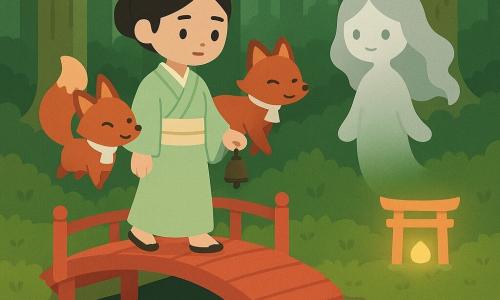
They reached a narrow bridge over a ravine. Below, the creek churned, black water biting at ice. The bridge was old, its planks slick with frost.
Ren stopped. Prudence raised a warning flag in his mind. One wrong step, and the incense box could fly from his arms like a startled bird.
The fox mask floated to the first plank. “Cross,” it said simply.
Ren's jaw tightened. “It's slippery.”
“Yes,” the mask agreed. “Winter is not known for being considerate.”
Ren tested the plank with his boot. It held, but his sole skated slightly. He pictured the incense sticks inside their lacquered box: fragile, waiting. He pictured the Snow Temple: a place of white roofs and silent bells, where monks would bow and light the incense so the smoke could carry prayers like tiny boats.
Ren shifted the box under his coat, tighter against his ribs. “If I fall, the village loses more than incense,” he muttered.
“You lose your promise,” the mask said, suddenly quieter. “And that is heavier than wood.”
Ren began crossing, one plank at a time. He moved slowly enough to make a snail look impatient. Halfway across, a gust of wind raced through the ravine like a mischievous child. The bridge shivered. Snow shook free, and Ren's foot slid.
His stomach dropped. He grabbed the rope railing, but his glove scraped on ice, and his grip threatened to slip.
The mask shot forward. Though it had no hands, it pressed itself against Ren's chest—right over the lacquered box—like a shield. The wind seemed to hesitate, as if confused by this bold, weightless thing. Ren used that heartbeat of pause to plant his foot firmly.
He stood still, trembling. The creek roared below, hungry and patient.
When he reached the far side, Ren leaned against a pine and breathed hard. “You… helped.”
“I dislike watching people fall,” the mask said lightly, as if discussing weather. “It makes the world feel clumsy.”
Ren's eyes narrowed. “Or you dislike losing your traveling companion.”
The mask's grin returned. “Both can be true. That is another lesson.”
Ren looked at the bridge behind him, then at the snowy path ahead. “Thank you,” he said, the words awkward in his mouth but sincere.
The mask bobbed. “Responsibility makes you polite. Good. It may also make you stubborn. Be careful with that.”
Ren almost smiled. “You sound like my grandmother.”
“I sound like the forest,” the mask replied. “Old and full of warnings.”
They continued upward. The trees grew shorter, their tops bent by wind. The mountain's breath turned sharper, like a blade wrapped in silk.
Soon, the path split in two: one route marked by a stone with carved characters, the other a narrow trail half-covered by drifting snow.
Ren knelt to brush the stone. The carved path was the proper road—longer, but safe. The narrow trail looked like a shortcut, whispering of speed and ease.
The mask floated over the narrow trail. “This one,” it said.
Ren's shoulders tensed. “No.”
The mask's voice softened. “If you take the long road, night will fall before you reach the temple.”
Ren looked at the sky. The pale light was already thinning, as if someone were pulling a curtain. “Then I'll walk faster on the safe path.”
“You can't hurry ice,” the mask replied. “And you can't argue with darkness.”
Ren stood. “My job is to deliver the incense. Not to gamble with it.”
For the first time, the mask fell silent. Snow drifted between them like unspoken thoughts.
Then the mask said, almost thoughtfully, “Responsibility is not only carrying. It is choosing.”
Ren nodded once, and stepped onto the long road.
The mask followed, and its voice, when it returned, held a hint of respect. “Very well, Ren of steady feet. Let us see if the mountain approves.”
Chapter 4
The long road climbed in wide curves. The wind grew stronger, combing the snow into ripples. Ren's legs began to ache, and every so often he flexed his fingers to keep them awake inside his gloves.
Dusk gathered like ink in water.
They reached a place where the trees fell away and the slope opened to the sky. The world was wide and empty, a white bowl turned upside down. In the distance, the Snow Temple's rooflines were barely visible, like dark brushstrokes on paper.
Ren's heart lifted—and then sank.
Between him and the temple stretched a field of snow that looked smooth, but Ren knew better. Drifts can hide holes. Ice can pretend to be ground. The safe road should have skirted the field, but the markers—small wooden posts—were buried.
The mask floated higher, as if sniffing the air. “The path is sleeping,” it said. “Winter has tucked it in.”
Ren stared at the field. “So what do I do?”
“Listen,” the mask answered.
Ren frowned. “To what?”
The mask tilted. “To the snow.”
Ren almost replied sharply, but Obā's voice rose in his memory: prudence and courage. He closed his eyes. At first he heard only wind, a low moan. Then—beneath it—a faint sound like tiny bells, irregular and distant.
He opened his eyes. “I hear… something.”
“Snow settling,” the mask said. “Where it settles differently, there is a hollow. Where it sings sharply, there is ice.”
Ren's stomach tightened. “You want me to cross by listening?”
“I want you to cross by paying attention,” the mask corrected. “There is a difference.”
Ren took a long breath. The incense box felt warmer against his chest, warmed by his own body, like a small heart he had been asked to guard.
He stepped forward, placing his boot gently. The snow answered with a dull, safe thump. He stepped again—another thump. He moved slowly, and between steps, he listened.
A few paces in, he heard a sharper, brighter sound. He froze. He shifted his weight back. The sound softened.
“There,” the mask whispered. “Ice tongue. It wants to taste your boot.”
Ren edged to the left, testing. The snow gave the dull thump again.
They moved like this across the field: step, listen, step, pause. Ren's focus became a rope he held tight in both hands. When the wind tried to steal it, he pulled it back.
Halfway across, the sky turned lavender, then deepened toward blue. The first star blinked awake, shy and small.
Ren's legs trembled with tiredness. “How far?” he asked through clenched teeth.
“Far enough to matter,” the mask said. “Not far enough to give up.”
Ren huffed a brief laugh that turned into a cough. “You're very poetic for a piece of wood.”
“I am carved from a tree that heard many stories,” the mask replied. “Stories leave their rings inside you.”
Another step. The snow thumped. Another—thump.
Then, without warning, the ground sighed under Ren's boot. Not a thump, but a soft collapse. His foot sank, and cold grabbed his ankle like a wet hand.
Ren's breath caught. He froze, terrified that moving would widen the hole. Beneath the snow, darkness gaped.
The mask hovered near his shoulder. “Do not fight,” it said quickly. “Fighting makes you heavy.”
Ren's mind flashed to panic, but he swallowed it down. Responsibility, he reminded himself, was not a loud hero. It was a quiet decision, made again and again.
“What do I do?” he whispered.
“Lay the box on the snow beside you,” the mask instructed. “Gently. Like placing a sleeping child in bed.”
Ren's hands shook. He drew the incense box out, and set it carefully on the surface. The cloth did not slip. The box rested, steady.
“Now,” said the mask, “spread your weight. Lie down.”
Ren obeyed, lowering himself onto his belly, arms out. The snow was cold against his coat, but it held him better than it held a single foot. He wriggled slowly, inching his trapped leg backward. The hole seemed reluctant to let go, but little by little, the snow released him.
At last his boot popped free with a wet sound. Ren lay still, breathing hard, staring at the sky.
“You are safe,” the mask said.
Ren turned his head. “The incense—”
“Safe,” the mask repeated, hovering above the box like a watchful bird.
Ren swallowed, relief flooding him so strongly it almost made him laugh. He sat up slowly, then picked up the box and tucked it against his chest again.
He looked at the hole: a hidden pocket of air, waiting for a careless traveler. “If I had rushed—”
“You would have dropped your promise into the dark,” the mask finished. “And the mountain would not have laughed.”
Ren's voice came out husky. “Thank you.”
The mask's grin softened, almost kind. “You are learning. That is rarer than magic.”
They crossed the rest of the field even more carefully. When Ren finally stepped onto firm ground near the temple's outer torii gate, his knees nearly buckled with relief.
The Snow Temple rose before him, quiet as a closed book. Lanterns glowed faintly behind paper windows, warm squares in the blue evening. Snow lay on the roof like icing, thick and peaceful.
Ren bowed to the gate. The mask floated beside him, strangely still.
“Are you coming in?” Ren asked.
The mask did not answer right away. Its voice, when it came, was softer than before. “Some doors are not mine.”
Chapter 5
A monk opened the temple door as if he had been expecting Ren all along. He was old enough that his eyebrows looked like thin snowdrifts.
“You carry winter's breath,” the monk said, and his voice was calm, like water in a deep pot.
Ren bowed so low his forehead almost touched his knees. “I brought the Winter Incense from Hoshikawa.”
The monk's gaze fell to Ren's coat, then to the air beside him. For a moment, Ren wondered if the monk could see the fox mask.
The monk smiled slightly. “And you did not come alone.”
Ren's throat tightened. “You… know?”
“Spirits are like wind,” the monk replied. “You cannot see them, but you can see what they move.”
Ren glanced sideways. The mask hovered near the torii, as if the boundary line was a river it did not wish to cross.
Ren stepped forward and held out the lacquered box with both hands. His arms trembled—not from cold now, but from the weight of reaching the end without losing what he carried.
The monk accepted it with the same care. “Responsibility is a candle,” he murmured. “It does not shout, but it makes darkness smaller.”
Inside the temple, the air was warmer and smelled faintly of tatami and cedar. Ren followed the monk to the altar room. A statue sat in shadow, serene, and the offerings in front of it were simple: rice, water, a pine branch, a few bright persimmons like small suns.
The monk opened the lacquered box. The incense sticks lay inside like slender winter reeds.
He lit one with a candle flame. Smoke rose, thin and silver, and curled toward the ceiling. It looked like a pale dragon learning to dance.
Ren watched, mesmerized. The smoke did not hurry. It did not struggle. It simply rose, carrying its quiet message upward.
The monk bowed. “May the village be steady. May the mountain be gentle.”
Ren bowed too, feeling something in his chest loosen—like a knot untied.
When they stepped back outside, night had settled fully. Stars scattered across the sky, bright as spilled salt.
The fox mask waited near the torii, its carved eyes catching lantern light.
Ren approached it. “It's done,” he said.
The mask bobbed. “So it is.”
Ren hesitated. “Why did you help me?”
The mask's voice was thoughtful. “At first, I followed because I was curious. Then I followed because I was entertained. Then… I followed because your promise became interesting.”
Ren frowned. “Interesting?”
“Most travelers carry things,” the mask said. “Food. Money. Pride. You carried duty like a bowl of water—trying not to spill a drop, even when your arms shook.”
Ren looked down at his hands. They were red from cold, and a bit scraped from the bridge rope. “I was afraid.”
“Courage is not the absence of fear,” the mask replied. “It is walking while fear makes faces at you.”
Ren let out a slow breath, watching it drift away. “Obā would like that.”
“She would,” said the mask, sounding almost amused.
Ren's eyes narrowed. “Do you know my grandmother?”
The mask's grin returned. “The forest knows many grandmothers.”
Ren laughed quietly. The sound felt good in the cold air, like a small bell.
He grew serious again. “What happens to you now?”
The mask floated closer to the torii, but did not pass it. “I return to the shrine where you found me,” it said. “Or perhaps I will rest in the snow until someone with manners speaks to me again.”
Ren thought of the wayside shrine, lonely under its boulder. He imagined the mask lying there, half-buried, waiting for the world to remember it.
“I could take you back,” Ren offered.
The mask tilted. “That would be kind. But kindness without thought can be clumsy. You are tired. The mountain grows darker. The safe road is longer.”
Ren looked toward the slope he had crossed. The field of snow gleamed faintly under starlight, innocent as a blank page.
He straightened. “Then I'll stay here until morning and go back in daylight.”
The monk, who had been listening quietly, nodded once. “The temple has a room and warm rice.”
Ren turned to the mask. “In the morning, I'll return you. I won't leave you in the snow.”
For a moment, the mask was silent. Then it said, very softly, “Responsibility can be shared.”
Ren blinked. “What do you mean?”
The mask drifted closer, and for the first time, Ren felt it not as eerie, but as gentle—like a winter breeze that did not bite.
“I was a festival mask,” it said. “I laughed on faces. I danced in lantern light. Then I was forgotten. Forgotten things grow restless. They begin to move, hoping someone will notice.”
Ren listened, his heart tightening. “So you moved because you didn't want to be alone.”
“Yes,” the mask admitted. “Even a spirit can feel like a shadow no one steps into.”
Ren nodded slowly. “I noticed you.”
“You did,” said the mask. “And you chose the safe path when I suggested the shortcut. You taught me something, Ren.”
“What?” Ren asked.
“That being responsible is not dull,” the mask said. “It is brave in a quiet way. It is the courage to care.”
Ren felt warmth rise behind his eyes, unexpected. He looked away at the snowy rooflines of the temple. “I didn't think anyone would call it brave.”
The monk spoke gently. “Many people think bravery is a shout. But the strongest snowflake falls without noise and still changes the mountain.”
The mask bobbed in agreement, as if the monk's words were a familiar melody.
Chapter 6
Ren slept at the temple that night, wrapped in thick quilts that smelled of sun-dried cotton. Outside, the wind wandered around the eaves, humming old songs. Ren dreamed of smoke that turned into silver fish and swam up into the stars.
At dawn, the world was washed clean with pale light. The monk gave Ren a small bundle of rice balls and pickled plum. “For the road,” he said. “And for your promise.”
Ren bowed, grateful.
The fox mask waited by the torii, dusted with new snow. It looked almost ordinary in the morning—just carved wood again—yet Ren knew better now. Ordinary things, he had learned, could contain strange hearts.
They started down the mountain together. The safe road, in daylight, seemed less threatening. The bridge still creaked, but Ren crossed it with steady feet. The forest glowed green-black beneath the snow, and sunlight flashed off ice like tiny mirrors.
When they reached the wayside shrine, Ren stopped. He brushed snow from the stone base and straightened the paper streamers that had twisted in the wind.
He looked at the mask. “Is this where you belong?”
The mask hovered over the shrine stone, then settled there as lightly as a leaf settling onto water. It did not leave a mark in the snow. It faced Ren.
“I belong wherever I am remembered with respect,” it said. “But this is a good place to rest.”
Ren bowed. “Thank you,” he said. “You helped me keep my promise.”
The mask's voice was warm with mischief again. “And you helped me remember I can be more than trouble.”
Ren smiled. “Try not to scare the next traveler too much.”
“I make no promises,” the mask said, and if wood could wink, it would have.
Ren laughed, then grew thoughtful. He reached into his pouch and took out a small tangerine he had carried from the temple's offering basket—given by the monk with a nod. He placed it at the shrine, beside the mask.
“For company,” Ren said.
The forest seemed to breathe in, pleased.
On the way back to the village, Ren's steps felt lighter, though his legs were still tired. Responsibility had not vanished; it had simply changed shape. It was no longer only a weight he carried. It was a way of walking—slow enough to notice, brave enough to continue.
When he reached Hoshikawa, Taro ran up, cheeks red from cold. “You're alive! And not even frozen into a statue!”
Ren chuckled. “I delivered it.”
Taro leaned closer. “Did you see a snow spirit? A fox? A dancing lantern?”
Ren thought of the moving mask, the bridge, the hidden hole, the smoke rising like a silver dragon. He thought of the monk's calm eyes.
He chose his words carefully, because some stories are like incense: they work best when shared gently.
“I met something,” Ren said. “And it reminded me that promises aren't just words. They're paths.”
Taro blinked. “That's… surprisingly deep for you.”
Ren bumped Taro's shoulder with his own, friendly. “Winter makes poets of us all.”
At home, Obā listened as Ren told her about the long road, the snow field, and the careful listening. He did not speak of the mask directly, only of the feeling of being watched over by the mountain.
Obā nodded as if she had always known. “You kept your responsibility,” she said, and her eyes shone like lanterns.
Ren looked out the window at the falling snow. Each flake was small, soft, almost nothing—yet together they could cover a world, reshape a path, build a temple's silence.
He understood then: responsibility was like that. A thousand careful choices, quiet and steady, building something you could not see all at once.
And somewhere on the mountain, at a small shrine under a boulder, a fox mask rested with a tangerine beside it—no longer forgotten, no longer restless—listening to the forest's old stories and waiting, politely, for the next traveler with manners and a promise.