Chapter 1: Cool Alleys and Quiet Work
In the year 2169, the city of Skygarden sprawled along the coast like a careful invention: tall towers wrapped in vines, glass bridges that caught the sun, and wind-turbines turning lazily above the rooftops like patient white flowers.
Down at street level, where most people hurried and hardly looked up, the best parts of Skygarden were hidden—its fresh venelles, the narrow alleys shaded by overhanging planters and mist-coolers. The air there always smelled of mint and wet stone. Water slid through slim channels in the pavement, cleaned and reused again and again, whispering as it went.
Milo Senn walked those venelles with a small toolkit bumping against his hip. He was almost eleven, which felt important and not important at the same time. He wore a work vest two sizes too big because it had pockets, and pockets meant you could be useful.
Beside him rolled and walked his best friend, Kenji Rao—also nearly eleven—who moved with a light metal brace on one leg. It made a soft click on the stone, like a polite little metronome. Kenji didn't like people staring at it, so Milo never stared. He just matched his pace.
“Pipeline sensor check,” Milo said, reading from a wrist-slate borrowed from his aunt. “Then the moss tiles, then—”
“Then we get paid in breakfast buns,” Kenji finished, grinning. “That's the best step.”
They worked for the Alley Wardens, a volunteer crew that looked after the city's small systems: water filters, soil vents, light panels, and the tiny robot sweepers that kept leaves out of drain grates. Skygarden had big engineers for big things, but it survived on hundreds of small hands doing small jobs.
Milo liked small jobs. Small jobs meant you could fix something without people making speeches.
They turned into a venelle so narrow their shoulders almost brushed the living walls. A line of blue lanterns glowed softly in daylight, powered by the walkway's pressure plates. Every footstep made the city a bit brighter.
Kenji nodded toward a shimmer ahead. “See that?”
A service drone hovered over a corner. Its round body was scraped, as if it had bumped into something sharp. It projected a floating red triangle that blinked: MAINTENANCE REQUIRED.
Milo crouched. The pavement there wasn't right. One of the moss tiles—soft, spongy green squares that held rainwater—had been replaced with something stiff and dark. Not even a tile. A cover.
He tapped it with a screwdriver. It rang hollow.
“That's not standard,” Kenji said, frowning. “Standard covers are yellow and have a spiral warning print. That one looks… secret.”
Milo swallowed. Skygarden didn't do secrets. Not on the ground where people walked barefoot in summer.
He pressed his palm on the dark cover. It felt cooler than the stone around it, almost cold enough to bite.
The drone whirred, then flicked a beam across the cover. The red triangle changed into a word:
UNREGISTERED ACCESS POINT.
Kenji's eyebrows went up. “Unregistered? Like, someone installed it without telling the city?”
Milo glanced around. The venelle was empty except for a stray cat perched on a pipe, watching them like they were the strange ones.
“We should tell someone,” Milo said.
“We are someone,” Kenji replied, and then he laughed, because it sounded brave in a ridiculous way.
Milo smiled anyway. “Okay. We should tell someone older.”
They backed away, and Milo used a chalk pen to mark the wall: a simple circle with a line through it—Warden code for “do not step here.”
As they turned to go, Milo felt the coolness from the cover again, like a draft from underground.
And then, very faintly, he heard something under the city.
Not a voice. Not exactly.
A hum, as if the earth itself had taken a deep breath and was holding it.
Chapter 2: The Listening Gate
They reported the access point to Jun, the Alley Warden coordinator, who was sixteen and acted like she was thirty. Jun stood on a footbridge above the venelles, hair tied back, eyes sharp as a scanning laser.
“Unregistered access?” she repeated. “Show me.”
So they led her back through the mint-scented alleys. The city around them felt normal—solar sails spread between rooftops, birds nesting in the eaves, the distant whoosh of a sky-tram—but Milo's mind kept circling that hollow ring.
Jun knelt by the dark cover. She ran a portable scanner over it. The device beeped in a worried sort of way.
“This isn't city hardware,” Jun said. “It's… corporate, maybe. Or black-market.”
Kenji leaned closer. “What's under it?”
Jun's mouth tightened. “Something connected to the water grid. And if it's connected wrong—”
Milo imagined pipes bursting, clean channels flooding, the careful little whispering water turning wild and dirty. Skygarden was built to respect the sky, water, and soil. Break the water, and you broke everything.
Jun stood. “We're not opening it. Not here. Not without proper clearance.”
Kenji crossed his arms. “So we wait for grown-ups and hope nothing happens?”
Jun looked at him, then at Milo. Her expression softened a fraction. “You did the right thing reporting it.”
Milo's cheeks warmed. He wasn't used to praise. It felt like wearing a hat too big.
Jun tapped her wrist-slate. “I'll alert the Civic Flow Office. They'll send a team.”
Milo blurted, “How long will that take?”
Jun hesitated. That was answer enough.
Kenji's eyes narrowed. “Milo… that hum you heard. Did you tell her?”
Milo shook his head, then said quietly, “There was a sound.”
Jun's gaze sharpened again. “What kind of sound?”
“Like… the city breathing,” Milo said, feeling silly the moment the words left his mouth.
Jun didn't laugh. She crouched, pressed her ear to the stone, and held still for a long time.
Kenji and Milo waited. The cat on the pipe flicked its tail like a ticking clock.
Finally Jun lifted her head. “I hear it too.”
Milo's stomach dipped.
Jun opened her toolkit and pulled out a small disc the size of a coin. She placed it on the wall and whispered, “Listen-bead, record.”
The disc blinked a calm green.
“We're going to do something careful,” Jun said. “You two will do exactly what I say. Deal?”
Kenji nodded fast. Milo nodded slower, because his throat felt tight.
Jun pointed at a ventilation grate nearby. “This venelle sits above an old service tunnel. The city uses it for soil-air cycling. If someone connected a device to the water grid down there, they might also be using the tunnel.”
Kenji's grin flashed. “An adventure tunnel. Of course.”
Jun gave him a look. “Not an adventure. A risk. And we minimize risk by listening first.”
She handed Milo a small microphone probe attached to a thin cable. “Feed this through the grate. Don't touch the cover. Don't tug the wire. Just… listen.”
Milo knelt by the grate. His hands were steady, which surprised him. He slid the probe into the darkness. It disappeared, swallowing the thin cable inch by inch.
Kenji leaned in, holding the receiver unit. Jun watched the street, alert.
At first there was only the normal city-underbelly sound: water moving, fans turning, distant robot footsteps.
Then the hum returned—stronger now, layered with a faint clicking pattern, like a code tapped on a metal table.
Kenji whispered, “That's not pipes.”
Milo listened harder. The clicking wasn't random. It paused, then repeated.
Jun's voice was low. “Someone is using the tunnel. Or something is.”
Milo's mind jumped to stories about rogue maintenance bots, forgotten down in the old levels, still trying to follow an old instruction no one remembered.
Then a new sound slid into the receiver: a soft hiss, like air escaping, followed by a tiny, clear voice.
Not human. Not quite.
“—pressure… rising… reroute… please…”
Milo's fingers tightened on the cable.
Kenji's eyes went wide. “Did that thing just say ‘please'?”
Jun exhaled slowly. “We are not alone down there.”
Chapter 3: Down Where the Water Remembers
The Civic Flow Office still hadn't answered Jun's alert an hour later. Skygarden was a good city, but it was also a busy one, and emergencies were like queue lines: someone always had a worse problem until suddenly you did.
Jun made a decision Milo could see forming behind her eyes like a storm behind glass.
“We go down,” she said.
Kenji bounced on his good foot. “Yes.”
Milo's mouth went dry. “What if it's dangerous?”
Jun nodded once. “That's why I'm coming. And why we go quietly.”
They used an access ladder hidden behind a curtain of ivy. The air got cooler as they descended, turning from minty fresh to damp and earthy. Lights in the tunnel glowed a gentle amber, powered by kinetic strips in the walls that stored energy from the city's vibrations.
Milo liked that. Even underground, Skygarden didn't waste what it could reuse.
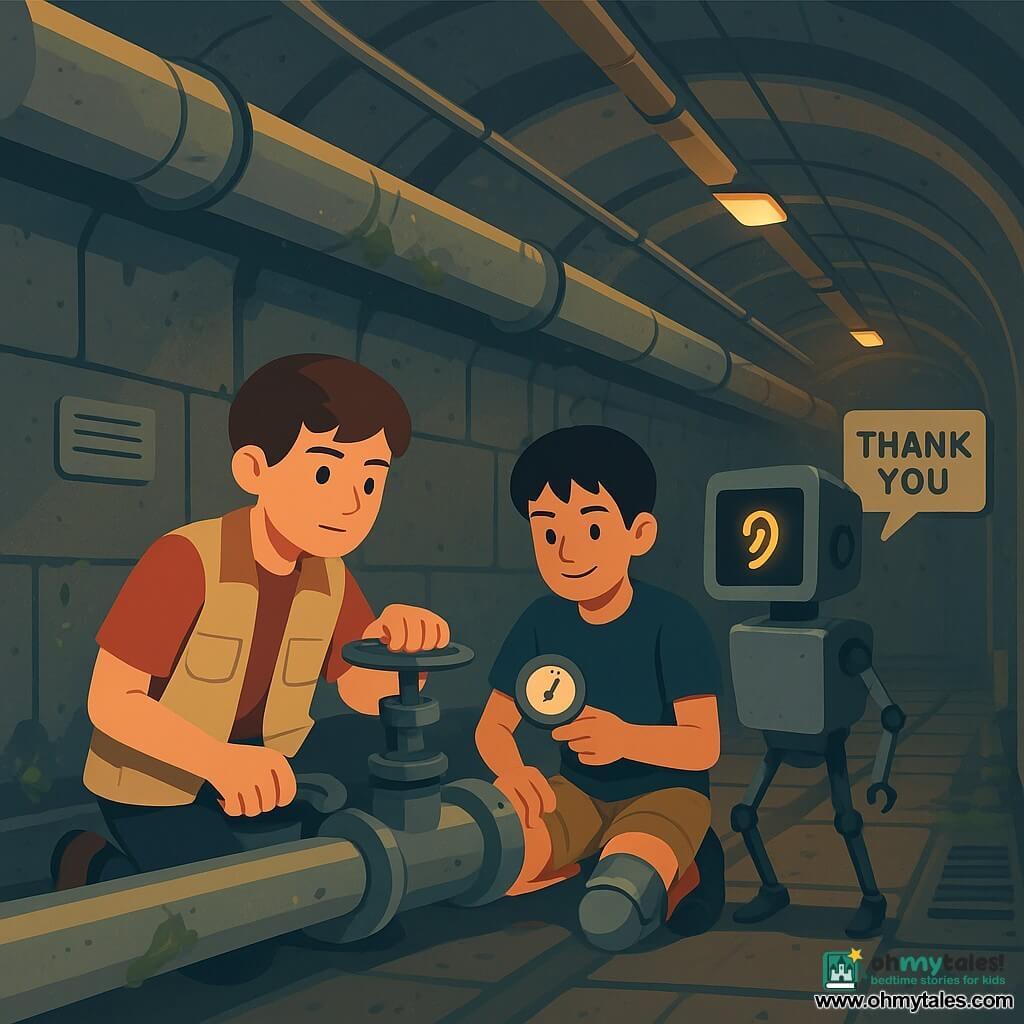
The service tunnel was wide enough for a small cart. Pipes lined the ceiling like silver roots. Some carried water, some carried air, some carried nutrient slurry for the rooftop gardens. Everything was labeled in bright, friendly icons so even a kid could tell which was which.
Kenji ran his fingers along a pipe with a fish symbol. “Clean water,” he said. “If someone messes with this…”
“We stop them,” Milo said, surprising himself again.
Jun held up a hand. “Listen.”
They stood still. The hum was louder down here, a deep thrumming through the soles of Milo's shoes. The clicking pattern came from ahead, around a bend.
Jun motioned them forward.
They crept along the wall. Milo could smell wet clay and something sharp, like ozone after a lightning storm.
When they rounded the bend, they saw it.
A machine crouched beside the main water conduit: a black box with silver clamps biting into the pipe. It had wires like stiff hair, and a small panel that blinked numbers too fast to read. A thin jet of mist sprayed from a valve, cooling the device.
And beside it—balanced on three spindly legs—stood a maintenance bot.
But not one Milo recognized.
City bots were usually bright colors with smiley status screens. This one was matte gray, scratched and patched, as if it had been rebuilt from leftovers. Its face-screen showed a simple symbol: an ear.
It turned toward them. The ear symbol pulsed.
Jun stepped forward, hands visible. “Hello,” she said calmly. “We're Alley Wardens. We look after the venelles.”
The bot's speaker crackled. “Listening,” it said. The voice was small and careful, like someone speaking through a scarf.
Kenji whispered, “It's… polite.”
Milo couldn't help it. “Are you the one who said ‘please'?”
The bot's ear symbol wobbled, then changed to a tiny dot—like a shy eye. “Yes,” it replied. “Pressure rising. Needed help. No one heard. So I made a gate.”
Jun's gaze flicked to the black box. “The unregistered access point.”
“A listening gate,” the bot said. “So the city would listen to the water.”
Kenji frowned. “Why not just send an alert like normal bots?”
The bot lowered its head. “Old model. Lost network key. I am… left behind.”
Jun's expression softened again, the way it had when Milo described the city breathing. “What's your name?”
The bot paused. “Name not assigned.”
Milo looked at its scratched limbs and the careful way it held itself, like it didn't want to knock anything over. It reminded him of himself in crowded places.
“You could be called Echo,” Milo said. “Because you listen and repeat.”
The bot's screen lit with the word: ECHO.
It sounded like a smile, somehow, when it spoke again. “Echo. Accepted.”
Jun crouched beside the black box. “Echo, this device is dangerous. Tapping into the water grid without regulation can cause contamination, pressure spikes—”
Echo's screen flashed a worried squiggle. “I know. But the pressure is already wrong. Someone else is changing flow. I tried to compensate.”
Milo's heart thumped. “Someone else?”
Echo pointed a thin arm deeper into the tunnel. “They placed a siphon in the soil-feed line. Stealing nutrient slurry. Plants above will weaken. Soil will dry. Then the roofs crack. Then water runs dirty. Chain reaction.”
Kenji let out a low whistle. “That's… evil. Like stealing the city's breakfast.”
Jun stood. “Show us.”
Echo's legs clicked softly as it scuttled forward. They followed, their footsteps echoing off damp stone.
The tunnel opened into a junction chamber where pipes crossed like streets. In the center sat a portable pump rig—slick and new, nothing like Echo's patched body. Hoses led from the soil-feed line into a sealed tank marked with a private company logo: GREYHOLLOW INDUSTRIES.
Milo knew the name. Greyhollow sold luxury garden soil to rich tower apartments. Expensive, dark, perfect soil—like a storybook.
Kenji muttered, “So they're stealing from the public grid to sell it back to people.”
Jun's jaw tightened. “That's sabotage.”
Echo's screen showed the ear again, pulsing faster. “I listened. I recorded. But I cannot send. No network key.”
Jun looked at Milo and Kenji. “We can. We take evidence, we alert again, and we stop the siphon safely.”
Kenji pointed at the rig. “Or we smash it.”
Jun's eyes snapped to him. “No smashing. Simple solutions. Safe solutions. We do this the right way.”
Milo felt something settle inside him, like a stone finding its place. Listening first. Acting second.
He nodded. “What do we need?”
Jun handed him a small clamp tool. “We shut the rig down without jolting the line. Milo, you're steady. Kenji, you read the pressure numbers. Echo, you guide us.”
Echo's ear symbol brightened. “Listening together,” it said.
And for a moment, in the humming belly of Skygarden, Milo felt like the city really was breathing—and they were helping it exhale.
Chapter 4: The Thank-You Plate
Kenji read the pressure gauge on the soil-feed line, squinting. “It's high. If we pull the hose too fast, it could snap back and—whoosh.”
Jun nodded. “Milo, clamp here. Echo, count down for a slow release.”
Echo extended a thin finger to the valve. “Three… two… one…”
Milo pressed the clamp. The metal bit gently into the hose, pinching it closed. The pump rig whined, confused, then slowed.
Kenji kept his eyes on the gauge. “Pressure dropping. Nice and steady.”
Jun disconnected the power cell from the rig, careful as if it were a sleeping animal. The rig went quiet. The hum in the tunnel changed too—less strained, more like a normal vibration.
Echo's screen showed a small wave symbol. “Flow stabilizing,” it said.
Jun pulled out her wrist-slate and snapped clear pictures: the company logo, the hose connections, the serial number plate. She also took Echo's recorded sound file from the listen-bead.
“We have proof,” she said. “Now we seal this and flag it for Civic Flow—again.”
Kenji tilted his head. “Will they come faster now?”
Jun's smile was grim. “If they don't, I'll march into their office and drip recycled water on their desk until they do.”
Milo snorted. Even down here, the idea was funny.
They used bright orange seal tape that hardened into a firm band when exposed to air. Jun wrapped it around the pump rig and stamped it with a Warden mark. “Tamper-alert,” she said. “If anyone touches it, the tape changes color and pings the local grid.”
Echo watched like a curious bird. “Clever,” it said.
Kenji leaned close to Echo. “So… where did you come from?”
Echo's ear symbol dimmed. “Old soil station. Built when Skygarden was smaller. When tunnels were louder. Then upgrades came. New bots. New keys. I stayed. I listened. No one listened back.”
Milo felt a pinch in his chest. “That's not fair.”
Jun looked thoughtful. “We can request a network key reissue. Or at least a safe station for you.”
Echo hesitated. “If I have a station… I can keep listening. I can warn.”
Milo remembered how the unregistered cover felt cold, like a mouth of hidden air. A listening gate. Made out of desperation.
He reached into his toolkit and pulled out a thin metal plate no bigger than his palm. It was meant for labeling pipes. He had an extra, because he always carried extras. It made him feel prepared.
He dug out his etching pen and scratched carefully, tongue between his teeth.
THANK YOU.
Kenji watched. “What's that for?”
Milo shrugged, embarrassed. “For Echo. For listening. For… trying.”
Jun nodded, approving. “That's a good habit. Gratitude keeps cities human.”
Milo found a clean spot on the wall beside the junction—right above a small maintenance shelf where Echo could dock. He drilled two tiny holes, screwed the plate in place, and wiped the metal with his sleeve until the words shone.
Echo stared at it. The ear symbol flickered, then changed into a simple smiling line.
“Thank you,” Echo said, voice softer than the tunnel hum.
Kenji cleared his throat, suddenly interested in the ceiling pipes. “Yeah. Thanks for not letting the roof gardens turn into crunchy salad.”
Jun tapped her slate again. “Civic Flow Office, this is Alley Warden Jun. We have active sabotage at Junction 12-B. Evidence attached. Also, we found an unkeyed maintenance bot named Echo, who installed an unsafe listening gate because it couldn't reach the network. We need a response team now.”
This time, an answer came almost immediately. A calm voice: “Received. Dispatching.”
Milo let out a breath he hadn't realized he was holding.
But Echo's ear symbol pulsed sharply. “Wait,” it said. “More footsteps. Above.”
Jun's eyes narrowed. “Someone's coming back for the rig.”
The three of them froze, listening.
From the tunnel behind them came a sound: fast shoes on stone, not the slow clunk of a city robot.
Kenji whispered, “Not Civic Flow.”
Jun whispered back, “Hide. And listen.”
They ducked into a side alcove between two big air ducts. Milo's heart banged hard enough to be heard by satellites. Echo folded itself low, like a gray crab.
Two shadows rushed past the junction. A man and a woman in sleek work coats with Greyhollow patches. They carried a tool case and moved like they expected no witnesses in the city's underbelly.
The man hissed, “Pump's offline.”
The woman crouched, fingers on the seal tape. “Wardens. Great.”
The man's voice turned sharp. “We remove the rig and leave. Now.”
Jun's hand tightened around her wrist-slate. Milo could see her thinking: don't rush, don't panic. Listening first.
Kenji's eyes met Milo's. In that look was a question: Do we do something?
Milo swallowed. Then he nodded once.
Because sometimes, being humble didn't mean being quiet. It meant knowing you were small—and acting anyway.
Chapter 5: The Smallest Alarm
Jun leaned close to Milo and Kenji. Her whisper was barely air. “We don't fight. We alert. Echo, can you trigger any local system? Lights? Doors?”
Echo's screen flickered. “No network. But… I can make sound.”
Kenji mouthed, How?
Echo extended an arm toward a nearby resonance pipe—an old metal tube designed to carry vibrations so workers could tell if a pump was failing. Echo tapped it with a quick, precise rhythm.
CLINK-clink-CLINK. CLINK-clink-CLINK.
The sound raced along the pipe like a message on a tin-can telephone. Somewhere, a sensor woke up.
Across the junction, a blue safety light blinked on.
The Greyhollow woman froze. “Did you hear that?”
The man snapped, “Ignore it.”
Another light blinked. Then another. The chamber filled with a calm, rising chime—the city's gentle warning tone, designed not to scare people, just to tell them, Pay attention.
Jun lifted her slate and spoke clearly, not shouting, just firm. “Civic Flow, suspects on site. Greyhollow personnel attempting to remove sealed equipment. Location confirmed.”
The Greyhollow man spun, finally noticing the blue lights. His eyes flicked toward the alcove.
Milo's stomach flipped. He wanted to disappear into the wall moss.
Kenji rolled forward a little, deliberately making his brace click on the stone—just once, like a punctuation mark.
The man's gaze snapped to Kenji. “Kids?”
Jun stepped out into the open. She held her hands up and kept her voice calm. “Stop. The rig is sealed and recorded. Civic Flow is on the way.”
The woman's face tightened. “You don't understand. This is a contract extraction.”
Jun's eyebrows rose. “From the public soil-feed line?”
The man took a step forward, angry. “Move.”
Milo heard himself speak, though his voice felt too small for the tunnel. “Please don't. The roof gardens need that. Everyone needs that.”
The man blinked, as if he hadn't expected a kid to sound sensible.
Echo scuttled out beside Milo, ear symbol bright. “Pressure changes harm soil. Harm water. Harm sky,” it said, like it had memorized the city's promises.
Kenji added, “Also, you're being super obvious.”
The woman hissed, “We don't have time for this.”
She grabbed the tool case and reached for the seal tape. The tape, designed to protect the city, did exactly what it was built to do: it flashed from orange to bright purple and began broadcasting a loud, steady ping.
The man swore under his breath.
Jun didn't move closer. She didn't need to. She simply said, “That ping is traceable. Walk away now and you'll still be walking when Civic Flow arrives.”
For a moment, everything balanced on a thin wire: the hum of pipes, the pinging tape, Milo's heartbeats, Kenji's quiet breathing.
Then the Greyhollow man grabbed the woman's sleeve. “Fine. We're leaving.”
They hurried off into the tunnel, their footsteps fading.
Kenji exhaled. “We did it.”
Milo's knees felt wobbly. “We… talked them away.”
Jun glanced at him. “That's a skill. Don't underestimate it.”
Echo's screen showed the word THANK YOU, matching the plate Milo had fixed to the wall. “You listened. Then you spoke,” Echo said.
Milo stared at the sealed rig. “It feels weird,” he admitted. “Like… huge things can go wrong because of one hose.”
Jun nodded. “That's why cities like ours need people who notice small things.”
A distant rumble grew louder: the sound of an inspection cart approaching, its wheels humming on the tunnel track.
Kenji grinned. “Here come the grown-ups.”
Jun's smile this time was real. “Good. Let's make sure they hear everything.”
Chapter 6: A Safer Skygarden
Civic Flow arrived with bright vests, portable scanners, and serious faces that softened when Jun presented the evidence. They removed the siphon rig properly, checked the lines for contamination, and installed a clean, official access hatch where the dark cover had been—yellow, with the spiral warning print Kenji had mentioned.
One of the inspectors, a tired-looking man with kind eyes, crouched beside Echo. “Well, hello there,” he said. “You've been down here a long time.”
Echo's ear symbol pulsed. “Listening,” it replied.
The inspector nodded, as if that explained everything. “We can reissue your network key. And we'll set you up in a proper monitoring nook. Would you like that?”
Echo paused. “Yes. Please.”
Milo felt relief spread through him like warm tea. Echo wouldn't have to build secret gates anymore.
Up on the surface, the venelles seemed brighter. Or maybe Milo was just noticing more. The mist-coolers sighed gently. The water channels ran clear, catching the light in quick silver flashes. Rooftop gardens above them swayed, healthy and green, their soil safe in its pipes.
Jun walked with Milo and Kenji to the junction of three alleys where a small community notice board stood. Someone had already posted an alert: GREYHOLLOW INDUSTRIES UNDER INVESTIGATION FOR ILLEGAL EXTRACTION. REPORT SUSPICIOUS HARDWARE.
Kenji read it aloud, then whistled. “That's going to make some tower people very grumpy.”
Milo shrugged. “Better grumpy than thirsty.”
They passed a group of younger kids playing hop-grid on the pressure plates, making the lanterns blink in a cheerful pattern. A delivery bot rolled by with baskets of vegetables, its wheels whispering over the stone.
Milo glanced at Kenji. “Do you think the city's safe now?”
Kenji thought, then said, “Safer. Because we'll keep listening.”
Jun overheard and nodded. “Exactly. Safety isn't a lock you click once. It's a habit.”
They returned to the tunnel entrance one last time. Milo peered down the ladder into the cool, damp air. Somewhere below, Echo would be settling into a real station, connected at last, able to send its careful warnings to people who could act before trouble grew teeth.
Milo touched the pocket where his etching pen was. “I'm glad we put that plate up.”
Kenji nudged him. “You and your thank-yous.”
Milo smiled. “It matters.”
Kenji's grin turned softer. “Yeah. It does.”
As they walked home through Skygarden's fresh venelles, Milo listened—not for danger, but for the normal music of a city that respected the sky, the water, and the soil: wind in the turbines, clean flow in the channels, and footsteps on stone that powered the lights for everyone.
And beneath it all, steady and calm, the city's deep hum sounded less like a held breath and more like a contented sigh.