Chapter 1: Mist Over the Recycled Falls
In Cascade City, water never stopped moving.
It slid down glass cliffs in shining ribbons, tumbled through gardens stitched into towers, and finally poured into wide, clean basins where it was filtered, spun, and sent climbing up again. The whole place breathed like that: down, up, down, up—always reused, always careful.
On the highest walkway, where the air smelled faintly of mint from rooftop moss, a young otter named Milo padded along with a satchel over his shoulder. Milo was the kind of otter who listened before he spoke. His voice, when it arrived, was calm and gentle, as if he didn't want to startle the world.
Below him, the recycled waterfalls shimmered. Tiny drones—no bigger than dragonflies—hovered near the streams, checking for leaves, dust, and anything that didn't belong. Every now and then, a drone gave a polite beep, like clearing its throat.
Milo stopped by a viewing rail made of smooth bamboo-metal. An elderly tortoise with a shiny shell-cover leaned there, watching the falls with patient eyes.
“Morning, Milo,” the tortoise said.
“Morning, Auntie Nara,” Milo replied. “The water sounds happy today.”
Auntie Nara chuckled. “Water always sounds happy when it's being respected.”
Milo's whiskers twitched at the word. Respected. That was one of the first lessons in Cascade City. You didn't waste what kept everyone alive. You didn't stomp through gardens, even if they were “just plants.” You didn't grab, or shout over others, or pretend the city belonged to you alone.
Today, though, the city felt… off.
A thin gray veil hung above the tallest towers, blurring the sun into a pale coin. It wasn't thick enough to panic anyone. It was thick enough to make the light look tired.
Milo adjusted the strap of his satchel. Inside were repair patches, a coil of vine-cable, and a small hand tool shaped like a leaf. Milo helped the neighborhood caretakers—checking sensors, fixing broken drip-lines, making sure the living walls stayed alive.
He started down a spiral ramp lined with ferns. Far below, the street-level canals reflected the city's neon vines and the soft glow of bio-lamps. A family of raccoons zipped past on a shared glider board, laughing. A pair of herons stood at a crosswalk, waiting for the light to turn green—even though they could have flown.
Rules mattered here. Not because someone yelled about them, but because the city worked better when everyone tried.
At the corner of Waterwheel Avenue, Milo found a crowd gathered near a recycling chute. A red panda technician was crouched by a panel, ears flicking with irritation.
“What's wrong?” Milo asked, keeping his tone steady.
“Dust spike,” the red panda said. “Air scrubbers are working, but something keeps sneaking through. Like the sky is shedding.”
“The sky doesn't shed,” Milo said softly.
“Tell that to the filters,” the technician muttered.
Milo looked up again. The gray veil drifted, almost thoughtful, as if it were searching for a place to settle.
He felt a small, cold worry in his belly. Not sharp. Not loud. Just present.
Then he remembered something he'd seen yesterday—between two delivery towers, a gap that wasn't on any map. A narrow passage, half-hidden behind a curtain of ivy and solar fabric, where a faint green glow had winked like a secret.
A gentle curiosity rose in him, warm and brave.
Maybe, Milo thought, the city still had places it hadn't shown him yet.
Chapter 2: The Alley That Wasn't There
After his morning rounds, Milo took the long way home on purpose.
He followed the sound of water until it blended with the hum of charging stations and the whisper of wind through balcony gardens. He passed a school where young foxes practiced “quiet robotics,” guiding tiny cleaning bots through an obstacle course made of pebbles and petals.
“Slow hands, kind minds!” their teacher called.
Milo smiled and kept going.
The gap between the delivery towers appeared exactly where he remembered: a slim slice of shadow, hidden behind climbing jasmine and a sheet of flexible solar cloth that rippled like a flag. Most animals hurried past without noticing. The towers were busy places—packages zipping on rail-lines, cargo drones nesting in docking bays. Nobody had time for a crack in the wall.
Milo did.
He pushed aside the jasmine carefully, whispering, “Sorry,” as if the vines could feel offended. His paw brushed the solar cloth. It was warm, like sun-baked stone.
Behind it, a narrow alley opened up. The air changed immediately—cooler, sweeter, with a scent like rain on dry earth.
And there they were.
Trees.
Not ordinary trees. Their trunks were sleek and pale, as if carved from moonlight, and their leaves were thin, flat panels that shimmered with a soft inner glow. Every leaf held a small thread of gold, like lightning trapped in a vein.
The whole alleyway was lined with them, close together, their branches arching overhead like a tunnel. Light pooled on the ground in gentle circles. Milo's fur prickled with wonder.
A small plaque sat at the base of the nearest tree. The letters were faded, but he could read them.
SOLAR LUMEN GROVE — PILOT PROJECT — YEAR 2149
Milo's ears tilted forward. “A pilot project,” he murmured. “So this is… old.”
A leaf above him made a quiet clicking sound. Then a second leaf clicked back. The trees were talking—through tiny adjustments, tiny transfers of energy.
Milo reached into his satchel and pulled out his leaf-shaped tool. Its display flickered to life.
POWER FLOW: STABLE
STORAGE: HIGH
AIR QUALITY: MONITORING… ACTIVE
“Air quality monitoring?” Milo whispered.
He looked up again. The glowing leaves weren't just collecting sunlight. They were doing something with it. He watched as a faint mist—gray like the veil above the city—drifted into the alley's entrance. The closest tree brightened.
The mist thinned.
It didn't vanish in a flash. It didn't explode or get sucked away like a vacuum. It simply… lost its gloom, as if the light was teaching it a better way to be.
Milo's paws went still.
“So that's what you do,” he said, as if speaking to an old friend. “You eat the dirty air.”
A voice behind him said, “They don't eat it. They fix it.”
Milo turned quickly—but not aggressively. His tail tightened for balance.
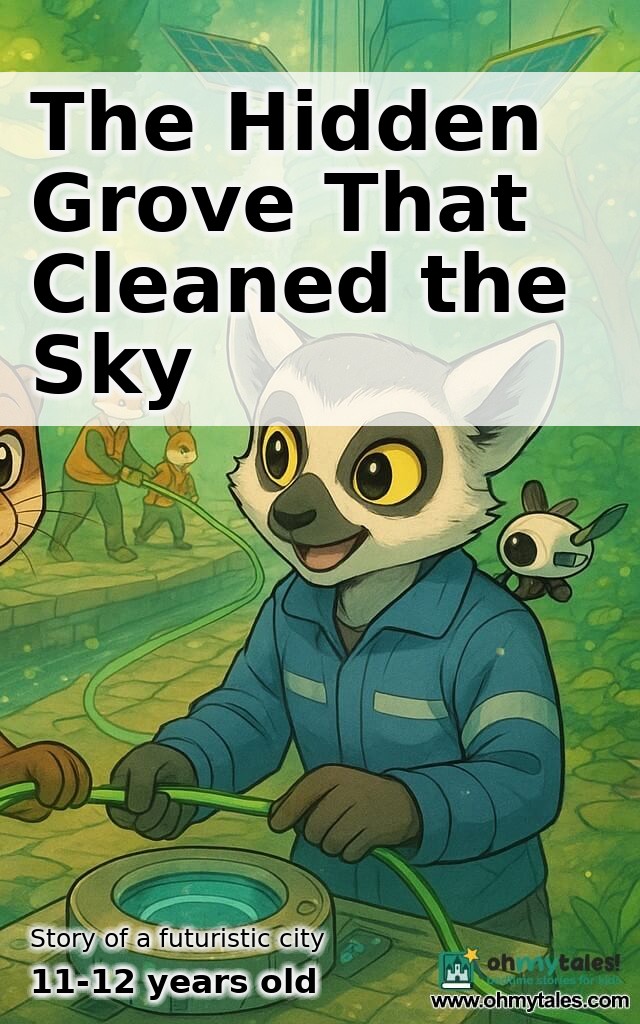
A young engineer stood at the alley mouth: a lemur in a gray-blue jacket with reflective stitching. Their eyes were bright and curious, and a slim drone perched on their shoulder like a metallic bird.
“You're not supposed to be in here,” the lemur said, but their tone didn't sound angry.
“I didn't mean to trespass,” Milo replied. “I just… found it.”
The lemur stepped closer, and the trees lit their face in mint-green and gold. “Most don't. This place got forgotten after the big upgrades. People assumed newer machines did the job better.”
“Do they?” Milo asked.
The lemur's mouth twisted. “Not today.”
Milo glanced toward the alley entrance, where another thin curl of gray tried to slip inside—and faded under the leaves' glow.
“What's happening to the sky?” Milo asked.
The lemur looked upward, as if they could see through concrete and gardens. “A dust stream from the outer construction rings. New satellite gardens are being installed. It's supposed to be controlled, but the wind shifted. The scrubbers are overloaded.”
Milo thought of the tired sun. The drifting veil.
“These trees could help,” he said.
The lemur sighed. “They could. But the city council doesn't like ‘unverified legacy tech.' It sounds old. Risky.”
Milo's whiskers lifted. “But they're working right now.”
The lemur hesitated, then smiled a little. “You're an otter, right? Practical. See a problem, fix it.”
“I try,” Milo said.
The lemur held out a hand. “I'm Jun. If you really want to help, I could use someone steady.”
Milo took Jun's hand gently. “I'm Milo. And… yes. I want to help.”
Above them, the trees clicked softly, as if approving the plan.
Chapter 3: A Plan Made of Light
Jun brought Milo deeper into the alley, where the trees grew closer and brighter. The ground was paved with old stone tiles speckled with tiny crystals that caught the glow and scattered it like starlight.
“This grove was designed to power itself,” Jun explained, walking backward as they talked. “Solar collection, storage in root-batteries, and a purification cycle. The leaves carry catalysts—special coatings that use sunlight to break down dirty particles.”
Milo blinked. “Catalysts. That sounds… very science.”
Jun laughed. “It is. But it's also simple. Sun in, cleaner air out.”
Milo liked that. A clear exchange. Respect in a system: you give, you receive, you don't take more than you need.
Jun stopped by a slim control post wrapped in ivy. “Here's the problem. The grove is hidden and underused. It's not connected to the city's air network anymore.”
Milo leaned closer. The control post had ports—round sockets shaped like seeds.
“I might have vine-cable,” Milo said, rummaging in his satchel. “The flexible kind.”
Jun's eyes widened. “You carry that around?”
Milo shrugged. “Sometimes the living walls need new lines. I like being prepared.”
Jun pointed to the ports. “If we link the grove's output to a nearby vent stack, the purified air could spread into the district. It won't fix everything, but it could lighten the load.”
Milo pulled out the coil of vine-cable. It looked like a bundle of green rope, but tiny fibers shimmered inside, conducting power and data. He held it carefully, as if it were a sleeping snake.
“Before we do anything,” Milo said, “are we sure it won't hurt the trees?”
Jun's face softened. “Good question. No forcing. We'll ask.”
“Ask?” Milo repeated.
Jun tapped their shoulder drone. It whirred, projected a small ring of light, and began to emit a series of clicks and soft pulses. The nearest tree responded with a brighter glow, then a slower dimming—like breathing.
Jun nodded. “They're ready. They've got stored energy. And they've been waiting to be useful.”
Milo felt a lump in his throat, unexpected and warm. “That's… kind of sad.”
“It is,” Jun said quietly. “Sometimes we forget what we built. Or why.”
They worked together. Milo held the cable steady while Jun connected the ends. Their paws and hands moved carefully, never yanking, never rushing. When a vine tendril snagged on a tile edge, Milo freed it gently.
“All right,” Jun said. “Now we need access to the vent stack outside. It's on the service ledge above the canal.”
Milo peered toward the alley entrance. The gray veil outside looked thicker now, as if afternoon had brought it confidence.
“I know that ledge,” Milo said. “It's slippery.”
Jun grinned. “You're an otter. Slippery is your whole brand.”
“My brand is being polite,” Milo said, deadpan.
Jun snorted. “Fine. Polite and slippery.”
They stepped out together. The city noise rushed in—delivery rails zipping, distant laughter, the constant soothing thunder of recycled waterfalls. But the light from the grove clung to Milo's fur for a moment, as if he'd borrowed a piece of it.
At the canal, the vent stack rose beside a vertical garden wall. A maintenance ladder ran up its side, dotted with tiny sensors.
Jun looked up. “We can climb. Or…”
Milo glanced at the canal. “Or we can take the water route.”
Jun frowned. “There's a water route?”
Milo pointed. A narrow service stream flowed from the falls' lower basin, heading toward the filtration hub. It was meant for maintenance bots, but it was wide enough for an otter—and, if they were careful, a lemur with a flotation belt.
Jun's eyes sparkled. “That is the most otter solution I've ever heard.”
Milo gave a small, pleased smile. “Simple. Accessible. And less chance of falling off a ladder.”
They borrowed a maintenance flotation belt from a nearby station (Milo left a quick note on the screen: BORROWED FOR CITY CARE — WILL RETURN). Respect, even in a hurry.
Then they slipped into the stream.
The water was cool and clean, smelling faintly of citrus from the filters. It carried them along the base of the vent stack. Milo paddled with smooth strokes while Jun clung to the belt, trying to look brave.
“I'm fine!” Jun declared, as a small splash slapped their face.
Milo kept his voice gentle. “You are very fine. The water agrees with you.”
“The water is laughing at me,” Jun sputtered.
Milo's whiskers twitched. “It laughs at everyone. Even me.”
They reached a maintenance platform tucked behind a curtain of hanging plants. Milo climbed up first, then offered a paw to Jun.
Jun took it. “Thanks.”
“Always,” Milo said.
Above them, the gray veil drifted lower. The city's bio-lamps turned on early, confused by the dimness.
Jun opened the vent stack panel. “If we connect here, the grove can push clean air into the district's circulation.”
Milo held the vine-cable up. Its fibers pulsed softly, as if eager.
Jun hesitated. “We should tell someone official.”
Milo looked across the city—at gardens clinging to towers, at animals moving below, trusting the systems that kept them safe.
“We will,” Milo said. “But first, we can start helping. Quietly. Kindly.”
Jun nodded. “All right. Quiet kindness it is.”
They plugged the cable in.
For a second, nothing happened.
Then the sensors on the vent stack blinked green, one by one, like a line of fireflies waking.
A soft breeze rose from the vent—cool and fresh.
Milo closed his eyes and breathed in. It smelled like rain and leaves and sunlight.
“It's working,” Jun whispered.
Far above, the gray veil shivered, as if surprised.
Chapter 4: The Council of Very Busy Animals
The clean air spread faster than Milo expected.
Within an hour, the nearest streetlights stopped flickering. The mint rooftop moss perked up, opening its tiny cups to drink from the moisture. Even the waterfall drones seemed less frantic, their beeps calmer.
But the gray veil still hung over the city, stubborn and wide.
Jun tugged Milo's sleeve. “Now we tell someone official. Before they think this is sabotage.”
Milo nodded. “Agreed.”
They headed to the district hub, a round building shaped like a lily pad perched beside a broad waterfall. Inside, the air was cooler, and the walls were covered in living screens—thin layers of algae-glass that displayed maps and numbers in gentle colors.
A receptionist—a serious-looking beaver with perfectly combed fur—glanced up. “Appointments?”
Jun cleared their throat. “We need to speak to the environmental coordinator. It's urgent.”
The beaver's eyes flicked to Milo's damp fur, to Jun's dripping flotation belt. “Urgent in the sense that you fell into a canal?”
Milo spoke softly. “Urgent in the sense that the sky is getting dusty, and we found a working purification grove.”
The beaver paused. “A grove.”
“Yes,” Jun said quickly. “Solar Lumen Grove. Legacy project. We connected it to a vent stack—”
The beaver's tail slapped the floor once. “You connected unregistered equipment to city infrastructure?”
Milo raised both paws a little, peaceful. “We checked the tree systems first. We didn't force anything. And it's helping.”
The beaver stared. Then, reluctantly, they tapped a screen. “You have five minutes. Don't drip on the floor.”
They were led into a circular room where three animals sat around a table: a tall crane with a sleek data-collar, a broad-shouldered boar with a construction badge, and a soft-eyed rabbit with a scarf woven from recycled fiber.
The crane's voice was crisp. “You are Milo, caretaker assistant, and Jun, junior engineer. Explain why my district vent stack is receiving power from an unknown source.”
Jun started fast, words tumbling. “The air scrubbers are overloaded because of dust from the construction rings and the wind shift and—”
Milo placed a paw on Jun's sleeve, gently slowing them. “May I?”
Jun exhaled. “Please.”
Milo looked at the council members one by one, making sure his voice stayed calm. “We found an old alley with solar-powered luminous trees. They purify the air using sunlight. They were underused. We asked the system—through Jun's drone—and it responded ready. We connected it to share clean air. It's already lowering the dust levels in the nearest streets.”
The boar snorted. “An alley of magic trees.”
“Not magic,” Jun said. “Science. Photocatalytic leaves. Storage roots. It was a pilot in 2149.”
The rabbit leaned forward. “If it works, why was it forgotten?”
Jun hesitated. “Newer systems replaced it on paper. And… it was hidden.”
The crane's eyes narrowed. “Hidden projects are a liability.”
Milo's tail curled around his ankles. He kept his tone respectful. “It's also a gift. Sometimes gifts are misplaced.”
The crane tapped their data-collar. A map appeared in the air, showing dust density across the district. A small green circle pulsed where Milo and Jun had connected the grove.
The crane paused. “The numbers are improved.”
The boar leaned in. “That's… actually impressive.”
The rabbit's ears lifted. “Then we should expand it. Carefully.”
The crane held up a wing. “Carefully is the key word. We can't have citizens plugging vines into vents whenever they feel inspired.”
Milo nodded. “I agree. That's why we came. To ask permission to do it properly.”
Jun added, “And to show you the grove. You can inspect it. Test it. We'll follow protocols.”
The boar grunted. “Protocols are fine. But the dust is getting worse. I'm in charge of the satellite garden ring installation. If the air gets too thick, we have to stop work. That delays food production.”
The rabbit's gaze softened. “Then we don't have time to argue. We need practical respect: respect for safety, for nature, for the systems… and for the animals breathing under this sky.”
The crane was quiet for a moment. Then they said, “Take us to the grove. If it's stable, we will authorize an emergency integration.”
Jun's shoulders sagged with relief. “Thank you.”
Milo's whiskers lifted. “Thank you for listening.”
The crane studied Milo. “You were respectful, even while breaking rules.”
Milo answered honestly. “Rules matter. So does air.”
The rabbit smiled. “Spoken like a true caretaker.”
They left the hub together. Outside, the gray veil drifted, slow and heavy. The waterfall's bright roar seemed muffled, as if wrapped in cotton.
Milo glanced back toward the hidden alley.
“Hold on,” he murmured to the city, as if it were a friend. “We're coming.”
Chapter 5: When the Wind Changed Its Mind
The council members followed Milo and Jun through the gap between the towers. When the crane pushed aside the solar cloth, their feathers caught the grove's glow and turned faintly gold.
They stopped in unison.
Even the boar, who looked like he wrestled cranes for fun, went quiet.
The luminous trees arched overhead, humming softly with stored sunlight. Their leaves clicked in tiny conversations. The air inside the alley felt clearer than anywhere else in the city—like stepping into a clean page.
The rabbit whispered, “It's beautiful.”
Jun walked to the ivy-wrapped control post. “We connected here. The grove's stable. Look.”
The crane scanned the data ports with their collar. Numbers streamed across a holographic panel.
“Purification efficiency: high,” the crane said slowly. “Storage: excellent. Structural integrity: good.”
The boar scratched his snout. “So why aren't we planting these everywhere?”
Jun's expression turned thoughtful. “They take time to grow. And the coating process needs careful maintenance. But we can start with this grove and add more corridors. The city already has solar fabric, recycled water, living walls. This fits.”
Milo stepped closer to the nearest tree and laid his paw against its trunk, gentle as a promise. It felt warm, like sun-warmed wood.
A thin curl of gray mist tried to creep into the alley again.
The trees brightened.
The mist faded.
The rabbit let out a breath. “They're protecting us.”
Milo shook his head slightly. “Not protecting. Cooperating. We help them stay alive, and they help us breathe.”
The crane nodded once. “Respect, then. Mutual.”
They began making a plan right there. The crane authorized temporary links to more vent stacks. The boar offered a team of construction workers to extend the conduit routes—careful ones, the kind who didn't trample seedlings. The rabbit volunteered to organize neighborhood helpers to keep the grove clean and monitored.
Jun looked at Milo, eyes shining. “We're doing it.”
Milo's heart felt light, but he stayed grounded. “One step at a time.”
They worked through the afternoon. Conduit vines were laid along existing green corridors, fastened with soft clamps that didn't pinch. Drones mapped airflow and suggested the best paths. Volunteers arrived—cats, dogs, badgers, even a shy armadillo—carrying water spritzers and gentle brushes for the trees' leaves.
A young fox approached Milo with a cloth. “Do you need this? You're dripping.”
Milo took it gratefully. “Thank you. And thanks for coming.”
The fox shrugged, trying to look cool. “I like breathing.”
Milo laughed quietly. “Me too.”
As the connections expanded, clean air flowed out like invisible rivers. The gray veil overhead began to thin at its edges, tugged apart by fresh currents.
But the dust stream wasn't done.
Near evening, the wind shifted again—harder this time, like a stubborn animal shaking its fur. A thick wave of gray rolled toward the city center, aimed right at the tallest waterfall towers.
Alarms chimed—soft, not panicked, but urgent.
Jun's drone buzzed. “Incoming density spike,” it reported in a flat voice.
The crane's feathers ruffled. “If that hits the central intake, the filtration hubs will clog.”
The boar swore under his breath. “That's my construction ring dust. The outer wind-break panels must have failed.”
The rabbit's eyes widened. “Can we stop it?”
Milo stared at the oncoming wall of haze. It looked like a storm that had forgotten it was supposed to be rain.
He felt fear, yes. But also the steady weight of the grove behind him, glowing with patient power.
“Can the trees handle more?” Milo asked.
Jun checked the readings. “They're strong, but not infinite.”
Milo thought quickly, but not wildly. “What if we guide the dust through the grove corridors instead of letting it hit the intake all at once?”
The crane tilted their head. “Guide the dust?”
Milo pointed to the city's design—its green bridges, its canal breezeways, its waterfall-driven air currents. “The city already has wind paths. We can open and close vent shutters to pull the dusty air toward the luminous alleys, like leading a messy puppy into a bath.”
Jun's mouth opened. Then they grinned. “That's… brilliant and weird.”
The boar barked a laugh. “A puppy bath plan. I like it.”
The crane snapped instructions into their collar. Across the district, smart shutters turned, vents adjusted, and airflow redirected. The recycled waterfalls increased their mist output slightly, weighing down the dust so it moved lower, slower, easier to catch.
Volunteers hurried—closing rooftop garden screens, opening corridor louvers, following the plan.
Milo ran with Jun along a green bridge, the city humming beneath their feet. Below, the canals reflected the dim sky like smudged silver.
“Are we really herding a dust cloud?” Jun panted.
Milo kept his voice even. “Gently. Respectfully. Like you'd guide someone who's lost.”
The gray wave rolled into the first luminous corridor.
The trees brightened until the alley glowed like dawn.
The dust thinned.
It kept moving—less like a wall now, more like a tired crowd being guided through a wide doorway.
Another corridor lit. Then another.
Cascade City began to sparkle in patches of green-gold, like fireflies answering each other across the streets.
And slowly—slowly—the sky started to remember how to be blue.
Chapter 6: The Clean Sky Promise
Night came, but it didn't feel heavy.
The bio-lamps along the canals reflected on the water in warm lines. Above, the last scraps of gray drifted away, broken into harmless wisps that dissolved under the luminous trees' steady work and the city's restored scrubbers.
Milo stood on a rooftop garden beside Jun, Auntie Nara, and a small crowd of volunteers. From here, they could see the recycled waterfalls shining again—bright, loud, confident. Their mist rose in pearly plumes, catching the lights like powdered stars.
Jun handed Milo a cup of hot kelp-cocoa from a street vendor. “For the hero otter,” Jun said.
Milo accepted it carefully. “I'm not a hero. I just walked into an alley.”
“That's how it starts,” Jun replied. “Someone notices what everyone else walks past.”
Auntie Nara sipped her own drink, slow and thoughtful. “And someone remembers respect.”
Below them, the crane coordinator spoke to the crowd through a gentle speaker system. “Solar Lumen Grove will be restored and expanded. Not as a secret. As a shared project. We will train caretakers, involve schools, and publish clear rules for safe connections.”
The fox from earlier called, “So we can't plug random stuff into vents anymore?”
The crane replied, perfectly serious, “Correct.”
The fox muttered, “Worth asking.”
A ripple of laughter passed through the rooftop.
Milo watched the sky.
It was clearer than it had been all day. Not just “less dusty.” Clean. A deep, honest blue, with a few bright stars peeking through like curious eyes.
The rabbit council member stepped beside Milo. “You did well today,” they said.
Milo's ears drooped shyly. “We did.”
The rabbit nodded. “That's the right word.”
Jun leaned on the railing. “You know what I like most? The solution wasn't a giant new machine dropped from nowhere. It was… a mix. Old trees, new vents, recycled water, smart shutters, volunteers.”
Milo took a careful sip of cocoa. “Technology and nature,” he said, “sharing the job.”
Auntie Nara smiled. “That is the city's best habit.”
For a moment they stood quietly, listening to the waterfalls. The sound was like applause that never ended, not for one person, but for a system that kept trying.
Milo looked down at the streets where animals moved in peaceful streams, where gardens climbed walls in bright layers, where the luminous corridors glowed softly—no longer secret, but inviting.
He imagined new groves planted along school routes, kids learning how sunlight could clean air, how patience could be a kind of power. He imagined signs that didn't say KEEP OUT, but PLEASE ENTER CAREFULLY.
Jun nudged him. “So. Tomorrow. Want to help write the caretaker guide?”
Milo's whiskers lifted. “With clear rules?”
“Very clear,” Jun promised. “And a section called: Don't Be A Boar About It.”
The boar, who was nearby, shouted, “I heard that!”
Jun called back, “Then behave!”
The boar grinned, unoffended. “Fair.”
Milo laughed, warm and quiet.
Above them, the purified sky stretched wide and clean, as if someone had gently wiped a window.
Milo held his cocoa, breathed in the fresh air, and made a small promise to himself—simple enough for anyone to follow:
Notice. Ask. Share. Respect.
And if you ever find a hidden alley of luminous trees, don't keep it secret.
Bring the light back to everyone.