The Silent Clock
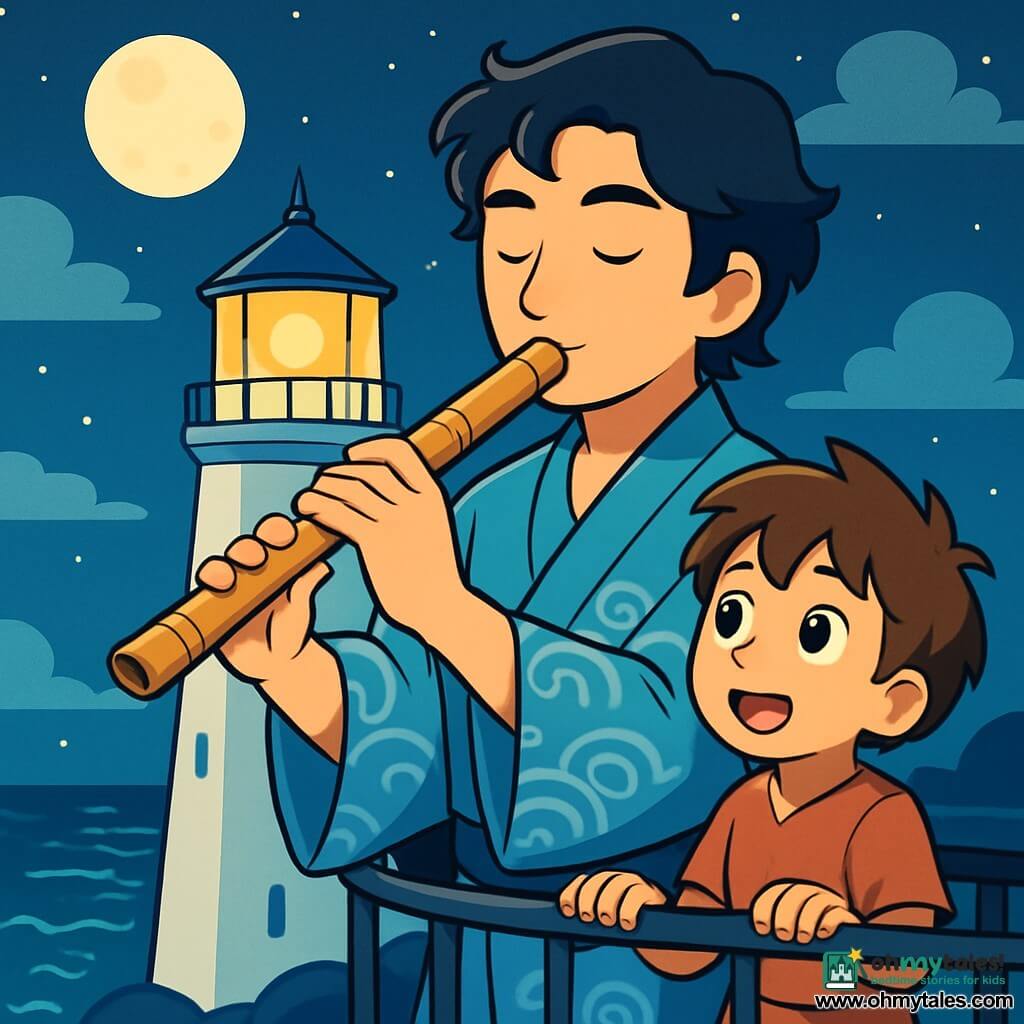
Long ago, or maybe not so long ago, a small village leaned against the coast like a cat curled beside a warm kettle. Fishermen mended nets. Children chased gulls. Pine trees drew tall green breaths along the ridge. And on the wave-bitten point stood a lighthouse, white as a moon-bone, its lantern watching over the sea.
At the heart of that lighthouse was a clock. Its hands once turned like cranes circling the sky, telling the village when to wake and when to return, when to bow to the sunrise and when to light evening lamps. But now the clock had fallen silent. Its two long hands pointed toward nowhere, like chopsticks laid down when a meal is unfinished.
Kaito lived in a cottage nearby, where bamboo whispered to the wind. He was an adult, but his laugh was soft and his eyes held the patient glimmer of tidepools. He made and played shakuhachi flutes. He carved them from bamboo with careful fingers, polishing each one until it caught the dawn in a mellow shine. His breathing was slow and deep, as if he had swallowed a piece of the mountain air and learned to carry it inside him.
Even so, every day when he walked past the lighthouse, his chest felt tight. He had watched the clock stop during a storm years ago, when the sky was a heavy drum. Back then he had been too afraid to climb the narrow stairs and face the rocking lantern room. He had stayed below, clutching a coil of rope in the fog. Since then, the silence of the clock had lived in him like a pebble in a shoe.
“I wish it would sing again,” a fish seller grumbled, wiping his hands on his apron. “My cat thinks dawn lasts until noon.”
“My tea oversteeps!” laughed the old woman who ran the inn. “The leaves need the hour hand!”
Kaito bowed to them and touched his flute. “Perhaps the clock is waiting to hear the right song.”
“We need a mender, not a musician,” said a boy with salt on his cheeks.
Kaito smiled gently at the boy. “Sometimes a song can mend, too.”
He did not say what he dared hardly admit to himself: he wanted to climb those stairs and repair the clock, to stand where his father once stood. His father had been the keeper before him, a man with hands like warm stones and a laugh like a small bell. When his father died, Kaito had lit incense and played a shakuhachi song that sounded like a thank-you. Since then, whenever Kaito breathed into his flute, he felt as if he spoke with everything—pines, waves, and the lanterns of those who had gone ahead.
Kaito drew a slow breath. Wind passed through his nostrils like a brush over paper. “If I find courage, I will fix it,” he whispered to the sea.
The sea replied in foam and hush, as if nodding behind a sleeve.
The Shrine Mirror
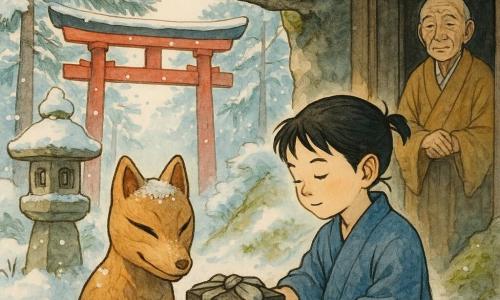
At the edge of the village, under a torii gate the color of autumn persimmons, a small shrine rested among moss and stones. Fox statues guarded the path with smiles that looked almost like secrets. Kaito came with a bundle of rice and a pinch of salt. He poured water at the basin and cleaned his hands and mouth, the way his mother had taught him.
“Good morning,” he said softly to the shrine. His breath made the prayer flags lift like butterflies.
Inside, under paper streamers, a polished bronze mirror glowed. In the mirror, the rafters and the offering box reflected clear as a mountain pond. Kaito bowed twice and clapped his hands gently. The sound was as small as two chopsticks meeting.
“I want to repair the lighthouse clock,” he told the mirror. “I'm afraid of the stairs, the storm memories, and the silence that has become comfortable. Please, counsel me.”
As he watched, the mirror clouded like a cup of tea swirling, then cleared. He saw himself as a boy with wind-tangled hair, holding a rope and staring up the tower stairs while thunder grumbled like a hungry stomach. He remembered the rainwater on the steps, the way the lantern had swung like a slow pendulum of light. He had been so sure his feet would slip. He had loved his father, and yet he had not climbed.
The mirror shifted. There was his father's face, warm and amused, a bit blurry as though seen through tears or salt spray. “Courage isn't loud,” the reflection of his father seemed to say, his lips moving in a way that matched words Kaito had heard long ago. “It is breath that keeps walking.”
Kaito blinked. For a moment, a fox tail flickered in the mirror's corner, or perhaps it was merely a passing shadow. Then a small voice tipped the air.
—Offer a song, and a promise, whispered something near his elbow.
Kaito looked down. A fox had padded into the doorway. Its fur was red like a maple leaf turned by the sun. It sat, tail curled neatly, and tapped the floor twice with its delicate paw.
“A promise?” Kaito asked, unsure if he had spoken in words or in thought.
The fox yawned, showing teeth like rice grains. —Fix the clock with kindness. Respect the spirits that dwell in the lighthouse. If you do, the path will open.
Kaito placed his rice and salt on the offering stand. “I promise to be kind to every gear and shadow. I promise to breathe when I am afraid.”
He took out his shakuhachi and played a song so soft it could have been the sound of snow if snow could hum. The mirror shimmered again. This time, Kaito saw the inside of the lighthouse: stairs spiraling like a shell; a clock wheel with one tooth broken; a brass key lying beneath a loose plank; a patch of brown rust shaped like a sleeping mouse.
“Thank you,” Kaito said. When he glanced up, the fox was gone. Only paw prints like commas dotted the dust. He took them as a sign: there was still more to say, more to read.
He bowed to the shrine, and as he left, a wind came from the pines, smelling of resin and sea. The prayer flags nodded like teachers who were pleased with a careful student.
The House of Gears
The lighthouse inside was cool, smelling of iron filings and old rope. The stone steps curved up and up, a pale river frozen into a spring. Kaito touched the railing. He could feel his heart, a small drum, ready to lead a parade. He let his breath be the drumstick: in, out, in, out. He began to climb.
Halfway, he paused to rest. The window showed him a slice of sea, wrinkled by wind. He put the shakuhachi to his lips. Notes floated, simple and round as pebbles, rising on the stairwell air. With each note, the fear inside him eased, like a knot loosening under a patient hand.
When he reached the clock room, the silence was thick as damp rice. In the center stood the mechanism: a forest of brass wheels and rods, with the lantern above like a glass moon. Kaito set his borrowed lantern down and bowed to the machine.
“I am Kaito,” he said. “I'm here to help.”
At first, nothing moved. Then he heard a tiny sneeze. Something shuffled behind a coil of rope. An oil can with a dent like a smile tipped its hat—if a hat were the idea of a hat on an oil can—and hopped forward on its spout. A wrench leaned against a beam and straightened as if waking from a nap. A broom swished its own bristles in greeting. Tsukumogami, the spirits of old things, had made their home here.
“Ah,” Kaito murmured, bowing to each. “Honored elders.”
—Honored indeed, squeaked the oil can, its voice thin as a line of ink. —We've been waiting for hands that greet before they grab.
The wrench cleared its throat, making a sound like two stones kissing. —One tooth is missing from the main wheel. Rust has grown like a sleepy mouse. The pendulum is tired.
Kaito knelt. He remembered the mirror's vision: a loose plank with a brass key below. He tapped the boards. One answered with a hollow note. He pried it up carefully. The key lay beneath, cold and obedient.
“Thank you,” he told the floor. “Thank you,” he told the plank. The broom nodded, pleased.
He found the rust patch. It was not quite like a mouse. It was more like a curled leaf, or an ear that did not want to listen. He touched it gently. “I'm not here to scrape you away in anger. We will bathe you in patience.”
He warmed a small cloth with his hands; the oil can leaned over to give a single shining tear. Kaito rubbed the rust with circles like little moons. He breathed. He played a slow melody that sounded like a boat rocking, a lullaby for metal. The rust sighed, and the brown quiet peeled away, leaving a dull but honest gleam.
Then he saw it: the gap on the main wheel, a missing tooth. No wonder the clock had lost its voice. Without that tooth, the wheel could not pass its message along, gear to gear, like people passing a story at a festival.
—We looked everywhere, said the wrench. —Storm night. A window was open. Something flew.
Kaito stood, walking to the lantern glass. The sea stretched out, a sheet of tin beaten by the moon, the islands like ink drops. Far below, the shore scribbled a line of foam. He remembered the mirror's hint. The missing tooth had gone to sea.
The oil can cleared its narrow throat. —You will need the mirror to find it.
Kaito nodded. “The mirror and the moon.”
He placed the key in his pocket. He closed the window. He thanked each tool. The broom made a little dance, tapping its handle to the floor as if to wish him luck. Kaito bowed and began the careful descent. The stairs seemed kinder than before.
The Moonlit Tidepool
That night, the village slept with windows like half-lidded eyes. Kaito carried a paper lantern down to the shore, where the rocks held tidepools like secret bowls. The moon laid a path of silver rice grains across the water.
“Are you sure?” asked a voice.
Kaito turned. The innkeeper stood wrapped in a shawl, her hair pinned with a comb that looked like a tiny wave. “If you fall in, you'll wake the fish,” she teased softly.
“I need to borrow the moon,” Kaito said. “Just for a little while.”
She chuckled. “Bring it back before dawn.”
The path over the rocks was uneven. Kaito's sandals found the rhythm. In–out, step–pause. The wind smelled of salt and old stories. In the nearest tidepool, small fish skated like commas, and a sea snail wrote slow sentences in the sand.
He knelt and held his lantern at an angle. The moon's face bent to look into the pool. For a moment it was a mirror. Kaito breathed, and the surface steadied. He saw the past clear as glass: the storm night; the lighthouse window yawning like a surprised mouth; the lightning cracking the sky into sharp pieces. A bright chip of brass—small, crescent-shaped—flew out and fell, a wink in the rain. It slid into a crack between two rocks, then into a shell that closed like a careful hand over a treasure.
“Ah,” Kaito whispered. He peered into the pool. There, between barnacles, rested a clam as big as his two palms. A thin line of shine showed where it almost, almost smiled.
“Excuse me,” he said to the clam. “Did the storm give you something that belongs to our clock?”
Something moved in the deeper part of the pool. A turtle, mossy-backed and calm, drifted up with dignity. Its eyes were old and kind.
—If you take, you give, rumbled the turtle voice. The words weren't exactly words, more like meanings that floated over like sea foam. —What offering do you bring?
Kaito set his lantern aside. He opened his bundle. “Rice. A pinch of salt. And a song.”
A small figure popped out from behind a rock, shaking with giggles. A tanuki, belly round as a drum, eyes as bright as soy sauce. It snatched a grain of rice, tossed it in the air, and caught it on its tongue with a “plop!”
“Hey!” Kaito laughed, surprised at how good it felt. “At least bow to the turtle kami first.”
The tanuki bowed so low its hat fell off, then scampered away, tail like a soft brush painting shadows.
Kaito sprinkled rice into the shallow water. He placed a bit of salt on the rock so it would not sting any creatures. Then he raised his shakuhachi and played. The song was simple, made of night and patience, made of a man thanking the sea for teaching him how to make his breath long. The notes rippled across the pool, and even the waves seemed to listen.
The clam shifted. It opened slowly, as if waking from a gentle dream. Inside, cradled on a cushion of pale muscle, lay the missing tooth. It was bronze, crescent-shaped, a small moon that had fallen and decided to be a gear for a little while.
—Take it, hummed the turtle. —Remember us when the clock sings.
Kaito bowed, his forehead nearly touching the rock. “I will remember. Each hour will be a bow.”
The turtle blinked. —Keep your lantern's light turned toward others. That is how a lighthouse is kept, even without walls.
Kaito held the tooth in his hand. It was cold, and then it quickly warmed, as if it recognized the path it would travel. He stood carefully, thanked the tidepool, and began the walk back.
The innkeeper was still on the shore. She cupped her hands like a little bowl. “Did you borrow the moon?”
“I borrowed its smile,” Kaito said, and placed the gear tooth gently in her hands so she could see. She smiled back without showing teeth, the way old friends do.
“Go,” she whispered. “The night is listening.”
The First Tick
Before the village had fully stretched its arms to greet morning, Kaito returned to the lighthouse. The stairs no longer felt like a test. They felt like steps cut in cloud. The oil can, wrench, and broom gathered near the open machine, buzzing with small, polite excitement.
—You found it, the wrench clinked, trying not to sound too proud.
“Yes,” Kaito said. “I had help.”
He polished the tooth, then set it into the wheel. It fit with a sigh. The oil can offered a drop shaped like a dew bead. Kaito turned the brass key gently. The gears leaned in to listen, like villagers at a story night. He drew a breath, long as a road, and started the pendulum. It swung out, paused, returned. Each swing was a sleeping cat's tail. Each pause was the moment before an answer.
Tick, said the clock.
The sound was small. Then it was medium. Then it was confident as a child's laughter.
Tick. Tock. Tick. Tock.
The lantern above brightened, as if pleased to have a heartbeat. The lighthouse gave a shiver that might have been relief. Through the windows, the sea caught the news and sent it skipping: tick, tock, tick, tock, until even the farthest gull cocked its head.
Kaito laughed softly and wiped one eye, surprised to find it wet. He put the shakuhachi to his lips and played the simplest of songs: the notes the clock was making, the notes the breath makes when someone is asleep and safe.
Footsteps clattered on the stairs. The fish seller peered in, hair wild, apron strings flying. “Is it true?” he puffed.
“It is,” Kaito said.
The boy who had spoken sharply before squeezed around his legs. He stood with his mouth open, then closed it, then opened it again. “I didn't think— I mean, I said—”
Kaito laughed. “Help me set the hands to the right time.”
They walked together to the face of the clock. Kaito guided the boy's small fingers. The boy's tongue stuck out the side of his mouth in concentration. Below, in the village, more people trickled out, looking up with hand-shaded eyes.
The hands fell into place. A note like a bell rolled through the tower. The broom swished a happy circle. The oil can made a tiny applause with drops that clicked on metal. The wrench went still, pretending not to be moved, but its shadow looked taller somehow.
“Listen,” Kaito whispered.
The clock spoke the hour, not loud, not scolding—just clear, like a leader the wind could trust. The sound stepped across roofs, slid under doors, brushed cheeks, woke kettles. It broke a little crust of sleep around each heart.
Kaito felt warmth behind him. He turned. In the lantern glass, for a breath-long instant, he saw his father as clearly as the moon sees its reflection in a calm pond. No sound. Only a nod, small and exact, like the final stitch that closes a sleeve.
Kaito bowed low. “Thank you for keeping watch,” he said.
Then the image was gone, or it had joined the light, which is much the same.
Mirrors and Footsteps
For several days, and then for many more, the village moved to the rhythm of the clock. Fishermen left when the hour leaned toward dawn. Children came home with pockets full of beach glass at the proper time. The innkeeper learned to steep her tea perfectly, and the cat learned that noon was not dawn, however loudly it asked.
Kaito polished the gears when they needed kindness. He swept the stairs alongside the broom spirit, who told him gossip about spiders. He oiled the axles while the oil can sighed contentedly and occasionally sneezed for fun. He played his flute for the room, for the sea, and for the quiet place inside himself where fear used to eat crumbs and now had gone outside to play.
One evening, he returned to the shrine with a basket of persimmons, their orange skins containing small suns. He bowed and placed them on the offering stand. This time, when he looked into the mirror, he did not see the storm night. He saw the lighthouse lantern, bright as a promise. He saw the boy who had helped him turn the hands, a few years older, holding a broom with serious pride. He saw his own back, smaller in the distance, walking up the steps with steady rhythm.
—The past is a mirror, murmured a voice that might have been his own breath. —But mirrors can be windows if you look with kindness.
A fox shape swirled across the surface like a cloud learning to be a fox. It tapped twice, as it had before.
—Courage, said the fox-not-fox. —It is not the noise of a drum in battle. It is the drum of a heart that keeps the beat for others.
Kaito left a persimmon near the fox statue. “For your sweet tooth,” he said.
He turned to go, humming. Outside the shrine, the evening wore a robe painted with first stars. He passed the inn, where the innkeeper sat on the steps fanning herself even though the air was cool.
“Did the mirror approve?” she asked.
“It taught,” Kaito said. “The way wind teaches pine to bow.”
She smiled. “People have started to say, ‘Meet me when the clock smiles.' I like that. It sounds like a poem.”
Kaito laughed. “Time is just breath pretending to be numbers,” he said.
“And what are we pretending to be?” she asked.
Kaito paused. “Lanterns that do not know they are lanterns. Until someone needs light.”
“Then tonight,” she said, “you're bright.”
He walked home under pine shadows that made the path look like a long pieced quilt laid by the forest. Crickets stitched their tiny songs around his ankles. He remembered the turtle's words: keep your lantern turned toward others.
Breath That Keeps Walking
Autumn slid into winter the way a sleeve slides over a wrist. Snow came to the village on quiet feet. The lighthouse wore a thin scarf of frost. The clock did not mind the cold. Its voice was clearer in the crisp air.
Kaito began to teach anyone who wished to learn the gentle breathing of the shakuhachi, even if they never played the flute. The boy from before would sit on the step and copy his breath. Old men would close their eyes and feel their shoulders sink. The innkeeper would pretend she wasn't learning, but her fan moved in time.
“Why are we breathing to a flute if we don't have a flute?” asked a girl with hair like black rope.
Kaito let a smile carry across his face like a small boat. “Because your breath is a flute,” he said. “Your ribs are bamboo. Your heart is a warm hand making the notes. In through the nose, out through the mouth. The air goes out kinder than it went in. In–out. That is how we practice courage.”
“And courage is… what?” the boy asked. He had grown taller. His sleeves looked shorter.
“Courage is breath that keeps walking,” said Kaito. “It is not about being unafraid. Afraid is just a bird that flies overhead. Courage is the feet continuing along the path while you carry tea for others without spilling.”
The children nodded. One of them mimed carrying a cup. “Like this?” She immediately pretended to spill and giggled.
“Yes,” said Kaito, “even the spilling is part of learning.”
He let them hold the shakuhachi and feel the cool bamboo. He told them how to bow to tools and say thank you, because tools can hear, just like waves can hear, and like time can hear when you speak kindly to it.
Sometimes, at dusk, Kaito would climb to the lantern room alone. He would set the clock's swing with a finger, the way his father once did. He would sit with his flute and look out to the place where the sky kisses the sea, and he would listen. In the lantern glass, he would sometimes glimpse a procession: the face of a turtle like a green stone with eyes; the flick of a fox tail; a tanuki pretending to be a rock and shaking with silent laughter; and, always, his father's smile, which was now more a feeling than a picture.
He would play a song for the living and the gone. He would play for the mirror that showed his past and then slowly, softly, turned to show a path forward like footprints laid in flour: step, step, step. He would step along them in his mind. He would promise again: to be kind, to breathe, to keep the clock honest, to lend his lantern to anyone who needed light.
Sometimes storms came. The lighthouse window rattled, remembering the night when Kaito had been a boy holding a rope and shaking. He would feel the prickle of old fear. Then he would breathe until his breath wore sandals and moved about like a helpful neighbor. He would play until the storm's shoulders dropped. He would tell the clock a joke—“Do you know the time?” he would whisper. “It's now.” The clock would answer, sincerely and steady: tick, tock.
And on the mornings after storms, fishermen would wave as if nothing could surprise them, and children would splash in puddles, and the innkeeper would open her door and yawn. The cat would sit on the step and pretend it had always known when dawn was.
There were nights when the sea was so quiet the stars could hear their own stories. On such a night, Kaito walked to the shrine and looked into the mirror. He saw not only himself. He saw children climbing the lighthouse stairs prudently, hand to the rail; he saw the boy grown and steady, oiling a hinge. He saw a girl with a broom sweeping away the dust of old worry. He saw the lighthouse standing not as a lonely guardian, but as a friend in a circle of friends.
He bowed once, twice. “Please watch our steps,” he said. Then he added, like someone telling a secret to an old, kind friend: “We are learning to be brave without being hard. We are learning to be lanterns.”
On his way home, the pine trees breathed. The sea breathed. The clock breathed. And Kaito breathed. Breath in, long and cool. Breath out, long and warm. In the hollow of that breathing, courage lived—not a shout, not a wave, but a steady walking in the direction of care.
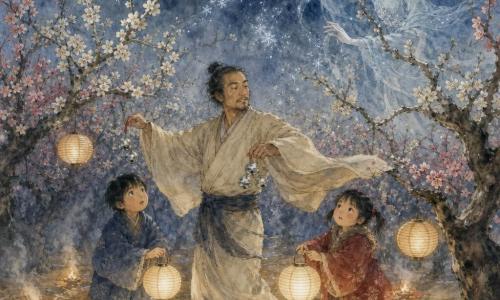
When snow melted and plum blossoms opened like little white lanterns on the trees, the village held a small festival to thank the lighthouse. Children hung paper wishes shaped like clocks and moons. Kaito played a song that sounded like the swing of a pendulum and the whisper of fox fur in grass. He played for the turtle and the tanuki, who listened invisibly from behind rocks and laughed at the proper parts. He played for the mirror that held the past and the path ahead.
“Tell us the moral,” the innkeeper said afterward, half-teasing, half-ceremonious, as if she were a storyteller in a painted robe.
Kaito thought. He held his flute. He watched the lighthouse, which now stood like a tall breath that would not run out.
“Courage,” he said quietly, “is being gentle longer than fear can be loud.” He looked at the children. “It is learning to carry your lantern through the dark and to turn it so that others can see their own steps.”
They nodded, some solemn, some bright. The clock chimed, Night folded its soft sleeve, and the sea nodded behind its fan. And when sleep came to each house, it came like a fox with careful feet, like a turtle gliding under moonlight, like a clock's steady whisper at the ear of a dreamer.
Tick, tock. Breathe, walk. The lighthouse watched. The village dreamed. And the mirror held everything gently, as a tidepool holds the sky.