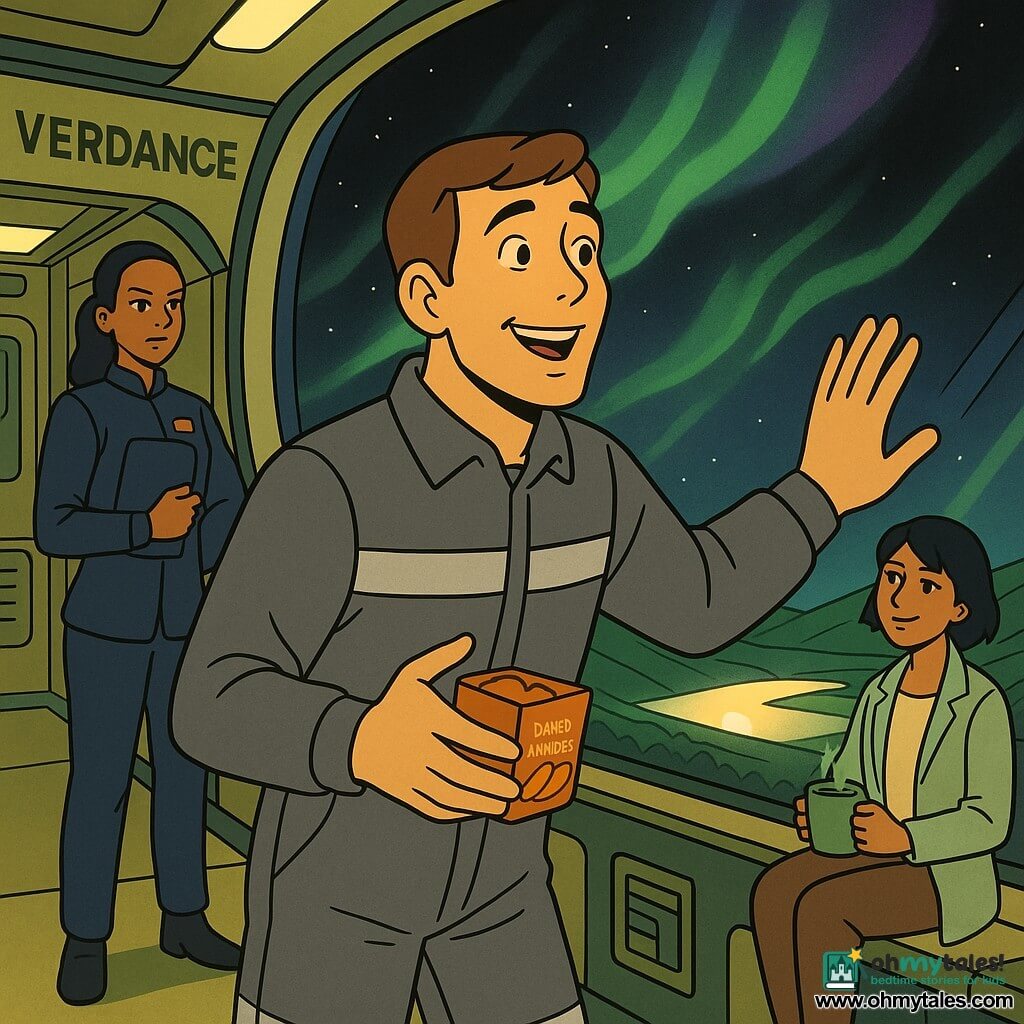
Chapter 1: The Quiet Alarm
Jace Moran floated in the drift between Earth and everywhere else, strapped into the pilot chair like it was a seat on a roller coaster that refused to admit it was scared.
His ship, the Kestrel, was small for deep space—sleek, angular, and practical. A tactical astronaut didn't need shiny chrome. He needed sensors that told the truth and thrusters that listened the first time.
On the main screen, a pale ring turned slowly against black: the Stanford torus called Verdance. From far away it looked like a silver bracelet with a green secret inside.
“Approach path confirmed,” said the ship's calm voice. Jace had named it Nia, because it sounded like someone who would remind you to drink water.
Jace checked his wrist pad. “Fuel margins?”
“Excellent,” Nia replied. “Your heart rate is also excellent. Slightly too excellent.”
“I'm fine.”
“You said that with the exact frequency of someone who is not fine.”
Jace snorted. He liked Nia's honesty. In training they taught you tactics: angles, timing, choices under pressure. Nobody taught you what to do with your thoughts when the universe got too wide.
He pulled up the space weather panel. A map of invisible forces unfurled—solar wind streams, radiation levels, and a bright yellow curve showing a coronal mass ejection that had launched two days ago.
Jace leaned closer. “That's… closer than I expected.”
“Your expectation was based on yesterday's forecast,” Nia said. “Today's forecast has improved its confidence. The solar storm's leading edge may brush Verdance's magnet shield within fourteen hours.”
Jace's stomach did a tiny flip, like an elevator stopping too fast.
Verdance wasn't just metal and machines. It was people. Families. Gardens. Schools. It was a whole world spinning to make its own gravity.
“Message it,” Jace said. His voice turned crisp, tactical. “Send Verdance Control a storm advisory. Include updated arrival window.”
“Sending,” Nia answered.
Jace watched the torus grow on the screen. In the shadowed inner curve, sunlight caught something green—real green, the kind that belonged to leaves.
He let himself breathe.
Verdance was the reason he'd joined Tactical Operations. It was the proof that humans could build something gentle in a hard place.
And now the Sun was reminding everyone that “gentle” still needed planning.
Chapter 2: The Spin of a New World
As the Kestrel approached, Verdance filled the view, not as a bracelet anymore but as a city that happened to be shaped like a ring.
Ports studded the outer rim like careful stitches. Great radiators spread like wings. Along one side ran a band of shimmering panels—solar collectors catching light like a net.
Nia guided the ship in with quiet bursts of thrusters. Jace kept one hand on the manual controls anyway. It wasn't distrust; it was habit. Tactics meant being ready to take over before trouble announced itself.
A new voice crackled through the comms—human, warm, and slightly amused. “Kestrel, this is Verdance Docking. Welcome back to the green donut.”
Jace smiled despite himself. “Docking, this is Jace Moran. Please tell me you call it that in official reports.”
“Only on days ending in ‘y.'” The voice belonged to Commander Imani Reyes, Verdance's docking chief and, if rumors were true, the only person who could glare a malfunctioning airlock into behaving. “We received your advisory. Storm's on everyone's mind. Come in on Vector Seven. We'll get you tucked in.”
“Tucked in,” Jace repeated.
“It's a comforting phrase,” Reyes said. “We're big on comfort here. Verdance Docking out.”
The Kestrel slid into the docking tunnel. Magnetic clamps kissed the hull with a heavy, satisfying thunk. A moment later, the pressure equalized, and the inner door rolled open.
Air rushed in—filtered, clean, with a faint smell of soil. Jace always noticed that first. Earth smell, stored and shared.
He stepped out and felt the gentle pull of spin gravity. His boots found the deck like they belonged there.
Reyes waited nearby with a tablet under her arm. She was tall, with hair tied back and eyes that looked like they never missed a detail. When she saw Jace, her sternness softened by half a degree.
“Moran,” she said. “You look like you've been arguing with your ship again.”
“My ship started it.”
Nia's voice came through Jace's earpiece. “Accurate.”
Reyes raised an eyebrow. “Your ship tattles.”
“She's loyal to the truth,” Jace said.
Reyes tapped her tablet. “All right, Tactical Astronaut. We've got an incoming solar event, and our council wants calm, clear updates. Your job is to monitor space weather, verify shield readiness, and be the voice that says ‘here's what we know' instead of ‘everyone panic.'”
Jace nodded. That was a job he understood. Fear loved empty spaces. Facts filled them.
“Before we get serious,” Reyes added, “look.”
She led him through a corridor with curved walls. The torus's rotation made the hallway slope gently, like a path built on the inside of a wheel.
They passed an open archway, and suddenly there it was: the habitat inside.
A broad valley spread along the inner rim—fields, streams, and clusters of houses with slanted roofs. Trees reached up toward a sky that was actually the other side of the ring. Cloud shadows slid over the land, painted by lights and careful engineering.
Jace stopped. For a second his tactical mind went silent.
“It's… greener than the feeds,” he whispered.
“Feeds can't smell,” Reyes said. “Or hear.”
From somewhere below came laughter. A ball arced through the air. A dog—yes, an actual dog—chased it with dramatic devotion.
Jace felt something loosen in his chest. “People live like this. Up here.”
Reyes watched his face, and her voice turned quieter. “That's why we plan. So they can keep living like this.”
Chapter 3: Reading the Sun's Mood
Verdance's Space Weather Station sat in a tower that leaned toward the outer hull, close to the sensors that stared into space. Inside, screens wrapped around the room like a cockpit made for a whole team.
A meteorologist named Priya Chen greeted Jace with a quick handshake. She was younger than Reyes, older than Jace, with short hair and a pen tucked behind one ear like it might run away.
“Glad you're here,” Priya said. “We've got data, forecasts, and one very grumpy Sun.”
Jace took the offered seat. “Show me.”
Priya brought up a stream of numbers and graphs—particle densities, magnetic field orientations, arrival estimates. She spoke quickly but clearly, translating the math into meaning.
“The storm's magnetic field might line up opposite ours,” she explained, pointing at a diagram where arrows met like crossed swords. “If that happens, it can push harder against our shield. Not catastrophic, but we'll feel it.”
“Feel it how?” Jace asked.
Priya glanced at another monitor. “Some systems might get noisy. Comms could crackle. Power loads could spike. Worst case, we pause extravehicular activity and route sensitive circuits through extra shielding.”
Jace nodded. “And the people?”
“The people,” Priya said, “get a weather alert like they would for a thunderstorm. They stay inside during peak radiation. Mostly it's boring.”
“Boring is good,” Jace said.
Priya smiled. “Exactly. I want the most dramatic part of this to be someone complaining they can't go jogging at noon.”
Nia's voice cut in, soft in Jace's ear. “Your ship would like to note that jogging at noon is irrational even without solar storms.”
Jace coughed to hide a laugh. Priya looked at him. “Did you just get scolded by your ship?”
“Constantly,” Jace admitted.
They worked through the next hours, verifying sensor calibration and comparing Verdance's readings with deep-space probes. Jace checked each step like a checklist was a life raft: confirm. validate. cross-check.
He sent updates to Reyes and Verdance Council, writing them in plain language, no fancy words.
Sunstorm timing: probable.
Intensity: moderate to high.
Risk: manageable with protocols.
But even with facts lined up neatly, a shadow stayed in Jace's mind.
When he was eight, a solar storm had knocked out power in his city on Earth. He remembered the sudden silence, the elevators stuck, his mother lighting candles and pretending it was fun. He also remembered how she kept glancing at the dark windows like the night might do something worse.
Now, standing inside a spinning world in space, he didn't want anyone to have that look.
Priya leaned back, rubbing her eyes. “We can't control the Sun.”
“No,” Jace said. “But we can control how ready we are.”
Priya studied him for a moment. “You're not just here to push buttons, are you?”
Jace shrugged. “Tactical means thinking ahead.”
“And?”
“And making sure people can sleep,” he said quietly.
Priya's expression softened. “Then let's make this boring.”
Chapter 4: The Shield Test
The next key step was a shield readiness test—Verdance's magnet field generators would run a controlled surge, like flexing muscles before a heavy lift.
Jace met Reyes near the generator control room. The hallway vibrated faintly with the station's pulse, the steady rhythm of life-support fans and spinning mass.
Reyes held out a small pouch. “Eat.”
Jace blinked. “Is this an order?”
“Yes,” she said, and her mouth twitched. “Also a kindness. You've been on station coffee for four hours.”
He opened the pouch. Dried mango slices, bright orange. Sweet, chewy, real.
He looked at her. “Thanks.”
Reyes's eyes flicked away, as if gratitude was a flashlight and she wasn't used to being seen by it. “Don't get sentimental. We're about to stress-test the thing that keeps our atmosphere from becoming a suggestion.”
Inside the control room, technicians moved with practiced speed. On the main screen, a schematic of Verdance showed generator nodes spaced around the torus like beads.
Priya joined them, carrying a tablet. “We've got the latest storm model. It's still on track. We should run the surge now, while the environment is stable.”
Reyes nodded. “All teams, status.”
Voices answered from speakers: “Node One ready.” “Node Two ready.” “Cooling systems nominal.” “Backup batteries online.”
Jace watched the readouts. He felt the old training settle over him—a calm that didn't ignore fear, but organized it.
Reyes glanced at him. “Tactical, you're here because you think like trouble. Anything bothering you?”
Jace hesitated. He didn't want to be dramatic. But ignoring a worry was how small problems grew teeth.
“The storm's field orientation,” he said. “If it rotates unexpectedly right at arrival, we could get a sharper hit. Our buffer is good, but I'd like a tighter trigger for nonessential power shutdown. Not a full blackout—just a smooth dip.”
Priya's eyes lit with interest. “A graceful brownout.”
Reyes considered, then nodded. “Do it. Set thresholds. Make it automatic so nobody has to argue during peak.”
Jace exhaled. “On it.”
He and Priya adjusted the protocols, building a plan like laying extra sandbags by a river: not because you expected a flood, but because you respected water.
Reyes raised her hand. “Begin surge.”
The generators hummed deeper. Jace felt it more than heard it, a low vibration in the bones. On-screen, magnetic field lines thickened, glowing blue arcs wrapping the torus.
“Field strength rising,” a technician called.
“Stabilizing at one-point-two,” another said.
Jace watched for drift, for flicker, for any sign of a weak node. For a tense minute, it seemed perfect.
Then an alarm chirped—sharp, quick.
“Node Four heat spike!” Priya said.
Reyes snapped, “Contain it.”
Jace's fingers flew over the console. Node Four's cooling loop showed a pressure drop. Not catastrophic, but trending wrong.
“Possible micro-leak,” Jace said.
Reyes's jaw tightened. “Can we isolate without collapsing the field?”
Jace ran the simulation in his head, then on-screen. “Yes, if we redistribute load to Nodes Three and Five. Field will dip eight percent for thirty seconds.”
“Do it,” Reyes ordered.
Jace executed the reroute. The blue arcs wavered like a flag in wind, then steadied. A breath later, the alarm softened to a warning.
“Heat stabilizing,” Priya reported.
Reyes's shoulders loosened. “Good. Moran, nice catch.”
Jace swallowed. His hands were steady, but his heart was loud. “It wasn't luck. Just… watching.”
Priya leaned toward him. “Watching is a skill.”
Reyes pointed at the display. “And now we fix Node Four before the Sun decides to throw rocks at us.”
Jace nodded. Trouble had shown its face early. That was a gift, even if it didn't feel like one.
He found himself thinking of the mango slices in his pocket. Small sweetness before hard work. He tucked the thought away like a charm.
Chapter 5: The Day the Sky Sparkled
Verdance prepared the way a good crew always did: with lists, drills, and jokes that kept fear from sitting too close.
Announcements went out across the habitat: Space Weather Alert. Peak window expected between 1300 and 1600 station time. Stay indoors during peak. Expect brief comms static and power fluctuations.
In the valley, children complained loudly about canceled outdoor games. Adults pretended to complain too, mostly to make the kids laugh.
Jace stood in the weather station with Priya, watching the incoming data climb like a rising tide.
“Particles increasing,” Priya murmured. “We're at the leading edge.”
Jace checked the shield readings. Node Four had been repaired—its cooling loop patched and tested. The field looked solid.
Reyes called in. “How's our Sun tantrum?”
“On schedule,” Jace replied. “Moderate-high intensity. Shield stable.”
“Copy. Council's calm. People are… mostly calm.”
Jace heard a faint cheer in the background of Reyes's comm, followed by someone yelling, “It's like space fireworks!” and another voice replying, “Only if fireworks could give you cancer, Kai!”
Jace winced. “Please tell me they're inside.”
“They're inside,” Reyes said. “Looking through shielded windows like it's a holiday.”
Jace allowed himself a small smile. Verdance's inner sky wasn't a real sky, but there were viewing galleries along the outer rim—thick, protected glass facing space.
On the main screen, the space weather visualization changed. A wavefront of charged particles swept over Verdance like invisible rain.
For a moment, the sensors showed a sharp spike. The magnet field responded, strengthening, bending the storm around the habitat like water around a stone.
The comms crackled.
Nia's voice in Jace's ear turned slightly fuzzy. “Your ship would like to announce it is experiencing static and feels personally offended.”
“You're doing great,” Jace muttered.
“What?” Priya asked.
“Nothing,” Jace said quickly, and then decided honesty was easier. “My ship complains.”
Priya laughed, brief and bright. “Tell it to file a formal protest with the Sun.”
Another spike hit. Lights in the station dimmed a fraction—exactly as planned. The graceful brownout engaged, redirecting power to the shield and life support.
Jace watched the system logs. No panicked scrambling. No shouted arguments. Just smooth, automatic choices.
“Good thresholds,” Priya said, voice low with relief.
“Good team,” Jace corrected.
Priya nodded. “Good team.”
Outside, the storm painted space with faint ribbons of color where particles met the magnet field—greens and purples so thin they looked like someone had brushed the black with watercolor.
Jace found himself staring, caught between science and wonder.
Then the readings began to drop. The worst passed, sliding away into the dark.
Priya exhaled like she'd been holding her breath for hours. “Peak is over.”
Jace leaned back, feeling the tightness in his shoulders ease. “Verdance held.”
“It always does,” Priya said, then added softly, “because people make it hold.”
A message came from Reyes: All clear pending final checks. Nice work.
Jace reread the words, and something warm rose in him—not pride exactly. More like gratitude, the kind that sits quietly but changes the way you look at everything.
He thought of Earth, of candles in a powerless apartment, of his mother smiling for his sake. Up here, their “candles” were planning, teamwork, and magnets strong enough to bend a storm.
He tapped out a reply to Reyes and Priya's team channel: Thank you for trusting the protocols. Thank you for catching the small things before they became big.
He meant it.
Chapter 6: A Well-Earned Pause
After the storm, Verdance didn't throw a parade. It did something better: it went back to normal.
Normal meant maintenance crews checking panels, teachers reopening classrooms, and someone in the valley setting up a table with snacks as if the Sun's tantrum had been an excuse for a picnic.
Reyes met Jace in the corridor outside the weather station. She looked tired in the way leaders did when they'd been holding everyone else steady.
“You can stand down,” she told him. “No more hero work.”
“I didn't—”
Reyes held up a hand. “Don't argue. You did your job. That's enough.”
Jace nodded. “What now?”
Reyes tilted her head toward the habitat. “Now you go see what we protected.”
Jace walked down into the valley, letting the spin-gravity pull him into a gentle, steady stride. The air felt different here—warmer, carrying the scent of grass and water.
He crossed a footbridge over a narrow stream. The water sparkled, real and moving, caught in careful channels. A flock of small birds—engineered to thrive in the habitat—darted between trees like living punctuation marks.
Near a community garden, Priya sat on a low wall, shoes dangling, holding a cup that steamed. She waved him over.
“Tea?” she asked.
Jace accepted a cup. It smelled like mint. “Thanks.”
They sat in silence for a minute, listening to ordinary sounds: distant conversation, a bicycle bell, wind in leaves—wind made by ventilation systems and temperature gradients, but still wind.
Priya nudged him lightly with her elbow. “You looked like you were going to wrestle the Sun earlier.”
“I hate the feeling of not being able to do anything,” Jace admitted.
Priya sipped her tea. “You did plenty. You watched. You warned. You planned. And when the storm came, everyone followed the plan.”
Jace stared at the garden beds. Someone had planted rows of lettuce like neat green commas. “Sometimes it feels like all we do is prevent disasters that never happen.”
“That's the dream,” Priya said. “A life full of disasters that never happen.”
A child ran by, chasing a floating drone shaped like a dragonfly. The drone beeped and dodged, pretending to be hard to catch. The child laughed like the universe was small enough to hold in both hands.
Jace smiled, then felt a sudden pinch behind his eyes. He blinked it away.
“What?” Priya asked, noticing.
He hesitated, then decided to say it plainly. “I'm grateful,” he said. “Not in a huge speech way. Just… grateful that this exists. That people built it. That it worked.”
Priya's expression softened. “Say it to them, then.”
Jace looked around. A gardener was kneeling by a row of tomatoes, tying stems to a support. An older man adjusted a solar-lamp on a path, humming. Two teens argued cheerfully about whether space storms were “cool” or “stressful,” as if both weren't true.
Jace stood and walked to the gardener. “Hey,” he said, voice a little awkward. “I'm on the space weather team. The storm passed safely.”
The gardener wiped dirt from their hands and smiled. “We heard. Thank you.”
Jace shook his head. “No—thank you. For making this place worth protecting.”
The gardener blinked, then laughed softly. “That's a new one. But… you're welcome. Want a strawberry? They're small, but they're stubborn.”
Jace took the berry. It was warm from the habitat sun lamps and tasted like summer memories.
He returned to Priya. “Strawberries,” he reported solemnly. “Verdance technology is incredible.”
Priya laughed. “The most advanced system: stubborn plants.”
They finished their tea. Above them, the inner sky curved overhead, a reminder that they lived on the inside of a spinning ring. It should have felt strange. Instead it felt… held.
Jace's wrist pad chimed. A final message from Nia: Space weather declining to baseline. Also, your heart rate is no longer “too excellent.” Proud of you.
Jace whispered, “Thanks.”
Priya arched an eyebrow. “Ship again?”
“Yeah,” Jace said, smiling. “She worries.”
Priya stood and stretched. “Come on. You've earned a pause. There's a viewing gallery on the rim. After a storm, the stars look extra sharp.”
They rode a lift up toward the outer curve. The gallery windows were thick and slightly tinted, but the view beyond was clean and endless.
Verdance's silver structure glinted. Farther out, the Sun shone with innocent brightness, as if it hadn't just hurled a storm across millions of kilometers.
Jace rested his forehead lightly against the glass. “It's strange,” he said. “How something so beautiful can be so dangerous.”
Priya folded her arms. “That's why we respect it. And why we appreciate the calm when we have it.”
Jace watched the stars. He thought of checklists and mango slices. Of Node Four's warning alarm. Of Reyes's steady voice, Priya's quick mind, and a whole habitat full of people who trusted the shield and each other.
He let himself be still.
For the first time in days, his thoughts didn't race ahead. They settled, quiet as dust in sunlight.
He took a slow breath and said, softly, to the glass, to the station, to the huge patient universe, “Thank you.”
Then he stood there a little longer, simply resting—on duty no longer, but awake to the rare, precious gift of peace.