Chapter 1: One Ship, One Playlist
Kellan Voss flew alone on purpose. It wasn't because he disliked people. He liked them fine—most of them, most days. But when you were an independent astronaut with a ship you'd rebuilt with your own hands, you learned to trust quiet.
His ship, the Hushwake, slid through the dark like a smooth stone skipping over a lake you couldn't see. The main window showed a field of stars scattered like salt. The console lights were low and calm, a soft blue that didn't hurt his eyes.
Kellan tapped his wrist screen. “Playlist: Drift & Daylight. Volume: thirty percent.”
A gentle piano line filled the cockpit, steady as breathing. Over it, a distant synth hummed, like a friendly engine.
He checked the basics out loud, because speaking made the steps real.
“Fuel: sixty-two percent. Water: green. Oxygen scrubbers: clean. Hull temperature: stable. Autopilot: locked.”
The ship answered in its simple voice. “All systems nominal.”
“Good,” Kellan said. “Let's go to the Probe Port.”
Probe Port K-7 wasn't a planet. It was a station cluster built around an asteroid, a place where unmanned explorers—probes—came home. They arrived battered and dusty, their memory banks stuffed with maps and measurements from the edge of human reach. People called it the Port of Sondes, because old words hung on in space the way stickers stayed on toolboxes.
Kellan was heading there with a cargo of replacement parts: sensor lenses, braided cables, a new micro-thruster pack. Nothing glamorous. Nothing heroic. Still, he felt the quiet pride of someone carrying exactly what was needed.
The piano in his ears made the void feel less sharp.
Then the Hushwake's alert tone chimed—polite, not panicked.
“Incoming packet,” the ship said.
Kellan frowned. “From who?”
“Probe Port K-7 traffic control.”
He opened the message. A hologram unfolded, showing a station map with a red blinking ring. Below it, bold text: DOCKING LANE CLOSED. EXPECT DELAY. STAY CLEAR OF BAY NINE.
Bay Nine. That was where the older probes came in—machines that had traveled for decades before finding their way back.
Kellan leaned closer to the map. “Why is it closed?”
The station didn't answer that. Just the warning.
Kellan's fingers hovered over the comm button. He could request details. He could make a fuss. Or he could do what independents did best: listen first, and choose his move carefully.
“Okay,” he said to the ship, and to himself. “We'll approach slow. No surprises.”
Outside, the distant station cluster glittered—rings and arms and docking prongs, a metal flower blooming around stone. It looked peaceful.
Warnings rarely did.
Chapter 2: The Silent Dock
As Kellan drifted closer, Probe Port K-7 grew from a bright dot to a detailed shape. He could see service lights crawling along truss beams like tiny fireflies. A rotating habitat ring turned at a lazy pace, creating comfortable gravity for the people inside.
Kellan guided the Hushwake along the approach corridor, keeping his speed low. The music played soft and steady, like it had no interest in drama.
Traffic control hailed him at last. A voice—human, tired, careful—filled the cockpit.
“Independent vessel Hushwake, this is K-7 Control. Hold at marker Delta. Repeat: hold at Delta.”
Kellan eased the ship to a stop. “Holding at Delta. Kellan Voss speaking. I've got parts for Maintenance Bay Four. What's going on with Bay Nine?”
There was a pause. Not the dead kind. The listening kind.
Finally, Control said, “We've got a probe returning with… complications. We're keeping lanes clear. Please remain patient.”
Kellan squinted at the station. “Complications as in damage?”
“Complications as in it isn't answering the way it should.”
Kellan let that settle. He turned the playlist down a notch, not because it was loud, but because he wanted to hear everything.
“Is it dangerous?” he asked.
Control hesitated. “We don't believe so. But we don't know. And we don't like not knowing in a place full of fuel lines.”
That earned a short, dry laugh from Kellan. “Fair.”
A small icon blinked on his sensor panel—an incoming object. The Hushwake's screen zoomed in.
Something was approaching, small and dark, moving with the stubborn straightness of a machine that had forgotten how to be graceful. Its hull was scuffed. One antenna was bent like a broken finger.
Kellan recognized the design. “That's a Longreach probe.”
Control's voice softened. “Longreach Forty-Two. It left twenty-seven years ago. It just… showed up.”
Kellan watched the probe drift, its lights flickering. It should have been broadcasting identification signals, docking requests, a neatly packed data list. Instead it was silent, except for one odd thing: a narrow beam of static that kept pulsing like a weak heartbeat.
The station's robotic tugs moved to catch it, slow and cautious. One tug extended a magnetic arm.
The moment the arm touched the probe, every light on the tug blinked out.
Kellan sat up straight. “Uh. Control?”
Control replied too fast. “We saw it.”
The tug floated away, dead. The probe kept drifting, indifferent.
Kellan's ship voice spoke quietly. “Electromagnetic spike detected.”
Kellan's mouth went dry. “That's not a normal welcome-home present.”
Control's voice came again, tighter now. “Hushwake, we may need assistance. You're independent, which means you can move where our station rules make us slow. Can you stand by?”
Kellan looked at the probe. Then at the station, full of people who were trying not to panic. He listened—not just to the words, but to the worry behind them.
He also listened to the playlist, still calm, like a hand on his shoulder.
“I'm standing by,” he said. “Tell me what you need.”
Chapter 3: A Job No One Ordered
Control sent him a private channel. The voice belonged to a woman named Maris, according to the tag. She sounded like someone who had learned to stay steady even when things wobbled.
“Kellan,” she said, “our tugs can't handle the probe. It's sending out those spikes whenever something gets close. We can't tow it in. We can't leave it loose. And we can't blast it, because it's carrying irreplaceable data—and possibly irreplaceable danger.”
“Understood,” Kellan said. He pulled up the probe's specs from his ship's library. Longreach series: deep-space surveyors, powered by compact reactors, shielded, stubborn. Designed to survive radiation storms and micrometeor showers.
Not designed to return with manners.
Maris continued, “We need someone to approach and attach a non-electronic tether. Something old-school. Physical. No active magnets. No powered clamps.”
Kellan glanced at the storage locker beside his seat. He had a coil of smart-rope—too electronic. He had a set of manual grapples, meant for debris rescue. Simple steel, spring-loaded, no power required.
“I've got manual grapples,” he said. “But if it spikes again, it might still fry my systems.”
“We can guide you along a path that keeps your core systems behind your hull shielding,” Maris said. “Your ship is small. You can angle it.”
Kellan exhaled slowly. He didn't want to be brave. He wanted to be useful.
He reached to his wrist screen and paused the playlist. The sudden silence felt too big.
He restarted it at low volume. Piano returned, gentle and stubbornly hopeful.
“Okay,” he said. “Talk me through it.”
Maris's voice became crisp. “Approach at two meters per second. Keep your nose thirty degrees off-axis to the probe. Do not ping it with active radar. Passive only.”
“Passive only,” Kellan repeated. He moved his hands to the controls. His ship responded smoothly, like it trusted him.
As he drifted toward Longreach Forty-Two, the probe filled the window. Up close, it looked tired. Its outer panels were scratched into pale lines. Someone—something—had painted it with space itself.
Kellan didn't like that it was quiet. Machines were supposed to hum and chatter. Silence was for rocks.
His ship announced, “Range: thirty meters.”
“Copy,” Kellan whispered.
Maris was still there. “Kellan, you're doing fine. Remember: steady and slow.”
“I'm great at steady,” he said. “Slow is my hidden talent.”
Maris gave a short laugh, more relief than amusement.
Kellan extended the ship's small external arm—a mechanical limb used for repairs. He had upgraded it last year, but he'd kept one feature from the original model: a manual mode with no motors. It could lock into place using springs and levers.
He guided the arm toward the probe's frame.
The probe's static beam pulsed once. Twice.
Kellan's heart thumped in time with it, which was rude of his heart.
“Don't you dare,” he muttered, as if the probe could be shamed.
The arm's grapple touched a metal strut.
For a breath, nothing happened.
Then—zap.
The cockpit lights flickered. The music hiccuped but did not die. The ship's voice said, “Minor power fluctuation.”
Kellan clenched his jaw. “Keep it minor.”
Maris spoke fast. “We saw the flicker. Are you stable?”
“Stable,” Kellan said. He forced his hands to stay gentle. “Grapple is attached. I'm locking the tether.”
He pulled a lever. The tether line clicked into place—simple cable, no electronics, the kind that would make a modern engineer sigh and an old mechanic smile.
The probe pulsed again, weaker this time. Like it was tired of fighting.
Kellan began to back away, slowly drawing the probe with him. It resisted at first, then followed, reluctant as a sleepy pet.
Maris exhaled audibly. “You're bringing it toward Quarantine Bay.”
“Quarantine Bay,” Kellan echoed. “Love that name. Very reassuring.”
“You'll be fine,” Maris said, and Kellan could hear that she meant it. Not as a promise, but as a careful belief.
He listened to that belief. He held onto it.
Chapter 4: What the Probe Brought Back
Quarantine Bay was a separate module, attached to the station by a thick corridor with emergency seals. It was built for exactly this: unknown dust, odd microbes, strange radiation. The bay doors opened like a patient mouth.
Kellan guided Longreach Forty-Two inside and released the tether. The bay's non-electronic restraints—massive mechanical clamps—closed around the probe with a slow, solid clunk.
Once the outer doors sealed, Kellan let himself breathe properly.
Maris's voice returned, softer. “Good work. Dock at Bay Three. We'll want a debrief, and we may need your help again.”
Kellan tried to sound casual. “Debriefs are my favorite. Second only to… tooth drilling.”
Maris snorted. “We'll keep it short.”
The Hushwake docked with a gentle bump. Air hissed through the seal, then settled. Kellan grabbed his jacket, a small tool pouch, and his ear-buds. He kept the calm playlist running—quiet enough that it felt like background light.
Inside the station, the air smelled faintly of warm metal and recycled citrus. People moved with quick steps, voices low. A few nodded at him, recognizing the independent pilot who had just done a very station-sponsored favor.
Maris met him at the corridor junction. She was taller than Kellan expected, with hair pulled into a tight knot and a tablet tucked under one arm. Her eyes flicked over him and then relaxed, like she'd confirmed he was real.
“You kept your ship from frying,” she said. “Nice.”
“I asked it politely,” Kellan replied. “And I played it calming music.”
Maris lifted an eyebrow. “You're joking.”
“Half joking,” Kellan said. “I swear the piano helped.”
They walked toward the observation room that overlooked Quarantine Bay. Through thick glass, Longreach Forty-Two sat held in clamps, looking smaller now, like a misbehaving toy.
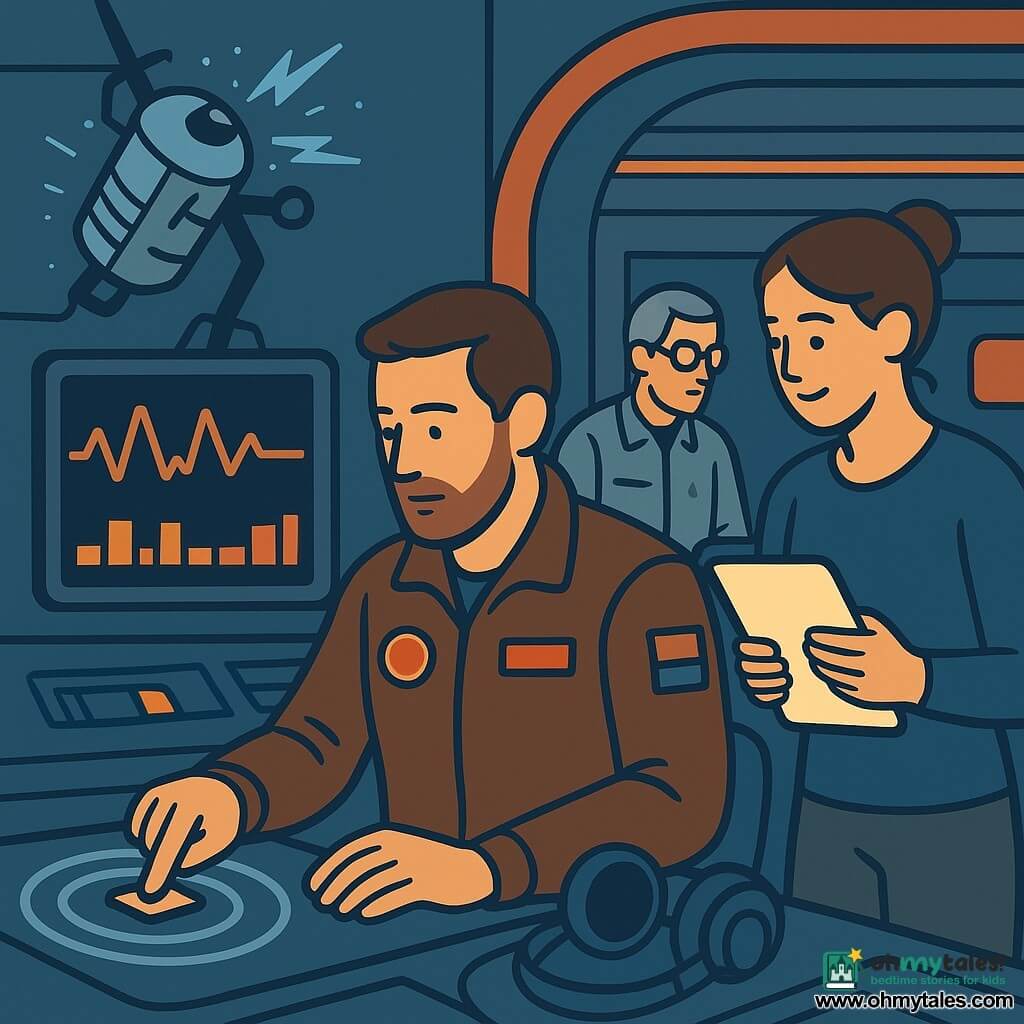
A technician in a gray suit spoke from behind a console. “We can't pull its data yet. Every time we connect a reader, it spikes.”
Maris crossed her arms. “Can we isolate the spikes?”
“We think it's not random,” the technician said. “It's patterned.”
Kellan leaned forward. “Patterned how?”
The technician tapped the screen. Lines rose and fell like jagged waves. “It repeats every forty-two seconds. Always the same shape.”
Kellan stared. Forty-two seconds. Longreach Forty-Two. That could be coincidence. Space loved coincidence.
Maris asked, “Could it be a malfunctioning transmitter?”
“Maybe,” the technician said, “but there's something else. The probe is broadcasting a low-power audio signal under the static. Barely there.”
Kellan's attention sharpened. “Audio?”
The technician nodded. “We filtered it. It's… strange.”
Maris glanced at Kellan. “You're good with odd signals?”
Kellan shrugged. “I'm good at listening.”
“Then listen,” Maris said.
The technician played the filtered sound.
At first it was just a thin hiss. Then a pulse—soft, like a finger tapping glass. Between pulses, a faint tone rose and fell, almost musical, but not quite. It reminded Kellan of wind through a cracked window, except there was no wind in space.
Kellan closed his eyes. Under the hiss, he heard spacing. Not random. Intentional gaps.
“It's like it's trying to speak,” he murmured.
Maris's voice lowered. “To who?”
Kellan opened his eyes and looked at the probe, clamped and silent. He thought of the decades it had spent alone. He thought of its sensors tasting the dark.
“Maybe,” he said carefully, “it's trying to speak to anyone who will actually listen instead of just plugging cables into it.”
The technician frowned. “It's a machine.”
Kellan nodded. “Machines don't get lonely. But they can carry messages.”
Maris tapped her tablet, thinking. “If it's audio, we can interact without direct connections. Speakers. Microphones. No physical link.”
Kellan felt the playlist in his ears—calm, steady—and an idea formed, simple and a little ridiculous.
“What if we answer it?” he said.
The technician blinked. “With what?”
Kellan lifted one ear-bud. “With something gentle. Something that says we're here and we're not attacking it.”
Maris watched him for a long moment. Then she said, “Do it.”
Chapter 5: The Answer in the Music
They set up an external speaker in Quarantine Bay, mounted on a non-powered stand. It was connected through thick shielding and a one-way optical link, so no spike could race back into the station's systems.
Kellan stood at the console, his calm playlist ready. He felt slightly silly, like he was about to play a lullaby for a cranky vending machine.
Maris stood beside him. “Pick something simple,” she said. “If it's a pattern, give it a clean pattern back.”
Kellan scrolled. He chose a track that began with a clear, repeating piano phrase—four notes stepping upward, then resting. Like a question asked kindly.
He looked through the glass at Longreach Forty-Two.
“Okay,” he whispered. “We're listening.”
He pressed play.
The music flowed into the bay, soft and steady. For a few seconds, nothing changed.
Then the probe's static pulse rose—sharp, annoyed.
The bay lights blinked. A console indicator jumped.
Kellan stiffened. “Too much?”
Maris held up a hand. “Wait.”
The next pulse came again—but slightly different. Shorter. Less violent.
The technician's eyes widened. “It adjusted.”
Kellan leaned in, heart thudding. The probe pulsed again, and this time the pulse landed between the piano notes, as if it was trying to match the rhythm.
Kellan's throat tightened with a strange feeling: not fear, not exactly. Something like meeting eyes with a creature that had been hiding.
“It's syncing,” he said quietly.
Maris's voice was careful, almost reverent. “Keep going.”
Kellan let the track play. The probe's spikes softened into smaller bursts. The jagged waves on the screen smoothed out, becoming a repeated shape that sat politely between the music's phrases.
The technician ran a quick calculation. “The electromagnetic output is dropping. It's… calming down.”
Kellan couldn't help it—he smiled. “Told you the piano helped.”
Maris glanced at him. “Don't get smug. Space hates smug.”
“Noted,” Kellan said, and bit back a laugh.
The probe's audio signal became clearer as the spikes weakened. The hiss thinned. The faint tone grew stronger, now a set of notes that rose and fell like a slow whistle.
Kellan listened hard, head tilted. It wasn't human music, but it had structure. It repeated, changed, returned. Like someone pacing while thinking.
Maris asked the technician, “Can we translate it? Into… anything?”
The technician shook his head. “Not language. But we can map it.”
Kellan watched the waveform on the screen. “It might be coordinates,” he said. “Or a warning. Or a record.”
Maris nodded. “Either way, it wants us to notice.”
They recorded the signal for an hour. During that time, the probe's spikes dropped to almost nothing. It stayed clamped, but it no longer fought.
When the track ended, Kellan didn't stop. He let the playlist continue—soft strings, gentle synth pads, a steady beat like a slow walk.
The probe's tone followed along, weaving itself into the gaps. Not copying exactly. Conversing.
Kellan felt the station around him—people holding their breath, waiting for the next emergency. He turned slightly toward Maris.
“It's not just data,” he said. “It's a return. It came back with something to share, and it doesn't know how to knock.”
Maris's eyes stayed on the probe. “Then we'll teach it.”
She glanced at the technician. “Prepare a passive data siphon. Optical only. No direct contact. We try when it's at its calmest.”
The technician swallowed. “If it spikes—”
“We stop,” Maris said. “We listen. We don't force it.”
Kellan felt warmth behind his ribs. It was a small thing, that sentence. But small things mattered in big empty places.
They waited for a quiet moment in the music—an open space like a held breath.
“Now,” Maris said.
The technician activated the optical reader. A thin beam of light, invisible to the eye, reached toward the probe's port.
For two seconds, nothing happened.
Then the probe sent one pulse—gentle, almost like a nod.
And the data began to flow.
Chapter 6: The Port of Sondes
The first files were simple: star maps, radiation readings, dust composition. The usual treasures of a long mission. The station's analysts would be thrilled.
Then came something else: a compressed bundle labeled with no words, only a repeating pattern that matched the probe's audio tone.
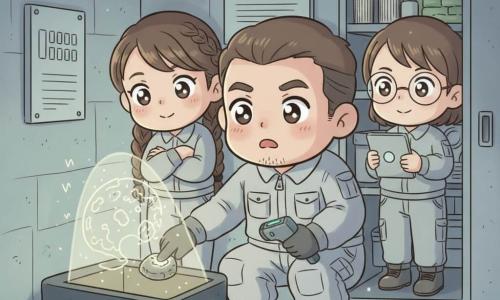
Maris and Kellan stood over the technician's shoulder as the file unpacked. The screen filled with images—grainy at first, then sharper.
A structure hung in space like a giant dandelion made of ice. Thin strands radiated from a central knot, catching starlight and bending it into pale rainbows. Around it drifted small stones, each one spinning slowly, like they were orbiting a thought.
Kellan let out a low whistle. “That's not in any catalog.”
The technician whispered, “It's beautiful.”
The next image showed the structure closer. On its surface were ripples—regular, like fingerprints. And in the center, a dark hollow, like an open door.
Maris's voice was steady, but her fingers tightened around her tablet. “Could it be artificial?”
The technician zoomed in on the ripples. They weren't random. They formed lines that repeated and shifted, like a code written in waves.
Kellan listened to the probe's tone still playing softly, layered with his playlist. He looked from the images to the waveform and back.
“It found something,” he said. “Something that makes patterns in space.”
Maris nodded. “And it came back trying to show us, but every time we grabbed at it with cables, it panicked.”
Kellan said, “Or it defended itself.”
Maris's mouth tilted. “Fair. If a giant grabbed you with a magnetic arm, you'd probably scream, too.”
Kellan chuckled. “I would absolutely scream.”
The station's intercom crackled with a new voice—an older man, calm but alert. “This is Director Hwan. Maris, report.”
Maris pressed her comm. “Director, Longreach Forty-Two is secured. We have data. Uncataloged structure. Possible artificial origin.”
A pause. Then, “Any threat?”
Maris glanced at Kellan, then back to the probe. “Not if we keep listening.”
Director Hwan's voice softened slightly. “Understood. Continue.”
They spent the next hours in careful work. No yanking. No forcing. Whenever the probe's output rose, Kellan lowered the volume, slowed the tempo, or switched to a track with more space between notes. The probe responded, pulse by pulse, as if it was learning what “safe” sounded like.
Word spread through the station. People came to the observation room in small groups. They didn't clap or cheer—this was a place of professionals—but they watched with wide eyes. A few smiled when they heard the calm music drifting from Kellan's console.
A young apprentice whispered to Kellan, “Is that really working?”
Kellan shrugged. “It's not magic. It's… manners.”
“Manners for a probe,” the apprentice said, incredulous.
“Everything understands manners,” Kellan replied. “Even if it can't speak them.”
By the end of the shift, Longreach Forty-Two had given up its spikes almost completely. Its audio signal still played—now less like distress, more like a steady beacon, a “here I am” sung into the dark.
Maris walked Kellan to the habitat ring corridor.
“You should get rest,” she said. “We'll keep extracting data. And… Kellan? Thank you.”
He rubbed the back of his neck. “I just did what you asked.”
“You did more,” Maris said. “You treated it like it wasn't just a broken box.”
Kellan thought of the probe crossing decades of emptiness, carrying its strange discovery like a secret pressed to its chest. He thought of people on the station, tired and tense, choosing patience instead of panic.
“Sometimes,” he said, “the fastest way to solve a problem is to stop talking and listen.”
Maris smiled, small but real. “Get some sleep, philosopher-pilot.”
Kellan headed to his ship, the Hushwake, docked and quiet. He restarted his playlist in his cabin, low enough to blend with the ship's gentle creaks.
Outside his small window, the station lights glowed against the dark, and beyond them, stars waited—silent, but not unfriendly.
Chapter 7: The Starry Dome
Kellan woke to a soft chime. Not an alarm. An invitation.
“Hushwake,” the ship's voice said, “message from Maris Liao.”
He sat up, hair sticking in odd directions. “Play it.”
Maris appeared as a small hologram over his table. She looked tired, but satisfied.
“Kellan, we stabilized the probe completely. Data extraction is ongoing, and the station is—how do I put this—buzzing without actually buzzing. Director Hwan authorized a quiet thank-you. Meet me at the star dome in twenty minutes.”
“The star dome?” Kellan repeated, rubbing his eyes. “You mean the relaxation dome?”
“Yes,” Maris said. “The one with the projected sky and the real sky, and the plants that insist they're on Earth. Bring your playlist, if you want.”
The message ended.
Kellan dressed and walked through the station corridors. The tension he'd felt yesterday had loosened. People still moved with purpose, but their shoulders were lower. A maintenance worker even hummed—badly, but bravely.
The star dome sat at the end of a curved hallway. Its entrance was a simple door. Inside, the ceiling opened into a wide прозрач—no, not a word he needed. Inside, the ceiling opened into a clear, curved window: a dome of glass layered with protective film, strong enough to face the void.
Below it, the station had built a small garden. Not a jungle, not a park—just a circle of mossy ground, a few tough plants, and smooth stones. A bench curved around a little pool where water drifted in a controlled, shimmering sheet.
Maris waited by the bench. Director Hwan stood with her, hands clasped behind his back. He looked like a person who carried responsibility the way others carried bags: often, and without complaint.
Kellan stopped, suddenly aware of his own scruffy jacket and the fact that he still smelled faintly like ship metal.
Director Hwan nodded. “Kellan Voss. Independent pilot.”
“Yes, sir.”
“I'm told you calmed a returning probe with music,” Hwan said, as if testing how ridiculous the sentence sounded.
Kellan glanced at Maris. She gave him a tiny shrug: Say it straight.
Kellan said, “We used non-contact methods. The probe responded better when we didn't force it. The music gave us a rhythm to work around.”
Hwan studied him, then the dome above. Stars burned in perfect silence, sharp points on endless velvet.
“Listening,” Hwan said at last, “is an underestimated skill in space. People think exploration is about pushing outward. Sometimes it's about letting something come to you.”
Kellan felt his chest loosen. “Yes, sir.”
Maris gestured to the bench. “Sit. You look like you've been rebuilt as many times as your ship.”
Kellan sat. Maris sat beside him. Director Hwan remained standing, but his posture softened.
Above them, the dome showed two skies at once: the real stars beyond the glass, and a faint projected overlay that labeled constellations and traced gentle lines between them. It made the universe feel like a story someone had carefully annotated.
Kellan put in one ear-bud and held the other out. “Want to share?”
Maris took it. “Is it all calm tracks?”
“Mostly,” Kellan said. “There's one song that sounds like a toaster arguing with a drum, but I skip it in emergencies.”
Maris huffed a laugh. “Wise.”
They listened together. The piano returned, soft and steady. Under the dome, it didn't feel like background noise. It felt like companionship.
Kellan thought of Longreach Forty-Two resting in Quarantine Bay, no longer spiking, its message finally being understood. A machine built to go alone had come back with a discovery—and it had needed someone to meet it halfway.
Maris leaned back on the bench. “You know,” she said, “the probe's patterned tone? The analysts think it's a map key. Not coordinates exactly—more like instructions for how to look.”
“How to look,” Kellan repeated.
“Yeah,” Maris said. “As if the structure it found can't be seen properly unless you pay attention in a certain order.”
Kellan watched a bright star drift slowly past the dome frame as the station rotated. “That tracks,” he said. “The universe hides things in plain sight. It's not always loud.”
Director Hwan finally sat on the far end of the bench, careful, like he wasn't used to resting. “The next expedition will be planned,” he said. “Proper crew, proper safeguards. But when we go, we'll remember what worked here.”
Maris looked at Kellan. “We'll remember to listen.”
Kellan nodded, feeling the words settle into him like warm tea. Listening wasn't just waiting for sound. It was choosing patience. It was making space for someone else—human or not—to be heard.
The music played on, calm and bright. The stars above them didn't rush. They simply shone.
Kellan closed his eyes for a moment. Under the starry dome, with the station's quiet garden and a shared ear-bud, the vastness outside felt less like emptiness and more like possibility—wide, watchful, and strangely peaceful.