Chapter 1: The Map That Breathes
In the year 2198, space was no longer a black mystery people stared at from rooftops. It was a place with schedules.
Ships slid between Earth and Moon the way ferries once crossed rivers. Orbital elevators hummed like giant harp strings. Cargo drones stitched bright lines through the sky, each one broadcasting its ID in polite, blinking code. On Earth, cities wore roofs of smart glass that dimmed for storms and cleared for stargazing. On the Moon, the old dream had become a neighborhood: Luna District Twelve—an orderly cluster of domes, tunnels, gardens, and windowed lounges built into the safe curves of a crater rim.
The lunar buildings were not shiny movie castles. They were practical, thick-skinned habitats designed to hold warmth and air like a careful hand holds water. Pipes ran in neat bundles. Airlocks opened with soft chimes. Outside, the dust was as fine as flour and as stubborn as a rumor; inside, every hallway had a brush station and a sign that read: CLEAN SUITS, CLEAN LUNGS, CLEAN MINDS.
Nolan Reyes liked signs like that.
He was a space archaeologist, which meant he hunted the past in places most people only visited for business or vacation. He studied abandoned outposts, lost probes, old landing sites—anything that left a story behind. His tools were simple and reliable: a scanner wand, sample pods, a fold-out microscope, and a notebook made of actual paper, sealed in plastic. He said writing by hand helped his brain slow down and notice details.
This morning, he stood in the observation lounge of the transit ship Larkspur, watching the Moon grow larger. It looked close enough to touch, but he knew better. Distance in space loved to trick you.
A message blinked on his wrist screen.
WELCOME TO LUNA DISTRICT TWELVE.
ASSIGNMENT: RESIDENTIAL SECTOR “MORNING CRESCENT”.
REQUESTED: ARCHAEOLOGICAL ASSESSMENT.
PRIORITY: QUIET.
“Quiet,” Nolan murmured. “Those are always the loud ones.”
Beside him, a service bot rolled past with a tray of water bulbs. Its voice was cheerful in a measured way. “Hydration reminder: in reduced humidity environments, sip every twenty minutes.”
Nolan took a bulb. “Thanks.”
He didn't gulp. He sipped—method first, always. He checked his equipment list. He reviewed the transit plan. He re-read the original report: a resident had found “a strange panel” behind a maintenance wall. The panel had a symbol that didn't match the district's standard markings.
Not a big deal, some might say. Luna District Twelve was built fast. Mistakes happened.
But symbols were like footprints. Someone had been there, and Nolan wanted to know who, and why.
As Larkspur angled into lunar orbit, the ship's captain spoke over the cabin speaker. “Approach will be smooth. Remember to equalize pressure in the vestibule. Welcome to the Moon, folks.”
Nolan watched the cratered surface slide beneath them, gray and patient. Somewhere down there, a normal residential street—Morning Crescent—held a secret that had waited quietly for years.
He smiled to himself. “All right,” he said. “Let's be polite. Let's be careful. Let's listen.”
Chapter 2: Morning Crescent, Under Glass
Morning Crescent was built in a shallow arc, like a smile pressed into the lunar dust. Domes the color of pearl sat connected by short tunnel-bridges. Inside the main dome, there was a small park: real soil in contained beds, a fountain that recycled water in a slow loop, and a mural of Earth painted across one wall—blue oceans, green swirls, clouds like whipped cream.
Children drifted through the park in low-gravity hops, pretending they were astronauts even though everyone here basically was. Adults moved with practiced ease, carrying grocery packs or tool kits. A delivery drone floated overhead, whispering directions to itself.
Nolan met the district supervisor in the administration hub, a room that smelled faintly of citrus cleaner.
Supervisor Keiko Tan was compact, sharp-eyed, and tired in a way that looked earned. She shook Nolan's hand firmly.
“Mr. Reyes,” she said, “thank you for coming quickly.”
“Please,” Nolan replied. “Nolan. And I'm glad you called. What did you find?”
Keiko tapped her tablet, and a hologram popped up: a narrow maintenance corridor, its wall panel pulled back to reveal a second panel underneath—older, darker, with a symbol like an eye made of three curved lines.
“It was behind a recent plumbing upgrade,” Keiko said. “The workers thought it was a joke. Then the panel… reacted.”
“Reacted how?”
“It warmed up. And it made a sound.” Keiko's mouth tightened. “A low hum. Not loud, but the kind that crawls into your teeth.”
Nolan nodded slowly. “Any radiation spikes? Air quality issues?”
“None. The sensors stayed normal. That's what worries me.”
Keiko led him through the residential tunnels. The tunnels were wide enough for two people to pass comfortably and lined with handrails. Every ten meters there was an emergency station: oxygen masks, sealant foam, a flashlight. The Moon did not forgive laziness, so Luna District Twelve didn't encourage it.
They stopped outside Unit 12-MC-44. A small nameplate read: AMINA VOSS.
Keiko knocked. The door slid open, and a woman in a knitted sweater—yes, knitted, on the Moon—peered out with suspicious curiosity.
“You're the archaeologist?” she asked.
Nolan kept his voice gentle. “That's me. Nolan Reyes. Thank you for reporting what you found.”
Amina stepped aside. “It's in the service closet. And it's… doing it again.”
The closet was cramped, packed with spare filters and cleaning cloths. A maintenance hatch sat at knee height. The newer panel had been removed and leaned against the wall.
Underneath, the older panel waited.
As Nolan crouched, the hum started—soft, steady, like a distant engine idling. The symbol on the panel shimmered, not with light exactly, but with a change in how it reflected the closet lamp.
Nolan lifted his scanner wand. He didn't touch the panel yet. First: observe. Second: measure. Third: decide.
The wand chirped. “Materials: composite unknown. Temperature: slightly above ambient. Energy field: localized, stable.”
Amina hugged herself. “So… am I going to explode?”
Nolan looked up at her, and made sure his smile was real. “No. If anything changes, we'll be the first to know. And you did the right thing by reporting it.”
Keiko crossed her arms. “Can you open it?”
“I can try,” Nolan said. “But not by guessing.”
He took out a small kit and placed it on the floor: thin probes, adhesive sensors, a mirror strip. He stuck the sensors around the panel, watching their readouts on his wrist screen.
Then he did something that surprised even him. He paused, closed his eyes, and breathed deeply—slow in, slow out. The hum seemed to match his breath for a moment, as if the panel was listening.
Method, he reminded himself. Calm is part of method.
He opened his eyes. “All right,” he said. “Let's ask it nicely.”
Chapter 3: The Door in the Wall
Nolan traced the symbol without touching it, moving his finger in the air a few centimeters above. The hum shifted, rising slightly. Not louder—sharper.
Keiko leaned closer. “You're… waving at it?”
“I'm mapping its response,” Nolan said. “If it reacts to proximity, it may have a touchless interface.”
Amina muttered, “Great. My closet has manners.”
Nolan couldn't help a small laugh. “Most old tech does, if you know the rules.”
He took the mirror strip and angled it along the panel's edge, searching for seams. There was one—so fine it looked like a shadow. He placed a soft probe against the seam, applied the smallest pressure, and waited.
Nothing.
He tried again, but this time he changed one thing: he matched his hand movement to the rhythm of the hum—steady, patient. The seam brightened, like frost melting in sunlight.
A thin line opened.
Air did not rush out; the closet pressure stayed stable. That was a good sign. If there was a chamber behind, it was sealed properly.
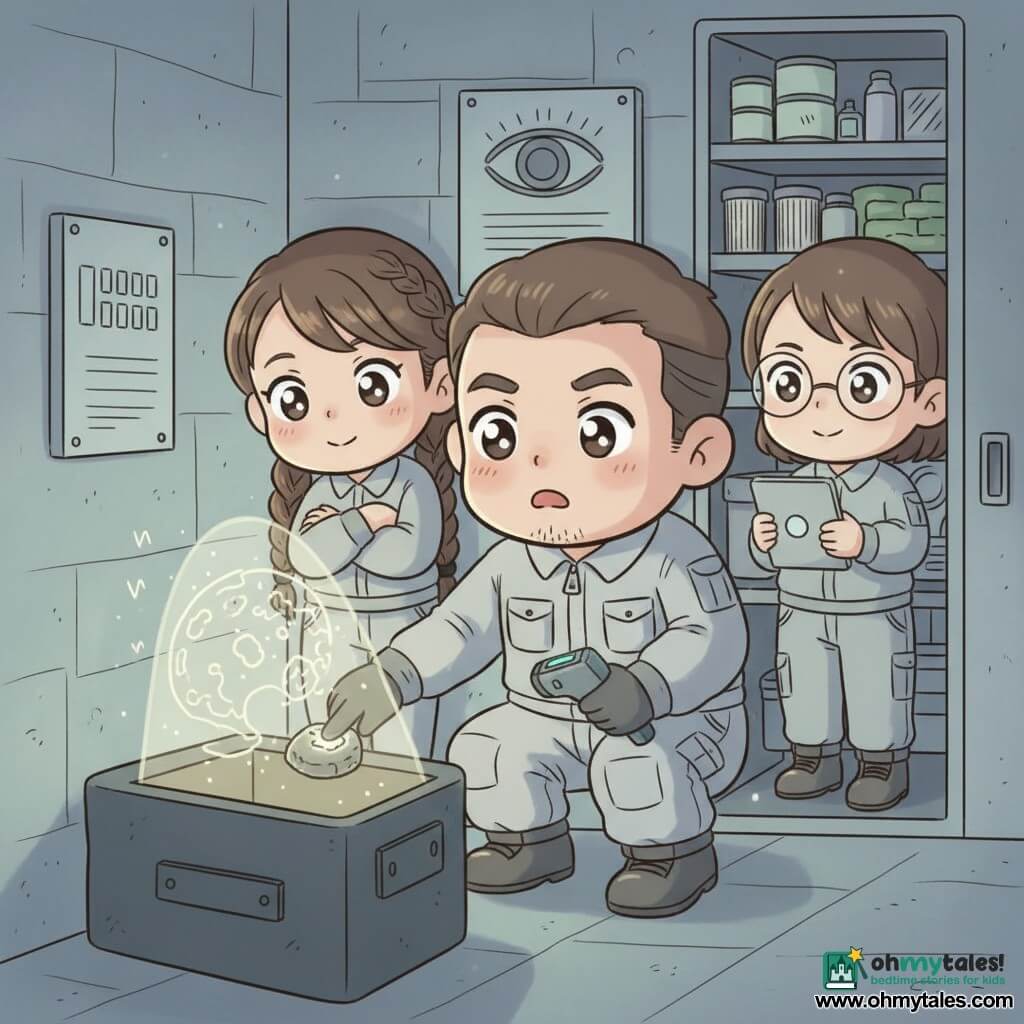
The panel slid aside with the quiet grace of a well-oiled drawer, revealing a shallow recess and a palm-sized plate inside, made of the same dark composite. In the center was a tiny indentation shaped like a thumb.
Amina took a step back. “Nope.”
Keiko's voice was tight. “Biometric?”
“Possibly,” Nolan said. “Or a key shaped like a thumb.” He looked at Amina. “To be clear, I'm not asking you to touch it.”
“Thank you,” Amina said, relieved.
Nolan scanned the plate. The wand chirped again. “Energy field: increased. Signal: attempting handshake.”
“A handshake,” Nolan repeated. He set the scanner down. “Okay. If it wants a handshake, we don't slap it with a crowbar.”
He pulled on a thin glove—conductive, insulated, and designed for delicate artifacts. Then he placed his thumb gently over the indentation.
The hum stopped.
For one heartbeat, the closet felt huge, as if the walls had stepped back to give something room.
Then a voice spoke—not from a speaker, but straight into the air, formed from careful vibrations.
“IDENTIFY,” the voice said. It sounded neither male nor female, neither young nor old. It sounded like someone reading a checklist.
Nolan swallowed. He kept his thumb in place, because pulling away suddenly could be a mistake. “Nolan Reyes,” he said clearly. “Space Archaeology Division, Earth-Luna Cultural Survey.”
“PURPOSE.”
“To understand what you are,” Nolan said. “And to make sure you're safe for the residents here.”
There was a pause. In that pause, Nolan noticed something: the panel wasn't just a door. It was part of a larger structure embedded in the wall, older than the district's construction. How could that be?
“SAFETY PROTOCOLS: ACTIVE,” the voice said. “ACCESS: LIMITED.”
A small projection formed above the plate: a map of the Moon, dotted with sites Nolan recognized—old landing zones, mining pits, research stations. One dot pulsed right under Morning Crescent.
The map zoomed in. A line appeared, leading from Amina's closet to a point deeper in the crater rim.
Keiko's eyes widened. “There's something under us.”
Amina whispered, “I knew it. My rent is too low.”
Nolan almost smiled, but his mind was already organizing steps. “How deep?” he asked.
The projection shifted, showing a cross-section: tunnels, conduits, a sealed chamber. Next to it, a symbol flashed—the same eye-like mark.
The voice returned. “REQUEST: MAINTENANCE.”
“Maintenance?” Nolan echoed.
“SYSTEM DORMANT. RESIDENTIAL LOAD: INTERFERING. REQUIRE CALIBRATION.”
Keiko rubbed her forehead. “In plain words?”
Nolan exhaled slowly. “Something under this neighborhood is waking up. It thinks the district is… noise. And it wants to adjust.”
Amina's face went pale. “Adjust as in—move the neighborhood?”
Nolan lifted his gloved hand away. The hum resumed, softer now, like a throat clearing. “We don't know,” he said. “But we can find out, carefully.”
Keiko straightened. “We have families here.”
“I know,” Nolan said. “That's why we do this by the book.”
He looked at the projected line leading into the crater rim. “It wants maintenance,” he said. “Which means it has a place to do it.”
Keiko met his eyes. “You're going down there.”
Nolan nodded once. “Yes. And I want a local guide who knows the tunnels.”
Amina raised a hand. “I know the tunnels. I volunteer—if it means my closet stops talking.”
Keiko opened her mouth to object, then closed it. “Fine,” she said. “But you follow Nolan's instructions exactly.”
Nolan gathered his tools. “Rule one,” he said, trying to keep his tone light but firm, “no improvising heroics.”
Amina saluted. “I will be the least heroic person you've ever met.”
“Perfect,” Nolan said. “Let's go meet what's under your floor.”
Chapter 4: The Quiet Machine
They entered the maintenance network through a hatch behind the administration hub. The air smelled more metallic here, and the lights were simple strips instead of cozy panels. Nolan liked it. Simpler systems were easier to read.
Keiko stayed above to coordinate, her voice in Nolan's earpiece. “You have a clear line to emergency services. Two minutes response time.”
“Understood,” Nolan said.
Amina walked beside him, wearing a utility vest that looked too big. “I feel like a kid sneaking into a grown-up meeting.”
“You're a grown-up,” Nolan said.
“Don't tell my posture.”
They followed the projected route. Every junction was labeled. Every pipe had a color code. Nolan paused at each turn to compare the real tunnel to the map, marking small notes in his paper notebook. Amina watched him.
“You really write it down?” she asked.
“It forces me to be honest,” Nolan said. “If I can't explain it on paper, I don't understand it yet.”
After fifteen minutes, they reached a section that wasn't on the district plans. The walls changed—older plating, darker, smoother. The hum grew stronger, like a bass note in the bones.
Amina swallowed. “This is not normal.”
“No,” Nolan agreed. He raised his scanner. “But it's stable. That matters.”
At the end of the tunnel was a circular door with the same eye-like symbol. There was no handle. There was, however, a small panel with a simple set of instructions projected in clean, readable text:
STEP 1: STAND STILL.
STEP 2: BREATHE.
STEP 3: STATE INTENT.
Amina blinked. “It has… directions.”
Nolan felt a strange, careful respect. “Good,” he said. “It wants cooperation, not force.”
They stood in front of the door. Nolan spoke softly. “Amina, you don't have to go in.”
“I'm already here,” she said, trying for bravery. “Also, if this thing is under my apartment, I want to know what it is.”
Nolan nodded. “All right. Follow the steps.”
They stood still. The hum steadied, as if waiting.
Nolan breathed in deeply, filling his lungs slowly, and breathed out just as slowly. He heard Amina imitate him, a little shaky at first, then calmer.
Then Nolan spoke. “My intent is to calibrate your system without harming the residents of Luna District Twelve.”
A moment later, Amina added, “And my intent is to keep my closet for towels, not secrets.”
The door opened.
Inside was a chamber carved into the rock, lined with ribs of metal that looked grown rather than built. In the center floated a cylinder the size of a small car, suspended by a gentle field. It was matte black, dotted with tiny lights like distant stars.
Around it were tools—some familiar, like robotic arms and diagnostic pads, and some unfamiliar, like thin rings that hovered above the floor, turning slowly as if thinking.
Nolan whispered, “This isn't district tech.”
Keiko's voice crackled in his ear. “Nolan, what are you seeing?”
“A pre-district system,” Nolan said. “Possibly pre-colony.”
Amina pointed at the cylinder. “Is that… a machine?”
“It's a machine,” Nolan said, “and maybe a library.”
As if responding, the cylinder brightened. A clear projection formed in the air: not just a map now, but an image of the crater rim before the district—just rock and dust—and then a small lander settling quietly, long ago.
A tiny figure stepped out—human-shaped, but the image was too simple to tell details. The figure placed the cylinder into the chamber and sealed it. The projection paused, highlighting one line of text:
LUNAR RESIDENTIAL COMPATIBILITY UNIT.
PURPOSE: QUIET HABITATS FOR FUTURE LIFE.
Amina frowned. “It was meant for neighborhoods.”
Nolan's pulse steadied. This wasn't a weapon. It was… infrastructure. Old, careful infrastructure.
But then another line flashed:
STATUS: MISALIGNED.
RISK: ATMOSPHERIC MODULATION ERROR.
Keiko's voice sharpened. “Translate that.”
Nolan kept his eyes on the readout. “If it calibrates wrong, it could change air handling in the sector.”
Amina's eyes went wide. “Change as in… no air?”
“Or too much pressure,” Nolan said. “Or the wrong mix.” He held up a hand. “But it hasn't happened yet. It's asking for maintenance before it acts.”
The cylinder projected a simple diagram: three nodes that needed recalibration—each located in different parts of Morning Crescent.
Keiko spoke fast. “We can evacuate if we must.”
Nolan shook his head, though she couldn't see it. “Evacuation adds chaos. This system wants quiet. We should fix it cleanly.”
Amina managed a weak joke. “So, no screaming.”
“Preferably,” Nolan said.
He stepped closer to the diagnostic pad. The interface displayed options in basic symbols, with short words. Nolan felt a rush of gratitude toward whoever designed it. They had built it to be understood.
Nolan set his notebook on a ledge and made a checklist.
“Step one,” he said, “confirm each node's condition. Step two, recalibrate in the order the system recommends. Step three, verify air stability with district sensors.”
Amina nodded. “Method.”
“Method,” Nolan agreed. “Because guessing is how people get hurt.”
Chapter 5: Three Nodes and a Missing Piece
The first node was near the park dome, behind a wall that held irrigation lines for the garden beds. Nolan and Amina arrived with a district technician, Jae, who had been sent down by Keiko.
Jae was tall and cheerful, with a tool belt that clinked. “So,” Jae said, eyeing the old panel Nolan had flagged, “we've got a secret moon machine under our feet. Normal Tuesday.”
Nolan handed him adhesive sensors. “Normal Tuesday with careful steps.”
They opened the panel. Inside was a compact unit with a ring of lights. One light blinked amber.
Nolan consulted the cylinder's instructions, displayed on his wrist. “Amber means drift,” he said. “We realign.”
“How?” Amina asked.
“By matching its baseline,” Nolan said. “Like tuning a string.”
He connected a calibration lead and watched the readings. The ring of lights shifted from amber to green.
Jae whistled. “That was… surprisingly gentle.”
“That's the point,” Nolan said. “Good systems don't demand bravery. They reward attention.”
The second node was in a tunnel ceiling above a row of apartments. They used a lift platform. Amina held the tool pouch steady while Nolan worked.
Halfway through, the lights flickered, and the hum in the tunnel deepened.
Keiko's voice came through. “I'm seeing minor pressure fluctuations. Nolan?”
Nolan kept his hands steady. “We're okay. Node two is resisting calibration.”
Amina looked up, nervous. “Resisting?”
Nolan checked the readout. “It's missing a reference signal. Like trying to tune a guitar with one ear covered.”
Jae frowned. “Could something be broken?”
“Or something's in the way,” Nolan said. He scanned around the node and found a thin strip of modern insulation pressed too close to the unit. It had been installed during recent upgrades—well-meaning, but wrong for this old system.
Nolan pointed. “That.”
Jae grimaced. “Our fault.”
“No blame,” Nolan said. “Just fix.” He carefully peeled the insulation back, leaving safe clearance. The node's lights steadied, then turned green.
Keiko exhaled audibly over the comm. “Pressure is stabilizing.”
Amina let out a breath she'd been holding. “Okay. Two down.”
The third node was the hardest. It lay beneath a communal lounge where residents watched Earthrise and drank cocoa from floating cups. The access hatch was under the floor, sealed with district security.
Keiko met them there in person, her face serious. “If we open this, we'll need to shut down the lounge for an hour.”
A resident nearby overheard and called, “An hour? That's when we do trivia night!”
Amina raised her voice. “We're preventing the air from doing something weird. Trivia will survive.”
The resident blinked. “Oh. Okay. Please don't let the air do weird things.”
Nolan crouched by the hatch. “We'll be as fast as careful allows.”
They opened it. The third node glowed red.
Jae sucked in air. “That's not drift.”
Nolan's scanner chirped. “Reference missing.”
Amina's voice shook. “What does that mean?”
Nolan stared at the readout and felt the shape of the problem click into place. “The system needs a central reference to calibrate against,” he said slowly. “A ‘quiet anchor.' Without it, node three can't settle.”
Keiko's jaw tightened. “Where is it?”
Nolan thought of the chamber, the cylinder, and the map. He pulled up the original projection. A small icon blinked near Amina's unit.
“In your closet,” he said.
Amina stared. “My closet is the anchor?”
“Not the closet,” Nolan said. “Something in it. Or behind it.”
They hurried back, moving with quick, controlled steps. Nolan didn't run. Running made mistakes.
In Amina's unit, the humming panel in the closet now pulsed faster, like a worried heartbeat.
Nolan breathed once, deeply, to steady himself. “Okay,” he said. “We need the anchor.”
He opened the panel again. Behind the thumb plate, a second recess slid open—one he hadn't seen before. Inside was a small object, smooth and gray, shaped like a pebble but warm to the touch.
Amina leaned in. “That's been in my wall this whole time?”
“Yes,” Nolan said. “And it's been waiting.”
The object projected a tiny circle of light, then pointed—like an arrow—toward the third node's location.
Keiko's eyes narrowed. “It wants to be moved.”
Nolan nodded. “Carefully. In a sealed case.”
Jae held out a padded container. Nolan placed the object inside. The hum in the closet softened immediately, like a sigh.
Amina whispered, “It feels… relieved.”
Nolan glanced at her. “Sometimes old systems are like people,” he said. “They do better when they're heard.”
Chapter 6: The Promise Under the Dome
Back at the communal lounge, Keiko cleared the area with calm efficiency. Residents watched from behind a transparent barrier, curious but not panicked. Nolan appreciated that. Calm was contagious.
They opened the hatch again. The red-lit node blinked, waiting.
Nolan placed the sealed container near the node. The gray “pebble” inside warmed, and the node's light shifted—red to amber to green, like a traffic signal choosing peace.
Keiko checked her tablet. “Pressure is stable. Oxygen mix is stable. Humidity stable.”
Jae let out a low laugh. “We just fixed the neighborhood's secret lungs.”
Amina rubbed her arms. “So it won't… adjust us into space dust?”
“No,” Nolan said. “It's aligned now.”
Over the comm, the chamber's voice returned, gentle and procedural. “CALIBRATION COMPLETE. RESIDENTIAL LOAD: ACCEPTABLE. GRATITUDE.”
Amina blinked. “It said gratitude.”
Keiko's stern expression softened by a millimeter. “You're welcome,” she said, then caught herself and cleared her throat, as if embarrassed to be polite to a machine.
Nolan knelt by the hatch, speaking toward the old system through the node. “You were built to support life,” he said. “We're living here now. We'll take care of you.”
A pause.
Then: “REQUEST: CONTINUED MAINTENANCE. INTERFERENCE PREVENTION.”
Nolan turned to Keiko. “It needs ongoing checks,” he said. “And we need to update district plans so no one installs insulation in the wrong place again.”
Keiko nodded sharply. “I'll file it. And we'll schedule monthly inspections.”
Amina looked from Nolan to Keiko. “So… what happens to the anchor pebble?”
“It belongs to the system,” Nolan said. “But we can house it somewhere appropriate—near the third node, in a secured, accessible compartment. Not in your towel closet.”
Amina's shoulders dropped with relief. “Thank you.”
Later, in the park dome, the fountain made its soft loop. Children hopped past, arguing about whether a kangaroo could live on the Moon if it had a helmet. The mural of Earth glowed under warm lights.
Nolan stood with Keiko and Amina near a bed of lunar-grown basil. He liked basil. It smelled like kitchens and ordinary days.
Keiko watched the residents. “You handled that well,” she said. “No drama.”
“Drama is expensive,” Nolan replied.
Amina gave him a sideways look. “You were scared though.”
Nolan didn't pretend otherwise. “Yes,” he said. “But being scared doesn't mean you stop thinking. It means you slow down and follow steps.”
Amina nodded, as if filing that away for later. “Method.”
“Method,” Nolan said.
Keiko folded her arms, but her voice was warmer now. “What is that system, really? Who put it there?”
Nolan looked up at the dome's curved ceiling, beyond which lay the crater rim and the silent stars. “I don't know yet,” he admitted. “But it was designed for people who weren't even here at the time. Someone planned ahead.”
Amina smiled faintly. “Like leaving a lamp on for a visitor.”
“Yes,” Nolan said. “A lamp. A quiet one.”
He tapped his notebook. “I'll submit a full report. And I'll request a deeper survey of the chamber—noninvasive, careful. If there are more units like this, they could help future settlements.”
Keiko extended her hand again. “Will you come back if we need you?”
Nolan shook her hand. Then he looked at Amina, who had been brave in a very unshowy way—by breathing, listening, and doing what needed doing.
“I promise,” Nolan said, “if this system asks for help again, or if anything else under Luna District Twelve wakes up, I'll be here. And I'll bring the right people, the right tools, and enough time to do it properly.”
Amina exhaled, long and steady, like releasing the last of the worry. “Good,” she said. “Because I'm hosting trivia next week.”
Nolan allowed himself a small, human smile. “Then we'd better keep the air behaving,” he said. “I'd hate to lose to a closet.”