Chapter 1 – Arrival at Halcyon Spoke
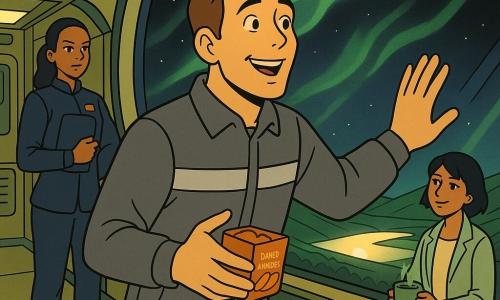
Dr. Mira Alvar stepped off the shuttle and into the bright, humming air of Halcyon Spoke Station.
The spaceport was a huge rotating ring around a pale-blue planet, and it felt like walking into a living machine. Screens shimmered on every wall, showing arriving ships, weather on distant moons, and cheerful ads for zero‑gravity ice cream. The floor under her boots rumbled with the gentle throb of reactors and docking clamps.
Mira adjusted the strap of her slim field pack and took a slow breath, letting her eyes sweep across the crowd. She liked to take things in, piece by piece, like a scientist working through a neat row of samples.
Families in station-gray jumpsuits hurried past with floating suitcases. A group of miners in dusty orange laughed loudly, their helmets clipped to their belts. A tall woman with iridescent implants along her jaw argued with a vending drone about the price of algae chips.
Beyond them all, a long, curving window showed the planet below: Tarrin-3, streaked with white clouds and swirling, storm-softened oceans. That was where Mira was headed, eventually. A world thick with life, still mostly untouched. Her kind of place.
“Dock E-Seven this way,” she murmured to herself, checking the glowing line on her wrist display. “And don't get distracted by space ice cream.”
Her stomach grumbled in disagreement.
She walked along the main concourse, where the air smelled faintly of metal, spices, and recycled citrus. The ceiling overhead arched high, lined with solar threads that drank light from the station's outer hull and glowed a soft, steady blue.
Mira smiled. Clean systems, efficient power. Someone here cared about not wasting resources.
A small, cube-shaped robot zipped up beside her on tiny magnetic wheels.
“Passenger identified: Dr. Mira Alvar,” it chirped. “Welcome to Halcyon Spoke! I am KIP-12, your kinetic information pod. May I optimize your route?”
Mira glanced down. “Hi… KIP, is it? That depends—do you waste energy chasing people who don't need help?”
Its single lens blinked. “Negative! I operate on surplus station power that would otherwise be lost as ambient heat. Route assistance increases overall crowd efficiency by 3.7 percent.”
“That,” Mira said, amused, “is a good answer. Sure, KIP. Optimize away.”
A slim line of light projected from KIP onto the floor, pointing forward.
“Dock E-Seven is 1,340 meters ahead, bearing twelve degrees clockwise. Estimated travel time at your current speed: sixteen minutes, forty-two seconds. Would you like a micro-tour of notable station features en route?”
“Only if it doesn't slow us down,” Mira said. Then, more softly, “And only if it doesn't waste your surplus power. I'm here to study how living systems balance what they take and what they give back. I'd rather not start by messing up the math.”
KIP hummed thoughtfully. “Tour will be audio-only and will not increase transit time or energy use. I can also adjust volume to maintain your preferred cognitive load.”
Mira chuckled. “All right then. Low volume. Surprise me.”
As they moved along the curving corridor, KIP pointed out water recycling towers, micro-farms built into the walls, and energy displays that showed how the station shifted power between sectors depending on time of day.
Mira listened, half of her mind already on Tarrin-3. She'd waited years for this posting. An entire ocean world, mostly unexplored, with complex microbial reefs and strange floating forests in the upper atmosphere. She'd prepared careful protocols, lean and efficient, to minimize waste and disturbance.
It felt good to be heading toward a place that needed someone like her.
Then a voice broke through the station noise.
“Dr. Alvar! Mira!”
Mira turned.
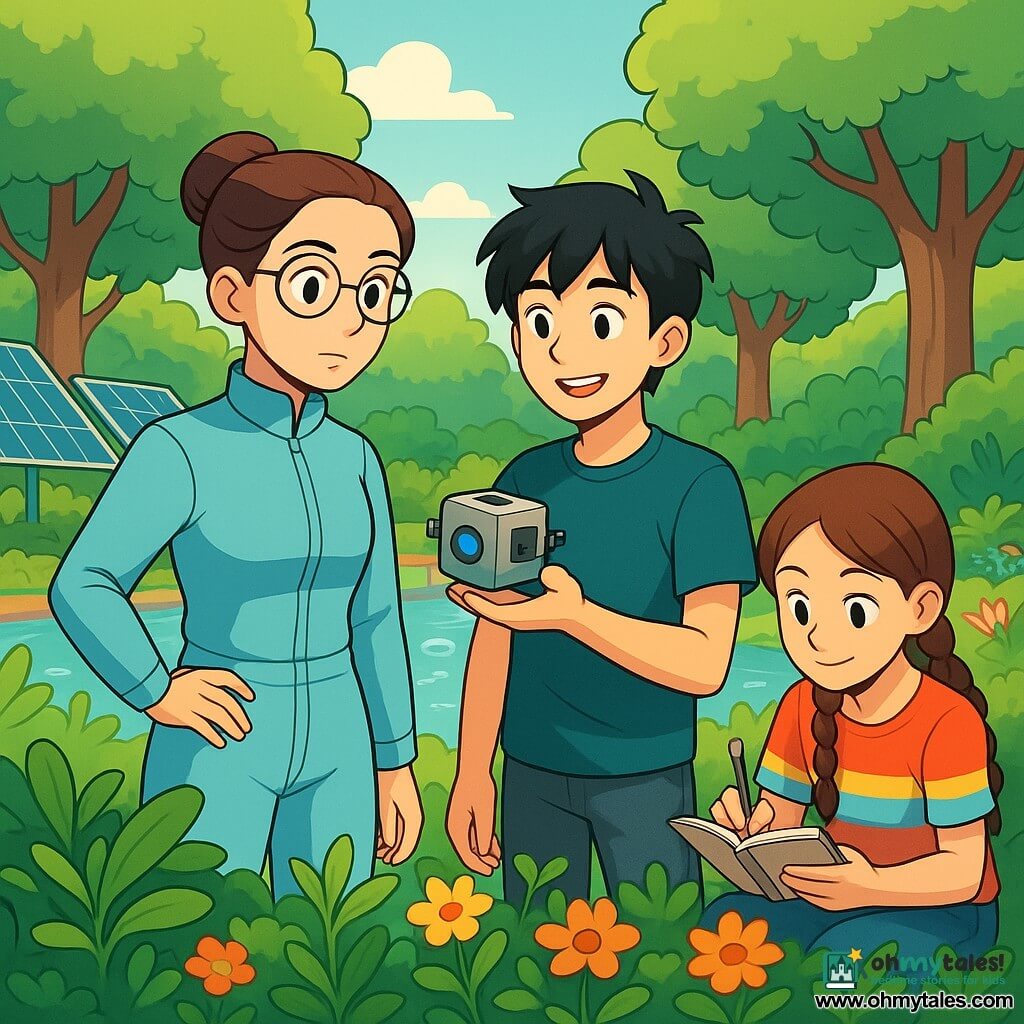
A tall boy—no, not a boy, she corrected herself, probably about sixteen—was waving one arm wildly while clutching a crate with the other. A small girl with braided hair trotted beside him, trying not to laugh as she got bumped by passing travelers.
“Over here!” the girl added, cupping her hands around her mouth.
Mira blinked. “Do I know…?”
KIP helpfully displayed names above their heads, tiny holograms only visible to her.
JAX ARDEN – CIVILIAN TECH APPRENTICE
LEENA ARDEN – CIVILIAN ECO-MAINTENANCE
Mira's eyes widened. “Arden… you're Felix's kids.”
Jax grinned as they caught up. “And you're Doctor ‘Don't Touch That Sample Without Gloves' from Dad's stories.”
Leena snorted. “He also said you made the best plankton cookies in the Belt.”
Mira's mouth twitched. “Your father exaggerated. About the cookies, I mean. About the gloves, he was absolutely right.”
Felix Arden had been her mentor on her first big mission, years ago. He'd died in an accident on Europa Station, but his messages about his children had kept arriving for a while, scheduled in advance. She'd watched them grow up in bursts of video: birthdays, science fair projects, one chaotic pet ferret.
“I didn't know you two were on Halcyon,” Mira said.
“Seasonal posting,” Jax replied. “I'm apprenticing in drone maintenance. Leena's on eco-team rota, cleaning up the community park and hydro levels.”
“Dad said if you ever came through here, we had to say hi,” Leena added. Her voice softened. “And to check you were sleeping and eating and not just staring at petri dishes all day.”
Mira's throat tightened for a moment. She swallowed it down with a small smile.
“Well, I just arrived, so my petri dish time is still at zero today. But it's nice to see you two in… non-video form.”
KIP swiveled. “Social connection detected. Do you wish to adjust route to include eco-park sector C for 4.2 minutes? Impact on arrival time: minimal.”
Mira hesitated. “I'm supposed to report to Dock E-Seven.”
Leena bounced a little on her toes. “We can walk you most of the way. The park is along your route. And… um… it's actually why we came to find you.”
Mira tilted her head. “Oh?”
Jax shifted the crate in his arms. The label read: HYDROBIO DRONE PARTS – FRAGILE.
“Station Central's having a little problem,” he said. “They didn't want your mission interfered with, but… well… we thought you might want to see.”
“See what?”
Leena met her eyes seriously. “The park's dying. And we don't know why.”
Chapter 2 – The Failing Park
The community park in sector C lay at the heart of the civilian ring, right where artificial gravity was closest to normal and the noise of the docking bays faded into a distant thrum.
Mira had passed small station parks before—places with a few stubborn shrubs, some recycled benches, and an awkward fountain that sprayed sanitized water in tired arcs. This was something else.
She stepped through the wide archway and stopped.
“Wow,” she whispered.
The park was a long, curving corridor of green, following the inside edge of the ring. Artificial sunlight streamed down from panels overhead, warm and golden. Tall trees—not holograms, real trees—rose three floors high, their leaves whispering softly in the air system's gentle breeze. Paths wound between flowering bushes. There was even a pond, its surface rippling as air currents passed over it.
Children chased a floating ball near one end. A group of elders played a slow, thoughtful game with hexagonal tiles under a broad-leaved tree. Someone laughed from a picnic blanket scattered with food packets and cups.
It smelled like damp soil, faint flowers, and something deeper that reminded Mira of rainy days on distant colonies. It smelled like a planet pretending to exist inside a metal ring.
“This is impressive,” she said. “Your eco-team runs all this, Leena?”
Leena's cheeks went slightly pink with pride. “There are ten of us and some full-time supervisors. Plus the bots. But I do a lot of the sensor checks. Or I did, before…”
Her voice trailed off.
Mira's eyes narrowed. Now that she was looking closely, she saw it. Brown edges on some leaves. One of the flower beds near the wall was half bare, tiny stalks shriveled and gray. A faint film of something opaque floated on part of the pond's surface, making the reflections cloudy.
“How long has it been like this?” Mira asked.
Jax set his crate down and flexed his fingers. “We noticed the first patch of dead moss about ten days ago. At first, Central thought it was a local contamination—some kid dropping candy, that kind of thing.”
“But it kept spreading,” Leena said. “Different species. Moss, then the ground vines, then some of the reeds. We ran all the standard tests. No new pathogens, no toxins above normal trace levels. Water filters are fine.”
Mira walked slowly toward the pond, her boots crunching on the fine, pale gravel.
“And Central's response?” she asked.
“Standard containment,” Jax replied, rolling his eyes. “Quarantine the bad patches. Replace the dead plants. Increase nutrient flow. It helped for like… a second. Then other things started going.”
Leena grimaced. “They cut light for two days to try and slow growth, thinking maybe it was a runaway algae issue. But that only stressed everything more. The grass near the benches went yellow.”
Mira crouched beside the pond and extended a finger. A dragonfly-like insect buzzed past, its transparent wings catching the artificial sun. She touched the cloudy film lightly, then lifted her fingertip. It glistened, thick and faintly iridescent, like a thin oil.
“Is this on the whole pond?” she asked.
“Only in the last week,” Leena said. “It clogs the filters but doesn't match any known leftover hydrocarbons. I thought at first it was someone dumping kitchen grease, but the pattern's… weird.”
KIP hovered at the edge of the path, venting a polite puff of air. “Park efficiency has dropped 18 percent in the last eight days,” it announced. “Station Central has authorized pruning of twenty-six non-critical species to reduce load.”
Mira's head snapped up. “Pruning? You're going to cut back living plants to make the numbers look nicer?”
KIP's lens rotated. “Overall station energy usage must remain within safe margins. The park is designated a secondary system.”
Leena's face tightened. “We tried to argue. The park's a lot more than ‘secondary.' It's where people breathe without thinking about filters and scrubbers. It's where kids see something alive that isn't a screen.”
“And it's where some of our air and water get their final polish,” Jax added. “Not to mention the mental health stats.”
Mira stood slowly. Her mind was already sorting the pieces. Dying plants. No obvious toxins. Strange film on the water. Energy cuts. A station trying to stay balanced.
“I'm one biologist,” she said. “And I'm booked on a ship to Tarrin-3 in a few hours. I'm not sure what you think I can do before—”
The lights flickered.
It was brief—less than a second—but the artificial sun panels overhead dimmed, then surged back. A low murmur swept through the park. A few children looked up uneasily. The dragonfly bug spiraled lower, confused.
KIP let out a tiny warble. “Unscheduled power fluctuation detected. Adjusting non-critical functions.”
“Not again,” Jax groaned. “Was that another draw from the cargo sector?”
“Affirmative,” KIP said. “Heavy freighter 9-Delta is currently charging capacitors at double the recommended rate. Station Central is negotiating a reduced draw.”
Mira frowned. “So the station's under heavy load.”
“We've had more traffic than usual this month,” Leena said quietly. “Refueling, restocking. Something about a new mining rush beyond the outer belt. They all want fast turnaround. They pay extra for priority.”
“At the cost of the park,” Jax muttered.
Mira walked to one of the tall trees and laid her palm lightly against the bark. It felt cool and slightly damp. A thin line of sensors ran in a spiral up the trunk, flickering faintly.
“You said you found no new pathogens,” she said. “No obvious chemicals. But what about energy? Has the park's power budget changed recently?”
Leena nodded miserably. “We're supposed to run on a stable cycle—sunlamps at 80 percent for sixteen hours, then down to 20 percent for eight, plus regular water circulation and nutrient dosing. But we've been hit with rolling brownouts all week. Light cuts, pump slowdowns. They tell us to ‘stay flexible' and ‘support station priorities.'”
Mira's jaw tightened. “Living systems can be flexible. Up to a point.”
She straightened and turned to KIP.
“Access park power logs for the last month,” she said. “Display average and peak loads, and overlay with plant health records.”
KIP hesitated. “Dr. Alvar, your clearance is limited to—”
Mira tapped her wrist display. A small, glowing symbol appeared: an old research authority code, still recognized by the station's systems. Felix had once joked that she collected clearances like some people collected mugs.
KIP beeped. “Authority acknowledged. Compiling data.”
Lines of light appeared in the air between them, a simple set of overlapping graphs. Even at a quick glance, Mira could see the pattern: as station-wide energy draw spiked over the last ten days, the park's power share dipped, especially at night. The plants weren't getting the rest cycle they needed. Light and dark were chopped into erratic blocks. Water pumps pulsed instead of flowing smoothly.
On another line, the plant health metrics—growth rate, leaf color, oxygen output—dipped and wavered in sync.
“It's not a disease,” Mira said slowly. “It's a stress cascade. You're starving parts of the system, then flooding others, over and over. The more the park struggles, the more energy you cut, which makes it struggle more.”
“And the film on the water?” Jax asked.
“Microbes taking advantage of the chaos, probably,” Mira said. “They love imbalances. Something that's harmless in tiny amounts explodes when the rest of the system is busy trying not to collapse.”
Leena chewed her lower lip. “Can we fix it?”
Mira's eyes drifted to the top of the park, where the artificial sun panels glowed a too-bright white.
“In theory,” she said, “yes. You re-stabilize the cycles. You limit sudden changes. You give the living parts room to recover.”
“But how?” Jax demanded. “The station's on edge. If we ask for more power, they'll just laugh and toss us a spare battery.”
Mira glanced at the time on her wrist.
Her ship to Tarrin-3 boarded in two hours.
Beyond the park walls, a whole new world waited: strange oceans, alien skies. Her years of planning.
She looked back at Leena's anxious face, at Jax's frustrated frown, at the brown edges creeping along the leaves of a plant that someone had once carried carefully through a docking tube.
“There's another answer,” she said quietly. “If we can't pull more power, we can make better use of what we have.”
Leena's eyes lit slightly. “Optimize consumption.”
“Exactly.” Mira turned to KIP. “I'll need a map of the park's energy grid, all environmental subsystems, and a list of everything in this station that uses more power than it really needs.”
KIP beeped in alarm. “That… is a very long list.”
“Good,” Mira said. “We'll start with the worst offenders.”
Chapter 3 – The Hidden Waste
KIP projected the park's energy grid in the air like a floating model. Lines of light traced from solar collectors and fusion taps to the lamps, pumps, climate controls, and tiny heaters under some of the soil beds.
“As you can see,” KIP said, its voice now in full ‘lecture mode,' “the park operates at a nominal efficiency of 82 percent. This is better than the station average of 74 percent.”
“Which is terrible,” Jax muttered.
Mira studied the model. “Where do you lose the most?”
“Heat bleed from old wiring,” KIP replied, zooming in on red patches. “Evaporation from open water features. Lighting scheduled for areas with no current visitors.”
Leena frowned. “We already reduced decorative lighting.”
Mira pointed at the pond. “What about that fountain cycle on the far side?”
Leena glanced over. A graceful spray of water arced up every few seconds, sparkling in the false sunlight.
“That's part of the aeration system,” she said. “Keeps the water oxygenated.”
Mira shook her head. “You can get the same effect with a low-energy bubbler under the surface and fewer high sprays. Less evaporation, same oxygen. Maybe even better, if we tune it.”
KIP hummed. “Replacing fountain with subsurface aerators could save 3 percent of the park's power usage.”
“Good,” Mira said. “Now show me the rest of the station.”
They stepped out of the park and into the busier main corridor again. As they walked, KIP highlighted different systems.
“These display banners,” it said, pointing at a row of shimmering adverts that flashed between colorful scenes, “use high-resolution holo-projectors. They could be replaced by static panels with negligible impact on information delivery, saving—”
“—a lot,” Jax supplied, eyebrows raised at the numbers.
“This cargo prep bay,” KIP continued, “keeps full gravity and lighting active even when unoccupied. Motion-triggered modulation could save—”
Mira listened, her brain sorting possibilities. Everything was connected. The same way a coral reef on a distant world could only survive if each tiny creature did its part, this station needed every component to cooperate.
“Why haven't these changes already been made?” she asked.
KIP's tone flattened. “People like bright banners and always-ready bays. Complaints increase when minor inconveniences occur. Station Central prioritizes short-term satisfaction to keep peace.”
“So we have a comfort habit problem,” Mira said. “Not a technical one.”
Leena's face set. “If we explain what's at stake, maybe people will accept small changes.”
“Some will,” Jax said. “Some won't. People are good at ignoring things they can't see, like power lines or air filters.”
“Then we'll make it visible,” Mira replied. “KIP, overlay real-time energy use on everything we pass. Big numbers.”
KIP hesitated. “That is not standard visualization—”
“Emergency override,” Mira said quietly. “The park is a life-support extension. If it collapses, station health metrics go down. You can flag this under environmental safety.”
KIP beeped, then obeyed.
As they continued, glowing numbers appeared above doorways, vending machines, corridor lights. Some were small and green. Others flared yellow, or even angry orange-red.
People began to notice.
“Hey,” a woman in a cargo vest said, pointing at the number over a drink dispenser. “Is that how much power this thing uses?”
Her friend whistled. “That's more than my whole apartment block.”
“Station Central initiative,” KIP chimed. “Real-time awareness of energy consumption to support system stability. Your small choices help everyone.”
Mira hid a smile. “Good phrasing.”
“Thank you,” KIP said primly. “I borrowed it from the fire-safety campaign.”
Within twenty minutes, they had a trail of curious citizens following them, asking questions.
“Does my oven really spike that high when I open it?”
“Why does the walkway scrubber run when the floor is clean?”
Jax was in his element, explaining how motion sensors worked, and how simple timers could cut waste without making life worse. Leena talked about the park, how every wasted watt out here meant a leaf there turned brown instead of green.
“Think of the station like a shared body,” she told a group of station kids. “If someone keeps hogging all the sugar, other parts get weak. We share, or we all get sick.”
Mira watched them, feeling both proud and a little worried. Time was slipping. Her ship wasn't going to wait forever.
They reached an observation bubble that looked out over one of the main docking arms. Huge freighters hung outside, their hulls lit by beacon lights.
One of them, a bulky, scarred vessel with the name IRON TIDE stamped along its side, pulsed with a thick orange halo in KIP's display.
“Freighter 9-Delta,” KIP said. “Current draw: excessive. Charge rate: double recommended.”
Mira folded her arms. “That's your worst offender.”
“Captain doesn't like waiting,” Jax muttered. “They pay premium to use two of the station's high-capacitor lines at once.”
Leena frowned. “That can't be safe.”
“Central recalibrated the limiters to allow it,” KIP said. Its voice was carefully neutral.
Mira stared at the glowing numbers around Iron Tide. Each spike there was a dip somewhere else. In someone's quarters. In a hydroponics pump. In the gentle, careful light of the park.
“KIP,” she said slowly, “show me the schedule for their charging cycles.”
A dotted line appeared, rising and falling in sharp steps. Every time Iron Tide's draw surged, there was a corresponding brownout in secondary systems. Including, she saw with a twist in her gut, the park's night cycles.
“It's like a giant thirsty animal yanking the straw out of everyone else's glass,” she murmured.
“Nice visual,” Jax said. “Now how do we make it sip instead of chug?”
Mira considered.
“We're not going to convince a cargo captain to slow down just by asking nicely,” she said. “Not when they're already paying extra to go fast. But what if we make ‘fast' look like ‘stupid'?”
Leena blinked. “How?”
“By showing them they're wasting their own energy,” Mira replied. “Charging that hard overheats their internal systems, right? They have to vent heat, maybe run extra coolant. They'll burn through more fuel later correcting all the stress they're putting on their systems now.”
Jax nodded slowly. “Yeah. We see that with greedy private ships all the time. Their coils degrade faster. More breakdowns.”
“Then we give them a simple choice,” Mira said. “We'll help them design a smarter charging pattern that uses less total energy for the same result. They save money and maintenance. In exchange, they stop choking the station.”
KIP's lens rotated. “You intend to negotiate with Captain Rhee of Iron Tide? She has a reputation for… stubbornness.”
Mira smiled faintly. “So did Felix. I learned from the best. Set up a link, KIP. I'll talk. Meanwhile, Jax, Leena—keep going. Talk to as many people as you can. Show them the numbers. Ask them what they can live with using less.”
Jax saluted with two fingers. “Captain Efficiency, reporting for duty.”
Leena grinned, then sobered. “Are you sure about missing your ship?”
Mira checked the time again. Her boarding window was narrowing into a thin, sharp line.
“If I fix this fast enough, I might not have to,” she said. “Besides… what's the point of studying living systems on a distant world if we let the one right under our feet fall apart?”
Chapter 4 – Negotiations in Orbit
KIP routed Mira to a quiet communication hub, a small room with a single chair, a curved interface desk, and a wide screen that could show anything from local announcements to the view outside.
“Channel open to Iron Tide,” KIP said. “Audio and video. Captain Rhee has allowed a five-minute window.”
“Five minutes,” Mira murmured. “Generous.”
The screen flickered, then resolved into the image of a woman in a patched flight jacket, dark hair pulled back in a tight knot. Her eyes were sharp, tired, and not interested in nonsense.
“This is Captain Jae Rhee,” she said. “Who am I talking to, and why are you interfering with my charge?”
Mira met her gaze calmly. “Dr. Mira Alvar. Environmental systems. I'm not here to stop your charge. I'm here to improve it.”
Captain Rhee snorted. “Environmental? So you're another person who thinks I should slow down so someone's pet tulips get full sunlight.”
“Not tulips,” Mira said evenly. “The community park. It helps polish your air and your water while you're here. It also keeps people sane enough that they don't punch your cargo handlers.”
Rhee's mouth twitched, then flattened again. “The park's nice. But it's not my concern. I pay for priority. I get priority.”
“And right now,” Mira said, “your charging pattern is chewing through the station like a hungry asteroid chews through a field of probes. You're causing random brownouts. That makes life harder for everyone, and it weakens critical systems by stress.”
Rhee leaned closer to the screen. “You think I don't know my own systems' limits, Doctor?”
“I think you know your minimum safe numbers,” Mira replied, “but not the long-term cost. May I show you something?”
Rhee hesitated. “You've got three minutes.”
KIP projected a holo between Mira and the screen, visible to both. It showed a simple model of Iron Tide's charging cycles overlaid with estimated heat buildup inside the ship's capacitors and coils.
“Charging this fast,” Mira said, “you're creating heat spikes. You have to dump that heat somewhere. Your radiators are glowing on every frequency band. And according to station logs—” she gestured, and data scrolled “—your coolant pumps are running at 120 percent of standard during each surge.”
Rhee's jaw tightened. “We can handle it.”
“For now,” Mira said. “But each time you push like this, you shrink the coil's lifespan. You increase micro-cracks, metal fatigue. Maybe you've already had more maintenance stops than you planned this year?”
Rhee's silence said enough.
“If you keep going,” Mira went on, “you'll either suffer a major failure or you'll have to replace your capacitors early. Both options are expensive. I'm not asking you to go slow. I'm asking you to be smart.”
“And what does ‘smart' look like?” Rhee asked grudgingly.
Mira had planned that part on the walk over, scribbling in her head.
“Pulsed charging with shallower peaks,” she said. “We lower your maximum draw by, say, 20 percent, but keep it more constant. Less stress on your systems, less heat to dump. According to KIP's estimates, you'll use about 15 percent less total energy to reach the same final charge.”
KIP projected a new graph, showing Rhee's current pattern next to Mira's proposal. The second curve was lower and smoother, like gentle hills instead of jagged mountains.
“You'd extend your coil life by an estimated 30 percent,” Mira added. “And the station wouldn't have to gut the park every time you stop by.”
Rhee squinted at the graphs. “I lose time on dock.”
“Not as much as you think,” Mira said. “Your current pattern forces occasional pauses so systems don't overheat. With a smoother draw, you can actually keep charging more steadily. You might even shave a bit off.”
Rhee stared at her for a long moment.
“Why do you care?” she asked finally. “You're clearly not station crew. Your file says you're heading out tonight.”
“Tarrin-3,” Mira said. “I study how living worlds work. Balance is everything. I can't ignore it when I see a system here wobbling toward collapse.”
Rhee leaned back, expression unreadable.
“You sound like my grandmother,” she muttered. “She used to say, ‘Don't wear out your boots stomping when you could get there with a good walk.'”
Mira smiled faintly. “Wise woman.”
Rhee blew out a breath. “All right, Doctor. You've got a point. But I'm not going to be the only one changing my habits. This station bleeds energy everywhere. I've seen it. Hollows lit up like festival nights when they're half-empty.”
“We're working on that, too,” Mira said. “Cooperation goes both ways.”
Rhee considered, then nodded once, sharp and decisive. “Send me the modified charge plan. My engineer will scream, but she'll like the numbers. If this really saves us wear and fuel, I'll make it our standard. But if I find out you're just shifting the burden to my ship…”
“You won't,” Mira said. “This is about cutting total waste, not shoving it around.”
“Fine,” Rhee said. “And, Doctor—thanks for looking out for the park. My crew likes to eat lunch there when we dock. Place reminds some of them of home.”
The screen went dark.
Mira let out a breath she hadn't realized she was holding.
KIP's lens glowed a little brighter. “That was… effective.”
“Now we see if it's enough,” Mira said. “Patch the new pattern to station control and Iron Tide. Flag it as a recommended protocol for all high-draw ships. Meanwhile, how are Jax and Leena doing?”
“Citizen awareness of energy consumption has risen 34 percent in the last hour,” KIP said. “Voluntary reductions include dimmed corridor lights, staggered use of heavy appliances, and cancellation of three non-essential holo-events.”
Mira pictured it: people choosing slightly darker hallways, shorter showers, simpler lunches. Tiny decisions, but stacking together.
“Reroute every bit of energy we free to the park,” she said. “No delays.”
KIP beeped. “Already done. Park power is stabilizing. But the damage to the living systems is not instantly reversible.”
“I know,” Mira said softly. “Let's go help them heal.”
Chapter 5 – Healing the Green
The park felt different when they stepped back inside.
The light overhead was softer, less harsh, shifted to a spectrum that plants loved. The strange film on the pond still clung to a corner, but it looked thinner. Tiny bubbles rose from where new aerator pipes had already been installed under the surface, quietly moving water.
Leena and Jax hurried over, both a bit out of breath.
“How did it go?” Leena asked. “KIP said you talked to Iron Tide.”
“They've agreed to a smarter charge,” Mira said. “And we've got a station-wide efficiency push going. But that's only half the work. Now we listen to what the park needs.”
She knelt beside a patch of withered ground vine. The leaves were curled and brittle, but the stems still had a hint of green at the base.
“Still alive,” she murmured. “Stressed, though.”
Jax crouched opposite her. “Can we save them?”
“Many,” Mira said. “Not all. We'll need to let some go and use their remains to feed the others. That's how it works in forests and reefs. Nothing is truly ‘waste' if we cycle it right.”
Leena nodded, jaw set. “We've already started composting the dead patches. It hurt, but… it felt better than just throwing them out.”
“Good,” Mira said. “We'll be more systematic now. Think of this as triage. KIP, highlight the worst-stressed zones.”
Soft red glows appeared over certain beds and tree roots. Mira moved from one to the next, touching leaves, sniffing soil, sometimes listening with a small sensor pressed to bark or water.
She gave simple orders.
“Shade this zone for two days and reduce its water a bit; they're drowning from erratic floods. Increase slow-drip irrigation here; the topsoil's drying and cracking. These ferns—” she pointed “—we'll have to cut them back. They're beyond saving, but their biomass can feed the moss.”
Leena followed close, making notes, asking questions.
“Why less water there? It looks dry.”
“Because the roots are rotting,” Mira explained. “Too much water at the wrong times. We let the top dry a bit so fungi and bacteria can rebalance deeper down. Plants don't just drink— they breathe through the soil, too.”
Jax and a few other eco-team members swapped out old light panels for newer, more efficient ones that KIP had flagged in storage. They rerouted cables, sealed tiny gaps in water channels, and installed simple motion sensors near path lights so they only brightened when someone walked by.
At one point, Mira found a group of kids huddled around a holoprojector, watching their favorite show. The holo shimmered in brilliant colors, drawing a heavy orange-red energy halo in KIP's display.
“Hey,” she said gently, crouching down. “Enjoying the episode?”
A boy with a shaved head nodded. “It's the last part of the comet chase!”
“Looks exciting,” Mira said. “I'm not here to stop your fun. But I wanted to show you something.”
She tapped the air, and a small window opened beside the holo, showing a live feed of a struggling moss patch nearby. Its tiny leaves were a dull gray-green, bending toward the light as if begging.
“Every minute this projector runs on full brightness,” Mira said softly, “the park loses a bit of power it needs to heal that moss. If we dim the picture just a little, we can give the moss more strength. You'll still see your show. It will just be… a bit cozier.”
The kids watched the moss in silence.
The girl next to the boy swallowed. “Will it die if we don't?”
“Not just because of your show,” Mira said honestly. “But all the little things add up. Right now, the park needs help from everyone. It's like… the station caught a cold, and the park is its lungs. If we let them rest, they'll get better.”
The boy reached for the control without a word and slid the brightness down until the holo glowed softly instead of blazing.
“Is that enough?” he asked.
“It's a good start,” Mira said. “Thank you.”
KIP whispered in her ear, “Energy drop in entertainment sector: 9 percent. Reallocated to park micro-climate systems.”
They kept going.
Hour by hour, the park responded. The air felt less stuffy. The leaves on some bushes perked up, edges smoothing. Oxygen readings ticked upward on KIP's display. The strange film on the pond almost vanished, scraped away by a skimming drone and starved by new, balanced flows.
“You're smiling,” Jax observed as they paused by the pond.
Mira blinked, realizing she was. “It's always a relief when the math of life starts working in your favor again.”
Leena wiped a smudge of dirt from her forehead with the back of her hand. “Do you think it'll last?”
“If the station keeps up the new habits, yes,” Mira said. “Systems like this are resilient if you give them a chance. But they can't be treated as decorations. They're partners.”
KIP's lens brightened. “Park efficiency is up to 89 percent,” it reported. “Projected full recovery of most species in two to three weeks.”
Cheers went up from the eco-team members nearby. Even a few visitors clapped, not entirely understanding the numbers but feeling the change.
Mira checked her wrist.
Her ship's departure window was now a thin line in the past.
She had missed it.
Leena must have seen her face change. “Your ship,” she breathed. “Mira, I'm so—”
Mira held up a hand. “Don't apologize. I made the choice.”
Jax rubbed the back of his neck. “Can you catch another one?”
“Not to Tarrin-3 this week,” Mira said. “The next scientific run is in a month. Maybe more.”
Leena's shoulders drooped. “We didn't mean to ruin your mission.”
“You didn't,” Mira said quietly. “I had a mission today. It just happened to be here.”
She looked around the park: at the kids chasing their ball under calmer light, at the elders moving their game tiles with new ease, at the tiny insect hovering above a leaf that no longer sagged.
“This is exobiology too,” she murmured. “Studying how life survives in metal shells around distant worlds. How it cooperates with machines and people. Tarrin-3 will still be there when I get there. In the meantime…”
“In the meantime,” Jax said, “we could really use someone who knows how to talk to both plants and captains.”
Leena's eyes were hopeful. “Stay for a bit? Help us set up permanent protocols? We can show you the rest of the station's green pockets. There's even a tiny rooftop garden by the comm tower.”
Mira felt a ache for the oceans she'd wanted to see. But she also felt something settle, like a puzzle piece clicking into place.
“Deal,” she said. “But only if you let me teach you everything I know. I'm not going to be here forever. The park needs guardians who understand it from the inside.”
Leena's grin was sudden and bright. “Yes!”
KIP chimed. “Dr. Alvar, I have received a message from Station Central. They wish to speak with you regarding your… unauthorized efficiency campaign.”
Jax winced. “Uh-oh.”
Mira chuckled. “Let them. Maybe we can get them to officially authorize it next time.”
Chapter 6 – A Clean Circle
In the days that followed, Halcyon Spoke Station changed, a little at a time.
Some changes were obvious. Corridor lights dipped to a comfortable glow when empty instead of blazing all night. A few flashy holo-banners were replaced with simple, elegant panels that used almost no power but still drew eyes with good design.
Other changes were quieter. Ships arriving in dock were offered optimized charging plans as a standard part of their welcome package. Many took them, especially after Iron Tide's captain reported lower fuel use and fewer maintenance delays.
People began to check the small energy numbers above devices and doors the way they checked the time. They didn't give up all their comforts. But they did choose more carefully when to run heavy programs, when to bake, when to start a full-holo concert versus a simple audio stream.
Mira worked side by side with Leena and the eco-team, setting up long-term monitoring patterns and clear rules: if the park's health metrics dipped below a certain threshold, automatic safeguards would slow non-essential station draws. No more invisible sacrifice.
“There,” she said, watching the new algorithm go live. “Now the park can say ‘no' when it has to.”
Leena nodded soberly. “Like any living thing.”
Station Central, once wary, discovered that the new efficiency protocols made their jobs easier. Fewer emergency brownouts. Smoother power curves. Better mood reports from civilians. They even sent Mira a neat little commendation file, which she filed away and promptly ignored.
She preferred the thank-you notes taped to the eco-team's office door, drawn by kids: crayon trees, blue ponds, smiling robots with leaves stuck to their wheels.
One morning, about two weeks after the crisis, Jax found her sitting on a bench in the park, eyes closed, listening to the layered rustle and drip and hum.
“Busy?” he asked.
“Scientifically listening,” she said without opening her eyes. “Very important work.”
He laughed and sat beside her.
“The captain of the next survey vessel pinged,” he said. “They've got room for one more scientist three weeks from now. Guess who they asked for?”
Mira opened her eyes. “The world's most charming kinetic information pod?”
“Second choice,” Jax said. “First choice: you.”
Mira let the news settle inside her. Tarrin-3 was back on her horizon. Its floating forests, its alien reefs, its puzzles. She wanted to go. She still burned for it.
But now, when she pictured leaving, she also pictured Halcyon Spoke—its curved halls, its humming systems, its patchwork community of humans and machines and plants all learning to balance together.
“How's the park?” she asked instead of answering.
Jax gestured around them. “Why don't you tell me?”
She looked.
The trees' leaves were a rich, deep green, with new shoots reaching toward the gentle, well-timed light. The pond's surface was clear, reflecting the artificial sky in ripples shaped by the soft bubbling of the new aerators. The ground vines that had once crisped at the edges now crept steadily around stone borders, tiny flowers opening along their length.
Children ran along the paths with soft-soled shoes. An older man sat in a wheelchair near the pond, eyes closed, breathing slowly. Leena knelt near a bed of moss, adjusting a sensor, her fingers moving with easy familiarity.
KIP whirred past slowly, a basket of compost slung under its chassis.
“Park efficiency at 93 percent,” it reported. “User satisfaction at 98 percent. Incidence of unauthorized plant-snacking by children: down 60 percent.”
Mira smiled. “Very precise.”
“We are learning,” KIP said. “About systems. And snacks.”
Jax nudged her with his shoulder. “Leena says you've taught her to ‘think like a leaf.' She keeps muttering to the plants and then telling us what they ‘want.'”
“That's just careful observation,” Mira said. “Besides, talking to plants is normal. It's when they start talking back that you worry.”
Jax grinned. “If any plant talked back, it would be on this station.”
Mira watched a little girl carefully pick up a fallen leaf and place it into one of the compost bins, then pat the soil as if reassuring it.
“You've built something strong here,” she said quietly.
“We all did,” Jax replied. “You, Leena, KIP, the eco-team… even grumpy Captain Rhee, I guess.”
“And everyone who dimmed a screen or changed a habit,” Mira added. “Cooperation isn't just about big meetings. It's about all the small choices that line up.”
Jax tilted his head. “So… about that ship. Are you going to take it?”
Mira thought about nights under a different sky, about cataloguing new species, about the feel of a real ocean breeze instead of calibrated, filtered air.
Then she thought about returning here afterward, to a station that was no longer quietly hurting itself.
“Yes,” she said slowly. “I think I will. Tarrin-3 has been waiting a long time. But I also think I'll ask for a route that passes back through Halcyon on the way home.”
Jax's smile was wide and genuine. “We'll keep the park safe until then. Promise.”
Mira stood and brushed invisible dust from her trousers.
“Before I go,” she said, “there's one more thing I want to see.”
Leena joined them as they walked toward the far end of the park, where a broad open space lay under a cluster of trees. It had once been covered in patchy, dying grass and scattered rubbish: food wrappers, old toy parts, a cracked visor someone had forgotten.
Now, it was clean.
Not empty—never that. The grass here was short but thick, dotted with tiny white flowers that swayed when people walked past. A simple path curved neatly along one side, and a few smooth stones formed a natural seating ring. The air smelled fresh and faintly sweet.
A group of volunteers had spent hours here, collecting every piece of trash, sorting it, sending what they could to recycling, composting the rest. Kids had chased down wrappers like they were catching butterflies. Adults had scrubbed scuff marks from stones and reseated loose tiles.
“They call this the Circle,” Leena said softly. “It used to be where people dumped things because it was out of the way. After everything that happened, we decided it should be the cleanest spot in the park instead.”
“Like a promise,” Jax said. “Every time someone sits here, they remember.”
Mira stepped onto the clean grass. It felt springy under her boots. She turned slowly, taking in the trees, the path, the quiet laughter from farther down the park.
“A system that learns,” she murmured. “The best kind.”
Leena slipped her hand into Mira's. “Thank you for staying,” she said. “For helping us fix what we couldn't see.”
Mira squeezed her hand gently.
“Thank you,” she replied. “For showing me that a station can be as alive and worth protecting as any distant world.”
KIP rolled up beside them, its basket now empty.
“Status update,” it said. “Park cleanliness: 100 percent. Recent litter has been voluntarily removed by users within an average of thirty-eight seconds.”
Mira laughed, the sound soft but full.
“Then I think,” she said, “that this park is ready—for whatever the station's future brings.”
They stood there together—scientist, siblings, and small, earnest robot—at the clean heart of a spinning ring in space, while beyond the park walls, ships came and went, lights dimmed and brightened in careful rhythm, and a community learned, slowly but surely, how to share its fragile, precious balance.
And somewhere below, an untouched ocean world waited patiently, knowing that when Dr. Mira Alvar finally arrived, she would bring with her not just questions about life, but the memory of a spaceport that had chosen to live wisely, together.