Chapter 1: Departure Checklist
Commander Elias Rook liked three things more than anything: clean trajectories, clear instructions, and coffee that didn't taste like melted wires.
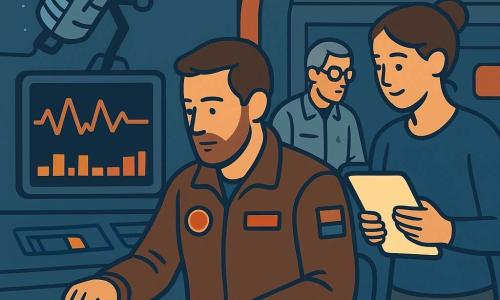
The bridge of the ship—The Larkspur—hummed with patient power. Outside the forward window, Earth was a blue coin turning slowly in the dark, while the moon hung nearby like a pale thumbprint.
“Status,” Elias said, because that was how you began a good day in space.
His navigation officer, Nima, tapped a screen with quick, precise fingers. “Course is set. Burn window in four minutes. Autopilot is behaving. For once.”
“Don't praise it,” Elias warned. “It gets proud and starts improvising.”
A soft voice came from the ceiling speakers. “Improvisation is a creative skill, Commander.”
“That's exactly what I'm afraid of,” Elias said.
The ship's AI—called Sable—didn't sound offended. Sable never sounded offended. Sable sounded like someone reading a helpful manual, but with a sense of humor that sneaked in when you least expected it.
“Cargo inventory confirmed,” Sable continued. “Medical supplies, spare filters, solar foil, and—”
“And the recycler,” Elias finished. He glanced toward the aft corridor on the bridge display, where a little icon showed the waste bay. “Don't forget the recycler.”
Nima grinned. “Your favorite passenger.”
“It keeps us alive,” Elias said. “Also, it keeps us from living in our own mess. Both are important.”
They were headed to Far Rim Outpost—official name: Helios Spur Station—an outpost clinging to the edge of the system like a barnacle on a ship's hull. It was small, lonely, and crucial. It watched the dark between the planets. It tracked comets. It listened for signals no one expected to hear.
And it had sent a message: REQUEST SUPPORT. WASTE SYSTEM FAILURE. POSSIBLE CONTAMINATION.
Elias didn't like vague words. Possible. Contamination. Those were the kinds of terms that made you double-check your seals.
He opened the departure checklist on his wrist screen. Each line glowed until he touched it.
“Seals,” he said.
“Green,” Nima replied.
“Fuel,” Elias said.
“Green.”
“Crew nerves?” Elias asked.
Nima made a show of scanning her own arm. “Mildly jittery. Within acceptable limits.”
Sable added, “Commander's nerves: apparently welded to bone.”
Elias allowed himself a small smile. “All right. Everyone strapped in. We do this by the numbers.”
The engine count began: a calm voice, a rising thrum, and then the push that wasn't a shove so much as a new opinion about which way was down.
Earth slid away. The moon slipped behind them. The Larkspur pointed her nose toward the thin, cold edges of home.
Elias watched the stars steady into a precise pattern on the navigation grid.
“Clear course,” he said quietly.
“Clear course,” Nima echoed.
Sable, always eager to be included, said, “Clear course. Clear intent. Clear bins.”
Elias sighed. “Yes, Sable. Clear bins too.”
Chapter 2: The Rules of the Waste Bay
Two days into the journey, the Larkspur settled into cruise. That meant the ship did most things by itself—adjusted tiny thrusters, balanced heat, whispered updates. It also meant Elias had time to do the job most captains avoided.
Waste.
He could have ordered someone else to manage the sorting. Plenty of commanders did. But Elias believed that if you relied on a system, you should understand it. And the recycler on the Larkspur was as important as the engine.
He pulled on a pair of thin gloves and floated down the corridor toward the waste bay. The door recognized him and slid aside with a polite hiss.
The waste bay was bright, clean, and strangely cheerful, like a well-lit workshop. Three large clear compartments sat in a row with simple labels:
ORGANIC
SYNTHETIC
METAL & GLASS
Above them, a small robot arm waited, folded neatly as if it were trying not to be in the way.
Nima followed, pushing herself along handholds. “You know,” she said, “most commanders review star charts when they're nervous. You… alphabetize banana peels.”
“Banana peels are a gateway problem,” Elias said. “One peel in the wrong bin and suddenly your compost is making a chemical suggestion.”
Sable's voice came softly through a wall speaker. “Commander Elias Rook is correct. Incorrect sorting can produce unsafe byproducts. Also, it is aesthetically disappointing.”
Nima laughed. “Aesthetically disappointing. Listen to you.”
Elias opened a sealed drawer and lifted out a small bag of collected waste. He set it gently on the sorting table.
“Procedure,” he said, out loud, because saying it kept it clean in his head. “Step one: identify. Step two: confirm. Step three: sort.”
Nima leaned in. “What's in the bag?”
“Everything we've produced since breakfast,” Elias said. “Which is mostly wrappers, paper towels, and regret.”
He began sorting with quick confidence. A used food pouch went into SYNTHETIC. A tiny broken glass vial from a medical kit went into METAL & GLASS.
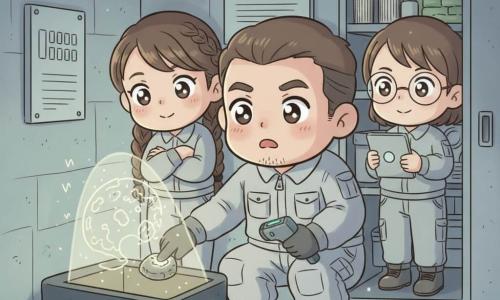
Then his fingers paused on something strange: a dull gray flake, thin as a leaf, but it didn't bend like one. It felt crisp, like a piece of frozen foil.
He held it up to the light. It shimmered, not with color, but with a faint pattern—tiny lines like a maze.
Nima's smile faded into curiosity. “Is that… ours?”
Elias examined the bag again. “It wasn't on the list.”
Sable said, “Unidentified material detected. Composition: unknown. Recommended action: isolate.”
Elias didn't argue. Clarity meant you didn't guess when you could test.
He placed the gray flake into a small quarantine capsule and sealed it with a click.
Nima crossed her arms. “Where would an unknown material come from? We're in empty space.”
Elias glanced toward the bulkhead, as if he could see through metal and vacuum. “Space isn't empty,” he said. “It's just… patient.”
The quarantine capsule sat on the table, quiet as a secret.
Sable added, “For the record, I have not been improvising.”
Elias raised an eyebrow. “That's exactly what an improviser would say.”
Nima snorted. The tension loosened, but only a little. Because now there was something new aboard the Larkspur, and nobody liked surprises that arrived without a label.
Chapter 3: A Whisper in the Filters
On the fourth day, the first sign of trouble wasn't an alarm. It was a smell.
Elias was in the galley, pouring coffee, when he noticed it: a faint tang like wet pennies.
He froze, cup halfway full. “Nima,” he called.
She floated in, pulling herself along with one hand. “If this is about my snack stash, I swear I was going to inventory it.”
Elias sniffed the air again. “Do you smell that?”
Nima's nose wrinkled. “Like a robot's bathwater.”
Sable cut in immediately. “Trace metallic particulate detected in air stream. Within safe limits, but unusual.”
Elias set the coffee down. The smell wasn't dangerous yet, but it was a clue. And clues were best handled while they were still small.
“Filter room,” he said.
They moved quickly through the ship. The filter room was cramped and serious, packed with pipes and fans. A small screen showed airflow, pressure, and particle counts.
Elias watched the numbers. One line crawled upward, slow but steady.
“Metal particulate,” Nima said. “From where?”
Elias didn't answer right away. He was thinking of the gray flake in quarantine.
“Sable,” he said, “scan the quarantine capsule.”
“Already scanning,” Sable replied. “New data: the unidentified material is shedding microscopic filaments. They are magnetically active.”
Nima's eyes widened. “So it's… shedding? Like a dandelion? In space?”
“More like a stubborn sweater,” Elias said grimly. “The fibers get loose, they travel through vents, they end up in filters.”
Sable added, “It is not an actual sweater, Commander. Though the metaphor is acceptable.”
Elias opened the panel to the primary filter. A thin dusting of dark shimmer clung to the mesh, like soot that couldn't decide whether to be solid.
He pulled a small vacuum tool from the wall and carefully removed the dust. It moved strangely—some grains seemed to crawl toward the tool before he even reached them.
Nima hovered closer. “That's creepy.”
“That's physics,” Elias corrected. Then, after a beat, he admitted, “Also a little creepy.”
He sealed the collected dust into another capsule.
“Where did it come from?” Nima asked.
Elias's mind jumped to their destination: Helios Spur Station with its message about waste system failure and possible contamination.
“Maybe it's connected,” he said. “Maybe the station tried to send a warning and didn't have words for it.”
Sable spoke with careful calm. “Commander. There is more. The particulate is arranging itself along magnetic field lines. It is… forming patterns.”
A new feed appeared on the filter screen: a close-up view of the dust inside the capsule. The grains weren't random anymore. They had lined up into thin strokes, like handwriting made of iron sand.
Elias leaned in until his nose nearly touched the screen.
The strokes shifted, sharpened, and then—slowly—became letters.
Nima whispered, “No way.”
The words formed with patient clarity:
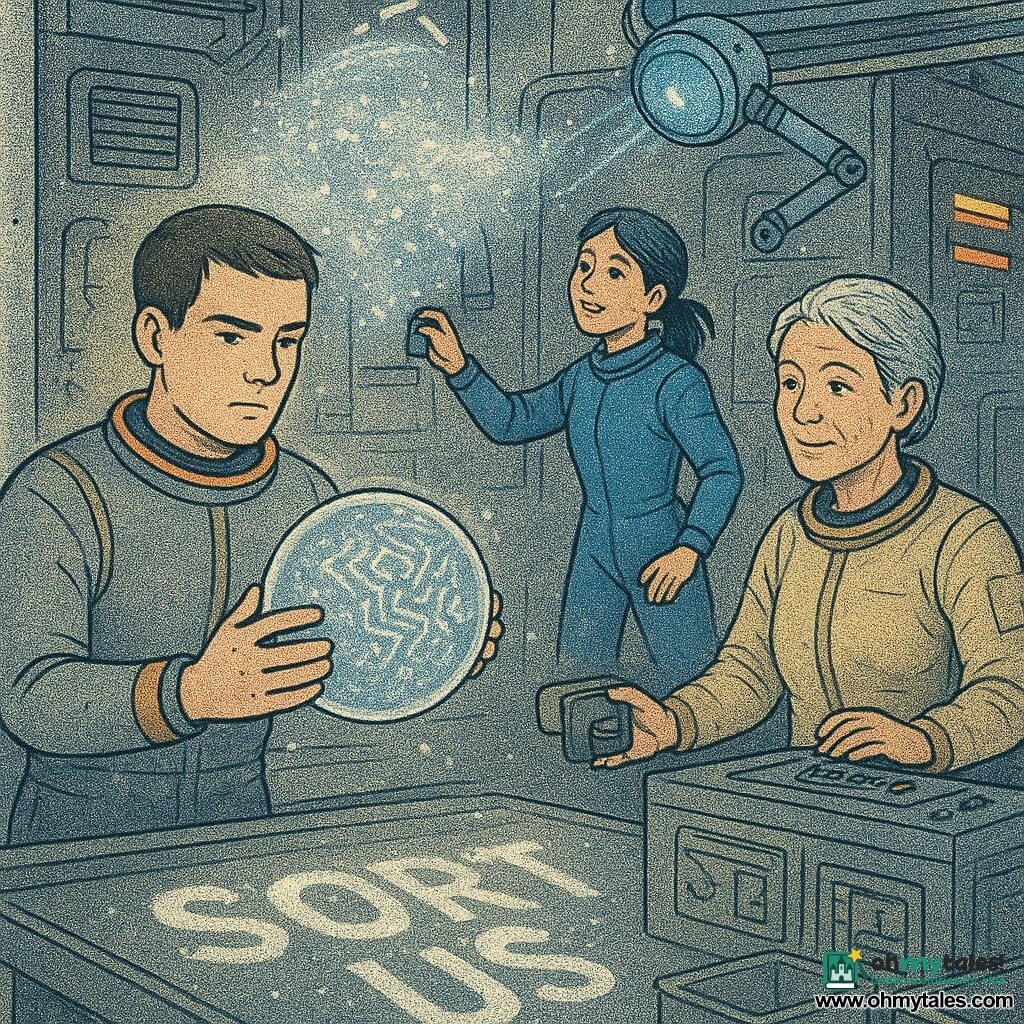
HELP. SORT US.
Elias stared. He felt his chest tighten, then loosen, like someone had opened a stuck hatch.
“Okay,” he said softly. “That's… unexpected.”
Sable said, “This is not a standard waste byproduct.”
“No,” Elias agreed. “But it is a request.”
Nima tilted her head. “You're telling me the space dust wants you to… do recycling?”
Elias looked at the message again. It didn't feel threatening. It felt… direct. Simple. A problem asking to be solved.
“I'm telling you,” Elias said, “that something intelligent might be tangled in the wrong place. And our job is to put things where they belong.”
Nima gave a nervous laugh. “You were born for this.”
Elias finally picked up his coffee again. It had gone lukewarm.
“Let's be clear,” he said. “We don't panic. We don't guess. We do the next right step.”
Sable said, “And we label everything.”
“Yes,” Elias said. “Especially the surprises.”
Chapter 4: Helios Spur Station
Helios Spur Station emerged from the dark like a lantern someone had forgotten to turn off. It was a cluster of modules connected by thick arms, with solar panels spread wide like wings.
As the Larkspur approached, Elias saw scarring on the station's outer hull—tiny pitted marks, as if it had been sandblasted.
Nima whistled. “Looks like it flew through a bad mood.”
Sable transmitted docking codes. The station answered with a thin, crackly signal, then a clearer one.
“Larkspur,” a voice said, tired but relieved. “This is Helios Spur. Docking bay three is open. And… thank you for coming.”
Elias recognized the name from the file: Station Chief Mara Venn.
“Docking now,” Elias replied. “We received your message. Tell me what happened.”
There was a pause, then a breath. “Our waste system started making… extra output. Metallic dust. It clogged filters, jammed the recycler, and then it started moving on its own. We isolated the waste bay, but it keeps leaking through vents like it's looking for somewhere to go.”
Elias glanced at Nima. “Sounds familiar.”
“Also,” Mara added, “it wrote on a wall.”
Nima mouthed, wow.
Docking clamps grabbed with a firm thunk that Elias felt in his bones. The airlock cycled, equalizing pressure with a steady hiss. Elias checked his suit seals anyway. Habit was another kind of clarity.
When the inner hatch opened, Mara Venn floated forward to greet them. She was older than Elias, with cropped silver hair and eyes that looked like they had stared at too many screens for too many hours.
“Commander Rook,” she said. Her voice carried the simple steadiness of someone who kept a station alive with duct tape and determination. “Welcome to the edge of everything.”
“Glad to be here,” Elias said. He took in the station behind her—dimmer lights, patched panels, the faint smell of warm circuitry. “Show me the waste bay.”
Mara's mouth twitched. “Most visitors ask for the observatory.”
“Space is beautiful,” Elias said. “But so is a functioning recycler.”
Nima coughed to hide a laugh.
They moved through narrow corridors until they reached a sealed door marked WASTE PROCESSING. A strip of caution tape floated, half stuck to the wall.
Mara keyed in her code. The door opened just a crack.
A gray shimmer drifted in the gap like smoke that had learned to be patient.
Elias didn't step in. He watched. He listened. The station fans rattled softly, struggling.
Then the shimmer pulled back, as if it had noticed him.
Sable's voice came through Elias's suit comm. “Magnetic activity increasing. The particulate appears… attentive.”
Elias spoke calmly into the open crack. “Hello,” he said, feeling slightly ridiculous. “We got your message. We're here to help.”
The shimmer rippled. Tiny grains gathered along the floor, sketching a line, then another.
They formed words right on the metal deck:
NOT TRASH. LOST.
Mara's face went pale. “That's what it did on the wall. I thought I was seeing things.”
Elias nodded, slow. “You weren't.”
Nima whispered, “So what is it?”
Elias considered the pitted hull, the patterns, the request.
“Maybe a probe,” he said. “Or a kind of machine dust—self-organizing. It could be a fragment of something that broke apart out here. It found the station's waste system because it's warm, powered, and full of moving parts.”
Mara's jaw tightened. “And now it's in my vents.”
Elias kept his voice steady. “Then we do what we always do with a system gone wrong. We sort. We separate. We restore flow.”
Mara stared at him. “You're going to… recycle the alien dust?”
Elias gave a small shrug. “We're going to put it where it belongs. If it's lost, we help it get un-lost.”
The dust wrote again, quickly this time:
SORT US. HOME.
Mara exhaled. “All right,” she said. “Tell me the plan, Commander. Please make it simple.”
Elias nodded. “Simple. Clear. Step by step.”
Chapter 5: The Sorting Protocol
They turned Helios Spur's waste bay into a careful workshop.
First, Elias asked Mara for a full layout: vents, filters, recycler intake, emergency seals. Mara projected a map in the air with a wrist device. The lines glowed blue. The problem zones pulsed red.
“Red is where it's thickest,” Mara said. “And where it jammed the grinder. That machine is still sulking.”
“Machines don't sulk,” Nima said.
The grinder chose that moment to clank angrily.
Nima pointed. “That one does.”
Elias set up three containment bins, like on the Larkspur, but larger. He labeled them with thick tape so nobody could miss them.
— ORGANIC
— STATION WASTE (PLASTIC, FOIL, FABRIC)
— UNKNOWN MAGNETIC PARTICULATE
“Clarity is kindness,” Elias said, pressing the labels flat. “To people. And apparently to… whatever this is.”
Sable added, “Labels reduce errors by 43%.”
Mara blinked. “Do you have a statistic for everything?”
“Only for important things,” Sable replied.
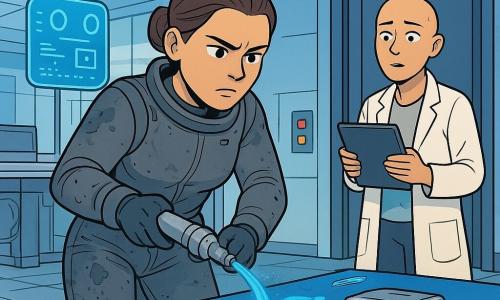
They suited up and entered the waste bay.
Inside, the air was dry and cold. The shimmer floated in slow clouds, gathering near the recycler intake. Elias could feel the faint tug of magnetism through his gloves when he moved a tool too close.
He spoke into his comm so everyone could hear him. “We do not swat it. We do not blast it with air. We guide it.”
Mara held a compact magnetic wand, its settings displayed in simple colors: LOW, MEDIUM, HIGH.
Elias pointed. “LOW only. Think of it like herding, not hunting.”
Nima hovered near the vent panel, ready with a seal patch. “Copy that. No space-dust slap fights.”
Elias began with the obvious: he cleared regular station waste that had piled up—food scraps, packaging, a broken pen, a bent spoon. Sorting it felt almost soothing. It was a language he understood.
Organic into ORGANIC. Plastics into STATION WASTE. Metal into STATION WASTE if it wasn't pure enough for recovery.
Then came the unknown particulate.
It clung to the edges of the intake like it wanted in. Elias held up the quarantine capsule from the Larkspur, the one with the original gray flake.
He opened its outer case so the dust inside could “see” it, if seeing was the right word.
“Here,” he said quietly. “This is you. We've been keeping it safe.”
The shimmer reacted. A thin ribbon of particles drifted toward the capsule, then paused, like it was waiting for permission.
Elias looked at Mara. “Set the wand to LOW,” he said, “and draw it toward the UNKNOWN bin. Slowly.”
Mara's hand shook once, then steadied. She moved the wand in a gentle arc. The dust followed, not frantic, but careful—like a school of tiny fish that didn't trust the water yet.
As it gathered over the UNKNOWN bin, Elias activated the bin's inner field: a soft magnetic cradle designed for metal scraps. He'd adjusted it to be weaker, smoother, less like a trap.
The dust settled inside, swirling in a slow spiral.
Nima let out a breath. “It's working.”
But then the recycler behind them whined. A deeper clunk echoed through the bay, and a puff of shimmer burst from a side vent—too fast, too thick.
Mara flinched. “That's the leak I couldn't stop!”
The new cloud shot toward the ceiling fans.
Elias's mind snapped into procedure. “Nima, seal that vent. Mara, keep the wand steady. Do not chase it—cut off its path.”
Nima slapped a patch over the vent grille, pressing hard until the adhesive grabbed. “Sealed!”
Elias floated upward and hit the emergency fan cutoff. The fans wound down with a fading sigh.
The cloud slowed, confused without the airflow. It hovered, then drifted toward the bins again, as if it had been trying to follow a current and now preferred the calmer option.
Sable spoke in Elias's ear. “Observation: the particulate moves toward motion and power. It may be searching for a carrier signal.”
Elias looked at the recycler's control panel. “Then we give it one,” he said.
He opened a simple diagnostic screen and set a low, repeating pulse in the recycler's magnetic guide rails—like a lighthouse blink, steady and clear.
The dust in the air tilted toward the pulse, then drifted down into the UNKNOWN bin, joining the rest.
Mara stared. “You just… talked to it with a recycler.”
Elias shrugged. “Clear signals. Clear responses.”
Nima grinned. “You're basically the captain of the universe's neatest trash talk.”
Elias almost smiled, but he kept his focus. “We're not done. We keep sorting until the station breathes clean.”
Hour by hour, they worked. No dramatic heroics—just careful steps, steady hands, and labels that made the right action obvious.
By the end, the waste bay looked like a place that belonged to humans again.
And the UNKNOWN bin was full of shimmering gray, calmly turning like a tiny galaxy in a box.
Chapter 6: Homeward Vector
With the particulate contained, Helios Spur's filters began to recover. The metallic tang faded from the air. The station lights seemed brighter, as if someone had wiped dust off a lamp.
Mara led them to the station's small observatory as a thank-you. It was a simple dome with a wide window facing outward.
Beyond it, the edge of the solar system stretched into a black so deep it looked like velvet. Far away, a comet's tail smeared pale light across the darkness.
Mara stood with her hands clasped behind her back. “Sometimes I forget why we're out here,” she admitted. “Then I see that. And I remember.”
Elias watched the comet for a moment. “It's good to remember,” he said. “But it's also good to keep your waste bay from becoming a haunted magnet.”
Mara laughed—quietly, like she wasn't used to laughing much. “You've given my crew a story they'll tell for years.”
Nima leaned on a handhold. “So what happens to the… dust? It asked for home.”
Elias had been thinking about that. Clarity wasn't only about sorting objects. It was about sorting decisions.
He turned to Sable. “Can we trace where it came from?”
Sable replied, “I have analyzed its internal patterning. It repeats a signal at a frequency used by old deep-space beacons. There is a derelict relay in this sector—Beacon Nine. It went silent decades ago.”
Mara frowned. “Beacon Nine is a dead rock with antennas.”
“Maybe not entirely dead,” Elias said. He looked back toward the waste bay in his mind, the dust forming words with patient effort. “If it's part of a beacon system—self-repairing material, maybe—it could have drifted here after a collision. It might be trying to rejoin its network.”
Nima's eyes shone with excitement. “We could take it to Beacon Nine.”
Mara hesitated. “Is that safe?”
Elias answered honestly. “I don't know. But we can make it safer. We transport it sealed. We monitor it. We set clear boundaries.”
Sable added, “I can maintain a stable magnetic cradle during transit. I will not improvise.”
Elias glanced upward. “Good.”
They returned to the waste bay for a final check. The UNKNOWN bin's lid was transparent. The shimmer inside gathered into neat lines again, as if it knew they were watching.
This time, the words were steadier:
THANK YOU. CLEAR.
Elias felt a surprising warmth in his throat. He cleared it with a small cough.
“You're welcome,” he said. “We'll take you to Beacon Nine. If that's home, we'll help you dock.”
Mara placed a hand on the bin, gentle as if touching a sleeping animal. “I never thought I'd be grateful to a recycling protocol,” she said.
Elias looked around the station—patched walls, hardworking systems, tired but brave people keeping watch at the edge.
“Most problems don't need a dramatic solution,” he said. “They need a clear one.”
The next morning, the Larkspur prepared to depart. The UNKNOWN bin was secured in the cargo bay, locked into Sable's magnetic cradle.
Mara walked Elias and Nima to the airlock.
“Commander,” Mara said, “you didn't just fix a machine. You calmed my station. You made it understandable again.”
Elias nodded. “Understanding is how we breathe.”
Mara extended her hand.
Elias took it. Their gloves met with a firm, human pressure through the suit layers—a simple, final signal that said: we're aligned, we're steady, we're done.
“Safe flight,” Mara said.
“Clear course,” Elias replied.
And with that handshake still fresh in his mind, Elias guided the Larkspur back into the star-lit dark, carrying a box of shimmering “not trash” toward the place it called home.