Chapter 1 — The Quiet Commander
In the year 2249, space was not a black emptiness anymore. It was a mapped neighborhood, stitched together by light-lanes and patient machines.
Above Earth, the Orbital Rings glimmered like silver halos. Cargo trains without windows slid along them, guided by magnetic rails and tiny bursts of ion gas. Between the rings and the Moon ran the Sky Tether—an elevator cable thicker than a city bridge, humming softly as it carried people, plants, and parcels up and down.
Out past Mars, stations floated like beads on invisible strings. Each station had its own smell: warm metal, recycled air, and something human—soap, soup, engine grease, or old paper. Solar sails flashed like giant dragonfly wings. Freight drones blinked polite green lights as they queued to dock. And in every ship, in every habitat, there were small reminders that people still needed comfort: wall gardens, music boxes, tea warmers, and window seats pointed toward the stars.
Technology had become good at the quiet things. Filters could clean air until it tasted like rain. Hulls could heal tiny micrometeor scratches the way skin healed cuts. Translation earclips could turn any language into another, as easily as breathing. Even so, nothing could replace careful hands and watchful minds.
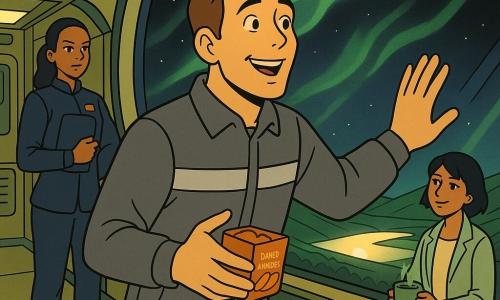
That was why Commander Jalen Sato mattered.
He was fourteen—young enough that some adults still tried to call him “kid,” until they saw the way he checked every gauge twice and spoke to his crew with steady respect. He had earned his command in the Youth Fleet, a program that trained teenagers to run small vessels for science and education missions. The ships were compact, clever, and safe—but the space outside them was still space, and it still demanded humility.
Jalen's ship, the Moth, was no bigger than a school bus if you squeezed it, with a smooth white hull and a ring of thrusters like a bracelet around its middle. Inside, everything was tight and tidy: bunks that folded into walls, a galley that could cook noodles and sterilize scalpels, and a cockpit full of screens that didn't try to impress anyone.
Jalen rested his palms on the console, feeling the faint vibration of the ship's heart. On the main display, their destination glowed: the Greenhouse-School called Verdance, built into the hollowed interior of an asteroid that drifted between Jupiter and Saturn.
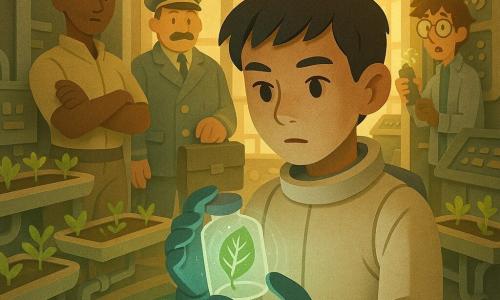
Verdance wasn't just a school. It was a living laboratory, a place where students learned by growing things that could survive anywhere—spinach in low light, beans in thin air, strawberries in artificial dawn. Some graduates designed farms for icy moons. Some invented pollination drones. Some became caretakers of seed vaults, guarding the future in tiny envelopes.
Jalen had been invited for a joint mission: deliver new seedlings and help with a field lesson at a nearby moonlet. Officially, it was “educational outreach.” Unofficially, it was a big deal.
His crew was small. That was the rule for Youth Fleet ships: enough hands to help, not so many that people stopped listening to each other.
“Captain,” said Nia, the ship's engineer, from the open panel beneath the cockpit floor. Her hair was tied back with a strip of copper tape. “If you fire the starboard maneuver thruster again, I'm going to name it ‘Sneezy.'”
“It did sound like it was laughing,” Jalen said.
“It's coughing,” Nia replied. “A laugh is cute. A cough is expensive.”
From the rear compartment, Milo—navigation and communications—called out, “Verdance is sending a welcome packet. Also a recipe. Also… a poem about lettuce?”
“A poem?” Jalen leaned back in his seat.
“It rhymes ‘chlorophyll' with… nothing,” Milo said, sounding deeply offended on behalf of poetry.
Jalen grinned. “We'll pretend we love it.”
He tapped the intercom. “Crew, checklist time. We're entering the outer corridor of the Jupiter-Saturn lane. Eyes open, voices calm.”
“Aye, Commander,” Nia said, with a mock-serious salute, then thunked her head lightly on the underside of the panel. “Ow. Solidarity with the ship's poor design.”
Jalen kept his smile soft. He never raised his voice unless he had to. Ships could sense stress, in their own way—crew certainly could. If he was calm, his crew could be calm. If he stayed humble, no one had to pretend to be fearless.
Outside the forward window, Jupiter was a giant marble, swirling with storms that looked like brushstrokes. A thin line of satellites winked in formation. Farther out, the light-lane markers blinked in patient patterns, like roadside reflectors for travelers who couldn't afford to drift.
Verdance awaited them, a green secret hidden inside rock.
Chapter 2 — The Garden in the Stone
The asteroid that held Verdance looked ordinary at first: a lumpy, charcoal-colored chunk with a slow, lazy spin. Then the Moth's sensors picked up the heat signature and the slight shimmer of the docking field.
A hatch opened in the rock like an eye blinking awake.
“Docking clearance confirmed,” Milo said. “They've assigned us Bay Three. And the lettuce poem is now officially in our ship's database. I tried to delete it. It came back.”
“Even poetry is persistent,” Jalen said. He guided the Moth forward with gentle taps, matching the asteroid's rotation. The docking field caught them like a careful hand. There was a soft thud, then a lock engaged with a sound like a firm handshake.
Air pressure equalized. A green light turned on.
Nia climbed up from her panel, wiping grease on her sleeve. “We are attached to a rock in deep space,” she announced. “This is either the start of a beautiful friendship or a bad joke.”
“Let's be polite to the rock,” Jalen said. He unbuckled and stood. “Helmets on. Verdance uses high humidity in some corridors.”
They stepped through the airlock and into a tunnel carved through stone. The walls were smooth, reinforced with a honeycomb of pale metal. Small lights ran in a line along the floor, guiding them inward. The air smelled different already—less like ship, more like wet earth.
As they walked, a soft voice came through their earclips. “Welcome, Moth crew. Please follow the moss path.”
“Moss path?” Milo repeated. “That sounds suspiciously poetic.”
Around the next bend, it was true. A strip of living green moss ran along the corridor like a carpet, glowing faintly. Tiny droplets trembled on its surface. It felt like walking beside a miniature forest that had decided to become a road.
At the main hub, the tunnel opened into a wide chamber with a glass ceiling. Above them, the asteroid's inner structure arched like the ribs of a whale. Between those ribs were panels—transparent, strong, and warm to the touch—holding in an atmosphere made for plants and people.
And there it was: Verdance.
Terraces spiraled upward, filled with soil beds and hydroponic towers. Vines climbed trellises. Water ran in narrow channels with a soothing trickle. Pollination drones, each no bigger than a thumb, buzzed gently from flower to flower, their bodies painted in cheerful stripes.
Students moved in clusters, carrying trays of seedlings and tablets. Some wore damp boots. Some wore lab coats with mud stains. Everyone looked busy in a way that felt happy.
A woman in a forest-green uniform approached, her smile wide and sincere. “Commander Jalen Sato?”
Jalen straightened. “Yes, ma'am. Commander of the Moth. Thank you for having us.”
“I'm Director Amara Venn,” she said. “And you can call me Amara. Verdance is a school, not a throne room.”
Jalen nodded, relieved. “Then I'm Jalen.”
Amara's eyes crinkled. “Good. We've been looking forward to meeting the famous calm captain.”
Milo whispered, “We're famous?”
Nia whispered back, “Probably for not crashing into things.”
Amara led them along a walkway that overlooked the terraces. “We've prepared a schedule. Your seedlings will go to Section Seven, where we're testing root growth under variable gravity. After that, we have a field lesson.”
“Field lesson?” Jalen asked.
Amara pointed upward, toward a curved window set into the asteroid wall. Through it, space glittered, and beyond, a small moonlet drifted—pale, icy, and speckled.
“That,” Amara said, “is Thimble. It's a captured chunk of ice and dust with a strange mineral layer. Our students need a real sample. Not a scan. A core.”
Jalen felt the weight of that word: core. “You want a drilled sample from the surface.”
Amara nodded. “A core sample, yes. The mineral layer might help plants lock water in ways we haven't seen before. If we can understand it, we can grow food on worlds that currently can't support it.”
Nia's eyes lit up. “That's… actually cool.”
Milo said, “Also, ‘Thimble' sounds cute. Like it's small enough to wear.”
“It's small,” Amara agreed, “but it still has micro-quakes and thin cracks. It's not dangerous if you work together and follow procedure.”
Jalen met her gaze. “We will. Solid plan. Solid team.”
Amara's smile softened. “That's what Verdance likes to hear.”
They delivered the seedlings first—tiny green lives in sealed trays, their leaves trembling as if they could feel the new air. Students thanked them, asking questions about the Moth's thrusters and Jalen's command badge. Jalen answered politely, always giving credit.
“Nia keeps our ship alive,” he said. “Milo keeps us from getting lost. I mostly keep us from arguing about what music to play.”
“That's leadership,” one student said seriously.
Jalen almost laughed. “Sometimes leadership is just choosing a playlist no one hates.”
By the time the field lesson briefing began, Jalen had walked under hanging tomatoes and past a wall of strawberries that smelled like summer. He felt something he didn't expect: a small, steady hope. Verdance was proof that people hadn't given up on making life possible in hard places.
Now they just had to bring back a piece of Thimble without turning it into a disaster story told in the cafeteria forever.
Chapter 3 — The Rules of a Small Moon
The next morning—if you could call it morning inside an asteroid—Jalen stood in Verdance's equipment bay, reading the mission plan on a screen while Amara and a group of students listened.
“Step one,” Jalen said, keeping his voice clear, “is not to rush. Space rewards patience.”
A student with curly hair raised a hand. “But it's just a small moonlet. Can't we hop down, drill, hop back?”
Nia, who was checking seals on their suits, snorted. “Sure. And while we're at it, we can juggle oxygen tanks.”
Jalen smiled at the student. “Thimble has low gravity, which makes movement easier but also trickier. A push can send you farther than you planned. The surface may be crusty ice over loose dust. Our boots have anchors, and we'll use tether lines. We move like a team of mountain climbers.”
Milo added, “But in space. With more rules.”
Amara nodded, pleased. “Our students will pair up with your crew. Everyone carries something. Everyone watches someone.”
Jalen liked that. On a ship, everyone mattered. On a moonlet, that was even more true.
They boarded the Moth with three Verdance students: Lysa, who spoke quickly and took notes even while walking; Bram, who was quiet and strong, with careful hands; and Keon, who loved jokes and was clearly trying to hide nerves behind them.
Keon tapped the side of the airlock. “So this is the legendary Moth. Does it… flutter?”
“It hums,” Nia said. “Like a tired fridge. Don't insult it.”
Inside the cockpit, Jalen ran the preflight checks out loud, partly for the students and partly because saying things made them real.
“Life support: green. Nav: green. Communications: green. Thrusters: mostly not sneezy.”
Nia pointed at him. “Mostly.”
Milo set their course. “Thimble's rotation is slow. We'll land near the brighter patch—less shadow, better visibility.”
Jalen took a breath. He always did before leaving a dock. It wasn't a ritual for luck. It was a reminder: you are small, and that is fine.
The Moth undocked and glided into open space. Verdance shrank behind them, the asteroid's docking eye closing like a sleepy lid. Ahead, Thimble waited—a pale pebble against the velvet dark.
As they approached, the moonlet's surface resolved into textures: ridges like frozen waves, dark seams like cracks in old paint, and glittering flecks that caught sunlight like scattered salt.
“Landing site in sixty seconds,” Milo said.
Jalen's hands moved in controlled patterns. The Moth's thrusters whispered. Dust rose as they touched down, floating in a slow, delicate cloud that took its time to settle.
“Touchdown,” Jalen said. “No bouncing, no drama.”
Keon clapped once, then stopped when everyone looked at him. “Sorry. My hands are excited.”
They suited up. The helmets were clear, with thin HUD lines that showed oxygen levels, tether status, and simple arrows pointing back to the ship. Their boots had anchor spikes that could bite into ice. Each person clipped a tether to the next, forming a short chain.
Outside, Thimble was quiet in a way that made Jalen's thoughts sound loud. The sky was pure black, and the stars didn't twinkle—they simply existed, sharp as pins.
“Remember,” Jalen said over comms, “we go slow. We talk through every step. If someone feels unsure, we stop.”
Lysa's voice came quick and bright. “Understood. Recording observations. Surface temperature: minus one hundred and twelve Celsius. That's… brisk.”
“Brisk is one word,” Bram said, voice low.
Keon said, “My nose is cold inside my helmet, which feels like a science trick.”
They moved away from the ship. Each step was a careful float and settle. Jalen watched their shadows stretch long across the ice. He watched the tether lines, the angle of their bodies, the way their boots bit in.
Halfway to the target patch, a soft tremor shivered through the ground. Dust lifted in a slow puff.
“Micro-quake,” Milo said calmly. “Sensors predicted mild activity.”
Bram planted his boots deeper. “Feels like the moonlet is clearing its throat.”
Jalen held up a hand. “Stop. Check tethers. Check footing.”
Everyone answered, one by one. Green lights on their HUDs confirmed it.
They continued, and soon the target patch lay ahead: a darker oval in the ice, where the mineral layer was close to the surface. It looked like a bruise on a pale skin.
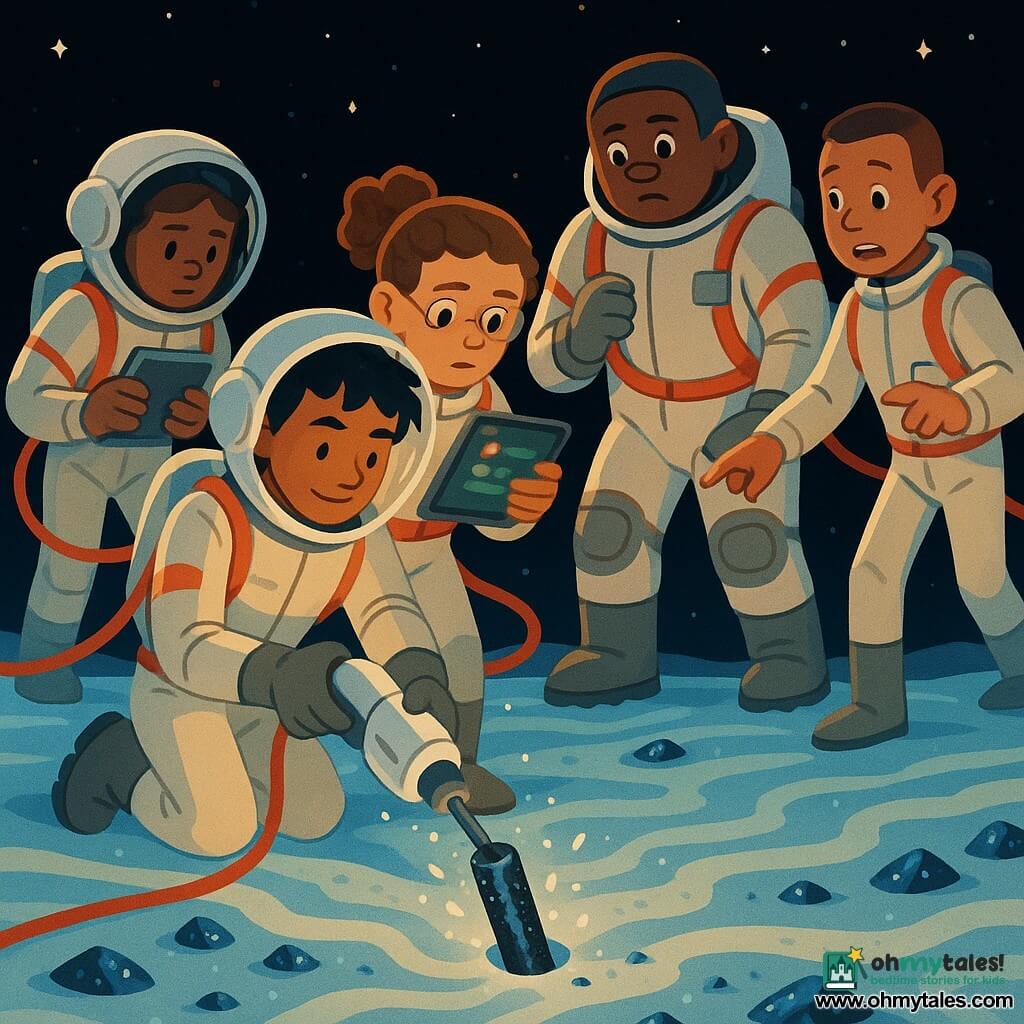
Amara's students had brought a compact drilling kit—more like a thick flashlight than a heavy machine. It used a vibrating tip to cut a clean cylinder, then sealed it inside a tube.
Jalen knelt, anchoring his boots. “Bram, you and I will handle the drill. Lysa, monitor readings. Keon, watch the surface and call out any cracks.”
Keon saluted dramatically. “Crack Watcher, reporting for duty.”
Nia muttered, “Please don't put that on a résumé.”
The drill's tip touched the surface. Jalen felt the vibration through his gloves, a steady buzz like an electric toothbrush with serious goals. Fine dust lifted, drifting like smoke in slow motion.
“Depth: five centimeters,” Lysa said. “Ten. Fifteen. The mineral layer begins at twenty.”
The drill met a slightly tougher resistance. Jalen adjusted pressure carefully. He could feel how easy it would be to press too hard and snap something—tool, sample, or trust.
“Thirty centimeters,” Lysa said. “Core integrity good.”
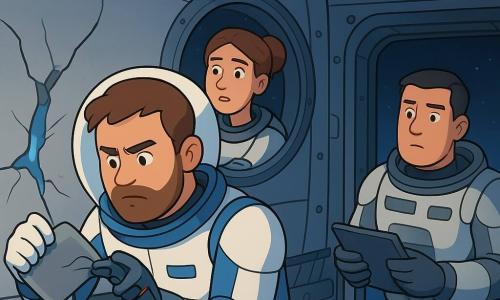
Then Keon's voice tightened. “Uh—Commander? There's a line forming. Like a crack. Near Bram's left boot.”
Jalen's heart did not race. He would not let it. “Bram, freeze.”
Bram stopped instantly.
Jalen leaned, careful not to shift his own weight too fast. The crack was thin, but it crept like a dark hair across the ice. In low gravity, a small fracture could spread quietly, then suddenly open.
“Everyone,” Jalen said, “ease back one step, except Bram. Bram, I'm going to clip your tether to my belt instead of the chain.”
Nia's voice came through comms from the ship—she was monitoring from inside. “Jalen, your suit pressure is stable. That crack looks shallow on the scan, but it could widen.”
“Copy,” Jalen said. He moved slowly, re-clipped Bram's tether. “Bram, when I say, you'll lift your left foot straight up, then place it behind you. No pushing off.”
Bram swallowed. “Got it.”
Jalen glanced at the drill. The core tube was almost full. If they abandoned it now, they might lose the sample—or worse, leave equipment that could damage the surface. But safety came first.
“Lysa,” he said, “pause recording and watch Bram's footing. Keon, keep eyes on the crack. Call out any change.”
Keon's humor vanished, replaced by focus. “It's… still. But I don't like it.”
Jalen didn't either. He kept his voice steady. “Okay. Bram—move.”
Bram lifted his foot slowly. The crack did not jump. He set his boot down behind him, gently.
“Good,” Jalen said. “Now right foot. Same way.”
Bram moved again. The crack remained thin, but it had grown a few centimeters.
“Back another step,” Jalen said, and guided Bram away from the weak spot until they were on brighter, thicker ice.
Only then did Jalen turn his attention to the drill. The core tube had sealed automatically when it reached capacity, but it was still attached to the drill body.
“Nia,” Jalen said, “can you guide the remote arm from the ship? We need to detach the drill without adding weight to the area.”
“Oh, now you want the ship's arms,” Nia replied, but her tone was warm. “Fine. I'll be the helpful robot.”
A small drone arm extended from the Moth's side, unfolding like a careful insect leg. Under Nia's control, it floated over, gripped the drill's handle, and twisted the core tube free with a soft click.
The tube—clear and sealed—contained a perfect cylinder of ice and dark mineral, layered like a strange cake.
“We have it,” Lysa breathed. “A full core sample.”
Jalen felt relief spread through him, slow and strong. “Good work. Everyone did exactly what they were supposed to do.”
Keon exhaled loudly. “I would like to file a complaint against cracks as a concept.”
“Complaint noted,” Milo said. “The universe will ignore it.”
They retreated to the ship in careful steps, tether lines taut, teamwork steady. Behind them, the dark patch on the surface looked unchanged, but Jalen knew better. Space didn't care about bravery. It cared about attention—and about people taking care of each other.
Back inside the Moth, helmets off, everyone's hair stuck to their foreheads with sweat.
Amara's students stared at the core tube like it was a treasure.
“It kind of is,” Amara had said in the briefing. Now Jalen understood why.
It wasn't gold. It wasn't a weapon. It was information. And information could feed people.
Chapter 4 — The Drift and the Decision
Leaving Thimble should have been easy. It almost was.
The Moth lifted off with a gentle push, dust blooming beneath them in a lazy halo. Milo guided them toward Verdance, and the greenhouse-asteroid appeared as a dark shape with a faint green glow, like a lantern inside stone.
Then a warning chimed—sharp, unmistakable.
Nia's fingers flew over the engineering display. “Okay. That's new.”
Jalen leaned forward. “Report.”
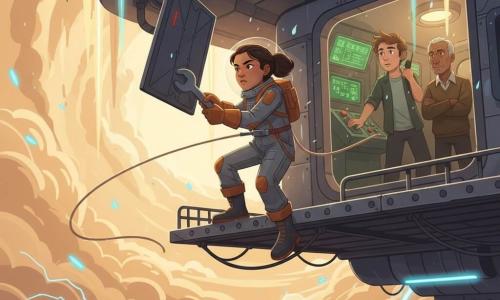
“Starboard maneuver thruster,” Nia said, glaring at the screen as if it had personally insulted her, “just dropped to seventy percent output. Sneezy is officially sick.”
Milo added, “We're slightly off the ideal approach line. Not dangerous yet, but—”
“But we're not sloppy,” Jalen finished. He took a slow breath. “Options?”
Nia rubbed her forehead with the heel of her hand. “We can compensate with port thrusters. But if the starboard one coughs harder during docking, we might scrape the bay field. Verdance won't like that. Rocks have feelings.”
Keon, sitting behind Milo, said, “I'm starting to believe we should be polite to the rock.”
Lysa held the core tube in her lap like a baby. “Is the sample safe?”
“Yes,” Jalen said. “It's sealed. But we need a clean dock to transfer it.”
Jalen's mind ran through procedures like flipping pages. He could try docking anyway, careful and slow. He could request a wider bay. He could hold position and repair.
“Nia,” he said, “can you fix it in flight?”
Nia gave him a look that was half insulted, half proud. “Commander, I can fix a lot of things. But I can't magically conjure spare parts out of your calm personality.”
Milo cleared his throat. “Verdance's welcome packet mentioned they have a maintenance annex. They repair student shuttlecraft.”
“Then we ask for help,” Jalen said.
Bram, quiet until now, nodded. “That's solidarity.”
Jalen opened a channel. “Verdance Control, this is Commander Sato of the Moth. We have reduced output on a maneuver thruster. Requesting a maintenance tether or guidance to a safer bay.”
A moment later, Amara's voice came through, calm as a garden pond. “Moth, copy. Thank you for reporting early. We'll open Bay Five—wider margins. Our maintenance team will meet you. Approach at one-third speed. Keep your port side toward the field.”
Jalen felt warmth in his chest. No scolding. No panic. Just teamwork, offered like a hand.
“Copy,” he said. “Approaching Bay Five at one-third speed.”
Nia cracked her knuckles. “All right, Sneezy. We're going to make you less dramatic.”
As they approached, the docking eye in the asteroid opened again. Bay Five's field shimmered a deeper blue than Bay Three, thicker and steadier.
Jalen guided the Moth in, using port thrusters more than usual. The ship responded like a limping runner—still moving, just needing attention.
“Distance ten meters,” Milo murmured. “Five. Three.”
Nia watched the thruster output. “Hold… hold… now.”
Jalen eased off. The docking clamps engaged with a satisfying thunk. The ship settled.
For a second, nobody spoke. Then Keon said, very softly, “We did not become a cautionary tale.”
“Not today,” Nia said, and finally smiled.
Maintenance crew arrived quickly—two older students and a compact service robot with bright orange panels. They opened the thruster housing and found the problem: a filter mesh had warped slightly, probably from fine dust on Thimble that had slipped past the intake screen.
“It's like the thruster sneezed and swallowed wrong,” Keon observed.
One of the maintenance students, a tall girl named Sera, nodded gravely. “That is… the least scientific description I've heard today. But not incorrect.”
They replaced the mesh, ran a test, and the thruster returned to full output. Nia watched the readings like a proud doctor.
“Back to one hundred percent,” she announced. “Sneezy has recovered.”
Jalen thanked everyone, especially Sera and the maintenance crew. “We couldn't have done it alone,” he said, meaning it.
Amara met them at the airlock. “Welcome back. And well done asking for help before it became a bigger problem.”
Jalen dipped his head. “It's tempting to pretend you can handle everything. But ships don't care about pride.”
“Nor do plants,” Amara said, glancing toward the terraces. “Come. The students are eager to analyze your core.”
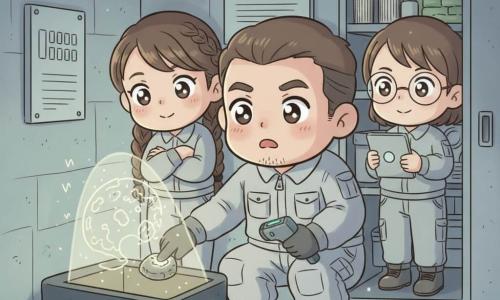
They carried the sample into a lab that smelled like clean water and leaves. Under bright lights, the dark mineral layer looked even stranger—sparkling blue-black, with thin veins that caught the light like frozen lightning.
Lysa traced the tube with a finger. “If this helps keep water from evaporating… we could grow crops on stations with limited supply.”
Bram added, “Or on long rescue missions. Fresh food.”
Jalen watched them, feeling the mission widen in his mind. It wasn't about being brave on an icy rock. It was about people sharing tools, knowledge, and care.
That night, Verdance hosted a simple meal for the visiting crew: soup made from leafy greens grown in low gravity, bread baked with algae flour, and strawberries that tasted like someone had bottled a memory of Earth.
Keon took a bite and sighed dramatically. “I would like to move into the strawberry wall.”
Amara laughed. “Applications are open.”
Jalen sat with his crew and the students, listening more than he spoke. He watched hands pass bowls, watched people refill each other's cups without being asked. In deep space, this was how civilizations stayed alive—not with speeches, but with small kindnesses repeated until they became habit.
Later, when he returned to the Moth for sleep, Milo paused at the cockpit window.
“Jalen,” Milo said quietly, “do you ever think about how huge everything is?”
Jalen looked out at the stars. “All the time.”
“And it doesn't… scare you?”
“It does,” Jalen admitted. “But it also reminds me that we're not the center. That means we have to be good to each other. We're all we've got out here.”
Milo nodded, satisfied, and went to his bunk.
Jalen stayed a moment longer, watching the dark. Somewhere beyond Verdance, Thimble drifted, cracking and shaking in its own slow life. Somewhere far beyond that, worlds waited for seeds and water and people who knew how to work together.
He turned off the cockpit lights and let the ship's gentle hum lull him.
Chapter 5 — The Blue Seer
The next day brought analysis and lessons. Verdance's lab scanners mapped the core sample in careful slices. The mineral veins showed a structure like layered nets—tiny pockets that could trap moisture and release it slowly.
“It's like a sponge,” Lysa said, “but smarter.”
Amara nodded. “Or like a library. It stores what you need until you're ready to use it.”
Jalen watched the data scroll, understanding enough to appreciate the wonder without getting lost in it. Science, he thought, was another kind of solidarity: the living helping the living by learning the rules of the universe.
By afternoon, the formal work was done. The sample was cataloged, sealed in Verdance's vault, and copied in digital models to share with other stations.
“You did good work,” Amara told Jalen in the main hub, where vines hung like green curtains. “You kept your team safe, and you brought us something valuable.”
Jalen shifted uncomfortably under praise. “We all did it.”
“That,” Amara said, “is exactly why you did.”
As if on cue, Verdance's lights dimmed slightly, and a soft chime echoed through the terraces. Students looked up. Some smiled as if they'd been waiting.
“What's that?” Keon asked.
Amara's face brightened. “Ah. Perfect timing.”
From a side corridor, a small group approached slowly. At their center floated a device about the size of a basketball: smooth, translucent, and filled with faint swirling light. It hovered without visible thrusters, moving as quietly as a drifting bubble.
Its glow was a deep, calming blue.
Jalen felt his skin prickle—not fear, but attention. The device's surface rippled like water when a breeze passes over it.
“That,” Amara said, lowering her voice, “is the Blue Seer.”
“The what?” Milo asked.
“The Seer,” Amara repeated, “is an old exploration instrument, upgraded again and again. It reads patterns—radiation, micro-gravity changes, magnetic whispers. It helps us predict when Verdance needs to adjust its spin for plant cycles, or when a dust stream might hit our outer panels.”
Keon frowned. “So it's like… a super fancy weather forecast ball.”
“A little,” Amara said. “But it also does something else. It watches us.”
Jalen's eyebrows rose. “Watches?”
“It reacts to crews,” Amara said. “To how people work. We don't fully understand it. Some say it's just responding to heat and motion. Some say it's picking up on heart rhythms through suit sensors. We don't claim it's magic.”
Nia muttered, “Good. I don't want to repair magic.”
Amara smiled. “Neither do I. But we do know this: when a team acts with real cooperation—clear communication, shared responsibility—the Seer's glow steadies. When people argue or hide mistakes, it flickers.”
The Blue Seer floated closer, drifting above the walkway rail. Its light pulsed once, slow and even, like a calm heartbeat.
Jalen stood still, hands at his sides. He remembered the crack on Thimble, Bram's careful step, Nia guiding the drone arm, Milo keeping the approach steady, Keon calling out what he saw instead of making a joke. He remembered asking Verdance for help without hesitation.
The Seer's blue brightened, not harshly, but like the sky deepening just after sunset.
One of the younger Verdance students whispered, “It likes them.”
Keon leaned toward Jalen. “Congratulations, Commander. A floating blueberry has judged you worthy.”
Jalen almost laughed, then decided it was allowed. “I'll accept the honor on behalf of the whole crew.”
The Seer drifted directly in front of Jalen. Its surface shimmered, and for a moment Jalen saw his reflection warped—helmetless, hair sticking up slightly, eyes wide with the same wonder he'd felt when he first saw Earth from orbit.
A gentle tone sounded—not words, but a musical note that vibrated in the air, low and reassuring.
Amara watched quietly. “It's greeting you.”
Jalen spoke softly, feeling a little silly and not caring. “Hello.”
The Seer's blue light steadied again, as if that was the right response.
Around them, Verdance continued its daily life: water running in channels, drones buzzing, students laughing, leaves turning toward artificial sunlamps. Yet the moment felt like a pause in a much larger story, a reminder that even in a future of machines and mapped lanes, there were still mysteries that rewarded good habits.
Amara placed a hand on Jalen's shoulder—light, respectful. “Verdance will remember this visit. And so will our students. They saw how you led.”
Jalen swallowed. “I just… tried to do the next right thing.”
“That's what leadership usually is,” Amara said. “One right thing after another. And you didn't do it alone.”
Jalen looked at his crew. Nia gave him a small nod, pretending she wasn't pleased. Milo offered a quiet smile. The students from Verdance stood taller, as if they'd learned something that wasn't written in any manual.
The Blue Seer floated upward, trailing calm blue light across the greenhouse air. It moved toward the higher terraces, where young plants lifted their leaves like open hands.
Jalen watched it go. Space was still huge. The unknown was still out there. But in this spinning garden inside a stone, with a core sample safely stored and a blue glow fading gently into the green, he felt steady.
Not because everything was safe.
Because he wasn't facing it alone.