Chapter 1: The Shuttle with the Scratched Paint
Milo Raines always said the same thing when people praised his flying.
“I'm just careful,” he'd shrug, as if steering a shuttle through space were no more dramatic than parking a bicycle.
His shuttle, the Kestrel, wasn't shiny. Its hull wore old micrometeor scratches like freckles. The cabin smelled faintly of warmed metal and mint tea, because Milo kept a small pouch of dried mint tucked behind the console. It helped when the air got too recycled.
Outside the forward window, Earth curved like a blue marble with white swirls. Ahead, the orbital fusion station—Helios Array—hung in darkness, a bright ring of lights around a thick central spine. It looked like a city made of steel and patience.
Milo's console chimed.
“Approach corridor established,” said the ship's calm computer voice. “Welcome back, Pilot Raines.”
Milo glanced at the docking schedule. “Back already,” he muttered. “Feels like I just left.”
A new message popped onto the comm panel.
—Helios Traffic: Kestrel, your berth has changed. Proceed to Port 6C. Approach speed reduced.
—Helios Traffic: And… Milo? We have a situation. Keep your sensors wide.
Milo frowned. “A situation is never just a situation.”
He flicked a switch. The sensor display blossomed with color bands and numbers. Heat. Pressure. Tiny impacts. Radiation. The world in quiet data.
“Kestrel to Helios,” Milo said, voice even. “Copy. Wide sensors on. What's happening?”
A pause. Then a different voice—human, tired, trying not to sound worried.
“This is Engineer Lysa Chen,” the voice said. “We've got a few problems, but the big one is we've detected a micro-leak on the station's outer shell, near the fusion coolant conduits. Small, but it's growing. We've sealed internal bulkheads, but we need an external patch before it gets clever.”
“Before it gets clever?” Milo asked.
Lysa let out a breath that was almost a laugh. “Leaks are like toddlers. Ignore them and suddenly the room is flooded and someone's painted the wall with jam.”
Milo's lips twitched. “Understood. I'm approaching Port 6C. Do you need me to carry a patch kit?”
“We've got patch kits,” Lysa said. “What we don't have is time and enough EVA crew. Half our suit team is down with motion sickness after last night's spin adjustment.”
“Spin adjustment?” Milo repeated.
“Long story. Not funny. You're steady, Milo. We could use steady.”
Milo looked at Helios Array again. The station was a promise—clean energy, bright cities, fewer smokestacks. It was also, right now, a thin shell holding back vacuum.
“I'm steady,” he said. “Tell me what you need.”
Chapter 2: Docking in a Hurry
Port 6C sat on the station's shadowed side, where sunlight didn't glare off the hull. Milo eased the Kestrel into alignment, thrusters puffing in tiny, careful bursts—like a person tiptoeing so they wouldn't wake a sleeping pet.
“Distance: twenty meters,” the computer announced.
Milo's hands moved with practiced calm. He watched the docking ring, the guide lights, the slight drift. Nothing dramatic. Nothing rushed. Space didn't reward rushing.
“Ten meters,” the computer said.
Milo exhaled through his nose. “Easy. Easy.”
A small jolt. A soft clunk.
“Docking complete,” said the computer. “Seal verified.”
The airlock indicator turned green.
Milo unstrapped and floated toward the hatch, pulling himself along with handholds. Gravity here was gentle and artificial, but near the port, it felt like being in a slow-motion swimming pool.
As the inner hatch opened, a woman in a station suit waited on the other side. Her hair was tied into a messy knot and her eyes were sharp with lack of sleep.
“You're Milo,” she said, extending a hand.
He took it, their gloves squeaking. “You're Lysa.”
“That's me,” she said. “Sorry for the panic message. We try not to panic here. It's bad for morale and the coffee.”
Milo glanced past her into the station corridor. Warning strips glowed along the walls. A few crew members hurried by, pushing tool cases that floated and bumped softly like polite luggage.
“How small is small?” Milo asked.
Lysa led him down the corridor. “Right now? The leak rate is low. But it's close to a coolant conduit. If it spreads, we could lose thermal control in the fusion ring. Then everything overheats, and the station becomes a very expensive toaster.”
Milo raised an eyebrow. “I don't like toast that much.”
“Neither do I,” Lysa said. “We've sealed off the nearest compartments. The fusion core is stable, but if the shell weakens, we're in trouble. We need an external inspection and patch.”
Milo slowed near a wall panel where a map of Helios Array pulsed. A red dot blinked on the outer hull.
“That's the spot?” he asked.
“Yes,” Lysa said. “On the station's outer ring, near Segment Twelve. There's a maintenance crawlway inside, but the crack is on the outside surface. We need someone out there.”
Milo's stomach tightened. He was a pilot. He'd done spacewalk training years ago, like everyone in his line of work, but he wasn't the station's regular EVA tech.
“Where's your EVA chief?” he asked.
Lysa grimaced. “Chief Navarro is currently green in the face and refusing to move his head. I told him he looked like a sad houseplant. He did not appreciate the joke.”
Milo nodded slowly. “So you want me in a suit.”
“We want you safe,” Lysa corrected. “And we want the station safe. We'll talk through every step. Methodical. No hero moves.”
Milo let out a careful breath. “Methodical is my favorite kind of move.”
Lysa's shoulders loosened a fraction. “Good. Come on. Suit room's this way.”
Chapter 3: Checklist Breathing
The suit room smelled like rubber, metal, and disinfectant. Two EVA suits hung in open racks like sleeping giants. Each one had a helmet with a clear visor and a small ring of lights around the edge, like a halo designed by an engineer.
Lysa pointed to a suit labeled EVA-3.
“This one fits you best,” she said. “We ran your biometrics from your pilot file. Don't ask how. The station knows more about you than your mother does.”
Milo snorted. “My mother still thinks I'm fifteen.”
They worked together, step by step. Lysa read from a checklist on a tablet. Milo followed it exactly, because space didn't care how confident you felt. It cared whether your seals were sealed.
“Undersuit on,” Lysa said.
Milo tugged on the thin thermal layer. It felt like wearing a blanket that didn't want to be hugged.
“Joint seals aligned,” Lysa continued. “Glove rings locked. Helmet latch tested.”
Milo twisted each ring until it clicked. He tried not to imagine a click that didn't happen.
“Radio check,” Lysa said.
“Loud and clear,” Milo answered. His voice sounded close and private inside the helmet, like talking in a closet.
Lysa tapped the suit's chest panel. “Oxygen flow stable. CO₂ scrubbers active. Battery full.”
Milo watched his own breath fog the visor for a moment, then clear as the suit's system worked. It was oddly comforting—proof that the machine was paying attention even when he was just breathing.
Lysa's tablet beeped again. “Tether lines.”
Milo clipped a tether to his waist ring. Then a second, because the station's rules were written in the ink of old mistakes.
“No single point of failure,” Milo said softly.
Lysa nodded. “Exactly. That's the value we teach rookies and forget when we're tired. Not today.”
Another engineer stepped into the suit room, drifting a little from hurry. He was broad-shouldered, with a shaved head and a worried crease between his eyebrows.
“Milo,” he said. “I'm Jae. I'll be at the inside hatch, monitoring tether tension and suit telemetry.”
“Nice to meet you,” Milo said. “Preferably in a situation where the station isn't trying to leak itself to death.”
Jae managed a thin smile. “We can schedule that for next week.”
Lysa leaned closer to Milo's helmet. “Remember: slow is smooth. Smooth is fast. You patch, you check, you come back. No improvising unless we talk it through.”
Milo's hands hovered for a second over the chest controls. He thought of the station as a living thing—airways, warm rooms, people telling jokes in the mess hall. A crack in its hull was like a cut in skin. Small, but it could become dangerous if you didn't clean and cover it properly.
“I won't race the vacuum,” he said. “I'll outlast it.”
Lysa's eyes softened. “That's a good plan.”
They guided him toward the EVA airlock. The corridor beyond was quiet, sealed off with red-lit barriers. Somewhere deeper in Helios Array, the fusion core hummed, a steady, invisible thunder.
At the airlock, Jae's voice came over Milo's headset.
“Telemetry reads good,” Jae said. “Heart rate slightly elevated. That's normal. Unless you're a robot. Are you a robot, Milo?”
Milo looked down at his gloved hands. He flexed his fingers. “If I am, my manufacturer owes me an apology for the knee joints.”
Lysa laughed once, short and grateful. “All right. Outer hatch in three minutes. Start your breathing.”
Milo did. In through the nose. Out through the mouth. Counted, like a checklist you could carry inside your ribs.
“Pressure dropping,” the airlock system said. “Ten… nine… eight…”
The numbers ticked down. The suit pressed lightly against Milo's body as the air thinned around it.
“Outer hatch unlocked,” said the system.
Lysa's voice was close. “Milo. You've got this. One step at a time.”
He placed his gloved hand on the hatch wheel and turned it.
The hatch swung open, and space waited—black, silent, sprinkled with stars.
Chapter 4: The Crack That Didn't Look Like Much
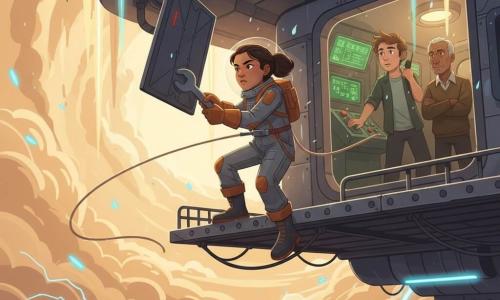
Milo pushed himself out of the airlock with a gentle shove. The station's exterior was a landscape of curved panels, handrails, and antennae. Sunlight struck the far side, turning metal into bright silver. The shadowed side was colder, darker, like the underside of a bridge.
He clipped his tether to an exterior rail and tested it with a tug.
“Tether secure,” he said.
“Confirmed,” Jae replied. “Tension nominal.”
Lysa's voice joined in. “Proceed along the rail to Segment Twelve. We've marked the route with beacon lights.”
Small blue lights blinked ahead, leading him around the curve of the station ring. Milo moved hand over hand, careful with each grip. His boots found footholds, magnets helping them cling to the station skin.
The view beyond was enormous. Earth rolled below, clouds like brushed paint. A thin line of sunrise glowed at the horizon, turning the edge of the planet into a soft ember.
Milo forced himself not to stare too long. Beauty could distract you just as much as fear.
“Coming up on Segment Twelve,” he said.
“Copy,” Lysa answered. “Scan for thermal differences. The leak should show as a small cold spot.”
Milo raised the suit's wrist scanner and swept it over the panels. The display painted a simple map: warmer zones in orange, cooler zones in blue.
“There,” Milo said. “I see it. A small blue line near a seam.”
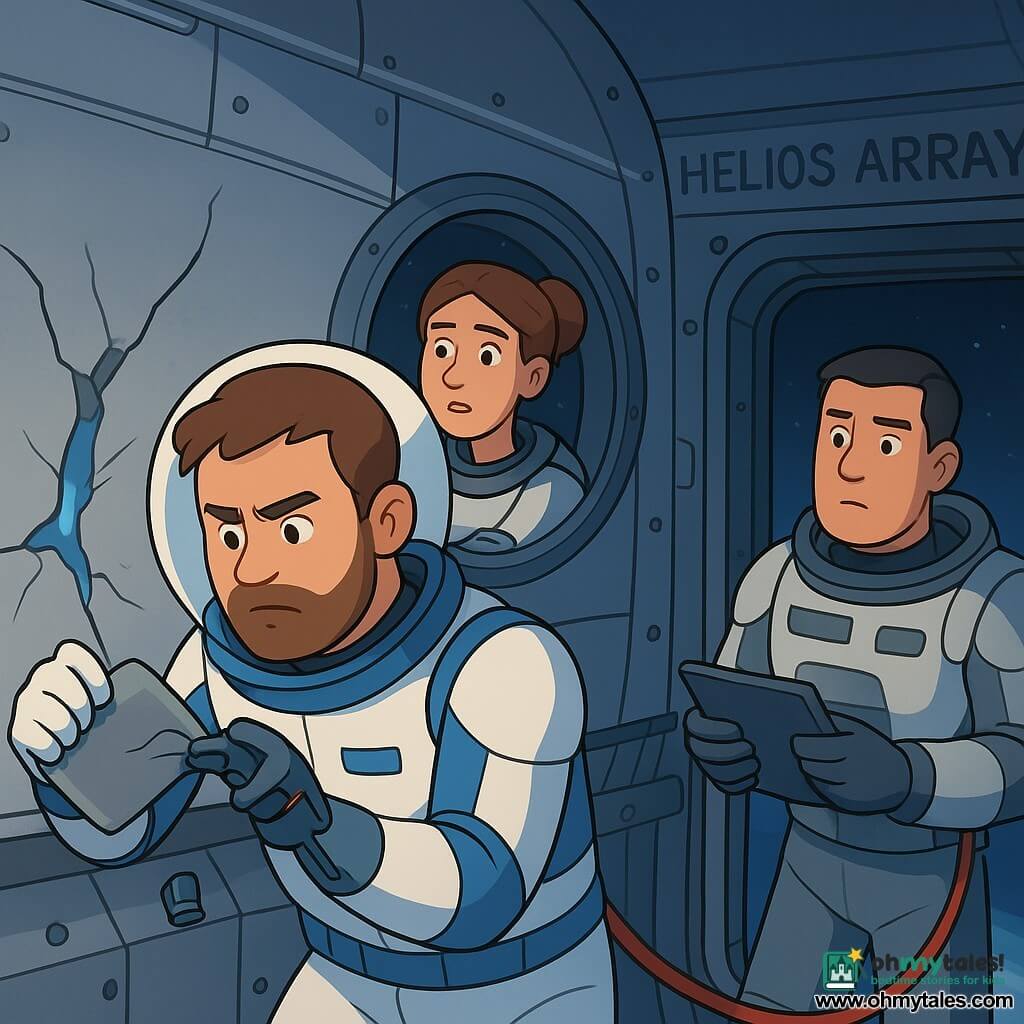
He drifted closer. The crack wasn't dramatic. It looked like a hairline scratch someone might ignore on a car door. But this scratch opened into nothingness.
“Leak confirmed,” Jae said, reading the numbers. “Pressure loss matches. It's tiny, but it's real.”
Milo anchored himself with a second tether and secured his boots. He pulled a patch kit from the tool pouch strapped to his thigh. The kit was a compact box with a peel-and-seal panel, a tube of quick-cure resin, and a small clamp frame.
Lysa spoke steadily. “Procedure: clean the surface, apply resin, place patch, clamp, cure, test.”
Milo nodded, even though they couldn't see it. “I remember.”
He took out a small scraper and brushed away dust and frost around the crack. In vacuum, even “dust” acted oddly, clinging in stubborn little grains. He used a vacuum nozzle built into the suit glove to suck loose particles into a filter.
“Surface cleaned,” he said.
“Good,” Lysa replied. “Resin next. Thin layer.”
Milo squeezed the resin tube gently. A clear bead emerged, thick like honey. He spread it over the crack with a flat applicator. It shimmered under the station lights.
As he worked, a faint vibration traveled through the station panel—like a distant purr.
“What was that?” Milo asked.
Jae's answer came quickly. “Station just rerouted coolant through a parallel line to reduce stress near you. You might feel small vibrations. It's normal.”
“Normal is comforting,” Milo said, trying to mean it.
He positioned the patch panel—a flexible sheet with embedded fibers—and pressed it over the resin. Then he fitted the clamp frame around it, tightening the knobs until the patch sat snug, hugging the hull like a bandage.
“Clamp secure,” Milo said.
Lysa exhaled audibly. “Great. Start cure.”
Milo tapped the patch's activation tab. A gentle warmth spread through the sheet as the resin began to harden.
Then the scanner on his wrist chirped sharply.
Milo froze. “Uh. Lysa? My scanner shows the cold spot widening.”
Silence for half a heartbeat—long enough for his imagination to sprint ahead.
Then Lysa's voice returned, still calm, just faster. “Widening where? Under your patch or adjacent?”
Milo adjusted his position and scanned again. “Adjacent. To the right. Along the seam.”
Jae swore quietly, then caught himself. “Sorry.”
Milo stared at the seam. A second hairline line had appeared, faint but real, like a crack in ice spreading from a pebble impact.
“It's branching,” Milo said.
Lysa's voice tightened, but stayed clear. “Okay. New plan, still methodical. Milo, do not remove the first patch. We'll stabilize the seam with a secondary strip. Can you reach the seam line with a reinforcement tape?”
Milo checked his kit. “I've got fiber tape and a small seal strip.”
“Good,” Lysa said. “We'll do a seam bridge. Clean, resin, tape, press. You have enough time. Your suit oxygen is solid.”
Milo swallowed. His hands felt very large and clumsy, even though they were doing exactly what he told them to do.
“One step at a time,” he whispered.
“What was that?” Jae asked.
“Talking to my hands,” Milo said. “They get nervous.”
“Tell them to behave,” Jae replied. “They're on station payroll for the next ten minutes.”
Milo almost laughed. The sound came out as a short puff in his helmet.
He moved to the branching crack and began again: scrape, vacuum, scan. His motions were deliberate, like assembling a model kit while someone watched with a stopwatch.
“Surface cleaned,” he said.
“Apply resin,” Lysa instructed.
Milo laid a thin resin line along the seam, then pressed the fiber tape over it. The tape stuck, dark and matte against the station's pale hull. He smoothed it with a gloved thumb until it lay flat, no bubbles.
“Press and hold,” Lysa said. “Thirty seconds.”
Milo counted out loud. “One… two… three…”
In the corner of his visor, the suit clock ticked. His breath sounded loud. His heartbeat felt like a drum, but steady.
At twenty seconds, the station gave another small vibration—stronger this time.
Milo's boots slipped half an inch.
His stomach lurched. He tightened his grip on the handrail. “I felt a jolt.”
Jae's voice sharpened. “We just got a micrometeor alert. Tiny debris cloud passing. Station shields are up, but you're outside.”
Milo's throat went dry. “What do I do?”
Lysa didn't hesitate. “Stay anchored. Minimize profile. Keep your face shield toward the station hull. Continue holding the tape. Do not let go.”
Milo pressed himself closer, like hugging the station. His body became a small bump on the metal surface. He held the tape down with both hands, elbows tucked.
In space, danger often arrived without sound. There was no roar. No whistle. Just the idea of a grain of sand moving faster than a bullet.
He kept counting. “Twenty-eight… twenty-nine… thirty.”
Another soft tap trembled through the panel near his left hand, like a fingernail on a table.
Milo didn't move. “Did something hit?”
Jae answered after checking. “We registered a minor impact on an outer baffle. Not your section. You're okay.”
Milo let out a breath he hadn't realized he'd been holding.
“Tape set?” Lysa asked.
Milo scanned. The cold line had stopped widening. The colors stabilized.
“Leak rate dropping,” he said, voice steadier now. “The seam looks stable.”
Lysa's voice warmed. “Excellent. Now we test.”
Chapter 5: Test, Verify, Then Breathe
Testing meant not trusting your own relief. Milo knew that. Relief was friendly, but it wasn't proof.
Lysa guided him through the check: scan along the patched areas, compare temperature gradients, watch for pressure change. Jae read suit and station numbers like a person reading a bedtime story—steady, predictable, safe.
“Leak rate now near baseline,” Jae said. “That's a good sign.”
Milo moved his scanner in slow arcs. The first patch glowed slightly warmer from the curing process. The second seam strip sat quiet and dark, holding firm.
“Visual looks good,” Milo said. “No fluttering edges.”
“Give it two more minutes,” Lysa said. “Resin needs full cure. We're not leaving a half-baked cookie out there.”
Milo stared at Earth while he waited, because it helped. The planet looked peaceful, which was unfair, considering how hard everyone worked to keep things peaceful.
“Milo,” Lysa said, softer now, “how are you doing?”
He considered lying. Humble pilots sometimes did that: pretend nothing touched them.
But method meant telling the truth so others could plan.
“My hands are shaking a little,” he admitted. “Not enough to drop anything. But enough that I notice.”
“That's human,” Lysa said. “You're doing great. Keep your elbows braced. Let the structure take the load, not your muscles.”
Milo adjusted, pressing his forearms against a ridge. Instantly, the tremor mattered less.
“Hey,” Jae said. “When you get back inside, I owe you a cup of station coffee. It tastes like brave decisions and old filters.”
Milo chuckled. “I'll take mint tea instead.”
“Mint tea?” Jae sounded offended. “On a fusion station?”
“Very advanced,” Milo said. “It's heated with science.”
Lysa's laugh came out brighter this time. “Resin should be cured now. Final scan.”
Milo scanned the seam carefully, then the area around it, widening his search circle. No new cold lines. No spreading blue. The station's outer skin looked whole again.
“Reading stable,” Milo reported. “No leak.”
Jae's voice lifted. “Pressure holds. Helios internal compartments can reopen in stages. Great work.”
Milo felt his shoulders loosen inside the suit. The tension that had lived in his spine began to drain away.
“Return to airlock,” Lysa said. “Same route. Slow.”
“Slow is smooth,” Milo replied.
He unclamped his tools, secured the kit, double-checked both tethers, and began the trip back along the handrails. His movements felt lighter now, not careless—just less burdened.
As he rounded the curve toward the airlock, sunlight caught the station's edge, turning the metal into a bright ribbon. For a moment, Helios Array looked less like a machine and more like something hopeful—an instrument pointed at the future.
At the airlock, Lysa's face appeared behind the inner window, eyes following every motion. She opened the outer hatch controls from inside once Milo signaled.
Milo pulled himself into the chamber and secured the door.
“Outer hatch sealed,” he said.
“Confirmed,” Lysa replied. “Pressurizing.”
Air hissed in. The suit relaxed slightly as pressure returned around it. Milo's ears popped.
When the inner hatch opened, Lysa and Jae were there, and the corridor behind them seemed suddenly cozy—just walls and lights and people.
Milo's boots touched the floor with a gentle thud as station gravity took him back.
He removed his helmet. Cool, recycled air washed over his face. He realized he'd been smiling.
Lysa clapped him once on the shoulder. “You did it, Milo.”
He tried to shrug it off, as usual. “Just careful.”
Jae pointed at Milo's suit. “Careful is going to get a promotion around here.”
Milo raised an eyebrow. “Does the promotion come with better coffee?”
Lysa's grin turned mischievous. “No. But it comes with responsibility. Much worse.”
They walked together down the corridor. The red warning strips were dimming, one by one, like the station was exhaling.
In the control alcove, a speaker crackled. A new voice came through—older, steady, the kind of voice that didn't waste words.
“Pilot Raines,” the voice said. “This is Station Director Amari. I've reviewed the telemetry. Your patch held. Your seam bridge held. You followed procedure under pressure.”
Milo stopped, suddenly self-conscious. “Thank you, Director. I had good guidance.”
“You did,” Director Amari agreed. “But guidance doesn't move hands. People do. Method, patience, and double-checking—those saved us today.”
Milo glanced at Lysa and Jae. Their faces were tired, but lighter.
Director Amari continued, voice lowering into something almost gentle. “Helios Array is stable. Crew compartments will reopen. Fusion output remains steady. You can stand down.”
Milo let the words sink in. Stable. Steady. Stand down.
“And Milo,” the director added, “for what it's worth: you're not ‘just' careful. You're the kind of careful that keeps thousands of lights on down there.”
Milo looked through a nearby window at the curve of Earth. Somewhere under those clouds, cities would be glowing tonight, powered by a station that now had one less crack.
He swallowed, suddenly aware of the simple things: the warmth in the corridor, the soft hum under his feet, the fact that he could breathe without a helmet.
Lysa nudged him. “Mint tea?”
Milo nodded. “Mint tea.”
As they walked toward the mess hall, Director Amari's voice came once more over the speaker, not as an announcement now, but as a reassurance meant for every tired person on the station.
“Helios crew,” the director said, “good work. You are safe. We're here together. Take it step by step. We have time.”