Chapter 1: Docking Lights Like Fireflies
Mara Quill watched the interplanetary transfer hub swell in her cockpit window until it filled the stars.
Helix Junction wasn't a planet or a ship. It was a spinning city built around a hollow ring, glittering with docking bays and glass corridors. Shuttles drifted in neat lanes, their engine plumes blinking like polite conversations. Farther out, cargo tugs hauled containers the size of apartment blocks. Everything moved with careful purpose, like a choreographed dance.
Mara's hands rested lightly on the controls. She didn't grip, because she didn't need to. Her scout ship, the Faraday Finch, knew the route as well as she did.
“Approach vector confirmed,” said Finch's onboard voice, crisp and calm. “Bay Twelve is reserved. Please refrain from dramatic piloting.”
Mara smirked. “Dramatic piloting is my only hobby.”
“That is statistically untrue,” Finch replied. “You also enjoy reorganizing tool drawers.”
“Don't tell anyone. I have a reputation.”
The hub's lights pulsed in a welcoming pattern: green, green, soft amber. Clear instructions, clear paths. Mara liked that. Space had enough mysteries; it didn't need confusing parking.
A traffic controller's voice came through, warm and efficient. “Faraday Finch, you're cleared for Bay Twelve. Welcome to Helix Junction. Keep your shields on standby—minor dust bloom reported near the outer rim.”
“Copy,” Mara said. “Thanks for the heads-up.”
She guided the Finch through the bay mouth. Magnetic clamps caught with a satisfying thud, like a door closing properly. The cockpit went quiet except for the gentle tick of cooling metal.
Mara unbuckled and stretched. Her suit was sleek, light, and scratched in places where she'd been too confident around sharp edges. She checked her wrist display: three transfer tickets, one delivery crate, and a message labeled URGENT.
She opened it.
MARA QUILL—IF YOU'RE AT HELIX JUNCTION, PLEASE REPORT TO LAB SECTOR EIGHT. CONTAINMENT STATUS: UNCERTAIN. PAY IS GOOD. TIME IS NOW.
—DR. HANA VOSS
Mara frowned. Lab Sector Eight was on the far side of the ring, past the gardens and the food courts and the “Please Do Not Touch the Robot” museum exhibit. Labs meant rules. Labs meant paperwork. Labs meant someone saying, “Don't touch that,” after you'd already touched it.
But “containment” and “uncertain” were words that made even confident explorers sit up straighter.
Finch chimed. “Your heart rate increased by eleven percent.”
“I read the message.”
“I noticed.”
Mara grabbed her utility belt and a small case of field tools. She paused, then added a compact sterilization unit—an emergency kit with a silver nozzle and a warning label that said USE WITH CARE, LIKE A TRUTH YOU CAN'T TAKE BACK.
Then she stepped into Helix Junction.
The corridor outside Bay Twelve smelled faintly of citrus cleaner and warm metal. People flowed past—pilots with grease-streaked sleeves, diplomats in shimmering fabric, station kids chasing a hovering ball that chirped every time it bounced.
Overhead, a sign glowed: TRANSFER HUB MAP—CLARITY IS SAFETY.
Mara pointed herself toward Lab Sector Eight.
“Okay,” she murmured. “Let's keep this simple.”
Finch, listening through her earpiece, replied, “Simple is not your usual setting.”
Mara walked faster anyway, boots tapping a steady rhythm on the deck, like a promise she intended to keep.
Chapter 2: The Door That Wouldn't Explain Itself
Lab Sector Eight was quieter than the rest of the hub. The lights were brighter and more even, with no cozy corners. Everything was designed to be seen clearly, with nothing left to guess.
Mara liked that too.
A security arch scanned her as she passed. It projected her name in pale blue letters:
MARA QUILL — VISITOR — ESCORT REQUIRED.
“Escorts are for people who get lost,” Mara muttered.
“Or for people who get curious,” Finch said.
A second door slid open after she pressed the buzzer. A tall woman with a shaved head and sharp eyes stood there, holding a tablet like it might bite.
“Quill?” the woman asked.
“Mara,” Mara said. “You must be Dr. Voss.”
“Yes. Thank you for coming quickly.” Dr. Hana Voss stepped aside. “Follow me. And do exactly what I say.”
Mara followed, hands relaxed but ready. She could feel the difference in the air: filtered, dry, with a faint chemical bite. The corridor walls were glass, showing rooms full of neatly arranged equipment—sealed cabinets, clean benches, robotic arms folded like sleeping insects.
Dr. Voss walked fast. “We had an incident in Microbiology Lab Three. It was supposed to be routine work. Non-sentient samples. Nothing dangerous.”
“That sentence rarely ends well,” Mara said.
Dr. Voss shot her a look that was half warning, half exhaustion. “A junior tech opened a quarantine drawer without running the scan first.”
Mara winced. “So… the drawer got offended?”
“The drawer did not. The contents did.” Dr. Voss stopped at a thick door with a red stripe. Above it, a status panel blinked: CONTAINMENT: PARTIAL.
Mara leaned closer. “What's inside?”
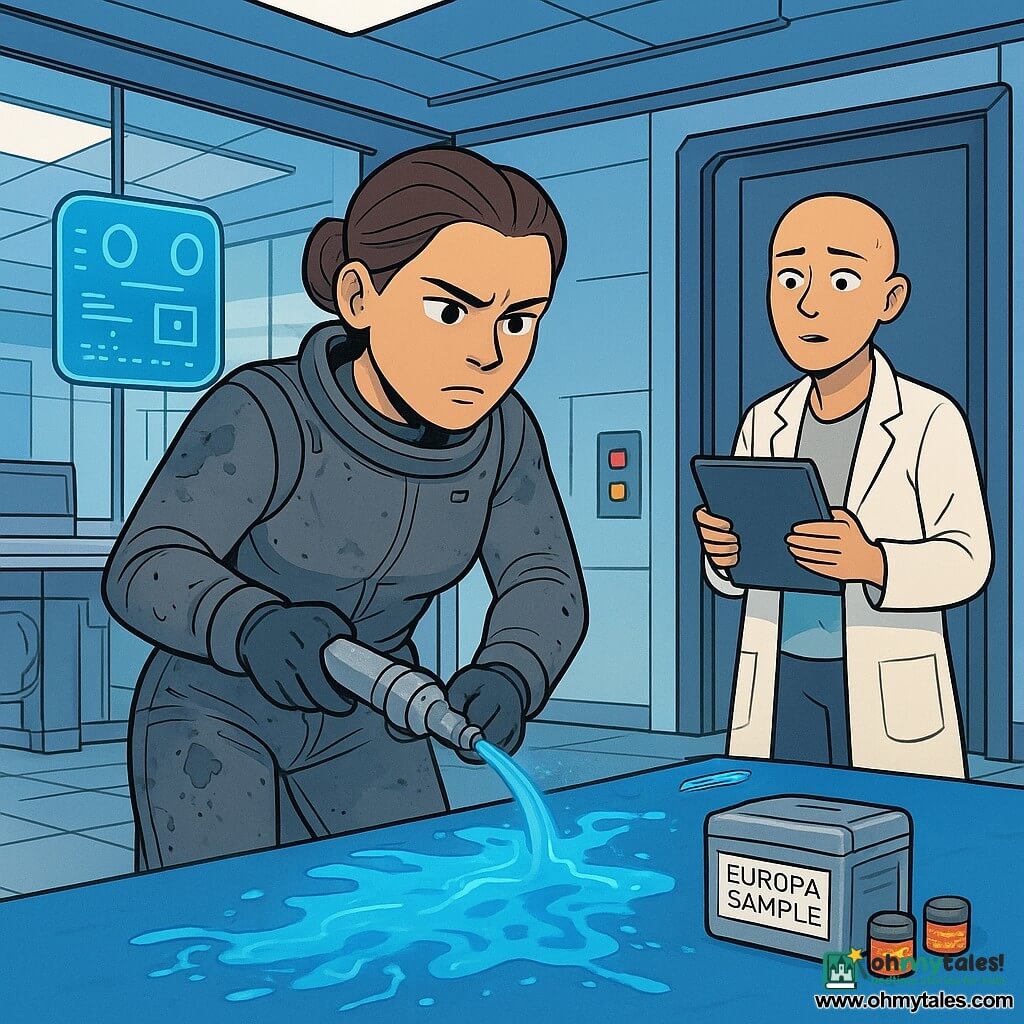
Dr. Voss tapped her tablet. “A biofilm sample from Europa's sub-ice vents. It doesn't behave like Earth bacteria. It forms sheets, responds to light, and—unfortunately—loves warm electronics.”
Mara pictured it draping over circuits like hungry moss. “So it's… a machine snacker.”
“It's not malicious,” Dr. Voss said firmly. “It's alive. It's confused. It's in the wrong place.”
Mara respected that phrasing. Clear. Kind. Still serious.
Dr. Voss continued, voice clipped. “Our sterilization system was set to automatic. But the biofilm spread into a maintenance channel and coated the sensors. The system can't see properly, so it won't fire. Safety protocols.”
“So the lab is locked in a nervous stalemate,” Mara said. “The system won't sterilize because it can't confirm what it would sterilize.”
“Exactly.” Dr. Voss looked at Mara. “We need a manual sterilization sweep. Someone who can follow procedure and stay calm.”
Mara raised an eyebrow. “You called me because I reorganize tool drawers?”
Dr. Voss's mouth twitched, almost a smile. “Your ship's logs show you've cleared contamination in derelict habitats. And you don't panic when alarms sing.”
Mara glanced at the blinking panel. It made a soft, patient chirp, like it wanted to be helpful.
“I'll do it,” Mara said. “But I need clarity. What's the goal?”
Dr. Voss's eyes sharpened. “Sterilize the lab. Full decontamination. Save the equipment. And—if possible—collect a sample without letting it touch anything else.”
Mara nodded. “Straight lines. No guessing.”
Dr. Voss handed her a small badge. “This gives you manual override access. It also records everything you do.”
“Good,” Mara said. “If I mess up, I want it documented with excellent spelling.”
Dr. Voss didn't laugh, but her shoulders loosened by a fraction. “Inside, you'll see pale blue patches. That's the biofilm. Avoid direct contact. It's not toxic, but it can cling. It's like… sticky curiosity.”
“That sounds familiar,” Mara said.
Dr. Voss pressed her palm to the door sensor. “Once you're in, the door stays sealed until the air is scrubbed. You'll have fifteen minutes of suit oxygen beyond the lab's supply. Use your time wisely.”
Mara checked her suit seals and pulled on her gloves. She clipped the sterilization unit to her belt where she could reach it quickly. Finch's voice hummed in her ear.
“I am tracking your vitals,” Finch said. “If you attempt dramatic heroics, I will complain loudly.”
“Thanks,” Mara whispered. “Complain with clarity.”
Dr. Voss stepped back. The door unlocked with a deep, reluctant sound.
Mara walked in.
Chapter 3: The Lab That Grew a Second Skin
Microbiology Lab Three smelled wrong—not bad, exactly, but mixed up. Like clean air trying to remember how to be clean.
The lights were on, bright and steady. That made the blue patches impossible to ignore.
The biofilm spread across the floor in thin sheets, glossy as wet paint. It climbed table legs and curled around a rolling chair, as if the furniture were warm rocks beside a sea. In the corner, it had crept onto a wall panel, where tiny indicator lights blinked underneath, trapped like fireflies under ice.
Mara moved slowly, boots placed carefully on clear tiles between patches. Her suit's visor displayed a simple map: green where it was safe, amber where it was questionable, red where the biofilm was thick.
“Okay,” Mara murmured. “We do this like a recipe.”
Finch's voice responded. “Step one: do not lick unknown alien substances.”
“Please stop reminding me of my childhood.”
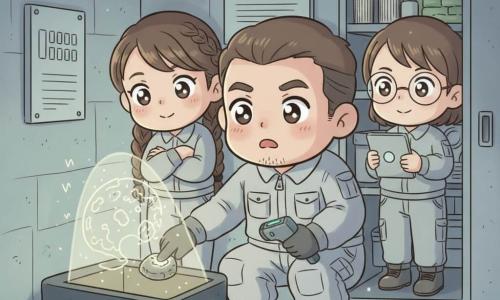
Mara opened her tool case and pulled out a handheld scanner. She swept it across the nearest patch. The screen showed a living layer with rhythmic ripples, as if it were breathing with the room's ventilation.
“Interesting,” Mara said, meaning it. “It reacts to the light.”
She dimmed her suit lamp a notch. The ripples slowed.
“Light-sensitive,” Finch noted. “It may be seeking energy or avoiding it.”
Mara approached the wall panel where the blue sheet covered sensors. Dr. Voss had been right: the lab couldn't “see” itself. The sterilization system was blindfolded by a thin, stubborn blanket.
Mara tapped her wrist display and began recording out loud, because speaking steps made them real.
“Manual sterilization sweep. Objective: restore sensor visibility, sanitize surfaces, prevent spread. Method: isolate, neutralize, confirm.”
She unclipped the sterilization unit. It was about the size of a water bottle, with a nozzle and a dial. Not a flamethrower—more like a focused, cool mist of reactive particles designed to break down organic films without melting the lab itself.
Mara adjusted the dial to LEVEL TWO. Strong enough to work, gentle enough to avoid turning the room into a science-smelling soup.
“Procedure,” Finch said. “Start at the edge and move inward.”
“Exactly.” Mara aimed at the thinnest edge of the biofilm near the wall panel and pressed the trigger.
A soft hiss. A pale mist. The blue sheen puckered, then dulled, then broke apart into dry flakes that the lab's air filters sucked away with a quiet slurp.
Mara exhaled. “Good.”
She worked in strips, as neat as mowing a lawn, clearing the panel first. With each pass, the trapped indicator lights came back into view, blinking like relieved eyes.
The panel's status shifted from red to amber.
A speaker in the ceiling clicked on. “Warning,” the lab announced in a neutral voice. “Sensor visibility improving. Awaiting full confirmation.”
“See?” Mara said. “It just needed someone to wipe its glasses.”
Finch replied, “The lab is grateful. The biofilm is not.”
As if on cue, a nearby patch quivered. The blue sheet lifted slightly at one edge, like a curtain caught in a breeze. It wasn't moving fast, but it was moving with intention—toward the warm hum of Mara's sterilization unit.
Mara stepped back. “It likes electronics,” she whispered.
She didn't run. Running made mistakes. She simply changed the plan.
“Finch,” she said, “how warm is this unit?”
“Surface temperature: thirty-two degrees Celsius,” Finch replied. “Comfortable for human hands. Possibly delicious for alien goo.”
“Great. I'm a walking snack cart.”
Mara unclipped a spare power cell from her belt, set it gently on the floor two meters away, and switched it on. A small green light glowed. Warmth radiated in a tiny halo.
The biofilm's edge angled toward it, sliding with slow, patient eagerness.
“Bait,” Mara said. “Simple. Clear.”
She continued sterilizing the panel while the biofilm drifted toward the decoy power cell like a cat toward a sunbeam.
The status panel by the sealed door beeped once. CONTAINMENT: STABLE.
Dr. Voss's voice crackled over the intercom. “Mara? Report.”
“Sensor panel is clearing,” Mara said. “Biofilm is attracted to heat. I'm using a decoy cell to pull it off critical systems.”
A pause. Then, with genuine relief, Dr. Voss said, “Good thinking. Keep your movements measured. Don't let it reach your suit joints.”
“Understood.”
Mara finished the wall panel. The lab's internal sterilization system chimed softly, like it had been waiting politely.
“Automatic sterilization now available,” the ceiling voice announced. “Confirm activation.”
Mara didn't confirm yet. The biofilm still covered the floor in wide sheets. If the system fired too soon, it could stir air currents and spread flakes into vents where they didn't belong.
“Not yet,” Mara said. “We do it cleanly.”
She turned, scanning the room. In the center stood a lab bench with sealed sample containers. One had been opened—the guilty drawer's prize. Its lid sat crooked, and a thin blue thread stretched from it to the floor like a spilled ribbon.
Mara's stomach tightened. “That's the source.”
Finch's voice lowered. “If you sterilize the source container, you prevent regrowth.”
“Right.” Mara moved toward the bench, stepping around thicker patches. Her suit lamp stayed dim, her movements slow.
The biofilm had reached the decoy power cell and wrapped around it lovingly. Its surface shimmered, pulsing faintly.
Mara felt a strange tug of sympathy. It wasn't attacking. It was trying to survive. It just had terrible manners.
“Okay,” she murmured, “we'll get you somewhere safer. But first, we clean.”
Chapter 4: Fifteen Minutes and a Clean Line
Mara stood at the lab bench, facing the opened container. A small label read: EUROPA VENT SAMPLE — HANDLE IN QUARANTINE.
“Someone skipped the last part,” Mara said.
She took a sterile scoop from a dispenser and held it like a tiny shovel. With her other hand, she aimed the sterilization nozzle at the blue thread connecting container to floor.
“Cut the bridge,” she told herself. “Then treat each side.”
She misted the thread gently. It shriveled and flaked away. The connection was gone.
The biofilm on the floor shivered, as if noticing it had been separated from its birthplace.
Mara didn't waste time feeling guilty. Clarity meant choosing the next right thing, even when emotions tried to crowd the controls.
She sealed the container lid, then wrapped it in a transparent quarantine bag from the bench drawer. The bag sealed with a snap, locking the sample inside a clean bubble.
“One source contained,” Mara said into her recorder. “Now we sterilize the environment.”
Finch chimed. “Oxygen estimate: twelve minutes remaining beyond lab supply.”
“Plenty,” Mara said, though she felt the clock like a weight in her pocket.
She moved back toward the door side of the room, creating a clear path behind her. She didn't want to cross treated areas and reintroduce flakes. Her boots tracked nothing; her suit soles were designed for cleanrooms. Still, she respected the rule: don't assume, verify.
She raised her wrist display. “Dr. Voss, I'm ready to activate automatic sterilization after I clear two more floor sheets. Confirm you're prepared on your side.”
Dr. Voss answered immediately. “Prepared. Airlock scrubbers are primed. Mara—thank you.”
“Save thanks for when I'm out,” Mara said. “It's bad luck to thank someone mid-alarm.”
“I don't believe in luck,” Dr. Voss replied.
“Then believe in timing.”
Mara returned to the floor sheets. The decoy power cell was now heavily coated, almost hidden. The biofilm around it had thickened, as if it had found a buffet and invited its cousins.
“That's fine,” Mara said. “Gather in one place. Make it easy.”
She adjusted the sterilizer to LEVEL THREE for the thick patch, and began at the edges, sweeping inward. The mist hissed. The blue sheen cracked and collapsed into pale dust, sucked into filters.
But the patch reacted more strongly this time. It pulled away from the mist, sliding toward Mara's boots.
Mara took one step back—then another—keeping a safe distance. Her heart tapped faster, but her hands stayed steady.
“Finch,” she said, “suggestion?”
“Lower heat signature,” Finch replied. “Your suit's external heaters can drop by two degrees. You may feel slightly less cozy.”
“Do it.”
Her suit cooled. The biofilm's forward slide slowed, as if disappointed.
Mara used the moment to place a second decoy—another warm cell—farther away, near a corner drain.
The biofilm angled toward the new warmth. Mara sterilized behind it, cleaning the path it left.
“Clear line,” she breathed. “Clear line.”
When the thickest patch was reduced to flakes, the floor tiles gleamed again. Only a few thin sheets remained near the far cabinets.
Mara checked the time. Eight minutes. She could finish manually, but the risk of stirring it by walking deeper was rising. Better to let the lab's system do what it was designed to do—now that it could see.
She approached the control panel by the door. Its indicator light was green.
“Automatic sterilization: ready,” the ceiling voice said. “Confirm activation.”
Mara took a steady breath. “Confirm.”
A low hum spread through the room. Vents opened in the ceiling, releasing a fine, invisible sterilizing cloud—not harsh, not smoky. The air took on a crisp smell, like rain on hot stone.
The remaining biofilm sheets dulled almost instantly. Their glossy shine faded into matte gray, then into nothing but specks.
Mara stood still, arms slightly away from her sides, letting the system do its work. It felt like being in a gentle, extremely strict snowfall.
“Sterilization in progress,” the lab said. “Please remain stationary for optimal coverage.”
“I can do stationary,” Mara whispered. “I'm excellent at dramatic stillness.”
Finch replied, “I am taking a screenshot of your posture for future teasing.”
The hum deepened, then softened. After a long minute, the lab announced, “Sterilization complete. Air scrub cycle engaged.”
Mara looked down. The floor was clean. The walls were clean. Even the decoy power cells sat bare, their green lights blinking innocently, as if they had not just served as alien bait.
“Dr. Voss,” Mara said, “lab appears sterile. Request unlock after scrub cycle.”
There was a sound on the other end that might have been Dr. Voss exhaling for the first time in an hour. “Unlocking as soon as pressure equalizes. Mara—did you manage to secure the source sample?”
Mara held up the quarantine bag. “Secured and sealed.”
“Excellent. You may have saved us weeks of shutdown.”
Mara's shoulders eased. “That's what I'm here for. Keeping things moving.”
The door panel blinked amber. The air scrubbers hissed, drawing the last of the sterilizing cloud into filters.
Mara waited, listening to the clean, steady sounds of systems doing exactly what they were meant to do.
Chapter 5: Helix Junction, Back to Breathing
The door finally unsealed with a smooth click. Mara stepped into the airlock, and the inner door closed behind her. The scrubbers washed her suit in a gentle gust, like a giant hand brushing dust from her shoulders.
When the outer door opened, Dr. Voss stood there with two technicians in clear masks. Their eyes went straight to the quarantine bag.
Mara held it up. “One Europa vent sample, safely contained. Also, your lab is cleaner than my kitchen.”
Dr. Voss accepted the bag with careful hands and passed it to a technician who slid it into a hard case. “Your kitchen must be legendary.”
“It's legendary for having a spoon in every drawer,” Mara said. “Organization is my brand.”
One technician laughed—quick, nervous, relieved.
Dr. Voss's face softened. “You kept your head. You followed procedure. And you improvised without turning it into chaos.”
Mara shrugged. “Improvisation is just planning with surprises.”
They walked down the corridor together. Through the glass walls, other lab rooms continued their quiet work. A cleaning drone rolled by, humming like it was proud of itself.
Dr. Voss glanced at Mara. “How did you know to use decoy heat cells?”
Mara tapped her temple. “The biofilm wanted warmth. I gave it warmth somewhere harmless. Clear cause, clear effect.”
Dr. Voss nodded. “Clarity. We teach it, but under pressure people forget.”
Mara remembered the blue sheen pulsing, the way it had curled toward the lights. “It wasn't evil,” she said. “Just out of place. Like a fish in a power outlet.”
“That is a terrible image,” Dr. Voss said, and then, unexpectedly, she smiled properly. “But accurate.”
They reached a small observation window that looked into Lab Three. Through the glass, the room gleamed. The sensors blinked calmly. The status panel now read: CONTAINMENT: FULL — ENVIRONMENT: STERILE.
Dr. Voss watched it like someone watching a storm pass. “We'll review our protocols. The tech who opened the drawer—”
“Don't crush them,” Mara said gently. “Teach them. Make the steps so clear they can't trip.”
Dr. Voss's gaze flicked to her. “You're confident.”
“I'm trained,” Mara corrected. “Confidence is just training that trusts itself.”
A station announcement echoed faintly from far away—something about boarding calls and orbital windows. Helix Junction kept moving, because it had to. People depended on it the way planets depended on sunrise.
Dr. Voss turned. “Your message said you were delivering a crate?”
Mara blinked. “Yeah. Nutrient gels for a greenhouse dome on Ceres. Glamorous stuff.”
Dr. Voss's expression became thoughtful. “We may need you again sooner than you think.”
Mara tilted her head. “Because of the biofilm?”
“Because of what the biofilm means,” Dr. Voss said. “A living layer that responds to light and seeks warmth—Europa's vents might be more active than we thought. There could be an ecosystem we're only beginning to understand.”
Mara felt the familiar pull of deep space curiosity, the kind that made her stare at stars too long. “And Helix Junction is the doorway to everyone's destinations.”
“Yes,” Dr. Voss said. “If something like this slips through again, it won't politely stay in one lab.”
Mara glanced at the clean corridor, the clear signs, the ordered flow of people. A hub like this was built on trust: that systems worked, that rules held, that everyone did their part.
She straightened. “Then we make the rules clearer,” Mara said. “And we stay ready.”
Dr. Voss studied her for a moment, then nodded once, decisive. “Agreed.”
Chapter 6: A Promise in Plain Words
Mara returned to Bay Twelve later with the taste of crisp sterilized air still in her throat. The Faraday Finch waited patiently, dock clamps holding it like a steady handshake.
As she stepped aboard, Finch greeted her. “Welcome back. Your suit smells like discipline.”
Mara laughed and tossed her gloves into a bin. “Discipline is a scent now?”
“It is to me,” Finch said. “I have excellent sensors and a judgmental personality.”
Mara sank into the pilot's chair and stared at the hub through the cockpit window. From here, Helix Junction looked peaceful again—lights in tidy arcs, ships sliding into place, the slow spin of the ring like a calm thought.
Her wrist display buzzed. A new message from Dr. Voss appeared.
QUILL—INCIDENT REPORT FILED. LAB SECURE. WE'RE REVISING TRAINING: CLEAR STEPS, NO SHORTCUTS.
ALSO: WE'VE RECEIVED ANOTHER EUROPA SHIPMENT NEXT WEEK. I'D LIKE YOU PRESENT.
CAN YOU HELP?
—VOSS
Mara read it twice, not because it was confusing, but because it was so direct. A clear request. No drama. No pretending everything was fine when it wasn't.
She opened her reply and spoke it aloud as she typed, letting each word land solidly.
“I can help. Send me the schedule and the procedures you want followed. I'll be there.”
She hit send.
Finch's voice softened, almost gentle. “A promise of aid has been recorded.”
Mara leaned back, feeling the Finch's familiar hum under her feet, like a purring animal made of metal and math. “Good,” she said. “Promises should be recorded. Makes them harder to wriggle out of.”
“Are you wriggly?” Finch asked.
“Only when someone tries to make things confusing,” Mara said. She looked at the hub again, at the bright lines of traffic and the bold signs that said what they meant. “Out here, clarity is kindness.”
Finch paused, then said, “Shall I plot a course to Ceres for your glamorous nutrient gels?”
Mara grinned. “Plot it. And Finch?”
“Yes?”
“Next time I bring bait cells, remind me to label them.”
“Label: NOT A SNACK,” Finch suggested.
“Perfect,” Mara said, and the Faraday Finch powered up, ready to glide back into the star-laced lanes—calm, precise, and prepared to return when help was needed.