Chapter 1: The Watch That Wouldn't Tick
Milo kept his treasures in a shoebox under his bed: a smooth stone shaped like a bean, a comic with a ripped corner, a tiny plastic astronaut missing one arm… and a watch that didn't belong to any of those things.
It was heavy and warm in his palm, like it had its own little heartbeat.
“Still dead?” asked Zara, peering over his shoulder. Her hair was tied up with a pencil, like she might suddenly need to write down a brilliant idea. She often did.
Milo shook the watch close to his ear. “No ticking. But it's not broken. It just… waits.”
Tomas leaned in, eyebrows raised. “A watch that waits. Like you before you brush your teeth.”
“I brush,” Milo protested.
“Eventually,” Zara said, grinning.
They were all eleven. They had been in the same class since second grade, which meant they had shared a lot: field trips, lost lunch money, and one spectacular science-fair volcano that had erupted too early and covered the teacher's shoes in foam.
Milo was the generous one. Not in a loud, braggy way. In a quiet way—like how he always split his last cookie, or how he carried extra pencils because someone always forgot theirs.
Today, he held the watch carefully, like it might be shy.
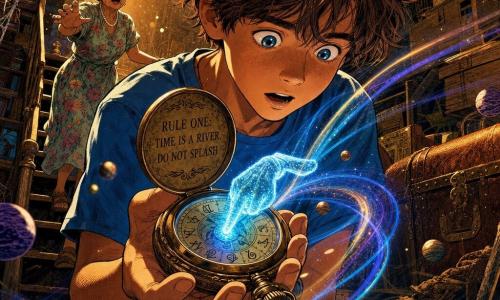
It was brass-colored with tiny scratch marks like little lightning. The face had numbers, but they weren't ordinary. Between the twelve and the one, someone had etched a small star. Between the six and the seven, a tiny spiral.
“Where did you even get it again?” Tomas asked.
Milo hesitated. “My grandpa's attic. It was in a drawer with old theater programs and… candle stubs.”
Zara's eyes lit up. “Theater programs?”
Milo nodded. “One said ‘The Candlelight Players.' Like, it's a real thing.”
Tomas made a dramatic bow. “Ladies and gentlemen! Welcome to the mysterious watch!”
Milo rolled his eyes, but he smiled. “Grandpa said it was a prop. But he also said not to wind it.”
Zara's fingers hovered. “So we should wind it.”
“Absolutely not,” Milo said quickly.
Tomas looked at the watch again. “Maybe it needs… a reason.”
“A reason?” Zara repeated.
Milo remembered his grandpa's voice, low and serious for once: Some things don't move until you're patient enough to listen.
Milo swallowed. “Maybe we should just… wait.”
Tomas groaned. “Waiting is your superpower.”
Zara tilted her head. “Or the watch is teaching you.”
Milo didn't answer. He simply set the watch on the desk between them, like a tiny sun. The afternoon light caught its face, and for a moment, the star on the dial seemed to sparkle.
Then—so softly Milo almost missed it—there was a single tick.
All three of them froze.
“Told you,” Tomas whispered, like he might scare it away.
Tick.
Tick.
The watch began to move, slow and steady, as if it had been holding its breath.
And then the air around it shimmered, like heat rising from pavement.
Zara's smile disappeared. “Uh… Milo?”
Milo's throat went dry. “That's… not normal.”
The desk seemed to stretch away. The room wobbled. The watch's hands spun in a smooth circle, not frantic—confident.
Tomas grabbed Milo's sleeve. “If this is your grandpa's ‘prop,' I want a refund.”
Milo tried to laugh, but the shimmer grew brighter. The sound of their classroom faded, replaced by another sound—soft and crackling.
Like flames.
Chapter 2: The Candle Theater
When the shimmer vanished, they weren't in Milo's bedroom anymore.
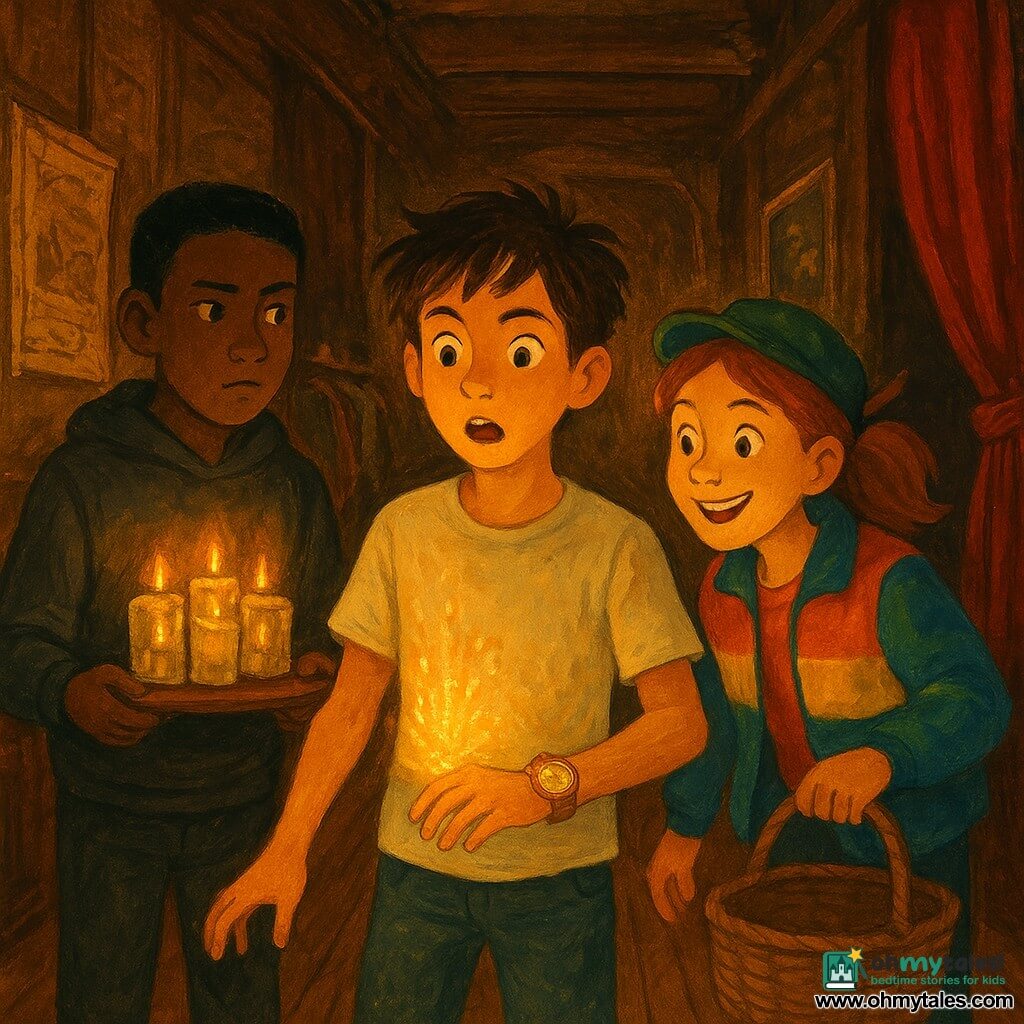
They stood shoulder to shoulder in a narrow hallway made of dark wood. The air smelled like wax and dust and something sweet—maybe oranges. The warm, flickering light came from rows of candles in glass holders, lining the walls like tiny suns.
Tomas blinked hard. “Either I fainted, or your shoebox is magical.”
Zara took one careful step. Her sneakers squeaked on polished boards. “This is real,” she said. “Listen.”
From somewhere ahead came a low hum: voices, shuffling feet, a faint pluck of strings, like someone tuning an instrument.
Milo's heart hammered. He glanced at the watch. It was now on his wrist, snug as if it had always belonged there. The star on the dial glowed faintly.
“How did it—” he began.
Zara pointed. “Look.”
A sign hung above a doorway, painted in curly letters:
CANDLELIGHT PLAYERS — TONIGHT
Tomas read it out loud, then whispered, “We're in a theater.”
Milo stared at the candlelight, the dark wood, the old-fashioned posters on the wall. People hurried by wearing long coats and caps, holding paper tickets. A lady carried a basket of ribboned pastries.
No one looked at the three kids like they were strange. That was the strangest part.
A boy about their age rushed past, holding a stack of folded costumes. He wore suspenders and had smudges on his cheek, like he'd argued with a chimney.
He stopped short when he saw them. “Are you here to help or stare?”
Zara straightened. “Help with what?”
The boy's eyes widened, as if that was the correct answer. “Backstage. We're missing a runner. Come on!”
He didn't wait. He turned and hurried through the doorway.
Tomas looked at Milo. “We should maybe… not?”
Milo's gaze flicked to the candles. To the sign. To the watch. The hallway felt like a page from one of his grandpa's dusty books.
He swallowed. “If we don't understand this, we might not get home.”
Zara nodded. “Also, I want to see backstage.”
Tomas sighed. “Fine. But if anyone asks, we're… small adults.”
They followed the boy.
Backstage was a world of ropes and curtains. Heavy velvet hung like dark waves. Candles stood in metal holders on crates, guarded by someone with a long pole and an expression that said I will not let anything burn today.
The boy shoved costumes at them—simple things: a cap, a cloak, a scarf.
“Put these on,” he said. “No time. The play starts in ten minutes. And if the Duke's letter doesn't get delivered in Act Two, the whole story collapses.”
Zara paused mid-scarf. “Collapses?”
The boy stared. “The audience gets confused. The actors argue. The director cries into a handkerchief. Everything collapses.”
Tomas muttered, “Drama. Literally.”
Milo tried to keep his voice calm. “What's your name?”
“Kit,” the boy said, already tugging a rope. “Kit Weller. And you?”
“Milo. That's Zara. That's Tomas.”
Kit nodded rapidly. “Great. Milo, you're the runner. Zara, you carry this basket. Tomas, you—” He looked Tomas up and down. “You're tall enough. You're the candle guard's helper. Don't let the candle tray tip. I'm serious.”
Tomas saluted. “I was born for candle safety.”
Milo watched Zara tuck her hair back under a cap. She looked thrilled and focused, like she'd stepped into one of her own daydreams.
“Okay,” Milo said quietly to the watch on his wrist. “If you brought us here, you'd better also bring us back.”
The watch's second hand moved with slow patience, as if it was saying: First, do what needs doing.
A bell rang. The backstage chatter snapped into place like puzzle pieces. Actors took positions. Someone whispered, “Places!”
Kit grabbed Milo by the sleeve and pointed at a narrow gap in the curtain. “You run across in the dark between Scene One and Scene Two. You give the letter to the actress in the blue dress. Don't miss. Don't dawdle.”
Milo's stomach fluttered. “I won't.”
Then Kit's eyes flicked to the watch, and his face changed—just for a second.
“Hey,” Kit whispered. “Where did you get that?”
Milo's mouth went dry. “It was my grandpa's.”
Kit nodded slowly, like that meant something important. “Then listen,” he said. “Don't change what you don't understand.”
Zara leaned in. “Are you… talking about time travel?”
Kit stared at her. “I'm talking about not making a mess.”
Tomas whispered, “Too late.”
The curtain rose. The candlelight warmed the air. The music began.
And Milo took his first step into the play—into the past—trying very hard not to make a mess of time.
Chapter 3: The Letter and the Paradox
Milo crouched behind a stack of painted scenery: a fake stone wall with vines, a moon on a stick, and a cardboard castle tower that looked brave from far away.
Through the curtain's gap, he saw the stage: a candlelit town square, cobblestones painted on the floor, actors moving like their feet had learned the music.
The audience sat close, faces glowing. No phones. No electric lights. Just quiet attention and the soft shiver of flame.
Journal Note — Milo:
Rule so far: Candle theaters are beautiful and slightly smoky. Also, my heart is doing sprints.
A stagehand pressed something into Milo's hand: a folded paper sealed with red wax.
“The Duke's letter,” the stagehand whispered.
Milo nodded. The wax felt real. The paper smelled like ink and age.
Zara passed behind him with the basket, pretending to be a market kid. She gave Milo a quick thumbs-up.
Tomas stood near a tray of candles, holding it steady like it was a wild animal. He mouthed, “Careful,” and widened his eyes.
Then the stage went dark—just a dim blue glow from a single covered lantern. The music shifted. Scene change.
Kit's whisper sliced the darkness. “Now!”
Milo ran.
The boards were smooth. The curtain brushed his shoulder like a soft warning. He crossed the stage fast, as quiet as he could, aiming for the actress in the blue dress waiting near the cardboard tower.
But right as he reached her, a small figure darted out—another kid, younger than them, wearing a cap too big for his head.
The kid collided with Milo. The letter flew.
Milo's fingers snatched at it, but the paper slid across the stage like it had its own plan.
It stopped near the edge, right in front of the audience's first row.
A man with a grand moustache leaned forward. His hand twitched, as if he wanted to pick it up.
Milo's brain did a quick, panicky flip. If the audience grabbed it, the play would break. If the play broke, Kit said everything would collapse.
Milo dove—more like a clumsy flop—and snatched the letter a heartbeat before the moustache man could.
There was a muffled giggle from the audience. They thought it was part of the show.
Milo pushed himself up and thrust the letter into the actress's hand.
She didn't blink. She tucked it into her sleeve with perfect grace and continued her line: “A message from the Duke… at this hour?”
The scene flowed on.
Milo scrambled offstage, breathing hard, and nearly ran into Kit.
Kit grabbed his shoulders. “Did you deliver it?”
Milo nodded. “Yes. But a kid ran into me. Who was that?”
Kit's face tightened. “There isn't supposed to be a kid there.”
Zara appeared, eyes bright. “I saw him too. He was fast.”
Tomas leaned in, whispering, “What if he's… also time traveling?”
Kit looked at the watch on Milo's wrist again. “Maybe,” he said. “Or maybe time is… glitchy.”
Milo blinked. “Time can glitch?”
Kit snorted softly. “Time can do whatever it wants. We just try not to make it angry.”
Zara folded her arms. “So what's the rule?”
Kit pointed at Milo's chest, like he was poking a rule into place. “You do your part. You don't add extras. You don't leave things behind.”
Milo felt suddenly cold. “Leave things behind?”
Kit's gaze dropped to Milo's pocket. “Like that.”
Milo froze. He reached into his pocket and pulled out something he hadn't put there: a modern, bright blue plastic pen.
Zara's eyes widened. “Milo! That's from your desk.”
Tomas groaned. “Congratulations. You invented plastic pens.”
Milo stared at the pen like it was a tiny disaster.
Journal Note — Milo:
New rule: Do not bring 21st-century objects into candle theaters. Also, my pocket is a traitor.
Kit's face went pale. “You can't keep that here.”
“I didn't mean to,” Milo said quickly. “I swear. It must've… stuck when we—”
Kit grabbed Milo's wrist, turning the watch slightly. “Then we fix it. You put it back where it belongs.”
Zara's voice lowered. “How?”
Kit jerked his chin toward the stage. “The kid who bumped you—he's part of this now. And the show isn't over. Time likes patterns. We use the pattern.”
Tomas frowned. “That sounds like you've done this before.”
Kit didn't answer directly. He just said, “Find the kid. Get the pen. Return it to where it came from.”
Milo swallowed. “But we don't know where ‘where it came from' is. Our room?”
Kit tapped the star on the watch face. “That watch is a door. But doors have rules. It won't open again until the moment matches.”
Zara whispered, “The moment matches what?”
Kit looked toward the stage, where an actor was now making a dramatic speech beside a painted fountain. “The ending,” he said.
Milo's chest tightened. “So we have to wait until the end of the play?”
Kit nodded once. “Patience. And meanwhile, you keep the story on track.”
A shout rose onstage—applause. The audience laughed.
Milo stared at the pen in his hand. It felt heavier than before.
He slipped it into his pocket, as if hiding it could undo it. “Okay,” he said. “We'll fix it.”
Tomas muttered, “I vote we fix it faster.”
Zara gave Milo a steady look. “We will. One step at a time.”
Milo looked at the watch. The second hand moved calmly, like a teacher tapping a desk: not angry, just firm.
Time wasn't sprinting.
Time was waiting.
And now, so were they.
Chapter 4: Backstage Rules and Sticky Time
They split up the way you do when you're trying to look brave: together, but each with a job.
Zara drifted near the costume racks, watching for the too-big cap. She pretended to straighten scarves while her eyes scanned every shadow.
Tomas stayed near the candles, because someone actually had to keep the place from catching fire. He looked like a bored guard at a museum, but his gaze was sharp.
Milo moved with Kit through the narrow paths between ropes and painted flats.
Kit kept talking in short bursts, like he didn't have time for full sentences.
“Don't touch props you don't need. Don't talk to the audience. If you hear your name from the wrong direction—ignore it.”
Milo frowned. “The wrong direction?”
Kit glanced upward, toward the rafters. “The direction time echoes from.”
Milo opened his mouth, then closed it. He could tell Kit wasn't trying to be mysterious. He just didn't know how to explain something that felt bigger than words.
Milo decided to try anyway. “Kit… are you from here?”
Kit hesitated. The candles flickered, making his face look older, then younger, then normal again.
“I'm from… around,” Kit said at last. “I help keep the play running. It's safer when it runs.”
“Safer for who?” Milo asked.
“For time,” Kit said, like it was obvious. “And for you.”
From the stage came a sharp sound: a slapstick thwack, followed by laughter. The play was in a funny part now. A character was hiding behind the cardboard fountain, clearly visible to everyone except the other characters.
Zara slipped up beside Milo. “I saw the kid,” she whispered. “He went toward the storage nook—by the trapdoor.”
Tomas appeared too, balancing the candle tray on his shoulder. “And I heard someone ask, ‘What's a pen?' which is not something people should say in a theater.”
Milo's stomach dipped. “He showed it?”
Zara nodded. “Just for a second. It looked like he was proud.”
Kit's jaw tightened. “Then we get it back before it becomes part of the world.”
Tomas whispered, “How would it become part of the world? It's a pen.”
Kit gave Tomas a look that was almost funny. “Small things are the worst,” he said. “They fit in pockets. They slip into stories. Big things get noticed.”
Milo thought of the blue pen. His blue pen. The one he'd chewed during math tests.
“Okay,” Milo said. “We go to the storage nook.”
They moved quickly, ducking under ropes and squeezing between stacked scenery. The theater felt like a wooden maze lit by tiny flames. Shadows stretched and shrank. Every candle made a soft crackle, like it was whispering secrets.
They reached a nook with old crates and rolled-up backdrops. A trapdoor was set into the floor, partly hidden under a cloth.
And there was the kid in the too-big cap.
He sat on a crate, turning Milo's pen over and over like it was a magic wand.
“Hey,” Zara said gently, stepping forward. “That's cool.”
The kid looked up, suspicious. His eyes were bright and quick. “It writes without ink,” he said proudly.
“It has ink inside,” Zara corrected, friendly but firm. “It's just… trapped in there.”
The kid frowned. “Trapped?”
Tomas leaned on the wall, pretending to be casual. “Like you when your mom says, ‘Just five more minutes,' and suddenly it's been an hour.”
The kid blinked. “Who are you?”
Milo stepped closer and crouched so he was at the kid's eye level. “I'm Milo,” he said softly. “That pen is mine. I dropped it by accident. I need it back.”
The kid's fingers curled around the pen. “Finders keepers.”
Milo took a breath. He wanted to grab it. He wanted to solve it fast.
But Kit's words echoed: Patience. Patterns.
Milo tried a different way. “What's your name?”
The kid hesitated. “Pip.”
Zara smiled. “Pip. That's a great name.”
Pip's chin lifted. “It's short.”
“It's quick,” Tomas said. “Like you.”
Pip's eyes flicked to Tomas, pleased despite himself.
Milo nodded at the trapdoor. “Do you work here, Pip?”
Pip shrugged. “I run messages. I hide when I'm bored. Everyone's busy. Nobody sees me.”
Milo's chest squeezed. Being unseen felt awful. He knew that feeling.
“You're good at running,” Milo said honestly. “I saw you. You're fast.”
Pip's grip loosened a little. “I am.”
“So,” Milo said, careful and calm, “you can help us. That pen doesn't belong here. It belongs… later.”
Pip frowned. “Later?”
Zara's eyes softened. “Another time.”
Pip stared at the pen again. “But it's special.”
“It is,” Milo agreed. “And because it's special, it can cause trouble.”
Pip looked up, alarmed. “Trouble like the director yelling?”
Kit stepped forward. His voice was quiet, but it filled the nook. “Trouble like the story cracking,” he said. “And when the story cracks, people get hurt.”
Pip's face went pale.
Milo held out his hand, palm up. “Give it back. And I'll give you something else.”
Zara's eyebrows shot up. Tomas mouthed, “What else?”
Milo didn't know yet. But he was generous. And generosity, he'd learned, didn't always mean giving stuff. Sometimes it meant giving time.
Milo said, “I'll teach you a trick.”
Pip blinked. “A trick?”
Milo nodded toward the stage, where the actors' voices rose and fell like waves. “A patience trick. One that makes waiting feel shorter.”
Pip hesitated, then slowly placed the pen into Milo's hand.
Milo closed his fingers around it, relief washing through him like warm tea.
“Okay,” Milo said, “here's the trick. When you have to wait, you pick three things you can see, two things you can hear, and one thing you can feel.”
Pip stared. “That's… a trick?”
“It is,” Milo said. “Because it pulls you into the moment. It makes time behave.”
Tomas whispered, “Time behaves?”
Zara nudged him. “Let him.”
Pip tried it, eyes moving. “I see candles. I see ropes. I see… your shoes.”
Milo smiled. “Good.”
“I hear music,” Pip said slowly. “I hear laughing.”
“And one thing you can feel,” Zara prompted.
Pip touched the wooden crate. “Splinters.”
Tomas nodded. “Welcome to theater.”
Pip's shoulders dropped, like he'd set down something heavy. “It did feel… shorter,” he admitted.
Kit crouched beside Pip. “Now you go back to your job,” he said. “And you stay out of the cracks.”
Pip swallowed. “Am I in trouble?”
Milo shook his head. “No. But… be careful. Some things are not meant for your pockets.”
Pip looked at Milo's wrist. At the watch. His eyes widened. “That's the star watch.”
Milo's breath caught. “You know it?”
Pip nodded quickly. “My gran said it belongs to the theater. It keeps the nights in order.”
Kit stood up fast. “Enough,” he said. Not angry—worried. “Go.”
Pip scrambled away, disappearing like a mouse into shadows.
Milo tucked the pen deep into his pocket. “Now what?” he whispered.
Kit looked toward the stage. “Now,” he said, “you wait for the ending. And when the last candle bow happens, the door will open.”
Tomas exhaled loudly. “So we're stuck doing… nothing?”
Zara shook her head. “Not nothing. We keep the play steady. And we don't drop any more future objects.”
Milo touched the watch. It felt warm. Steady.
Journal Note — Milo:
Patience trick works. Also, I owe Pip a real thank-you. Time is like a story: if you rush, you skip the part that explains why the ending matters.
Chapter 5: The Moment That Matches
The rest of the play moved like a careful machine.
Zara carried baskets, slipped through shadows, and whispered reminders when an actor nearly missed an entrance. Tomas kept the candles steady and cracked quiet jokes that made even the serious candle guard snort once.
Milo stayed close to Kit, watching and learning. He noticed how Kit listened—not just to words, but to timing. Like he could hear the hinges of the night.
In Act Three, the cardboard castle “collapsed” on purpose. Everyone gasped. Then they laughed when the villain popped out, dusty and angry.
In Act Four, the heroine forgave her friend. The candles made her face glow like a painting. Milo felt his throat tighten in a good way.
Between scenes, Milo wrote quick notes on a scrap of paper Zara found.
Journal Note — Milo:
The past smells different. Like wax and ink and wood. People pay attention. They really look at each other.
Journal Note — Milo:
Rule: don't tell people the future. Even nice facts. Especially nice facts. They might change their steps.
Journal Note — Milo:
Patience isn't empty. It's full of noticing.
Finally, the last scene arrived. The music softened. The actors gathered at the front of the stage, hands linked.
The director, a thin man with silver hair, stepped out and bowed so deeply his coat almost brushed the floor. The audience clapped, stamping their feet. Candle flames trembled with every gust of movement.
Kit leaned close to Milo. “This is it,” he whispered. “The moment matches.”
Milo's watch grew warmer, like a small sun waking up.
Zara appeared at Milo's side, breathless. “I don't want to leave,” she admitted, eyes shining.
Tomas leaned in too. “I do,” he said quickly. Then he added, “But also… this was kind of awesome.”
Milo looked at the stage one last time. Candlelight danced on smiling faces. He thought of Pip, of Kit, of all the careful work hidden behind the curtain.
“Kit,” Milo whispered. “Will you be okay?”
Kit's mouth tilted, almost a smile. “I'm always in the wings,” he said. “That's my place.”
Milo swallowed. “Thank you.”
Kit tapped the watch lightly. “Put the pen back where it belongs,” he said. “And don't forget: time likes kindness, but it respects patience.”
The watch face shimmered again. The star glowed bright. The air around the three kids wavered, like the world was made of water for a second.
Tomas grabbed Zara's sleeve. Zara grabbed Milo's hand. Milo's fingers tightened around the watch, as if holding onto a railing.
The candle crackle faded.
The applause stretched into a long, soft roar.
Then—snap.
Silence.
Chapter 6: Back to Now
They were back in Milo's bedroom, standing in the exact same triangle around the desk.
Afternoon light lay on the carpet. A car passed outside. Somewhere, a dog barked like nothing had happened at all.
Milo blinked fast. His room looked too bright. Too quiet.
Zara's scarf—borrowed from the theater—was gone. Tomas's borrowed cap was gone. Only their normal clothes remained.
Milo's blue pen was in his pocket.
He pulled it out like it might bite him.
Tomas pointed at the desk with a shaky finger. “Put it back,” he said. “Before we invent the printing press.”
Zara let out a small laugh, half relief, half amazement. “No,” she corrected. “Before we invent the pen.”
Milo nodded. Very carefully, he set the blue pen back into the pencil cup on his desk, exactly where it belonged.
The air didn't shimmer. The room didn't wobble. Nothing dramatic happened.
And somehow, that felt perfect.
Milo looked at the watch. It had stopped ticking.
Not broken—resting.
Zara leaned closer. “Do you think Kit was… real?”
Tomas rubbed his arms. “My brain says no. My eyes say yes. My nose says candle wax.”
Milo smiled softly. “He was real,” Milo said. “At least… in the way that matters.”
Zara sat on the edge of Milo's bed. “We should write this down,” she said, already reaching for a notebook. “Like a real journal.”
Milo hesitated. He thought of Kit's warning: Don't change what you don't understand.
“We can write what we learned,” Milo said. “Not… instructions.”
Tomas nodded. “Lesson one: don't carry extra stuff in your pockets.”
Zara added, “Lesson two: patience is not the same as doing nothing.”
Milo looked at the watch again. He felt a strange affection for it, like it was a quiet teacher who didn't need to shout.
He gently unbuckled it and placed it on the desk.
Right beside the pencil cup.
The watch lay still, catching the sunlight, its tiny star calm and bright, as if it had simply been waiting for the right time to rest.