Chapter 1: The Garage Rule
Milo kept three rules taped to the workbench in his parents' garage.
1) Wear goggles.
2) Label your wires.
3) Never, ever build something you can't explain to your friends.
Tonight he was breaking rule three—only a tiny bit.
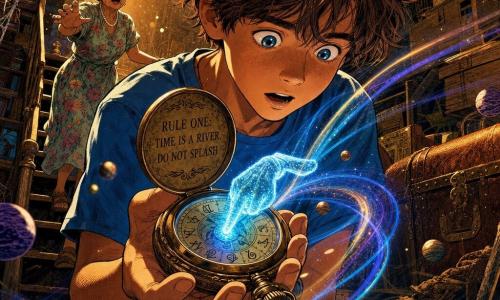
On the bench sat a metal lunchbox with a compass glued to the lid, a kitchen timer taped to the side, and a bicycle bell on top for reasons Milo refused to explain until he was sure it worked.
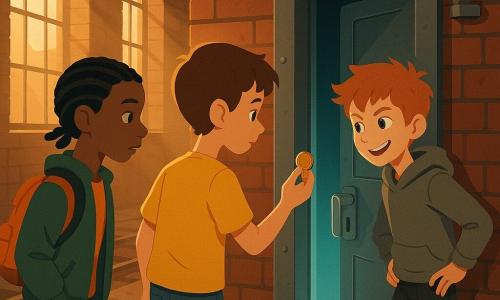
Zara leaned in, her dark braid swinging like a question mark. “So. Is this your… science project?”
“It's our science project,” Milo said quickly. He was cheerful by nature, the kind of kid who waved at dogs even if the dogs didn't wave back. “And it's not just science. It's—” He lowered his voice. “Time.”
Jun, sitting cross-legged on the concrete floor, held a notebook like it was a shield. “Time as in… clocks. Or time as in… yesterday.”
“Yesterday,” Milo said, eyes shining.
Zara stared at the lunchbox. “That is a lunchbox.”
“It used to be,” Milo admitted. “Now it's a Chrono-Carrier.”
Jun flipped his notebook open. His neat handwriting marched across the page. “Explain it like we're not about to faint.”
Milo pointed at the compass. “This helps it ‘listen' to the Earth's magnetic whisper.”
Zara blinked. “The Earth whispers?”
“Everything whispers,” Milo said. “You just have to listen.”
Jun raised a finger. “Value lesson noted. Continue.”
Milo tapped the kitchen timer. “This sets the minute. Exactly the minute. That's important.”
“How important?” Zara asked.
“Like… if we miss it, we might come back when my little cousin is running my life important.”
Jun made a strangled sound that might have been laughter. “I'd like to avoid that.”
Milo pointed at a roll of copper wire wrapped around a jar. “This is the coil. It makes a loop for… time to trip over.”
Zara poked the bicycle bell. “And this?”
Milo grinned. “Emergency stop. If anything feels wrong, you ring it. Ding means ‘bring us home.' Simple.”
Jun scribbled. “Rule: If you feel weird, ring the bell.”
Zara crossed her arms. “Define weird.”
Milo thought. “If the air tastes like pennies. If your ears pop. If you suddenly remember a song you've never heard.”
Jun looked up. “That last one sounds… specific.”
Milo smiled sheepishly. “It happened once. On a very small test. With a spoon.”
Zara's eyebrows climbed. “You time-traveled a spoon?”
“It was only three seconds,” Milo said. “And it came back slightly warmer. Which means—”
“That you nearly invented hot cutlery,” Zara said.
Jun closed the notebook with care, like it might explode if startled. “Okay. Let's establish the most important rule.”
Milo pointed to the tape on the bench. There, in thick marker, were the words:
LISTEN FIRST. ACT SECOND.
Zara read it aloud. “Listen first. Act second.”
Milo nodded. “If we're going to meet the past, we don't barge in like we own it.”
Jun added, “Also, we do not touch anything we might recognize. No ‘accidental' autograph hunting.”
Zara smirked. “You mean no stealing a famous baseball card to pay for college.”
Jun's ears turned pink. “I was joking.”
Milo flipped a small switch. The coil hummed softly, like a sleepy bee. The compass needle trembled, then steadied.
Outside the open garage door, their neighborhood looked ordinary: streetlights, quiet hedges, the distant sound of someone's TV. The present.
Milo swallowed, but his grin stayed. “Ready?”
Zara and Jun looked at each other. Then Zara lifted the goggles from the bench and put them on like a crown.
“Ready,” she said. “But if we land in dinosaur times, I'm climbing you.”
Jun sighed. “If we land in dinosaur times, I'm ringing the bell before you can climb anything.”
Milo set the kitchen timer with careful fingers. “June 14th, 1966. 7:42 p.m.”
Zara whistled. “Specific.”
“It's the night of the Maple Street Block Party,” Milo said. “My grandma told me about it. Lights strung across the street. Music. Lemonade. A moon so bright it looked like it had been polished.”
Jun's eyes narrowed. “How do we know we won't bump into your grandma?”
“We won't,” Milo said. “She said she was at her aunt's that summer, two towns away. And we're going to stay on the edge. Observe. Listen.”
Zara leaned close to the lunchbox. “Okay, Chrono-Carrier. Don't be dramatic.”
Milo pressed the red button.
The air thickened, as if the garage had become a jar of honey. The hum rose to a smooth, bright note. The compass needle spun once, twice, then pointed straight down.
Jun's hair floated like he'd been underwater. “I… don't… like… thiiiis…”
Zara opened her mouth to speak, but her voice stretched like taffy.
Milo reached for the bicycle bell.
Then the world snapped like a rubber band.
Chapter 2: A Street Full of Sparkle
They landed standing up, which felt like winning an invisible contest.
Warm summer air wrapped around them. The sky was the color of deep blue ink, and the moon hung above the rooftops like a bright coin. Maple Street looked familiar in shape—same sidewalks, same trees—but everything wore a different outfit.
The cars were boxy and shiny, like toys made of real metal. The streetlights had rounder tops. And the houses—oh, the houses had more front-porch chairs, as if people were expecting conversation to arrive any minute.
Across the street, colorful bulbs were strung from pole to pole. They glowed in cheerful dots: red, green, gold. Paper lanterns bobbed in the breeze. Someone had set up a record player on a folding table, and music spilled out—bouncy and bright, with a drumbeat you could hop to.
Zara's eyes went wide. “We're… here.”
Jun checked his watch like it might have opinions. “7:42. Exactly.”
Milo exhaled, relief and wonder mixing in his chest. “It worked.”
A group of kids ran past, laughing, their sneakers flashing white in the moonlight. One boy carried a hula hoop. A girl had a balloon tied to her wrist. They didn't look scary-old. They looked… like kids.
“Blend,” Milo whispered.
Zara looked down at her clothes. “I'm wearing a hoodie with a neon logo.”
Jun stared at his bright sneakers. “And I'm wearing shoes that probably didn't exist yet.”
Milo opened the Chrono-Carrier. Inside were three plain shirts and three pairs of simple shorts, folded tight, like a secret.
Zara's jaw dropped. “You planned wardrobe?”
Milo grinned. “Rule two: Label your wires. Rule four: Bring backup clothes.”
They ducked behind a tall hedge and changed quickly, giggling and shushing each other.
When they stepped back onto the sidewalk, they looked like any other kids at the party—almost. Zara's braid still looked like it belonged to someone who could solve puzzles faster than most adults. Jun's careful calm still hung around him like an invisible backpack. Milo's smile still made him look like he'd just heard good news, even when he hadn't.
They walked toward the lights, keeping to the edge like Milo promised.
A table was set up with pitchers of lemonade and paper cups. A hand-painted sign said: HELP YOURSELF! ONE CUP EACH!
Jun leaned closer to Milo. “One cup each. That's… organized.”
Milo nodded. “And polite. We follow the rules.”
Zara sniffed the air. “I smell hot dogs.”
Milo's stomach answered with an embarrassing growl.
They moved past families chatting on folding chairs. People waved at each other with the easy friendliness of a street that had known itself for a long time.
A man in a short-sleeve shirt turned the record over and the music changed, still lively but softer. A couple began to dance, laughing when they bumped into each other.
Zara breathed, “This is like stepping inside an old photo.”
Jun whispered, “Except the photo is loud.”
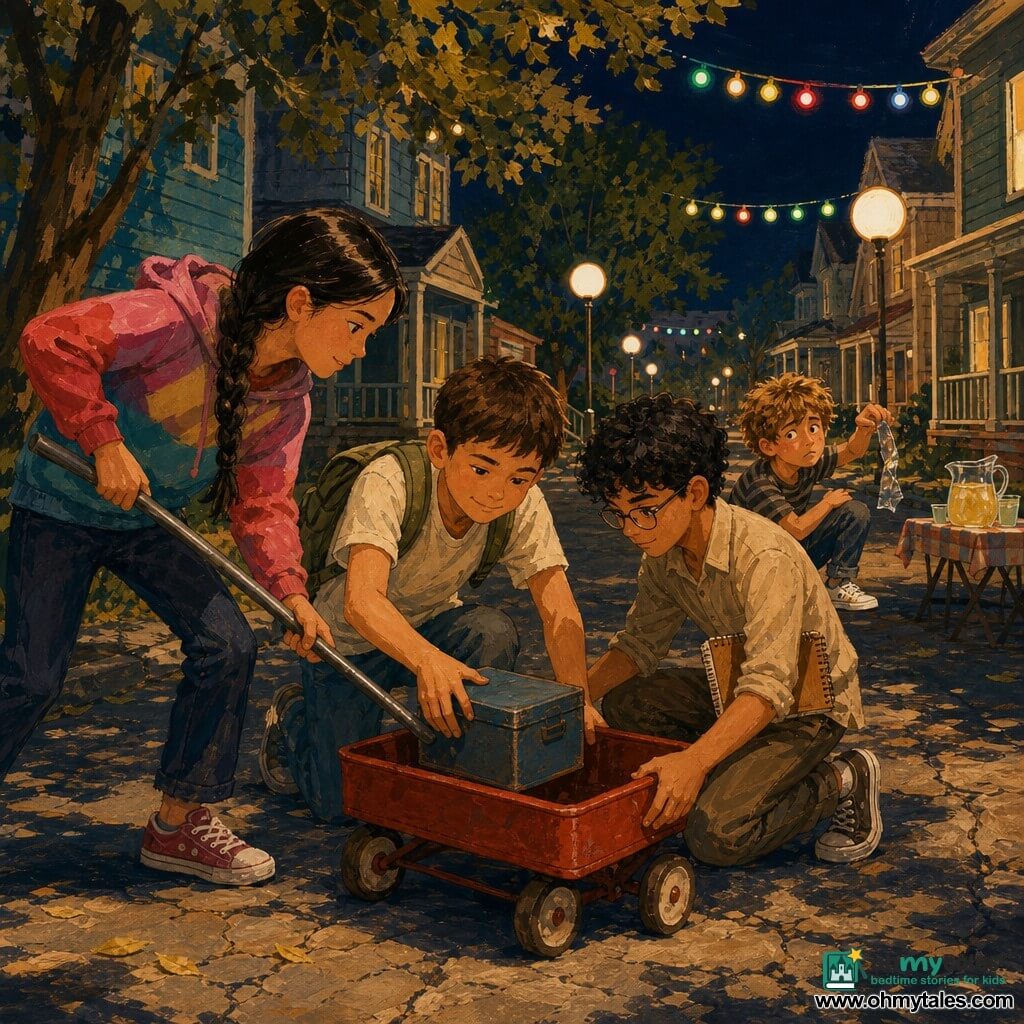
Milo's eyes caught on something near the curb: a little red wagon loaded with glass soda bottles. A sign on the wagon said: SODA—10¢.
Zara stared. “Ten cents?”
Jun frowned. “We don't have… time money.”
Milo patted his pocket. “We have… emergency nickels.”
Zara gave him a look. “You planned money too?”
Milo shrugged. “Grandma's coin jar. She said it was ‘from the old days.' I asked if I could borrow some. She said yes, but she also said, ‘Listen carefully when the past talks.'”
Jun's eyebrows lifted. “Your grandma is wise.”
Milo smiled. “She's also scary when you don't listen.”
They approached the wagon. A girl about their age stood behind it, hands on hips like a mini boss.
“Want a soda?” she asked. Her voice had a confident bounce.
Milo tried to sound casual. “Sure. Three.”
“Thirty cents,” she said.
Milo held out three dimes, trying not to look proud.
The girl eyed them. “You're not from Maple Street.”
Zara's shoulders stiffened.
Jun answered too fast. “We're visiting.”
The girl leaned in, curious, not mean. “Visiting from where?”
Milo remembered the tape on the bench: LISTEN FIRST. ACT SECOND. He took a breath. “From… across town. My friend's aunt lives nearby.”
The girl nodded slowly, still studying them. “Okay. I'm Lottie. Don't do anything weird.”
Zara coughed. “Define weird.”
Lottie pointed at a boy trying to juggle apples. “That's weird. But it's allowed because it's funny. Also, don't mess with the grown-ups' radios. Mr. Phelps gets grumpy.”
Jun opened his soda carefully, like it might be historic. “We won't.”
Lottie's eyes flicked to Jun's watch. “Nice watch.”
Jun froze. “Thanks.”
“Does it tell the future?” Lottie asked, half-joking.
Milo almost choked on his soda.
Zara jumped in, smiling. “Only boring stuff. Like… when it's time to go home.”
Lottie laughed. “That's the most important future.”
Milo felt the Chrono-Carrier in his backpack, a comforting weight. In exactly… how long? He checked the timer's dial through the crack of the lunchbox lid.
They had sixty minutes.
A breeze moved the lanterns. The street glittered. Somewhere, someone yelled, “Three-legged race starts in five!”
Zara's eyes shone. “Can we?”
Jun hesitated. “We're supposed to observe.”
Milo listened—to the music, to the happy noise, to the steady beat of the moment. “We can observe while racing. Just… gently.”
Zara grinned. “Gently competitive. My favorite.”
They stepped toward the chalk line painted on the street.
And that's when Milo saw it.
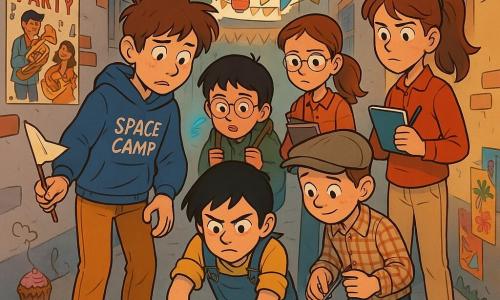
A small boy, maybe seven, was crouched near the curb, peering under the wagon. His face was tight with worry. Next to him, an older man with a clipboard was counting something and frowning.
“Missing,” the man muttered. “It was right here.”
The boy whispered, “It rolled under.”
The man shook his head. “No time. We start the raffle at eight.”
Milo felt a tug in his chest, like the past had just cleared its throat.
Zara noticed too. “What's missing?”
Lottie followed their gaze. “The raffle ticket box,” she said. “It's the money for the community garden. If it's gone, grown-ups will argue all night.”
Jun's voice dropped. “If it changes the mood of the whole party…”
Milo nodded. “Small thing. Big ripple.”
Zara's grin faded into focus. “We should help.”
Jun looked alarmed. “Are we allowed to?”
Milo remembered the rule. Listen first. Act second. He watched the man's face, the boy's worry, the way adults nearby were starting to turn their heads.
Helping wasn't barging in. Helping was… listening to what the moment needed.
“We help,” Milo decided. “But we do it carefully. No showing off. No weird.”
Zara lifted her soda. “Define weird.”
Jun sighed. “We know.”
Chapter 3: The Mischievous Paradox
The three-legged race began with a whistle, but Milo, Zara, and Jun drifted toward the wagon instead.
The boy was still crouched, his small hands reaching under the wooden wheels. His fingers scraped the pavement.
“It's too far,” he whispered.
Milo knelt beside him. “Hey. I'm Milo. Want help?”
The boy's eyes darted to Milo's face. “I'm Eddie. It's stuck.”
Jun knelt on the other side, careful not to block anyone's view. “What does the box look like?”
Eddie pointed. “Tin. Blue. Has stars on it.”
Zara leaned down, her braid brushing the curb. “Like a cookie tin?”
Eddie nodded hard. “Yeah!”
Milo peered under the wagon. In the dim light, he saw something blue wedged behind a crate of soda bottles.
“I see it,” Milo whispered. “But we can't just yank it. The bottles could tip.”
Jun's brain clicked like gears. “We need a lever.”
Zara scanned the street. “A stick.”
Milo listened to the party sounds, to the grown-ups talking louder, to the man with the clipboard tapping his pencil faster.
Then Milo spotted a spare tent pole leaning against a porch. It was thin metal, smooth, perfect.
Zara started to move.
Jun caught her sleeve. “Ask.”
Zara blinked. “Right. Listening first.”
They approached the porch where a woman was arranging napkins.
Zara spoke clearly. “Excuse me. May we borrow that pole for one minute? We're trying to reach something under the wagon.”
The woman looked at them, surprised but kind. “Just bring it right back, honey.”
“Thank you,” Zara said, and she carried it like it was a valuable instrument.
Back at the wagon, Milo slid the pole under carefully, nudging the tin. The box scraped the pavement with a tiny squeal.
Eddie held his breath.
Jun steadied the wagon's side with both hands, his face serious. “Slow. Slow.”
The tin inched forward.
Then—clink.
A soda bottle shifted. Another bottle clinked back. The sound was sharp in Milo's ears, like a warning bell.
Zara whispered, “Stop!”
Milo froze.
They listened. The bottles settled. No crash. The party noise flowed on, unaware they'd just nearly invented a rainstorm of glass.
Milo tried again, even slower. The tin slid, stubborn but obedient, until Eddie could finally grab it.
Eddie pulled it out like a treasure chest. “Got it!”
The man with the clipboard turned. His face changed from frown to relief. “There it is! Good work, kiddo.”
Eddie beamed—then looked at Milo and the others. “They helped.”
The man nodded at them. “Thanks. Where you three from?”
Milo's heart did a quick jump-rope.
Jun began, “We're—”
But Zara stepped on his sentence with a smooth smile. “We're friends of Lottie. Just visiting for the party.”
Lottie, hearing her name, glanced over and lifted her chin like, Yes, they are.
The man chuckled. “Well, visiting friends are the best kind. Now we can do the raffle on time.”
He carried the tin away.
Milo exhaled.
Zara handed the pole back to the woman, who nodded approvingly. “Good manners,” she said.
Jun murmured, “We changed something.”
Milo frowned. “We returned something that was supposed to be here.”
Jun opened his notebook, flipping to a page. “But why was it under the wagon in the first place?”
Eddie, still beside them, shrugged. “It rolled. I tried to get it, but I couldn't.”
Zara's eyes narrowed. “Rolled… on its own?”
Eddie frowned. “No. Someone bumped the table.”
Milo's thoughts raced. Someone bumped the table. The tin rolled. It got stuck. They retrieved it. Normal.
Then Milo noticed something near the wagon wheel: a thin strip of shiny plastic, like the torn corner of a modern wrapper.
Plastic that looked very much like something from their time.
Zara saw it too. Her voice dropped. “Milo…”
Jun followed their gaze, eyes widening. “That… shouldn't exist.”
Milo's stomach turned cold, even in the warm night. “Did we drop something?”
Zara patted her pockets. “No.”
Jun's face tightened. “We haven't eaten anything with a wrapper.”
Milo stared at the strip. It glinted under the party lights, out of place like a neon fish in a pond.
A mischievous thought flickered through Milo's mind, unwanted but loud: What if this is from us—later? What if we haven't dropped it yet?
Jun whispered, as if reading Milo's mind. “A loop.”
Zara swallowed. “A paradox.”
Milo looked around. No one else noticed the strip. Kids ran past. Music played. The moon watched silently.
Milo leaned in, voice low. “We have to fix it. If someone finds that, they'll ask questions.”
Jun nodded. “And questions travel.”
Zara picked up the strip with two fingers like it was a bug. “We take it with us.”
Eddie tilted his head. “What's that?”
Milo smiled gently. “Just trash. We're cleaning up.”
Eddie brightened. “Oh! My mom says clean streets make happy feet.”
Zara blinked. “That's… adorable.”
Jun scribbled quickly. “Note: 1960s children have excellent sayings.”
They moved away from the wagon, toward the darker edge of the street where shadows gathered under trees.
Milo opened the Chrono-Carrier and dropped the strip inside.
The kitchen timer's hand ticked steadily.
Forty-two minutes left.
Then Zara pointed across the street.
A small group of kids had gathered near a table with a big, shiny object on it—like a camera, but bulkier.
A sign beside it read: FILM CLUB—TAKE A PICTURE! ONLY ONCE!
Jun squinted. “A camera… That could capture us.”
Milo's eyes widened. “We can't end up in someone's photo album.”
Zara's mouth quirked. “Unless we want to become the mysterious ‘strange kids' that haunt Maple Street history.”
Jun looked horrified. “No.”
Milo listened again. The past wasn't angry. It was busy. It was friendly. It didn't want strangers on film. It wanted kids laughing, raffle tickets, and the right things in the right places.
“We stay off-camera,” Milo decided. “And we keep an eye out. That plastic strip means something is trying to tangle time.”
Zara tilted her head. “Or someone.”
Jun's gaze slid over the crowd. “Someone else might be out of place.”
Milo's grin returned, smaller now but still brave. “Then we listen. And we act carefully.”
They melted into the party's edge, three quiet detectives in borrowed shorts.
Chapter 4: The Boy with the Wrong Sneakers
They found the out-of-place person near the record player.
He was about their age, maybe eleven. He wore a striped shirt like everyone else, but his sneakers were unmistakable: bright white with a sleek shape Milo had seen in ads online. The kind that practically screamed, I was made in the future.
The boy stood stiffly, watching the dancers like he was afraid the music might bite. Every few seconds he glanced down at his shoes, as if they were going to report him.
Zara murmured, “Wrong sneakers.”
Jun nodded. “Definitely wrong.”
Milo approached slowly, hands visible, smile gentle.
“Hi,” Milo said. “Cool shoes.”
The boy flinched. Then his face relaxed a fraction. “Thanks.”
Zara leaned in, voice light. “You look like you're trying to remember how to be normal.”
Jun added, “No offense. We're also working on it.”
The boy's eyes flicked from face to face. “You're… like me.”
Milo kept his voice soft. “Time travelers?”
The boy's shoulders sagged with relief so big it looked like it hurt. “Yes.”
Zara crossed her arms. “Okay, time traveler. Name?”
“Cal,” he said. “Calvin. But Cal.”
Jun asked, “How did you get here?”
Cal swallowed. “My dad's lab. He's building a prototype. I wasn't supposed to touch it. But I did. And then—” He waved at the glowing lanterns. “This.”
Milo nodded slowly. “And you dropped something. Plastic.”
Cal's eyes widened. “I— I had a snack bar in my pocket. I panicked and… I threw the wrapper.”
Zara's face went flat. “You threw it. In 1966.”
Cal looked miserable. “I know. I know! I tried to pick it up but I got scared someone would see me. Then the raffle box rolled and people started looking and—” His words tumbled like marbles. “Everything feels like it's happening because of me.”
Jun's voice stayed calm. “Maybe it is. Maybe it isn't. But we can solve the part we can see.”
Milo nodded. “We already picked up the wrapper piece. But we need to make sure no one found any other bits.”
Zara pointed at Cal's shoes. “And those. Those are basically yelling.”
Cal glanced down. “I know! I tried to hide them in the dark.”
Jun asked, “Do you have a way home?”
Cal pulled a small device from his pocket—thin, shiny, like a remote. “This. But it needs a signal from the machine. I think it only works if I'm in the right spot, at the right time.”
Milo's fingers tightened on his backpack strap. “Same for us.”
Zara's eyes sharpened. “So we have a shared problem. Great. Team-up.”
Cal looked up, hope flickering. “You'll help me?”
Milo's smile warmed again. “Yes. But we have rules.”
Jun held up his notebook. “Rule one: Don't change big things. Rule two: Don't leave future objects. Rule three: Listen first. Act second.”
Cal nodded quickly. “Okay. I'll listen.”
Zara said, “Good. Listening includes not running away when things get awkward.”
Cal winced. “Fair.”
They moved toward the edge of the street, away from the music. Under a tree, Milo opened the Chrono-Carrier and showed Cal the plastic strip.
Cal sighed. “That's mine. Sorry.”
Jun asked, “Any other items from your time?”
Cal patted his pockets and pulled out a small, modern coin and a crumpled paper with printed text. “I didn't even realize.”
Zara took a breath, then softened. “Okay. Not the end of the world. We can contain it.”
Milo held out his hand. “Give them to me. They'll ride back with us.”
Cal handed them over. His shoulders lowered as if someone had unhooked a heavy backpack.
Then a voice called, “Hey! You kids!”
They all froze.
Mr. Phelps—apparently—stood near a porch with a radio the size of a suitcase. He peered at them, suspicious.
“You three,” he said, eyes narrowing at Cal's too-white sneakers. “And you. What are you doing lurking?”
Zara opened her mouth.
Milo squeezed his eyes shut for half a second and listened. What did the moment need? Not lies piled like pancakes. Not panic. It needed respect.
Milo stepped forward. “Sorry, sir. We were making sure no trash got left near the wagon. The garden raffle is important.”
Mr. Phelps' stern look wobbled.
Jun added quickly, “And we were staying out of the way of the music.”
Cal nodded, copying them. “Yes, sir.”
Mr. Phelps grunted. “Well… that's decent. Just don't mess with the radio.”
Zara smiled sweetly. “Wouldn't dream of it.”
Mr. Phelps walked off, still grumpy, but less suspicious.
Cal breathed out. “You're good at that.”
Milo shrugged. “It helps to listen. Adults usually tell you what they care about without meaning to.”
Jun glanced at the timer inside the lunchbox. “Twenty minutes.”
Zara looked at Cal. “Can you get back with us?”
Cal's face tightened. “I don't know. My device might not sync with yours.”
Milo's mind raced. Time rules felt like train tracks: you could ride them, but you couldn't pretend they weren't there.
“We'll try,” Milo said. “But we have to be in the exact spot we arrived. And we have to leave the party the way it would have gone if you hadn't tossed your wrapper.”
Zara pointed toward the raffle table. “Which means: make sure the raffle happens. On time. With no weird objects.”
Jun nodded. “And no photos of us.”
Cal gulped. “Okay.”
They slipped along the edge, scanning the ground for any other shiny bits. Milo spotted one more sliver near the curb and scooped it up fast.
Zara watched the camera table carefully, steering them away whenever someone lifted it.
At 7:57, the man with the clipboard carried the blue tin to the raffle table. He set it down with a satisfied nod.
A woman lifted a microphone connected to the radio speaker and tapped it. “Testing, testing!”
The speaker crackled. Mr. Phelps looked thrilled, which was somehow even scarier than his grumpy face.
Jun whispered, “If the raffle starts at eight…”
Milo checked the timer. “We leave at 8:02. Two minutes after. Enough to let it begin.”
Zara's eyes darted to Cal. “Can you wait that long without doing something impulsive?”
Cal managed a small smile. “I can listen.”
The microphone squealed softly. Kids giggled. Adults hushed them with friendly hands.
The woman's voice rang out. “All right, Maple Street! Let's raise money for that garden!”
Cheers rose like bubbles.
Milo felt the moment settle into its rightful shape. The tin was where it belonged. The mood was bright again. The past was back on its feet.
Now they just had to leave it without tripping over it again.
Chapter 5: The Bell That Means Home
At 8:00 p.m., the raffle began. Numbers were drawn. People clapped. Someone won a pie and held it up like a trophy.
Zara watched, smiling, but her foot tapped with quiet urgency.
Jun kept checking the timer in Milo's lunchbox. “Two minutes.”
Cal held his device so tightly his knuckles turned pale. “What if it doesn't work?”
Milo's voice stayed steady. “Then we'll ring the bell.”
Zara glanced at the bicycle bell sticking out of the backpack. “Your emergency plan is a bike bell.”
“It's a good sound,” Milo said. “Happy and clear. Time should respond to clear signals.”
Jun murmured, “Please let time enjoy bicycles.”
At 8:01, a boy ran by waving a glow stick—except it wasn't a glow stick. It was a sparkler, bright and fizzing, held at arm's length.
Cal flinched. “Fire—”
“It's okay,” Zara said quickly. “They do that here.”
Milo felt Cal's fear like a draft. He leaned closer. “Listen. Not every unfamiliar thing is dangerous.”
Cal nodded, swallowing.
At 8:02, Milo tapped Jun's shoulder. “Now.”
They moved fast but not frantic, slipping away between hedges and parked cars, toward the darker side street where they'd arrived. The lantern glow faded behind them. The music became muffled, like a song behind a closed door.
Under the same tree, the air felt slightly thicker, as if it remembered them.
Milo set the Chrono-Carrier on the ground. The timer hand clicked to the marked minute.
Jun stood close, shoulders squared. Zara held the backpack strap and glanced back once at the party lights.
Cal whispered, “I'm sorry. For the wrapper. For everything.”
Milo looked at him. “You're here now. That matters.”
Zara added, “And next time, listen before you touch the scary science machine.”
Jun nodded. “Also: pockets. Check your pockets.”
Cal almost laughed. “Yes. Definitely.”
The air tasted faintly like pennies.
Jun's eyes widened. “That's one of your signs.”
Milo's fingers found the bicycle bell. “Ready?”
Zara said, “Ready.”
Jun said, “Ready.”
Cal said, “Ready.”
Milo pressed the red button.
The hum rose again, brighter this time, like the garage had taken a deep breath from far away. The compass needle spun and pointed down.
Cal lifted his device. A tiny light blinked on, matching the Chrono-Carrier's rhythm.
“It's syncing!” Cal whispered, amazed.
The world thickened. The moonlight smeared into silver paint. The distant music stretched into a long, friendly note.
Milo's stomach floated.
Zara's braid lifted.
Jun's notebook pages fluttered as if trying to escape.
Milo rang the bell once—just in case.
Ding.
The sound cut through everything like a clean line drawn with a ruler.
And the world snapped.
Chapter 6: The Exact Minute
They were back in the garage.
Not a second later.
The hum faded. The air returned to normal. The streetlight outside shone on the same hedge. Somewhere, a dog barked like it always did in the present.
Jun checked his watch. His eyes widened, then softened with relief. “We're back. Same minute. Same… everything.”
Zara pulled off the plain shirt and stared at her hoodie on the bench like it was an old friend. “I missed you, neon logo.”
Milo's grin returned at full strength. “It worked. We did it. We came back exactly.”
Cal stood near the door, blinking at the garage like it was a miracle. “So… what now?”
Jun's calm returned, but his voice was gentle. “Now you go home. To your dad's lab. And you tell him the truth.”
Cal's face twisted. “He'll be furious.”
Zara shrugged. “Probably. But listening includes listening to consequences.”
Milo nodded. “And you can tell him you learned the most important rule.”
Cal looked at the tape on the bench. “Listen first. Act second.”
Milo opened the Chrono-Carrier and poured the collected future items onto the workbench: the plastic strip, the modern coin, the printed paper.
“We didn't leave anything behind,” Milo said.
Jun added, “And we didn't take anything from 1966.”
Zara smirked. “Except memories. Those are allowed.”
Milo's mind flashed with lanterns, music, Eddie's relieved grin, Lottie's bossy kindness, the raffle cheering. The past felt warm, like a small lamp inside him.
Cal took a shaky breath. “Thank you. You didn't have to help me.”
Milo's voice stayed bright. “We did because it was the right thing. And because time is… kind of a team sport.”
Jun closed his notebook with a satisfied tap. “Also because paradoxes are annoying.”
Zara laughed. “True.”
Milo walked Cal to the side door. The night outside was quiet again, the present settling around them like a familiar blanket.
Cal paused. “Will you… do it again?”
Milo thought of the party, the rules, the bell. He thought of how easy it was to make mistakes, and how possible it was to fix them when you listened.
“Maybe,” Milo said. “But only if we're careful. Time deserves respect.”
Cal nodded, then slipped into the night.
Back at the bench, Jun pointed at the tape with the rules. “We should add another.”
Zara grabbed the marker. “Do it.”
Milo listened to the scratch of the pen, the soft garage sounds, the steady, ordinary ticking of the present.
Zara wrote, in big letters:
CHECK YOUR POCKETS.
Jun added underneath, smaller:
AND YOUR FRIENDS.
Milo smiled. “Especially your friends.”
They stood there a moment, three eleven-year-olds in a garage that suddenly felt as wide as the universe.
Outside, the streetlight hummed. Inside, the Chrono-Carrier sat quietly, its compass needle resting as if it had finished a long, proud journey.
Milo glanced at the kitchen clock.
Same minute.
Perfectly home.