Chapter 1: The Door Behind Platform Three
Leo liked being the person who pulled everyone together. If two classmates argued over soccer rules, Leo found a fair way. If someone sat alone at lunch, Leo slid in with a grin and a sandwich to share.
On Saturday, he did the same with his two best friends.
“Field trip without teachers,” Leo announced, spreading a crumpled town map on the low wall outside the old rail station. “We explore. We observe. We do not lick anything rusty.”
Jamal snorted. “That last rule feels very specific.”
Owen, who rolled up beside them, lifted an eyebrow. “It's also wise.”
The station had been shut down for years. New trains ran on the other side of town, sleek and quiet. This place was all red brick, broken clocks, and windows filmed with dust, like the building had been holding its breath.
Leo tucked the map away. “Ready?”
They slipped through a gap in the fence and crossed weeds that grew between the tracks like brave green flags. Inside, the air smelled of old paper and rain.
Jamal pointed at a sign hanging crookedly: PLATFORM 3. “Why does that sound like we're about to meet a wizard?”
“Wizards don't usually come with pigeons,” Owen said, nodding at a fat bird waddling near a bench.
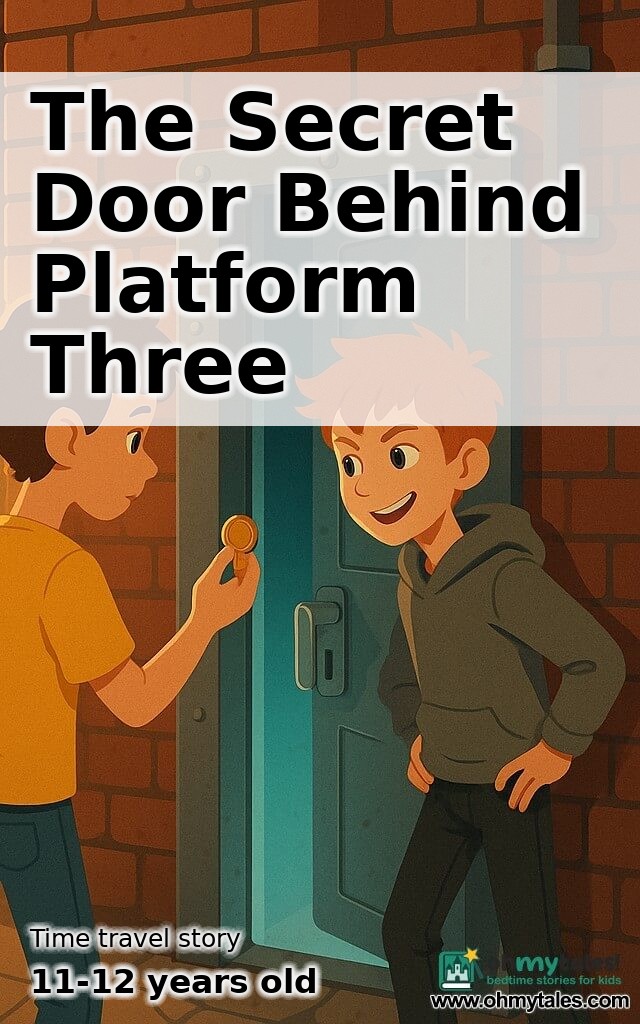
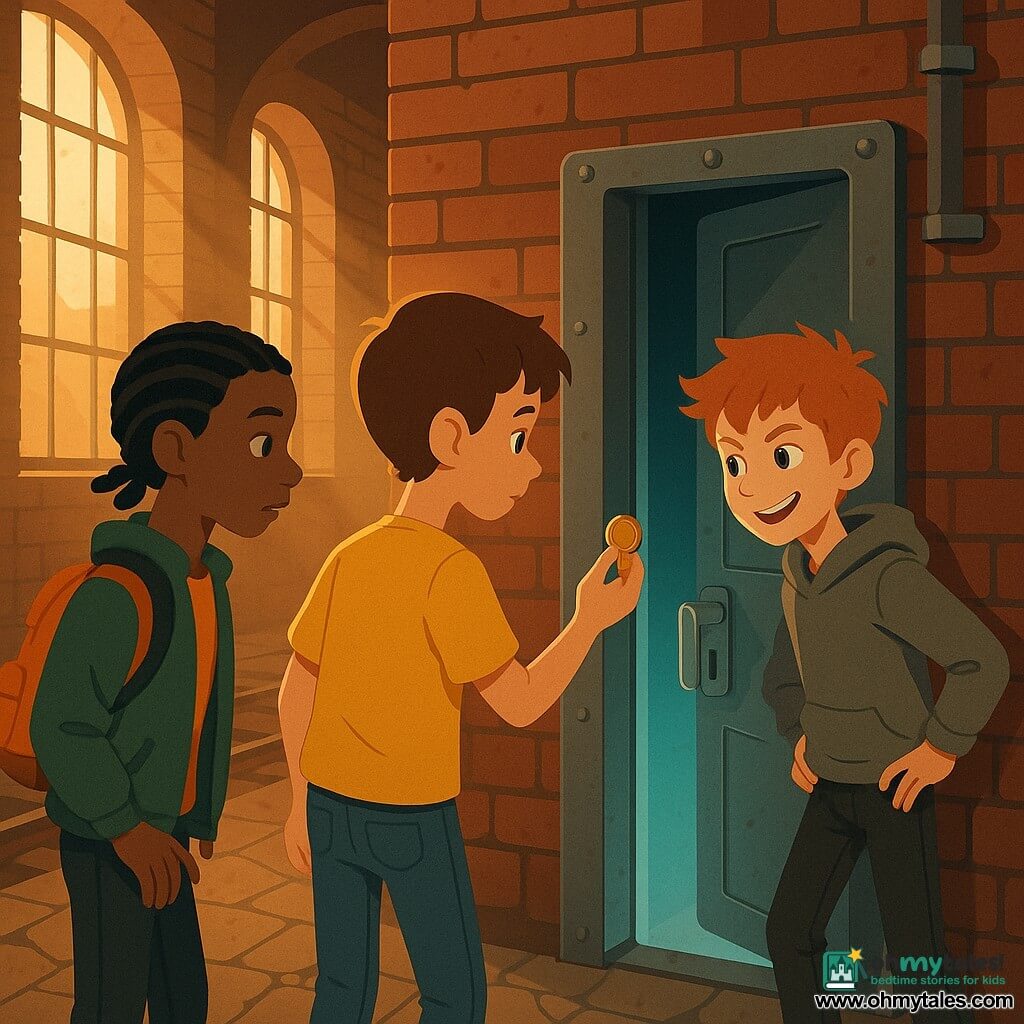
They moved along the platforms. Most doors were chained. Most rooms were empty. But behind Platform Three, Leo spotted something strange: a narrow metal door set into the wall, half hidden by a torn poster that read—WELCOME TO TOMORROW!—in fading letters.
“Was this… an ad?” Jamal asked.
Leo tugged the poster aside. The door had no handle, just a round plate with a small slot. Next to it, scratched into the metal, were neat words:
PLEASE RETURN WHAT YOU BORROWED.
Owen leaned closer. “That's an odd thing to say to a door.”
Jamal tapped the slot. “Maybe it takes a ticket.”
Leo's hand went to his pocket, where he always kept little things—gum wrappers, string, and today, a bent brass token he'd found in his grandfather's junk drawer. It had a tiny train stamped on it.
“I was going to use this as a lucky charm,” Leo said. “But maybe it's a key.”
“Only one way to find out,” Owen said. His voice was calm, but his eyes were bright.
Leo slid the token into the slot.
The plate warmed under his fingers. A quiet click echoed, like a tiny latch letting go. The door eased open by itself, as if it had been waiting for someone polite enough to return what they borrowed.
Jamal whispered, “Okay. That is officially not normal.”
Leo looked at his friends. “We stick together. No running off.”
“Scout's honor,” Jamal said, though Leo was pretty sure Jamal had never been a scout.
Owen nodded. “Together.”
They stepped through.
Chapter 2: The Clockwork Capsule
The room behind the door was small and clean, like someone had dusted it yesterday. A single lamp glowed softly, even though there were no windows.
In the center sat a strange machine—part chair, part pod, part suitcase. Its sides were smooth, silver-gray, and it had a clear dome on top like a bubble helmet. Wires ran into the floor, but the floor had no cracks where they could lead away.
Jamal walked a slow circle around it. “Is this… a rocket toilet?”
Owen's laugh came out as a surprised snort. “Please don't sit on it and find out.”
Leo moved closer. There was a panel with three simple buttons: PAST, PRESENT, FUTURE. Under them was a dial marked with years, like a clock that didn't believe in hours.
On a shelf beside the pod lay a notebook with a leather cover. Leo opened it carefully. The first page read:
TIME IS A LIBRARY.
YOU MAY VISIT, BUT DO NOT STEAL THE BOOKS.
RULES KEEP THE SHELVES FROM FALLING.
Below were three rules, written in firm, tidy handwriting:
1) DO NOT TAKE OBJECTS THAT DO NOT BELONG TO YOUR TIME.
2) DO NOT REVEAL FUTURE EVENTS TO YOUR PAST SELF OR OTHERS.
3) IF YOU DROP A PROBLEM, PICK IT UP. GRATITUDE IS A KIND OF GLUE.
Jamal leaned in. “Time has homework.”
Leo turned more pages. Most were blank, except the last one, where someone had scribbled:
TO THE ONE WHO FINDS THIS—
THE FUTURE STATION NEEDS HELP.
GO TO THE SKY-TRAIN HUB. LOOK FOR THE BROKEN SCHEDULE.
YOU WILL KNOW IT BY THE WIND.
Owen's fingers rested on the edge of the pod. “Sky-train hub?”
Leo swallowed. He felt that mix of excitement and careful fear—like standing at the top of a tall slide. “It says future. It says help.”
Jamal pointed to the buttons. “Which one do you think is least likely to explode?”
“Probably ‘present,'” Owen said.
Leo smiled, even though his heart was thumping. “We can come back to the present. That's the point.”
Jamal put his hands on his hips. “We're really doing this.”
Leo looked at them. “We don't have to.”
Owen's gaze moved over the machine, the rules, the clean room like a secret. “We found it. That means something.”
Jamal sighed in a dramatic way. “Fine. But if we meet a robot principal, you're doing the talking.”
Leo sat inside the pod first. The seat fit him like it had been measured. Owen rolled close and transferred smoothly, settling in beside Leo. Jamal squeezed in on the other side, shoulder-to-shoulder.
“We are going to be the most uncomfortable pioneers in history,” Jamal said.
Leo reached for the dial. The year markers spun lightly under his fingers. He stopped at a number far ahead, one that made his brain try to picture it and fail: 2148.
He pressed FUTURE.
The dome slid down with a soft hiss. The lamp dimmed. For a moment, nothing happened.
Then the air inside the pod grew fizzy, like a soda bubble rising behind their ears. The machine hummed. The floor seemed to drop away, but their stomachs stayed right where they were.
Jamal gripped the armrest. “I would like to file a complaint with time.”
Owen's voice was steady. “Look.”
Outside the dome, the room blurred—not spinning, not shaking, but stretching like taffy. Colors pulled into thin lines. The hum became a deep, steady note.
Leo held his breath.
And the world snapped into focus again.
Chapter 3: The Sky-Train Hub of Tomorrow
The dome lifted.
Warm air rushed in, smelling like clean metal and something sweet, like citrus. The little hidden room was gone. In its place was a wide platform that seemed to float inside a giant glass tunnel. Above them arched a roof so high it felt like the sky had been captured and polished.
Trains moved overhead—not on tracks, but on sleek rails that curved up and around like ribbons. They didn't roar. They whispered past, leaving shimmering trails of light that faded quickly, like the memory of a comet.
Jamal's mouth hung open. “Okay. This is officially extremely normal.”
Owen turned slowly, taking it in. “That's… beautiful.”
Leo stepped out of the pod. The floor under his sneakers was smooth and springy. Signs floated in the air—holograms, his brain supplied—displaying destinations with arrows that shifted as people walked.
A voice chimed gently from somewhere above: “Welcome to Nimbus Hub. Please keep all loose items secured. Please mind the time lanes.”
“Time lanes?” Jamal echoed. “Like bike lanes, but for… time?”
Leo remembered the notebook. LOOK FOR THE BROKEN SCHEDULE. YOU WILL KNOW IT BY THE WIND.
A gust swept through the hub, stirring their hair and tugging at Jamal's hoodie strings. It wasn't just wind. It felt… busy, like air that had somewhere important to be.
Then Leo saw it.
Near a central pillar, a giant schedule board flickered. Most of it glowed with neat lines and times. But one section was cracked like a spiderweb, and the information there kept scrambling—Train 12 to Cloudline… Train 12 to Yesterday… Train 12 to Potato…
Jamal squinted. “Did it say ‘Potato'?”
“It did,” Owen said. “That seems incorrect.”
As they approached, the wind grew stronger. It whistled through the cracked section of the board as if the break was a mouth trying to speak.
A small drone zipped by, then stopped abruptly in front of them, hovering at eye level. It was the size of a lunchbox, with a round camera lens like a curious eye.
“Visitors detected,” it said. “Age range: preteen. Fashion: historic. Confidence level: questionable.”
Jamal pointed at it. “Hey! My confidence is fine.”
The drone's lens adjusted. “Nimbus Hub maintenance unit Q-17. I am authorized to ask: are you lost in time?”
Leo chose his words carefully. Rule two. “We're… travelers. We found a machine. We saw a note about a broken schedule.”
The drone bobbed once. “Then you are expected. Follow. Please do not touch the time lanes. They bite.”
“They bite?” Jamal repeated, offended. “Why does everything in the future sound like a warning label?”
Q-17 led them along a wide walkway. People hurried past—some in bright jackets that shifted colors, some with bags that floated beside them. Everyone looked busy, but not angry. More like they were carrying important puzzles in their heads.
At the base of the central pillar, a human in a sleek blue uniform was arguing with a wall screen.
“I don't care if it's ‘statistically unlikely,'” the person snapped. “We have commuters stuck in a loop!”
They turned as Q-17 approached. Their hair was braided tight, and a badge on their chest read: STATION COORDINATOR RINA VALE.
Rina's eyes landed on the three boys. “Q-17, those are children.”
“Correct,” Q-17 said. “Children are often involved in unexpected solutions.”
Jamal muttered, “That's what my mom says right before I get chores.”
Leo stepped forward, hands visible, voice polite. “We saw the broken schedule. We want to help, if we can.”
Rina's expression softened just a little, like a knot loosening. “Help? You're not even from this era.”
Owen said, “We noticed the wind near the crack. Like air is being pulled through.”
Rina's gaze sharpened. “You can feel it?”
Leo nodded. “It's like the hub is… leaking.”
Rina looked at Q-17. “Scan them.”
“Already did,” Q-17 said. “They are sincere. Also underfed by future standards.”
Jamal puffed up. “I had cereal.”
Rina pinched the bridge of her nose, then sighed. “All right. But you follow rules. If you make this worse, you're going straight back to… wherever you came from.”
Leo thought of the notebook's first page. Time is a library.
“We'll be careful,” he promised. “And… thank you for trusting us.”
Rina blinked at that, as if she didn't hear gratitude often during emergencies. “Fine. Come on. I'll show you the schedule core.”
Chapter 4: The Mischievous Paradox
They entered a maintenance corridor behind the pillar. The public hub sounds faded. Here, the air was cooler and filled with a soft clicking, like tiny gears thinking.
At the end of the corridor sat a clear chamber. Inside, a spinning ring of light hovered over a metal pedestal. Lines of glowing data ran up the walls like vines. The cracked schedule section was visible through the glass, flickering like a glitchy ghost.
“That,” Rina said, “is the Chrono-Index. It keeps all arrivals and departures aligned. Every train's path is timed to the second.”
Jamal peered through the glass. “So why is it trying to send Train 12 to Potato?”
“Because,” Rina said grimly, “something is tugging on our present from the past.”
Leo remembered rule one. Do not take objects that do not belong to your time.
His pocket felt suddenly heavier.
He reached in and pulled out the brass token.
Rina's eyes widened. “Where did you get that?”
Leo's throat tightened. “I… put it in the door to open it.”
Rina stared at the token as if it were a live beetle. “That is an access coin. Those were recalled a century ago. It should not be here.”
Owen's voice was gentle. “If it shouldn't be in our time… then maybe it shouldn't be in this time either?”
Rina's jaw worked. “A coin like that belongs to Nimbus Hub's early days. If it's out of place, it can create a small paradox. Not a world-ending one,” she added quickly, seeing Jamal's wide eyes, “but enough to make schedules… mischievous.”
Jamal raised his hand. “Like a prank?”
“Yes,” Rina said. “Time doesn't always break loudly. Sometimes it giggles and trips people.”
Leo looked down at the token. It had seemed harmless. A lucky charm. A key. Now it felt like a borrowed book he'd forgotten to return.
“I'm sorry,” he said. The words came out strong and clear. “I didn't know. I should have thought about where it came from. We'll fix it.”
Rina studied him. “You can't just toss it anywhere. The Chrono-Index is trying to pull it back to where it belongs, and it's snagging trains in the process.”
Owen pointed at the ring of light. “So we need to… put it back in the right shelf.”
Q-17 hovered closer. “Translation: return coin to origin point. Preferably without becoming train luggage.”
Rina tapped on a screen. A map of time lanes appeared, thin glowing lines weaving through the hub like threads. One line flashed red.
“That's the snag,” Rina said. “A loop forming around Platform Twelve. Every time Train 12 tries to depart, it slides into the wrong lane and snaps back.”
Jamal frowned. “Like trying to walk forward on one of those airport moving sidewalks going the other way.”
“Exactly,” Rina said. “And if the loop tightens, it could pull in other trains.”
Leo hugged the token in his palm. “Where is the origin point?”
Rina hesitated. “We don't send people into the time lanes. But you… you arrived with an antique machine. It might be tuned to the origin.”
Owen asked, “Could we use our pod to return the coin?”
Rina nodded slowly. “Maybe. But you'll have to get to Platform Twelve, where the loop is strongest. The wind is the clue—remember? It will pull toward the tear.”
Jamal blew out a breath. “Of course it's Platform Twelve. It's always the spooky-sounding number.”
Leo looked at his friends. Owen met his eyes and nodded. Jamal rolled his shoulders like a boxer.
“All right,” Leo said. “We go together. We don't panic. And we say thank you to anyone who helps us, even if their robot tells us we're underfed.”
Q-17's lens blinked. “Gratitude noted. Proceeding.”
Chapter 5: Platform Twelve and the Time Wind
Back in the main hub, they moved quickly. Above them, trains slid along curving rails like silver fish in a glass ocean. The schedule board flickered harder now, and the wind had turned sharp, tugging at posters and making hologram arrows wobble.
Rina guided them to an elevator tube. It rose with a smooth glide, revealing more levels—platforms stacked like layers of a futuristic cake.
When the doors opened at Platform Twelve, the air rushed past them with a steady pull, like someone had opened a window to a storm that wasn't there.
Jamal leaned into it. “Yep. That wind definitely has an opinion.”
The platform stretched long and clean, but the far end looked hazy, as if the air itself couldn't decide what it wanted to be. A train waited there, sleek and white, doors open, lights blinking impatiently.
And in front of the train, the space rippled.
It wasn't scary. It was strange—like heat shimmer over pavement, except it shimmered with bits of light and tiny echoes of sound. Leo thought he heard a distant station announcement, then a laugh, then a whistle.
Rina kept her voice calm. “That ripple is the loop's edge. Do not step into it.”
Q-17 added, “Unless you enjoy repeating the same ten seconds until you forget your own name.”
Jamal swallowed. “Good to know.”
Leo held the token up. It warmed, as if it recognized the ripple. The wind tugged at it in his hand.
Owen pointed. “It's pulling toward the tear.”
Rina nodded. “The Chrono-Index wants it back. The loop is trying to ‘correct' the mistake by dragging the coin through the wrong channel.”
Leo's mind raced. “So we shouldn't let the loop take it. We should send it properly—through our pod, back to the door.”
Rina's eyes narrowed. “Your pod is on the lower level.”
Jamal looked down through the glass railing. “And the elevator is… over there.”
The wind surged. A loose paper—an actual paper ticket someone must have kept as a souvenir—skated across the platform and vanished into the ripple. The train's lights flashed faster.
Owen said quietly, “The loop is growing.”
Leo's chest tightened, but he forced his voice to stay steady. “We can do this in steps. First, we keep the token safe. Second, we get back to the pod. Third, we return it and close the door.”
Q-17 hovered close to Leo's shoulder. “Caution: the loop may attempt to reclaim the coin during transit.”
Jamal looked at the ripple. “So it's like time has sticky hands.”
Rina pulled a slim device from her pocket and snapped it open. A soft blue shield shimmered around them, like a bubble of calm air.
“This is a drift-screen,” she said. “It won't stop the loop forever, but it can reduce the pull.”
Leo exhaled. “Thank you.”
Rina's mouth twitched. “You're welcome. Now move.”
They hurried back to the elevator. The drift-screen hummed, pushing against the wind. Still, Leo felt the token tugging like a small animal trying to wriggle free.
Halfway to the elevator, the hub lights flickered. The schedule board in the distance spat out nonsense words in bright green.
Owen gripped the edge of his chair. “It's destabilizing.”
Jamal kept pace beside him. “If we get stuck in a loop, I call dibs on the version of me that doesn't have to do homework.”
Leo didn't laugh, but the joke loosened the knot in his stomach.
The elevator arrived. They rushed in. As the doors slid shut, the wind howled one last time, like it was disappointed.
Down they went, back toward the hidden room and their pod.
Chapter 6: Returning the Borrowed Thing
They reached the maintenance door behind Platform Three—except here, Platform Three looked newer, cleaner, with bright lines painted on the floor. Still, the narrow metal door was the same, like a familiar bookmark in a different edition of the book.
Leo slid the brass token out of his pocket. It pulsed with warmth.
Rina held out her hand. “Let me.”
Leo hesitated. The rules echoed in his head: If you drop a problem, pick it up.
“I found it,” Leo said. “I should return it.”
Rina studied him, then nodded once. “All right. But do it carefully.”
Owen and Jamal stood close, like bookends.
Leo approached the door. The slot waited. He held the token up for a second, letting himself feel something important: gratitude for finding friends who stayed, for a future coordinator who trusted them, for a universe where problems could be fixed.
“Thank you,” he whispered—not just to Rina, or the hub, but to the moment itself. “I'll put it back.”
He slid the token into the slot.
The metal plate warmed, and the door clicked open with the same gentle sound as before.
Inside was the little clean room and the pod, exactly as they'd left it, as if it had been holding its breath too.
“Now,” Rina said, “set the dial to your present. And—no offense—go home.”
Jamal saluted. “With pleasure.”
Owen looked at Rina. “Will the hub be okay?”
Rina glanced back toward the platforms. The wind had already softened. The schedule board, visible through a glass wall, steadied. Train 12 stopped trying to go to Potato.
“It's stabilizing,” Rina said, relief loosening her shoulders. “You did good.”
Q-17 hovered closer. “Statement: your assistance reduced commuter frustration by eighty-two percent. That is statistically delightful.”
Leo smiled. “We couldn't have done it without you.”
Rina's eyes flicked away, but her voice was quieter. “People forget to say that. They hurry. They complain. They assume machines and coordinators will hold everything together.”
Leo remembered rule three: Gratitude is a kind of glue.
He stepped into the pod with Owen and Jamal. Before the dome lowered, he looked at Rina and Q-17.
“Thank you,” he said. “For the drift-screen. For trusting us. For… keeping all this running.”
Rina nodded, and this time she didn't hide her smile. “Safe travels, time tourists.”
Q-17 added, “Please do not borrow additional centuries.”
The dome slid down. Leo set the dial to their year—his year—and pressed PRESENT.
The fizzy feeling returned. The hum deepened. The bright future blurred into stretched lines of light.
Jamal's voice wobbled slightly. “If we land in dinosaur times, I'm quitting friendship.”
Owen said, “Too late. You're already enrolled.”
Leo laughed, and the sound steadied him.
The world snapped.
Chapter 7: The Same Station, A Brighter Now
The dome lifted.
Dusty air. Old brick. Broken clock. The abandoned station wrapped around them like a familiar hoodie.
Leo climbed out of the pod, heart still racing. Jamal stumbled after him, blinking.
“We're back,” Jamal said, as if he needed to hear the words to believe them.
Owen rolled forward, looking around. “Same dust. Same smell. Different feeling.”
Leo closed the notebook and placed it neatly back on the shelf. The leather cover looked ordinary now, but he knew it held a truth: rules matter, and so does fixing what you mess up.
They stepped out through the metal door. It clicked shut behind them, and when Leo tugged at it, it didn't budge.
Jamal exhaled. “Good. Because I do not need a time machine in my weekend plans.”
They made their way out of the station, through weeds and sunlight. The town sounded the same—distant cars, a barking dog, someone mowing a lawn.
Yet Leo noticed things he usually skipped past: the way the sun warmed the back of his neck, the steady kindness of sidewalks that didn't float, the comfort of a present that didn't ask him to save an entire hub.
At the fence, Owen paused. “You okay?”
Leo nodded. “Yeah. Just… thinking.”
Jamal kicked a pebble. “Thinking about how my cereal is going to taste boring now?”
Leo laughed. “Thinking about how many people are doing jobs we never see. Like Rina. Like… everyone who keeps things running.”
Owen's eyes softened. “Gratitude.”
“Yeah,” Leo said. “And also—next time I find a ‘lucky charm,' I'm asking where it came from.”
Jamal groaned. “You're going to become the kind of adult who reads labels, aren't you?”
“Maybe,” Leo said. “But I'll be a fun label-reader.”
They walked toward home, the sky wide above the town. A plane crossed far overhead, tiny and bright.
Leo stopped and looked up longer than usual. He imagined silent trains gliding through a glass-roofed hub, light trails curling like ribbons. He imagined the wind that knew where things belonged.
Jamal followed his gaze. “What are you staring at?”
“The future,” Leo said. Then he smiled. “And the present. Both at once.”
Owen tilted his head back too. For a moment, all three of them stood still, faces lifted, eyes on the open blue, as if the sky was a schedule board of possibilities—steady now, waiting for the next right train.