Chapter 1: The Friendly House That Wasn't Quite Still
Lucide liked old things, but she didn't like people telling her what to think about them. At twelve, she had a sharp way of looking at the world, like she carried a small flashlight inside her mind.
On Saturday afternoon, she stood on the sidewalk with her dad in front of the Rosewood House Museum.
It didn't look like a museum. It looked like someone still lived there—curtains gently puffing at the windows, a brass door knocker shaped like a lion's head, and a garden that seemed to whisper, Come in.
“I bet they'll have dusty chairs and rules,” Lucide muttered.
Dad squeezed her shoulder. “Or secrets.”
Lucide raised an eyebrow. “That's your polite way of saying you're bored too.”
Inside, the air smelled of lemon polish and paper. A cheerful volunteer in a sunflower scarf waved them in.
“Welcome! You're just in time for the self-guided tour. Please don't touch the objects—unless a sign invites you.”
Lucide heard that last part like a dare.
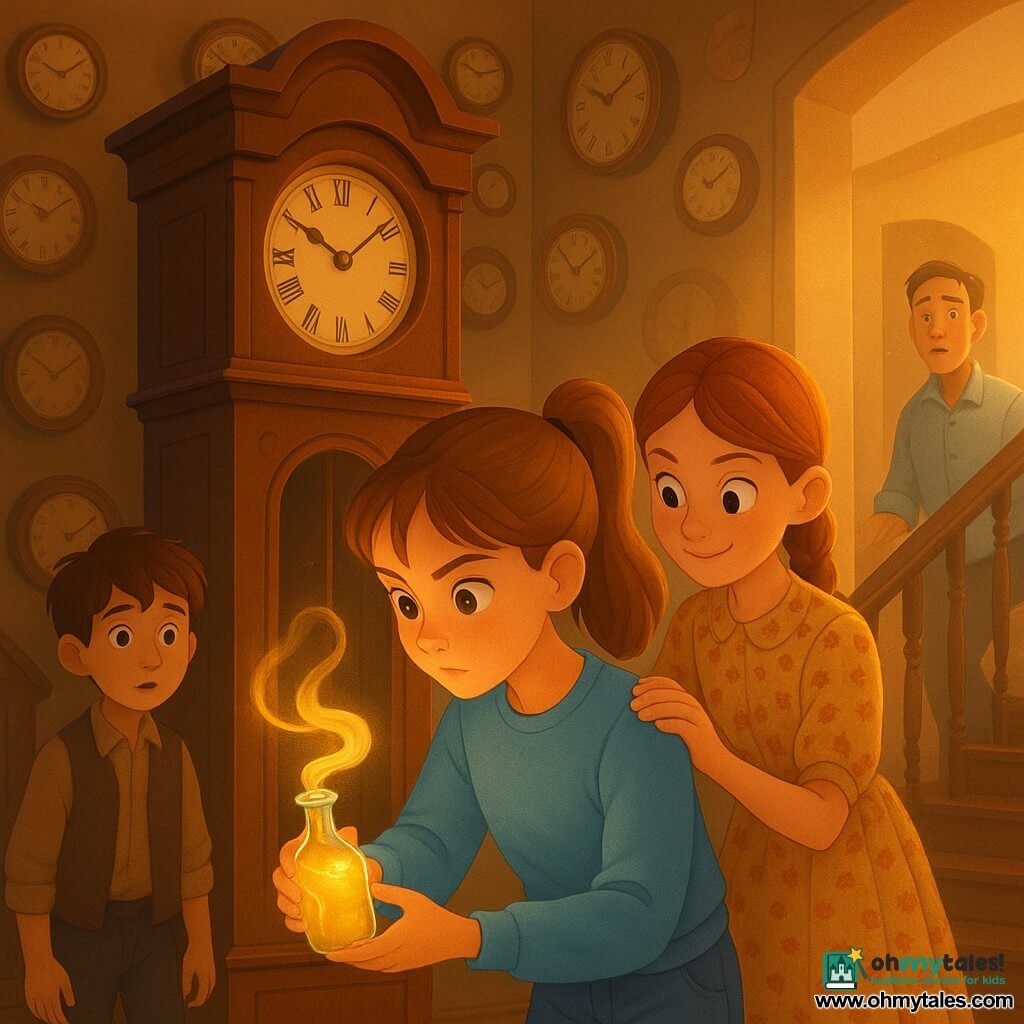
She wandered into a room full of clocks. Not just one or two—dozens. Tall grandfather clocks. Tiny travel clocks. A glass case holding a silver pocket watch like a sleeping fish.
Tick. Tick. Tock. Tock.
Every clock showed a different time.
“That's… not correct,” Lucide whispered.
A small sign stood on a stand: THE ROOM OF HOURS. Listen carefully.
She leaned closer. The ticking wasn't random. Some clocks ticked fast, some slow, and one—an elegant walnut clock with a moon face—seemed to tick in a rhythm that matched her heartbeat.
Dad called from the doorway, “Lu, come see the old kitchen! It's like a time capsule.”
“I'll catch up,” she said, and because she was curious and because she was a little stubborn, she stayed.
The walnut clock's glass was warm. That made no sense. Glass wasn't supposed to feel like sunlit stone.
Lucide slid her fingers along the edge. Under her fingertip, she felt a tiny notch, as if the clock had a hidden button.
“What are you?” she murmured.
Tick.
Her finger pressed.
The room gave a soft, polite shiver. Like a cat stretching.
Then the air folded.
Lucide didn't fall. She didn't spin. It was more like the museum itself inhaled and held its breath, and in that held breath, everything changed.
The clocks went silent.
The floorboards looked fresher, less scratched. The wallpaper brightened. And outside the window, the street wasn't a street anymore.
It was a dirt road.
A horse snorted.
Lucide's flashlight-mind flicked on. “Okay,” she said, very calmly, because panic felt useless. “That's new.”
A voice behind her said, “You found the Hour Door, didn't you?”
Lucide turned. A girl stood there—about her age, with a neat braid and a dress that looked like it came from a painting. She held a feather duster like it was a microphone.
The girl grinned. “Don't worry. This house is friendly. It just… wanders.”
Lucide stared. “Who are you?”
“Maisie,” the girl said. “Assistant to the House Curator. Or at least I was, before the house started skipping.”
Lucide blinked. “Skipping?”
Maisie tapped the walnut clock. “Time skipping. Like a rock across a pond.”
Lucide swallowed her questions and chose one she could stand on. “What year is it?”
Maisie brightened. “Excellent first question. It's 1892.”
Lucide's stomach did a polite flip.
“Second question,” Lucide said. “How do I get back?”
Maisie's grin turned serious, but not scary. Just careful. “We follow the rules. The house has rules. If you try to wrestle time, it wrestles back.”
Lucide nodded slowly. “Then teach me the rules.”
Maisie tilted her head. “You're not even screaming.”
Lucide shrugged. “Screaming doesn't fix clocks.”
Chapter 2: The Curator's Rules
Maisie led Lucide through the hallway. The house felt the same but different—like the museum had stepped out of a photograph and into daylight.
They passed a mirror where Lucide's reflection lagged behind by half a second.
Lucide stopped. “Did you see that?”
Maisie didn't look scared. She looked annoyed. “Yes. Time echoes. Don't stare too long or you'll get a headache.”
They reached a snug sitting room. A fire crackled. On a table sat a thick notebook with a leather cover. Beside it, a pencil sharpened to a perfect point.
Maisie patted the notebook. “The Curator's Log. It's for visitors who fall through.”
Lucide touched the cover. The leather was scratched, like many fingers had worried it.
She opened it. Inside were neat entries, some in ink, some in pencil. Each entry had a date, a time, and a rule written in bold.
RULE 1: DO NOT BRING INFORMATION THAT CHANGES A PERSON'S CHOICE.
RULE 2: DO NOT TAKE OBJECTS OUT OF THEIR TIME.
RULE 3: ALWAYS LEAVE A NOTE FOR YOURSELF, NOT FOR OTHERS.
RULE 4: WHEN IN DOUBT, OBSERVE. ASK. THINK.
Lucide felt a small relief. Rules meant patterns. Patterns meant she could reason her way out.
Maisie pointed to a page with fresh ink. “The house brought you here for a reason. It always does.”
Lucide read the latest entry.
VISITOR: LUCIDE (NAME SPOKEN BY HOUSE)
ARRIVAL: 1892, ROSEWOOD HOUSE
PROBLEM: PARADOX STIRRING IN THE ROOM OF HOURS
TASK: RETURN THE MISSING MINUTE
Lucide frowned. “A missing minute?”
Maisie opened a drawer and pulled out a brass timer, the kind you twist in a kitchen. “The house measures itself. One minute is gone from its clockwork. Without it, the house can't land properly. It might jump too far, too fast.”
Lucide imagined the house hopping like an excited puppy—except the puppy was time.
“So we find the minute,” Lucide said. “Where did it go?”
Maisie lifted a small box from the shelf. Inside lay three objects: a cracked compass, a blue ribbon, and a tiny glass vial with a label: ONE MINUTE (HANDLE WITH CARE).
Lucide pointed. “It's right there.”
Maisie sighed. “It was. Then it wasn't.”
Lucide leaned in. The vial was empty.
Maisie spread her hands. “Someone opened it. The minute escaped. That's what a paradox looks like when it's being mischievous.”
Lucide sat down, careful not to touch the wrong thing. “Okay. Let's use our brains. Who would open a vial labeled ‘One Minute'?”
Maisie's eyes sparkled. “Exactly. That's the spirit.”
Lucide grabbed the pencil and wrote in the log under RULE 4:
CARNET NOTE: Don't assume magic. Assume someone made a choice. Find the chooser.
Maisie nodded, approving. “We'll need clues. The house leaves them, like breadcrumbs. But the breadcrumbs are… sometimes in the wrong century.”
Lucide stood. “Then we follow the trail. What's the first clue?”
Maisie pointed toward the kitchen. “A sound. A tick that shouldn't be there.”
They walked, and as they moved, Lucide noticed something comforting: the house felt welcoming, like it wanted them to succeed. The hallway lamps glowed softly. The floor didn't creak under their feet, as if it was trying not to interrupt.
In the kitchen, copper pots hung like shiny moons. On the table sat a loaf of bread, still warm. And under the table, hidden in shadow, came a faint sound.
Tick… tick… tick…
Lucide crouched. She found a small toy—an old tin beetle with a wind-up key. But it wasn't moving. It was just ticking, steadily, like a tiny trapped clock.
Lucide lifted it carefully. The beetle's belly had a tiny slot.
Maisie whispered, “The house uses beetles sometimes. It's a message carrier.”
Lucide's mind flashed with questions again, but she chose a sharp one. “If this is a message, who sent it?”
The beetle ticked faster, as if impatient.
Lucide turned it over. Etched into the tin were letters: E. R.
Maisie's face changed. “Oh.”
“What?” Lucide asked.
Maisie lowered her voice. “Elias Rosewood. The first owner of the house. He loved puzzles. He also loved… testing people.”
Lucide held the beetle up. “Then he's our suspect.”
Maisie shook her head. “Or our helper. With time, it's hard to tell which is which.”
Lucide clicked the beetle's key gently, but instead of whirring, it sprang open like a little box. Inside was a rolled strip of paper.
Lucide unrolled it. In tidy handwriting, it said:
THE MINUTE HIDES WHERE TIME IS TALKED ABOUT BUT NEVER KEPT.
Lucide read it twice. “Talked about but never kept…”
Maisie snapped her fingers. “A classroom!”
Lucide shook her head. “People keep time in classrooms. Bells, schedules…”
Maisie tilted her chin toward the doorway. “Not in this house.”
They hurried back toward the Room of Hours, and Lucide's heart thumped—not with fear, but with that bright, fizzy feeling of solving something. The house seemed to hum with them, like it approved.
At the clock room, Maisie pointed to a narrow door Lucide hadn't noticed before. The door had a painted sign:
THE LECTURE CABINET
Lucide reached for the knob.
The walnut clock ticked once.
Lucide paused. “Is that a warning?”
Maisie smiled. “It's the house saying, ‘Think before you open.'”
Lucide took a breath. “Okay. Rule 4.”
She opened the door.
Chapter 3: A Lesson That Steals Back
The Lecture Cabinet was a tiny room lined with shelves. On the shelves were jars of buttons, folded maps, and stacks of paper tied with string. A chalkboard leaned against the wall.
At the center stood a tall wooden podium, and on it lay a strange object: a brass speaking trumpet, the kind used before microphones. Its wide mouth gleamed.
Lucide stepped inside. “This is where time is talked about.”
Maisie pointed to the chalkboard. Written there in white chalk were numbers and arrows. It looked like someone had been explaining something in a hurry.
Lucide read the words under the arrows:
IF YOU BORROW A MINUTE,
YOU MUST PAY IT BACK.
Lucide frowned. “That sounds like a warning and a joke.”
Maisie walked around the podium. “Elias Rosewood gave lectures in here. He liked to tell guests that time was a polite creature. Polite, but with a memory.”
Lucide lifted the speaking trumpet. It was heavier than it looked. The metal felt cold and bright, like winter sunlight.
The moment she touched it, the air tightened—again like the house held its breath.
Then a voice poured out of the trumpet, not loud, but clear.
“Testing, testing,” the voice said. “If you can hear this, you are in the middle of a problem. Congratulations.”
Lucide nearly dropped it. “It's… recorded?”
Maisie looked impressed. “Or echoed. Time can store sounds like a jar stores jam.”
The trumpet continued. “A minute has gone missing. Not stolen, exactly. Borrowed. Someone wanted one extra minute to fix a mistake.”
Lucide exchanged a look with Maisie. “That's… relatable.”
The voice went on. “But a borrowed minute doesn't vanish. It tugs. It pulls at other minutes. It makes small knots in the day.”
Lucide thought of her reflection lagging behind. A knot.
The trumpet crackled softly. “To find the minute, you must visit the moment it was borrowed. The house will take you. Be kind. Be curious. And do not—DO NOT—try to impress anyone with knowledge from the future. That is how time bites.”
Maisie murmured, “Rule 1.”
Lucide held the trumpet like a living thing. “How do we visit the moment?”
The chalkboard had a drawing of the walnut clock and an arrow pointing to a pocket watch.
Maisie rummaged in a drawer and pulled out a pocket watch on a chain. Its cover had tiny roses carved into it.
“This,” Maisie said, “is the Rosewood Watch. It chooses the landing.”
Lucide took it. The watch felt warm, like it had been waiting.
“Open it,” Maisie said.
Lucide flipped the cover. The face wasn't numbered. Instead, it showed a simple sentence:
SHOW ME THE BORROWED MINUTE.
Lucide whispered it aloud, feeling slightly silly.
The watch hands spun. The house gave its gentle shiver.
Lucide grabbed Maisie's hand without thinking. Maisie squeezed back like she'd expected it.
“Ready?” Maisie asked.
Lucide swallowed. “No. But yes.”
The room brightened. The shelves blurred. The chalk dust lifted into the air like tiny stars.
Then—click.
They were somewhere else.
It was still Rosewood House, but it looked even newer, like freshly baked bread. Sunlight poured through windows. Voices echoed from downstairs. The smell of soap and ink floated in the air.
A sign on the wall read: 1907.
Lucide's eyes widened. “We jumped forward.”
Maisie nodded. “Fifteen years. Not too far.”
They crept down the stairs. In the hallway, a boy about ten stood near a coat rack. He wore a vest and had messy hair like he'd fought a pillow and lost.
In his hands was the little glass vial.
It wasn't empty.
He was turning it slowly, watching the liquid inside shimmer like a trapped sunrise.
Lucide whispered, “That's the minute.”
Maisie whispered back, “And that's Edwin Rosewood. Elias's son.”
Edwin looked over his shoulder as if he felt watched. He bit his lip.
Then he uncorked the vial.
Lucide's mind flashed: Don't interfere. Observe. Ask. Think.
But the boy's face was so worried that Lucide's feet moved before her thoughts finished.
She stepped into the hallway, hands open. “Hey,” she said gently. “What are you doing?”
Edwin yelped and nearly dropped the vial. “Who—who are you?”
Maisie stayed behind Lucide, quiet as a shadow.
Lucide chose her words carefully. “I'm… a visitor. This house is full of odd things. That looks like one of them.”
Edwin clutched the vial. “It's my father's. He says it's dangerous. But he's always saying things are dangerous. He even says the attic is dangerous, and it's only full of trunks.”
Lucide glanced at Maisie. Maisie mouthed: Be careful.
Lucide nodded. “Why do you need it?”
Edwin's eyes shone, not with mischief, but with desperation. “Because I made a mistake.”
Lucide didn't laugh. Everyone made mistakes. Even time.
Edwin rushed on. “I broke his pocket watch. Not this one—his other one, his favorite. It fell. It cracked. He'll be furious. He'll think I'm careless. I'm not careless! I just—my hands did the wrong thing!”
Lucide understood that feeling too well.
Edwin held up the vial. “If I had one extra minute, I could put it back before he sees. Just one minute. I can fix it. Then nobody has to be upset.”
Maisie whispered, “That's the borrowed minute.”
Lucide swallowed. She had to be truthful without spilling future knowledge. She had to use her flashlight-mind.
“Edwin,” Lucide said, “what if you borrow it and then… time wants it back?”
Edwin frowned. “Time can't want things.”
Lucide pointed at the hallway clock. Its hands were twitching, not moving smoothly. The air felt slightly stretchy, like warm chewing gum.
“Look,” Lucide said. “The house is already acting weird.”
Edwin stared. “It's just… a house.”
Maisie stepped forward at last. Her voice was calm. “This house remembers. Your father tried to teach that. Sometimes he teaches too sharply. But he isn't wrong.”
Edwin blinked at Maisie as if she was a dream. “Are you real?”
Maisie smiled. “Real enough to tell you: if you hide a mistake, it grows teeth.”
Lucide hid a smile. That was a very Maisie way to say it.
Edwin's shoulders slumped. “So I'm doomed.”
Lucide shook her head. “No. You can still fix the watch. Just not by stealing time. You fix it by telling the truth. And by using your brain.”
Edwin stared at the vial, trembling. “But he'll be angry.”
Lucide thought of Rule 4 again: Observe. Ask. Think.
She asked, “What does your father do when he's angry?”
Edwin hesitated. “He… gets quiet. He looks at you like he's measuring you. Then he lectures.”
Maisie said, “Lectures can be survived.”
Lucide added, “And sometimes lectures hide love in them. Like a sandwich with too much bread.”
Edwin snorted a laugh despite himself.
The hallway clock gave a sudden lurch. The air tugged at Lucide's hair.
Maisie whispered urgently, “The knot is tightening.”
Edwin looked frightened now. “What's happening?”
Lucide held out her hand. “Give me the vial. We'll put the minute back where it belongs.”
Edwin clutched it. “And then?”
Lucide met his eyes. “Then you go tell your father what happened. Not later. Not after you try ten other tricks. Now.”
Edwin swallowed hard. Then, like someone stepping off a diving board, he thrust the vial into Lucide's hand.
The liquid shimmered brightly, as if relieved.
Lucide didn't uncork it. She held it steady, like holding a firefly without squeezing.
“Where do we put it?” she whispered to Maisie.
Maisie pointed up the stairs. “Back to the Room of Hours.”
They hurried. Behind them, Edwin followed, wringing his hands, muttering, “I can do this. I can do this.”
At the top of the stairs, a man's voice called from below, “Edwin?”
Edwin froze.
Lucide leaned close. “That's your moment.”
Edwin took a breath. “Father! I'm coming!”
His voice shook, but it held.
He turned to Lucide and Maisie. “Thank you,” he whispered, and ran downstairs.
Lucide looked at the vial. “Now we return the minute.”
But as they approached the clock room, the walnut clock began to tick wildly.
And the door to the Room of Hours was closed—locked.
Maisie's face went pale. “That's not supposed to happen.”
Lucide's flashlight-mind swept the scene. “Someone is keeping us out.”
Maisie nodded slowly. “A paradox doesn't like being fixed.”
Lucide tightened her grip on the vial. “Then we'll fix it anyway.”
Chapter 4: The Paradox With a Sense of Humor
Lucide tried the handle. Locked.
Maisie pressed her ear to the door. “I hear… laughter.”
Lucide frowned. “Laughter?”
From inside came a sound like tiny bells, like someone giggling into a pillow.
Lucide looked at the speaking trumpet hanging on a hook nearby. “Time has a sense of humor.”
Maisie's eyes narrowed. “Or someone does.”
Lucide examined the lock. It wasn't modern. It was an old keyhole, the kind that looked like an eye.
Lucide crouched. “If the house is friendly, it won't trap us forever. This is a puzzle.”
Maisie nodded. “Elias's style.”
Lucide held up the vial. The shimmering liquid pulsed gently, like a heartbeat. “Maybe the minute can help. It's time, after all.”
Maisie hesitated. “We should not open it unless we must.”
Lucide agreed. “We won't waste it. But we can listen.”
She held the vial close to her ear.
At first she heard nothing. Then, faintly, she heard a whispery chorus—voices of people saying “Just a second,” and “Wait one minute,” and “Time flies,” and “If only I had more time.”
Lucide pulled back, eyes wide. “It's full of phrases.”
Maisie blinked. “A minute made of all the times people talk about time.”
Lucide remembered the beetle message: where time is talked about but never kept.
“Words,” Lucide said. “Promises. Excuses.”
Maisie nodded. “And the Lecture Cabinet.”
Lucide looked down the hallway. “We should go back there.”
They hurried into the Lecture Cabinet. The chalkboard still showed the warning: IF YOU BORROW A MINUTE, YOU MUST PAY IT BACK.
Lucide grabbed chalk and wrote under it:
IF YOU STEAL A MINUTE,
YOU MUST RETURN IT WITH TRUTH.
Maisie watched. “That's… not in the log.”
Lucide shrugged. “It's in life.”
As soon as the sentence was complete, the speaking trumpet gave a cheerful cough.
“Good,” it said, as if pleased. “Now, to unlock what is stuck, you must answer a question.”
Lucide crossed her arms. “Of course.”
The trumpet spoke again. “What is the safest way to change the past?”
Maisie whispered, “Trick question.”
Lucide thought. The safest way… was probably not to change it. But the house had brought them to help Edwin, and Edwin had changed his choice—from hiding to telling. That was a change, but it was his own choice, not theirs.
Lucide spoke carefully. “You don't change the past like a puppet. You help someone see clearly so they can choose. And you accept the consequences.”
The trumpet hummed. “Acceptable.”
Lucide leaned closer. “Is that the answer?”
The trumpet continued, sounding amused. “Part of it. The safest way to change the past is to change yourself in the present.”
Maisie smiled slightly. “That's very Curator.”
Lucide nodded. “And it doesn't cause time to bite.”
The chalk on the board shimmered. The words lifted like smoke, drifting through the air, curling into the shape of a key.
The key floated into Lucide's hand and felt solid, cold, and real.
Maisie let out a breath. “The house approves.”
They ran back to the Room of Hours. Lucide slid the key into the lock.
Click.
The laughter stopped.
The door opened.
Inside, the clocks were ticking again, but unevenly, like a choir that couldn't agree on the song. In the center of the room stood the walnut clock, its moon face now frowning.
Lucide stepped forward. On the clock's base was a small round opening, like a tiny mailbox.
Maisie pointed. “That's where the minute belongs.”
Lucide lifted the vial. “Ready?”
Maisie nodded. “Open it carefully. Pour it like it's warm tea.”
Lucide uncorked the vial.
The minute didn't pour like liquid. It rose like a ribbon of light, twisting gently in the air. In it were the whispered phrases, the tiny excuses, the hopes, the rushing footsteps of people trying to catch up with their days.
The ribbon hovered, then drifted toward the walnut clock as if it recognized home.
But just before it reached the opening, it jerked sideways.
The ribbon of minute wrapped around a nearby clock—an ornate one with golden hands—and yanked.
The golden clock lurched forward like it had feet.
Lucide jumped back. “Uh—Maisie?”
Maisie's eyes widened. “That clock shouldn't move!”
The golden clock skittered across the floor, dragging the minute ribbon with it like a stolen scarf. It bumped into another clock, which toppled with a soft thud. Then another.
The Room of Hours became a gentle chaos of ticking and wobbling.
Lucide grabbed a chair to block the golden clock's path. “Why is it running?”
Maisie dashed to steady a falling clock. “Because paradoxes are slippery! The minute doesn't want to be pinned down. It wants to stay borrowed—free.”
Lucide thought quickly. “We need to convince it, not chase it.”
Maisie looked at her. “How do you convince a minute?”
Lucide watched the ribbon flicker. Inside it, she heard Edwin's voice: I can fix it. Then her own: Tell the truth. Now.
Lucide raised her voice, not shouting, but speaking clearly, like in class when you want everyone to listen.
“Minute,” she said, feeling silly again but doing it anyway, “you were borrowed for fear. You can be returned with honesty.”
The ribbon hesitated.
The golden clock bumped into the chair and wobbled.
Lucide continued, voice steady. “You don't belong to hiding. You belong to choosing.”
Maisie added softly, “And to learning.”
The ribbon of minute trembled, as if thinking.
Then, from downstairs, came Edwin's voice, loud and shaky:
“Father! I broke your watch! I'm sorry! I tried to fix it and I made it worse!”
A pause.
Then another voice, older, deep and not cruel—just surprised.
“You came to tell me at once?”
Edwin's answer was small but clear. “Yes.”
The ribbon of minute brightened. The golden clock stopped moving, like it had suddenly remembered it was furniture.
The minute ribbon slipped free and floated, calm now, to the walnut clock's opening. It poured inside.
The walnut clock's moon face relaxed into a peaceful smile.
Every clock in the room—every single one—clicked into the same rhythm.
Tick.
Tick.
Tick.
Lucide let out a breath she didn't know she'd been holding. “We did it.”
Maisie's shoulders dropped. “We untied the knot.”
A final click sounded from the walnut clock, crisp and certain, like a stamp on a paper.
A small drawer opened at its base. Inside lay a folded note.
Lucide opened it. It read:
RETURN TRIP READY.
REMEMBER: THE PRESENT IS YOUR HOME LAB.
Maisie grinned. “Home lab. I like that.”
Lucide nodded. “Me too. But—wait. What about Edwin? Did we… change too much?”
Maisie listened. Downstairs, Edwin's father spoke again, quieter now.
“I am angry,” he said, “but not because you made a mistake. I am angry because you were frightened to tell me. Bring the watch. We will repair it together.”
Edwin sniffed. “Together?”
“Yes,” the father replied. “Together. And next time, you may borrow my time by asking for it.”
Lucide's chest warmed. That felt right. Like the minute had been paid back with something better than secrecy.
Maisie nodded. “That's not a dangerous change. That's a truthful one.”
Lucide glanced at the walnut clock. “So… how do we go back?”
Maisie pointed to the clock's moon face. The moon now showed a tiny door drawn in silver.
Lucide reached out. The glass was warm again.
“Ready?” Maisie asked.
Lucide took a breath. “Yes. And I'm writing a note first.”
She opened the Curator's Log and wrote:
CARNET NOTE: Time is not a toy, but it is a teacher. Ask questions. Don't borrow minutes with fear. If you need time, tell the truth and make a plan.
Maisie watched, approving. “Critical thinking,” she said. “In pencil.”
Lucide smiled. “Pencil can be erased. Lies are harder.”
Then she touched the moon-door.
Chapter 5: Back to the Museum, Back to Tomorrow
The world folded again, gently, like turning a page.
Ticking returned in layers. The smell of lemon polish floated back. The street outside the window became a street again, with cars and a bicyclist wobbling past.
Lucide stood in the Room of Hours as if she had never left, except her heart felt fuller, like she'd carried a lantern through a tunnel and come out brighter.
The walnut clock ticked calmly.
From the hallway, her dad called, “Lucide? There you are! I thought you got lost in the clock room.”
Lucide turned. Her dad looked exactly the same as before, except his eyebrows were slightly higher, like he'd been mildly worried.
“How long was I gone?” Lucide asked.
Dad glanced at his phone. “Two minutes. Maybe three. You okay?”
Lucide stared at the clocks. Two minutes. Three. She had crossed fifteen years, untied a paradox, and come back in the time it took for a museum visitor to read a sign slowly.
“I'm okay,” she said. “I just… learned something.”
Dad smiled. “From the clocks?”
“From a mistake,” Lucide said carefully. “And from fixing it the right way.”
As they walked out of the museum, Lucide kept expecting to see Maisie in the doorway, waving. But there was only the sunflower-scarf volunteer, handing a brochure to a couple.
Outside, the afternoon sun felt normal and sweet.
At home, Lucide went straight to her room. She pulled out her own notebook—her real-life log—and wrote, in big clear letters:
OBSERVE. ASK. THINK.
DON'T LET FEAR BORROW YOUR TIME.
Then she paused and added:
If you want an extra minute, earn it: pack early, plan, and tell the truth.
She looked at the clock on her wall. It ticked in a steady, friendly way.
From downstairs, Dad called, “Don't forget—tomorrow's your science club presentation!”
Lucide's stomach did a little flip again, but this time it wasn't dread. It was the feeling of being ready to be brave.
“I won't!” she called back.
She opened her closet, pulled out her backpack, and began to pack—notes, pencil case, water bottle, her small model rocket for the demo. She checked each item like a careful explorer preparing for a voyage.
When she was done, she zipped the bag and set it by the door.
Lucide stood for a moment, listening to the quiet house, to the simple ticking of a normal clock.
“Tomorrow,” she whispered, “I'm not borrowing time. I'm bringing it with me.”
And her bag was prepared for tomorrow.