Chapter 1: The Door That Tick-Tocked
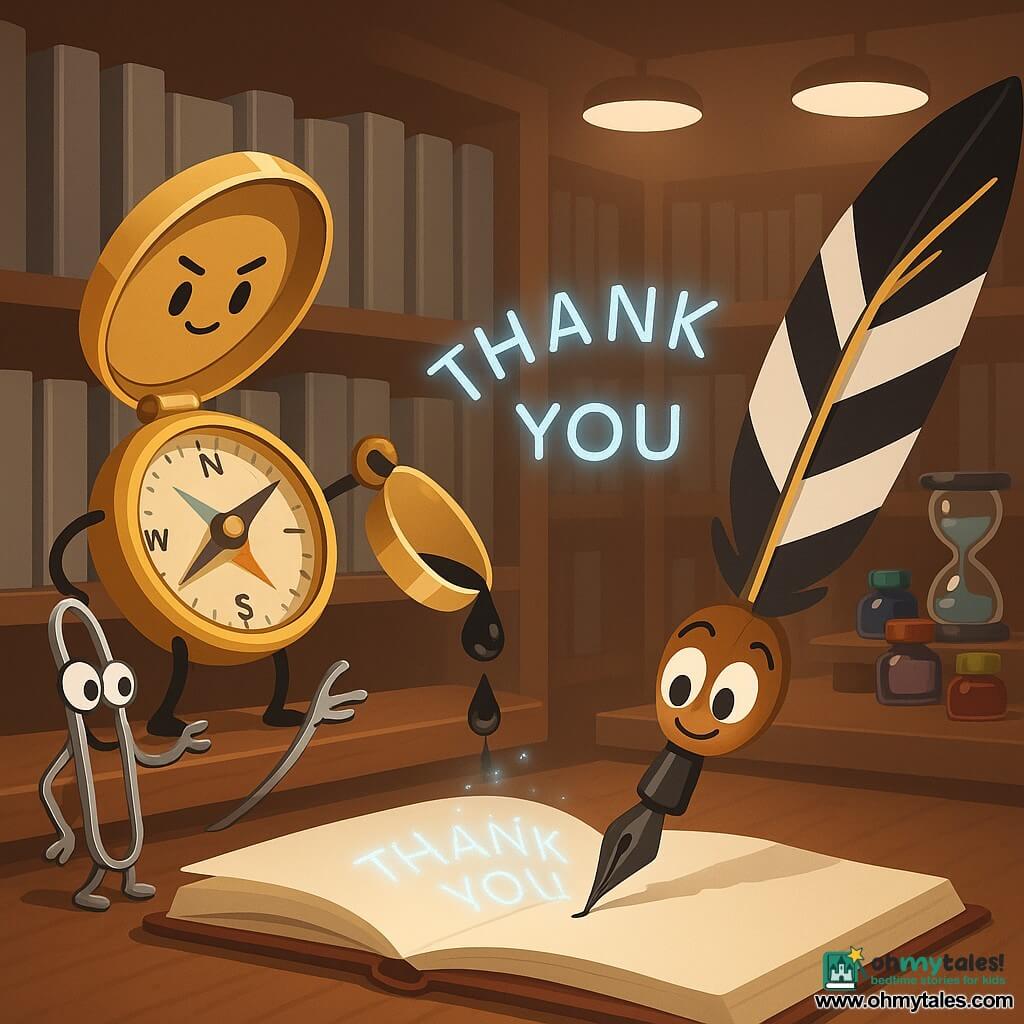
On the third shelf of the Dustyville Library, between a cracked atlas and a sleepy cookbook, lived a small brass compass named Cora. She had a lid that clicked shut like a secret and a needle that never stopped thinking.
Cora liked patterns. She liked lists. She liked knowing where “north” was, even when everything else felt messy.
Tonight, the library was closed. The lamps were dim. The air smelled of paper and old glue.
Cora's best friend, Pip the paperclip, dangled from a bookmark like a gymnast who had forgotten why he was upside down.
“Cora,” Pip whispered, voice thin as foil, “do you hear that?”
Cora listened. At first, only the usual library sounds: a page settling, a distant tap from the radiator, the soft sigh of a broom leaning against a wall.
Then—tick. Tock. Tick. Tock.
Not from a clock.
From behind the shelf.
Cora's needle trembled. “It's… regular. Like a heartbeat that knows math.”
Pip swung closer. “Or a door that's practicing being a door.”
Cora rolled forward on her rounded base and pressed her ear to the wood. The sound grew clearer, and with it, a faint smell of ink—fresh ink, not the tired sort found in old stamps.
“Something is hidden,” Cora said. “And it is very confident about it.”
Pip straightened himself, as much as a paperclip can. “We should investigate. For science. And also because it's fun.”
Cora paused. “We should also be careful.”
“Careful is your middle name,” Pip said.
“I don't have a middle name,” Cora replied.
“That's the spirit!”
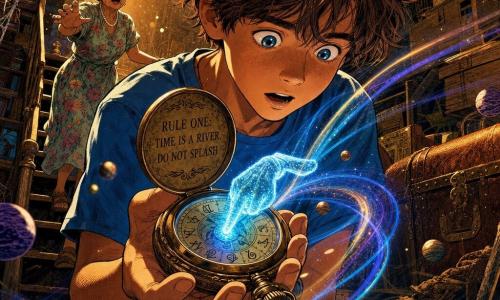
Together, they nudged a loose board at the back of the shelf. The board slid aside with a dry whisper. Behind it stood a narrow doorway made of polished walnut, shaped like an arched book cover. Instead of a handle, it had a silver quill mounted in the center. The quill bobbed slightly, as if it was breathing.
A tiny brass plate beneath it read:
RULE ONE: ENTER TO LEARN.
RULE TWO: DO NOT TAKE WHAT IS NOT YOURS.
RULE THREE: DO NOT MEET YOURSELF.
RULE FOUR: EXIT BEFORE THE INK DRIES.
Pip gulped, which was impressive because he had no throat. “That last one feels oddly specific.”
Cora's needle pointed straight at the quill, as if drawn by a magnetic promise. “It's a time door,” she said softly. “I've read about them. In books, of course.”
“Do you think it works?” Pip asked.
The quill scratched the air by itself—scritch, scritch—writing a glowing word that hung like smoke:
NOW.
Cora clicked her lid shut. “We go together.”
Pip saluted with one bent end. “Cooperation. Like a two-part invention.”
Cora nudged the quill. It dipped as if signing a page.
The doorway opened with a gentle sigh, and the tick-tock turned into a bright, humming wind.
They stepped through.
Chapter 2: The Feather-Pen Workshop
The air on the other side tasted like clean rain and warm paper.
Cora and Pip found themselves in a wide workshop, lit by skylights that looked up into a sky the color of milk. Long tables filled the room, each crowded with parchment, bottles of ink, wax seals, and—most surprising—hundreds of quills standing upright in cups like a forest of feathers.
No humans sat there. No hands moved. Yet the workshop was busy.
Quills wrote on their own.
Pages turned themselves with polite little flips.
Ink bottles scooted closer when needed, like helpful pets.
A large, gentle machine stood in the corner, built of copper pipes and glass tubes. It puffed quietly, blowing tiny paper scraps into a basket. On its side, a label read: DRAFT-CATCHER MODEL VII.
Pip shivered with excitement. “A writing factory!”
“A writing workshop,” Cora corrected, but her voice held wonder. “Look at the dates.”
She rolled to a nearby page. In the top corner, a neat heading had been written:
TUESDAY, 14 MAY, 1843
Pip peered over her lid. “That's… not today.”
Cora's needle spun once and settled. “We are in the past. The door is a time door, just like the sign said.”
A quill in a silver cup paused and tilted toward them, as if noticing two strangers at the edge of its forest. Then it wrote on the page in bold, swirly letters:
WELCOME, TRAVELERS. PLEASE WIPE YOUR FEET ON THE DOORMAT OF LOGIC.
Pip looked down. There really was a doormat. It had the word LOGIC stitched into it.
Pip stepped on it. “I feel… slightly smarter.”
Cora rolled over it. “I feel… the same. But reassured.”
The quill wrote again:
TIME RULES KEEP STORIES FROM FALLING APART.
ASK BEFORE YOU CHANGE.
LISTEN BEFORE YOU LEAP.
Cora clicked her lid, thinking. “These are sensible rules.”
Pip leaned toward a pile of papers. “What are they writing?”
Cora read the nearest page. It was a story about a lighthouse that learned to sing. The sentences were lively and crisp. Each line seemed to glow with a gentle purpose.
“This place is making stories,” Cora said. “Maybe it teaches them, too.”
As if answering, a bell rang—ding!—and the workshop tables slid apart by themselves. Chairs rolled into a circle.
Chairs. Empty chairs.
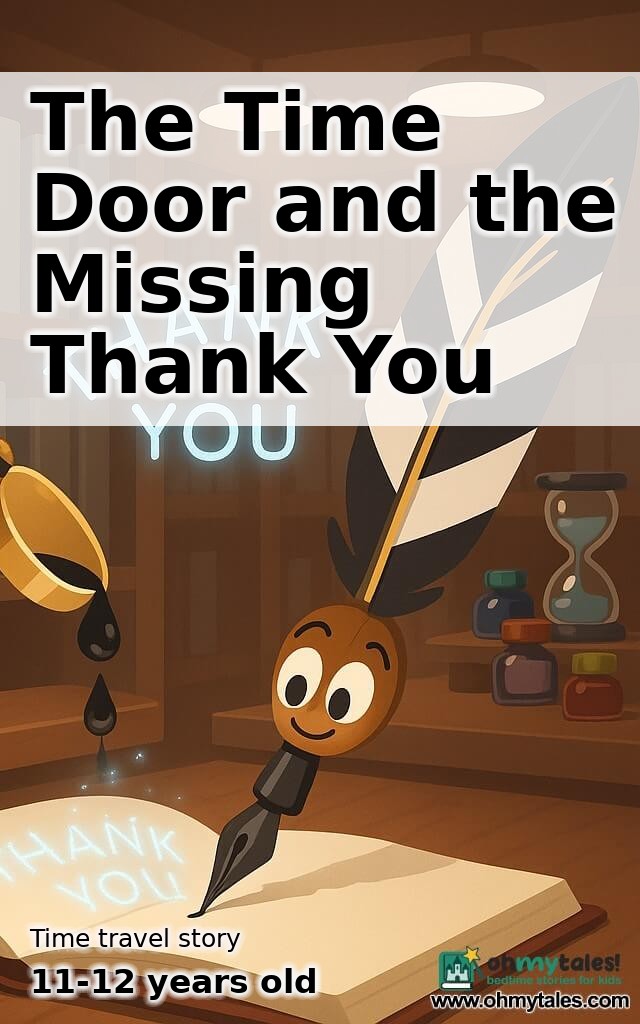
The quills floated from their cups and hovered above the chairs like curious birds. One large quill, striped black and white, moved to the center and dipped its tip in a golden ink bottle.
It wrote in the air, letters forming bright ribbons:
TODAY'S LESSON: PARADOXES ARE MISCHIEF WITH MANNERS.
Pip whispered, “Is it going to teach us?”
Cora's needle pointed to the center quill. “It already is.”
The striped quill drew a simple diagram in the air: a line for time, a loop, and a little dot.
IF YOU REMOVE THE REASON YOU CAME, YOU CANNOT HAVE COME.
THAT IS A PARADOX.
PARADOXES TEND TO BITE PAGES.
Pip laughed nervously. “Pages that bite. That sounds like my cousin Staple's sense of humor.”
Cora tried to stay calm. “We must be careful not to cause a paradox.”
The striped quill wrote:
EXCELLENT. YOUR FIRST TASK: FIND THE MISSING INKWORD.
WITHOUT IT, THIS WORKSHOP STOPS MAKING STORIES.
WITHOUT STORIES, MEMORIES FADE FASTER.
Cora's lid clicked open. “Missing Inkword?”
A smaller quill zipped over and scribbled on a parchment sheet, then pushed it toward them. On it was a map of the workshop, drawn like a treasure hunt. Three spots were circled:
1) THE CLOCKWORK PRESS
2) THE ERASER-BOX OF REGRETS
3) THE SHELF OF UNWRITTEN ENDINGS
At the bottom, in a tidy hand:
THE INKWORD IS “THANK YOU.”
BUT IT IS STUCK IN A LOOP.
Pip blinked. “How can a word get stuck?”
Cora's needle quivered. “In time, anything can loop—footsteps, songs, even gratitude.”
The striped quill dipped in gold ink again:
COOPERATE.
TRUST THE MAP.
EXIT BEFORE THE INK DRIES.
Pip straightened. “We can do this. Two friends. One compass. One paperclip. One very polite quill army.”
Cora breathed in the scent of ink and possibility. “Let's begin.”
Chapter 3: The Clockwork Press and the Sneaky Loop
They rolled and skittered across the workshop floor. The wooden planks were smooth, worn by years of sliding chairs and busy ideas.
First stop: the Clockwork Press.
It was a tall machine with gears that turned like slow thoughts. A stack of blank pages rested on one side. On the other side, finished pages came out—printed with elegant letters and tiny illustrations. Every few seconds, the press coughed politely: ka-CHUFF.
Cora watched the gears. “It runs in cycles. Perfectly timed.”
Pip hopped up onto a lever. “Everything here loves patterns.”
A small brass plaque on the press read:
IF YOU HEAR YOUR OWN WORDS BEFORE YOU SPEAK THEM, STEP BACK.
Pip froze. “That's… oddly creepy.”
“Not creepy,” Cora said quickly. “Preventive.”
They moved closer. In a tray beneath the press lay several words made of hardened ink, like little tiles: ONCE, UPON, A, TIME, and—curiously—THANK.
But not YOU.
Cora examined the tray. “We found part of it. The word ‘THANK' is here. The ‘YOU' is missing.”
Pip poked THANK with one end. It was warm. “Why is it warm?”
Because, Cora realized, the press was still trying to print THANK YOU, but something kept interrupting the second half. The gear pattern stuttered every time it reached a certain point.
“Listen,” Cora murmured.
Ka-CHUFF… ka-CHUFF… ka—ch—ch—CHUFF.
A hiccup in time.
Pip hopped off the lever. “It's looping right there.”
Cora traced the gear teeth with her eyes. “A loop can happen when a moment is forced to repeat. Like a sentence that keeps rewriting itself.”
Pip squinted. “Can we… unrepeat it?”
Cora's needle swung toward a small side door on the press labeled MAINTENANCE: ONLY FOR PATIENT MINDS.
“That seems like you,” Pip said.
Cora felt a shy glow. “Yes. Also, we should cooperate. You're good at squeezing into tiny spaces.”
Pip puffed himself up, which did not change his size at all. “Watch me squeeze.”
He slipped into the maintenance door with a tiny metallic scrape. Inside, Cora could hear faint clinks and Pip's muttered comments.
“Ow. That gear is rude.”
“Hello, dust. Please stop.”
“Ah-ha!”
“What do you see?” Cora asked.
“A tiny paper strip,” Pip called. “Wrapped around a gear like a scarf. It says… ‘DO NOT SAY THANK YOU YET.'”
Cora's needle spun. “That's a warning from someone trying to delay gratitude. But why?”
Pip tugged. “It's stuck! The gear keeps snapping back—like it's time-glued.”
Cora thought hard. Rule Three: Do not meet yourself. Rule One: Enter to learn. Rule Four: Exit before the ink dries.
“We can't force it,” she said. “Forcing time makes it bite. We need to outsmart the loop.”
“How?” Pip asked, voice muffled by machinery.
Cora studied the press again. Every time the stutter happened, the same blank page slid in, paused, then slid back out, still blank. The press was trying to print YOU, but the page kept being “un-printed” into blankness.
“The page is being pulled backward in time,” Cora said. “Like a rewind.”
Pip groaned. “So the press is stuck saying THANK and never reaching YOU.”
Cora looked around for a clue. On the table beside the press sat a sand timer—but the sand was ink, dark and shining. A tag read:
INK DRIES WHEN DECISIONS DO.
Cora's lid clicked shut. “We must make a decision that completes the cycle.”
Pip wiggled inside. “The paper strip says ‘not yet.' Maybe someone was saving THANK YOU for later, and now ‘later' never arrives.”
Cora rolled closer to the ink-sand timer. The ink grains fell steadily. Not much time.
“Pip,” she said gently, “I think the missing word is trapped because nobody here wants to finish it. Gratitude can feel like an ending.”
Pip went quiet. Then: “Endings can be scary.”
“Yes,” Cora agreed. “But endings also let new chapters start.”
She called toward the maintenance door. “Can you loosen the strip just enough for one full turn? Not rip it. Just… cooperate with the gear.”
Pip inhaled, which again was impressive. “I'll try. Gear, please be reasonable.”
Cora, outside, pressed her body against the press frame to steady it. She used her weight—small, but firm—to keep the machine from jolting back.
Inside, Pip tugged in rhythm with the stuttering gear. Cora counted aloud.
“One… two… three… now!”
On “now,” the gear clicked past the snag. The loop hiccuped, tried to snap back, and failed. The press exhaled—ka-CHUFF!—in the smoothest cough yet.
A fresh ink tile slid into the tray.
YOU.
Pip crawled out, dusty but proud. “We did it!”
Cora smiled with her whole lid. “We cooperated. It matters.”
Pip nudged the two tiles together: THANK + YOU.
They fit like puzzle pieces.
But the moment they touched, the tiles shimmered and slipped away, like fish made of ink.
Pip yelped. “Hey! It ran away!”
In the air, the striped quill's gold letters appeared, drifting from the center of the workshop:
GOOD. YOU FREED THE WORD.
NOW FIND WHERE IT HIDES NEXT.
LOOPS MOVE LIKE RIPPLES.
Cora consulted the map. The next circle glowed faintly.
“The Eraser-Box of Regrets,” she read.
Pip sighed. “That sounds… emotionally sticky.”
Cora rolled forward, brave and steady. “We'll face it together.”
Chapter 4: The Eraser-Box of Regrets
The Eraser-Box sat under a side table, half in shadow. It was a wooden crate with a lid that didn't quite close, as if it was full of sighs.
Written on the crate in neat ink:
FOR MISTAKES THAT TEACH.
NOT FOR MISTAKES THAT HIDE.
Pip leaned in. “So it's… a learning box.”
Cora nodded. “Regret can be useful if it points to better choices.”
A tiny quill fluttered down and tapped the lid twice. Tap-tap. The lid creaked open.
Inside were erasers of every kind: pink rubber blocks, crumbly white rectangles, soft gray kneaded lumps. They lay like sleeping stones. And between them, faintly glowing, were letters—floating, half-erased.
T… h… a…
Cora's needle dipped. “The word is here, being erased.”
Pip frowned. “Why would anyone erase THANK YOU?”
At the bottom of the box, a note was pinned with a sharp tack. It read:
IF WE SAY IT, WE MIGHT CHANGE WHAT HAPPENED.
IF WE CHANGE WHAT HAPPENED, WE WON'T BE WHO WE ARE.
BETTER TO STAY SILENT.
Pip whistled. “That's a big thought for a box.”
Cora felt a tug inside her, a quiet ache. “That's fear of paradox. But silence isn't the same as safety.”
The erasers stirred, as if offended.
A pink eraser rolled forward and rubbed at the floating letters. The T vanished with a tiny pop.
“Stop!” Pip cried.
The eraser paused, then rubbed harder. The H began to fade.
Cora moved quickly. She rolled right up to the box edge and spoke clearly, calmly, like reading rules out loud.
“Time Rule: You can't remove the reason you came. We came to restore the word. Erasing it removes our reason. That creates a paradox.”
The erasers froze.
Pip blinked. “Did you just… argue with erasers?”
Cora's needle steadied. “I used logic. The workshop likes logic.”
The kneaded eraser, gray and squishy, rose like dough being pulled upward. It shaped itself into a question mark.
Then, in the air above the box, words appeared—written by an unseen quill:
PROVE THAT GRATITUDE DOES NOT CHANGE THE PAST.
PROVE IT ONLY BRIGHTENS THE PRESENT.
Cora thought. “Gratitude is not a shovel,” she said slowly. “It doesn't dig up old choices. It's a lantern. It shows what mattered.”
Pip added, “Also, if you say ‘thank you' to a lamp, the lamp doesn't travel back in time and become the sun.”
The question mark wobbled, as if laughing.
Cora continued, “Saying THANK YOU does not erase mistakes. It can even exist beside them. You can thank someone for trying, even if it went wrong.”
The pink eraser hesitated.
Pip hopped into the box—carefully, landing on a safe spot between erasers. “Look, erasers. You help fix messy lines, right? But you don't delete the whole story. If you erase everything, there's nothing left to learn.”
The erasers trembled, then slowly relaxed. The floating letters brightened again.
T… H… A… N… K… Y… O… U…
The letters gathered together and became a single glowing word, as bright as fireflies in a jar.
THANK YOU.
Cora felt warmth behind her lid. “We did it.”
But the word did not settle. It spun once and zipped out of the box like a startled bird, streaking toward the far wall.
Pip groaned. “It's still looping!”
Gold letters from the striped quill drifted down again:
FINAL STOP: THE SHELF OF UNWRITTEN ENDINGS.
BEFORE THE INK DRIES.
Cora glanced at the ink-sand timer across the room. The ink was nearly at the bottom.
Pip scrambled out of the box. “No pressure.”
Cora rolled fast, her brass body humming on the floorboards. “We can make it. Together.”
Pip skittered beside her. “Together,” he echoed, as if the word itself was a tool.
Chapter 5: The Shelf of Unwritten Endings
The Shelf of Unwritten Endings stretched high, nearly touching the milky skylights. It was filled with blank books—thick, thin, tiny, enormous. Each had a title stamped in faint silver, but the pages inside were empty.
Pip read a few spines as they hurried along the bottom row.
“THE DRAGON WHO LEARNED TO KNIT.”
“THE CITY UNDER THE PUDDLE.”
“THE DAY THE MOON SNEEZED.”
“Why are these unwritten?” Pip asked.
Cora's needle pointed upward, then circled, uneasy. “Maybe the endings were delayed too long. Maybe the stories are waiting for the missing word.”
Near the center of the shelf, an open book lay on a stand. Its pages fluttered as if impatient. Above it hovered the glowing THANK YOU, spinning in a tight circle, trapped like a planet in a tiny orbit.
Around the orbit, faint lines of time shimmered—loops within loops.
Pip stared. “How do we grab it without… breaking time?”
Cora read the book's blank page. At the top, a sentence had been written, but the ink kept fading and reappearing:
AN ENDING MUST BE TRUE, OR TIME WILL REWRITE IT.
Cora swallowed. “We need to place THANK YOU into a true ending. A real conclusion. Not forced.”
Pip tilted his head. “But these are empty.”
Cora looked at the stand. There was a quill resting there, but it wasn't writing. Its tip was dry.
A tag hung from it:
NEEDS ONE DROP OF PRESENT INK.
Cora's needle snapped toward her own body. Inside her, tucked beneath her lid, she carried a tiny vial of modern ink—a little emergency refill from the library's stamp pad. She'd brought it without thinking, because she liked being prepared.
“I have present ink,” she whispered.
Pip grinned. “Cora the Careful strikes again.”
Cora hesitated. “Rule Two: Do not take what is not yours. This ink is mine. So it's allowed. But Rule Three…”
“Do not meet yourself,” Pip finished. “We're not meeting ourselves. We're just… lending a drop of now.”
Cora opened her lid. The vial gleamed. She tipped one single drop onto the quill's dry tip.
The quill shivered as if waking from a nap. Ink flowed again—dark, rich, alive.
The hovering THANK YOU slowed, as if listening.
The quill wrote on the blank page, not in the air this time, but into the book itself:
IN EVERY TIME, SOMEONE HELPS SOMEONE ELSE.
THAT DOES NOT CHANGE WHAT HAPPENED.
IT MAKES IT WORTH REMEMBERING.
Cora watched, heart-quiet. “That's true.”
The quill continued:
THE COMPASS STEADIED THE MACHINE.
THE PAPERCLIP TURNED THE GEAR.
TOGETHER, THEY FREED A WORD THAT WANTED TO BE SPOKEN.
Pip whispered, “Hey, that's us.”
Cora's needle quivered. “But it's describing us now. Is that allowed?”
The striped quill appeared in gold letters above the page:
IT IS SAFE TO BE SEEN BY A STORY.
IT IS NOT SAFE TO MEET YOURSELF IN THE FLESH OF TIME.
Pip nodded. “Stories can watch. Time can't shake hands with itself.”
The book's last line waited, blinking like a cursor made of candlelight.
Cora leaned close. “The ending needs the word.”
Pip spoke softly, as if not to startle it. “Then say it.”
Cora took a steadying breath. Her voice was small, but clear.
“Thank you,” she said.
The hovering word snapped into place on the page, ink sinking into paper like rain into thirsty soil.
The loops shimmered, then untangled. The shelf seemed to sigh with relief. Several blank books flickered—silver titles brightening—as if their endings had just been given permission to exist.
Across the workshop, machines resumed smooth rhythms. Quills wrote faster, happier, as if a stubborn knot had been undone.
But the ink-sand timer made a final gloop.
The last ink grain fell.
Pip's eyes widened. “Rule Four. Exit before the ink dries!”
Cora's needle spun toward the walnut doorway. It was still open, but the air around it was turning dull, like paint that's been left too long.
“We run,” Cora said.
Pip didn't argue. “Fastest paperclip in the west—well, in any time!”
They raced. Floorboards blurred. Quills lifted like a cheering crowd. The striped quill drew one last message in gold:
REMEMBER: GRATITUDE DOES NOT PULL TIME BACK.
IT PUSHES YOU FORWARD.
Cora tucked the thought inside her lid as they reached the doorway.
The quill-handle trembled.
The time wind hummed.
They leapt through together.
Chapter 6: Back on the Third Shelf
Cora landed with a soft clink on familiar wood. Pip bounced and caught himself on a bookmark.
The library air was cooler, quieter. The lamps were the same dim glow. The radiator tapped. A distant book settled.
Everything looked exactly as it had.
Except Cora.
Inside her, something felt newly arranged, like a map that finally matched the world.
Pip exhaled. “We made it. No paradox bites. No page injuries.”
Cora listened. The tick-tock behind the shelf was gone. When she nudged the loose board, it fit snugly, as if it had never been loose at all. The walnut doorway was nowhere to be seen.
“Was it real?” Pip asked softly.
Cora's needle pointed north—steady, sure. “Yes,” she said. “And even if time tries to smooth it over, we carry the memory.”
Pip glanced at her lid. “Do you think we changed anything?”
Cora considered. “We didn't change the past. We helped a word find its place. That changes… us.”
Pip smiled, a bent bit of metal trying its best to look wise. “I guess cooperation does that. It makes you more than your shape.”
Cora rolled closer to the cracked atlas, her usual neighbor. She could almost smell the workshop's ink again, and see the hovering word looping like a star.
She spoke so quietly the dust barely heard.
“Thank you,” she murmured—to the quills, to the rules, to the strange bright lesson, and to the way memories can warm the present without rewriting it.
Pip echoed, softer still. “Thank you.”
In the hush of the closed library, their gratitude settled gently among the books, like a bookmark placed exactly where it belonged.