Chapter 1: The Quiet Workbench
Milo Hart was twelve and famous for two things at school: saying almost nothing, and fixing everything.
When other kids argued about who was best at soccer, Milo listened. When pencils snapped, he repaired them with tape so neat it looked printed. Teachers called him “thoughtful.” His sister called him “a walking pause button.”
Milo didn't mind.
In the corner of his room sat his workbench: a scarred wooden table, a jar of screws sorted by size, and a notebook with a black elastic band. The notebook was not for poems. It was for plans.
On a rainy Saturday, Milo clicked on his desk lamp and opened to a page labeled, very carefully:
LOGBOOK: TIME TOOL (Version 1)
He wrote in small, tidy letters:
— Rule 1: Start with what you can measure.
— Rule 2: Change one thing at a time.
— Rule 3: If you don't understand it, don't touch it.
A soft beep came from the object sitting in the middle of the bench.
It looked like a lunchbox made of brushed metal, with a dial on top and a handle on the side. A red button sat beside the dial like a cherry on a sundae.
Milo didn't have a sundae. He had a time machine.
He had built it from a broken microwave timer, a bicycle dynamo, an old compass, and one mysterious part he'd found at a flea market: a ring of glass that felt cold even in summer. The seller had winked and said, “Keeps its own secrets.”
Milo had not winked back. He had written: GLASS RING: DO NOT LICK.
He checked his list again.
— Tools: packed.
— Safety: goggles.
— Anchor: set.
The Anchor was important. It was a small chip taped inside his watch. It hummed softly, like a sleepy bee. The Anchor would pull him back to the exact moment he left, as long as he returned within one hour of his own time.
That was Rule 4.
— Rule 4: Always come back.
Milo tightened the strap on his watch. He took a deep breath, not dramatic, just careful. Then he turned the dial.
Numbers clicked under his fingers. He stopped at a date he'd circled in his notebook three times.
A cathedral was being built in his town eight hundred years ago. He'd read about it in the library: stone towers, stained glass, a forest of scaffolding.
He wanted to see it. Not as a picture, not as a paragraph, but as a living place—hammer sounds and dust and sky.
Milo placed his palm on the handle.
“Okay,” he said aloud. The word sounded odd in his room, like a shoe on a silent floor.
He pressed the red button.
The lunchbox flashed white.
The air turned thick, like he was walking through warm honey. The desk lamp stretched into a long glowing noodle. The jar of screws became a spinning starry circle.
Milo grabbed the handle harder.
And the world folded.
Chapter 2: Stone, Sky, and Shouting
Milo landed on his knees.
Not on carpet.
On packed earth scattered with straw and small white chips of stone.
He blinked grit from his lashes. The air smelled sharp—wet wood, smoke, and something like chalk. He looked up.
A cathedral skeleton rose above him, huge and unfinished. Tall arches stood like stone ribs. Wooden scaffolding climbed the walls in crooked ladders. Men hauled ropes. A cart creaked. Somewhere a hammer hit stone—tap, tap, TAP—like a heartbeat that had learned rhythm.
Milo's time tool sat beside him, still humming. The dial glowed faintly. His watch ticked in a very normal way, as if nothing strange was happening at all.
A boy about Milo's age ran past carrying a bundle of thin wooden pegs. He stopped short when he saw Milo's sneakers.
“What are those?” the boy demanded, eyes wide.
Milo stood slowly. He suddenly remembered the part of his notebook titled: CLOTHES.
He had ignored it.
Milo's hoodie and jeans looked like they belonged to a different universe. Which, technically, they did.
“I… I'm Milo,” he said, trying for calm.
The boy stared at his hoodie strings like they might bite. “Are you a lord's son? Or a wizard?”
Milo's mouth wanted to say, I'm just a kid with a time machine, but his rules marched into his mind like serious little soldiers.
— Rule 5: Don't explain time travel to the past.
“I'm a… helper,” Milo said, which felt true enough.
The boy narrowed his eyes. “Helpers wear boots.”
Milo glanced down at his bright sneakers. “These are… quiet boots.”
The boy snorted, then grinned as if he'd decided Milo was entertaining instead of dangerous. “I'm Tom. If you're a helper, come help. Master Alain is shouting again.”
As if on cue, a loud voice rang out. “Where is the plumb line? We cannot hang an arch by guessing!”
Tom grabbed Milo's sleeve. “Come on, Quiet Boots.”
They rushed under the scaffolding. Milo tried not to stare too much, but everything was stunning: stone blocks the size of suitcases, chisels lined like teeth, ropes thick as his wrist.
They reached a worktable where an older man with a square beard was waving his arms like windmills. A thin string with a weight at the end dangled from his fist.
“This is missing,” the man barked, “and without it your stones will drift like drunken geese!”
Tom pointed at Milo. “He's a helper.”
The man's sharp eyes landed on Milo. “He looks like a sparrow in a storm.”
Milo swallowed. “I can find things,” he said.
The man huffed. “Then find my plumb line weight. It's iron, pear-shaped, and it does not walk away by itself.”
Milo nodded, because nodding was easier than talking.
He searched methodically, like he did at home when his sister lost her earbuds.
First: look where it belongs. Then: look where it could fall. Then: look where someone would put it “just for a moment.”
He checked under the table. Behind the tool rack. Near the ropes.
Nothing.
Tom tugged his sleeve. “If Master Alain keeps shouting, birds will fall from the sky.”
Milo looked up at the scaffolding.
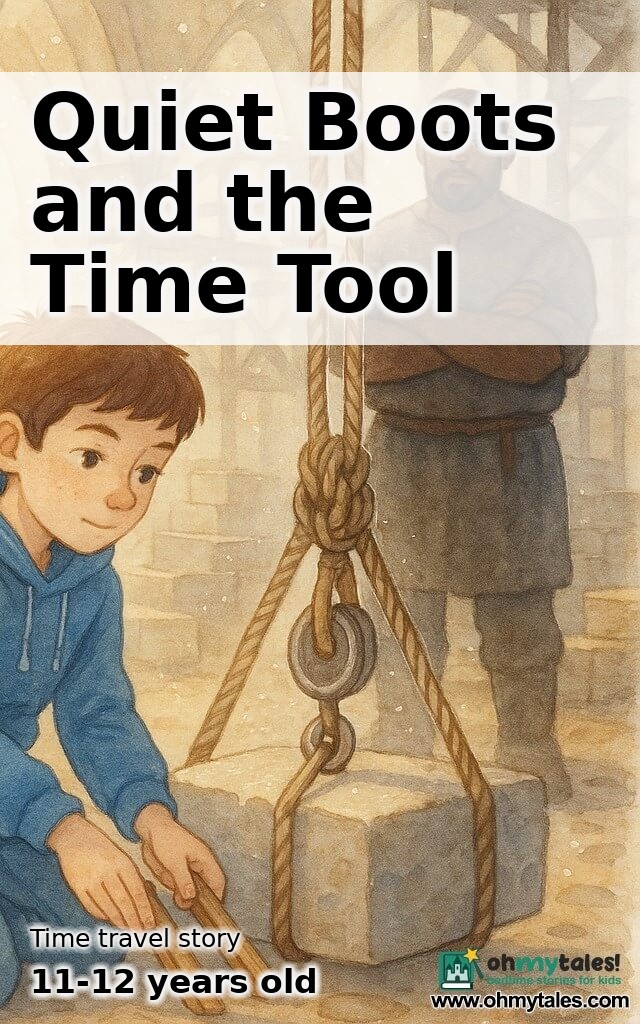
A rope went over a beam and down to a pulley. A small iron weight swung beneath it.
Not pear-shaped. But iron.
Milo stepped closer. The weight had scratches, fresh and bright, like it had recently been scraped on stone.
He pointed. “That.”
Master Alain stomped over, squinted, and then his face shifted from anger to surprise. “My plumb weight! Someone used it as a counterweight!”
Tom raised his hands. “Not me!”
Milo said nothing, but he noticed something else: the rope above the weight was frayed. One thin strand waved loose, like a tired hair.
Method, Milo thought. Look again. Notice small things.
He touched Tom's arm. “That rope needs fixing.”
Tom looked. His grin vanished. “Oh.”
Master Alain followed their gaze. His voice lowered, suddenly serious. “If that snaps, the stone block on the hoist will drop. Clear the path!”
Shouts spread. Men moved. The hoist groaned as a heavy stone block hung in the air like a suspended moon.
Milo's heart thumped. He hadn't come here to cause trouble.
He'd come to see the past.
Now the past was swinging on a frayed rope.
Chapter 3: The Mischievous Paradox of the Pegs
Milo's mind raced, but his hands stayed steady. He pulled his small tool pouch from his hoodie pocket. He'd packed it with care: tape, wire, a tiny multitool, and a roll of strong cord.
Tom gaped. “You carry a squirrel's treasure in your shirt.”
Milo didn't answer. He was focused on the rope.
Master Alain shouted orders. “Lower it! Slowly!”
The men tried, but the rope slipped in jerks. The stone swung. Dust sprinkled down like flour.
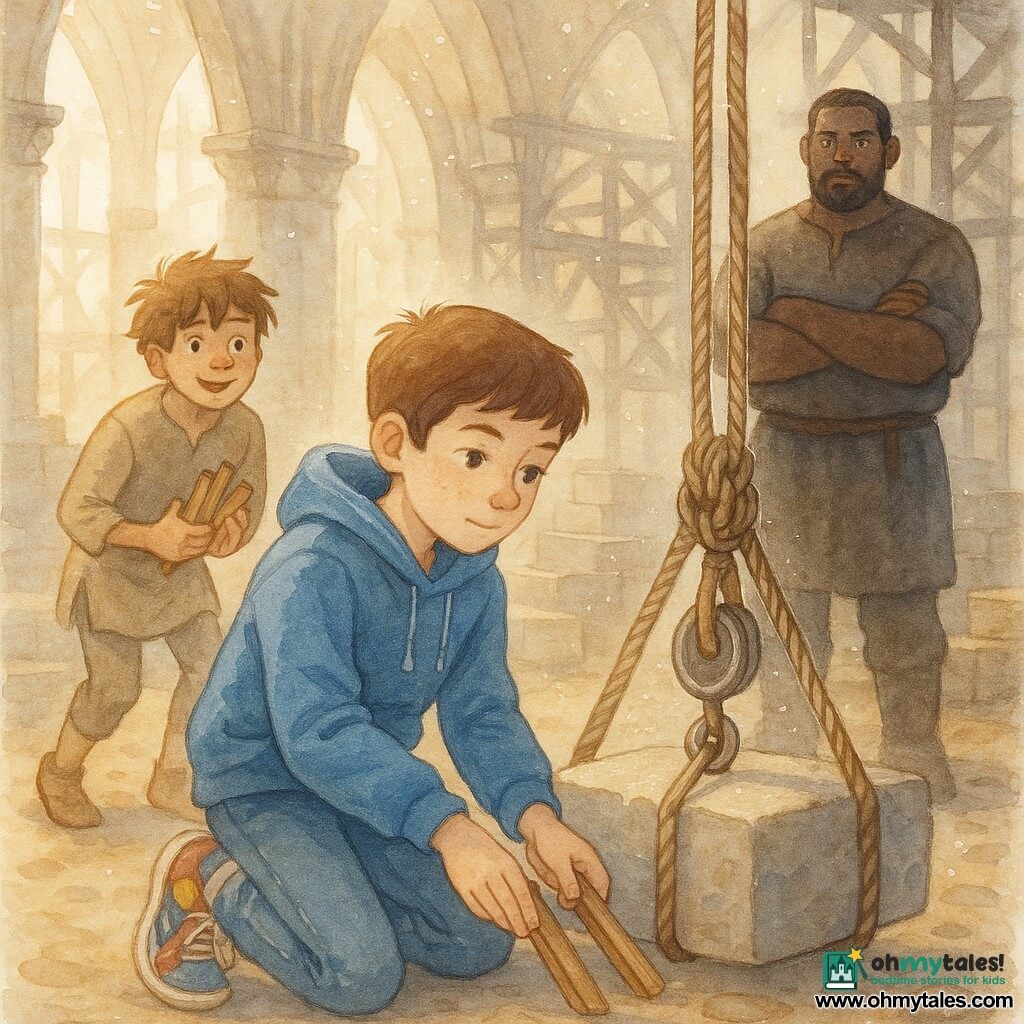
Milo looked for the best spot to help without being in the way. He noticed a rack of wooden pegs—thin, smooth, and stacked like pencils. Tom had been carrying some earlier.
“Tom,” Milo said, quick and quiet. “Those pegs. Bring them.”
Tom blinked. “Why?”
“Just do it. Please.”
Tom ran. Milo moved to the hoist post where the rope wrapped around a wooden beam. If they could stop the rope from sliding, they could lower the stone safely. A simple wedge could create friction.
Tom returned, panting, and shoved the bundle into Milo's hands. “If this is a wizard trick, I want to watch.”
Milo slid two pegs under the rope wrap, pressing them like wedges. The rope bit into the wood. The slipping slowed.
“Now,” Milo called, louder than he liked. “Lower!”
The men pulled. The stone descended in a controlled groan, like a giant sitting down carefully.
A cheer went up when it thudded onto a stack of supports.
Master Alain's shoulders dropped. He looked at Milo with a new expression, almost respectful. “You're quick,” he said. “Quiet, but quick.”
Tom beamed as if he'd invented Milo himself. “Told you. Quiet Boots.”
Master Alain held up the frayed rope. “This must be replaced. Someone tied the plumb weight onto it. Foolishness.”
Milo stared at the scratches on the iron weight again. Something about them bothered him, like a math problem that wouldn't balance.
He had a sudden, prickly thought.
His time tool. It had a handle, a dial, and a strap—also a strap.
Had he left something on the scaffolding when he landed?
Milo's stomach tightened. He glanced toward the spot where he'd arrived. The scaffolding above looked the same as before, except now he noticed a loop of fabric hanging from a beam.
A modern fabric strap.
His fabric strap.
He walked closer, trying to look casual. Tom trailed him. “What are you staring at?”
Milo reached up and pulled down the strap. It was the strap from his time tool, the one he'd used to carry it. It must have snagged when he landed.
On the end of the strap, someone had tied the plumb weight. Probably because it was handy.
Milo's face went hot.
Tom's eyes widened. “That's yours?”
Milo stared at the strap in his hands, then at the weight, then back at the strap.
Paradox, his brain whispered. A mischievous loop.
If he hadn't dropped the strap, nobody would have used it. If nobody had used it, the rope might not have frayed so badly. If the rope hadn't frayed, the stone might not have nearly fallen. If the stone hadn't nearly fallen… he might not have shown up with the pegs.
Milo pictured time as a neat row of dominos, and his strap had rolled under the table and nudged one.
Tom poked him. “Are you sick?”
Milo forced a breath. “No. Just… embarrassed.”
Tom laughed. “Embarrassed is better than crushed. Want to see the stone carver's shed? It smells like wet pennies.”
Milo looked at his watch.
Fifty-three minutes of his hour were already gone.
He needed to go back soon, but he couldn't just vanish without fixing what he'd tangled.
Method, he reminded himself. Make a plan.
He spoke to Master Alain. “I can help replace the rope. And… I should take this back.” He held up the strap.
Master Alain frowned at the strange fabric. “Take your ribbon. But first, help. Then you may go.”
Milo nodded.
Tom leaned close. “Where will you go, Quiet Boots?”
Milo hesitated, then chose the safest truth. “Home.”
Tom made a face. “Lucky.”
They worked fast. Milo followed instructions, watching each knot and each loop. He didn't try to be the boss. He tried to be accurate.
When the new rope was tied and tested, Master Alain finally stopped frowning. “You have a steady eye,” he said. “Remember: measure twice, cut once.”
Milo's lips twitched. “I will.”
Tom elbowed him. “See? That's what I've been saying. Quiet Boots is clever.”
Milo looked at his watch again.
Fifty-nine minutes.
The Anchor hummed slightly louder, like a bee waking up.
Time to leave, before time decided to be less polite.
Chapter 4: A Rule Written in Stone
Milo walked back toward the open patch of ground where he'd landed. The cathedral loomed above, unfinished but already magnificent. Sunlight slipped between beams and stone arches, turning dust into glitter.
Tom followed, dragging his feet. “You didn't even see the stained glass maker. He has colors trapped in sand. It's magic.”
“I'd like to,” Milo said. “But I can't stay.”
Tom folded his arms. “Because of… lord business? Wizard lessons?”
Milo looked at the busy workers, at the careful placing of each stone. Everyone here was building something that would last longer than their own lives.
“I have rules,” Milo said simply.
Tom rolled his eyes. “Rules are for monks.”
Milo smiled a little. “Rules are for not getting crushed. And for getting home.”
Tom stopped. “You really mean it. You're leaving now.”
Milo nodded. He set the time tool on the ground. Its metal sides looked oddly clean in the muddy yard.
Tom crouched, fascinated. “It's like a small chest.”
Milo didn't correct him. He opened his notebook to a fresh page and wrote quickly, the way he did when his brain was loud and needed a place to sit.
LOGBOOK: FIELD NOTE
— The past is busy. It does not pause to admire itself.
— Tiny mistakes become big dangers.
— Method helps you notice the frayed strand before it snaps.
— Do not drop modern straps in medieval yards.
Tom peered at the writing. “Those marks… are they secret?”
“They're just letters,” Milo said. “But… yes. Secret enough.”
Tom picked up a pebble and offered it to Milo. “Take this. So you remember.”
The pebble was pale limestone, warm from the sun. It fit Milo's palm perfectly.
Milo hesitated. He knew another rule.
— Rule 6: Don't bring souvenirs that change history.
A pebble wasn't a crown jewel. But if that pebble belonged in a wall later, taking it might matter.
Milo looked around and spotted a pile of loose stone chips, already broken off and swept aside like crumbs. He chose one from the ground near the pile instead.
“I'll take this one,” Milo said, swapping gently. “That other pebble might be needed.”
Tom blinked, impressed in spite of himself. “You think like Master Alain. Always counting stones.”
Milo tucked the chip into his pocket. “Thanks, Tom.”
Tom's grin returned, a little shaky. “If you ever come back, bring quieter boots.”
Milo snorted. It was a small sound, but it surprised him. “I'll try.”
The time tool's dial glowed brighter. The Anchor hummed in his wrist, steady and insistent.
Milo gripped the handle. “Goodbye.”
Tom stood up straight, suddenly solemn. “Goodbye, Milo the Helper.”
Milo pressed the red button.
The cathedral yard blurred. The hammer taps stretched into long echoes. For a heartbeat, Milo saw the half-built arch and imagined it completed—stone meeting stone, patient and perfect.
Then the world folded again, neatly, like a map being closed.
Chapter 5: The Present Snaps Back
Milo stumbled onto carpet.
His desk lamp was still on. Rain still tapped the window. The jar of screws sat exactly where it had been, calm and ordinary.
The clock on his wall showed the same minute he'd left.
Milo stood very still, waiting to feel different. He felt mostly dusty.
He checked his pockets. The stone chip was there. He held it up under the lamp. It looked like nothing special: pale, rough, and small.
But Milo knew it had been lying under an unfinished cathedral, while voices shouted in a language close to his own, and boys named Tom ran with pegs.
He placed the chip on his workbench like it was fragile.
Then he opened his notebook and wrote another entry, slower now.
LOGBOOK: RETURN
— Anchor worked. Returned within one hour.
— Paradox observed: my dropped strap caused trouble I then helped fix.
— Conclusion: the past reacts. It does not forgive carelessness.
— Next time: secure all parts. Double-check straps. Pack clothing that blends in.
He paused, then added:
— Most important: method is kindness. It keeps people safe.
From downstairs, his sister shouted, “Milo! Mom says dinner in ten!”
Milo looked at the time tool. It sat quietly, as if it had never swallowed a cathedral yard at all.
He wiped a smear of mud off its side with an old cloth. He tightened the handle screws. He wrapped the strap properly this time, looping it and tucking the end so nothing dangled.
He didn't press the red button again.
Not tonight.
Instead, he slid the time tool into a plain cardboard box and labeled it in careful block letters:
OLD PROJECTS — DO NOT STACK BOOKS ON TOP
He placed the box on the lowest shelf of his closet, behind a line of board games.
Then, with the same steady hands he'd used on the hoist rope, Milo shut the closet door.
The humming stopped.
Milo went downstairs to dinner, quiet as ever, but inside his mind the cathedral was still rising—stone by stone, rule by rule, bright against the sky.