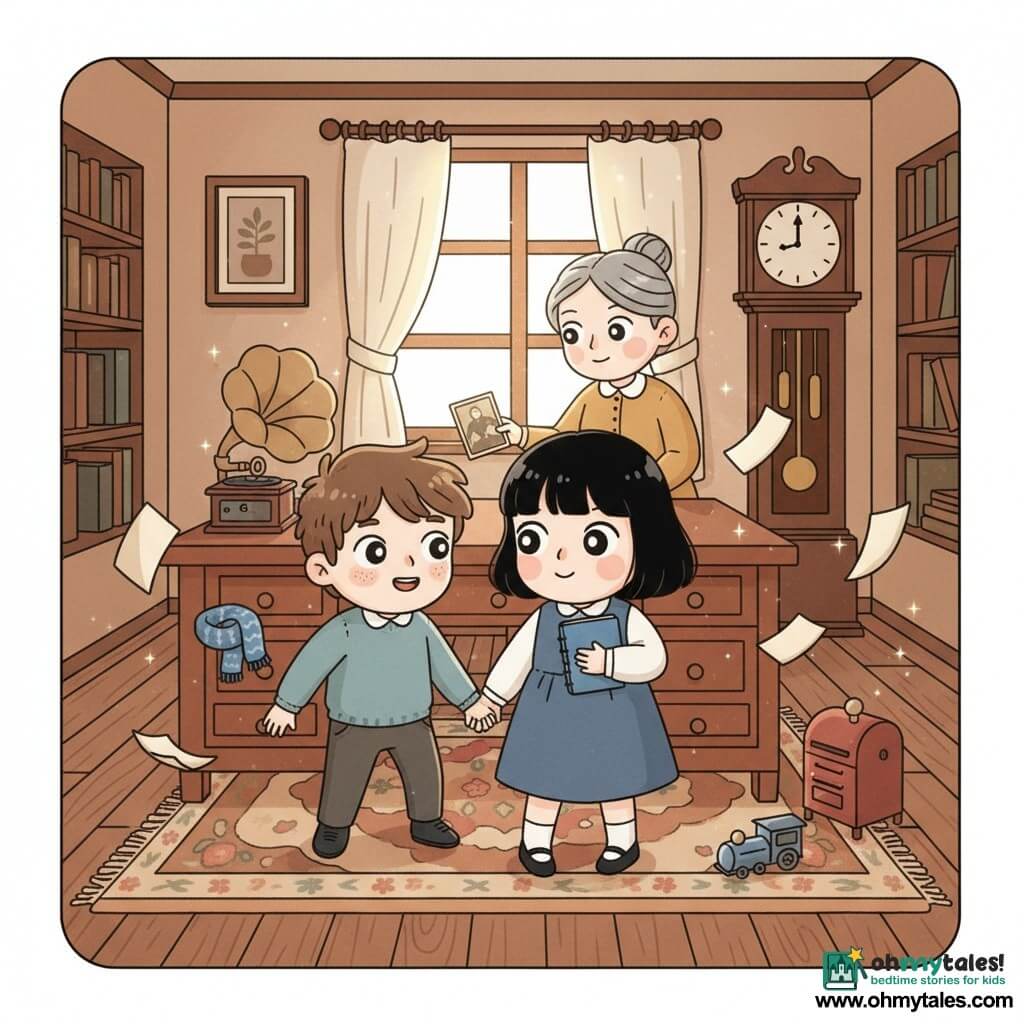
Chapter 1: The Museum That Smelled Like Rain
Mira liked quiet places. Not the boring kind of quiet, like waiting rooms. The good kind—like a library aisle, or the moment right after a storm when the street glistened.
That was why she loved the House on Alder Lane.
It wasn't a normal museum with velvet ropes and “DO NOT TOUCH” signs the size of pizza boxes. It was a house-museum, warm and welcoming, with creaky stairs, sunlit windows, and rugs that looked like they had listened to a thousand conversations.
Mira was twelve, small for her age, with quick eyes and a gentle way of moving—as if she didn't want to startle the world.
Beside her, her best friend Jax bounced on his heels. He was the opposite of gentle. He was kind, but in a loud way.
“Tell me there's a secret tunnel,” he whispered.
“There are no secret tunnels,” Mira whispered back.
“You don't know that,” Jax said, grinning. “Museums are basically legal treasure chests.”
A volunteer guide in a green cardigan waved at them. “Welcome! Feel free to explore. If you hear the old clock chiming, that's normal. It's… enthusiastic.”
Mira's ears perked up. “Old clock?”
“In the study,” the guide said. “It's been here longer than the museum has. Longer than most things.”
Jax's eyes shone as if someone had just said the words free snacks.
They walked through rooms that felt like gentle time itself: a parlor with portraits, a kitchen with copper pans, a bedroom with a quilt stitched in tiny squares. Each object had a small label, neat and calm, like it was trying not to brag.
Then they reached the study.
It smelled like paper and cedar and something else—something sharp and clean, like rain on warm pavement.
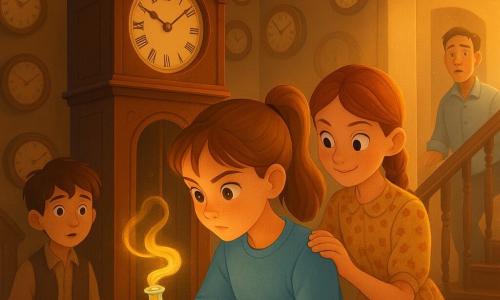
Against the far wall stood a tall grandfather clock. Its wood was dark and glossy, the face pale as moonlight. The hands ticked with an oddly patient sound.
Tick. Tock. Tick. Tock.
Mira stepped closer. Under the clock, on a small table, sat a visitor book and a pencil.
And beside them, a slim notebook with a blue cover.
No label.
Mira touched it, then hesitated.
Jax leaned in. “Maybe it's a prop.”
Mira opened it carefully.
Inside, the first page read, in tidy handwriting:
FIELD NOTES: TEMPORAL VISITS
RULES ARE NOT SUGGESTIONS.
Mira's heart did a small, excited flip.
Jax read over her shoulder. “Temporal… like time?”
The clock ticked louder, as if it had heard them.
Mira turned the page.
A folded slip of paper fell out and landed on her shoe. She picked it up.
On it, someone had drawn a simple sketch: the study, the clock, the exact spot where Mira stood.
And beneath the sketch, one sentence:
When the clock strikes, hold hands. Bring memory, not souvenirs.
Mira looked up.
Jax swallowed. “That's… very specific.”
The minute hand shivered forward.
The clock began to chime.
Dong.
Mira grabbed Jax's hand before her brain could argue.
Dong.
The air in the room thickened, like honey turning into light.
Dong.
The study blurred. The cedar smell stretched into a bright thread.
Mira's fingers tightened around Jax's, and the last thing she saw before the world tilted was the blue notebook sliding open by itself, pages fluttering like a bird's wings.
Dong.
And then—
The floor was not the same floor anymore.
Chapter 2: A Friendly House in Another Year
Mira's stomach felt as if it had taken a quick elevator ride without asking permission.
She blinked.
The study was still a study. The clock was still a clock.
But the air had changed. It was warmer. The sunlight slanted in a different angle, like it had been moved by a careful hand. And the room was… alive.
Not spooky-alive. Busy-alive.
A woman stood near the desk, humming. Her hair was pinned up, and her sleeves were rolled as if she had been cleaning.
She turned, saw Mira and Jax, and smiled like she had been expecting them.
“Oh! You're right on time,” she said. “Literally.”
Jax stared. “Did we just—”
Mira squeezed his hand, a warning: Don't say too much.
The woman walked over and offered a hand like this happened daily. “I'm Mrs. Pell. Welcome to the Pell House.”
Mira shook her hand because it seemed rude not to.
“Are you… the museum guide?” Mira asked.
Mrs. Pell laughed. “Museum? No, dear. This is my home. Though I suppose one day it might be full of people peering at my teacups.”
Jax mouthed the word teacups with silent awe.
Mira glanced at the clock. The hands were moving normally, but the date on the little calendar near the desk made her throat tighten.
June 17, 1913.
Jax leaned close. “Mira,” he whispered. “Is that… a hundred years ago?”
“More than,” Mira whispered back, trying to keep her voice steady. “Don't panic.”
“I'm not panicking,” Jax said, voice a squeak. “I'm… aggressively curious.”
Mrs. Pell studied them, eyes bright. “You've come through the clock, haven't you?”
Mira's jaw dropped. “You know about it?”
Mrs. Pell lifted a finger. “Hush. The house hears. And the house likes rules.”
She walked to the desk, opened a drawer, and pulled out a notebook—blue cover, same size as the one Mira had seen.
She handed it to Mira.
“Every visitor writes,” Mrs. Pell said. “Not everything, of course. Just enough to remember. Time is slippery. Memory is the rope.”
Mira opened the notebook. On the first page was the same title, written in the same careful hand.
FIELD NOTES: TEMPORAL VISITS
RULES ARE NOT SUGGESTIONS.
Underneath were short entries from different handwriting styles—some neat, some rushed, some shaky.
Mira read one line:
Do not remove objects. The past is not a shop.
Another:
If you meet yourself, wave politely and leave.
Jax snorted, then tried to turn it into a cough.
Mrs. Pell looked pleased. “You have good manners. That helps. Now—why are you here?”
Mira's mind raced. Why were they here? Because of a clock? Because of curiosity? Because something wanted them to learn?
She answered honestly. “We didn't plan it. We found the notes.”
Mrs. Pell nodded as if that was a perfectly sensible reason to cross a century. “Then the house chose you. It does that sometimes.”
She pointed to a wooden shelf where small objects sat: a pocket watch, a ribbon, a tin soldier, a cracked marble.
“Those are not for taking,” she said firmly. “Those are for remembering.”
Jax raised a hand like he was in school. “Question. If we can't take souvenirs, can we take… facts?”
Mrs. Pell's eyes twinkled. “Facts are excellent. They travel well.”
Mira's shoulders loosened a little.
Mrs. Pell clapped her hands softly. “Come along. I'll show you the house-museum before it becomes a museum. And there's something you must see.”
Mira and Jax followed, their footsteps quiet, as if the floorboards were listening.
Mira pulled the blue notebook against her chest like it was a map.
In the margin of the last page, someone had written a fresh note, as if it had just appeared:
Find the missing label. Fix nothing. Understand everything.
Mira swallowed.
“Jax,” she murmured, “I think we have a job.”
Jax grinned, nervous and thrilled at the same time. “Best field trip ever.”
Chapter 3: The Missing Label and the Mischief of Time
Mrs. Pell led them into the parlor. It looked familiar, but brighter, with fewer “museum” touches. No ropes. No signs. Just life.
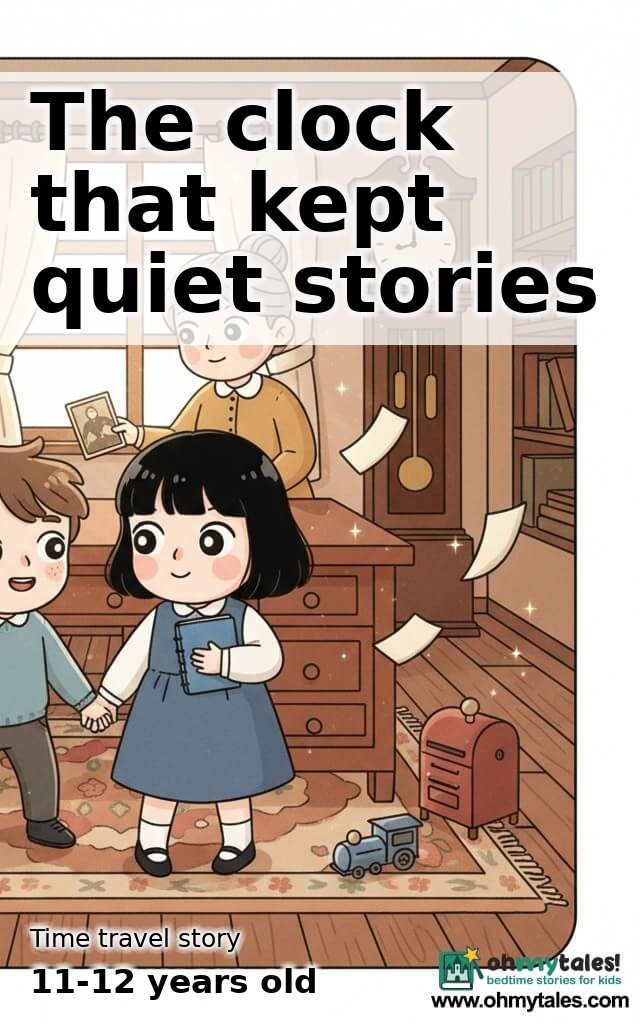
A little boy sat on the rug, pushing a tin train along the pattern. He glanced up at Mira and Jax and waved, as casual as if time travelers dropped by every Tuesday.
“Hello,” Mira said, waving back.
Mrs. Pell lowered her voice. “That is my nephew, Oliver. He is supposed to be napping. Time, as you'll notice, enjoys ignoring schedules.”
Jax whispered, “Same, honestly.”
Mrs. Pell stifled a laugh and continued. “In this room, one object will one day sit behind glass with a label. But today, the label is missing. Not the paper label. The meaning.”
Mira frowned. “How can meaning be missing?”
Mrs. Pell walked to the mantel where a small framed photograph stood. It showed a group of people in front of the house, faces serious but proud.
“This photograph will be important,” she said. “But it has been… untethered. People will look at it and see only old clothes. Not the story.”
Mira leaned closer. The photo looked ordinary, but something about it tugged at her. In the corner, barely visible, was a girl about Mira's age, holding a notebook.
A blue notebook.
Mira's skin prickled. “That's—”
Mrs. Pell nodded. “Yes. Visitors sometimes leave traces. Not objects. Echoes.”
Jax peered. “Is that you?”
Mira stared. The girl in the photo had a similar shape, a similar calm face.
“It can't be,” Mira whispered, but her voice sounded unsure, even to herself.
Mrs. Pell tapped the frame gently. “No paradox wrestling in the parlor, please.”
Jax choked on a laugh. “Sorry.”
Mrs. Pell turned serious. “Listen carefully. There is a rule that keeps the clock kind. You may observe. You may learn. You may write. But you must not change what you do not understand.”
Mira nodded, because that rule felt like it belonged in her bones.
Mrs. Pell picked up the photograph and turned it over. On the back was a blank space where writing should be.
“The story should be here,” she said. “It vanishes. Again and again.”
Mira's stomach tightened. “So the museum in our time doesn't know who's in it.”
“Exactly,” Mrs. Pell said. “And when memory disappears, people stop caring. When people stop caring, things get thrown away. Even houses.”
Jax's grin faded. “So… the house could stop being a museum.”
Mrs. Pell looked at the walls as if she loved them. “Or stop being at all.”
Mira's hands curled around the notebook. “How do we help without changing things?”
Mrs. Pell's smile returned, gentle. “By doing what visitors always do in a good museum: reading the truth. The house has clues. Follow them. The story is in the rooms.”
Oliver zoomed his tin train into a chair leg and made a dramatic crash noise.
Jax flinched. “The house does not care about indoor volume, apparently.”
Mrs. Pell tilted her head. “The house cares about kindness. Not whispers.”
She led them to the hallway, where hooks held hats and a mirror reflected them in a slightly wobbly way.
On a small table lay a stack of letters tied with string.
Mira noticed one envelope had a smudge on it shaped like a thumbprint.
She reached for it, then paused. “Can we read these?”
Mrs. Pell nodded. “Yes. Reading is not stealing.”
Jax said, “Tell that to my sister when I borrow her comic books.”
Mira untied the string carefully, like it might snap the air.
The top letter began:
To Mrs. Pell,
Thank you for preserving our stories—
Mira's breath caught. The ink looked fresh, but the paper looked old.
She turned the page and found a list of names. One name had been crossed out so hard it tore the fibers.
Mira pointed. “Why is that one scratched out?”
Mrs. Pell's eyes darkened with worry. “Because someone, someday, wanted to be forgotten.”
Jax frowned. “Why would anyone want that?”
Mrs. Pell glanced toward the grandfather clock, even though it wasn't in the hallway. “Because memory can be heavy. And some people confuse heavy with bad.”
Mira felt a strange tug, like the house was pulling on the thread of her attention.
On the wall, a small spot of lighter paint marked where something used to hang.
A missing plaque.
A missing label.
Mira opened the blue notebook and wrote, carefully:
FIELD NOTE: The missing label is not paper. It is a story someone erased. We need to learn the name and why it matters.
As soon as she finished, the ink shimmered—just once—then dried.
Jax saw it too. His eyebrows jumped. “Okay. That's officially not normal.”
Mrs. Pell said, “Normal is a fence. Curiosity is a gate. Now, let's find the story before time trips over itself.”
Chapter 4: The Room That Replayed Yesterday
They climbed the stairs. The house seemed to lean in, as if it was eager to show them something.
At the end of the hallway was a door Mira didn't remember from the museum. A plain door with a brass knob polished by many hands.
Mrs. Pell stopped. “This room is… special,” she said. “It holds onto moments. Like a pocket holds marbles.”
Jax whispered, “I once held a frog in my pocket.”
Mira hissed, “Focus.”
Mrs. Pell opened the door.
Inside was a small sitting room with a window seat. Sunlight poured in. Dust floated like tiny planets. On a side table sat a phonograph and a stack of records.
And on the wall—there it was.
A plaque.
Not missing.
It was wooden, with a place for a name.
But the space where the name should be looked smeared, as if someone had rubbed it away with an angry thumb.
Mira stepped closer. Her reflection wavered in the plaque's varnish.
“Don't touch it,” Mrs. Pell warned softly. “This room pushes back.”
Jax clasped his hands behind his back so hard his shoulders lifted. “No touching. Got it.”
Mira looked around for clues. On the window seat lay a scarf, blue and soft, the same shade as the notebook cover.
Next to it was a pencil and a scrap of paper covered in scribbles.
Mira leaned in to read. The handwriting was messy, hurried:
If they remember me, they'll come looking.
If they forget me, I can breathe.
Mira's chest tightened. “This is about someone hiding.”
Mrs. Pell nodded. “A young woman once lived here for a short time. She helped protect something precious. Her name belonged on that plaque.”
Jax's eyes widened. “Like… a secret hero?”
“Like a scared person,” Mrs. Pell said gently. “Sometimes that's the same thing.”
Mira stared at the smeared name space. “If we can't change things, how do we bring the name back?”
Mrs. Pell gestured to the phonograph. “This room keeps yesterday's sounds. If you listen carefully, you may hear what was said before the name was erased.”
Jax took a step back. “The room replays sounds? That is awesome and mildly creepy.”
Mrs. Pell smiled. “Mildly. Not deeply.”
Mira approached the phonograph. The needle hovered above a record, ready.
She hesitated. “Should we?”
Mrs. Pell nodded once.
Mira set the needle down.
A soft crackle filled the room, like a fire starting in a distant hearth.
Then voices—faint, as if behind a curtain.
A man: “You can't keep it here, Ida. It will bring trouble.”
A woman: “Trouble is already here, Henry. The only question is whether we act brave.”
Mira froze. “Ida.”
Mrs. Pell's eyes glistened. “Yes.”
The record continued.
Ida's voice again, firm but tired: “If they make me vanish from the story, so be it. But do not let the house vanish. It must remember the others. Promise me.”
Henry: “But you deserve—”
Ida: “No. I deserve peace. Write my name somewhere safe. Somewhere that won't be displayed like a bug in a box. Somewhere only a careful heart will find.”
The record crackled louder, then went quiet.
Mira's hands shook a little. Not from fear. From the weight of it.
“She didn't want a plaque,” Mira said. “Not like that.”
“She wanted memory,” Mrs. Pell corrected softly. “Just not the kind that chases.”
Jax looked at the blue scarf. “So the ‘missing label' is missing on purpose.”
Mira opened the blue notebook. “Then the museum should know her name, but maybe not shout it.”
She wrote:
FIELD NOTE: Her name is Ida. She asked to be remembered quietly, not displayed. The house must keep her story safe.
As Mira wrote “Ida,” the air seemed to exhale.
The smeared space on the plaque didn't fill in. It stayed blank.
But the room felt calmer, like a restless cat finally settling into a lap.
Mrs. Pell nodded. “Good. You respected the rule. You didn't force the past into your shape. You listened to its shape.”
Jax rubbed his arms. “Okay, but how does that help the museum in our time?”
Mira looked at the window. Outside, the garden shimmered in heat.
“Maybe the answer comes with us,” Mira said slowly. “Not an object. A memory.”
Mrs. Pell smiled. “Now you sound like the clock.”
The grandfather clock chimed faintly from downstairs.
One chime.
A warning, or an invitation.
Mrs. Pell's voice turned brisk. “Time is tugging. Before you go, there is one more thing to do.”
She pointed to the photograph downstairs, the one that had no writing on the back.
“You must give it the right kind of label,” she said. “A quiet one. For careful hearts.”
Mira nodded, notebook clutched like a promise.
Chapter 5: A Label Written in Light Steps
Back in the study, the clock ticked with steady patience, like it had all the time in the world. Which, Mira had to admit, it probably did.
Mrs. Pell placed the photograph on the desk, face down.
Mira stared at the blank back. The emptiness looked loud.
Jax leaned in. “So we write ‘Ida'?”
Mrs. Pell shook her head. “Not only a name. A meaning.”
Mira thought of the scribbled note: If they remember me, they'll come looking. If they forget me, I can breathe.
“How do you remember someone without trapping them?” Mira asked.
Mrs. Pell's eyes softened. “By remembering what they did, and what they asked for.”
Mira picked up the pencil. Her hand hovered.
She wrote slowly, using simple words that felt honest:
This house was protected by many hands.
One helper asked to be remembered quietly.
If you are reading this, be kind with the past.
She paused, then added one more line:
Memory is not a spotlight. Sometimes it is a lantern.
Jax read it and nodded, unexpectedly serious. “That's good. That's… actually good.”
Mrs. Pell pressed her palm to the back of the photo, just for a second, as if sealing the words with warmth. “Now it will stay.”
Mira frowned. “But how do we make sure the museum in our time gets it?”
Mrs. Pell looked at the blue notebook. “The notebook travels. It is the rope, remember?”
Mira flipped through its pages. Some entries were faded, some bold, some half-smeared by time.
At the very end was an empty page.
Mrs. Pell pointed. “Write your final note there. The clock will do the rest.”
Mira wrote:
FINAL NOTE: We met Mrs. Pell in 1913. We learned about Ida, who chose quiet memory. We wrote a gentle label for the photograph. Do not take objects. Take care.
Jax leaned over. “Add that the past has terrible plumbing.”
Mrs. Pell raised an eyebrow.
Jax coughed. “Never mind.”
Mira couldn't help smiling. She added, smaller:
P.S. The house feels happier when people listen.
The grandfather clock began to chime again.
Dong.
Mrs. Pell stepped back, her face warm but steady. “Hold hands. And remember: when you return, do not rush. Let the present feel new.”
Dong.
Jax reached for Mira's hand without joking this time. His palm was sweaty.
Dong.
The study brightened, as if someone had turned the world into a page and held it up to a lamp.
Mrs. Pell's voice came through the light. “Tell them the house remembers them, too.”
Dong.
Mira blinked hard. “We will!”
Dong.
The room folded.
And unfolded.
Chapter 6: The Present, the Photograph, and the Sky
Mira's sneakers were back on the museum floor. The air was cooler. The sunlight through the windows was the angle she knew.
The clock stood silent for one heartbeat.
Then it ticked again, perfectly ordinary.
Jax let go of Mira's hand and looked around like he expected confetti. “We're back,” he whispered. “We're actually back.”
Mira's whole body hummed, as if she had swallowed a tiny engine.
On the table beneath the clock sat the visitor book, the pencil, and the blue notebook.
Mira opened it. Their notes were there. Fresh.
And tucked inside the back cover was a photograph.
The same photograph from the parlor.
Mira flipped it over.
On the back, in pencil, were the words she had written—still neat, still calm.
Jax leaned in. “So it worked. The clock delivered it.”
Mira held the photo gently, like it could bruise.
They walked quickly—but not running, because museums didn't like running—to the parlor exhibit in their time.
There it was, behind glass now: the photograph, framed, with a printed label card beside it.
Mira's breath caught.
The label had changed.
It didn't list a long name. It didn't shout.
It said:
Alder Lane House, early caretakers.
Some stories are kept quietly, by request.
Please read with kindness.
Mira stared until her eyes watered.
Jax whispered, “That's… exactly what you wrote. But museum-y.”
Mira nodded. Her throat felt tight in a good way.
A family walked up to the display. A little kid pointed at the photo. “Who's that?”
The parent read the label aloud, slowly, like it mattered.
Mira watched the parent's face soften.
Memory, she thought, was contagious.
They returned to the study. Mira signed the visitor book with a careful hand.
Mira Patel, age 12.
Visited the house. It visited back.
Jax added his name and, in smaller letters:
Did not steal anything. Heroic, honestly.
Mira closed the book. The clock ticked like a satisfied metronome.
She looked up at the clock face. The hands moved forward, steady and fair.
“No time loops?” Jax asked. “No future us bursting in to yell at us?”
Mira shook her head. “I think we did it right. We didn't force anything. We just… remembered.”
Jax nudged her shoulder. “You're good at that. You remember the small stuff.”
Mira thought of Ida, asking for quiet. She thought of Mrs. Pell, smiling like a lantern in a hallway. She thought of the rule: bring memory, not souvenirs.
Outside the study window, the afternoon sky stretched wide and blue.
Mira stepped closer to the glass.
Clouds drifted like slow ships. Somewhere above them, beyond what she could see, the same sky had watched 1913 and today and every day in between.
Jax followed her gaze. “Do you think the sky remembers?”
Mira's smile was soft. “Maybe not the way we do. But it keeps looking down. That's something.”
They stood together, calm in the present, and Mira lifted her eyes higher—past the rooftops, past the museum's friendly chimneys—up into the bright, patient sky.