Chapter 1: The Door That Wasn't a Door
Leo liked rules the way cats liked baths: loudly and not at all.
“Don't touch the taped-off shelves,” the librarian had said. “They're being reorganized.”
Leo had nodded in a very convincing way, then immediately slid into the dusty back corner of Maple Street Library with his best friend, Mina.
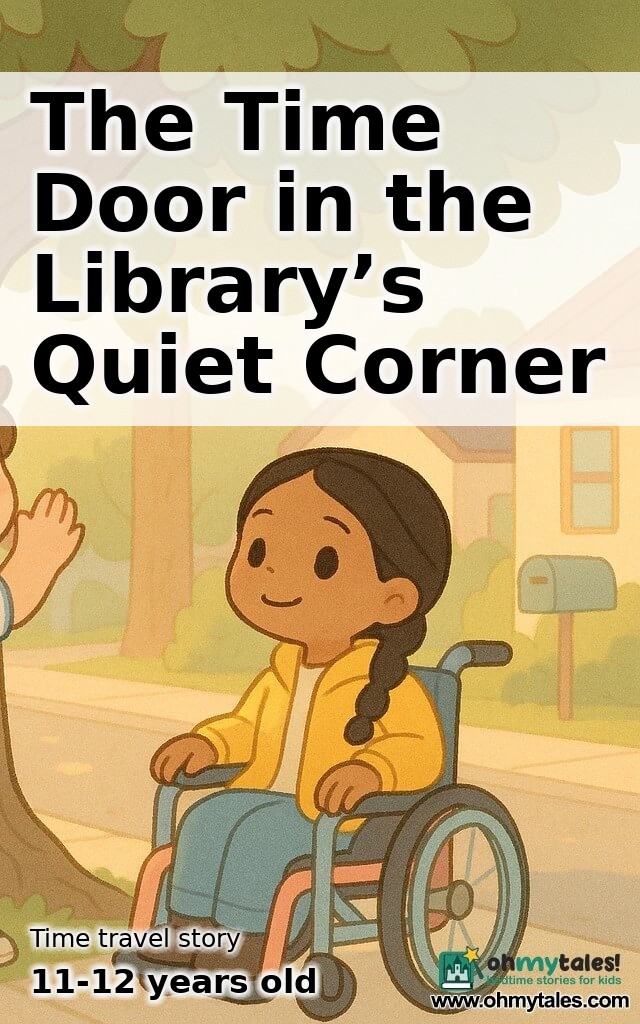
Mina rolled beside him in her wheelchair, her braid swinging like a small rope. “Your convincing nod needs work,” she whispered.
“I'm practicing,” Leo whispered back. “One day I'll nod so well people will applaud.”
They reached the taped-off shelves. A thin strip of yellow tape drooped like a tired smile. Behind it, a narrow aisle hid in shadow.
Leo squinted. “Do you hear that?”
Mina tilted her head. “Hear what?”
A soft ticking. Not loud, not scary. More like a watch keeping secrets.
Leo leaned in. The air smelled different here—like rain on warm pavement, and old paper, and something metallic.
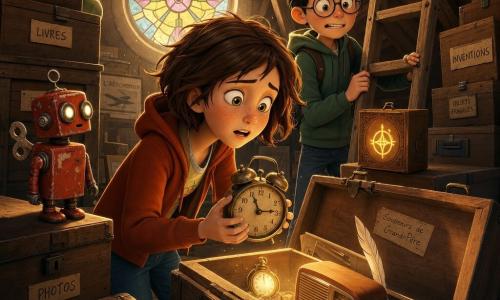
Between two bookcases, where a wall should have been, a tall frame stood. It looked like a doorway made of smooth, dark wood. But there was no door. Just a shimmer, like heat above a sidewalk.
Mina's eyes widened. “That wasn't here last week.”
Leo grinned. “Maybe the library got an upgrade.”
He stepped closer. Tiny symbols were carved on the frame: spirals and arrows and a small hourglass. Someone had rubbed chalk into the grooves, so the marks glowed faintly.
Mina pointed at a brass plate near the bottom. “Read it.”
Leo bent down. On the plate, in neat letters, it said:
PLEASE CLOSE GENTLY. TIME IS SENSITIVE.
Leo laughed quietly. “Time is sensitive. Like my stomach when I eat cafeteria chili.”
Mina didn't laugh. She was staring at the shimmer. “Leo… do not touch it.”
Leo touched it.
His fingers didn't meet wood or glass. They met cool air that pushed back—like the surface of a pond that wasn't wet.
“Okay,” Leo whispered, thrilled. “That is definitely not normal.”
Mina reached out and caught his sleeve. “Promise me you won't—”
Too late. Leo leaned forward. The shimmer tugged, as if it had been waiting for someone curious enough to feed it a fingertip.
His balance tipped.
“Leo!” Mina hissed.
He grabbed the frame. Mina grabbed his backpack strap.
For one second they were a messy knot of limbs and wheels and panicked whispering.
Then the world folded.
The library vanished like a page turning too fast.
Leo's stomach did a flip. His ears popped. The ticking became a roar, then a hush.
And they fell—without falling—through a tunnel made of light, like someone had painted the air with glowing ribbons.
Leo squeezed his eyes shut.
He heard Mina's voice, steady and annoyed. “If we end up inside a dinosaur, I am not speaking to you for a month.”
Leo tried to answer, but his words turned into laughter that sounded like bubbles.
Then—thump.
They landed on something firm and springy.
Leo opened his eyes.
The sky above them was a crisp blue, but it didn't look exactly like their sky. It was cleaner somehow, as if someone had washed it.
They were on a wide walkway that shimmered faintly, like a soap bubble pretending to be a road. Strange trees lined the path—tall and silver, with leaves like thin coins that chimed softly in the breeze.
Mina sat upright, blinking. “We're not in the library.”
Leo sat too, heart hammering. “Nope.”
A sign floated politely in the air beside them. It was as calm as a museum label.
WELCOME TO MAPLE STREET, YEAR 2146.
PLEASE KEEP YOUR PERSONAL TIMELINE INSIDE THE WALKWAY AT ALL TIMES.
Leo read it twice. Then a third time, because his brain refused to accept it.
Mina exhaled. “Leo.”
“Yeah?”
“You touched the time door.”
Leo swallowed. “Technically… I poked it.”
Mina's mouth twitched, despite herself. “Well. Congratulations. Your poking has consequences.”
Leo stared down the walkway. In the distance, buildings rose like smooth seashells—curved, pale, and shining. Little drones zipped through the air like dragonflies, humming pleasantly.
“Okay,” Leo said, trying to sound brave and failing a little. “Future. Great. We'll just… find the door back.”
Mina pointed behind them.
There was no doorway. Just empty air and chiming silver trees.
Leo's grin slipped. “Uh-oh.”
Mina patted his arm. “Don't panic. Yet.”
Leo pulled a small notebook from his backpack. He called it his “Field Journal,” because it sounded adventurous, even when he used it mostly for comic sketches and snack rankings.
He flipped to a blank page and wrote in careful letters:
FIELD JOURNAL, ENTRY 1:
WE ARE IN THE FUTURE.
THERE ARE NO DINOSAURS.
YET.
Chapter 2: A Guide Who Knew Too Much
A shadow crossed the walkway.
Leo looked up, expecting a drone.
Instead, a girl about their age stood in front of them. She wore a simple jacket with a bright patch on the sleeve: a small hourglass. Her hair was short and springy, and her eyes were sharp in a friendly way, like she noticed everything but didn't judge you for it.
“Hi,” she said, as if meeting time travelers was on her weekly schedule. “You're early.”
Mina narrowed her eyes. “Early for what?”
The girl smiled. “For the part where you pretend you didn't come through the Maple Street Temporal Access Point.”
Leo blinked. “The what?”
“The time door,” the girl translated, patient. “We call it an Access Point. Less dramatic. More accurate.”
Mina crossed her arms. “Who are you?”
“Jun,” the girl said. “Junior Time Steward. I help keep things… tidy.”
Leo looked around. “So you're like a time janitor?”
Jun's smile turned mischievous. “More like a time librarian. Same rules, fewer shushing.”
Mina's eyebrows rose. “Wait. If you're expecting us… does that mean time travel is normal here?”
Jun rocked on her heels. “Normal-ish. Carefully controlled. We have rules.”
Leo raised a hand. “I am excellent with rules.”
Mina coughed. “He is not.”
Jun glanced at Leo's face and nodded. “Yeah, I can tell.”
Leo put his hand down.
Jun gestured down the path. “Come on. You can't stay here. The walkway logs new arrivals, and then you'll get a visit from someone who carries too many clipboards.”
“Clipboards in the future?” Leo said. “That's disappointing.”
Jun led them toward the shell-like buildings. As they moved, the walkway adjusted under Mina's wheels, becoming slightly textured, like it was helping her roll. Mina noticed and tapped it with interest.
“Nice,” she said.
Jun glanced back. “The city tries to be kind. Most things here do.”
Leo watched a drone deliver a small box to a balcony. The drone made a happy chime, like it was proud of itself.
“So,” Leo said, “how do we go back? We have school on Monday.”
Jun snorted. “In your time, it's probably still Saturday.”
Mina frowned. “How do you know what day it is for us?”
Jun stopped beside a fountain that didn't throw water. It threw mist, forming little shapes—planets, comets, a tiny whale that swam through the air and dissolved.
Jun tapped her sleeve patch. “Time Steward tools. We read temporal signatures. Yours are… loud.”
Leo looked offended. “My signature is loud?”
Jun nodded. “Like someone banging pots in a quiet kitchen.”
Mina leaned closer. “And can you send us back?”
Jun's face turned serious. “Yes. But not immediately.”
Leo groaned. “Why not? Is there a waiting line? Do we need a ticket?”
Jun lowered her voice. “Because if you rush back without stabilizing your timeline, you might take something with you.”
Mina's eyes flicked to Leo's backpack. “Like what?”
Jun pointed toward the mist fountain. The whale turned into a clock, then into a tiny library with fluttering pages.
“Like an idea,” Jun said. “Or a habit. Or a single careless sentence that changes what someone does next. Time is sensitive, remember?”
Leo swallowed. The brass plate's words echoed in his head.
Jun continued, “A small change now can become a big change later. Or earlier. It gets messy.”
Mina nodded slowly. “So what do we do?”
Jun smiled again, lighter. “We follow the rules. We do a short loop.”
Leo blinked. “A loop like… going in circles?”
Jun's eyes gleamed. “A loop like learning one important thing, then taking it home without breaking anything.”
Leo pulled out his Field Journal and scribbled:
ENTRY 2:
FUTURE PEOPLE HAVE RULES.
ALSO, MIST WHALES.
Jun led them into a building that opened like a flower, petals sliding aside with a soft whisper. Inside, the air was cool. The walls glowed gently, showing moving pictures: a street at dawn, a kid planting a tree, an old woman laughing as she fixed a robot's loose arm.
A sign appeared on the wall in calm letters:
TEMPORAL ORIENTATION ROOM.
PLEASE DO NOT CREATE PARADOXES.
Leo read it aloud. “Please do not create paradoxes. As if I wake up thinking, ‘Today, I will invent a paradox.'”
Mina glanced at him. “I'm not sure you don't.”
Jun pointed to a circular table. On it sat a small device like a compass, except its needle spun in slow, thoughtful circles.
“That,” Jun said, “is a Chrono-Compass. It finds the safest return moment for you.”
Leo leaned in. “So it'll just… send us back?”
“After your loop,” Jun said. “A loop needs an anchor.”
Mina asked, “What's our anchor?”
Jun's face softened. “Gratitude.”
Leo and Mina stared.
Leo whispered, “Like… saying thank you?”
Jun nodded. “But not the quick kind you toss like a coin. The kind you actually feel. It makes your timeline heavier—in a good way. Harder to blow off course.”
Mina looked at Leo. “You hear that? Your timeline is… light.”
Leo shrugged, trying to joke. “I can feel gratitude. Watch. I'm grateful we're not inside a dinosaur.”
Jun laughed. “Good start. Not enough.”
She tapped the Chrono-Compass. The needle slowed and pointed toward a doorway on the far side of the room. Above it, words shimmered:
FIELD VISIT: MAPLE STREET—PAST LAYER.
Mina's eyes widened. “Past layer? Wait, I thought we were in the future.”
Jun held up a finger. “You are. But the future keeps records. Like… thick, living history. You're going to visit a moment connected to your street. Not to change it—just to see it clearly.”
Leo felt a nervous fizz in his chest. “And no paradoxes.”
Jun opened the door. Light spilled out, smelling faintly of chalk and summer grass.
“Stay close,” Jun said. “No souvenirs. No sudden announcements of future sports scores. And whatever you do—”
Leo leaned forward. “Yes?”
Jun smiled. “Don't poke anything.”
Leo sighed. “Everyone is so negative about my poking.”
Chapter 3: The Day the Tree Wasn't There
They stepped through.
The light snapped into a familiar street—Maple Street—but not their Maple Street.
The houses looked smaller, their paint fresher. Cars were boxier. A newspaper lay on a porch, the front page showing a grainy photo and a headline Leo couldn't quite read.
The biggest difference was the empty spot near the sidewalk where a large oak tree stood in their time.
Here, there was only bare earth and a thin wooden stake.
Mina's voice came out soft. “The tree… isn't here yet.”
Jun nodded. “This is the year it gets planted.”
Leo stared at the empty patch. He had climbed that oak a hundred times. He had hidden candy wrappers in its knot holes (not his proudest moment). He had once dared Mina to race him around it, and she had beaten him anyway by taking a tighter turn.
And now, it was just dirt.
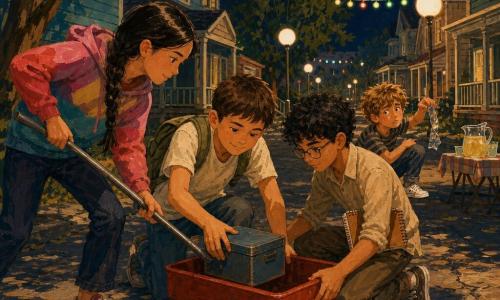
A group of kids ran into view, laughing. They wore bright shirts and carried a sapling together, its roots wrapped in burlap.
Leo's breath caught. One of the kids looked like… like his dad. Same crooked smile. Same ears that stuck out a bit.
Mina whispered, “Is that—?”
Jun nodded once. “Your dad, at eleven.”
Leo felt suddenly wobbly. “He was… short.”
Mina smirked. “Like someone else we know.”
The younger dad-kid plopped the sapling down, hands on hips. “Okay,” he said, “who has the shovel?”
Another kid patted empty pockets dramatically. “I thought YOU had the shovel.”
A third kid—freckled, serious—groaned. “We had one job.”
Leo snorted. “This is definitely my dad.”
Jun crouched. “Remember: observe only.”
Mina leaned forward, fascinated. “So the tree that we climb… started with them forgetting the shovel?”
The kids argued, then ran off, leaving the sapling alone like a skinny broom.
Leo watched, heart tugging oddly. The sapling looked helpless. The wind nudged its leaves, and it swayed like it was trying to wave.
Leo took one step forward.
Jun's hand shot out like a magnet. She gently caught his sleeve. “No.”
Leo swallowed. “But if they don't plant it—”
“They come back,” Jun said. “History already happened. You know the tree exists. That's your proof.”
Mina added quietly, “If you ‘help,' you might become the reason it's there. Then what? You'd be trapped in a loop of always having to help.”
Leo imagined himself doomed to shovel dirt forever. That did not sound fun.
They hid behind a hedge as the kids returned, breathless, dragging a shovel that looked twice as heavy as the kid carrying it.
“My dad is… kind of dramatic,” Leo whispered.
Mina whispered back, “You're surprised?”
The kids dug and joked and complained about blisters. The younger dad-kid wiped his forehead and said, “One day this tree will be huge. Like, superhero huge.”
The freckled kid snorted. “Trees aren't superheroes.”
“They are!” younger dad-kid insisted. “They give shade. They give air. They… save picnics from sunburn.”
Leo's throat tightened, and he didn't know why. He had never thought about the oak giving shade. It was just… there. Like the sidewalk. Like his dad making pancakes on Saturdays. Like Mina rolling beside him and pretending not to laugh at his jokes (even when she did).
Jun watched Leo's face. “You're starting to get it,” she said softly.
Leo frowned. “Get what?”
Jun pointed at the sapling. The kids patted the dirt down, proud and muddy. One of them hung a little sign on the stake: OAK PROJECT — DO NOT STEP ON.
Jun said, “In your time, you enjoy the shade. But you didn't see the work. You didn't see the choosing.”
Mina murmured, “The time before the thing exists.”
Leo pulled out his Field Journal, hands a little shaky, and wrote:
ENTRY 3:
THE OAK TREE STARTED AS A SAD STICK.
DAD WAS SMALL AND LOUD.
I DIDN'T KNOW I WAS BORROWING SHADE.
As the kids ran off, younger dad-kid turned back and saluted the sapling like it was a brave soldier.
“Grow big!” he called. “Don't be a wimpy twig forever!”
Mina stifled a laugh. “Your dad was a poet.”
Leo smiled, but it felt different—warmer. “He still is. In his own… pancake way.”
Jun stood. “Loop part one complete.”
Leo blinked. “That was part one?”
Jun grinned. “Gratitude has layers too.”
She led them down the street. The air shimmered at the end of the block, as if the day itself had a seam.
“Next,” Jun said, “you'll see the future of something you take for granted.”
Leo gulped. “Like… Wi-Fi?”
Jun's eyes danced. “Like people.”
Chapter 4: The Museum of Ordinary Miracles
They stepped through the shimmer.
They were back in 2146, but not outside. They stood in a bright hall filled with glass cases and interactive screens. Above them, letters floated calmly:
MUSEUM OF ORDINARY MIRACLES.
Leo stared. “A museum… for ordinary stuff?”
Mina wheeled forward, curious. “That sounds like my kind of museum.”
Jun pointed to the first display. Inside a case sat a battered lunchbox with stickers peeling off.
A label read:
LUNCHBOX, 2026.
CARRIED DAILY.
CONTAINED 1,204 PEANUT BUTTER SANDWICHES.
PROVIDED COMFORT DURING A DIFFICULT YEAR.
Leo leaned closer. “That's… kind of sad and kind of cool.”
Mina moved to another case. It held a worn-out library card.
LABEL:
LIBRARY CARD, 2024.
USED TO CHECK OUT 312 BOOKS.
INSPIRED 1 FUTURE ENGINEER.
RETURNED LATE 17 TIMES.
Leo coughed. “Okay, wow. People in the future are judgmental.”
Jun pointed to the corner, where a small robot vacuum sat, scratched and dented, as if it had fought many crumbs.
LABEL:
MODEL SWEEP-7.
SAVED APPROX. 600 HOURS OF CLEANING TIME.
ALSO ATE 43 SOCKS.
Mina laughed. “Even the future has sock problems.”
Leo's eyes kept moving, pulled along by the displays. There were ordinary things: a cracked phone screen, a soccer shin guard, a hairbrush, a bus pass.
Each label told a tiny story. Not about the object being fancy—but about what it meant to someone.
Jun led them to a wall with a timeline line drawn in light. A dot glowed on it, and beside the dot was a familiar name:
MINA S. — 2038.
Mina froze. “That's… me.”
Leo's stomach dipped. “Is this safe?”
Jun's voice was gentle. “It's a record. Not a prophecy you must obey. It's one possible thread.”
Mina rolled closer. The wall displayed an image: Mina, older, smiling, standing in front of a community center with kids around her. A caption read:
FOUNDER, MAPLE STREET SCIENCE CLUB.
CREATED ACCESSIBLE KITS.
TAUGHT 4,000 STUDENTS TO BUILD THEIR FIRST CIRCUIT.
Mina stared, silent.
Leo looked at her, then at Jun. “She… does that?”
Jun nodded. “She might. If she keeps being Mina.”
Mina's voice came out small. “I don't even know how to do that yet.”
Jun shrugged. “Neither do saplings.”
Leo felt something rise in his chest, like a bubble of pride. “Mina, that's awesome.”
Mina swallowed, eyes shining, and tried to sound normal. “It's… okay.”
“It's not just okay,” Leo said. “It's… you.”
Another dot glowed.
LEO P. — 2037.
Leo approached like the wall might bite.
An image formed: Leo, older, holding a battered notebook. He stood under the huge oak tree, now wide as a giant umbrella. Around him, younger kids sat on blankets, listening. A caption read:
STORY COLLECTOR.
RECORDED NEIGHBORHOOD HISTORY.
REMEMBERED PEOPLE WHO WERE OFTEN FORGOTTEN.
Leo stared, confused. “Story collector?”
Jun crossed her arms. “You like attention. In a good way. Turns out you can use it to pay attention to others.”
Mina smirked. “You? Paying attention? That's the real science fiction.”
Leo tried to joke, but his throat felt tight again. He looked at the older version of himself, notebook in hand, under the oak.
He thought of the sapling. The work. The choosing.
He thought of his dad's pancakes. His mom's reminders. The library's quiet corners. Mina's steady bravery that didn't need announcing.
Leo opened his Field Journal and wrote, slower now:
ENTRY 4:
ORDINARY THINGS ARE NOT ORDINARY.
THEY ARE TIME WEARING A DISGUISE.
Jun led them to a final display. It was a simple wooden frame, like the one in the library. Next to it, a clear panel explained:
TEMPORAL ACCESS POINTS ARE GIFTS.
GIFTS REQUIRE CARE.
CARE REQUIRES GRATITUDE.
Jun turned to them. “Now you understand why you can't rush back. You need a clean return. No tugging on the thread.”
Mina nodded. “So what's next?”
Jun smiled. “Now comes the paradox. A small one. The mischievous kind.”
Leo perked up. “I like mischievous.”
Jun pointed to a small door at the side of the hall. Above it, a sign floated:
RETURN PREP: ONE MESSAGE ONLY.
“One message?” Mina asked.
Jun nodded. “You can send one harmless message to your present. Not to change events. Just to prepare yourselves to be grateful when you get back.”
Leo frowned. “How is that a paradox?”
Jun's grin widened. “Because you'll be grateful for a message… that you only send because you became grateful.”
Mina whispered, “A gratitude loop.”
Leo rubbed his hands together. “Okay. Let's do it.”
They stepped into a small booth. Inside was a panel with a single button and a slot for a written note.
Jun handed Leo a slim card and a pen. “Write carefully. No spoilers. No winning lottery numbers. No ‘Dear me, invest in—'”
Leo sighed. “Fine.”
Mina leaned close. “What do we say?”
Leo thought. His mind flicked through a hundred silly possibilities. Then he saw the sapling again, trembling in the wind.
He wrote:
TO US:
WHEN YOU GET HOME, SAY THANK YOU—OUT LOUD—FOR THREE THINGS YOU USUALLY IGNORE.
START WITH SHADE.
—L & M
Mina nodded. “Good.”
Leo slid the card into the slot.
A soft chime sounded. The card vanished.
Leo blinked. “So… we'll get it?”
Jun nodded. “You already did. You just don't remember yet, because for you it hasn't happened.”
Mina groaned. “Time is so smug.”
Jun laughed. “It can be.”
The Chrono-Compass appeared on Jun's wrist screen. Its needle settled, steady at last.
Jun's expression turned official. “Your return window is open. Remember: arrive, breathe, and do the message. It matters—not because time demands it, but because you do.”
Leo swallowed. “What about the door? In the library?”
Jun tilted her head. “It will be there. For a moment. Then it won't. Access Points move when they've done their job.”
Mina asked quietly, “Will we see you again?”
Jun considered. “Time has many shelves. Maybe.”
Leo wanted to ask a thousand questions, but the air beside them began to shimmer with that pond-surface shine.
Jun stepped back and gave a small salute, like younger dad-kid had.
“Close gently,” she said.
Leo nodded, and this time his nod really was convincing.
He took Mina's hand.
They stepped into the shimmer together.
Chapter 5: Back Where the Dust Waited
The tunnel of light returned—ribbons, ticking, a flip in Leo's stomach.
Then—thump.
They tumbled onto the library carpet, right where they'd started. The dusty back corner. The taped-off shelves. The same sleepy smell of paper and quiet.
Leo sat up fast. “Are we—?”
Mina looked around, breathing hard. “We're back.”
The time doorway shimmered between the shelves for one heartbeat longer.
Leo leaned toward it, tempted, curiosity already scratching at him.
Mina grabbed his hoodie. “Don't. Poke. Anything.”
Leo held up both hands. “I am a model of self-control.”
The shimmer faded like a candle going out.
The wall was just a wall again.
Somewhere in the front of the library, a cart squeaked. A librarian coughed politely.
Leo checked his phone. The time read 2:17 p.m.
Mina glanced at the library clock. Same time.
Leo whispered, “Did time pass?”
Mina shook her head slowly. “Not here.”
Leo's backpack lay beside him. He opened it and checked his Field Journal. The entries were there, written in his own handwriting.
He flipped to the next page.
A card lay tucked inside.
Mina spotted it first. “No way.”
Leo pulled it out. It read:
TO US:
WHEN YOU GET HOME, SAY THANK YOU—OUT LOUD—FOR THREE THINGS YOU USUALLY IGNORE.
START WITH SHADE.
—L & M
Leo stared, then laughed once, quiet and amazed. “We did get it.”
Mina smiled. “Gratitude loop confirmed.”
They stood. Mina rolled out from behind the taped shelves with Leo walking beside her, both trying to look like normal kids who had not just visited the year 2146.
At the checkout desk, the librarian raised an eyebrow. “Find what you needed?”
Leo glanced at Mina, then at the calm rows of books, at the sunlight slanting through the windows.
He felt like the light was a little more noticeable than before. Like it had a story.
“Yes,” Leo said, and meant it. “We did. Thank you.”
The librarian blinked, surprised, then smiled. “You're welcome.”
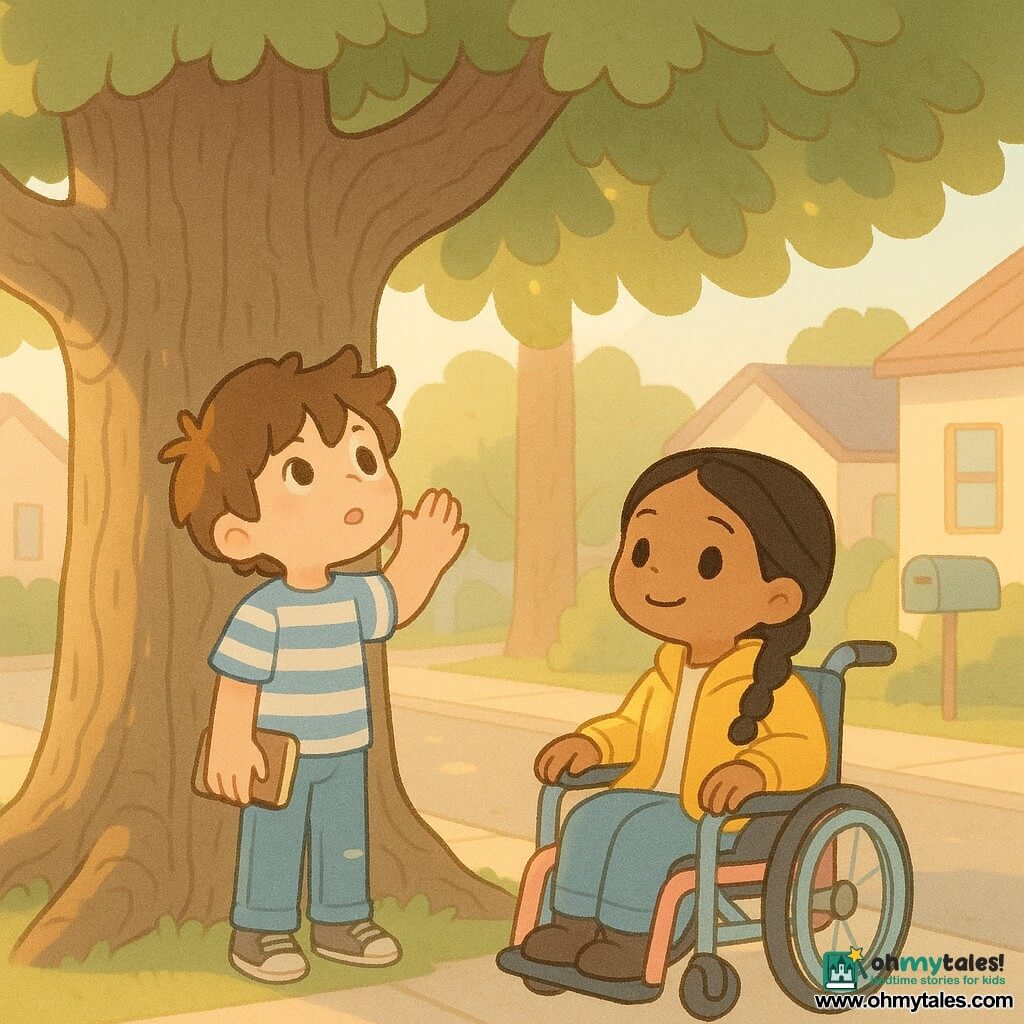
Outside, Maple Street looked exactly the same: the sidewalks, the mailboxes, the familiar oak tree spreading its branches over the corner like a friendly giant.
Leo and Mina paused beneath it. The shade pooled around them, cool and steady.
Leo touched the bark gently, not poking. Just… greeting.
Mina said, “Three things.”
Leo nodded. “Out loud.”
He cleared his throat, suddenly shy, then decided that was silly.
“Okay,” Leo said. “First: thank you… shade. For existing and not charging rent.”
Mina snorted. “That's one.”
Leo looked up into the leaves. They rustled like quiet applause.
“Second,” he said, “thank you… whoever planted this. For doing the boring part so we could do the climbing part.”
Mina's smile softened. “That's two.”
Leo glanced at Mina. “Third… thank you, Mina. For grabbing my backpack strap. And for being smarter than me in every timeline.”
Mina rolled her eyes, but her cheeks warmed. “You're welcome. Also, I would like to thank your terrible impulse control, because it accidentally got us a life lesson.”
Leo laughed. “See? Gratitude. It's contagious.”
They headed down the street. The present felt like a place you could step into, not just run through.
That night, Leo brushed his teeth without being reminded. He even set his Field Journal on his desk like it was something important.
In bed, the house made its usual sounds: pipes clicking softly, a distant car whooshing by, the wind tapping the oak's branches against the window like a gentle drummer.
Leo's door opened a crack. His dad peeked in.
“Hey,” Dad whispered. “Good day?”
Leo thought of a small boy with a shovel, saluting a sapling.
“Yeah,” Leo whispered back. “Really good.”
Dad smiled. “Love you, buddy.”
“Love you too,” Leo said, and it felt like another kind of thank you.
When the door clicked shut, Leo pulled his blanket up and thought about the museum of ordinary miracles, and Jun's grin, and a mist whale turning into a clock.
He didn't feel scared of time.
He felt careful.
He felt lucky.
And with that warm, steady feeling, he wriggled down, comfortable as a seed in soil, and slept with the covers pulled up to his chin.