Chapter 1: The Quiet Clock in the Attic
Mina Loew, age eleven, was the kind of girl who carried tissues for other people's sneezes and a spare pencil for anyone who forgot theirs. She wasn't loud. She wasn't shy, either. She was… steady. Like a lamp left on in a hallway.
On a rainy Saturday, Mina climbed the narrow attic stairs of her grandmother's house. The attic smelled of cedar wood and old paper, like a library that had been folded up and stored away.
“Try not to poke anything sharp,” Grandma called from below. “And don't open boxes marked ‘FRAGILE—GRANDFATHER'S PRIDE.'”
“I won't,” Mina promised, because she meant it.
A single window let in gray light. Dust floated in it like tiny planets. Mina walked carefully between trunks and picture frames, until she saw something that did not belong.
A tall clock stood near the chimney, but it wasn't like any clock she'd seen. Its face had two sets of hands—one silver, one brass—and a small round dial below that read:
PAST — PRESENT — POSSIBLE
Mina leaned closer. The wood was warm, as if the clock had been sunbathing. On its side, a small brass door sat slightly open.
Inside was a key.
Mina looked over her shoulder. “Okay,” she whispered to nobody. “We are being sensible.”
She touched the key with one finger. Nothing exploded. Nothing hissed. Still, she waited three full seconds, just in case.
Then she picked it up.
The key was heavier than it looked, and it had tiny engraved letters along the stem: BE CAREFUL WHERE YOU STAND.
Mina frowned. “That is… extremely specific.”
She found a keyhole under the clock face, right between the words PRESENT and POSSIBLE. Mina swallowed. Her heart beat faster, but not in a scary way—more like right before a science fair demonstration that might actually work.
She turned the key a little.
The clock did not chime. It sighed, softly, like a door opening in a quiet room.
A circle of light spread across the attic floor, pale as moonmilk. Mina stepped back at once. The light smelled faintly of peppermint and metal.
“Rules,” Mina told herself. “If something glows, you do not step into it without… thinking.”
She looked around. The attic had a thick rug near a trunk. Mina dragged the rug closer with both hands until it lay partly over the circle, like a safe island edge.
Then she placed one sneaker toe on the rug, one toe just outside the light.
Nothing happened.
“Good,” Mina said. “I am still in charge of my toes.”
She took a breath, then stepped fully into the circle.
The attic vanished in a blink—not like falling, not like spinning. More like someone switched scenes in a play.
Mina found herself standing in a hallway that smelled of lemon polish and fresh bread.
And above her, a sign painted neatly on a wooden beam read:
WELCOME TO THE HOUSE OF TIME MUSEUM. PLEASE WALK, DO NOT RUN THROUGH HISTORY.
Mina blinked. “A museum house,” she murmured. “That is… oddly comforting.”
A warm lamp glowed beside a coat rack. The hallway felt lived-in, not echo-y like most museums. Somebody had set out a bowl of shiny red apples on a table, as if visitors might get hungry while time traveling.
Mina tried to remember the last thing Grandma said. No sharp things. No fragile pride.
Also, probably: Do not mess with time.
She took one careful step forward.
Somewhere deeper in the house, a clock ticked—slow, steady, and listening.
Chapter 2: A Guide Who Knows Too Much
A door opened on the left, and a girl about Mina's age stepped out. She wore a blue sweater with elbow patches and a lanyard that held a badge: JUNIOR CURATOR.
Her hair was braided into two neat ropes, and her eyes were bright with the kind of curiosity that never sat still.
She looked Mina up and down like a person who had been expecting someone, but not sure which someone.
“You're early,” the girl said.
“I'm… what?” Mina replied.
The girl laughed. “Kidding. Mostly. I'm Tamsin. Welcome. You came through the attic clock, right?”
Mina's mouth opened and closed once. “How do you know that?”
Tamsin tapped her badge. “Junior Curators learn things. Also, there's a bit of dust on your sleeve shaped exactly like a grandfather clock. It's very fashionable in some centuries.”
Mina glanced at her sleeve. Sure enough, there was a smudge like a tiny clock. She brushed it off, feeling both relieved and slightly offended by the dust.
“Is this really a museum?” Mina asked.
“It's a house,” Tamsin said, “and it's a museum, and it's a… how do I put this… a polite shortcut through time.”
Mina's stomach fluttered. “Time travel is real.”
Tamsin nodded. “Yes, but we treat it like hot soup. You don't run with it. You don't wave it around. And you definitely don't pour it into your pockets.”
“That sounds messy,” Mina said.
“It is,” Tamsin agreed cheerfully. “Messy and complicated. So we have rules.” She held up one finger. “Rule one: Don't take things out of their time.”
A second finger. “Rule two: Don't leave things behind.”
A third finger. “Rule three: Don't talk to your past self.”
Mina swallowed. “What if you see your past self?”
“You look away,” Tamsin said quickly. “Or you cough. Or you suddenly become deeply interested in the ceiling.”
“What happens if you break a rule?” Mina asked.
Tamsin's grin softened. “Usually? You get a paradox. A paradox is like a knot in a necklace. It doesn't end the world, but it makes everything feel… wrong until you untangle it.”
Mina nodded slowly. A knot in a necklace sounded fixable, but only if you didn't yank.
Tamsin clapped her hands once. “Now. The House of Time Museum has rooms set to different moments. We guide visitors—carefully. We learn. We don't interfere.”
Mina looked down the hallway. There were doors with small plaques: 1912 KITCHEN, 2040 WORKSHOP, 1789 STUDY, and one that simply said: DO NOT OPEN.
“Who lives here?” Mina asked.
Tamsin's face grew proud. “Caretakers. Historians. And one very strict cat.”
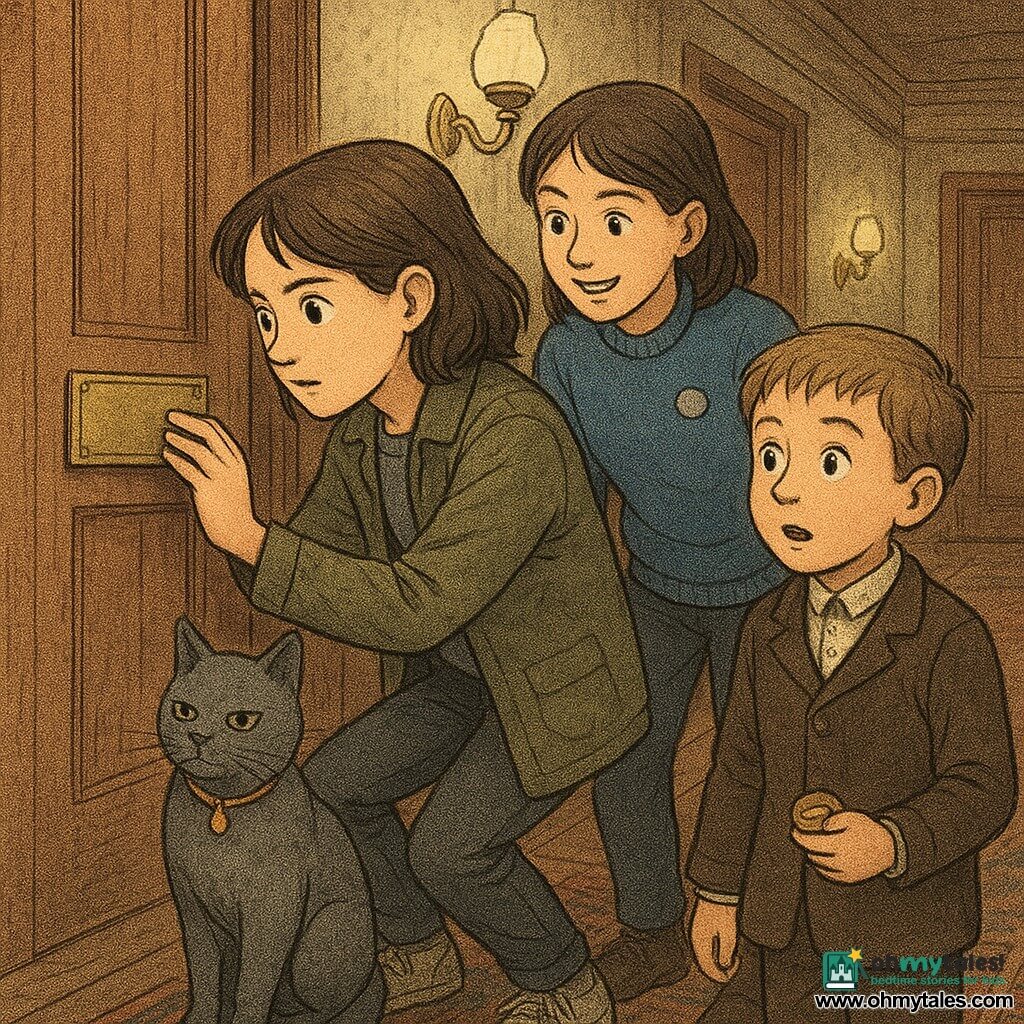
As if summoned, a gray cat trotted out from under a side table. It wore a tiny collar with a tag that read: PROFESSOR WHISKERS.
The cat sat, tail wrapped around its feet, and stared at Mina like a teacher who already knew her grade.
Mina tried to smile politely at it. “Hello, Professor.”
Professor Whiskers blinked once, slow and unimpressed.
Tamsin leaned closer to Mina and lowered her voice. “He only likes people who wipe their shoes.”
Mina instantly wiped her sneakers on the mat.
The cat blinked again, slightly less unimpressed.
“Good start,” Tamsin said. “Okay. First stop: the kitchen. There's something I want you to see. And please—walk. The house hates sprinting.”
“The house hates—”
“Shh,” Tamsin whispered, eyes twinkling. “It hears you.”
Mina walked carefully, feeling as if the floorboards were paying attention.
When Tamsin opened the kitchen door, warm air rolled out like a hug.
Inside, copper pots hung from hooks. A kettle simmered. The room looked old-fashioned, but clean and cheerful, like a postcard that had decided to be real.
On the table sat a large glass jar filled with paper slips.
Tamsin pointed. “That is the Errand Jar.”
Mina leaned in. “Errands?”
“Time needs help,” Tamsin said. “Tiny helps. Like returning a button. Or making sure a letter reaches the right shelf. Nothing dramatic.”
Mina looked at the jar. The slips fluttered slightly, though there was no breeze.
Tamsin handed her one. “Pick a task. But read it out loud. The house likes manners.”
Mina unfolded the paper and read, clearly, “Return the missing museum label to the correct door before it causes… ‘mischief.'”
She looked up. “Mischief?”
Tamsin sighed. “Paradoxes always start with something silly.”
Professor Whiskers jumped onto a chair and meowed once, sharp as a warning bell.
Mina held the slip carefully. “Which label is missing?”
Tamsin's smile turned nervous. “That is the question. Come on.”
Chapter 3: The Label That Slipped Sideways
They walked down a corridor lined with framed photographs. Each photo showed the same house, but in different styles—different wallpapers, different lamps, different people in the background who looked like they'd been caught mid-laugh.
“It changes,” Mina said.
“It adjusts,” Tamsin corrected. “This place is like… a careful librarian. It keeps everything sorted.”
They reached a row of doors. Tamsin inspected the plaques.
“1912 Kitchen—present. 2040 Workshop—present. 1789 Study—present,” she murmured. Then she stopped. “Uh-oh.”
One door had no plaque at all. Just a pale rectangle where something had been.
Mina looked at the bare spot. “So the label is missing. That's not too bad.”
Tamsin crouched, serious now. “Except labels in this house aren't just names. They're instructions. They tell the door where to go.”
Mina's hands tightened around the paper slip. “So if the door doesn't know where to go…”
“It might go somewhere else,” Tamsin finished. “Somewhere nearby in time. Or somewhere that shares a smell. Or a sound. The house tries its best, but without a label, it guesses.”
Mina stared at the door. It looked normal—polished wood, brass handle. But it felt… expectant.
Professor Whiskers padded forward and sat in front of it, like a guard.
Mina took a slow breath. “Okay. We find the missing label. Where would it be?”
Tamsin pointed upward. “Sometimes labels slide. There's a draft that isn't exactly air. It's more like… time breathing.”
Mina looked along the baseboards, under a small bench, behind a plant. Nothing.
Then she noticed something near a coat stand: a small brass plaque lying face down on the floor.
She approached with careful steps, as if the plaque might bite.
Tamsin whispered, “Don't touch it yet. Read it first. In your head.”
Mina crouched. The plaque had curled letters. She tilted it without lifting it.
It read: 1873 PARLOR.
Tamsin exhaled. “Oh, good. That's not too far.”
Mina frowned. “What happens if it ends up as, like, 1073 Dungeon?”
“There isn't a dungeon,” Tamsin said, then paused. “Probably.”
Mina decided not to ask why she said probably.
She picked up the plaque with two fingers. It was cool and slightly vibrating, like a phone set on silent.
They walked back to the unlabeled door.
“Before we attach it,” Tamsin said, “we should check where the door is currently pointing.”
“How?”
Tamsin pulled a small pocket mirror from her sweater and held it near the doorknob. In the mirror, the reflection of the hallway looked… different. The wallpaper had green stripes. A hat stand held tall feathered hats.
Mina's eyebrows rose. “That's not our hallway.”
“Nope,” Tamsin said. “It's already guessing. It's pointing to 1873-ish, but not stable. If someone opens it now, they could step into the wrong moment by a few minutes, or a few years.”
“That sounds… slippery,” Mina said.
“It is,” Tamsin agreed. “So we fix it fast. But carefully.”
Mina held the plaque up to the pale rectangle. It seemed to pull itself into place, like a magnet finding its mate. It clicked softly.
The air around the door settled. Even Professor Whiskers looked less tense.
Tamsin smiled in relief. “Nice work.”
Mina felt a warm glow of pride—small, steady. “So that's it?”
Professor Whiskers meowed again, this time in a tone that sounded like: Don't celebrate yet.
Tamsin's eyes darted to the floor. “Wait. If that label fell off… what replaced it?”
Mina's stomach sank. “Replaced it?”
Tamsin nodded slowly. “Labels don't like to be missing. Something else might have been stuck there by mistake.”
Mina looked around. On the bench nearby, half-hidden under a folded scarf, was another plaque.
She picked it up and read: PRESENT STORAGE.
Tamsin groaned. “Oh no.”
“What?” Mina asked, though she already had a bad feeling.
“That plaque belongs on a closet door in the present,” Tamsin said. “If it was stuck on the parlor door—even briefly—it could have sent someone from 1873 straight into a modern storage closet.”
Mina pictured a person in old-fashioned clothes opening a door and stepping into a room full of plastic bins and mop handles.
“That would be… confusing,” Mina said.
“Confusing,” Tamsin agreed, “and confusing is how mistakes start.”
Mina held the PRESENT STORAGE plaque like it was a sleeping mouse. “So we have to put this back where it belongs.”
Tamsin nodded. “Yes. But we also need to check something.”
She turned to the parlor door—now properly labeled 1873.
“If someone wandered into the present,” Tamsin said softly, “we must guide them back. Quietly. Without making it worse.”
Professor Whiskers leaped down and walked ahead, tail straight like an arrow.
Mina swallowed. “We're going in?”
Tamsin glanced at Mina, and her voice became gentle. “Only a step. Only if you're comfortable. And we'll follow every rule.”
Mina thought of the key's engraving: BE CAREFUL WHERE YOU STAND.
“I'm in,” she said. “But we walk. And we don't touch anything.”
Tamsin grinned. “That's the spirit of a responsible time traveler.”
She opened the parlor door.
Warm lamplight spilled out, golden and soft, and Mina stepped into 1873.
Chapter 4: The Parlor with the Singing Wallpaper
The parlor smelled of tea, beeswax, and something like cinnamon. A fire crackled behind a delicate screen. The wallpaper had tiny birds printed on it, and Mina could have sworn the birds were shifting—just a little—as if they were listening.
“This is… cozy,” Mina whispered.
“I told you the house is welcoming,” Tamsin whispered back. “It likes to make visitors behave.”
A woman's laugh floated from somewhere else in the house, bright and quick. Mina's muscles tightened.
“People are here,” Mina murmured.
“Yes,” Tamsin said. “But we don't mingle unless necessary. We're shadows with good manners.”
They moved quietly, stepping where rugs softened their footfalls. Professor Whiskers padded ahead, as if he had lived in every century and expected dinner in all of them.
Near a side table, Mina spotted a small wooden box filled with paper labels. Some were blank; some had dates written in careful ink.
Tamsin's eyes widened. “A label box. That's how they managed doors before plaques. Clever.”
Mina leaned closer. The ink looked fresh, as if written yesterday, not a hundred and fifty years ago.
Then Mina heard it: a small sound, like someone sniffing back tears.
It came from behind a half-open door that did not look like a door at all. It looked like a wall panel—except it had a modern metal handle.
Mina stared. “That doesn't belong.”
Tamsin's face went pale. “That's the storage closet handle. In the parlor.”
“So someone opened the parlor door when it was labeled PRESENT STORAGE,” Mina whispered, putting the pieces together, “and they got—this.”
“And someone from here may have stepped through,” Tamsin finished.
Professor Whiskers sat beside the panel and stared at it with the weighty patience of a librarian guarding the last copy of a rare book.
Mina took a careful step closer. “Hello?” she called softly, because shouting across time seemed rude.
A small voice answered, trembling. “Is someone there?”
Mina looked at Tamsin. Tamsin nodded once.
Mina lowered herself so her face was level with the crack of the door. “Yes. My name is Mina. I'm… helping with the museum.”
There was a pause, then the door creaked open a bit more.
A boy appeared. He was maybe nine or ten, with neatly combed hair and a collar that scratched his neck. He clutched a brass button in his fist like a treasure.
His eyes were wide. “I was looking for Father's gloves,” he whispered. “And I opened a door, and it was full of strange brooms.”
Mina tried not to smile at the word strange brooms. “That makes sense,” she said gently. “That door got mixed up. Are you hurt?”
“No,” the boy said quickly. “Just… startled. Is this… my house?”
Tamsin stepped forward, voice warm and calm. “It's a house that sometimes borrows rooms. You're safe.”
The boy blinked at Tamsin's sweater and badge. “Your clothes are… bold.”
Tamsin glanced down at her lanyard. “Thank you. It's a modern adventure.”
Mina held up her hands, palms out, to show she wasn't grabbing anything. “What's your name?”
“Elliot,” the boy said, still whispering. He opened his fist slightly. “I found this button on the floor in the broom room. It's not mine.”
Mina's mind clicked. Rule one: Don't take things out of their time. Rule two: Don't leave things behind.
“That button probably belongs here,” Mina said. “But it fell into the wrong room. That's why time got… mischievous.”
Elliot frowned. “Time can be mischievous?”
Tamsin gave a tiny smile. “Only when people forget to label doors.”
Elliot looked worried. “Will I be in trouble?”
“No,” Mina said at once, firm and kind. “This isn't your fault. We're going to guide you back to your hallway. You'll close the door, and it will be as if you only… took a wrong turn.”
Elliot nodded slowly, swallowing.
Mina glanced at the modern handle again. “We need to put the PRESENT STORAGE plaque back where it belongs in our time. Then this panel should stop being… here.”
Tamsin pointed to the label box on the table. “Or we can use a paper label right now, to stabilize the doorway from this side.”
Mina felt a rush of awe. “Like a temporary sign.”
“Exactly,” Tamsin said.
She grabbed a blank paper label and a pencil from her pocket. She wrote quickly but neatly: HALLWAY—1873 (ELLIOT'S HOME). Then she held it near the panel.
The paper label fluttered as if a tiny wind lived inside the door. It stuck to the wood with a soft slap.
The modern metal handle shivered.
Then, like watching a picture fade into another picture, the metal dulled, reshaped, and turned into an old brass knob.
Elliot gasped. Mina breathed out. It worked.
Tamsin murmured, “The house prefers clarity.”
Mina nodded. “So do I.”
Professor Whiskers stood and flicked his tail, as if saying, Proceed.
Mina looked at Elliot. “Ready?”
Elliot hugged the brass button. “Should I keep this?”
Mina hesitated. That button might have come from the present storage closet—maybe off a jacket or a bag—and if Elliot kept it, it would become a tiny knot.
She chose her words carefully. “Let's put it back where you found it. Then you won't carry a piece of the wrong time.”
Elliot looked relieved, as if she'd told him he didn't have to hold his breath anymore. “Yes. Please.”
Together, quietly, they opened the door. Instead of brooms, a familiar 1873 hallway lay beyond, with patterned carpet and a stand of umbrellas.
Elliot stepped out and turned back. “Thank you,” he whispered.
Mina smiled. “You did great.”
Elliot looked at Professor Whiskers. “Your cat is very serious.”
Professor Whiskers blinked slowly.
Tamsin said, “He's a professor. Serious is his hobby.”
Elliot almost smiled. Then he looked down at the button and carefully set it on a little table in the hall.
Mina watched closely. The brass button did not glow. It did not vanish. It simply… belonged.
Elliot stepped back into his own world. “I will not open strange doors again,” he said solemnly.
“That's wise,” Mina said. “Curiosity is good. But caution is smarter.”
Elliot nodded, then closed the door.
The door clicked.
The parlor's air steadied, like a pond after a pebble settles.
Mina let out a long breath. “Okay,” she whispered. “That was… a lot.”
Tamsin gave her a proud look. “And you handled it perfectly.”
Professor Whiskers trotted toward the parlor door, as if they still had chores to do in the present.
Mina remembered the plaque in her pocket. “We still need to return this to the closet door in our time.”
Tamsin nodded. “And we should do it before the house decides to get creative again.”
Chapter 5: The Paradox with a Polite Bow
Back in the House of Time Museum's main hallway, everything looked normal again: the lemony shine, the apples, the calm lamps.
But Mina felt different. As if she now had an invisible compass pointing toward “be careful.”
Tamsin led Mina to a narrow door beside the stairs. It was plain, with a simple sign holder—empty.
“Present storage,” Tamsin said. “Home of mop heads and forgotten brochures.”
Mina held up the brass plaque. It vibrated once, as if eager to stop traveling.
“Ready?” Tamsin asked.
Mina nodded. “Attach it, step back, and then we double-check.”
They pressed the plaque into the sign holder. It clicked into place with a satisfying little snap.
The hallway seemed to relax. Even the light looked steadier, less flickery at the edges.
Professor Whiskers walked to the storage door and sniffed it, then sat and began washing one paw, as if the crisis were now boring.
Mina tilted her head. “So is the paradox gone?”
“Mostly,” Tamsin said. “But we should confirm the parlor door is stable. The house likes to test.”
They went to the 1873 PARLOR door. Tamsin pulled out her pocket mirror again and held it near the doorknob.
In the mirror, Mina saw warm lamplight and the bird wallpaper—no modern handle, no storage shelves.
Tamsin nodded, relieved. “Stable. Elliot is safe in his hallway, and our storage closet is… properly boring.”
Mina felt her shoulders drop, like she'd been wearing a backpack full of bricks and finally set it down.
Tamsin leaned against the wall. “You know what's funny?”
“What?” Mina asked.
“The big time disasters in stories are always meteor showers and evil geniuses,” Tamsin said. “But real problems start with something small. A missing label. A dropped button.”
Mina nodded. “Like tripping over a shoelace.”
“Exactly,” Tamsin said. “Time is strong, but it's also picky. It wants things in the right place.”
Mina looked down the hallway at the door marked DO NOT OPEN. It looked even more serious now.
“What's behind that?” Mina asked softly.
Tamsin followed her gaze. “That is where the house keeps… temptations.”
Mina blinked. “Temptations?”
“Moments people want to change,” Tamsin said. “A failed test. A mean comment. A day they wish they could redo.”
Mina's chest tightened. She thought of a time last month when she'd stayed quiet while a classmate got teased. She hadn't teased—she'd just… not helped. The memory pinched like a small pebble in her shoe.
“What if you opened it?” Mina asked.
Tamsin's voice was gentle but firm. “Then you might get what you want. For a second. And then you'd realize you changed more than you planned.”
Mina stared at the door. It did not glow. It did not rattle. It just waited, like a question.
Mina stepped back. “I don't want to open it.”
Tamsin smiled. “That sentence is the secret password to not ruining everything.”
Mina laughed, surprised. “Good. Because I'd be terrible at ruining everything. I'd probably forget where I put the ruins.”
Professor Whiskers let out a small “mrrp,” which sounded suspiciously like approval.
Tamsin glanced toward the entrance hall. “You should go home soon. Time travel tires the brain, even when it's gentle.”
Mina nodded. “How do I get back?”
“The same way you came,” Tamsin said. “But first—one last lesson.”
She picked an apple from the bowl and offered it to Mina.
Mina hesitated. Rule one. Don't take things out of their time.
Tamsin saw her expression and chuckled. “Good catch. Don't worry. These apples are from the present. The house keeps a small present kitchen for visitors who forget lunch.”
Mina accepted the apple and took a bite. It was crisp and sweet, like relief.
Tamsin walked with Mina toward a small door under the stairs. A modest plaque read: ATTIC RETURN.
Mina's heart gave a soft jump. “I'll remember this place.”
“You should,” Tamsin said. “But remember the rules more.”
“I will,” Mina promised.
Professor Whiskers followed them and sat beside the return door, like a final checkpoint.
Tamsin opened the door. Inside was not a closet, but a thin slice of Mina's grandmother's attic—dusty light and cedar smell—like someone had cut out a rectangle of her world and leaned it here.
Mina stood at the threshold. “Will I meet you again?”
Tamsin shrugged, smiling. “Time is funny. But if you come back, come carefully.”
Mina looked at Professor Whiskers. “Goodbye, Professor.”
The cat blinked once, and Mina decided that was a formal farewell.
She stepped through.
The attic snapped around her like a familiar blanket. The old clock stood exactly where it had been, calm and innocent as a piece of furniture.
Mina turned. The circle of light on the floor was shrinking, fading, like the last bit of sun slipping behind a cloud.
She hurried—but did not run—to the clock. She turned the key back.
The clock sighed again, softer this time.
Then the little brass door on its side swung inward, slowly, and closed.
Mina watched it until it was fully shut.
The latch settled with a gentle click, like a book being placed carefully back on a shelf.
And the door closed softly.