Chapter One: The Map That Wouldn't Hold Still
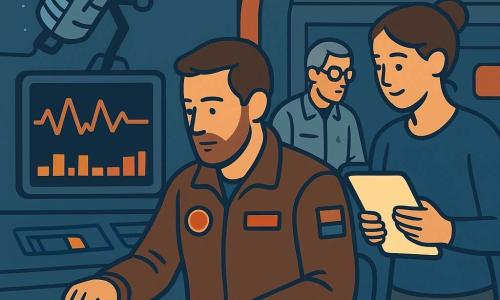
Jonah Vale loved maps because maps told the truth—if you treated them kindly. He was a stellar cartographer who flew a one-man survey ship, the Middensong, threading the empty miles between stars, logging the hidden paths that ships could use to sail safely.
On the third morning of a quiet transit, his truth slipped.
Jonah pressed his palm to the glass of the navigation table. The star-grid projected above it looked clean. The lines between beacons were thin and steady, like silk threads pulled tight. He blinked and the silk wavered. The threads shivered, a millimeter to the left, then steadied again.
“Don't do that,” he told the map. His voice sounded soft in the cockpit, swallowed by the hum of the air recyclers.
He ran the diagnostic again. The result glowed a patient blue: Star-tracker array misalignment: 0.27 degrees. Phase prism drift: significant.
That wasn't nothing. A drift like that could make a cargo hauler miss a gate by a thousand kilometers—a mistake that cost lives and fuel. It might even erase a road, if the map caught the wrong star and wrote it as truth.
Jonah leaned back. He stared at the starfield outside. It looked calm. Dots of light. A haze of nebula like breath on glass.
It was ridiculous, he thought, how small he felt when a tool failed him. He had repaired thruster leaks with a spoon and a strip of foil. He had reprogrammed an obstinate comms panel with his eyes closed. He had stitched tears in his flight suit by himself, knees braced against his seat, while the ship turned slowly under him. He could fix this.
He ran another alignment. The numbers were worse.
He accepted the truth he didn't like. He whispered it, so it would be easier to bear. “I need help.”
On the starboard console, a different map showed him his surroundings: trade routes humming with traffic, station nodes bright as campfires, dead zones pale and washed out. Tucked to the side, as if it were modest, a ring station rotated around a quiet rock. The label read: Museum of Star Roads.
He had never been. He had always told himself he would visit when he had less work stacked up on his docket. He always had more work.
Now he set a course.
He tapped the comm. “Museum of Star Roads, this is survey vessel Middensong, Jonah Vale, requesting approach and assistance with star-tracker calibration. I'll pay, of course.”
He didn't know he was holding his breath until a clear voice answered, light and precise. “Middensong, we've got you. Dock at Port Twelve. We'll get you stable. I'm Lena Quill, station logistics. See you soon.”
Jonah exhaled. He watched the map. He watched the silk threads tremble and steadied his hands on the controls. Asking for help was a kind of courage, he told himself. He believed it. He plotted his approach.
Chapter Two: The Museum of Star Roads
Port Twelve opened like the eye of a patient whale. The Middensong slid into its mouth on a coil of gentle thrust. The docking clamps closed with a sound like two hands meeting. Above him, the ring station turned, a city of windows and halls held together by careful math and stubborn hope.
He stepped out into a corridor lined with history. The floor lights traced a spiral the color of old paper. The walls held star charts behind glass, long strings of beacons lit like tiny lanterns.
A figure in a gray jacket waited for him, holding a tablet. Lena Quill was precise even in the way she stood: feet shoulder width, tablet scaled to her palm, hair braided back as if to keep stray strands from wandering onto her checklists. She looked maybe thirty, maybe older; her eyes were very awake.
“Jonah Vale,” she said, “I like your timing. We needed a break from a docent drone that insists dust is part of our heritage.”
“It could be,” Jonah said. The air smelled faintly of metal and tea. He thought of the way dust glowed when a beam of sunlight hit it just right.
Lena's mouth quirked. “We can discuss the philosophy of dust later. Your message said a phase prism drift and general misalignment, right?”
Jonah nodded. He could have made a joke to hide the twist in his gut, but he didn't. “I thought I could tune it mid-flight. I couldn't.”
“Good,” she said simply. “That you came in. We have an alignment cradle and a legacy beacon we use for exhibits. It's a serious piece of equipment hiding in a room with gift shop models. Come on.”
They walked through a hall called Thread Gallery. Hundreds of fine strands arched overhead, glowing. Each was a route, even if no one used it anymore: old miner paths, refugee corridors, trade lanes that had shifted with the economy. Children stood below them, faces tipped up, whispering. A guide's voice floated: “These are the roads we built and the roads that built us.”
“That one,” Lena said, pointing to a line that was slack and dimmer than the others, “sags because the beacons it references were retired. We keep it to remind people that we don't erase our past. But we don't let a sagging line mislead a ship that's hunting for truth.”
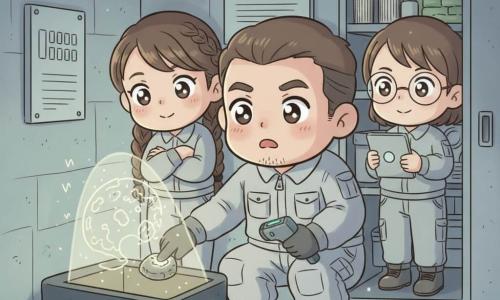
She led him into a bay where the Middensong's nose fit into a cradle like a hand in a glove. A tall cylinder stood in the corner on a stand. It was painted a faded red. The paint was chipped and honest.
“Is that the legacy beacon?” Jonah asked.
Lena patted it. “Model GR-9 Distress Beacon, first used on the Saturn routes. It was built to scream ‘I am here' when ships were lost in ion storms and dark. It emits a pure signal no matter the noise. We use it in our practical workshops to teach kids about calibration. We can use it to lock your array and feed you a stable reference point.”
Jonah smiled despite his nerves. “A museum beacon to fix a working ship. I like it.”
“Good,” Lena said again. She flicked her tablet, and a gentle alarm rang. “I need to call in inventory. We've got gimbal rings, micro-thrusters, and a phase prism in storage. You're lucky. A donation came in last month, and I got curious and cataloged the lot myself.”
Jonah had met many kinds of people on stations: those who left things till they were urgent, those who built towers of to-do lists and hid behind them, those who did the work with no drama and little fuss. He was grateful to meet this kind.
“Thank you,” he said.
Lena shrugged, one precise shoulder. “Thank me when the map stops shaking.”
Chapter Three: The Plan and the Ask
The repair began with a plan. The plan began with a list. Lena showed him hers. Each step was a single clear line. No heroics. No shortcuts.
1. Secure the Middensong in the alignment cradle. Triple-lock the clamps.
2. Bring the legacy beacon online. Verify signal purity.
3. Remove the old phase prism. Check for micro-cracks.
4. Install new gimbal ring. Test for smooth rotation.
5. Fit new phase prism. Align to beacon signal.
6. Micro-thruster nudges to eliminate residual drift.
7. Retest against museum beacons and local stars.
Jonah felt the plan steady him like a hand on his back.
“We'll need to go outside for steps four to six,” Lena said. “Our cradle can't reach the aft array housing.”
“Good,” Jonah said. He meant it. Outside work made sense to him. You clipped onto a tether. You breathed slow. You moved careful. “I'll suit up.”
Lena looked at him. “I'll come too. It's easier with two pairs of hands. And two sets of eyes.”
Jonah hesitated. He had done many solo repairs. He knew the dance. His pride said yes to doing it alone. He listened to something braver. “Help would be good.”
Lena nodded. “I'll get the suits. Pebble will bring the parts.”
“Pebble?”
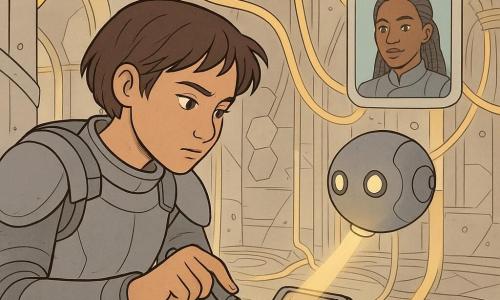
A round maintenance robot rolled into the bay on quiet wheels. It was no taller than Jonah's knee and had a stripe of tape on its shell with PEBBLE written in neat capitals. It paused to regard Jonah with a tiny camera lens like a cat deciding if it liked him.
“Pebble is exact,” Lena said. “It will not let us forget a nut or a strap.”
Pebble piped something in a cheerful tone that sounded suspiciously like “Checklists are love.”
They set the legacy beacon on its stand and connected it to a power line. Jonah watched Lena's fingers fly over her tablet. She woke the beacon, and it hummed. A tiny light on top flashed a steady pulse: I am here. I am here. Not loud. Not dramatic. Just the kind of truth a map liked.
“Signal purity at ninety-nine point nine,” Lena said with satisfaction. “I'll feed it to your navigation computer.”
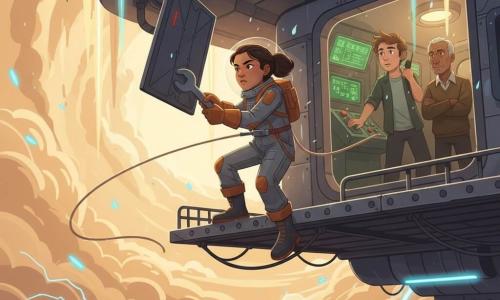
Jonah suited up. He tested his seals. He clicked his tether to the guide rail that ran around the cradle like a waist-high fence. He checked Lena's suit, and she checked his. They inched open the bay doors. The stars waited, cool and patient.
“Lena,” Jonah said, his voice small in his own helmet. The word fogged and cleared. “Thanks for being exact.”
“Thank you for asking,” Lena said. “It's a quiet kind of brave. People forget.”
They pushed off into the turning dark.
Chapter Four: Outside, the Stars Hold Their Breath
Outside the station, the light was thin and fair. The Middensong's hull curved like a small whale's back. Jonah's gloves closed on cold metal. He clipped his tether to a new point and tugged to feel it lock.
Pebble's small thruster pack whistled as it floated a gimbal ring and a sealed box the size of a thick book. Pebble rotated the box so Jonah could read the label: PHASE PRISM, HANDLE WITH COMMON SENSE.
Inside his helmet, Jonah laughed. It came out like a cough.
“Old part, new map,” he murmured. “Let's do this.”
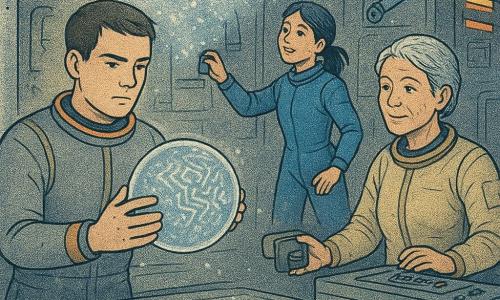
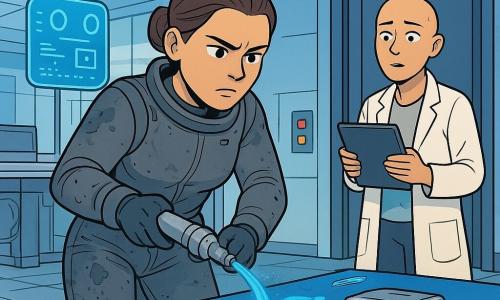
They removed the aft panel together, Lena steadying the housing while Jonah loosened the catches. The old gimbal was stiff. The phase prism had a hairline crack glittering inside it like frost on a window. Jonah held it up so they both could see.
“There's your drift,” Lena said. “It's beautiful the way a bad idea is beautiful.”
“It wants to be ice,” Jonah said. “Poor thing. Not in my array.”
They set the cracked prism in a padded box and slid in the new gimbal. Pebble's light blinked as it tracked their tools, making soft notes whenever a wrench drifted too far.
“Beacon signal's good,” Lena announced. “Hold the prism at forty-five degrees. A hair down. No, a breath. There.”
Jonah breathed with the work. His muscles had their own clock when he was outside: slow; careful; sure. He adjusted until the beacon's steady pulse and the prism's reflection matched like two voices saying the same word.
Inside the station, children's voices from Thread Gallery floated through the structure and curled around them: “What does this line mean?” “Why is that one dim?” The simple interest made Jonah's hands steady even more.
“Clamps,” Lena said. “Now the micro-thrusters, and then we test.”
Jonah tapped his wrist pad. Tiny nozzles along the housing puffed. He felt the slightest recoil at his boots. The array shifted a fraction of a fraction of a degree.
“Again,” Lena said.
He tapped. A third time. He watched the numbers on his heads-up display drift toward zero, jitter, settle.
Then the station shuddered. It wasn't a quake. It was a hiccup in the power grid—small, but unplanned. The legacy beacon's light flickered as it switched to internal backups. It kept its pulse—bless it—but their channel to the signal wavered.
Jonah swore very softly. “We're still tethered,” he said. He tried the micro-thrusters. The nozzles answered late. Inside the Middensong's console, a tone chirped to ask if everything was fine when everything wasn't fine.
In his ear, Lena's voice stayed even. “We can ride this out. The beacon's backups will hold for five minutes. Then it sleeps.”
“And our array?” Jonah asked.
“It will remember most of what we taught it,” Lena said. “But most isn't enough for the truth you want. We need another reference. Pebble, ping the local beacons.”
Pebble pinged. The museum's permanent beacons were strong, but the hiccup had sent them into a safe, low-power state. They were too quiet to anchor their work.
“No need to panic,” Lena said. She didn't sound like someone pretending not to panic. She sounded like someone counting to ten.
Jonah looked at the stars. They looked exactly the same, which was unhelpful. He thought of his map. He thought of the freight haulers that trusted the silk threads. He thought about asking.
He swallowed. “We need help.”
“Say it out loud, so it's real,” Lena said.
“I need help,” Jonah said, and it felt like the first time he'd said it, even though he had before. He tapped a command. The legacy beacon, so steady and modest, had one more job. Its designers had given it a map-saver of last resort. It could broadcast a distress signal that said, in the old language of space: Not for me alone. For all within this sound.
Jonah sent it.
The beacon's light quickened, the way a heartbeat does when you run upstairs. Its signal went out like a bright thread unrolling, tangling with history. The museum didn't like to use it; it spooked people. But the old ways worked.
A voice came into their channel, full of gravel and cheer. “Museum, who's crying for Grandma? This is tug Firefly. Juno Bisset at your service. I know that beacon's voice. Where do you want me?”
Lena laughed once, sharp. “Juno, you beautiful surprise. You're not on my schedule.”
“You never put me on your schedule,” Juno said. “I don't like being expected. What's the problem?”
“Power hiccup,” Lena said. “We're aligning an array by beacon. We need a second anchor.”
“I can hold your ship steady with my tug's light lock,” Juno said. Jonah pictured the Firefly: a squat tug built to push and hold. “And I've got a personal beacon calibrated to the old Saturn rhythm. We retired it to my wall, but I'm sentimental. I keep it charged.”
“You kept a distress beacon in your apartment?” Lena said, and then, “Of course you did.”
Juno's chuckle fizzed. “Tell me where to park.”
“We're outside the aft array of survey vessel Middensong, Port Twelve,” Jonah said. “I'm Jonah.”
“Hi, Jonah,” Juno said. “Don't move. I'm coming around.”
The Firefly slid into view, stubby and stubborn-looking, with a paint job so scratched it told a long story. It stopped with the calm confidence of a rock finally meeting the riverbed. A new light joined the old beacon's pulse, not as bright, but steady. Two truths to hold onto.
“Set your array between them,” Juno said. “Think of it like tuning a guitar between two piano keys. If the guitar's true to both, it sings.”
“I don't play guitar,” Jonah said.
“It's a metaphor, honey,” Juno said. “Please don't make me call it a harp.”
They worked fast without hurrying. Jonah nudged the thrusters in tiny, controlled breaths. The array drifted into place as if it had been waiting there all along. The numbers slid toward zero. Lena's voice gave him the small corrections he needed, not the ones she would have given herself.
“Good,” she said at last, and Jonah heard the smile in it. “Hold.”
The legacy beacon's internal power passed its five-minute mark, and its light dimmed. The Firefly's old personal beacon held, a candle cupped carefully between hands.
“Locked,” Jonah said.
“Locked,” Lena echoed, checking the measurements again.
Pebble trilled and displayed a happy green checkmark on its tiny screen.
“Like a harp,” Juno said, pleased. “You did it.”
Jonah realized his shoulders were tight. He let them ease. He looked at the stars. They were just as they had been, but now they meant something again.
“Thank you,” he said, to Lena, to Juno, to the old beacon that had worked past its bedtime.
“Good asking,” Lena said.
“Any time, Museum,” Juno said. “I say it every week at the volunteer desk and I mean it.”
“Juno volunteers?” Jonah asked.
“For the gift shop sometimes,” Lena said. “She rearranges the models to annoy me. And she rescues fools with pride in their hands.”
Juno's laugh rumbled. “Guilty on all counts.”
Chapter Five: The Test of the Silk
Inside the bay, Jonah watched the navigation table reboot. The map rose in delicate threads. He thought of a spider web washed clean by rain.
He lined up the Middensong's sensors with the museum beacons, now fully awake again. He pinged a gate on the edge of the system. He sent a polite hello to a minor star named Pasha. Everything answered where it should.
“Numbers?” Lena asked from over his shoulder, though her tablet showed the same things.
“Alignment error under 0.02,” Jonah said, reverent. “Drift negligible. Map truthful.”
He felt light. He felt as if he had been forgiven for something he hadn't done yet. He wanted to run through Thread Gallery and pluck on each glowing line like strings.
Instead, he looked at Lena. “Tell me about the inventory. Do you always know exactly where everything is?”
“It's my job. It's how we're safe.” She brushed a hand along the edge of his console, almost fond. “We live in a big story. Lists keep us from getting lost in it.”
Jonah thought about his own lists. He made them on paper, mostly, folded and unfolded, stuffed into pockets and stuck to consoles with tape. His were messier than Lena's. He liked that there were many ways to do a brave thing.
Juno came aboard, helmet under her arm, a woman with silver in her hair and grease on her knuckles. She offered Jonah a thermos.
“Tea,” she said. “Always the tool you didn't know you needed.”
It was hot and plain and perfect. Jonah's shoulders lowered another half inch.
“We'll run a practical test through the Thread Gallery route simulator,” Lena said. “It's built for students. It will tell us if your map plays nicely with what we teach here.”
“Do I have to answer questions from a guide?” Jonah asked.
“If you like,” Lena said. “Children ask the best ones.”
A small group of students clustered around the simulator: a bowl of dark glass with stripes of light that moved like gentle rivers. A guide with a scarf shaped like a comet smiled and stepped back to give them room.
Jonah laid his hand on the control pad. The simulator pulled a strand called the Lantern Road, old and tested, and asked the Middensong to follow it with a ghost version of herself. Jonah watched the ghost ship slide along the path like a fish in a stream.
A child asked, “What happens if a ship thinks the road is somewhere else?”
“You get lost,” Jonah said, because there was no point in lying to children. “But if you ask, we will look for you. We have beacons and tugs and people who listen.”
Another child raised a hand. “How do you know which line to follow?”
“You make a plan,” Lena said. “And you change it when the stars ask you to.”
Jonah glanced at her. Her expression was polite and kind. Her look said: remember this.
The ghost ship finished the route. The simulator chimed approval. Pebble, which had somehow found its way into the crowd, made a delighted loop.
“Map truthful,” Jonah said again, because the words tasted good.
Juno leaned against the railing beside him. “You going to write this story down?”
“I'll file the repair,” Jonah said.
“Not the repair,” Juno said. “The part where you asked for help and got it. Other people need to hear it, so they can practice the word when they need it. Brave things pass from mouth to mouth.”
Jonah nodded. He made a note in his mind to write something real, not just a receipt.
“I want to see the old beacons,” he said. He couldn't help it. The idea felt like biting an apple. He wanted the taste of the past.
Lena pointed toward a hall with a window at the far end. “You can see them through the glass. Please don't press your face to it. Everyone does. It smudges.”
He did not press his face to the glass. He leaned close. The old beacons stood like patient soldiers on their pedestals, paint worn, edges blunt. He looked at the GR-9 in the exhibit, twin to the one in the bay. “I'll bring you something when I come back next time,” he told them, as if they were people.
“What would you bring?” Lena asked.
“A map,” he said. “An honest one. That's the only gift I have.”
“Good,” she said.
Chapter Six: A Last Look
It took half a day to stow tools, file reports, and return the legacy beacon to its stand. Pebble fussed over them with tiny cleaning pads until even Juno laughed and held out her hands to be wiped.
When the work was done, there was a quiet that felt like the end of a song—the kind you let sit in the air before you clap.
Jonah stood by the Middensong's open hatch. Lena held a pack of snacks she said were important for long flights without vending machines. Juno had her helmet back on and a list of errands to run that she wouldn't keep in order just to bother Lena.
He held out his hand. It felt like the right size gesture for the size of his thanks. Lena shook it firmly. Juno ignored it and pulled him into a short, hard hug that smelled like engine oil and peppermint tea.
“Safe roads,” Juno said.
“Send a note when you get to the next gate,” Lena said. “So I can check it off.”
“I will,” Jonah promised. He meant it.
He sealed the Middensong. He sat at his console. He placed his palm on the glass of his navigation table the way some people pray. The map rose beneath his hand, threads straight and sure. He watched them for a whole minute and they didn't shake at all.
He set his course. He breathed in and out. He pushed away from the cradle. The Museum of Star Roads fell back, the ring a thin line against black. Thread Gallery's window flashed once with sunlight and then went dark as the station turned.
He could still hear the legacy beacon in his head, steady as a heartbeat. I am here. I am here.
He didn't feel small now. Or rather, he felt small and it didn't scare him. He belonged to something that would hold him up if he asked, and he had asked, and that was a kind of power.
He thought of children pointing up at strings of light. He thought of Lena's exact lists and Juno's stubborn tug and Pebble's insistent checks. He thought of all the roads he had yet to find.
The Middensong's engines answered, soft as breath.
Jonah Vale took one last look through the dome. The stars were set like pins and fireflies and promises. They were not his alone, and that was the point. He lifted his hand to them the way he might wave to friends on a shore. Then he turned to his map and followed the road forward.