Chapter 1: The Clockwork Lunchbox
Mina Lopez was twelve, quick with a smile, and the sort of person who held doors open even when her backpack was sliding off her shoulder.
On Saturday morning, she wheeled her toolbox onto the garage floor like a tiny mechanic. The air smelled of dust, old paint, and the lemon soap her dad used on the workbench.
“Today,” Mina told her best friend, Jay, “I'm going to help time.”
Jay blinked behind his glasses. “Time seems… pretty busy already.”
Mina grinned. “Exactly. It deserves a hand.”
On the bench sat her newest project: a lunchbox-sized machine with copper coils, a small clock face, and a crank taken from a broken eggbeater. She had named it, in her notebook, the Kindly Chrono-Carrier.
Jay leaned closer. “That's not a toaster, right?”
“It's not a toaster,” Mina said, offended on behalf of her invention. “It's a time machine. Small trips only. Like hopping over puddles.”
“You built a time machine,” Jay repeated slowly, as if his brain was trying to put on a hat that didn't fit.
Mina tapped her notebook. She wrote everything down: ideas, mistakes, and the best snack combinations.
LOGBOOK — Mina
- Goal: travel briefly, learn something useful, return safely.
- Rule 1: Don't change big things.
- Rule 2: Be polite in every century.
- Rule 3: If confused, go back.
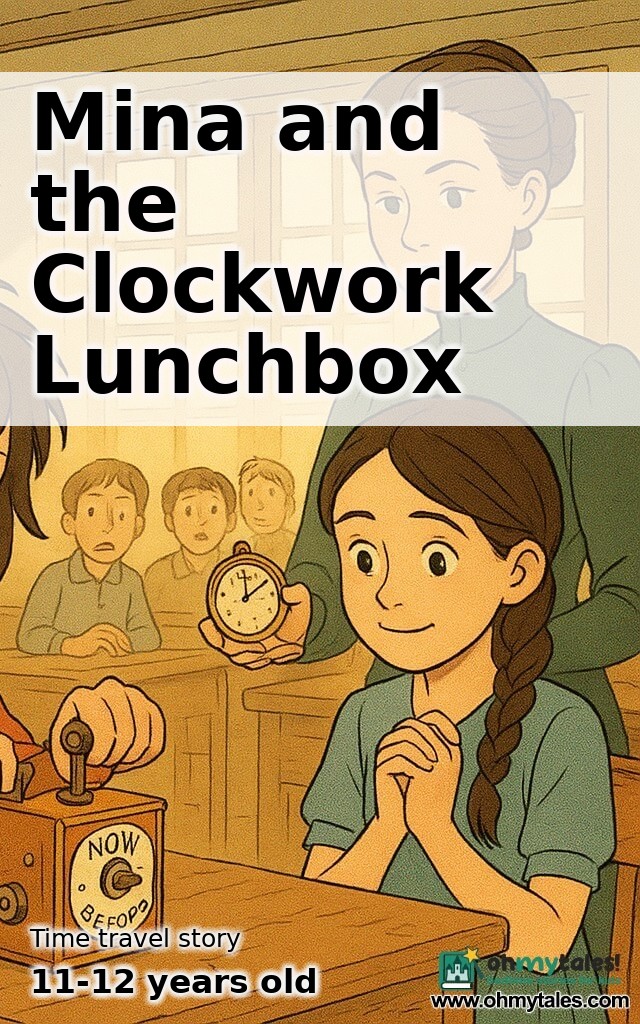
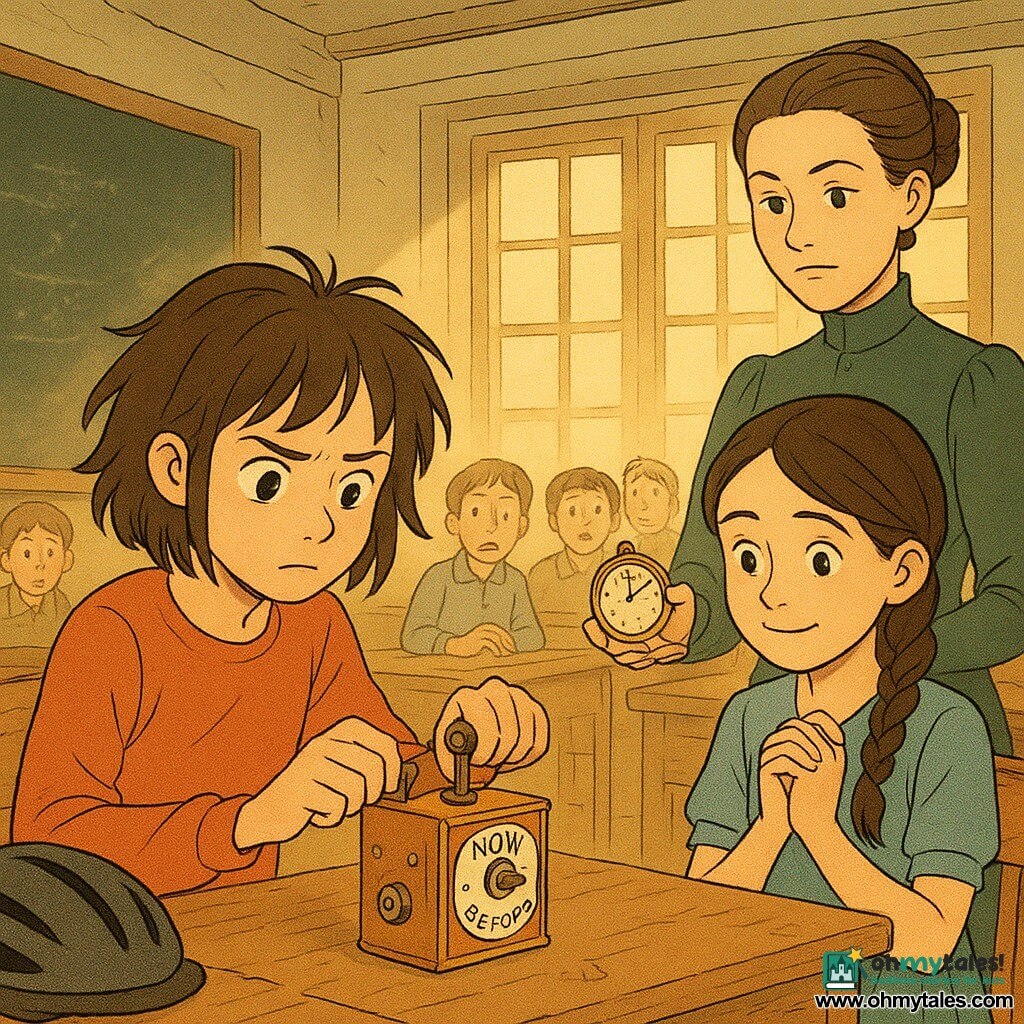
The machine's clock face had two hands. One was normal. The other was a thin silver needle that Mina had made from a paperclip. The needle pointed not to numbers, but to tiny scratched labels: NOW, BEFORE, BEFORE-ER.
Jay squinted. “Before-er is not a word.”
“It is in my garage,” Mina said. She tightened a screw. “Ready?”
Jay backed up a step. “Ready to… watch from over here.”
Mina placed a small object beside the machine: her class schedule, printed on bright paper and covered with doodles of planets and stars. She clipped it to the Chrono-Carrier like a destination card.
“I'm aiming for a classroom,” she said. “I want to see what school was like long ago. Maybe I'll appreciate my squeaky chairs.”
Jay pointed to the coils. “And you're sure it won't send you to dinosaur times?”
Mina held up a finger. “I calibrated it using three things: the school's old yearbook scans online, the library's building records, and the fact that our garage clock is always five minutes fast.”
“That last one feels… not scientific,” Jay said.
“It's very scientific,” Mina replied. “It teaches humility.”
She slipped on her bike helmet—because time travel still counted as “an activity with wheels, sort of”—and grabbed the crank.
“One turn for curiosity,” she whispered, “two for caution, three for kindness.”
She cranked.
The copper coils began to hum, not loudly, but like a cat purring beside a warm radiator. The air shivered. The garage light flickered as if it were blinking.
Jay's voice sounded far away. “Mina? Your hair is—whoa.”
Mina's hair lifted gently, as if it had remembered it could float. The clock face spun. The silver needle clicked onto BEFORE.
A smell of chalk dust filled her nose.
The garage blurred, as if someone had dragged a wet paintbrush across reality.
And then the world snapped into focus.
She was sitting at a wooden desk, smooth with age and scratched with tiny, careful carvings: initials inside hearts, a crooked star, the word “HOPE” in wobbly letters. Sunlight slanted through tall windows. A blackboard stretched across the front wall, and on it, written in perfect white loops:
Monday, March 12, 1900
Mina swallowed.
Jay was gone.
Her Chrono-Carrier—still the size of a lunchbox—sat on her lap, warm and quiet, like it was pleased with itself.
A bell rang outside. Not a modern buzz, but a bright metal clang.
Children filed in wearing stiff collars, long skirts, and suspenders. Their shoes clicked like little hammers on the wooden floor.
Mina stared, then remembered her notebook.
LOGBOOK
- Arrival successful.
- Year confirmed: 1900.
- Heart status: thumping like a drum solo.
A girl with dark braids paused at Mina's desk. “Are you new?” she asked, eyes sharp but not unkind.
Mina's mouth opened. Her brain offered several answers, none of them helpful, like: Hello, I'm from the future, please don't scream.
She chose a better one. “Yes. I'm Mina. I—um—moved.”
The girl nodded as if this happened every day. “I'm Elsie Carter. Don't sit crooked. Miss Hart sees everything.”
Mina straightened so fast her spine made a polite apology.
At the front of the room, a woman in a high-collared dress stood like a ruler. Her hair was pinned so neatly it looked like it had never had a messy thought.
Miss Hart turned, and her eyes swept the room.
They paused on Mina.
Mina smiled in what she hoped was a respectful, normal-year-1900 smile. Not a nervous, future-person smile.
Miss Hart's gaze softened slightly, like the sun finding a gap in clouds. “Good morning,” she said. “We have a guest today. Class, we show respect by listening with our whole faces.”
The children sat tall.
Mina sat tall too, holding her lunchbox time machine like it was a very ordinary lunch.
Chapter 2: The Chalk-and-Ink Surprise
The lesson began with arithmetic. Mina understood the numbers, but the way they did them felt like watching someone build a bridge with toothpicks.
Miss Hart wrote on the board with a piece of chalk that squeaked like a tiny mouse. “Two hundred thirty-seven divided by three.”
Hands shot up. Elsie's hand rose calmly, as if it had all day.
Mina's own hand twitched. She knew the answer. She also knew she shouldn't suddenly become the smartest kid in 1900, like a magician pulling a rabbit out of a history book.
So she kept her hand down and watched.
Elsie stood. “Seventy-nine, with two remaining.”
“Correct,” Miss Hart said. “Sit.”
Mina leaned toward Elsie and whispered, “Nice.”
Elsie whispered back, “You're brave to whisper. Miss Hart hears whispers too.”
Mina pressed her lips together.
Then came writing practice. The students dipped pens into ink wells. The classroom smelled like paper and iron and something slightly sour, as if the ink had feelings.
Mina opened her own pencil case out of habit. A bright orange mechanical pencil peeked out like it was proud to be modern.
Elsie gasped softly. “What is that?”
“A pencil,” Mina said. “A… special pencil.”
Elsie stared as Mina clicked it. The little lead tip popped out.
Elsie's eyes widened. “It makes its own point!”
Mina quickly hid it. “It's… new.”
Miss Hart's shoes tapped closer. “Mina,” she said gently, “may I see your writing tool?”
Mina froze.
Rule 1: Don't change big things.
Rule 2: Be polite in every century.
She stood and offered the pencil, holding it like a peace offering.
Miss Hart examined it carefully. Mina expected shock, questions, maybe a fainting spell.
Instead, Miss Hart's eyebrows lifted, and she murmured, “Ingenious.”
She looked at Mina. “We do not mock what we do not understand,” she told the class, voice calm and clear. “Curiosity is welcome, but respect is required.”
The room went still. A boy in suspenders, freckles scattered across his nose, huffed as if he'd been planning to whisper something unhelpful.
Miss Hart handed the pencil back. “Use it quietly. And do not let it become a distraction.”
“Yes, ma'am,” Mina said, relief washing over her like warm tea.
Elsie whispered, “You're lucky.”
Mina whispered back, “I think Miss Hart is… time-proof.”
Elsie frowned. “Time-proof?”
“Never mind,” Mina said quickly.
At recess, the class poured outside into a yard with a single oak tree and a swing that looked like it had been built by someone who distrusted fun. Girls stood in neat clusters. Boys tossed a ball that looked stitched by hand.
Mina stayed close to Elsie. Her sneakers felt wrong on the dirt, too bright, too cushioned, like they belonged on a different planet.
Elsie pointed to Mina's shoes. “Those are strange.”
“They're… comfortable,” Mina admitted.
Elsie sighed. “My boots bite my ankles.”
Mina remembered her backpack—she had it, somehow, as if time had been kind enough to pack it for her. She opened it and found, to her surprise, a roll of soft cloth athletic tape.
She hesitated. Would that count as changing something big? It wasn't like giving someone a smartphone. It was just… kindness.
“May I?” Mina asked.
Elsie sat on the bench, puzzled but curious. Mina wrapped the tape gently where the boot rubbed.
Elsie stood and tested it. Her face brightened. “It doesn't hurt!”
Mina smiled. “Sometimes the future is just… better bandages.”
Elsie laughed, a quick sound like a bird taking off. “You talk like a storybook.”
Mina's Chrono-Carrier warmed in her backpack, a quiet reminder: be careful, be respectful, and don't get cozy enough to forget what year it was.
Then the bell rang again, pulling them back inside like a tide.
As the students filed into their seats, Mina noticed something on the teacher's desk: a brass pocket watch. Its case was open, and its hands were stopped.
Miss Hart looked at it with a small frown, as if it had insulted her.
Mina's stomach tightened.
A broken watch in a classroom full of ticking rules felt like an invitation to trouble.
Chapter 3: The Paradox in the Desk
After lunch—simple sandwiches and apples, no crinkly wrappers—the class worked on reading aloud. Mina tried to blend in by choosing a steady pace and not pronouncing words like she'd learned them from modern cartoons.
Still, her accent slipped now and then, like a fish darting out of water.
When the reading ended, Miss Hart said, “We will have a short lesson on punctuality. Time is a courtesy we give to one another.”
Mina's ears perked up. Time. Courtesy. That felt aimed at her, even if Miss Hart didn't know it.
Miss Hart lifted the brass pocket watch. “This watch belonged to my father,” she said. “It stopped this morning, and I confess it has unsettled me.”
The class murmured.
Miss Hart closed her fingers around the watch. “We are not ruled by objects. Still… we respect what matters to others.”
Mina's chest tightened again. A watch from 1900. If she fixed it with future knowledge, would that ripple out? If she did nothing, would Miss Hart spend the day worried?
Her logbook rules rattled in her mind.
During copywork, Mina's pencil scratched across the paper. She tried to focus on the sentence:
“Order is the friend of learning.”
But her eyes drifted to the stopped watch.
A tiny idea, mischievous and shiny, popped into her mind: What if the watch stopped because Mina arrived? What if the time machine's jump had nudged it, like two gears bumping?
She imagined the watch as a proud old clock saying, Excuse me, did someone just step on time?
When Miss Hart stepped out to speak to another teacher, the room loosened. Chairs creaked. A few children whispered, careful and quiet.
Freckle-nose boy leaned toward Mina. “Your pencil makes no sense,” he muttered. “Where's the sharpening?”
Mina turned to him. “Where's your curiosity?” she whispered back, not unkindly.
He blinked, surprised, then scowled as if he didn't want to enjoy being challenged.
Elsie leaned close to Mina. “His name is Thomas. He thinks anything new is trouble.”
“Sometimes new things are trouble,” Mina whispered. “Sometimes trouble is… educational.”
Before Elsie could ask what that meant, Mina's backpack shifted. The Chrono-Carrier slid slightly, and a corner of her notebook poked out.
Thomas's eyes caught the glint of copper inside the bag. “What's that?” he hissed.
Mina's brain raced. “Just… my lunchbox.”
“It's not,” Thomas said, too loudly.
Mina looked up. Several heads turned.
She reached into her bag, meaning to push the machine deeper, but her fingers brushed its dial.
The silver needle twitched.
A faint hum rose, like a bee waking up.
Mina froze. “No, no, no,” she whispered.
On the blackboard, the chalk writing shimmered, as if the date was printed on water. The sunlight through the windows stretched into long, syrupy beams.
Elsie grabbed Mina's sleeve. “Mina, what did you do?”
“I didn't mean—” Mina whispered.
Thomas's eyes went round. “Witchcraft!”
“No!” Mina snapped, then lowered her voice. “Not witchcraft. Science. Also, calm down.”
The hum grew louder. The air thickened.
Mina felt a tug, gentle but firm, like an invisible hand trying to pull her backward through a doorway.
Papers fluttered on desks. Ink quivered in wells.
The stopped pocket watch on Miss Hart's desk suddenly ticked once.
Then again.
And then, impossibly, it began to run—backward.
Mina's stomach dropped. “Oh. That's… not good.”
Elsie stared at the watch. “It's… it's wrong!”
Mina grabbed the Chrono-Carrier and snapped the lid of her backpack shut around it, trying to muffle the hum like closing a lid on a buzzing jar.
The room steadied. The sunlight returned to normal.
The pocket watch, however, continued to tick backward, its hands sliding the wrong way like a crab walking.
Footsteps approached in the hall.
Miss Hart returned, her expression changing the moment she saw the watch.
She picked it up. Her face didn't show fear. It showed something else: sharp attention, like a scientist meeting a surprise.
“Mina,” Miss Hart said softly, “would you come to my desk, please?”
Mina stood. Her knees felt like they'd forgotten their job.
She walked to the front, aware of every eye on her.
Miss Hart held the watch out. “Look at it carefully.”
Mina leaned in. The second hand was moving the wrong direction, steady as a marching band.
Miss Hart lowered her voice. “I have lived with time all my life. This is not a simple break. This is a disturbance.”
Mina's cheeks burned. “I'm sorry,” she whispered.
Miss Hart's gaze flicked to Mina's bag. “You carry something unusual,” she said. It was not an accusation. It was a question dressed in good manners.
Mina swallowed. She could deny. She could lie. She could run.
But respect mattered. And Rule 3: If confused, go back.
Mina chose the truth, in the safest pieces she could manage. “I made… a machine,” she whispered. “It helps me travel. Just a little.”
Miss Hart didn't gasp. She didn't shout. She simply nodded once, like a person accepting a difficult math problem.
“Then we must be careful,” Miss Hart said. “Time is not a toy. It is a trust.”
Mina's eyes stung. “I know. I tried to be careful.”
Miss Hart closed the watch and tucked it into her palm. “Then you will help me restore what was disturbed. And you will do it with respect.”
Mina nodded, fiercely. “Yes, ma'am.”
In the back, Thomas looked both thrilled and terrified, like he'd found a secret tunnel and wanted to tell everyone but also wanted to pretend he never saw it.
Miss Hart turned to the class. “We will have a quiet study period,” she announced. “No questions today about Mina's belongings. Curiosity can wait. Kindness cannot.”
The room hushed.
Mina sat down, heart pounding, and opened her logbook with trembling fingers.
LOGBOOK
- Problem: pocket watch running backward after machine hum.
- Risk: paradox (small but sneaky).
- Plan: fix disturbance without changing history.
- Reminder: respect is not optional, even when time is weird.
In her backpack, the Chrono-Carrier pulsed warmly, like it was trying not to laugh.
Chapter 4: The Quiet Deal with Time
After school, Miss Hart did not send Mina out with the other children. Instead, she asked Elsie to remain as well.
Thomas tried to linger, but Miss Hart's look sent him away as neatly as sweeping chalk dust.
When the room was empty, Miss Hart closed the classroom door. The click sounded final, like the end of a sentence.
Mina sat at her desk. Elsie sat beside her, hands clasped, eyes darting between Mina and the pocket watch.
Miss Hart placed the watch on the teacher's desk. “Tell me,” she said, “what are the rules of your machine?”
Mina blinked. “You… believe me?”
Miss Hart's mouth twitched, almost a smile. “I am a teacher. I have seen children insist they did not eat the last cookie while holding crumbs in their eyelashes. Compared to that, time travel is simply… unusual.”
Elsie let out a small laugh, nervous but real.
Mina took a breath. “The rules,” she said, counting on her fingers. “Don't change big things. Be polite. If confused, go back.”
Miss Hart nodded. “Wise. And what do you consider ‘big'?”
Mina hesitated. “Things that change… lots of other things. Like warning someone about a fire that should happen, or giving someone a winning lottery number, or—”
“Or telling me about the future,” Miss Hart finished gently.
Mina's shoulders sagged. “Yes.”
Miss Hart's voice softened. “Then we will not do that. We will focus on the small: repairing what you accidentally disturbed. Then you will return to your time.”
Elsie's eyes went wide. “Return? Mina, you're leaving?”
Mina's throat tightened. “I have to. I'm not supposed to stay.”
Elsie swallowed hard, then straightened. “Then we must do it properly.”
Miss Hart opened the pocket watch. “Observe,” she said. “The hands run backward, but the mechanism feels smooth. It is not broken. It is… reversed.”
Mina leaned closer. “Like… like someone flipped the direction of time inside it.”
Miss Hart looked at Mina with approval. “Exactly. A local inversion.”
Mina's mind clicked along like gears. “When my machine hummed, it probably made a tiny ‘time field.' The watch got caught in it because it was already stopped. Like a boat stuck in a weird current.”
Elsie frowned. “A boat?”
Mina pointed to the watch. “If time is a river, the watch is like a little waterwheel. Mine shoved the water the other way for this one wheel.”
Miss Hart nodded. “Then we must nudge it back.”
Mina pulled the Chrono-Carrier from her backpack and set it on the desk. Its copper coils gleamed in the late light. It looked innocent, like a fancy lunchbox that just happened to argue with the universe.
Elsie leaned in, whispering, “You truly made this?”
Mina smiled, shy. “I like fixing things. And helping. I thought… maybe I could learn from the past, and then be more useful in the present.”
Miss Hart's gaze warmed. “A fine reason. Though next time, perhaps begin with a history book.”
Mina chuckled. “I tried. It didn't have chalk dust.”
She opened the Chrono-Carrier's dial. The silver needle wobbled between NOW and BEFORE.
Miss Hart lifted a hand. “If you must adjust it, do so slowly.”
“Yes, ma'am,” Mina said.
She turned the crank a quarter turn—tiny, careful. The machine hummed softly, like a whisper of electricity.
The watch's backward ticking slowed.
Mina held her breath and turned the crank a hair more, watching the second hand.
It paused.
For one quiet moment, the classroom seemed to listen.
Then the second hand moved forward.
Tick. Tick. Tick.
Elsie gasped. “It's normal!”
Miss Hart closed the watch with a decisive snap. “Well done.”
Mina exhaled so hard her bangs fluttered.
But the Chrono-Carrier gave a sudden, bright pulse of warmth. The dial needle jumped—just a twitch—toward BEFORE-ER.
Mina's eyes widened. “No. Wait.”
A low hum filled the air again.
Elsie grabbed Mina's wrist. “Is it doing it again?”
Mina stared at the dial. “I think… it wants to ‘correct' itself. Like it overshot, and now it's trying to settle.”
Miss Hart's voice stayed calm. “What does that mean?”
Mina's mind raced. “It might pull me back farther than I planned. Like bouncing on a trampoline and flying off.”
Elsie's face paled. “Farther than 1900?”
“Maybe,” Mina whispered.
Miss Hart placed a steady hand on Mina's shoulder. “Then you must return now, before it chooses for you.”
Mina swallowed. She looked at Elsie, who was biting her lip like she was holding in a storm.
“I'm sorry,” Mina said. “I didn't mean to make your day weird.”
Elsie blinked quickly. “It wasn't weird,” she said fiercely. “It was… amazing. And you helped my boots.”
Mina smiled, eyes stinging. “I did.”
Miss Hart slid a small object across the desk: a single sheet of paper, folded neatly. “A note,” she said. “For your notebook. Not about the future. About the present.”
Mina took it carefully, as if it might break.
Outside, the late afternoon light turned golden. The classroom felt like it was holding its breath.
Mina tucked the note into her logbook and placed her hands on the Chrono-Carrier.
She looked up at Miss Hart. “Thank you for believing me.”
Miss Hart inclined her head. “Thank you for taking responsibility.”
Mina looked at Elsie. “Be brave,” she said.
Elsie tried to smile. “Be… time-proof.”
Mina laughed, a watery laugh that helped her not cry. “Exactly.”
She turned the crank—one turn for curiosity, two for caution, three for kindness.
The hum rose, gentle but strong.
The classroom blurred into streaks of chalk and sunlight.
Mina's stomach flipped, like she'd stepped onto a moving escalator made of years.
She clutched her notebook.
And the world folded.
Chapter 5: The Return That Almost Wasn't
Mina landed on the garage floor with a soft thump.
The smell of lemon soap and dust rushed into her nose like a familiar song. The fluorescent light buzzed overhead. A spiderweb trembled in the corner, offended by the sudden wind.
Jay was there, frozen mid-step, holding a bag of chips.
“Mina!” he yelped. “You vanished! And then—are you older? Wait. Are you… the same?”
Mina sat up, dizzy. “I'm the same,” she said. Then, after a second, she added, “Mostly.”
Jay stared at the Chrono-Carrier. “It worked?”
“It worked,” Mina said, voice shaking with relief. “And it almost worked too much.”
She scrambled to her notebook and flipped to a fresh page.
LOGBOOK
- Returned to present: successful.
- Side effect: machine tried to drift to BEFORE-ER.
- Fixed: pocket watch inversion (no lasting harm, I hope).
- Met: Miss Hart and Elsie.
- Lesson: responsibility is heavier than curiosity, but it fits better.
Jay crouched beside her. “So… what was it like? Did you see horses? Old-timey hats? A plague?”
“No plagues,” Mina said firmly. “Just chalk. Ink. And a teacher who could probably stare down a tornado.”
Jay released a breath. “Good.”
Mina opened the folded note Miss Hart had given her. The paper was slightly yellowed, but the ink was crisp.
It read:
“Respect travels well. If you carry it, you will not be lost.”
Mina traced the words with her finger. Her throat tightened. “She knew what mattered,” Mina whispered.
Jay peered. “That's… actually kind of awesome.”
Mina nodded. “It is.”
She set the note beside her logbook and stared at the Chrono-Carrier. It sat quietly now, as if it had used up its mischief for the day.
Jay poked it with one cautious finger. “So you're done? No more time travel?”
Mina thought of Elsie's laugh, Miss Hart's calm voice, the pocket watch ticking forward again. She thought of the hum, and the needle twitching toward BEFORE-ER like a dog pulling at a leash.
“I'm not done learning,” Mina said. “But I might be done jumping without a plan.”
Jay nodded wisely. Then he held up the chips. “Want some? They're from… the present.”
Mina smiled. “Yes, please.”
They sat on the garage floor, sharing chips and silence for a moment, letting the normal world settle back around them like a blanket.
Then Mina stood and carried the Chrono-Carrier to the workbench. She found a small screwdriver and tightened the dial plate. Then she added a new label beside BEFORE-ER.
She wrote, in neat black marker:
NOT TODAY.
Jay laughed. “Good label.”
Mina opened her notebook again and wrote one more rule.
LOGBOOK — New Rule
- Rule 4: Ask for permission when possible. Even time deserves manners.
That evening, Mina lay in bed, listening to the steady tick of her digital clock. It didn't sound like Miss Hart's watch. It didn't sound like 1900. It sounded like now—bright, reliable, a little impatient.
Mina held the folded note under her pillow like a secret compass.
Her eyelids grew heavy.
And as she drifted toward sleep, time seemed to stretch—softly, kindly—like a cat stretching in a sunbeam.
Not pulling her away.
Just reminding her it was there, moving forward, one respectful tick at a time.