Chapter 1: The Grinning Find
Milo was eleven and had a smile that showed up before he did. Even when he was supposed to be “walking carefully” through Grandpa Theo's attic, his grin bounced ahead like a flashlight.
“Remember,” Grandpa called from downstairs, “no stepping on the loose boards!”
“I'm being methodical!” Milo shouted back, which was his new favorite word. It meant doing things in steps, like a scientist. He said it with extra pride, as if the word itself wore a lab coat.
The attic smelled like dry wood and old paper. Sunlight slid through a tiny window and made bright stripes across boxes labeled WINTER COATS, SCHOOL STUFF, and DO NOT OPEN.
Naturally, Milo opened DO NOT OPEN.
Inside was a strange device the size of a microwave, with a glass dome on top and a dial that looked like a clock had gotten confused. A brass plate on the front read:
TEMPORAL TRANSFER UNIT — MODEL 3
Milo's grin widened until it nearly fell off his face.
“Okay,” he whispered. “That's… not a toaster.”
A leather strap dangled from the side, holding a small notebook with a pencil loop. On the first page, in tidy handwriting, it said:
RULES FOR SAFE TIME MOVEMENT
1) Stay calm.
2) Observe before acting.
3) Make small changes only.
4) Write everything down.
Milo lifted the notebook. “Methodical,” he murmured, and liked the way the rules sounded—firm but friendly, like Grandpa's voice when he explained how to fix a bike chain.
Under the notebook was a canvas bag, folded flat. It had pockets, buckles, and a tag that said: RETURN KIT.
The machine gave a soft click. The dial's hand twitched. Then the glass dome glowed like a jar full of fireflies.
Milo's heart did a quick dance.
“Um,” he said to the machine, because sometimes talking to objects made them less mysterious. “Hi.”
The dial had numbers, but not just dates. There were symbols too: a quill, a gear, a rocket, a leaf. Milo turned the dial carefully, one notch at a time, like Grandpa had taught him with the radio.
Click. Click.
The quill symbol landed under a tiny arrow.
The attic air changed. It felt thicker, as if the room had put on a heavy coat. Milo took one step back, then remembered Rule 2: Observe before acting.
He watched.
The glass dome brightened. The boards under his sneakers hummed. His grin wobbled, but it didn't leave.
“Okay,” Milo said, voice squeaky. “Methodical. Calm. Definitely calm.”
The world folded like a page turning.
And Milo fell—without moving—into another time.
Chapter 2: Ink, Iron, and a Very Loud Press
Milo blinked. The attic was gone.
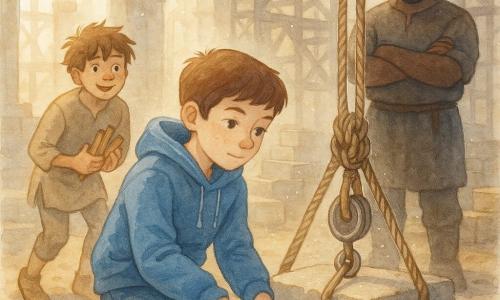
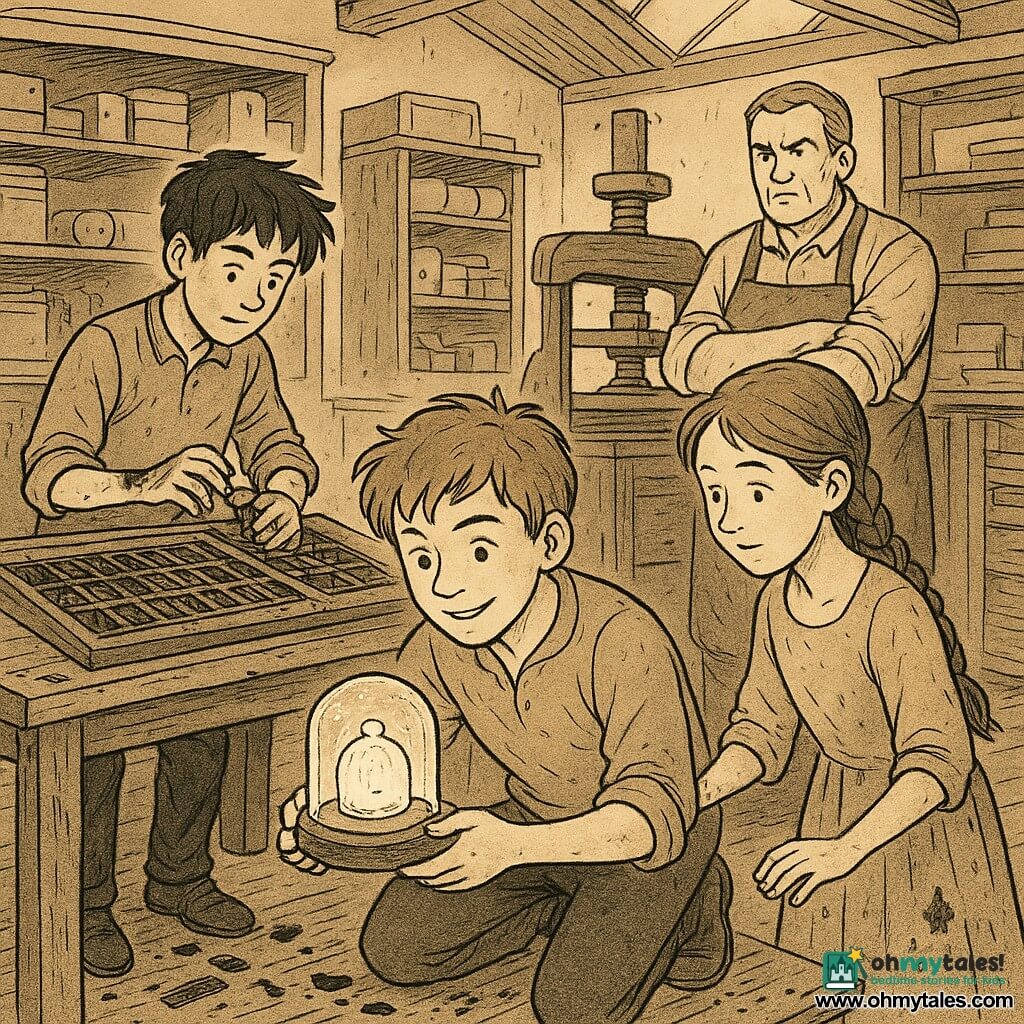
He stood in a workshop crowded with machines that looked half like furniture and half like hungry metal animals. A giant wooden press loomed nearby, its screw as thick as Milo's arm. The air smelled sharp and wet, like vinegar mixed with soot. Ink stained everything: benches, aprons, fingertips, even the floorboards in black freckles.
And the noise—clack, thump, squeak—was like a drumline made of wood and iron.
A boy about Milo's age stood at a table, setting tiny metal letters into a frame. His hair was dark and messy, and his face had one clean streak where someone had wiped away ink with a sleeve.
He looked up, startled.
“Who are you?” the boy demanded. “And what is that—those shoes? They look like—like soft boats!”
Milo glanced down at his sneakers. “They're just shoes.”
The boy stared at Milo's T-shirt. “And your shirt has… words on it already.”
Milo's grin returned, smaller now. “I'm Milo. I think I—um—took a wrong step.”
The boy's eyes narrowed. “No one takes a wrong step into Master Pritchard's print shop.”
Before Milo could answer, a large man with ink-splattered sleeves emerged from behind the press. His eyebrows were shaped like two angry caterpillars.
“Jasper!” the man barked. “Why are you talking instead of setting the type? Words don't print themselves.”
Jasper jerked his chin toward Milo. “He just… appeared.”
Master Pritchard's gaze swept over Milo—sneakers, T-shirt, the notebook in Milo's hand.
“Appeared,” he repeated, as if tasting the word. “From the air?”
Milo remembered Rule 1: Stay calm. He also remembered that “time traveler” might not be the best thing to say in a room full of heavy metal tools.
“I'm… delivering something,” Milo blurted.
Jasper's eyes flicked to Milo's empty hands. “Delivering what? A smile?”
Milo couldn't help it. He smiled harder.
Master Pritchard huffed. “If you're here, you'll work. Jasper, put him to sorting. If he breaks a letter, he sweeps the floor until he's ninety.”
Jasper leaned close to Milo and whispered, “Don't touch the wet ink unless you want black ears.”
Milo whispered back, “Noted.”
Jasper slid a small wooden tray toward him. Inside were dozens of tiny metal blocks, each with a letter on one end. The letters were backwards.
Milo picked one up. The little “a” looked like it had been doing gymnastics.
“Why are they reversed?” Milo asked.
“So they print the right way,” Jasper said, as if Milo had asked why the sky was up. “You set the type like a mirror.”
Milo glanced around the shop. Rolls of paper stood like pale trees. A kettle hissed on a stove. In the corner, an apprentice turned a crank, and the press kissed paper with a heavy thump.
Milo's notebook tugged at his attention. He opened it and wrote quickly:
LOCATION: PRINT SHOP. TIME: ??? (QUILL SYMBOL)
RULES REMEMBERED. DON'T PANIC. DON'T TOUCH WET INK.
TYPE IS BACKWARDS. LIKE MIRRORS.
“Writing already?” Jasper asked, half amused. “Are you a poet?”
“A scientist,” Milo said, then added, “Sort of.”
Jasper snorted. “Well, Scientist Sort-of, start with the a's. And don't mix them with the e's unless you want Master Pritchard to explode.”
Milo nodded. Step one: sort letters. Step two: don't get anyone exploded.
Methodical. He could do that.
Then he heard it: a faint ticking, like a tiny clock trapped in a wall.
The time machine.
It wasn't in his hands. It wasn't on his back. It wasn't under the table.
Milo's grin froze.
“Oh no,” he breathed. “Where did you go?”
Chapter 3: The Mischief of a Missing Minute
Milo forced himself to follow Rule 2 again: Observe before acting.
He scanned the shop. The workers moved like parts in a big machine—ink, paper, press, stack, repeat. Jasper's hands danced with the type, fast and careful.
The ticking came from under a workbench near the press. Milo crouched, pretending to reach for a dropped letter. Under the bench, tucked behind a bucket, sat the Temporal Transfer Unit. The glass dome was dim now, but the dial still pointed at the quill.
Next to it lay the folded canvas bag.
Relief warmed Milo's chest. He was not trapped forever in the Year of Very Loud Printing.
But just as Milo slid his fingers toward the machine, a small hand grabbed the handle first.
A girl, maybe thirteen, with a braid like a rope and eyes full of questions, pulled the device out.
“What's this?” she whispered, as if whispering made stealing polite.
“Hey,” Milo said, louder than he meant to. Jasper looked over.
The girl straightened quickly. “I'm Lark,” she said, as if that explained everything. “And you're not from here.”
Milo's brain did a quick flip. If she took the machine, he might be stuck. If he snatched it back, she might yell. If she yelled, Master Pritchard might explode.
Rule 3: Make small changes only.
Milo softened his voice. “It's… mine. Kind of. It's important.”
Lark's eyes glittered. “Is it a magic lantern? A pocket press?”
“It's a—” Milo stopped. A good explanation was useful. A dangerous explanation was like dropping ink on fresh paper. “It's a tool. It helps me… get home.”
Jasper walked over, wiping his hands on his apron. “Lark, you shouldn't be in here. You'll get ink on your skirt, and then your aunt will chase me with a broom again.”
Lark hugged the machine to her chest. “Jasper, you set type. I set mysteries.”
Milo held up his notebook like a shield made of paper. “Look, there are rules. It's not for messing around.”
Lark tilted her head. “Rules? That makes it even more fun.”
Before Milo could stop her, she twisted the dial.
The machine clicked. The glass dome flickered.
Milo's stomach dropped as if he'd swallowed an elevator.
“Wait!” he said. “You can't just—”
The workshop air thickened again. The press noise stretched into a long, wobbly note, like someone pulling taffy made of sound. Ink drops hung in the air for an extra heartbeat.
Time hiccuped.
Then everything snapped back.
Master Pritchard shouted, “Why is the press silent? Who stopped the—”
The apprentice at the crank stared at his hands. “I didn't stop! It just… paused!”
Jasper blinked rapidly. “Did you feel that? Like… a missing minute?”
Milo swallowed. “Yes.”
Lark's face had gone pale, but her eyes were still bright. “I didn't mean to break time,” she whispered, sounding disappointed, like someone who had cracked an egg and found it empty.
Milo stepped closer and held out his hand. “Give it to me. Please. Methodically.”
Jasper frowned. “Method—what?”
Milo pointed at his notebook. “Step by step. First, we fix the minute. Then we go back to work. No more surprise dial-turning.”
Lark hesitated, then handed the machine over slowly, as if it might bite.
Milo looked at the dial. The quill symbol was still there, but the little hand trembled between two notches. Like it didn't know what “now” meant.
“Okay,” Milo muttered. “We need a plan.”
Jasper leaned in. “You keep saying ‘we.' Are we in trouble?”
Milo's grin returned, shaky but present. “Not if we're careful. We just have to put things back the way they were.”
Lark crossed her arms. “How do you put back a minute?”
Milo took a breath, then spoke clearly, like Grandpa explaining a bicycle chain.
“Minutes are made of actions,” Milo said. “If we repeat the important actions in the right order, maybe time… re-stitches.”
Jasper stared. “You're saying we sew time like cloth.”
“Exactly,” Milo said. “And we just dropped a stitch.”
Lark nodded slowly. “All right, Scientist Sort-of. What's the stitch?”
Milo glanced at the press, the ink, the type forms, the stack of papers waiting.
“The press cycle,” he said. “One full print. Same steps. Same order. No skipping.”
Jasper rubbed his hands. “That's easy. Printing is nothing but steps.”
Milo smiled. “Then we do it. Methodically.”
Chapter 4: The Press of Paradoxes
They moved like a small team in a big, loud world.
Milo wrote the steps in his notebook as Jasper called them out, and Lark watched the press like a hawk watching a mouse made of paper.
“Step one,” Jasper said. “Ink the type.”
Milo repeated, “Ink the type,” and wrote it down.
Master Pritchard was stomping around, grumbling about “lazy hands” and “mystery pauses,” but he was too busy to notice three kids acting like a secret committee.
Jasper rolled the ink onto the letters—smooth, even, not too thick.
“Step two,” he said. “Lay the paper.”
Lark placed a sheet carefully, her fingers hovering as if the paper might run away. “Like this?”
Jasper nodded. “Square. No wrinkles.”
Milo watched the ticking of the machine in his arms. It sounded steadier now, as if it liked the idea of a checklist.
“Step three,” Jasper said. “Pull the press.”
The apprentice stepped aside, confused but willing. Jasper grabbed the lever. The press came down with a deep thump. The sound felt solid, like a door closing properly.
Milo held his breath.
For a moment, the workshop lights seemed brighter. The air felt lighter. Like the missing minute had been found behind a chair.
“Step four,” Jasper said. “Lift. Remove. Stack.”
Lark lifted the paper and held it up. Black letters shone, crisp and fresh. She smiled—just a little, the way someone smiles when a complicated knot finally loosens.
Milo checked the machine's dial. The trembling hand slid back into place. The quill symbol sat neatly under the arrow again.
“It worked,” Milo whispered.
“Of course it did,” Lark said, but her voice had a tremble too. “Because we did it properly.”
Jasper leaned closer. “So your… tool… likes order.”
Milo nodded. “Time likes order. Or at least… it likes when people pay attention.”
From across the room, Master Pritchard barked, “Jasper! Why are you printing that page again? We already printed it!”
Jasper's face went blank. “Uh…”
Milo flipped the page Lark was holding. At the bottom, in tiny print, was the date.
Except it wasn't today's date. It was tomorrow's.
Milo's grin vanished. “That's not supposed to happen.”
Lark's eyes widened. “We printed the future.”
Jasper swallowed. “Is that… bad?”
Milo's brain raced. Printing tomorrow's date today was not a small change. That was a big, stompy change wearing muddy boots.
Rule 3 again: Make small changes only.
Milo snatched the page gently from Lark. “We cannot let anyone see this.”
Master Pritchard marched over, suspicious as a cat in a fish shop. “What are you three hiding?”
Jasper blocked him with a tray of type. “Nothing! Just… being methodical.”
Master Pritchard blinked. “Methodical? In my shop? That's what I've been begging for!”
Milo's eyes flicked to the waste bin. He could crumple the page, toss it, pretend it never existed. But paper in a print shop had a way of being found. Used. Reused. Read.
Then Milo noticed something: beside the press was a stack of scrap sheets, already printed with blurred mistakes—smudged ink, crooked letters, half-pages.
A perfect hiding place.
Milo slid the future-dated page between two ruined ones. He kept his face calm, like a poker player, though he'd never played poker and would probably giggle.
Master Pritchard peered at them. “Well? Back to work. And no more pauses. Printing waits for no one.”
As he stomped away, Jasper exhaled. “That was close.”
Lark leaned in. “So what happens if someone reads tomorrow's date today?”
Milo rubbed his forehead. “It could make people act differently. Or worry. Or try to stop something that hasn't happened. And then…”
“And then you get a knot,” Jasper said.
“A paradox,” Milo corrected softly. “A time knot.”
Lark's mouth twisted. “I hate knots.”
Milo looked at the machine. “Then we follow Rule 4. We write everything down, and we leave things as we found them.”
Jasper frowned. “Leave things as we found them… including that page?”
Milo thought carefully. “We hid it in the scrap. Scrap gets pulped or burned. It won't become a poster on the street.”
Lark nodded. “Small change. Good.”
Milo's grin returned, tired but true. “Now we just need to get me home. Without losing any more minutes.”
Jasper glanced at the machine. “How do you pick the right time?”
Milo opened the notebook attached to the strap. Under the rules, there was a small chart in Grandpa Theo's handwriting:
QUILL = PRINT SHOP ERA
GEAR = INDUSTRIAL AGE
ROCKET = NEAR FUTURE
LEAF = HOME (PRESENT)
Milo tapped the leaf symbol. “That.”
Lark's eyes softened. “So you're leaving.”
Milo nodded. “But first—” He looked at the press, the ink, the careful steps. “Thank you. You both helped fix time.”
Jasper gave a crooked smile. “I like fixing things. It's better than getting yelled at.”
Lark shrugged, trying to look casual. “I like mysteries. But maybe… not the kind that breaks minutes.”
Milo laughed quietly. “Good choice.”
He tightened his grip on the machine. “Okay. Leaf. No twisting without permission.”
Lark raised two fingers. “Scout's honor.”
Jasper whispered, “Whatever a scout is.”
Milo turned the dial one notch at a time.
Click. Click.
The leaf symbol slid under the arrow.
The glass dome glowed like captured sunlight.
Milo took one breath in the ink-scented air, as if storing it in a jar. Then he said, “Goodbye.”
The workshop folded like a page turning.
Chapter 5: Home, With a Clearer Now
Milo landed on a dusty attic board with a soft thump. The sunlight stripes were still on the boxes, as if they hadn't moved an inch. A spiderweb trembled gently, surprised by the sudden breeze of returned time.
The machine's glow faded. The ticking slowed into a calm, ordinary rhythm.
Milo stood very still. He listened.
Downstairs, Grandpa Theo hummed while washing a mug. The sound was so normal that it felt like a blanket.
Milo exhaled. “I'm back.”
He looked at the notebook and added the last lines, his pencil scratching like a tiny press:
RETURNED TO PRESENT. TIME RULES WORK.
METHOD HELPS: OBSERVE, PLAN, DO STEPS IN ORDER.
DO NOT LET CURIOUS PEOPLE TURN DIALS.
He paused, then wrote one more thing:
JASPER + LARK = GOOD TEAM. PRINTING IS LIKE TIME: ONE STEP AT A TIME.
Milo tucked the notebook into the canvas bag. He looked at the Temporal Transfer Unit. It sat quietly now, innocent as a breadbox, as if it hadn't just taken him to a world of iron presses and missing minutes.
Milo thought of the future-dated page hidden in scrap. He pictured it being pulped, turned back into plain paper. The idea felt right. Mistakes and almost-mistakes returning to blankness.
He carried the machine and the bag to the attic stairs, then stopped. Grandpa's rule about loose boards floated up in his mind.
Methodical, Milo reminded himself.
He tested each step with his foot before putting his full weight down. No rushing. No hero leaps. Just careful, steady movement.
At the bottom, Grandpa Theo looked up. “Find anything interesting?”
Milo's grin tried to explode, but he kept it to a reasonable size. “Some old stuff,” he said, which was technically true. “And… a good reminder.”
Grandpa raised an eyebrow. “A reminder of what?”
Milo slung the canvas bag over his shoulder, feeling its weight—real, present, comforting. “That if you want things to work,” Milo said, “you do them in the right order. And you write things down.”
Grandpa smiled. “That's my boy.”
Milo walked to the front door, set the canvas bag neatly on the floor beside it, and zipped it shut. Then he stood for a second, listening to the ordinary sounds of home: the clock ticking, the kettle starting to boil, Grandpa humming again.
Outside, the day waited—bright, simple, and full of minutes that belonged exactly where they were.