In the year 2273, humanity had become a spacefaring civilization. Across the Solar System, dazzling cities gleamed beneath transparent domes on the Moon, Mars, Europa, and beyond. Gargantuan spaceships soared between the planets, their silvery hulls reflecting the light of distant stars. Artificial intelligence, quantum computers, and bioengineered plants had transformed life, making it possible for people to live, learn, and explore in the most hostile corners of the cosmos.
At the heart of human space exploration was Helios Base, a sprawling research center built into the frozen crust of Ganymede, Jupiter's largest moon. From its shimmering blue towers to its crystalline observation decks, Helios Base buzzed with activity. Here, astronauts, scientists, and engineers worked tirelessly to uncover the secrets of the universe, pushing the boundaries of science and technology.
Every year, a contest was held across the Solar System: the Galactic Young Explorers Challenge. Children aged 10 to 13 submitted their wildest ideas for inventions, discoveries, or experiments they dreamed of conducting in space. The winners—brilliant, curious, and imaginative—were invited to join a journey to the famous Polaris Education Station, an orbiting classroom dedicated to teaching young minds about the wonders of the universe.
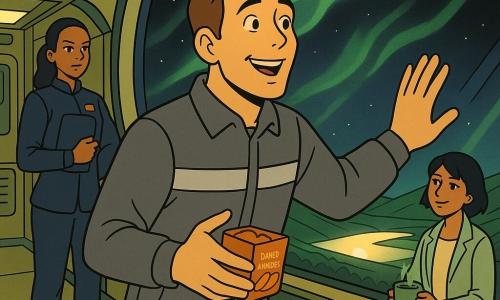
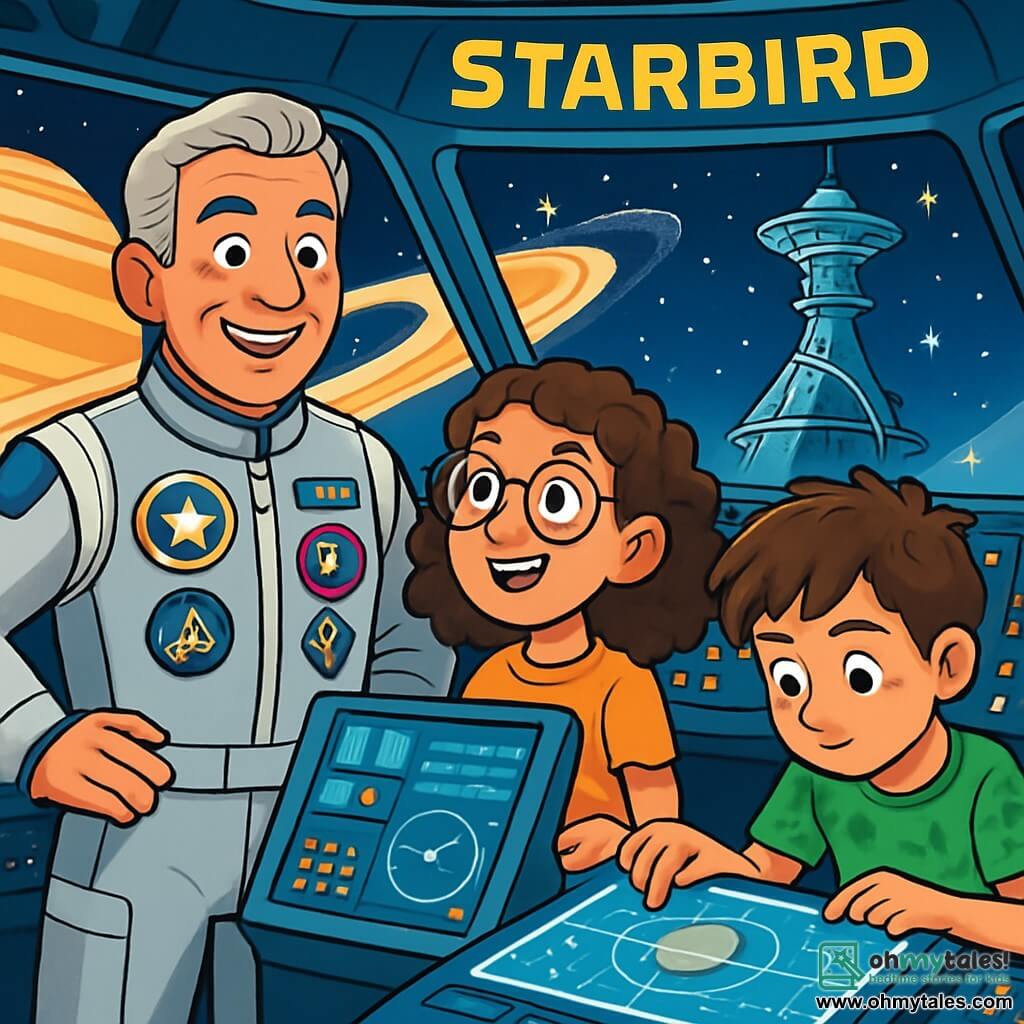
This year, the task of transporting these remarkable children—and mentoring them along the way—fell to Captain Elias Voss. Captain Voss was a seasoned pilot, his sharp gray eyes reflecting both the vastness of space and the wisdom of experience. With a comforting smile and a voice that inspired confidence, he was a legend among explorers. But beneath his calm exterior, he was always eager for a new adventure.
Chapter 1: The Call to Adventure
Captain Elias Voss sat in his office at Helios Base, reviewing a holographic map of the Solar System. The walls around him hummed with soft blue light. His desk was cluttered with data pads, mission logs, and a miniature model of his beloved ship, the Starbird.
Suddenly, his communicator chimed. The face of Dr. Linh, the base's director, appeared, her eyes twinkling with excitement.
“Elias, are you ready for this year's Galactic Young Explorers Challenge?” she asked.
Voss grinned. “Always, Linh. How many winners this time?”
“Seven. All of them bright as supernovas, with ideas that might change the future. You'll be taking them to Polaris Station, with a stop at Europa for the ice labs. Think you can handle that?”
Voss laughed. “I've piloted through asteroid storms and plasma whirlpools. A group of eager kids should be a pleasant change.”
“They'll need your guidance, Elias. Some of these children have never left their home planets.” Dr. Linh's voice softened. “Show them the stars.”
“I intend to,” Voss said, feeling a familiar spark of excitement. “I'll meet them at the docking bay.”
As the call ended, Voss gazed out the window, watching Jupiter's swirling clouds through the reinforced glass. He remembered his own first journey into space, the feeling of awe and terror, the sense that anything was possible. He wondered what the children would think when they saw the universe for the first time.
He stood, straightened his jacket, and headed for the bay.
Chapter 2: The Young Explorers
The docking bay was a hive of activity. Technicians checked ships, robots scuttled by with crates, and the air was filled with the scent of ozone and oil.
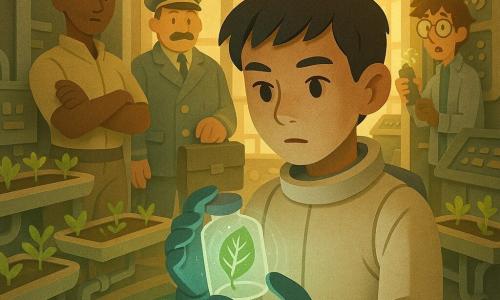
Seven children stood in a circle, their eyes wide with wonder—and a touch of nervousness—as Voss approached. He recognized some faces from their contest entries: Ava, the robotics prodigy from Mars; Mateo, an Earth-born botanist passionate about xenoplants; twins Iris and Imani, engineers from Luna City; Jun, the data scientist from Mercury; Leila, a poet and code artist from Titan; and Zayd, a stargazer from Europa.
“Welcome, explorers!” Voss announced, his voice warm. “I'm Captain Voss, and this—” he gestured to the sleek ship behind him, its silver wings folded like a bird's “—is the Starbird. She'll carry us on our journey.”
The children murmured in awe. Ava's eyes glittered. “Is it true the Starbird can land on comets?”
“She can, if the captain's steady enough,” Voss said with a wink. “But today, we're headed to Polaris Educational Station, with a few stops for discovery along the way.”
Mateo raised his hand. “Will we see the floating gardens on Europa?”
“If you help me plot the course,” Voss replied, “we'll see more than gardens. We'll see things no one else has.”
He led them up the ramp into the Starbird. Inside, the ship was a marvel: walls of transparent aluminum, glowing data screens, comfortable seats that molded to their shapes. The children gasped as the windows revealed a sweeping view of Jupiter's giant storms.
Voss settled into the pilot's seat, the children gathering around him. “Before we launch, I want to hear what each of you hopes to find in space. Who wants to start?”
Iris grinned. “I want to build machines that can fix themselves when they break.”
Imani chimed in, “I want to design habitats that feel like home on any planet.”
Ava said, “I want to create robots that can explore places humans can't go.”
Mateo nodded. “I want to discover plants that can grow in zero gravity—and maybe even eat some.”
Jun, shy at first, spoke up. “I want to find patterns in the stars that can help us travel faster.”
Leila smiled. “I want to write poems that describe the beauty of space in a language everyone can understand.”
Zayd, gazing at the stars, said softly, “I just want to see what's out there.”
Voss nodded, proud of their dreams. “You're all explorers. And you're about to see more than you ever imagined. Ready?”
They cheered.
“Launch sequence initiated,” Voss declared, as the engines hummed to life.
Chapter 3: Into the Infinite
The Starbird lifted gently from the docking bay, its thrusters glowing blue. The children watched in awe as Helios Base shrank behind them, replaced by the endless tapestry of space.
“Destination: Europa Ice Labs,” Voss announced. “It'll take us two hours at cruising speed. Until then, who wants to learn how to fly a starship?”
Hands shot into the air.
Voss guided them through the controls—how to read star-charts, plot courses, and monitor the ship's systems. Ava traced the glowing lines on the navigation panel, her eyes sharp with curiosity. Mateo asked about the hydroponic bay, eager to see the tiny jungle within. Leila gazed out the window, scribbling lines of poetry on her tablet.
As the ship glided through the darkness, Voss told stories of past missions—of asteroid mining, comet landings, and the time he rescued a lost probe from Jupiter's radiation belt. The children listened, wide-eyed.
Suddenly, the ship's sensors beeped. A swarm of micro-asteroids flickered on the screen, blocking their path.
“Looks like we have our first challenge,” Voss said, his tone light but focused. “Who wants to help with evasive maneuvers?”
Iris and Imani leapt forward. Voss showed them how to operate the ship's thrusters. Together, they guided the Starbird through the swirling rocks, dodging and weaving with precision. The children cheered as the last asteroid zipped past, harmless.
“Nice flying, cadets,” Voss said, high-fiving the twins. “Exploration isn't just about seeing new things—it's about overcoming the obstacles in your way.”
As Europa's icy orb grew larger in the window, Voss felt a surge of pride. The children were already proving themselves.
Chapter 4: Wonders Beneath the Ice
Europa was a world of frozen beauty. As the Starbird descended, the children pressed their faces to the windows, marveling at the shimmering ridges and deep blue cracks.
They landed near the entrance to the Europa Ice Labs—a gleaming dome nestled in a crystalline valley. Inside, biologists and engineers worked together to study the moon's hidden ocean.
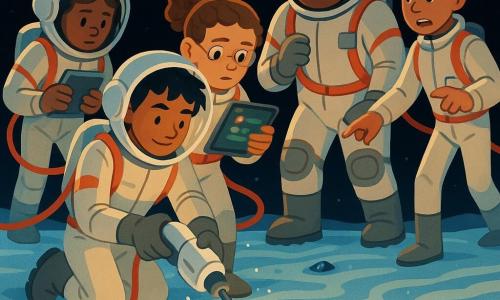
The children donned thermal suits and followed Voss into the lab. Dr. Sabine, the lead scientist, greeted them. “Welcome, explorers! Are you ready to see Europa's secrets?”
She led them to an observation window. Beneath their feet, robots drilled through the ice, lowering submersibles into an underground sea. Glowing creatures drifted in the inky water—jellyfish with rings of light, fish with transparent skins.
Mateo's eyes sparkled. “Could we grow plants down there?”
Dr. Sabine smiled. “We're trying. Some algae can survive in the dark, feeding on the chemicals in the water. Maybe one day, we'll build gardens under the ice.”
Ava asked, “Can the robots fix themselves if they break?”
“Not yet,” Dr. Sabine admitted. “That's a challenge for the next generation of inventors. Maybe one of you.”
Imani and Iris exchanged a look. “We have some ideas.”
Voss watched with satisfaction as the children asked questions, took notes, and sketched designs. They were already thinking like true explorers.
After the tour, the group gathered for a meal in the lab's cafeteria. Jun tapped away at his tablet, analyzing data from the submersibles. Leila recited a poem she'd written about Europa's silent sea, her words painting a picture of mystery and hope.
“That was beautiful,” Zayd said quietly. “It makes me feel like I'm really part of something… big.”
“You are,” Voss assured him. “We all are.”
As they prepared to leave, Dr. Sabine handed Voss a data crystal. “For Polaris Station. It contains our latest findings. Maybe your students can help us solve some puzzles.”
Voss tucked the crystal into his pocket, feeling the weight of their responsibility—and the thrill of discovery.
Chapter 5: Shadows and Stars
Back aboard the Starbird, the children buzzed with excitement, trading theories and ideas. The ship soared away from Europa, setting course for Polaris Station, which orbited high above Saturn's rings.
But as they approached the asteroid belt, the lights flickered. An alert flashed on the screen: “UNIDENTIFIED OBJECT DETECTED.”
Voss frowned. “Everyone, buckle in.”
The children obeyed, eyes wide.
A shadow drifted across the window—a ship, sleek and black as obsidian, with no markings. It hovered near the Starbird, scanning them with an eerie blue light.
“Who are they?” Iris whispered.
Voss's voice was calm, but tense. “Unknown. But we're not alone out here.”
The communicator crackled. A distorted voice echoed through the cabin. “Starbird, state your purpose.”
Voss responded, “This is Captain Elias Voss, transporting contest winners to Polaris Educational Station. Identify yourself.”
A pause. Then, “We are the Solaris Collective. We monitor all travel through this sector. Prepare for inspection.”
The children exchanged nervous glances.
Voss nodded at them. “Stay calm. The Collective are strict, but fair. They protect the outer colonies from smugglers and pirates.”
A boarding hatch opened. Two figures—tall, armored, faces hidden—entered. They scanned the ship, their movements precise. When they saw the children, their tone softened.
“So young. Future explorers?”
Mateo spoke up. “We're going to Polaris Station!”
“Good,” said one inspector, her voice gentle. “We need curious minds. The universe is vast, and we have much to learn. Remember: exploration is a privilege. Treat it with respect.”
They finished their inspection and returned to their ship. The shadowy vessel vanished into the asteroid field.
The children exhaled, relieved.
“That was intense,” Jun said, his hands shaking slightly.
Voss smiled. “Space is full of surprises. Sometimes, you meet friends. Sometimes, you meet challenges. Both are important.”
As Saturn's golden rings came into view, the children leaned forward, awed by the beauty before them.
Chapter 6: Polaris Station
Polaris Educational Station was a marvel—a spiraling structure of silver and crystal, orbiting above Saturn's luminous rings. As the Starbird docked, the children gasped at the sight of classrooms suspended in glass globes, laboratories floating in zero gravity, and gardens blooming under artificial suns.
A welcoming party greeted them: teachers, researchers, and young explorers from across the Solar System.
The group was led by Professor Amina, a tall woman with a shock of silver hair and a contagious smile.
“Welcome to Polaris Station!” she announced. “Here, you'll learn, experiment, and maybe even discover something new. Are you ready?”
The children cheered.
Their days at Polaris were filled with wonder. They studied alien biology in the living labs, designed robots that could repair satellites, and navigated virtual starfields, learning from the best minds in the system.
Ava and the twins built a prototype robot inspired by Europa's submersibles—one that could repair itself using nanobots. Mateo worked with the botanists to create a floating garden of edible algae. Jun helped the data scientists crack a code hidden in Europa's ocean currents, discovering a new pattern that could help ships travel through turbulent space.
Leila composed poems in the garden, her words projected onto the walls for all to read. Zayd spent hours at the observatory, mapping new stars and sharing his discoveries with anyone who would listen.
Voss guided them, offering advice and encouragement. He watched with pride as the children grew more confident, their curiosity boundless.
One evening, as Saturn's rings glittered outside, Voss gathered the children on the observation deck.
“You've all achieved amazing things,” he said. “But the most important lesson in exploration is not what you find—but how you work together, and how you grow.”
The children nodded, understanding.
“Will we ever travel beyond the Solar System?” Zayd asked, his eyes shining.
Voss smiled. “Maybe one day. And if you keep asking questions—if you keep exploring—you'll be the ones to lead us there.”
Chapter 7: The Unexpected Signal
On their last day at Polaris Station, an urgent message arrived. The data crystal from Europa had been analyzed, and something unusual had been found: a repeating signal, deep beneath the ice.
“It could be natural,” Professor Amina explained, “or it could be… something else. A mystery to solve.”
The children's eyes sparkled with excitement.
“Can we help?” Ava asked.
“Absolutely,” Voss said. “Who's up for one last adventure?”
They returned to the Starbird, joined by Professor Amina and a team of scientists. Their mission: investigate the signal at Europa.
As they approached the moon, the team worked together—mapping the signal's source, programming the submersible, and preparing for the unknown.
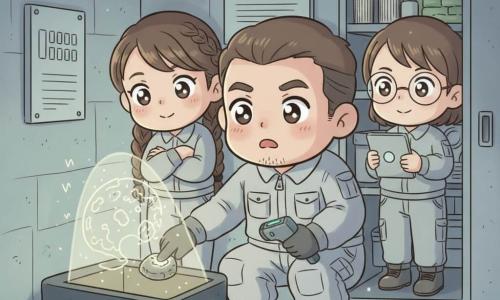
The submersible descended into the dark sea. On the screen, shimmering shapes appeared—strange structures, almost geometric, unlike anything seen before.
“It's like a city,” Mateo whispered.
The signal grew stronger. Suddenly, lights flickered in the water—patterns of color, pulsing in time with the signal.
“Is it alive?” Leila wondered.
Jun analyzed the data. “It's a pattern. Like a language.”
Ava and the twins sent a sequence of lights from the submersible, mimicking the pattern. For a moment, nothing happened.
Then, the lights in the water responded, repeating the sequence. The children cheered.
“It's communication!” Professor Amina exclaimed. “We've made contact—with something new.”
Voss grinned. “You did this. Together.”
They spent hours exchanging patterns, learning from the mysterious lights. Though they couldn't understand each other's words, they shared curiosity and wonder—a universal language.
Chapter 8: Reflections and Goodbyes
Back aboard the Starbird, the children buzzed with excitement, their minds racing with possibilities.
“We need to study this more,” Iris said.
“We could build a robot that can dive deeper,” Imani added.
Mateo beamed. “Maybe we'll discover new life.”
Voss looked at them, pride and affection in his eyes. “You've shown bravery, creativity, and teamwork. These are the qualities of true explorers.”
As they prepared to return to their home worlds, the children hugged each other, promising to stay in touch. They shared dreams of future adventures—missions to distant moons, new inventions, and journeys to the stars.
On the observation deck, Voss gazed out at the universe, the children by his side.
“There are always new horizons,” he said softly. “Never stop reaching for them.”
As the Starbird sailed through the darkness, the children watched the stars, their eyes filled with wonder and hope.
And somewhere, deep beneath Europa's ice, the lights pulsed in greeting—an invitation to return, to learn, and to explore.
The adventure had only just begun.