Chapter One: The Case of the Vanishing Tick
The afternoon rain made the windows of Harborview Library look like a watery veil. I was not there to investigate anything. I was there for a quiet seat, a mug of tea, and a book about birds. That's the thing about me: I'm a detective who discovers things by accident. Curiosity pulls me in like a tide.
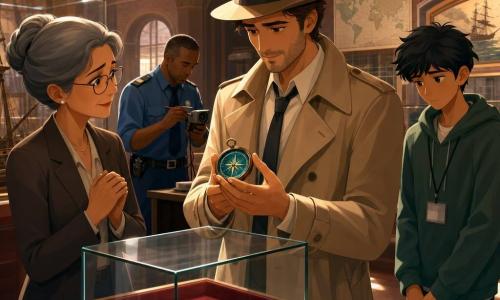
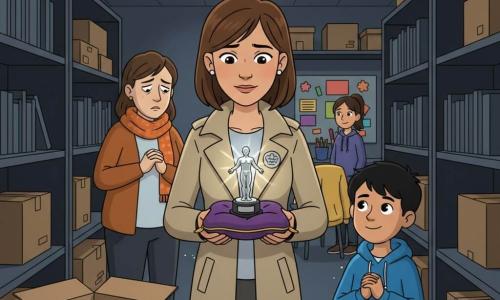
I sat near the front exhibit where the Clockwork Curiosities were displayed. Polished brass gleamed. Tiny gears winked in glass cases. The star was the Finch Chronometer, a pocket watch that a sailor once used to find his way home in fog. It sat on black velvet like a small sun.
Ms. Brant, the head librarian, hovered nearby with her clipboard. She wore a blue cardigan, and her hair was pinned in a neat twist. She was famous for being punctual. If she said three o'clock, she meant three o'clock on the dot.
“Three fifteen,” she murmured to herself, tapping the schedule. “Mr. Kline's talk begins at three fifteen.” She smiled at the group of kids working at a craft table. They were decorating shoeboxes with star stickers and little magnets, for a “Treasure Tales” display. The lemon scent of their glue floated across the room.
Mr. Kline, the visiting clockmaker, was already setting up his demonstration by the far wall. He was thin, with silver hair and a gentle way of holding his tools. “We'll talk about springs and balance wheels,” he told a kid named Toby, who wore a hoodie and had glitter on his jeans. “But never forget—punctuality is respect.” He tapped his pocket watch. “The bus comes at 3:15 and I will not miss it.”
Ms. Kettle, the collector who had lent the watches, moved tightly between cases like a careful fox. “Do not touch the glass,” she warned anyone with fingers. “The Finch Chronometer's value is—well—immeasurable.”
I sipped my tea and looked up at the tall windows. Behind them, the rain suddenly got heavier. The lights flickered once. Then everything went dark.
There was a collective gasp. A kid giggled, then hushed. Somewhere, a beeping sound started, then died.
“Everyone, please remain calm,” said Ms. Brant's voice, perfectly even. “Our backup will come on in—”
Her sentence didn't finish because something else finished first: a metallic click, a small, sharp sound like a cricket. I marked it in my mind. Then the lights came on, one by one.
“Whew,” said Toby. He held up his glittery hands. “Whoa—”
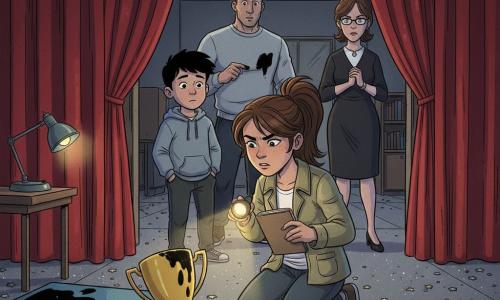
A cry ripped through the whispers. Ms. Kettle was staring into the glass case where the Finch had been a moment ago.
“It's gone,” she said, voice thin. “My chronometer—it's gone.”
I forgot my tea. The room turned to me the way rooms do when trouble walks in. I didn't mean to be a detective today. But accidents rarely ask permission.
“All right,” I said. “No one leaves the library just yet. We'll make sure we find it before any buses are missed.”
“The bus,” Mr. Kline said, checking his pocket watch. “Three fifteen.”
“We'll make sure truth doesn't miss it either,” I said.
I crouched by the glass case. There was no sign of a smashed lock or broken hinge. No scattered glass. Just a clean, empty velvet pad.
“Who has keys to this case?” I asked.
“Two keys,” said Ms. Kettle. Her hand flew to the chain around her neck. “One is with me. One is with Ms. Brant.”
“I keep mine in the office safe when not in use,” said Ms. Brant. Her voice was steady, and her eyes were on the clock. “It's 2:57. I need to call the power company for an explanation.”
“Later,” I said gently. “Just tell me where you were when the lights went out, and we'll talk.” I looked toward the craft table. The kids had those decorated boxes in every color, with stars, flowers, and little gears drawn on the lids in marker. A faint lemon smell tickled my nose.
“Everyone,” I said, “this is a puzzle. And puzzles can be solved. We'll need clear heads and careful eyes. And maybe a little patience.”
Chapter Two: Lemon Glue and a Cricket Click
We formed a small circle near the empty case. The rain banged a little harder on the glass. The big wall clock behind us hummed.
“Clues first,” I said. “Who noticed anything during the blackout? Any sounds? Any movements? Use your best detective eyes.”
“Something clicked,” said a girl with braids, tilting her head. “Like a tiny bug.”
“Cricket click,” said Toby. “I heard that too.”
“What did you smell?” I asked. “Sometimes our noses catch clues our eyes miss.”
“Lemon,” said three kids at once. They grinned at each other.
“That might be from our glue,” said a smaller boy. He held up a bottle labelled Lemon Fresh Craft Gel. “We used tons.”
I leaned closer to the case. On the black velvet pad, along the very edge, there was a shimmer where shimmer shouldn't be. I touched it with the tip of my finger. It sparkled.
“Glitter,” I murmured. I looked at the velvet rope in front of the case. It had a smear of blue glitter too, as if a glittery sleeve had brushed it. My eye slid to Toby. His hoodie had glitter everywhere. Toby noticed me noticing and hugged himself like he was cold.
“I didn't touch anything!” he said quickly. “Promise!”
“It's okay to promise,” I said, “but promises are stronger with details. Where were you when the lights went out?”
“Right here,” he said, pointing at a chair by the craft table. “Okay, fine, I was actually kneeling on the floor because I dropped my star stickers. Then Sara screamed because she thought my sticker was a spider, and—sorry, Sara.”
Sara rolled her eyes. “It brushed my ankle.”
“Any grown-ups come close during the blackout?” I asked. “Maybe to keep you calm?”
“Ms. Brant said, ‘Everyone please remain calm' from somewhere,” said the girl with braids. “I think she was near the desk.”
“I was at my demonstration table,” said Mr. Kline. He lifted his magnetic parts tray, a shallow metal dish that clung to his table. Tiny screws glittered in it like silver fish. “I didn't move. I clutched my tools and counted seconds. Three seconds until power returned. Punctual as always.”
“And you?” I asked Ms. Kettle.
“I stood right here,” she said, jaw tight. “I never took my eyes off the case. How could I? And still—” She spread her hands.
I looked again at the case, at the hinges, the lock, the tiny gap between glass and frame. There were no scratches. The lock wasn't bent. The keyhole seemed untouched. I noticed a faint foggy circle high on the glass, as if someone had breathed there.
“Did the power come back fast?” I asked.
“Twelve seconds,” Mr. Kline said. “I counted.”
“Of course you did,” I said.
I straightened and turned to the kids. “Here's a question for you: If there was no broken glass and no forced lock, how did the watch get out? Write down three ideas in your head. Don't tell me yet. Keep them. We'll compare later.”
Toby sighed. “Am I a suspect?”
“Everyone is a suspect until they're not,” I said. “It's not personal. It's math.”
He made a face. “I'm good at math.”
“Then help me check the numbers,” I said. “Time, steps, distances. Clues add up if you let them.”
He nodded slowly. Maybe the glitter on his hoodie got brighter. Or maybe the lights did.
Chapter Three: Punctual People and Hidden Corners
We began checking alibis. Not because I love alibis, but because they are walls that either stand or fall.
“Ms. Brant,” I said, “your key.”
“In my office safe,” she said. “I checked it at ten to three. I always check at the same times.” She reached into her cardigan pocket and pulled out her key ring with other keys flashing like tiny fish. “Not the case key. The office key.” She watched the wall clock. “It's 3:05. I need to call—”
“Soon,” I said. “First, where were you at 2:57?”
She pointed with her chin to the circulation desk. “Right there. Making sure the talk would start on schedule.”
“Mr. Kline?”
“Counting seconds,” he said. “Right here.”
“Does your parts tray stick to anything metal?” I asked, nodding at the dish.
“Any steel,” he said, a proud spark in his eye. He slapped it under the edge of the table, and it hung there. “It's magnetic. Keeps screws from wandering.”
“And Mrs. Diaz?” I asked the room. “Our cleaner?”
“She's off today,” said Ms. Brant. “She comes on Thursdays.”
I walked slowly past the craft table. A tower of decorated boxes stood drying on a back shelf. Stars, hearts, swirls. On one lid, someone had drawn a gear with a face. On another, a tiny whale blowing sparkles. The lemon glue perfume was strongest here.
“Did any adult step in to help you kids when the lights flickered?” I asked.
“Ms. Brant said we were okay,” said Sara. “Mr. Kline didn't move. Ms. Kettle said, ‘Oh dear.'”
“Could the watch have slipped?” asked the boy with the glue. “Like slid under the case?”
I got down on my knees and looked under the case. Just dust specks and a stray star sticker. I picked up the sticker and stuck it to my notebook. I stand by souvenirs.
Mr. Kline cleared his throat. “Detective,” he said, “I must tell you I can't miss my bus. 3:15, on the dot. There's another talk at the town hall this evening.” He smiled apologetically.
“How far is the bus stop?” I asked.
“Behind the library,” he said. “Down the corridor, out the loading dock, down the ramp, left to the street.”
“And the loading dock door?” I asked, half to myself.
“It makes a squeak,” said Ms. Brant, with precision. “I had it oiled last week. It should squeak less.”
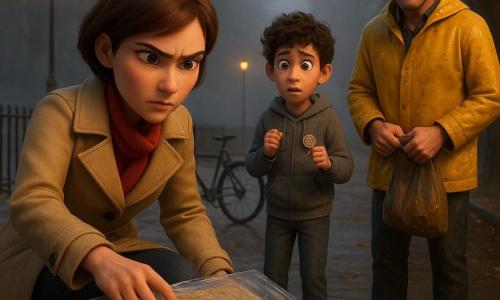
I nodded and wandered to the back corridor. The hum of fluorescent bulbs was familiar. I pushed the loading dock door, and it gave a tired creak. The rain smell was stronger, metal and wet leaves. A bus hissed in the distance.
I leaned against the door and listened to the library breathe. I was thinking about keys. About magnets. About tiny cricket clicks. I was thinking about lemon.
Behind me, footsteps landed in even taps. Mr. Kline appeared, coat on, umbrella ready. He checked his pocket watch, even though the wall clock above the door told exactly the same time.
“Three fifteen,” he said, smiling. “On the—”
The door swung wide, and I stepped with him into the light rain. The bus had not yet rolled to the curb. He turned toward the ramp. I held up a hand.
“Wait,” I said. “Just for one minute.”
“I am a punctual man, Mr.—?”
“Greer,” I said. “Elliott Greer.”
“Yes, Mr. Greer. Punctuality is fairness,” he said kindly. “Time treats everyone the same.”
“Then a minute won't hurt it,” I said. “Where were you, exactly, when the lights went out?”
“Counting seconds,” he said. “Right at my table.” His eyes flicked to the clock. “I'll be late.”
“Wait,” I said again, and the bus doors gasped open below. He hesitated, which surprised me. Punctual people dislike hesitating.
The bus closed its doors and pulled away with a breathy sigh. Mr. Kline's jaw worked. He pressed his lips together as if to keep an old habit from spilling out, then smiled again.
“No matter,” he said. “There is another bus in fifteen minutes. That is also a time. And I always have my watch.”
He turned back toward the library. I watched a drop of water run down the back of his umbrella like a careful thought.
As he stepped through the door, I said, “You told the kids that magnets keep screws from wandering.”
“Yes,” he said. “Magnets are honest workers. They whisper to metal. They hold what needs holding.”
I didn't know it then, but a sentence was about to pull the rug out from under the whole room.
Chapter Four: The Key Phrase
We gathered in the main space again. I could feel everyone's frustration rising like steam. The Finch was somewhere. I could almost hear it not ticking.
“Detective,” said Ms. Kettle, wringing her hands. “It's priceless. You understand that means more than money.”
“I do,” I said. “It means story.”
“Maybe it was the janitor?” someone whispered.
“We do not have a janitor,” said Ms. Brant crisply. “We have a cleaning contract with—”
“Before we chase shadows,” I said, “let's chase facts.”
Mr. Kline stood by his table of tools. He reached into his vest and brought out a cloth to polish his watch. He looked at the kids and said, in the tone of a teacher trying to soothe a nervous class, “Don't worry. Time keeps perfect secrets.”
Those words slid across the room and clicked into place somewhere in my head—a better click than the one during the blackout.
Perfect. Secrets.
Magnets whisper to metal.
The latch had clicked like a cricket.
Lemon glue on little hands. Blue glitter on velvet. But the lock hadn't been forced. Two keys were accounted for. A magnetic parts tray clung to a metal table like a barnacle.
If a latch had a steel tongue, a magnet could tug it open. No keys. No scratches. Just a quiet cricket click in the dark.
I felt the puzzle turning under my fingers.
“Kids,” I said, my voice low. “Do your boxes have magnets?”
“Yes!” said the boy with the glue. “We glued them on the back so our boxes can stick to fridges!”
I smiled, even as my stomach made its own calculations. “Would one of you bring me a magnet? A strong one.”
Toby ran and came back with a square magnet stuck to the side of a file cabinet. It popped off with a decisive snap. His eyes were wide.
“If this works,” I said to him, “it changes who we look at first. Ready?”
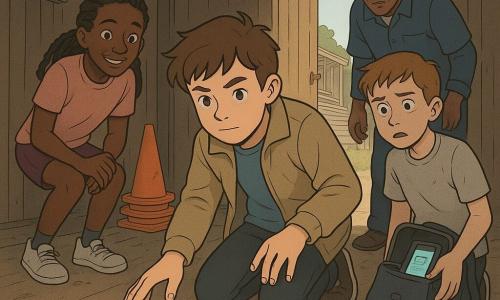
He nodded. We crouched by the case. I ran my hand under the seam of the glass where it met the metal frame, feeling for a spot that felt eager. I placed the magnet there. The magnet tugged. The latch gave a small, unmistakable click.
The case door eased.
Toby breathed, “Whoa.”
I let the door rest without opening it further. I stood up and looked at everyone. My heartbeat felt loud, like a clock someone had wound too far.
“This case can be opened with a magnet,” I said softly.
Mr. Kline's face didn't change much. Maybe the corners of his mouth tightened. Maybe I imagined it. The kids made a ripple of oooooh.
“Let's clear something up,” I said, turning to Toby. “You had glitter and lemon on your hands because you were making boxes. But you didn't have a magnet in your pocket. You were ten steps away, on the floor, chasing a star sticker under a chair. I don't think you took the watch.”
Toby blinked. “You…don't?”
“Not anymore,” I said. “I wanted to re-evaluate you as a suspect. Now I have. You're still a suspect in the sense that everyone is, but you've slid to the low end of my list. Someone else just slid higher.”
“Who?” asked Sara.
I looked at the punctual man with the magnetic tray.
But I wasn't ready to point. Not yet. Justice takes patience. And proof.
“Everyone, I need to ask you not to touch the boxes on the back shelf,” I said. “In fact, step away from them, please.”
“Why?” asked Ms. Kettle.
“Because if someone used a magnet to open the case,” I said, “they might also have used something else at hand to hide what they took.”
“A bag?” Ms. Brant asked. “A pocket?”
“Possibly,” I said. “But pockets leave bumps. Bags leave shapes. In a room full of watching eyes, the cleverest hiding place is often in plain sight, among things no one thinks to suspect.”
I looked at the boxes. They looked back like bright, innocent faces.
“Detective,” whispered Toby beside me. “You think…?”
“I think the Finch might be in one of those boxes,” I said quietly. “And I think the person who put it there didn't plan on the bus schedule changing.”
Chapter Five: A Bus Missed and a Box Noticed
“Will you open them?” Ms. Kettle asked in a thin voice.
“I don't tear open kids' work without reason,” I said. “We'll check carefully. We'll check logically.”
I pulled a chair over and stood on it to look at the high back shelf. Ten boxes rested there. Some had lids closed tight under star stickers. Some were slightly ajar where the glue hadn't dried.
“Look,” I said. “Which one would you choose? If you were nervous, in a hurry, and the lights were out for twelve seconds. If you needed to hide something the size of a watch quickly.”
“Not the ones with glitter puddles,” said Sara. “They're sticky.”
“Not the tiny ones,” said the boy with the glue. “Some are too small.”
“Maybe one that doesn't swoosh if you move it,” said Toby. “The glass watch might make a noise.”
“Good,” I said. “You're thinking like a detective.”
I invited Ms. Kettle, Ms. Brant, and Mr. Kline closer but kept the kids a step back. I lifted the first box. It was light. A little lemon smell. I put it back. The second was heavier, but when I tilted it, I heard dried glue crackle. The third was very light. The fourth was medium, and when I angled it, something slid inside. I listened. Not a ring of metal. More like beads. I set it down.
Mr. Kline watched carefully. He stood a little too straight, like a man on a deck.
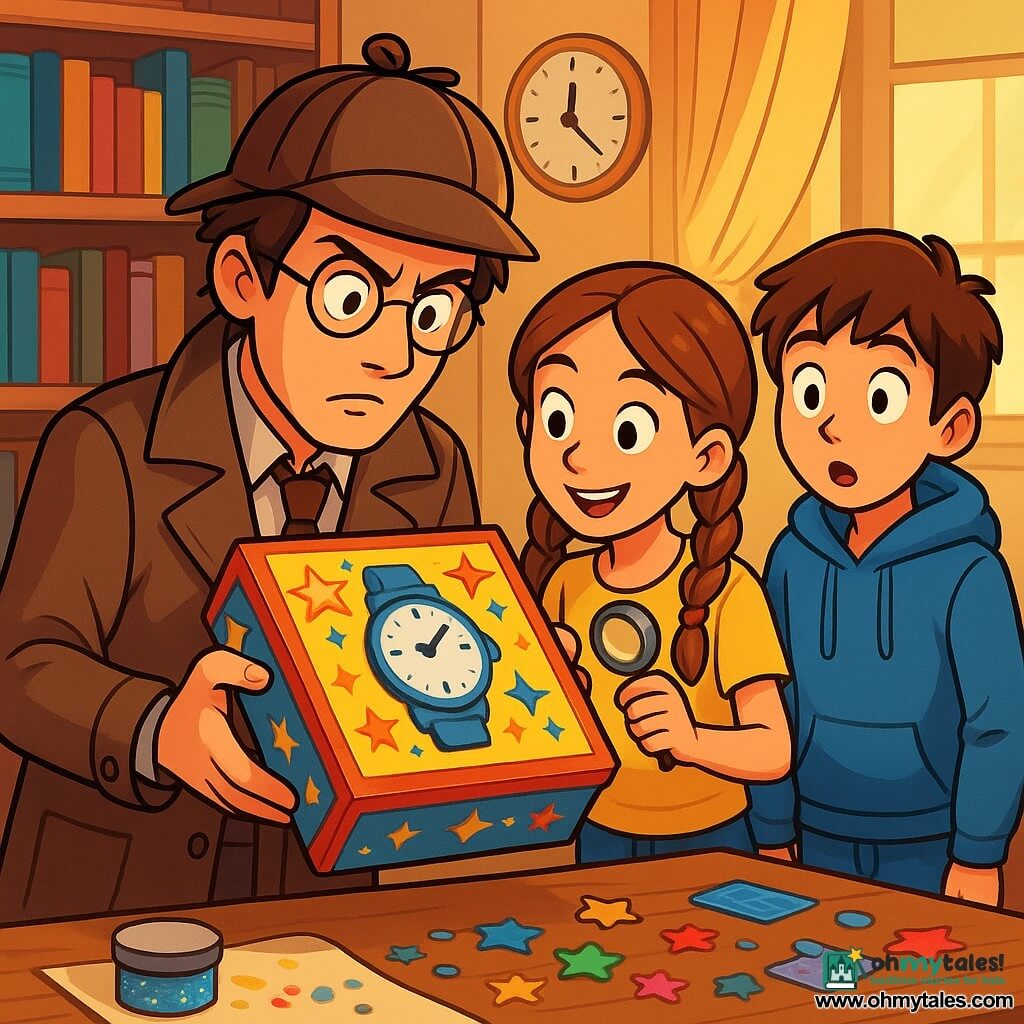
I reached for the fifth box and saw that someone had drawn a small clock on the lid with the hands at 3:15. The gears were doodled in the corners in black pen. Blue glitter stars made a border. My fingers hovered over it, then stopped.
“What?” asked Toby. He was beside me, eyes narrowed. “You see something?”
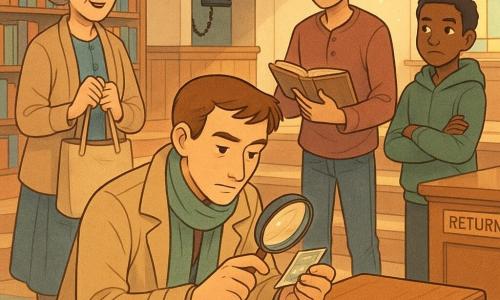
I nodded at the edge of the lid. There was a smudge, not of glitter, but of something dark. A smudge too neat—like a fingerprint. I glanced at Mr. Kline's hands. His fingertips had the faint stain that oil leaves after a day of touching moving parts.
“Mr. Kline,” I asked, my voice even. “You said you were counting seconds. Did you move from your table when the power went out?”
“I did not,” he said.
“Did you touch any of the boxes?”
“I did not.”
“Did you talk to anyone closely during the blackout?”
“No,” he said. He kept his face calm, but his watch chain trembled.
“You told me time keeps perfect secrets,” I said. “It doesn't. People try. Time tells. You missed your bus while we talked at the loading dock. But when the lights went out, you would have had exactly—what was it you said?—twelve seconds. Enough to slip forward, tug the magnet you had on your tray under the case edge, click the latch, and slide the Finch into something within reach. The craft table. The boxes.”
“That's a story,” he said softly. “Not proof.”
“True,” I said. “Then answer this: Why is there clock oil on this box?”
His eyes flicked there. He blinked. A muscle in his cheek ticked, once. Time measured it.
He looked at the kids. He looked at the watchless velvet. Then his shoulders fell half an inch, like sails when wind dies.
“I didn't want to steal it,” he said, almost to himself. “I wanted to keep it safe.”
“From what?” asked Ms. Kettle, fierce but trembling.
“The case,” he said. “I tested it before my talk. The latch is weak. A magnet shouldn't open it so easily. You let children press their noses to the glass. Humidity. Breath. A single careless elbow could do it. The Finch—” He shook his head. “I meant to tuck it away for one hour, finish my talk, and then return it with a lecture on proper cases. I picked the nearest place. I thought—no one will disturb a child's craft. Then the lights returned and panic grew and… I ran out of time.”
Silence settled like dust.
Justice isn't having a villain just because a story wants one. It's about actions and consequences fitting together. It's about telling the truth even when your watch says you should be somewhere else.
“We'll open the box,” I said gently. “Then we'll talk about what happens next.”
I slid my fingernail under the lid of the box with the 3:15 clock drawn on it. The star sticker lifted like a small moon. The lid came free. Inside, wrapped in tissue patterned with purple flowers, something rested as quiet as a stone.
I pulled back the paper. Brass blinked. The Finch Chronometer lay there, not ticking, but very much real.
A breath went around the room. Toby whispered, “We found it.”
“Justice,” breathed Ms. Brant, not softly but proud. “That's what it looks like.”
Mr. Kline closed his eyes. When he opened them, they were wet. “I'm sorry,” he said to Ms. Kettle. “I should have spoken to you. I should have said what I thought about your case. I should have asked before acting.”
“You should have,” she said. Her hands trembled, but she wasn't unkind. “And yet, thank you for not taking it too far from here.”
He bowed his head.
“What happens now,” I said, not as a question but as a path, “is reporting the attempt to remove the piece without permission, returning the Finch to its rightful place, and agreeing on better security. Also, Mr. Kline, you'll agree to make amends.”
“What kind?” he asked.
“Teach a free workshop for the library,” I said. “On secure display cases. And maybe one on patience.”
A few kids laughed. The tension felt a little less sharp.
“And you, Toby,” I added, “could you help make a sign for the exhibit? Something like: Please admire with your eyes, not your hands.”
“On it,” he said. “With stars. But no glitter near the case.”
“Good plan,” I said.
Chapter Six: Fairness on the Dot
We set things right with slow hands. I made notes. Photos were taken, not of faces, but of the actions: the box, the wrappings, the watch, the case, the magnet demonstration, the smudge of oil. Ms. Kettle held the Finch like a small bird. Her fear calmed as if it had somewhere to perch.
“I'll lend a proper case,” said Mr. Kline, steady now. He seemed smaller without the weight of his secret. “One with a lock that laughs at magnets.”
“And I will write a better procedure,” said Ms. Brant, her voice firm with purpose. “No more keys in just two places. No more breath fogging glass. We will be as punctual with safety as with story hours.”
“Detective Greer,” she added, looking at me with a squint that might have been respect, “you surprised me. You always look as if you're daydreaming.”
“I am,” I said. “Daydreaming is where dots line up so you can draw lines between them.”
“Twelve seconds,” said the girl with braids out loud, ticking it off on her fingers. “Magnet. Lemon smell. Glitter. The cricket click.”
“Exactly,” I said. “You saw. You listened. You put pieces together.”
Mr. Kline stood by, hands folded. “I will speak to the police if you wish.”
“I do,” said Ms. Kettle gently. “We must. Justice doesn't work on an honor system. But justice also remembers why people do what they do, and whether they make it right.”
“I will make it right,” he said. He glanced toward the back. “Until the next bus.”
Toby tugged my sleeve. “Detective,” he said, “you knew it was that box because of the drawing of the clock, huh? It was like he wrote a clue without meaning to.”
“Partly,” I said. “Also, because it was heavier than it should have been, and because it had a fingerprint in oil, and because I've seen the inside of a watchmaker's fingernails.”
“I'll remember that,” he said, grinning. “Not the fingernails. The heavier part.”
“You don't have to be a grown-up to notice weight,” I said. “You just have to care what things weigh.”
“Like justice,” he said, thoughtful.
I looked at him. Sometimes twelve-year-olds say things that land in the room like a bell. “Exactly.”
We placed the Finch back into its case, but not before Mr. Kline wound it gently and set it ticking. The sound was small, but it felt like the room began breathing again. Twelve seconds seemed shorter now, contained in each tick. Time wasn't keeping perfect secrets anymore.
After statements were made and hands were shaken, the sky lightened. The rain moved on in a thin curtain. Quiet returned to the library in the way it always does—suddenly and all at once, as if it had been standing outside waiting to be let back in.
“Thank you,” said Ms. Brant. She looked at her clipboard. “It's 4:30. We are ten minutes behind for youth chess.”
“We can catch up,” I said.
“We always do,” she said, the corner of her mouth lifting.
I reached for my mug. It was stone-cold. That's all right. Some afternoons trade warmth for other things.
Before I left, I walked to the back shelf and picked up the box with the little clock drawn on the lid. I held it up to the kids.
“Who made this one?” I asked.
The boy with the glue raised his hand. “Me.”
“You want it back?” I said.
He shook his head. “It's part of the display. ‘Treasure Tales,' remember?” He pointed at the sign they'd made in bright marker. “It's about hiding something special in plain sight and telling its story.”
“That it is,” I said.
He leaned closer and whispered, “We can stick it to the fridge in the staff room. It has a magnet.”
“Easy,” I said. “Just not near anything that opens with a whisper.”
He giggled.
As I headed for the door, Toby called, “Detective!”
I turned. He jogged up, breathless, then said, a little too formal, “Thanks for re-evaluating me. I mean—for not just deciding and sticking with it.”
“Good detectives re-evaluate,” I said. “Good judges too. If a clue points left, follow it. If it points right, follow that. Justice isn't a race. It's a path.”
He nodded like he'd found a path he liked. “See you around.”
“On the dot?” I said.
He grinned. “On the dot.”
I stepped out into the cooling street. The air smelled washed. In my hand, I still held the box—the one with the drawn clock, the one that had held a secret badly. I turned it over once. Blue glitter sparkled. A purple flower patterned the tissue inside, a bit torn but still pretty. It wasn't just a hiding place. It had been a lesson in plain sight.
As I walked, the small sound of a watch ticking came with me from the library, steady and reassuring. Even when time keeps its own counsel, people can choose to be honest. People can choose to make things right.
On my way home, I passed the bus stop. A bus was on time. Mr. Kline stood there, hands in his pockets, shoulders set. He saw me and nodded. The nod of a man waiting on the dot, and on justice.
I nodded back and kept walking. The rain had stopped. The evening had space for a quiet chair and maybe even warm tea. But first I set the box carefully on a low wall under a window where the sun, when it returned, would catch the blue stars.
It was small, decorated, and light in my hands. And it felt, in that moment, like the end of a puzzle, and a beginning too. The story concluded by a decorated box.