Chapter 1
Mara Keene didn't carry a badge. She carried a notebook, a pen that clicked too loudly, and the calm attention of someone who noticed small things on purpose.
On Maple Street, the “Neighborhood Watch” wasn't a group of people peering through curtains like owls. It was a handful of neighbors who volunteered to keep the block friendly and safe—checking on bikes, reporting broken streetlights, helping lost delivery drivers, and, once in a while, solving problems before they grew teeth.
Mara was their unofficial detective.
That afternoon, the community center smelled like floor cleaner and old posters. Kids' laughter bounced off the gym walls. A poster near the entrance announced SATURDAY ART SHOW in bright paint, with glitter that refused to behave.
Inside, Mr. Sato, the art teacher, stood by a set of empty display stands. He looked like someone had erased his smile.
“It's gone,” he said, voice low.
“What's gone?” Mara asked, already turning her eyes into searchlights.
“The framed drawing. The one we were going to reveal at the end of the show.” He rubbed his temples. “It's called The Thread of Things. A student worked on it for months. It was going to be the centerpiece.”
Mara wrote the name down. THE THREAD OF THINGS. Underlined twice.
“Where was it last?” she asked.
“In the supply room. Behind the tall cabinet. I locked the door.” Mr. Sato's hand fluttered toward his pocket, as if checking for the key even though he knew it was there.
Mara walked with him down the hall. She listened—really listened. The building had its usual noises: a distant basketball thump, a squeaky mop bucket, someone singing off-key in a classroom.
The supply room door was painted the color of oatmeal. Mr. Sato unlocked it. The air inside smelled of paper, glue, and paint that had learned patience.
He pointed. “There. That's where the frame was.”
A rectangle of dust on the shelf showed where something had rested. The dust looked undisturbed, like a smooth slice missing from a cake.
Mara leaned closer. On the floor, near the shelf, was a tiny curl of blue thread.
She didn't pick it up right away. She just stared at it, letting her brain line up questions like dominoes.
Blue thread didn't belong with frames and dust. It belonged with stitching. Or a scarf. Or a tote bag. Or… a curtain.
“Before we panic,” Mara said, “we map the facts. You said you locked the door. Did anyone else have a key?”
Mr. Sato hesitated. “The janitor. Mrs. Linden, the center manager. And… the student volunteers sometimes borrow supplies, but I'm careful about the key.”
Mara clicked her pen once. Too loud. She stopped.
“Okay,” she said. “Let's not rush. Patience first. We'll follow the thread.”
And she meant it, literally.
Chapter 2
Mara's first rule was simple: don't chase a guess when you can collect a clue.
She crouched and took out a small evidence bag from her tote. The Neighborhood Watch called them “mystery bags,” mostly to make Mr. Patel from number 12 laugh, but they worked.
With a clean tissue, she lifted the blue thread and sealed it.
Then she studied the room like it might confess if she stared hard enough. The tall cabinet's door was slightly ajar. A metal step stool stood under the shelf—placed neatly, not kicked.
“No mess,” Mara murmured. “That means whoever took it wasn't in a hurry. Or they wanted it to look calm.”
Mr. Sato swallowed. “Could it be… a prank?”
“Maybe.” Mara kept her voice steady. “But a months-long drawing in a frame isn't a funny prank. It's a cruel one. We'll treat it as a theft until proven otherwise.”
She stepped into the hallway and found Mrs. Linden by the front desk, tapping her phone with sharp little movements. Mrs. Linden had a habit of speaking as if she was always late, even when she wasn't.
“Mara,” she said. “If this is about the art show, I can't have drama. Parents will complain. The mayor's niece is in the show.”
“I'm here so there won't be drama,” Mara replied. “Who had access to the supply room today?”
Mrs. Linden sighed. “I did. The janitor, Gus. Mr. Sato. And the volunteer team this morning.”
“Names?” Mara asked.
Mrs. Linden's eyes narrowed, but she answered. “Talia Reeves and Ben Crowley. They helped set up tables.”
Mara wrote them down. Then she asked, “Did anyone report anything odd? A door left open? Someone wandering?”
Mrs. Linden tilted her head. “Now that you mention it, Gus said he heard the supply room door click around ten. He assumed Mr. Sato was in there.”
“Did he see anyone?”
“No.”
Mara thanked her and walked outside to the small courtyard. The day was bright, but the wind had teeth. The community center's side door opened onto a line of bushes and a bike rack. Mara scanned the ground.
Near the rack lay a smear of pale chalk—like someone had dragged a shoelace through it. And by the bushes, half-hidden, was a paper scrap with a dab of gold paint.
Gold paint. Glitter on the poster. The art show.
Mara held the paper up to the light. It wasn't just paint. It was paint on thick paper, the kind used for serious drawings.
She placed it in another bag.
A voice behind her said, “Looking for treasure?”
Mara turned. Ben Crowley stood with a roll of tape in one hand. Ben was twelve, lanky, and wore his confidence like a hoodie—always on, sometimes too big.
“I'm looking for a missing framed drawing,” Mara said. “You helped set up today, right?”
Ben's eyebrows jumped. “Yeah. Talia and me. We put up the stands, moved boxes. I didn't touch any… fancy drawing.”
“Where were you around ten?” Mara asked.
Ben's mouth opened, then closed. He frowned, thinking. “We were in the gym. Coach needed chairs moved. Then I went to the vending machine. Talia was—uh—sorting posters.”
“Did you go near the supply room?”
Ben shook his head fast. “Nope.”
Mara watched his hands. The tape roll spun on his finger. Not nervous—bored, maybe. Or acting bored.
“Talia?” Mara asked. “Where is she now?”
Ben pointed with his chin. “Parking lot. She said she had to meet her mom.”
Mara looked toward the lot. A girl with a dark braid was standing by a car, arms crossed. Her face was turned toward the street, like she was waiting for something to happen.
Waiting, Mara thought, is not the same as doing nothing.
She walked over.
Chapter 3
Talia Reeves saw Mara coming and straightened, as if posture could build a wall.
“I didn't take it,” she said before Mara even spoke.
Mara stopped a few steps away. “I haven't accused you.”
Talia's cheeks colored. “Everyone always thinks it's the volunteer kid. Like we're all sneaky.”
Mara studied her. Talia's backpack strap had a loose thread—blue.
“Tell me about your morning,” Mara said.
Talia shrugged, but it was a shaky shrug. “We set up tables. I put up the glitter poster. My hands got all sparkly. Then I helped Mr. Sato carry frames—empty ones—from the closet.”
“Did you go into the supply room?” Mara asked.
Talia hesitated. “No. Not today.”
Mara didn't pounce. Pouncing made people lie better. She waited, letting silence do what it did best: make the truth itch.
Talia's eyes flicked to Mara's tote bag, then to the building. “Okay, I went in once,” she admitted. “To get more tape. The kind that doesn't rip the posters. I didn't see any special drawing. I swear.”
Mara nodded. “Who else did you see near there?”
Talia's gaze slid toward the side door. “Gus was pushing his cart. And Mrs. Linden rushed by talking into her phone. She looked… angry.”
“Angry about what?”
Talia lifted one shoulder. “Dunno. But she said something like, ‘If it's not perfect, it's pointless.'”
Mara's notebook absorbed that sentence.
A car horn honked once—impatient, sharp. A woman waved from the driver's seat. “Talia! We're late!”
Talia winced. “That's my mom. She's always late, then she yells like it's everyone else's fault.”
The driver tapped the steering wheel with quick fingers. Her other hand clutched her phone, and the hand trembled slightly, as if the whole arm was tired of holding stress.
The story shifted in Mara's mind. Not because of the horn. Not because of the words. Because of that trembling hand.
A trembling hand could mean nerves. Or too much coffee. Or fear. Or guilt.
Mara stepped closer to the car window.
“Hi,” Mara said politely. “Mara Keene. Neighborhood Watch. Quick question—did you come inside earlier?”
The woman blinked. “Inside? No. I'm just picking her up. We're already behind.”
Behind, Mara thought, is a good place to hide something. You rush so no one asks questions.
Mara's eyes dropped to the back seat. A blanket. A gym bag. And a flat, rectangular shape under the blanket—too straight to be a jacket.
Talia followed Mara's gaze and stiffened. “Mom?”
The woman's trembling hand tightened on the wheel. The tremble got worse for a second, like a tiny earthquake in her fingers. Her smile tried to be normal and failed.
“It's nothing,” she said. “Just my work stuff.”
Mara didn't reach into the car. She didn't accuse. She didn't grab. Patience, she reminded herself, wasn't waiting lazily. It was waiting smartly.
“I understand,” Mara said. “We're missing an artwork from the center. If you think of anything helpful, you can call me.”
She handed over a small card with her number.
As the car pulled away, Talia looked back through the rear window. Her face was a mix of embarrassment and worry, like she'd stepped into a puddle she hadn't seen.
Ben jogged up behind Mara. “What was that about?”
“Nothing yet,” Mara said. “But I saw something I want to check.”
She turned toward the side door and headed back inside, her thoughts pulling tight like a knot.
If the framed drawing was in that car, it wasn't a random theft. It was personal.
But why would Talia's mom take a student's artwork?
Mara needed more facts. The thread was still unspooling.
Chapter 4
Mara found Gus the janitor in the hallway, leaning on his mop like it was a cane. Gus had a gray mustache that made him look permanently amused, even when he wasn't.
“Gus,” Mara said. “I heard you noticed the supply room door around ten.”
Gus nodded. “Heard it click. Like a latch. I was by the drinking fountain.”
“Did you see anyone?” Mara asked.
He scratched his chin. “Not then. But earlier, I saw Mrs. Linden come from that hall. Fast. Like a goose being chased.”
“Did she have anything in her hands?” Mara asked.
Gus's eyes went up, searching his memory. “She had… a cloth. Blue cloth, maybe. Folded over her arm.”
Mara's stomach tightened. Blue thread in the room. Blue cloth with Mrs. Linden. A shape under a blanket in a car.
A chain of clues, but chains could be misleading. A lot of things were blue.
Mara thanked Gus and walked to the front desk again. Mrs. Linden was now talking to a parent, smiling brightly. The smile looked pinned on.
Mara waited until the parent left.
“Mara,” Mrs. Linden said quickly. “Have you found it? We can't delay the show. People hate waiting.”
Mara kept her tone even. “Waiting is part of doing things right. Can we talk in private?”
Mrs. Linden's smile cracked slightly. “Fine.”
They stepped into the small office. It smelled of toner and peppermint gum. On the wall was a schedule with too many sticky notes.
Mara asked, “Did you enter the supply room this morning?”
Mrs. Linden's eyes narrowed. “Of course. I manage the building.”
“Did you take the framed drawing?” Mara asked, watching her face carefully.
Mrs. Linden gasped, loud and offended. “Absolutely not.”
Mara nodded, as if she believed her. Sometimes nodding made people talk more.
“Then help me,” Mara said. “The frame was removed neatly. A blue thread was left behind. Gus saw you with a blue cloth.”
Mrs. Linden blinked fast. “A blue cloth? I was carrying a cleaning rag. That proves nothing.”
“It doesn't prove anything,” Mara agreed. “It's just a thread. But I'm trying to understand the whole line.”
Mrs. Linden's jaw tightened. “I don't have time for your little detective hobby. I have donors arriving. A council member. A—”
“A mayor's niece,” Mara said.
Mrs. Linden froze for half a second. Then she lifted her chin. “Yes. And if this event goes wrong, it reflects on me.”
Mara leaned forward. “Did something go wrong already? Something you tried to fix?”
Mrs. Linden's hands went to the edge of the desk. Her fingers tapped. One, two, three. A metronome of impatience.
Mara waited. The silence thickened.
Finally, Mrs. Linden said, “That drawing… it's important. But I didn't steal it.”
“Why is it important?” Mara asked.
Mrs. Linden's eyes slid away. “Because it's… about the center. About the neighborhood. It shows things people don't want shown.”
Mara's mind flashed to the name: The Thread of Things. Maybe it connected people, events, secrets.
“Who made it?” Mara asked.
Mrs. Linden hesitated. “A student. A very observant one.”
Mara stood slowly. “I'm going to find it. If you're hiding something, I suggest you let the truth out gently now, instead of letting it rip later.”
Mrs. Linden's mouth opened, then closed. She looked as if she wanted to argue, but the words refused to line up.
Mara left the office and went straight to Mr. Sato.
“I need to see the sketchbook,” she said. “Any drafts. Any notes about the framed piece.”
Mr. Sato looked startled, then nodded. “It's in my classroom. Come on.”
As they walked, Mara's phone buzzed with a text from Ben: SAW TALIA'S MOM'S CAR CIRCLE BACK. SHE WENT BEHIND THE CENTER.
Mara's pulse quickened. Not panic. Focus.
“Mr. Sato,” Mara said, “stay here. Lock your classroom. Don't confront anyone. I'll be back.”
Then she headed for the back exit.
Chapter 5
Behind the community center, the air smelled like damp leaves and old asphalt. A narrow service lane ran along the building. The dumpsters sat like two big metal mouths.
Mara spotted the car: Talia's mom's sedan, parked crookedly near the far wall. The driver's door was open.
Mara approached carefully, staying quiet. She heard a muffled thump, then a frustrated whisper.
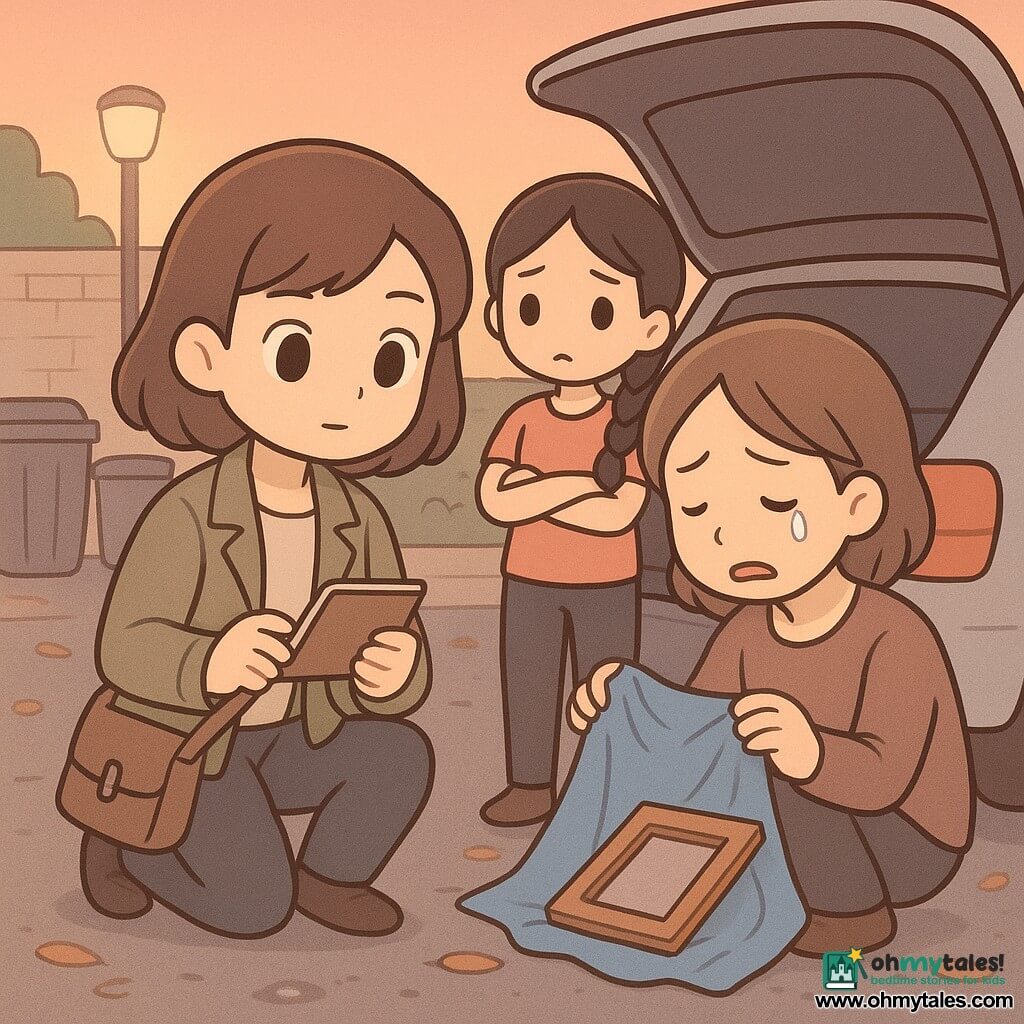
She rounded the corner and saw Talia's mom kneeling by the open trunk, tugging at something wrapped in a blue cloth.
The cloth was slipping, revealing the edge of a wooden frame.
Mara didn't shout. She didn't run. She spoke like someone approaching a scared animal—calm and steady.
“Ma'am,” she said. “Please stop.”
The woman jerked around. Her face went pale, and that trembling hand rose again, fluttering in the air like a trapped bird.
“I—” she began. Her voice cracked. “I didn't hurt it.”
“Talia,” Mara said gently, noticing the girl standing near the dumpster, eyes wide. “Are you okay?”
Talia nodded quickly, but her throat moved like she'd swallowed a stone.
Mara kept her gaze on the woman. “Your name?”
“Renee Reeves,” the woman said, words rushing now. “I was going to bring it back. I just needed—” She pressed the trembling hand to her chest, as if trying to calm it. “I needed time.”
Mara nodded. “Time for what?”
Renee's eyes filled. “To decide what to do.”
Mara stepped closer, but not too close. “Tell me the truth, start to finish.”
Renee took a shaky breath. “I work for a printing shop. Mrs. Linden asked me to make a poster for the show. She wanted it perfect. Always perfect. This morning she showed me the framed drawing—The Thread of Things—because she wanted me to… ‘touch it up.' Add some shine. Make it more impressive for donors.”
Mara's eyebrows rose. “She wanted you to change a student's original work.”
Renee nodded, shame on her face. “I said no. It was already beautiful. But she pushed. She said the council member would be there, that funding depended on it. She said if the piece showed certain details, it could… cause trouble.”
“What details?” Mara asked.
Renee swallowed. “The drawing includes tiny scenes of the neighborhood. And there's a part where someone is dumping paint into the storm drain behind the center. It looks like—” Her eyes flicked away. “Like Mrs. Linden. The hair. The scarf. The way she stands.”
Mara's mind snapped a picture into place: gold paint scrap by the bushes. The center's back lane. Glitter that wouldn't behave.
“So you took the drawing,” Mara said, keeping her voice neutral, “to keep it safe. Or to hide it.”
Renee flinched. “Both. I panicked. I thought if it disappeared, the show could go on without anyone seeing it. Then I could talk to Mr. Sato and return it later. I know that's wrong. I know.” Her trembling hand wiped her cheek. “I wasn't trying to steal it forever. I just—” She looked at Talia. “I wanted to protect her from drama. From being dragged into adult mess.”
Talia's voice came out small. “Mom, you should've told me.”
“I didn't want you to worry,” Renee said. “And we were late. We're always late. I thought I could fix it fast.”
Mara took a breath. This was the moment where people wanted quick endings—scolding, punishment, easy blame.
But quick endings were how mistakes got repeated.
“Mistakes don't untie themselves,” Mara said quietly. “We untie them, patiently. One loop at a time.”
She nodded toward the trunk. “Let's bring it back. Together. And then we'll talk to Mr. Sato. And Mrs. Linden.”
Renee nodded, tears slipping down. “Okay.”
Mara helped lift the wrapped frame. It was heavier than she expected, not just in wood and glass—heavy with months of work, heavy with truth.
As they walked toward the door, Mara spoke to you, the reader, the way she often did in her head when she trained new Watch volunteers:
Think about the clues.
—A blue thread in the supply room.
—A gold-painted scrap outside.
—A neat, careful removal.
—A trembling hand.
—A person in a rush who hates waiting.
Which clues pointed to the thief, and which pointed to the reason?
The answer mattered, because the reason was the key to solving it without breaking anyone.
Chapter 6
Mr. Sato met them at the classroom door, eyes wide when he saw the wrapped frame.
“Oh,” he breathed, like the air had been knocked out of him. “You found it.”
Mara set it gently on a table. “We need to talk. All of us. Mrs. Linden too.”
Mrs. Linden arrived minutes later, summoned by a short message from Mara. She walked in briskly, lips pressed into a line.
Then she saw the frame.
Her face changed—just a flicker, but Mara caught it. Relief? Anger? Fear?
“What is this?” Mrs. Linden demanded.
Mr. Sato said, voice tight, “It's the missing artwork.”
Renee stepped forward, hands clasped. “I took it. But not to keep it. Mrs. Linden, you asked me to alter it.”
Mrs. Linden's eyes flashed. “That is not true.”
Mara raised her notebook slightly, like a quiet stop sign. “Renee told me the drawing shows someone dumping paint into the storm drain. That would be a serious problem. The gold paint scrap outside supports that something happened behind the center.”
Mrs. Linden scoffed. “A child's drawing is not evidence.”
“It's not proof by itself,” Mara agreed. “But it's a warning. And you were concerned about ‘certain details.' You pushed for ‘perfect.' You wanted the drawing changed.”
Mr. Sato's face hardened. “You tried to change a student's work?”
Mrs. Linden's hands went rigid at her sides. For a moment, she looked like she might shout. Then her shoulders sagged slightly, as if the fight leaked out of her.
“It would ruin us,” she said, voice quieter now. “People would think the center is careless. The donors would leave. The council member would—”
“The center won't be ruined by honesty,” Mr. Sato said. “It's ruined by hiding.”
Mara nodded. “And by rushing. By thinking impatience can erase consequences.”
Mrs. Linden's eyes darted to the frame. “I didn't dump paint,” she said, but her voice wobbled. “I—I saw someone else do it. I didn't stop them. I was… busy. I told myself it was none of my business.”
Mara held her gaze. “Sometimes not stopping something is a choice too.”
Silence pressed in.
Then Mr. Sato exhaled slowly. “We'll handle this properly. We'll report what needs reporting. And we'll protect the student who drew it. The show will go on, but the work stays as it is.”
Renee looked at Talia. “I'm sorry.”
Talia nodded, blinking hard. “I'm still mad. But… I get why you panicked.”
Mara watched that moment—the anger and understanding sitting in the same chair. It was messy, but real.
“Patience,” Mara said softly, “doesn't mean nothing hurts. It means we don't make the hurt worse by rushing.”
Mr. Sato untied the blue cloth carefully, as if it were a ribbon on a gift that might break if pulled too fast.
The glass caught the classroom lights.
And there it was.
A detailed drawing of Maple Street, threaded with tiny lines that connected everything: the bakery, the park, the storm drain, the community center. Little scenes tucked into corners like secrets in pockets. People drawn with such sharp observation it made Mara's skin prickle.
In the bottom right corner, the artist had drawn a small frame inside the big frame.
Inside that tiny frame was a drawing of a drawing—like a promise.
Mara smiled, just a little. “Let's put it where it belongs.”
At the art show that evening, when the chatter filled the gym and the lights warmed the painted walls, Mr. Sato revealed the centerpiece.
The framed drawing stood on an easel, bordered in clean wood.
And beneath it, the student had added one final detail since the morning—a small, neatly inked square that looked like a frame around a simple sketch:
A hand, no longer trembling, holding a thread with steady fingers.