Chapter 1: The Missing Trophy
I know my neighborhood the way some people know their phone screens: every crack in the pavement, every stubborn hedge, every window that always has a curtain twitching.
That's why the call from Maple Street didn't surprise me. It was the kind of street where news traveled faster than bicycles.
“Mr. Crowe?” a breathless voice said. “It's— it's gone. The trophy. From the community center.”
I arrived to find a small crowd gathered under the COMMUNITY CENTER sign, which had lost a few letters over the years and now read COMMU ITY CE TER, as if it couldn't quite commit to being official.
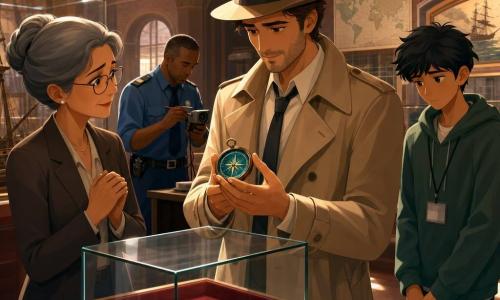
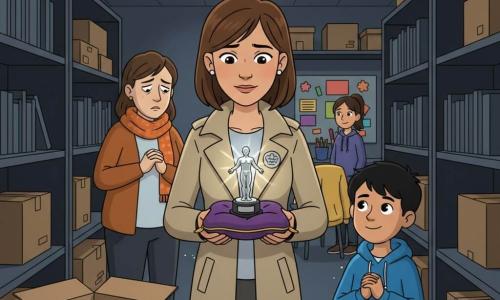
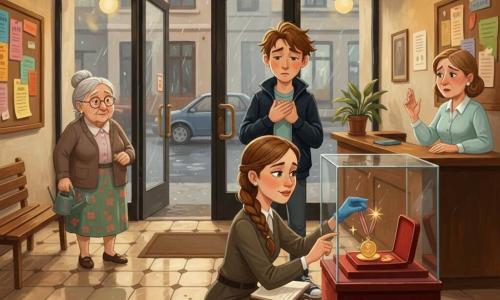
Inside, the main hall smelled of floor polish and yesterday's popcorn. A trophy case stood against the wall. The glass door was open. The velvet base inside had a pale rectangle where something shiny had been.
Lina Patel, the center's youth coordinator, rubbed her forehead. She was in her late twenties, usually unshakeable. Today she looked like someone had pulled the rug out from under her.
“It was the Founders' Cup,” she said. “Ninety years old. Given to the neighborhood every year for… well, for being us, I guess.” She tried to smile and failed.
I leaned closer to the case. The lock wasn't broken. No splinters. No bent metal. Just open, as if someone with a key had come by and helped themselves.
“Who has keys?” I asked.
Lina held up three fingers. “Me. Mr. Dobbs, the caretaker. And… Mrs. Calder from the historical club. She likes to dust it.”
From behind us, a man with a gray mustache and a fluorescent vest appeared, pushing a mop bucket like it was his loyal pet. Mr. Dobbs paused when he saw me.
“Detective Crowe,” he said, as if my job title were an accusation.
“Morning,” I replied. “When did you last see the Cup?”
“Yesterday afternoon,” he said. “Still there. I locked up at nine. Same as always.”
Lina's gaze flicked toward the hall doors. “And I opened at seven. Case was already open.”
I stood very still. The best clues don't shout. They whisper, and you have to stop moving to hear them.
There was a tiny smear on the edge of the glass door. Not a fingerprint—more like a streak, faint and dusty, as if someone had wiped their hand there after handling something dirty.
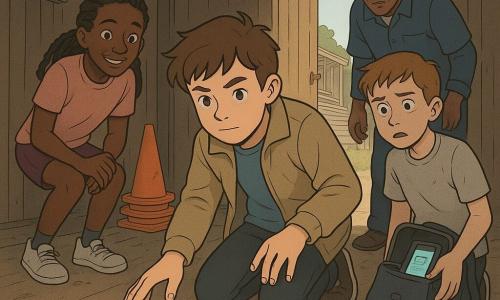
I looked down. On the polished floor were two faint marks: a scuff and a thin line, like the wheel of a small cart had rolled, then turned.
“Did anyone bring equipment in?” I asked.
Mr. Dobbs snorted. “This place? Always. Chairs, boxes, kids and their science projects. You can't blame every scratch on me.”
“No blame,” I said. “Just questions.”
Lina folded her arms tight. “We have the Spring Fair tonight. The trophy is supposed to be on stage. People will notice.”
“I will too,” I said. “I notice everything. It's a habit.”
I took out my notebook. “Let's start with what we know. Locked case. No damage. Only three keys. A wheel mark. And a smear.”
I looked up at them. “Now we need stories. Two of them, at least. And we'll see which one stays standing when we compare.”
Chapter 2: Two Stories, One Hallway
If you want to solve a mystery, you don't chase the loudest person. You chase the smallest difference between two versions of the same moment.
I sat Lina and Mr. Dobbs at opposite ends of the folding table in the back office. A poster of last year's talent show watched us like a suspicious witness.
“Tell me your evening,” I said to Mr. Dobbs. “Slowly. From the moment you decided to lock up.”
He rolled his shoulders. “Fine. At eight thirty, the chess club left. Kids everywhere, little crumbs like a bakery explosion. I swept. At eight forty-five, the yoga group finished. They always leave their water bottles. I put two in the lost-and-found. At nine, I checked the doors, set the alarm, and locked the trophy case. Then I went home. Simple.”
I didn't write “simple.” I wrote “swept,” “water bottles,” “alarm,” and I underlined “locked case.”
Then I turned to Lina. “Your morning. Same pace.”
She took a breath. “I got here at six fifty-five. Unlocked the front door. Alarm off. I went straight to the hall to set up for the bake sale table. That's when I saw the trophy case open. I thought maybe Mr. Dobbs left it that way—”
“I didn't,” Mr. Dobbs snapped.
“—so I checked. The Cup was gone,” Lina finished, her voice tight. “I called you at seven ten.”
I tapped the pen against my notebook. “Did you touch the case?”
“I… I closed it,” Lina admitted. “Then I opened it again to check if it was really missing. I didn't want to panic over nothing.”
Mr. Dobbs threw up his hands. “So now my fingerprints are mixed with hers, and you're going to tell me that's evidence.”
“Fingerprints aren't my main tool,” I said. “Stories are.”
I stood. “I want to walk the route you both took. Mr. Dobbs, show me where you swept. Lina, show me where you set up.”
Mr. Dobbs led me into the main hall. “I swept here. Under the stage. The corner by the trophy case. Always the same. Kids track in dirt like it's a hobby.”
“Any unusual dirt?” I asked.
He frowned. “Just… more grit than usual. Like sand.”
Sand. In our neighborhood, sand usually meant one place: the little playground at Finch Park, where the sandbox was a miniature desert.
Lina pointed to the corner where she planned to put the bake sale table. It was across from the trophy case. “I carried two tables from the storage room,” she said. “One at a time.”
“Storage room?” I repeated.
She nodded and opened a door. Inside were stacks of chairs, crates of decorations, and a hand truck—the kind used for moving heavy boxes. Its wheels were thin and dark.
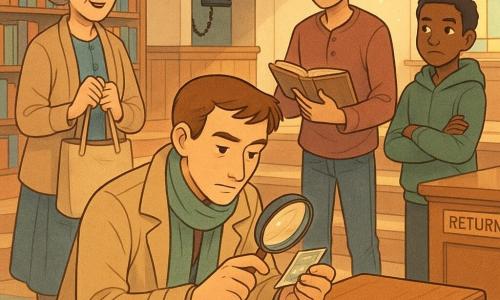
I crouched and examined the wheels. A fine layer of pale grit clung to the rubber treads.
“Do you use this often?” I asked.
“During events,” Lina said. “Mr. Dobbs uses it too.”
Mr. Dobbs looked annoyed. “Everything has wheels. That doesn't mean it stole a trophy.”
“No,” I agreed. “But someone rolled something.”
On the handle of the hand truck, there was a faint sticky patch, like dried syrup. It smelled vaguely sweet.
“Bake sale?” I asked Lina.
She blinked. “We haven't started baking yet.”
I rolled the hand truck forward. Its wheel made the same thin line I'd seen in front of the trophy case.
“Let's talk about keys,” I said. “Where are yours kept?”
Lina patted her pocket. “Mine are always with me.”
Mr. Dobbs reached into his vest and jingled his ring. “Same.”
“And Mrs. Calder?” I asked.
Lina hesitated. “She keeps her keys at home. But she's… careful. She's proud of her little duties.”
I left them in the hall and stepped outside for air. The morning had that bright, innocent look that always feels like a trick when something has gone wrong.
Across the street, a boy on a bike slowed down to stare at the commotion. Beside him, a woman held a paper cup of coffee and pretended not to listen.
Everyone hears everything here, whether they admit it or not.
I made a list in my mind:
1) Someone used a key.
2) Someone used the hand truck.
3) Sand and something sweet were involved.
Now I needed a voice that didn't belong to the community center—someone who could tell me what they saw without being tangled up in the panic.
I knew exactly where to find one.
Chapter 3: The Old Neighbor on Hawthorn Steps
On Hawthorn Lane, the houses sat close together like they were sharing secrets. At number twelve, Mr. Eli Granger sat on his front steps with a blanket over his knees, watching the world as if it were an old film he'd seen before.
He was the kind of neighbor who remembered everyone's name and their parents' names and sometimes their grandparents' names. People assumed age made you forget. Often, it makes you notice.
“Detective Crowe,” he said before I reached the gate. “You're walking like a man who's missing something.”
“Just a trophy,” I said. “And maybe a little sleep.”
He chuckled softly. “Trophies wander. People worry.”
I sat on the bottom step, keeping my voice low. “You've got a good view of the community center from here. Did you see anything odd last night?”
Mr. Granger's eyes narrowed, not with suspicion, but with focus. “I saw Mr. Dobbs leave at nine-ish. He always does. He walks like he's chasing his own shadow. Then the street went quiet.”
“Anyone else?”
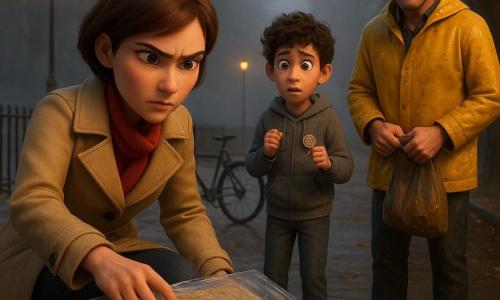
“A van,” he said. “White. No logo. Parked for a minute, then gone.”
My pen paused. “What time?”
“After nine. Not long after. I was listening to the radio. Old jazz. The trumpet solo had just started.”
Jazz and trumpet solos weren't precise clocks, but Mr. Granger was steady. His memories had edges.
“Did you see who was driving?” I asked.
“No,” he said. “Curtains and reflections. But I saw someone step out. Medium height. Hood up. They moved quick, like they didn't want the streetlight to recognize them.”
A hood. A van. A key.
Then Mr. Granger added, in the same calm tone you'd use to comment on the weather, “And I smelled cinnamon.”
I looked up sharply. “Cinnamon?”
He nodded. “Like someone had opened an oven and let the smell escape. It drifted down the street for a minute. Made me crave a bun. Then it was gone.”
Cinnamon.
Sweet residue on the hand truck handle. No baking started at the center. Yet cinnamon had floated through the night air.
Sometimes a case turns on a confession. Sometimes it turns on a word that seems harmless until it isn't.
Cinnamon was that word.
I stood. “Thank you, Mr. Granger. If you remember anything else—anything at all—call me.”
He tilted his head. “You'll solve it. You always do. Just don't let the loud people drown out the small facts.”
I walked back, my mind arranging the clues like tiles in a puzzle.
White van. Hooded figure. Key use. Hand truck. Sand. Cinnamon.
Here's where you, the reader, can help me:
- Who in our neighborhood would have cinnamon on them late at night?
- Who might use a hand truck and leave sand behind?
- And why would anyone steal a trophy that's famous mostly for being old?
The answer wasn't “a criminal mastermind.” It was likely something smaller and more human.
I went to find the person who loved old things more than anyone else on Maple Street.
Chapter 4: Dust and Details at Mrs. Calder's
Mrs. Calder lived in a narrow house that smelled like lemon polish and old paper. When she opened the door, she wore rubber gloves and a cardigan the color of storm clouds.
“Detective Crowe,” she said stiffly. “If this is about that terrible rumor—”
“It's about the trophy,” I said. “May I come in?”
She hesitated, then stepped aside. Her living room was a museum of the neighborhood: framed photos of parades, a faded map, even an ancient ticket stub in a glass frame like it was priceless.
“I told Lina,” she said, “the case should have a better lock. A proper lock. Not that flimsy thing.”
“Yet it wasn't forced,” I replied.
Her mouth tightened. “Meaning what, exactly?”
“Meaning someone used a key,” I said gently. “And you're one of three people who has one.”
She lifted her chin. “I was home all evening. Reading. Tea at eight. Bed by ten.”
“What were you reading?” I asked.
She blinked, as if she hadn't expected interest. “A book about the river docks. The old trading days. Fascinating, really.”
“And your key?” I asked.
“In the drawer,” she said, pointing to a small cabinet.
I opened the drawer—carefully, with her watching—and saw a ring of keys lying on a crocheted doily.
“Do you ever lend it?” I asked.
“Never,” she snapped. Then her eyes flicked, just for a moment, toward the kitchen.
It was the kind of tiny glance that can matter more than a speech.
I followed it with my own eyes. On the kitchen counter sat a tin labeled CINNAMON STARS. Next to it, a cooling rack held crumbs and a dusting of sugar.
Mrs. Calder saw me looking and flushed. “I bake,” she said defensively. “So what?”
“So someone smelled cinnamon outside the community center last night,” I said. “And I found something sticky and sweet on the hand truck handle.”
Her expression changed—not guilt, exactly. More like alarm. “That's ridiculous. I didn't go anywhere.”
“Then someone else did,” I said, “and the cinnamon traveled with them.”
She frowned. “Are you accusing my biscuits?”
“I'm following the trail,” I said. “May I ask—did anyone visit you yesterday evening? Family? Neighbors?”
She hesitated again. “My nephew, Tyler. He stopped by to drop off some boxes for the historical club. Posters for the Spring Fair. He's helping with the setup.”
“Tyler,” I repeated. “Does he have access to your keys?”
“Of course not,” she said quickly, too quickly. “He's… he's a bit scatterbrained, but he's not a thief.”
“What time did he leave?” I asked.
“About nine fifteen,” she said. “He—he rushed off. Said he had to pick something up.”
A white van. Hood up. Nine-ish. Cinnamon smell.
I nodded slowly. “What kind of van does Tyler drive?”
Mrs. Calder's shoulders sagged a fraction. “A white one. It belongs to his delivery job. He uses it after hours sometimes.”
Now we had a suspect, but a suspect isn't the same as a solution. Critical thinking means not grabbing the first explanation that fits. It means testing it.
“Mrs. Calder,” I said, “I'm going to ask you something uncomfortable. Could Tyler have taken your key?”
Her eyes widened. “No.”
“Not knowingly,” I said. “But could he have copied it? Borrowed it? Lifted it while you were in the kitchen?”
She looked down at her gloves. “He did ask for tape,” she admitted softly. “I went to the pantry. When I came back, he was standing near this cabinet.”
I closed the drawer. “Thank you for telling me. That detail matters.”
Outside, the afternoon sun had shifted. The Spring Fair banners fluttered on lampposts, bright and cheerful, like they had no idea they were decorating a crime scene.
I headed back to the community center, but not to accuse Tyler. Not yet.
First, I needed to compare one more story with another.
Chapter 5: The Van, the Sandbox, and the Small Lie
Tyler Calder was easy to find. He was unloading cardboard boxes near the community center stage, moving fast, talking faster. He wore a hoodie—down, not up—and his hands were dusted with something pale.
Flour? Sand? Both?
“Tyler,” I said. “Can we talk?”
He froze for half a second, then forced a smile. “Sure, Detective. If this is about the trophy, I already heard. Crazy, right?”
“Crazy things usually have simple beginnings,” I said. “Where were you last night after nine?”
His eyes darted toward the side exit. “Home. Mostly. I mean—I was here earlier helping. Then I went to my aunt's. Then home.”
“That's one story,” I said. “Tell it again, but slower. Times. Places.”
He swallowed. “I left here at eight. Went to Aunt Marjorie's around eight thirty. Left at nine fifteen. Drove home.”
“Did you stop anywhere?” I asked.
“No,” he said, too quickly.
I watched him. People think detectives look for twitchy noses and shifty feet. I look for when the words don't match the face.
“Tyler,” I said, “a neighbor smelled cinnamon outside this building last night after nine. That's not a normal street smell.”
He blinked. “Maybe someone was baking.”
“At nine thirty?” I asked. “Outside?”
He laughed, thinly. “Maybe they burned something. I don't know.”
I crouched near the boxes he'd been unloading. One had sand sprinkled along the bottom seam.
“Where did these boxes come from?” I asked.
“Storage,” he said.
“Not these,” I said, tapping the sandy seam. “These were in a van. Sand gets in by riding places. Like Finch Park.”
His jaw tightened.
“Let's do another comparison,” I said. “Your aunt says you stood near her key drawer while she was in the pantry.”
His face reddened. “She said that?”
“She also said she trusts you,” I replied. “So I'm giving you a chance to tell me the real version.”
For a moment, the noise of the hall—tape ripping, kids laughing somewhere, chairs scraping—seemed far away. Tyler stared at the floor as if the truth were written there.
“I didn't steal it,” he said finally.
“Then what did you do?” I asked.
He exhaled hard. “I… borrowed it.”
“Borrowed the trophy?” I said.
He nodded miserably. “Just for a little while. Look, the Spring Fair is tonight. The historical club has this whole speech, and it's always boring. Everyone looks at their phones. I wanted something… different. Something dramatic.”
I kept my voice calm. “Keep going.”
“I thought we could do a ‘mystery reveal,'” he said. “Like, pretend it got stolen, then bring it out at the end with a spotlight. People would pay attention. It would be fun. I didn't think it would get this big.”
I let the silence stretch. “How did you take it?”
Tyler's shoulders slumped further. “I copied Aunt Marjorie's key weeks ago. She left it on the counter once while she baked. I used clay from Finch Park to make a mold. That's why… the sand.”
Clay. Sandbox. Wheel tracks.
“And the cinnamon?” I asked.
He grimaced. “She gave me cinnamon star cookies in a bag. I ate them in the van. Crumbs got everywhere. I wiped my hands on whatever—probably the hand truck handle when I came back to move it.”
“So you came back here after nine,” I said.
He nodded, eyes shiny. “I parked the van on Hawthorn for a minute because the streetlight by the center is too bright. I wore my hood because… because I knew it looked suspicious. Then I used the key, took the trophy, put it on the hand truck, rolled it out the side door, loaded it into the van.”
“And where is it now?” I asked.
Tyler hesitated. “In my garage. Under a blanket. It's safe. I swear.”
I believed him about one thing: he hadn't meant harm. But intention doesn't erase consequences. A fake mystery can turn into a real mess fast.
“We're going to fix this,” I said. “But we're going to fix it the honest way.”
Tyler nodded, wiping his nose with his sleeve. “Am I going to jail?”
“You're going to face the people you scared,” I said. “And you're going to listen. That's harder than jail for some folks.”
He gave a tiny, miserable laugh.
I stood. “Let's get the Cup back before the fair starts. Then we'll talk to Lina. And your aunt. Together.”
As we walked toward the parking lot, I glanced back at the trophy case, still empty, still accusing.
Mysteries aren't just about finding what's missing. They're about learning why it went missing—and how to think clearly when emotions try to take over.
Chapter 6: The Logical Ending and a Quiet Wish
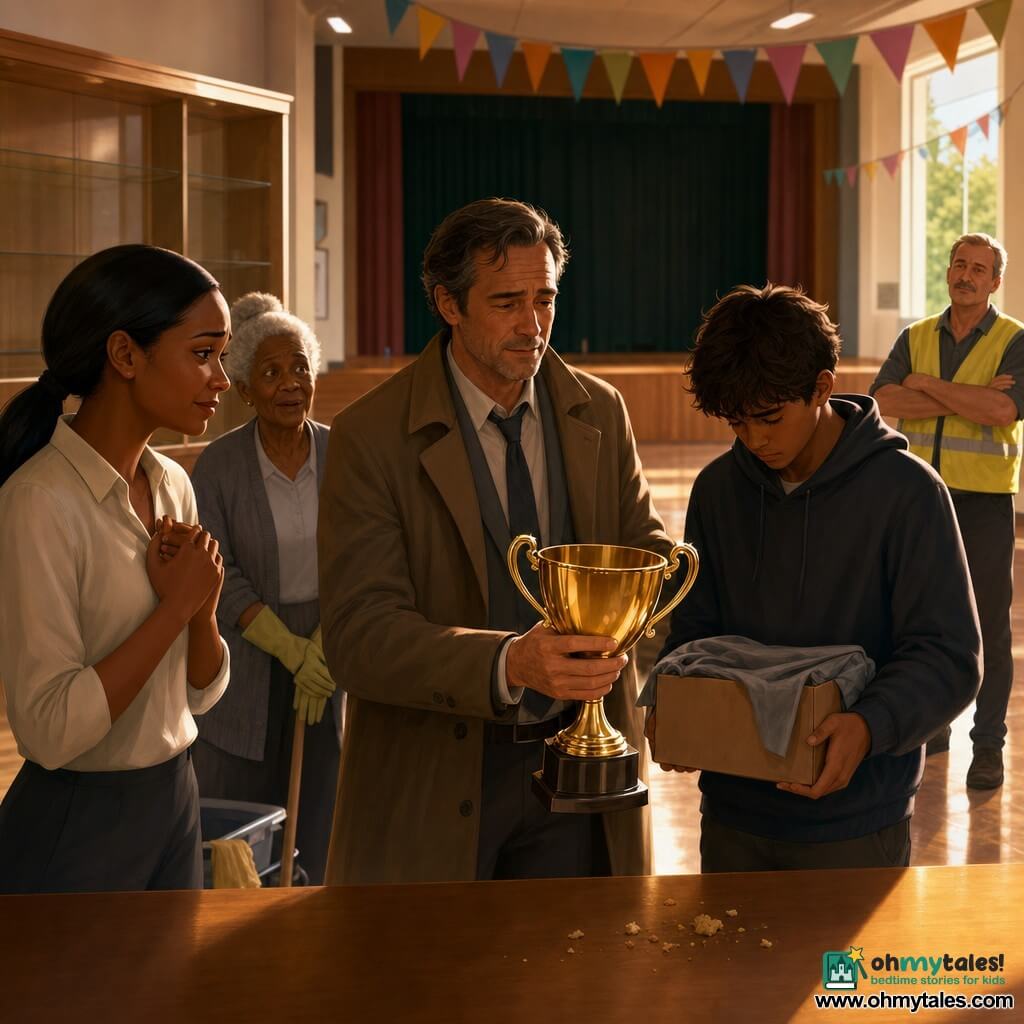
Tyler's garage smelled like motor oil and old sports gear. Under a gray blanket, the Founders' Cup sat on a workbench, catching the weak light and turning it into something almost warm.
He lifted it carefully, as if it might scold him.
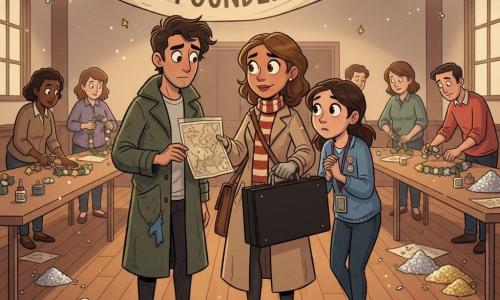
Back at the community center, Lina, Mr. Dobbs, and Mrs. Calder waited in the office. The tension in the room was thick enough to slice.
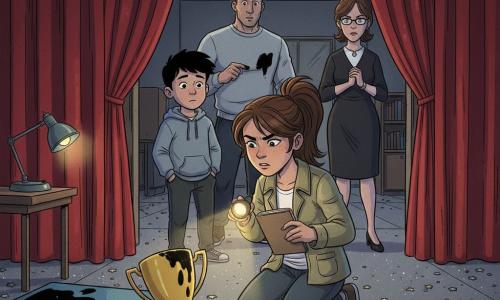
I set the trophy on the table. For a second, nobody spoke. Then Lina let out a breath she'd been holding since sunrise.
Mrs. Calder stared at Tyler. Her voice came out thin. “You copied my key?”
Tyler nodded. “I'm sorry. I thought it would be… exciting.”
Mr. Dobbs leaned back, arms crossed. “Exciting. That's one word.”
Lina's eyes narrowed. “People were ready to call the police. We were panicking.”
I held up a hand. “Before we argue, let's lay out the facts. Clear thinking first.”
I opened my notebook, not for drama, but for order.
“Locked case, no damage,” I said. “So: key access. Wheel marks and grit: hand truck used, sand from Finch Park. Sticky sweetness on handle and cinnamon smell outside: cookies. White van seen after nine: Tyler's delivery van. Two stories didn't match: Tyler said he went straight home. His aunt's timeline placed him near the keys. When we compared details, the truth appeared.”
Mr. Dobbs grunted. “So I wasn't lying.”
“No,” I said. “Your story matched the evidence. That matters.”
Lina looked at Tyler. Her anger softened into something tired. “Why not just suggest an actual game or performance? Why make people afraid?”
Tyler stared at the trophy. “Because I didn't think. I wanted attention without earning it. And… I like history. I wanted people to care. But I did it the worst way.”
Mrs. Calder's eyes shone. “You could have asked,” she whispered. “I would have helped you make it interesting. With facts, not tricks.”
I watched Tyler absorb that. This was the real consequence: understanding the ripple you made in other people's minds.
“We'll handle this properly,” Lina said, voice steady again. “Tyler, you'll apologize at the fair. Publicly. And you'll help Mr. Dobbs upgrade the lock and make a new key policy.”
Mr. Dobbs raised an eyebrow. “Key policy?”
“Yes,” Lina said. “No more casual keys. Sign-outs. Copies forbidden.”
Tyler nodded quickly. “I'll do it. Anything.”
Mrs. Calder placed her gloved hand over his. “And you'll return the copied key mold, if you still have it.”
He winced. “I do.”
Lina leaned toward me. “Thank you, Mr. Crowe.”
I closed my notebook. “You did part of it yourselves,” I said. “You told the truth when it mattered. And you were willing to look at evidence, not just feelings.”
That evening, the Spring Fair filled the hall with chatter and music and the smell of honest popcorn. The Founders' Cup sat on stage behind a new temporary seal of tape, like a patient with a bandage.
Tyler stepped up to the microphone, hands trembling. “I did something stupid,” he said, voice carrying across the room. “I took the Cup to make a fake mystery. I scared people. I'm sorry. I'm going to make it right.”
The crowd murmured—some annoyed, some relieved, some amused in that way people get when danger turns out to be smaller than it felt.
I didn't stay for the whole fair. My work was done. The neighborhood would handle the rest, with its loud opinions and its quick forgiveness and its long memory.
On my way home, I passed Mr. Granger's house. He was on his steps again, blanket in place, watching the streetlights blink on.
“You found it,” he said, not asking.
“Yes,” I replied. “It was cinnamon.”
He smiled. “Small facts.”
I nodded. “Small facts. Big difference.”
I walked the last block slowly. The night air was cool. Somewhere, someone laughed. Somewhere, someone was probably already telling the story in a more dramatic way than it deserved.
At my door, I paused and looked back at the familiar street—my patch of the city, imperfect and noisy and worth knowing.
Quietly, where only the night could hear me, I made a wish.
I wished for fewer tricks and more questions.
For people to compare stories before they believe them.
For the next mystery to be smaller.
And for the neighborhood to stay, in its own stubborn way, safe.